In the fantastic world of Van Cleef & Arpels, the art of watchmaking is not just a matter of mechanics, but also of imagination.

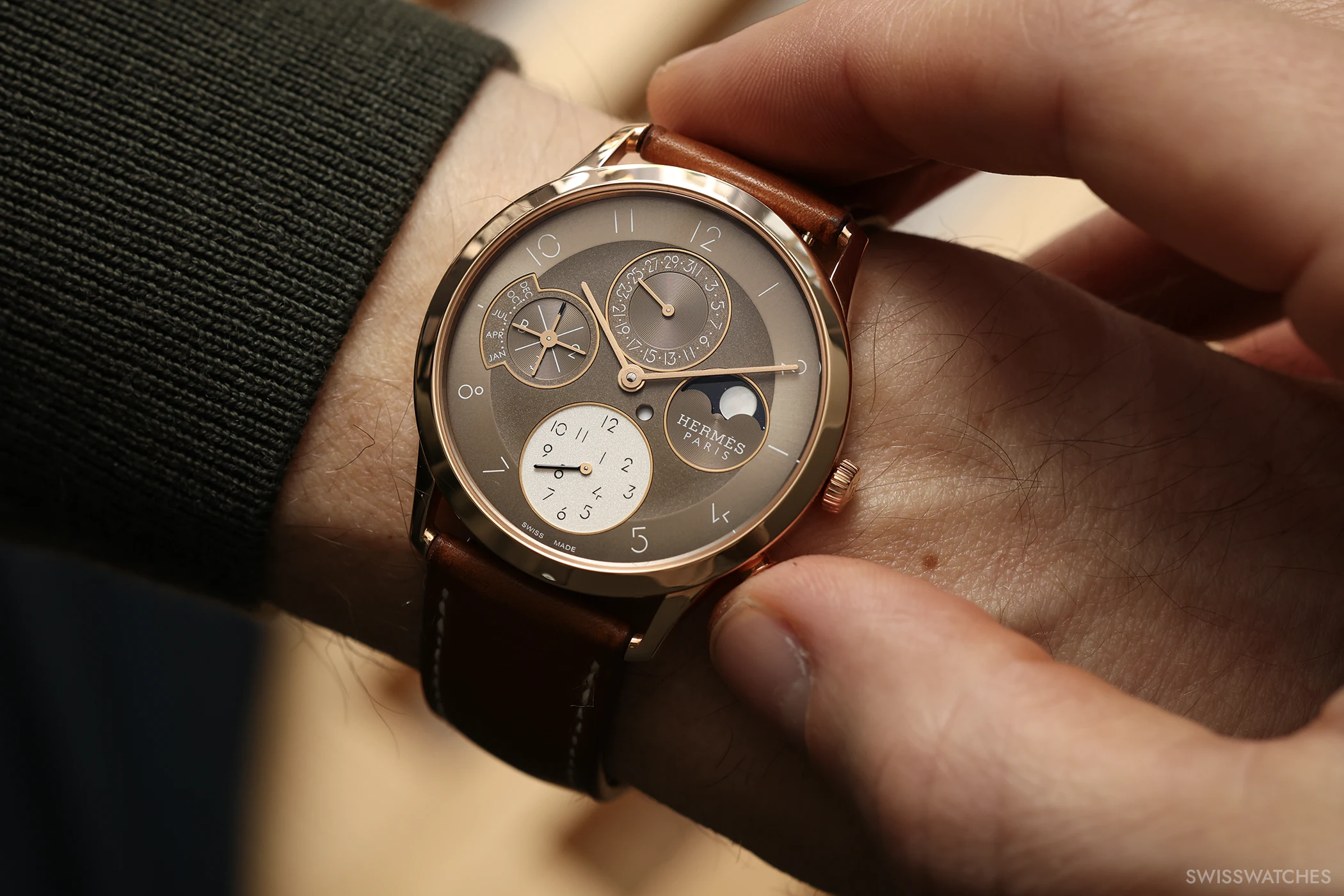
The Slim d’Hermès celebrates its 10th anniversary this year. As a tribute to the first of its kind, Hermès launched the new Slim d’Hermès Quantième Perpétuel in rose gold. The eponymous perpetual calendar complication is complemented by a practical GMT display and a poetic moon phase.
At first glance, it may seem surprising that a complication such as the perpetual calendar holds such a special fascination for lovers of mechanical watches. After all, it reminds the wearer of their own mortality – albeit in a technically fascinating and aesthetically appealing way.
Before we discuss the new perpetual calendar from Hermès, allow me to make a brief comment about the French luxury brand, for which watches account for only a fraction of the product range and single-digit percentage of sales.
However, at a time when many luxury goods companies are struggling with this ticking segment, the Hermès Horloger division is being gradually expanded and production capacity increased. The Swiss-made timepieces are therefore anything but second-rate products.
Not yet enamoured with the creative, stylish watches of the French brand? Then I recommend taking a closer look. It’s worth it, I promise. And perhaps your gaze will linger longer than you expect. For example, on the new Slim d’Hermès Quantième Perpétuel and its interpretation of eternity, combined with a second time zone and a moon phase.
The complication known as the perpetual calendar is a perpetual calendar that takes into account the different lengths of the months until the year 2100, including leap years. However, the limitation to the year 2100 has nothing to do with any technical inadequacy, but applies to almost all watches with this function.
The reason for this is the calendar reform of 1582 and the transition to the Gregorian calendar. According to this, a year is a leap year if it is divisible by 4. However, if the year is divisible by 100, it is not a leap year. Unless it is divisible by 400, as was the case in 2000, when there was a 29th February. 100 years earlier, there was no leap day. And in 2100, there will also be a February with only 28 days.
Sounds confusing? Understandable. How fortunate that, as a fan of mechanical timepieces, you can always carry the correct perpetual calendar with you on your wrist. The only downside: in the year 2100, you will have to intervene and manually ‘advance’ the watch from 29 February directly to 1 March.
It’s less complicated than it sounds. By the time it comes to that, the wearer will have practised the procedure enough anyway. Due to finite power reserves, even a watch with a perpetual calendar requires manual date correction after a long period of inactivity or when the hand-wound energy has run out.
However, if you always remember to wind a manual-winding model in good time, or if an automatic timepiece is always kept on a watch winder when not worn on the wrist, the correct date will be displayed continuously until 28 February 2100. That’s quite a long time. Fascinating, isn’t it!?
The Slim d’Hermès first saw the light of day in the watchmaking world exactly ten years ago, conceived by Philippe Delhotal, who has been Creative Director at Hermès since 2008 and comes from Patek Philippe. This completely new watch line also featured the newly developed H1950 automatic calibre, which is characterised by its remarkable thinness, measuring just 2.6 millimetres (4.0 millimetres including the calendar module) in height. The timepiece therefore fully deserves the ‘Slim’ part of its name.
From the outset, the modern inner workings were complemented by a dial design that was also created especially for the line. It is the brainchild of renowned Parisian graphic designer and long-time artistic director of the Louvre, Philippe Apeloig. Among other things, he is responsible for the striking openwork typography of the hour numerals on the Slim d’Hermès.
The basic design of this model is probably the most purist watch produced by Hermès, representing graphic clarity and modern elegance. This makes it the perfect stage for unusual special editions that are anything but minimalist in design. The latest example is Slim d’Hermès Faubourg of dreams.

The first Slim d’Hermès was honoured with the perpetual calendar, the most sophisticated of all calendar complications. It also featured a moon phase display and a second time zone. The Slim d’Hermès Quantième Perpétuel in rose gold made an immediate impression in 2015 and was awarded the prestigious Calendar Watch Prize at the Grand Prix d’Horlogerie de Genève (GPHG) in the same year.
To date, only a few other Slim d’Hermès models with perpetual calendars have been released, including versions in platinum, platinum/titanium and rose gold/titanium. However, only the 2025 edition is part of the brand’s active collection.
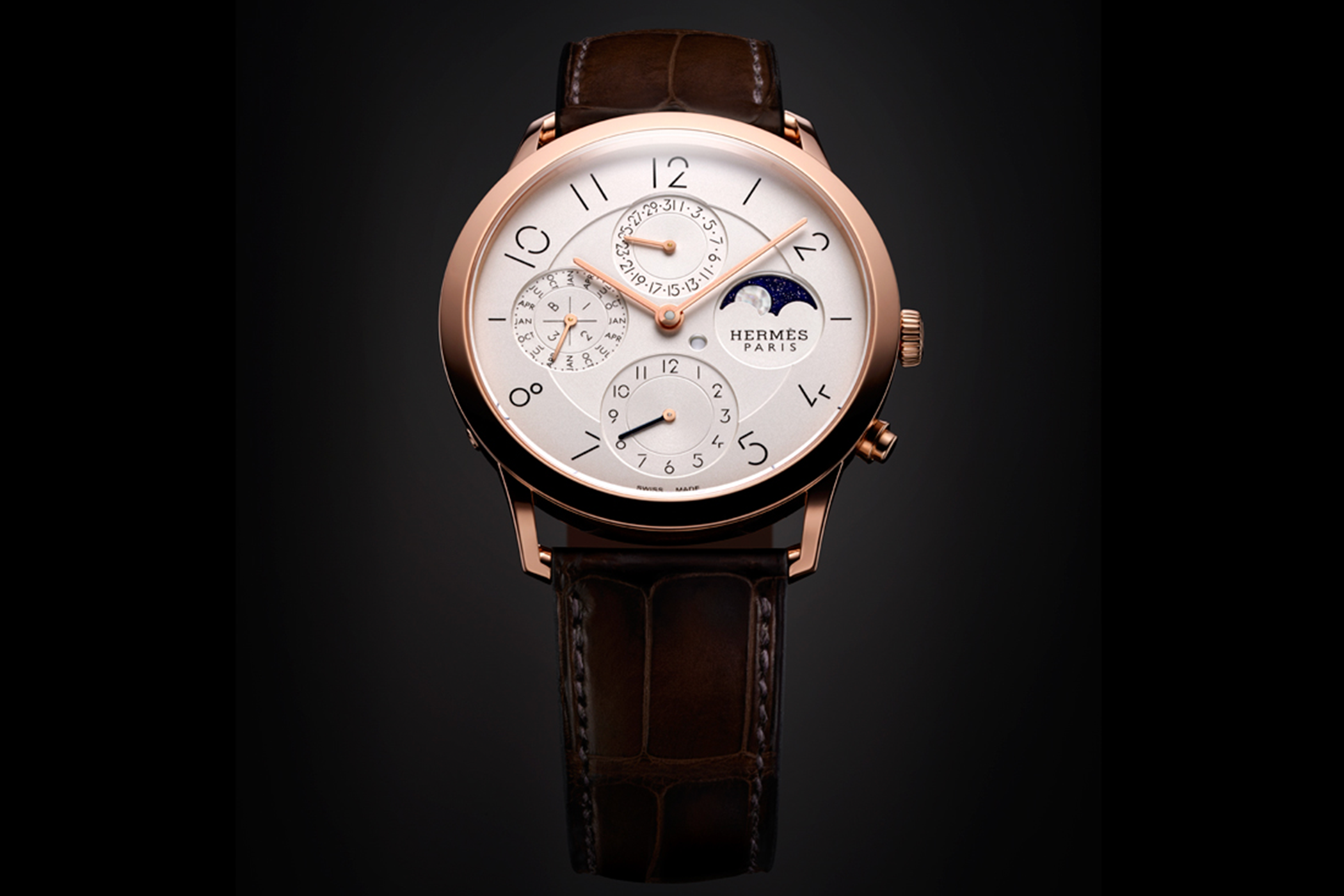
Credit © GPHG
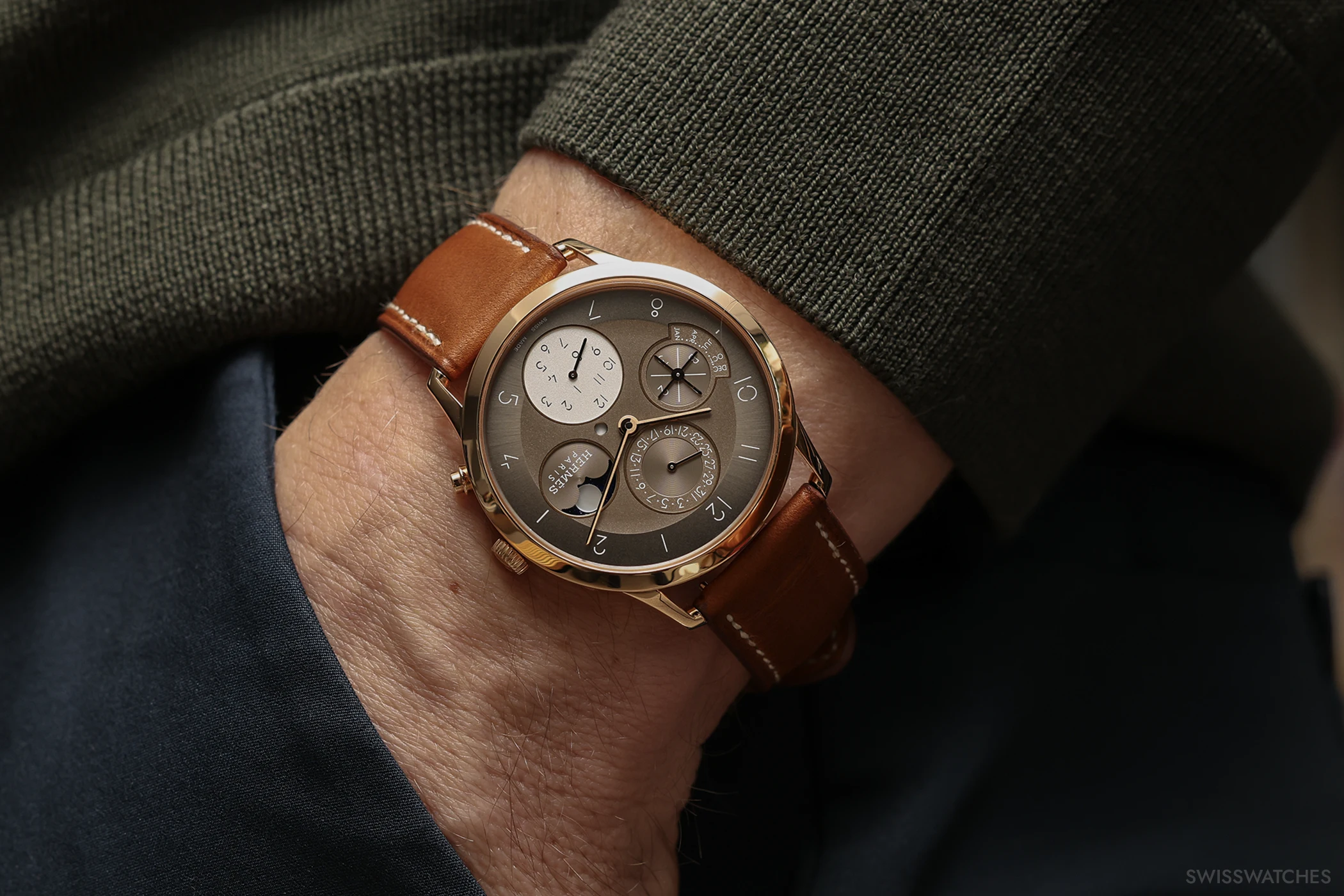
The youngest representative with a perpetual calendar in the Slim d’Hermès line is dressed in shimmering rose gold for its tenth anniversary, just like the first of its kind. However, it differs significantly from the number 1 at first glance due to its galvanised, dark brown dial with stamped Arabic numerals in white.
Other key features of this scene include the four precious metal-framed counters, which display the date at 12 o’clock, the month and leap years at 9 o’clock, the second time zone at 6 o’clock and the moon phase at 3 o’clock. The latter shimmers with mother-of-pearl against an aventurine sky. Surface finishes in the form of sandblasting, spiral and sunburst patterns add a touch of finesse. Two golden baton hands circle above it all to display the hours and minutes.
The dual time function is complemented by a discreet day/night indicator. Less discreet is the playful Hermès-style number pattern of the GMT function, which contrasts sharply in eggshell white with the brown and gold tones of the watch.
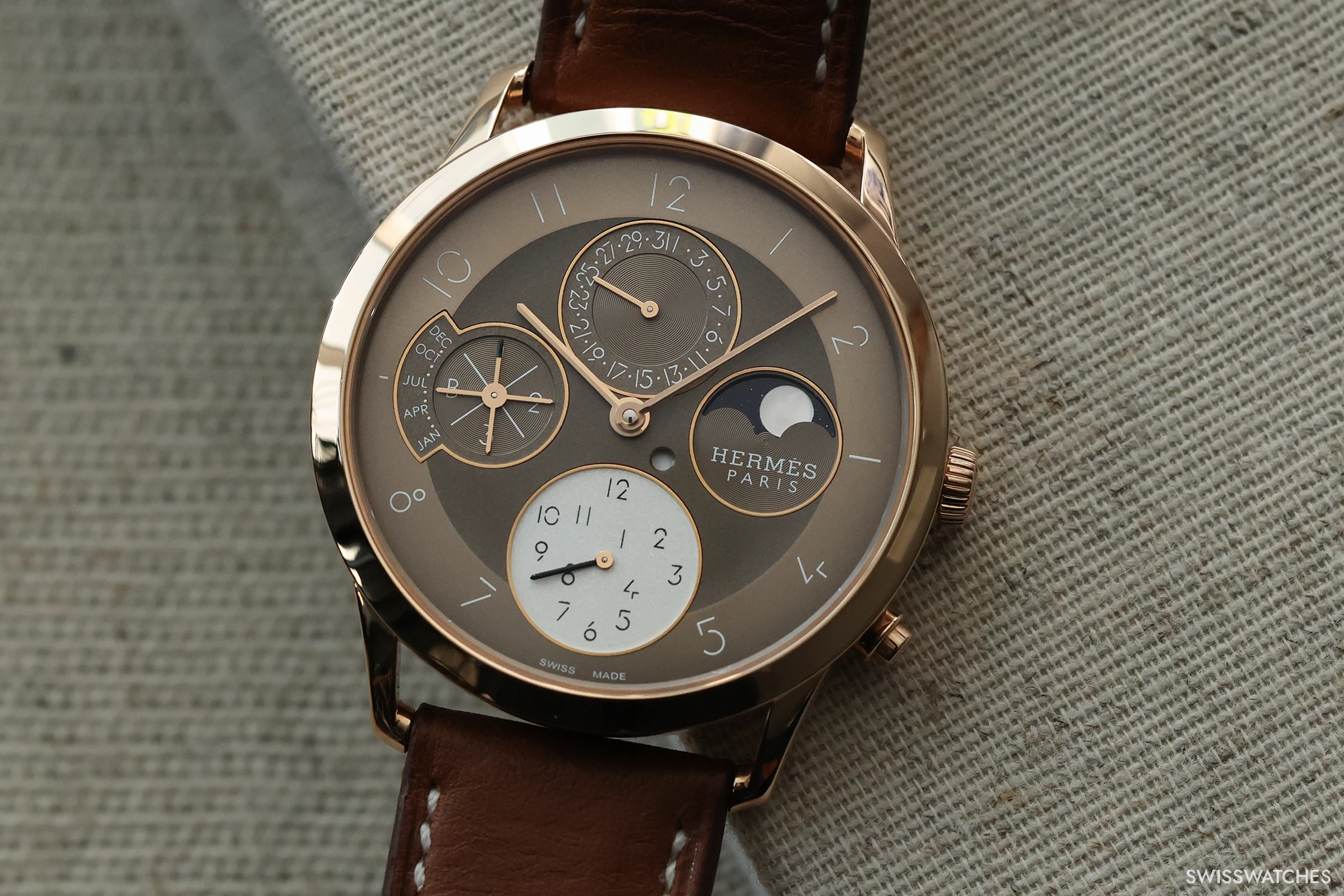
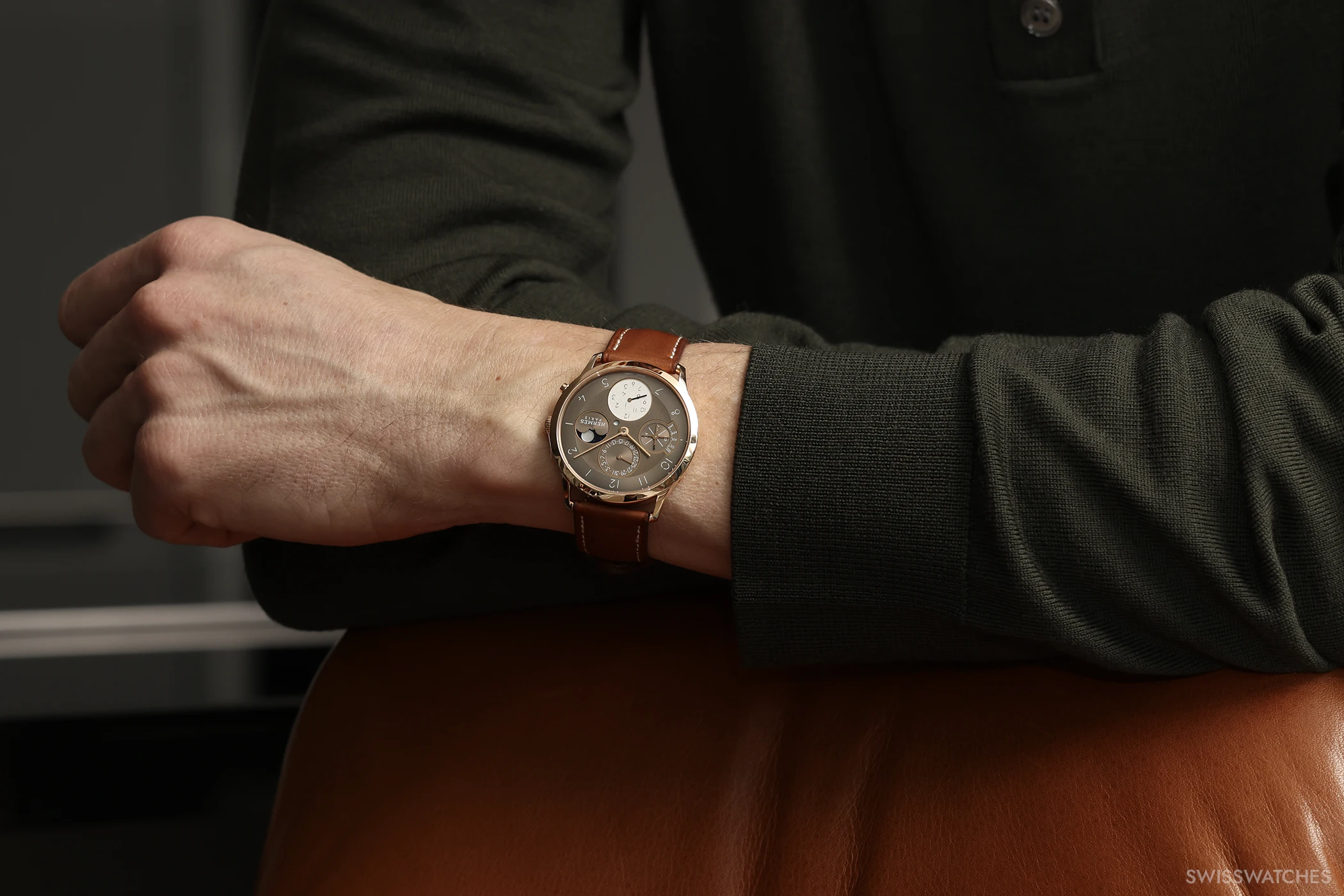
With its water-resistant case up to 3 bar, the new Slim d’Hermès Quantième Perpétuel follows in the footsteps of its 2015 predecessor: rose gold with a diameter of 39.5 millimetres. Despite the integrated perpetual calendar, the entire watch is exceptionally flat at just 9.06 millimetres. The sapphire crystal case back reveals the movement and its impressive details, such as the bevelled bridges decorated with the H motif.
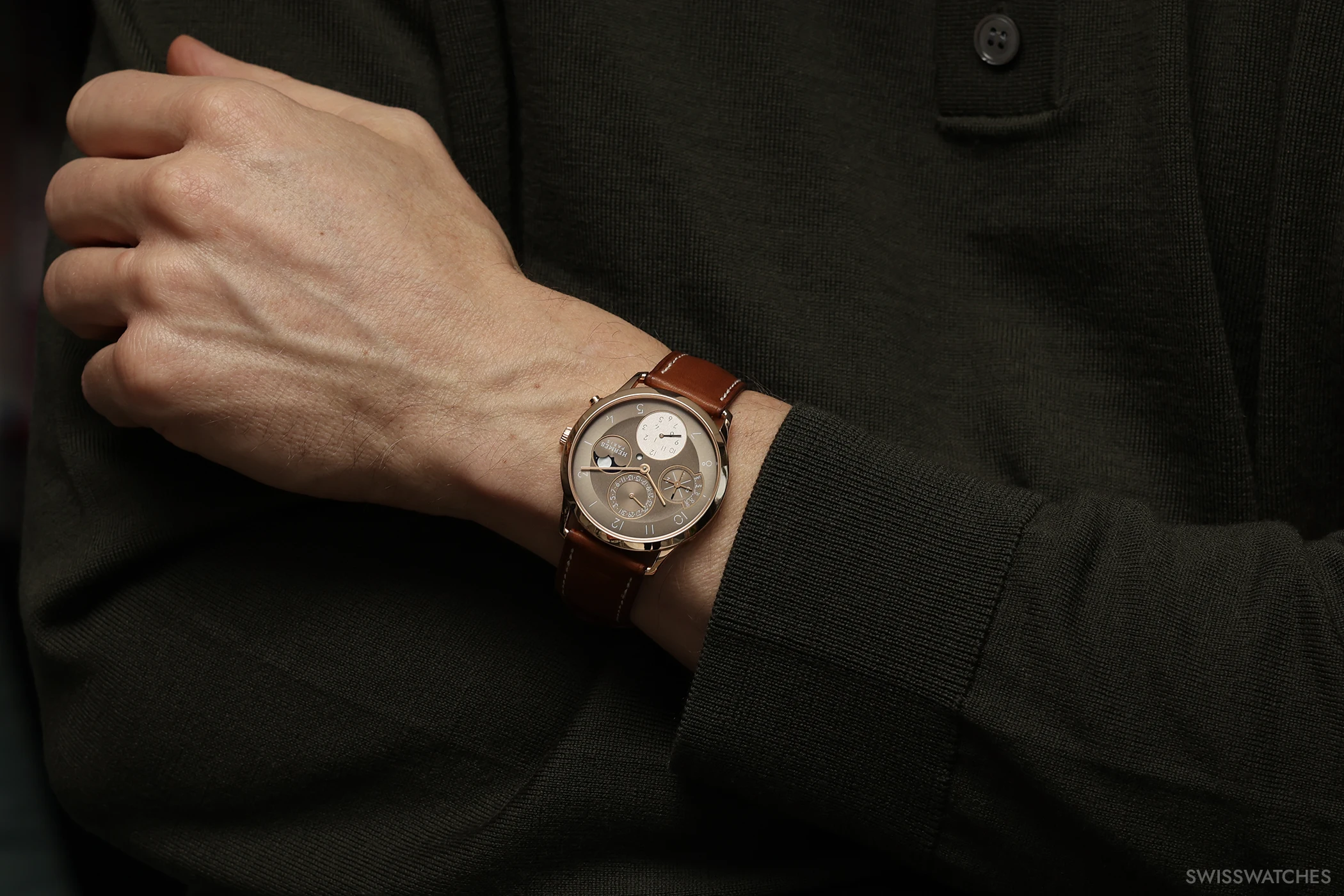
The heart of the Slim d’Hermès Quantième Perpétuel beats to the rhythm of the ultra-thin Hermès H1950 self-winding movement: 3 hertz, or 21,600 vibrations per hour. With the calendar module, it has a total height of just 4.0 millimetres.
The movement consists of 160 components. Added to this is the 137-piece module for the perpetual calendar, which supplements the hour, minute and moon phase display functions as well as GMT with day/night indicator. The second time zone can be set using the push-button at 4 o’clock without affecting the perpetual calendar.
The H1950 calibre is a modified version of the VMF5401 from movement specialist Vaucher Manufacture Fleurier S.A., in which Hermès holds a quarter of the shares, with the remainder belonging to the parent company of watch brand Parmigiani Fleurier.

The new Slim d’Hermès Quantième Perpétuel is worn on a Havana brown alligator leather strap. Available now, the timepiece costs EUR 39,550.