At LVMH Watch Week 2026, Hublot showcases the standout models for the year – from technical upgrades to limited editions.

As part of the seventh LVMH Watch Week, taking place from 19 to 21 January 2026, the LVMH Group brings together its nine watchmaking Maisons in Milan to present their most important new releases and technical innovations. Alongside Bulgari, Daniel Roth, Gérald Genta, Hublot, L’Epée 1839, Louis Vuitton, Tiffany & Co., and Zenith, TAG Heuer will also be in attendance, unveiling several noteworthy novelties as well as the revival of a historic model.
At LVMH Watch Week 2026, TAG Heuer introduces three new Carrera models featuring a newly developed 41 mm case. In addition, the brand presents the first-ever Carrera equipped with a split-seconds chronograph, as well as a reinterpretation of the Seafarer—an exceptional model from the 1950s that was the first timepiece to combine a tide indication with a chronograph function in a single watch. We had the opportunity to test these new TAG Heuer LVMH Watch Week 2026 releases in advance and would like to take this occasion not only to examine the novelties in detail, but also to delve deeper into the fascinating origins and development of the Seafarer model.
The TAG Heuer Seafarer not only tells the story of an exceptional model that, at the time of its introduction, represented a genuine curiosity within the Heuer portfolio, but also illustrates the longstanding connection between TAG Heuer, the moon, and seafaring. Before turning our attention to the new model in detail, it is worth first examining the origins of the TAG Heuer Seafarer.
To understand the lineage of the watches that ultimately led to the TAG Heuer Seafarer presented at LVMH Watch Week 2026, we must turn the clock back to the mid-1940s. At that time, Heuer was producing a wide range of timepieces—including chronographs—for the American retail company Abercrombie & Fitch on a private-label basis, meaning they were sold under the Abercrombie & Fitch name, then regarded as the most prestigious address for sporting goods. The president of Abercrombie & Fitch at the time was Walter Haynes. An enthusiastic angler, Haynes recognised through his hobby the need for a watch capable of displaying the tides. He carried out the initial calculations for such a complication and filed a corresponding patent. Through his connection with Heuer, Haynes approached Charles-Edouard Heuer—grandson of the company’s founder Edouard Heuer, who was then leading the business in its third generation—to further develop his concept of a tide-display watch and to manufacture the watch under the name “Solunar” for the historic New York sporting-goods retailer.
Jack Heuer, the son of Edouard, who would ultimately assume leadership of Heuer in 1961 and who also played a key role in the introduction of the Solunar, recounts the origins of the watch in his autobiography:
“One day my father came home from work and told me that Walter Haynes, then head of the exclusive sporting-goods outfitter Abercrombie & Fitch in New York, had asked him to develop a watch capable of indicating the tides. Interestingly enough, my father had already conceived a watch with a moon-phase display some years earlier, after noticing during mushroom foraging that more morels seemed to grow when the moon was waxing. A watch with a tide indication, however, had never occurred to him. He had not seen the sea for several years and was not familiar with the subject of tides at all. He scratched his head and admitted that he had no idea how such a thing could be done. I told my father that my physics teacher at school, Dr Heinz Schilt, was a genius and that I was certain he would find a solution. And indeed, he carried out all the calculations for the wheels and gears required for a watch to predict the tides at a specific location.”
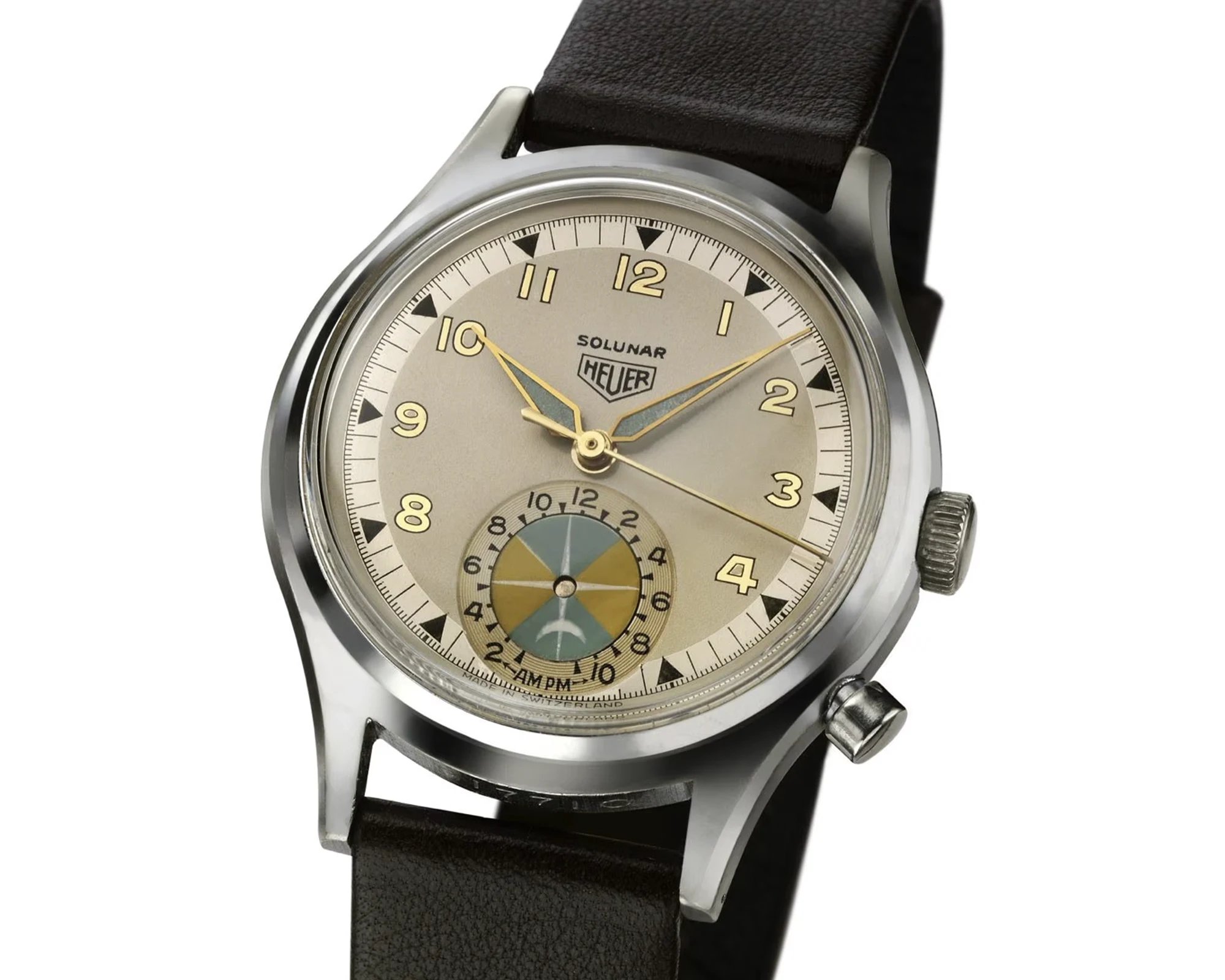
The result of Walter Haynes’s original idea, combined with Heuer’s manufacturing expertise and the calculations of physics teacher Dr Heinz Schilt, was ultimately a genuine curiosity within Heuer’s then chronograph-dominated product portfolio and the direct forerunner of the later Seafarer: the Solunar, launched in 1949. Its name, derived from “solar” and “lunar”, reflected its astronomical inspiration, and it became the very first watch to feature a tide indicator, positioned at 6 o’clock.
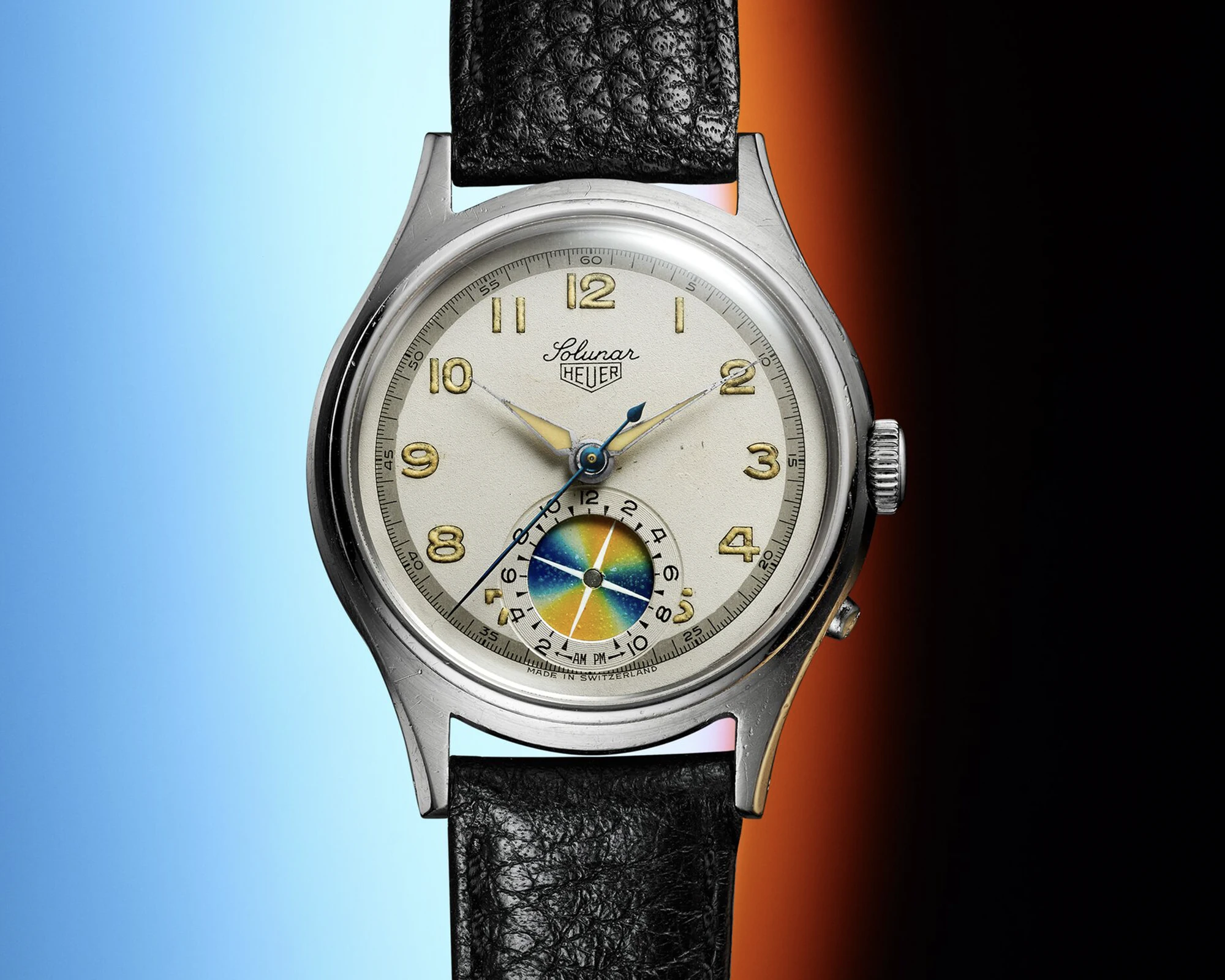
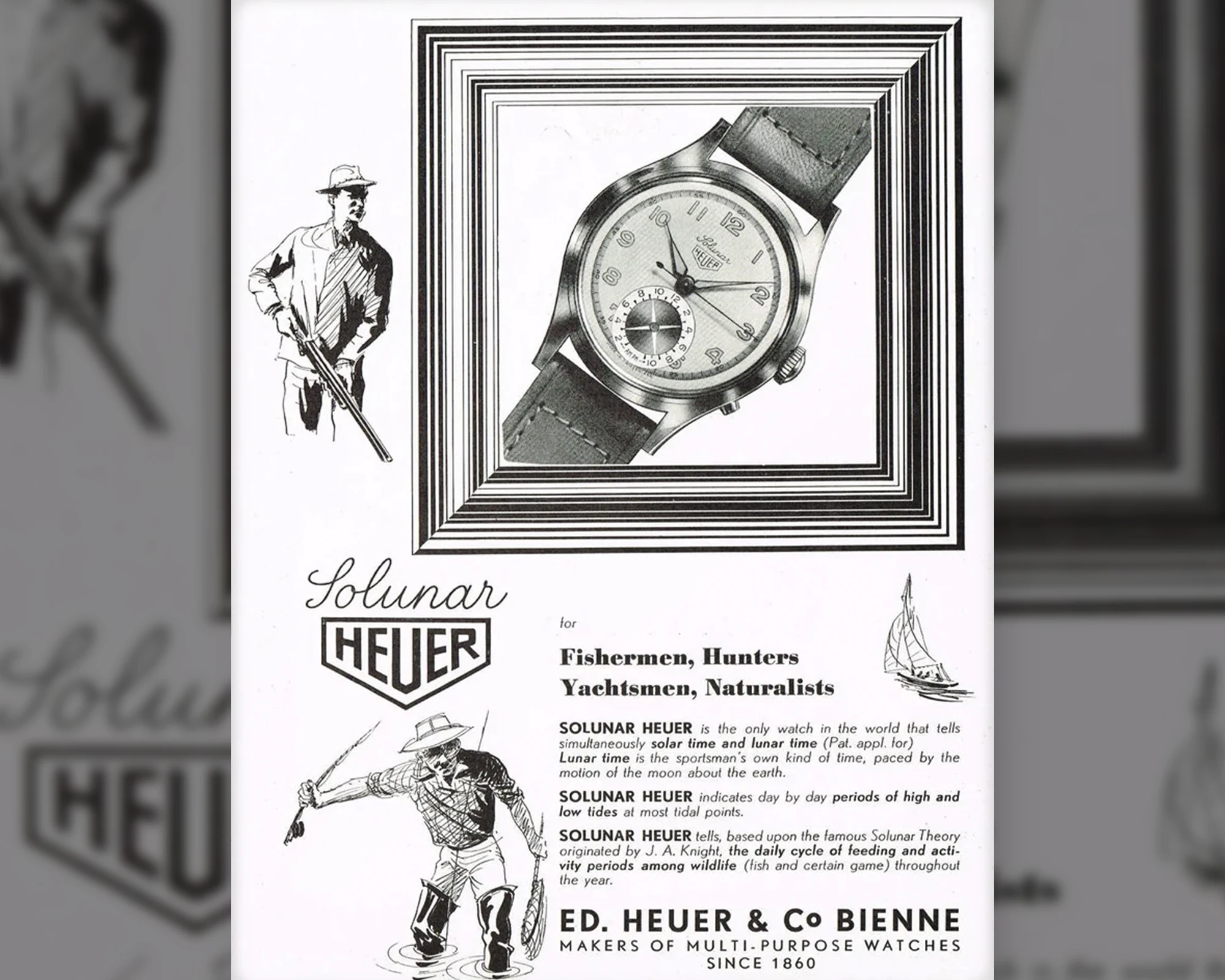
To briefly explain how a tide indicator functions: as the moon orbits the Earth, its gravitational pull draws the oceans towards the side of the planet facing the moon, while simultaneously creating an opposing effect on the opposite side, as sea levels equalise along the tangential angles relative to the moon’s position. As a result, moon-phase displays and tide indications are mechanically very closely related, and in fact the underlying calculation is identical.
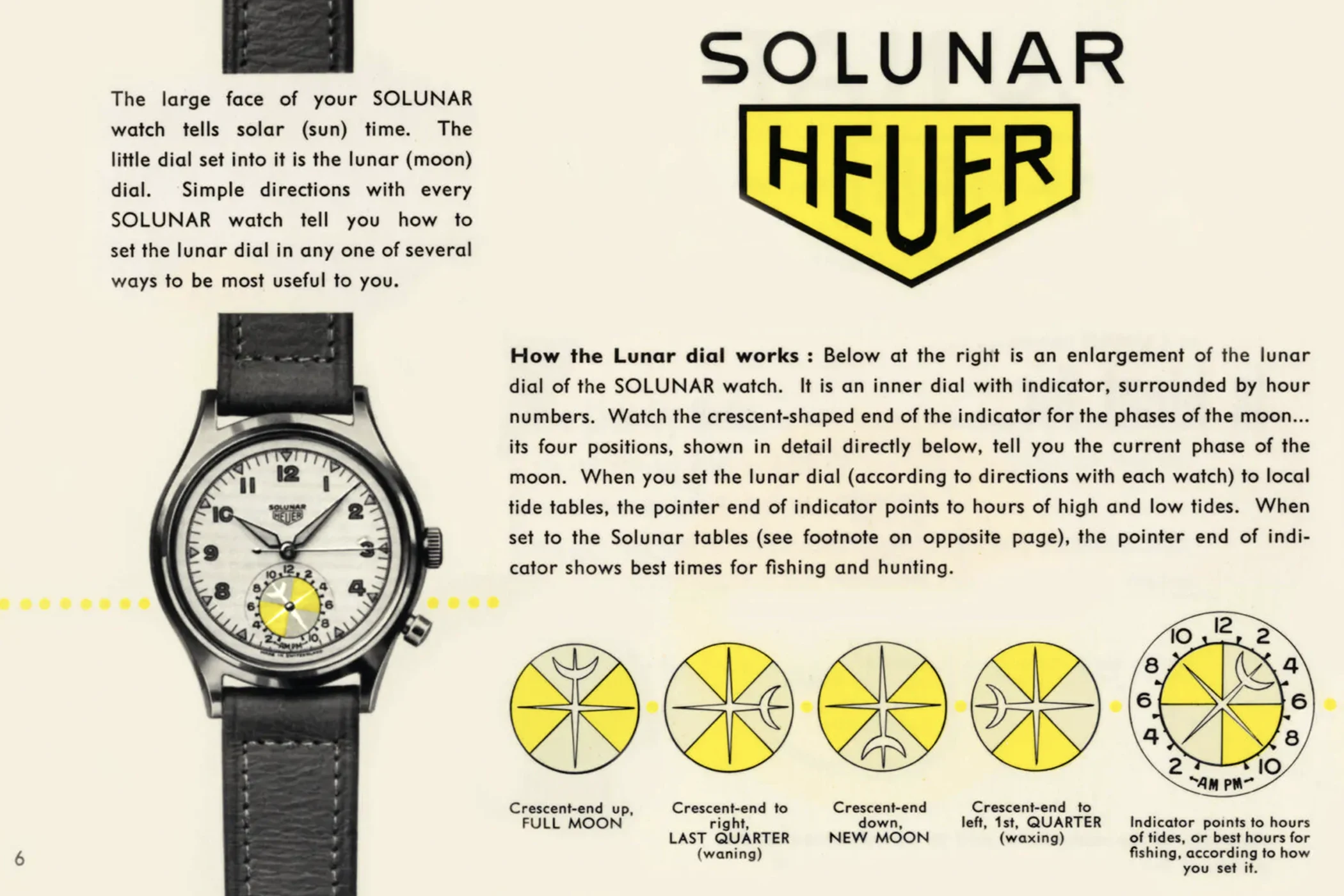
With this display—primarily aimed at sailors and fishermen—ebb and flood could be indicated for a specific location based on the lunar cycle. The indication was set to a particular location using the pusher at 4 o’clock and would then complete a full rotation every 50 days, or roughly twice the length of the 28.5-day lunar cycle. It was surrounded by a 24-hour ring that visualised the tides: white lines edged in blue denoted high tide, while white lines framed by an orange tone indicated low tide. Setting the tide indication, however, was not as straightforward as one might initially assume. To adjust it correctly, the wearer needed to know their geographical location as well as the times of high and low tide in order to establish the reference position. In the pre-internet era, such information could be obtained from daily newspapers, radio broadcasts, or even from local sailors at the harbour.
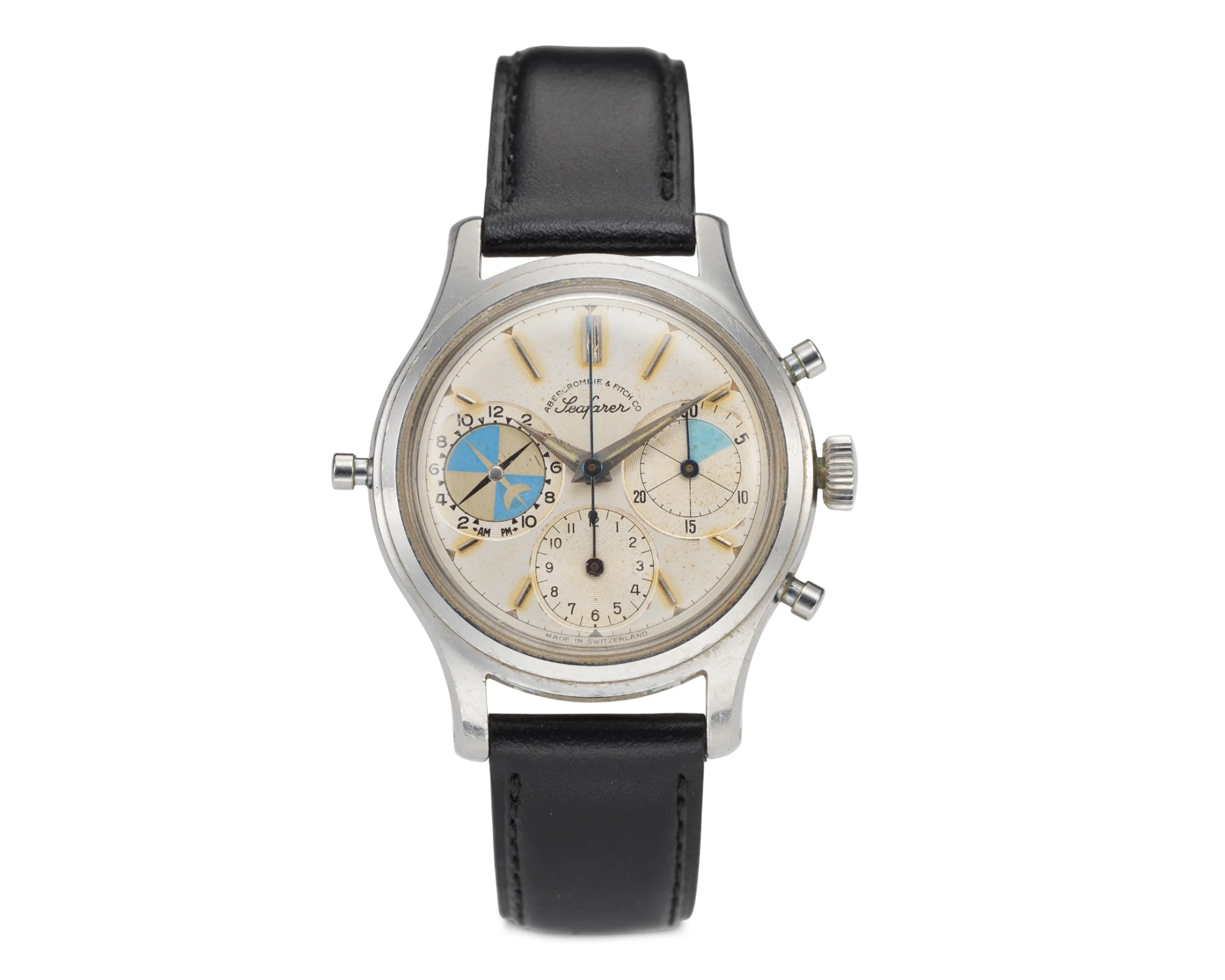
With its unconventional display, the Solunar laid the foundations for a timepiece that, for the first time, combined a tide indication with a chronograph function: the Heuer “Mareograph”. Introduced around 1950, this watch already came very close to what would later become the Seafarer as we know it today. It combined the Solunar’s tide dial at 9 o’clock with a 12-hour counter at 6 o’clock and a 30-minute counter at 3 o’clock, which also served as a regatta timer. Thanks to its division into five-minute intervals, this counter could be used to time the start of yacht or boat races. The concept of this chronograph—which was sold by Abercrombie & Fitch under the name “Seafarer” and later by Orvis as the “Solunagraph”, although all of these models were manufactured by Heuer—returned to prominence in 2024, when it was reissued in a modern, limited edition of 968 pieces as the TAG Heuer Carrera Chronograph Seafarer × Hodinkee.
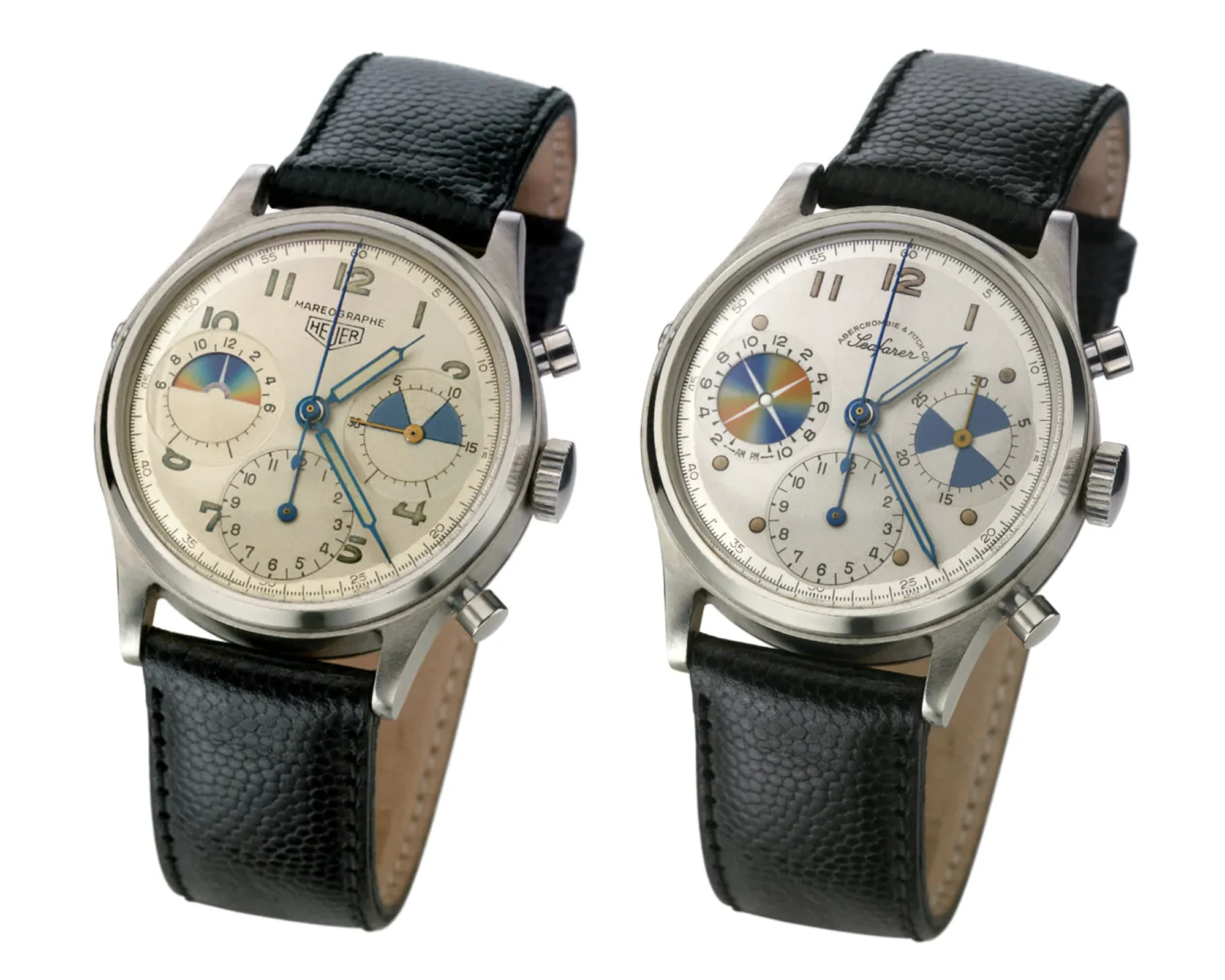
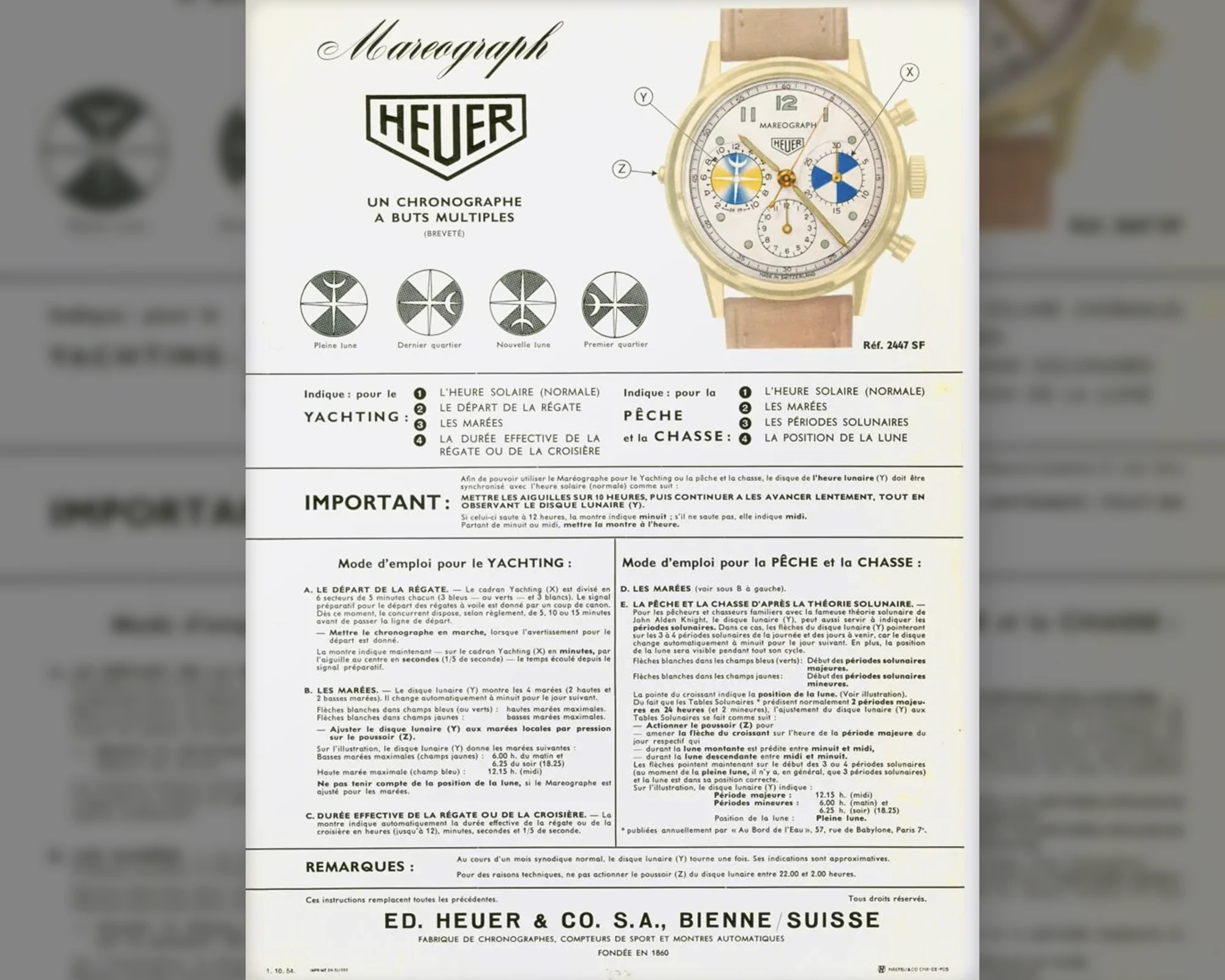
The first Seafarer model was reference 346. It featured an oversized case inspired by the large-format military watches that Heuer also produced, an oversized crown, and a pusher at 9 o’clock for setting the tide indication. This initial reference was followed by the Seafarer reference 2443, the second iteration of the model, which retained the oversized case but introduced faceted lugs—an element that would later reappear on the Seafarer reference 2447. One of the most significant evolutions came with the Seafarer reference 2444 from the 1950s, which reduced the case diameter to 36 mm and, above all, simplified the tide display. Instead of graduated colour transitions, this reference adopted clearly defined colour fields in yellow and sky blue to visualise the tides. In 1962 and 1963—years marked respectively by the introduction of the Autavia and the Carrera—the case designs of these two iconic models were also applied to the Seafarer. Accordingly, the Seafarer reference 2446 was housed in an Autavia case, while the Seafarer reference 2447 was, for the first time, fitted with a Carrera case. Today, both models, references 2446 and 2447, rank among the most sought-after historical Heuer timepieces among collectors.
Credit © Christie’s
While the Solunar of 1949 disappeared from Heuer’s catalogue after only a few years, the “Mareograph” or “Seafarer” line continued until the mid-1970s—before now being revived once again, albeit in a very different form.
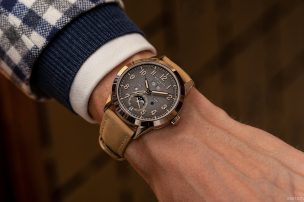
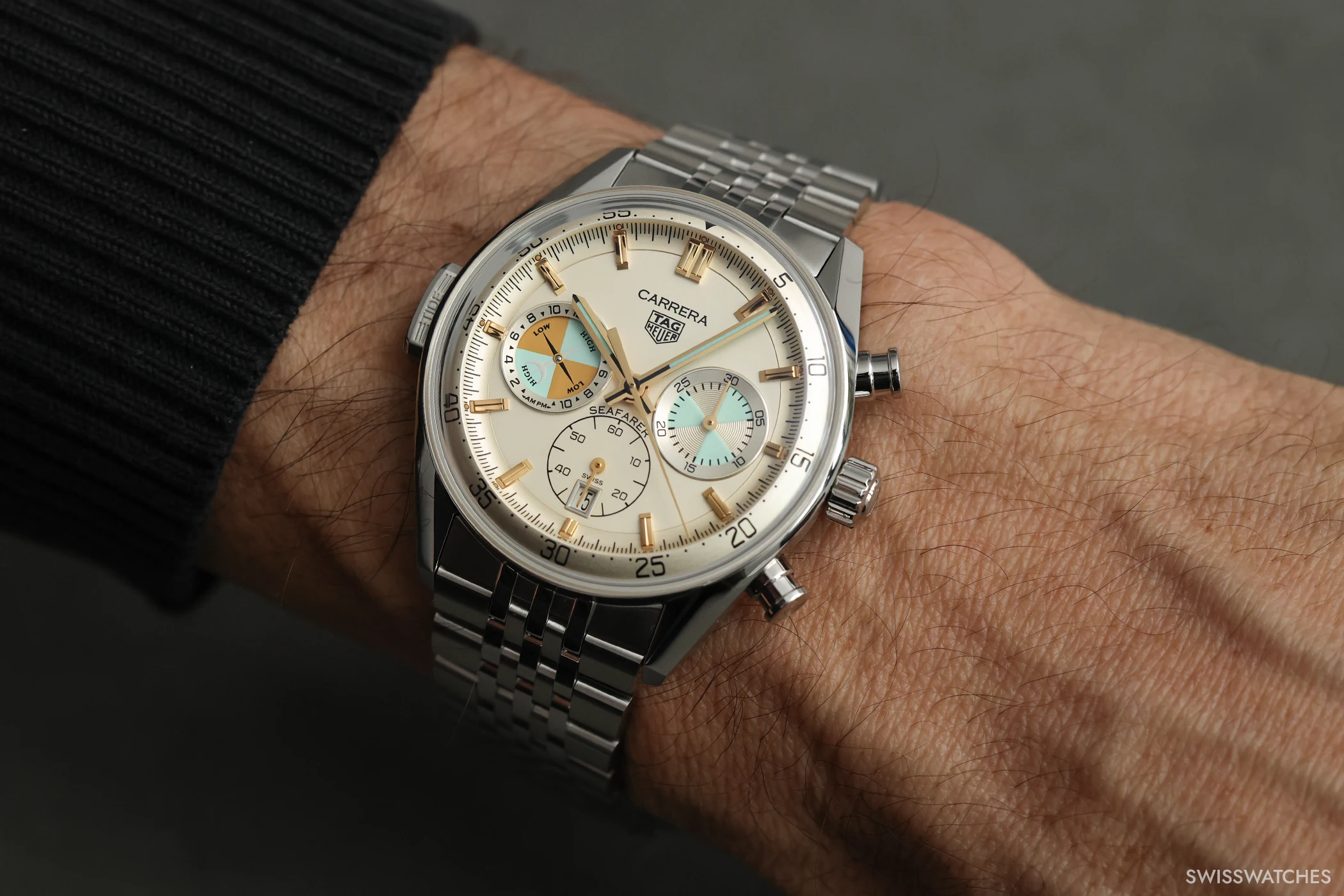
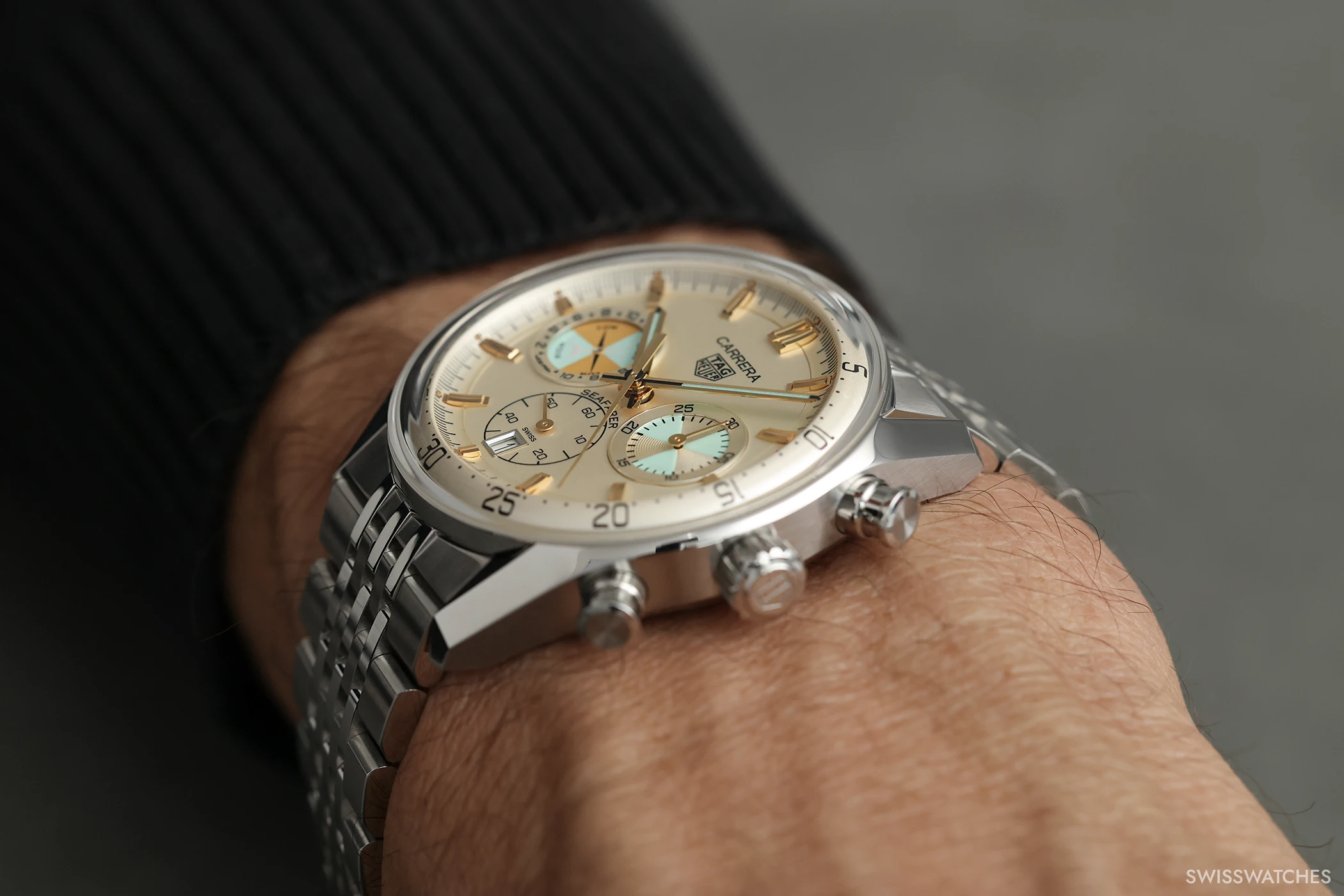
Against this backdrop, the significance of the newly unveiled Seafarer is considerable. The new TAG Heuer Carrera Chronograph Seafarer marks the first time since the model’s discontinuation in the 1970s that the Seafarer returns to the brand’s permanent catalogue, while the tide indication itself experiences a new dawn 77 years after its debut in the Solunar. The tide display of the new Seafarer completes a full rotation in 29.53125 days, thus replicating the synodic lunar cycle. Over this period, its markings—yellow indicating low tide and blue denoting high tide—reliably show when high and low tides are to be expected. The tide indication can be easily set via the specially marked “TIDE” pusher at 9 o’clock on the case. When actuated, the pusher sets the quadrant-divided tide disc in motion.
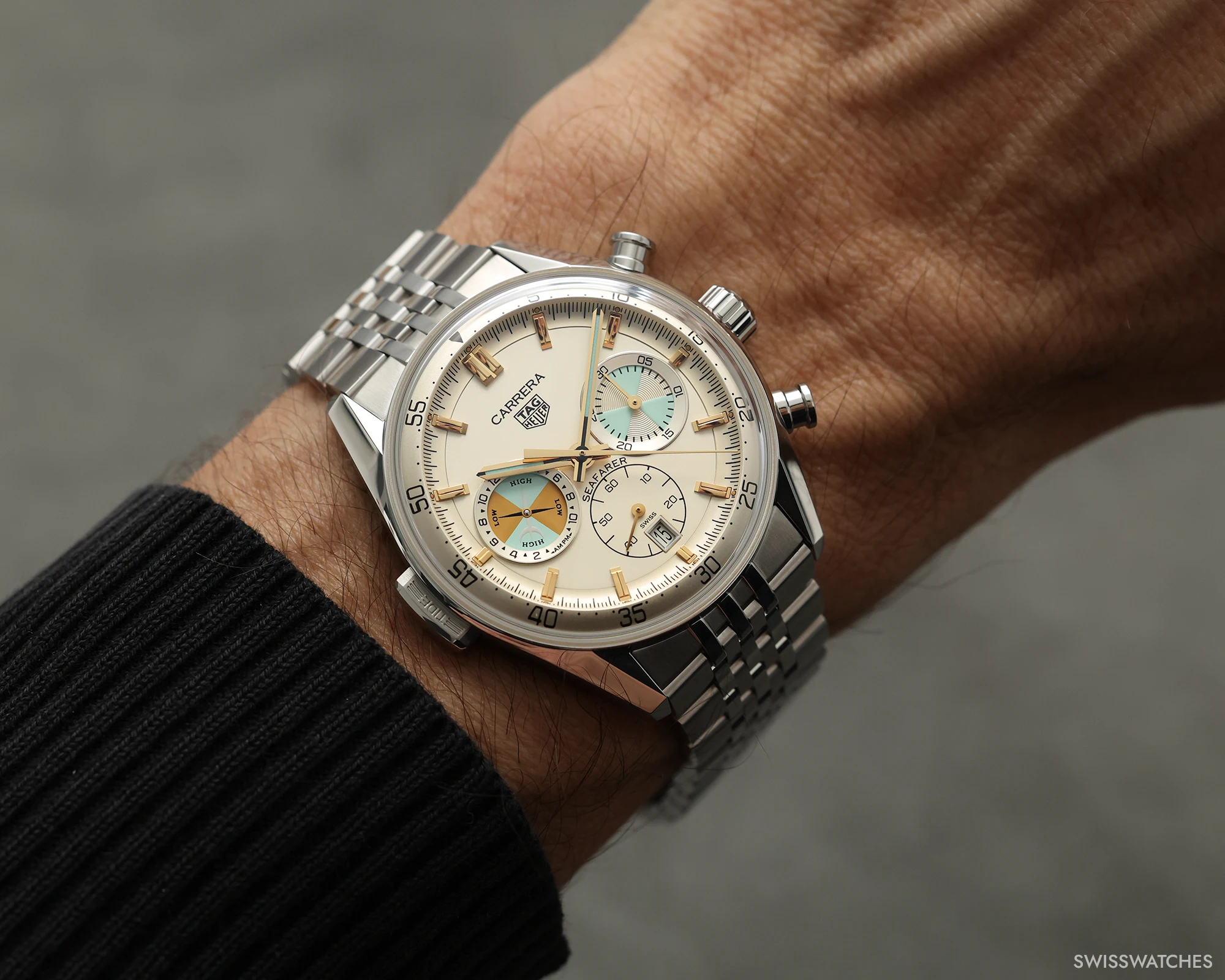
Opposite this display, at 3 o’clock, sits the 30-minute chronograph counter, which—just as on the historical Heuer “Mareograph”—can also serve as a regatta timer thanks to its subdivision into five-minute intervals. The most notable departure from the original Heuer “Mareograph” is found at 6 o’clock. Here, the former 12-hour counter has been replaced by the small seconds, complemented by a cut-out for the underlying date window. All of these indications are set against a champagne-coloured opaline dial, which is further distinguished by large, applied and faceted hour markers crafted from 18-carat, 3N yellow gold-plated metal. Completing the display are the paired hour and minute hands, also made from 18-carat 3N yellow gold-plated metal and filled with blue Super-LumiNova, which sweep across the dial above all else.
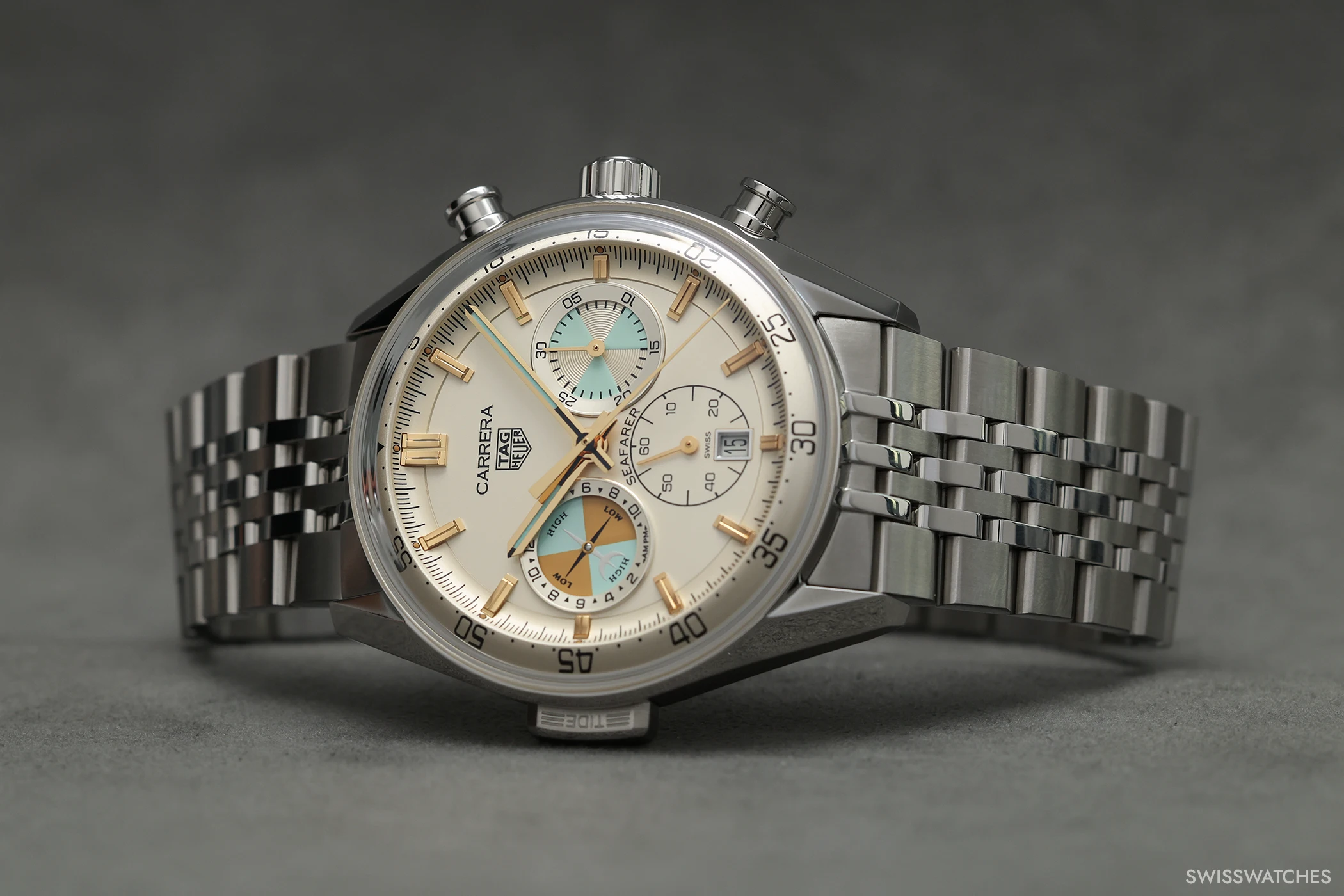
Providing both the frame and the protective architecture for the dial is the Carrera case in its “Glassbox” design, officially introduced in 2023. This construction—with its curved dial ring and prominently domed sapphire crystal—is now also applied to the Seafarer. The stainless-steel case measures 42 mm in diameter and 14.40 mm in height, combining finely satin-brushed and polished surfaces while deliberately dispensing with a separate bezel. It is water-resistant to 100 metres and fitted with a screw-down sapphire crystal caseback bearing the so-called “Victory Wreath” engraving.
Turning the watch over reveals that TAG Heuer has equipped the timepiece with the new in-house calibre TH20-04, developed specifically to integrate the tide indication. This self-winding chronograph movement features a column wheel and a vertical clutch, ensuring smooth and precise pusher action. It offers a power reserve of 80 hours, allowing the watch to continue running reliably even after several days off the wrist. Winding is provided by a rotor shaped in the form of the TAG Heuer shield.
The TAG Heuer Carrera Seafarer (ref. CBS2016.EB0430) will be available from March 2026, comes with a five-year warranty, and is priced at CHF 8,300. In addition to the seven-row stainless-steel “beads-of-rice” bracelet revised in 2025, the Seafarer is supplied with a beige textile strap that complements the historical character of the tide indication.
As was already the case with the Carrera Astronomer, which introduced an innovative moon-phase display to the TAG Heuer portfolio upon its launch in September 2025, the brand aims with the new Carrera Chronograph Seafarer to establish a counterpoint to the largely motorsport-driven models that dominate its current collection. To this end, TAG Heuer draws equally on the heritage of both the Solunar and the Mareograph, integrating the historic tide indication—combined with a chronograph function—into the modern Carrera case with its “Glassbox” construction. The individual elements come together coherently, and legibility benefits from the chosen colour palette, in particular the shade known as “Intrepid Teal”, inspired by the America’s Cup-winning yacht Intrepid of 1967.
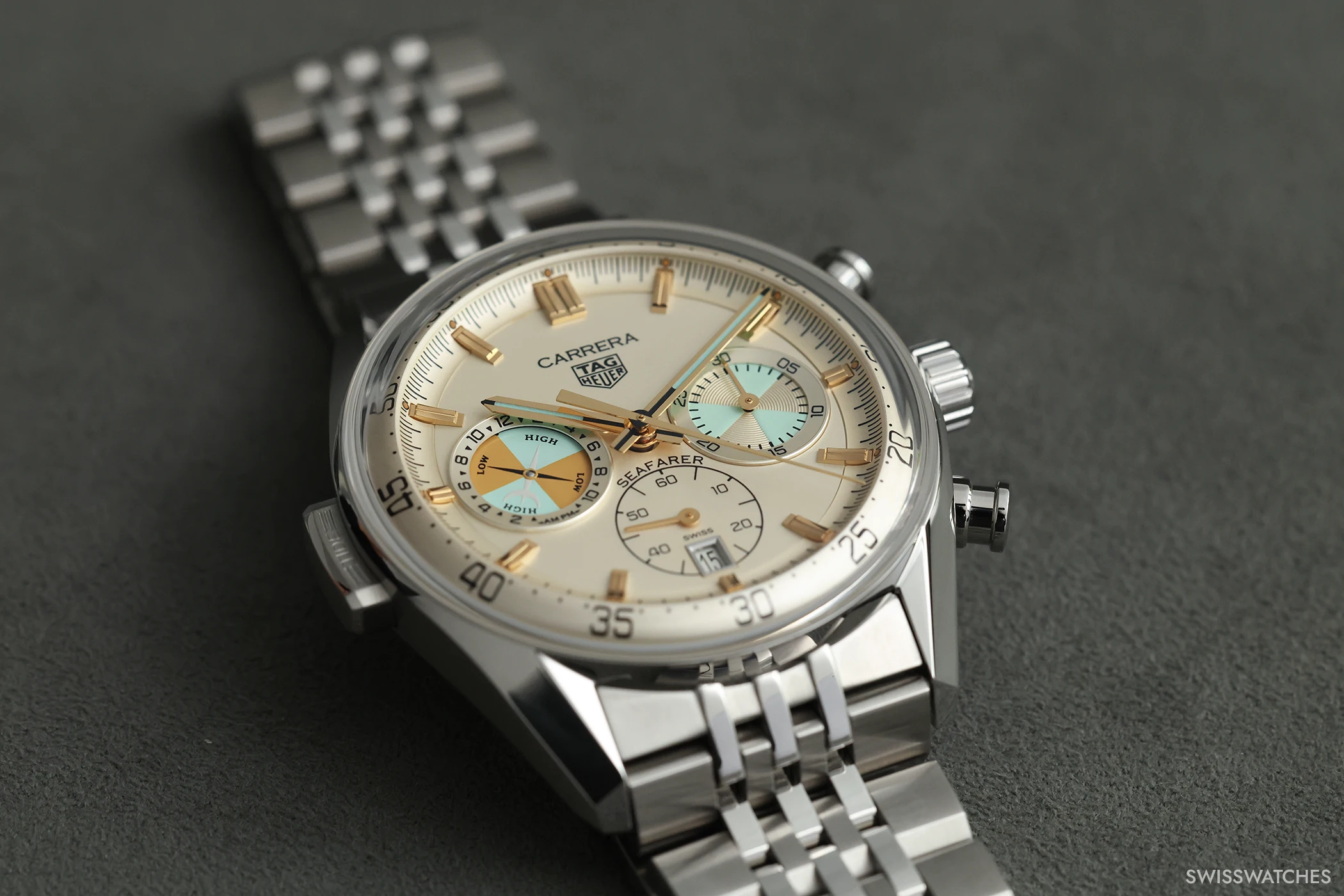
One drawback, however, became apparent to me while wearing the watch. The interplay between the applied hour markers in 18-carat 3N yellow gold-plated metal and the sub-dials of the tide indication on the champagne-coloured dial can appear somewhat restless in places. The generously sized indices, with their pronounced golden hue, draw noticeable attention away from the three sub-dials and at the same time seem slightly over-proportioned in relation to the rest of the dial. This creates an impression of a deliberately accentuated expression of luxury that, in my view, is more pronounced than necessary—particularly given that the historically charged tide complication already lends the timepiece a strong intrinsic sense of value in its own right.
In 2023, TAG Heuer celebrated the 60th anniversary of one of its most emblematic models—the Carrera, first introduced in 1963—and marked the occasion with a reinterpretation of this icon. The new generation of the Carrera featured the “Glassbox” construction, originally introduced in 2015 with the Calibre 18 Telemeter ref. CAR221A. This design is characterised by a domed sapphire crystal that extends to the very edge of the case, along with a rehaut whose shape follows the curvature of the crystal, rendering a separate bezel unnecessary and improving overall legibility. Owing to the absence of a bezel, the “Glassbox” Carrera also appears noticeably more present on the wrist than its dimensions might initially suggest. Following the 39 mm and 42 mm Carrera models, TAG Heuer now presents three new Carrera references at LVMH Watch Week that further develop this concept. These new models introduce cases with a diameter of 41 mm and, in addition, dispense entirely with a date window on the dial.
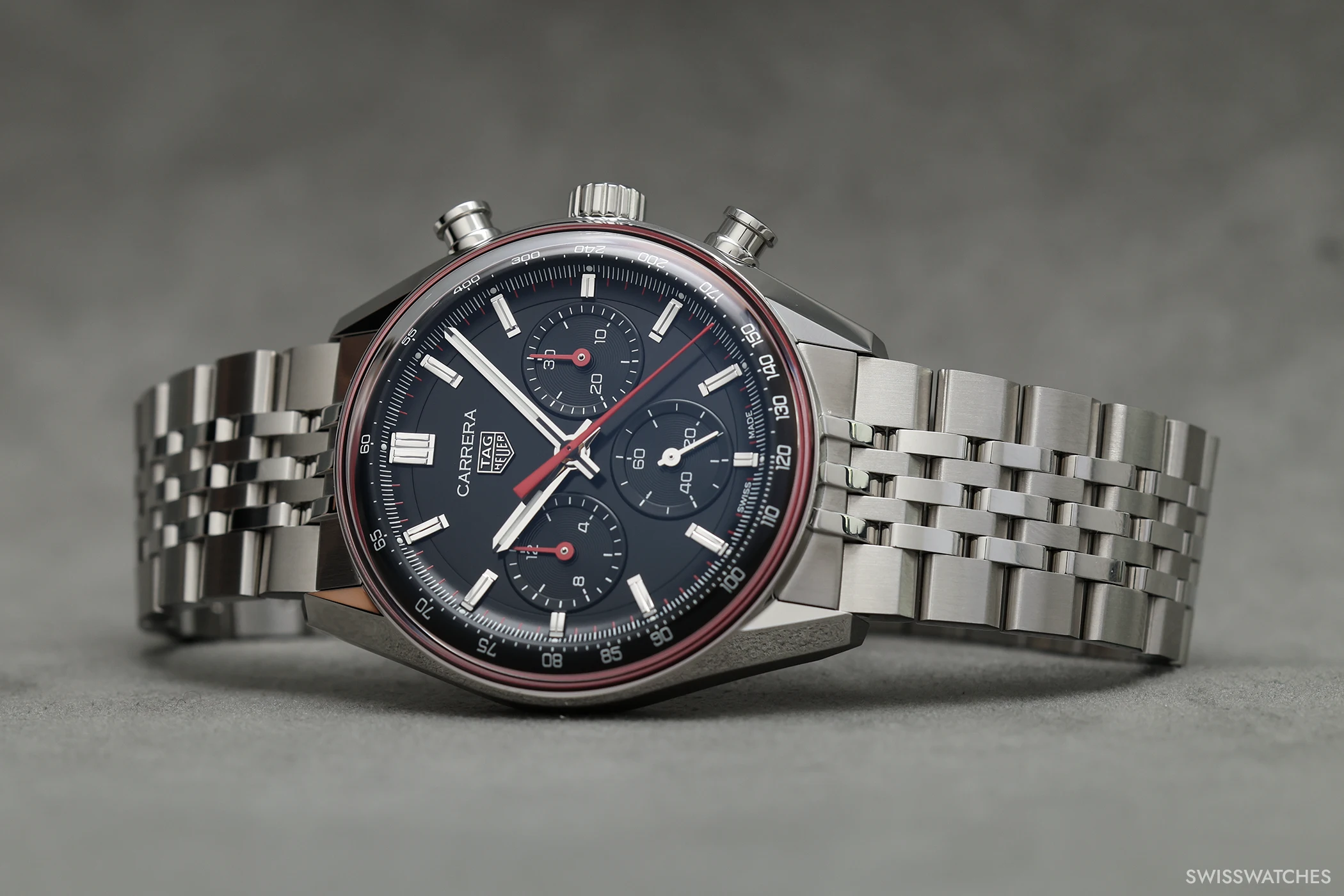
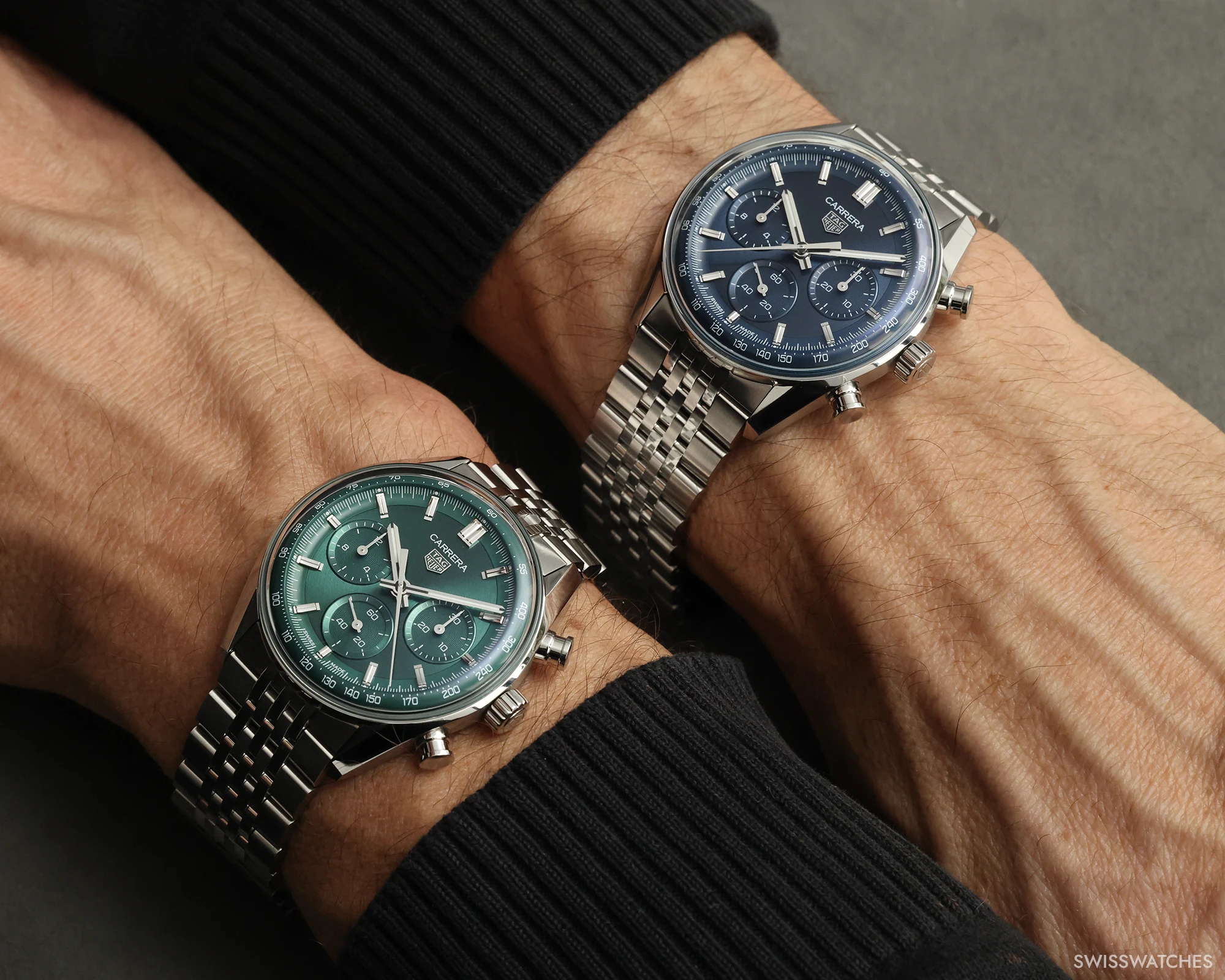
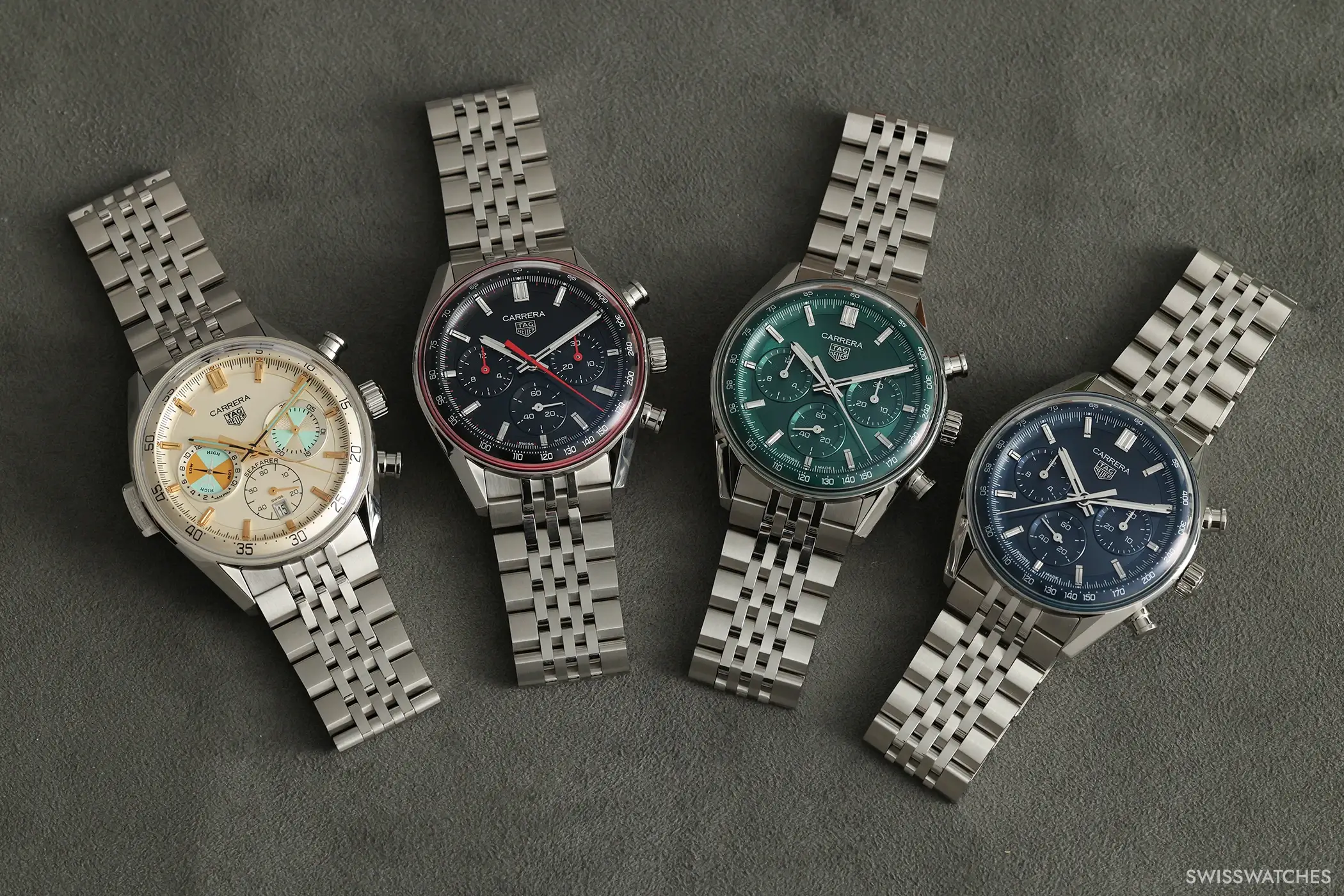
The new TAG Heuer Carrera models are initially launched in three versions, all of which share the new stainless-steel case measuring 41 mm in diameter and 14.17 mm in height, a uniform sub-dial layout with a 30-minute chronograph counter at 3 o’clock, the running small seconds at 6 o’clock, and a 12-hour chronograph counter at 9 o’clock, as well as a circular decorative finish on both the dial and the totalisers. Turning the watches over reveals, through the sapphire crystal caseback of the 100-metre water-resistant “Glassbox” case, a new evolutionary stage of TAG Heuer’s chronograph movement, now designated calibre TH20-01. The TH20-00 was also introduced in 2023 with the new generation of the Carrera and brought with it the key change of a bi-directional winding system for the automatic chronograph movement. The new TH20-01 simultaneously leads us to the second major update of these new variants: the decision to dispense entirely with a date display on the dial.
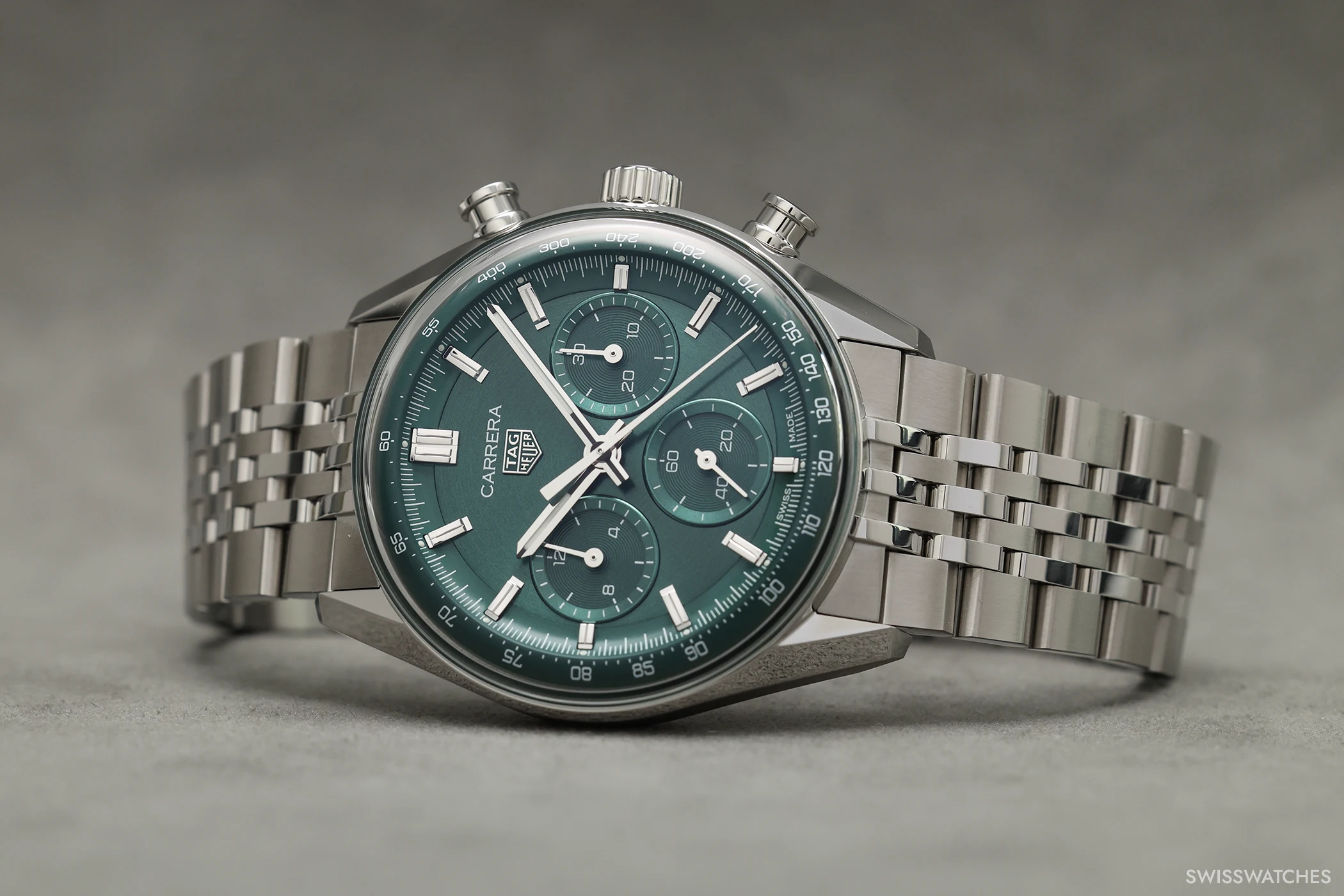
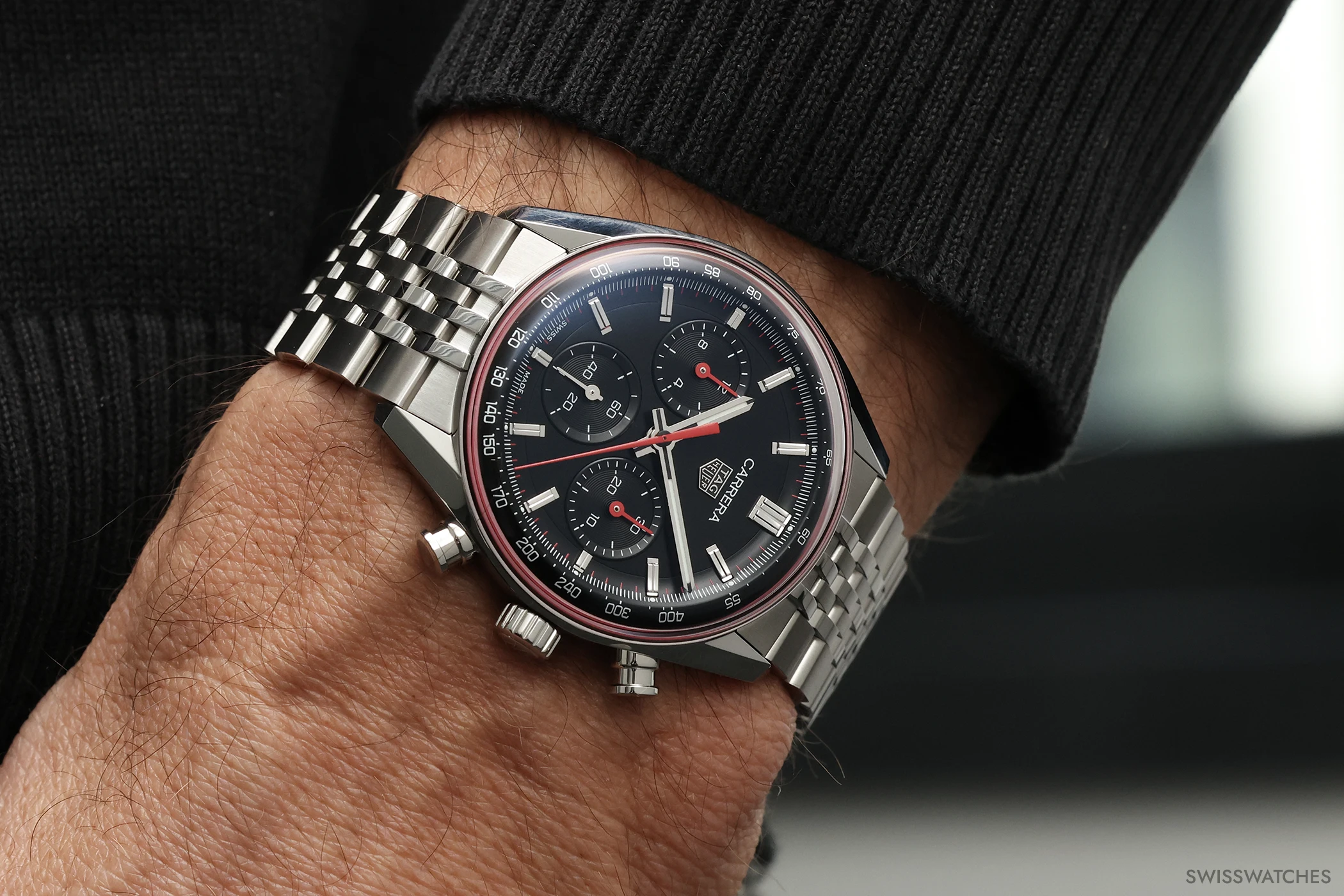
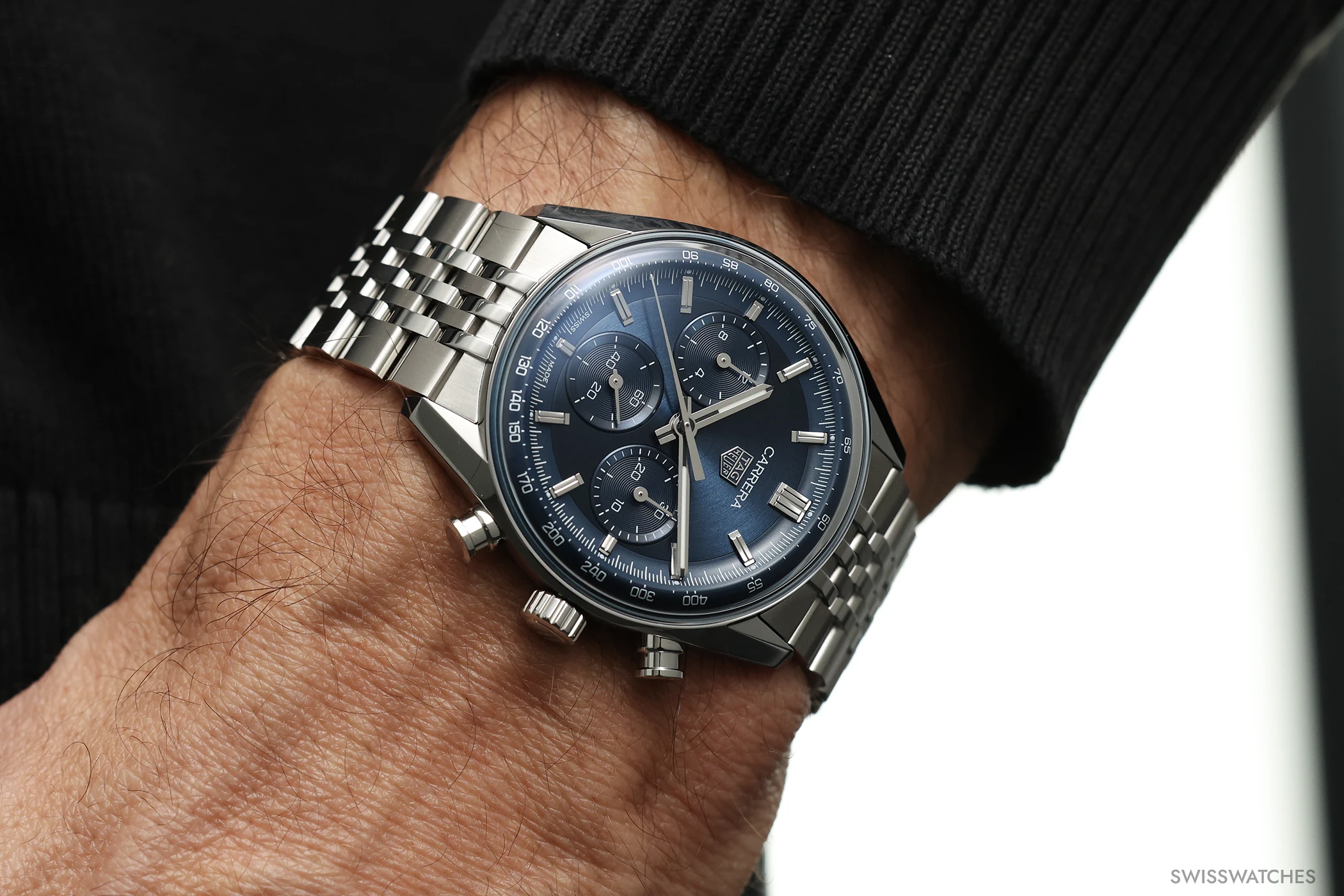
Let us now move from the shared characteristics to what distinguishes the three new 41 mm Carrera variants from one another. The blue and green versions feature circularly satin-brushed dials with totalisers executed entirely in matching blue or green. Both models are fitted with faceted hour, minute, and central chronograph seconds hands which—like the applied indices—are fully rhodium-plated. In addition, the hour and minute hands on both versions are filled with white Super-LumiNova, a luminous material that ensures good legibility even in low-light conditions. The third variant, by contrast, features a black dial in which the hands of the 30-minute and 12-hour chronograph counters, as well as the central chronograph seconds hand, are rendered in a striking red to enhance differentiation. To provide the dial with a subtle visual frame, a red contour also runs along the perimeter of the sapphire crystal.
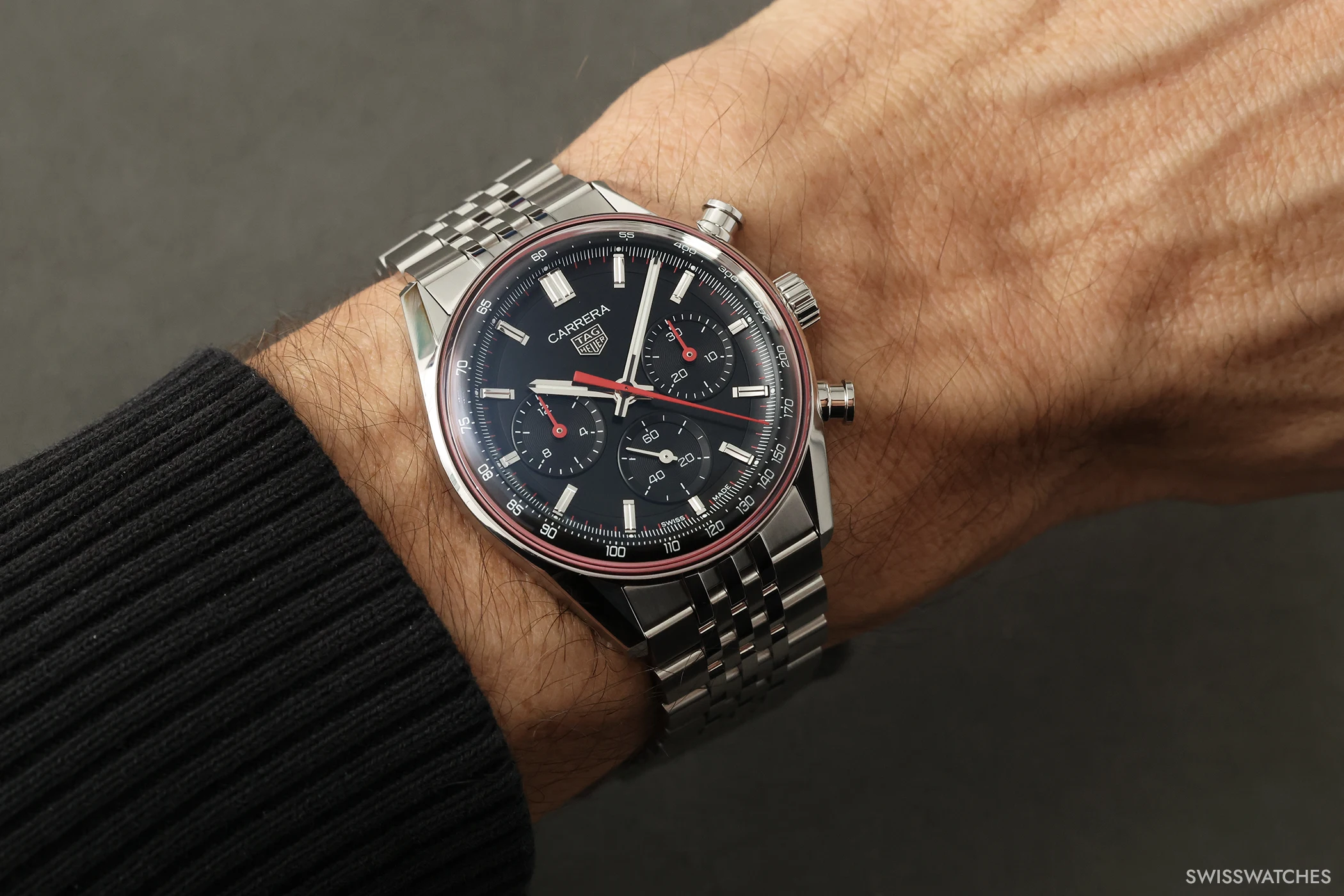
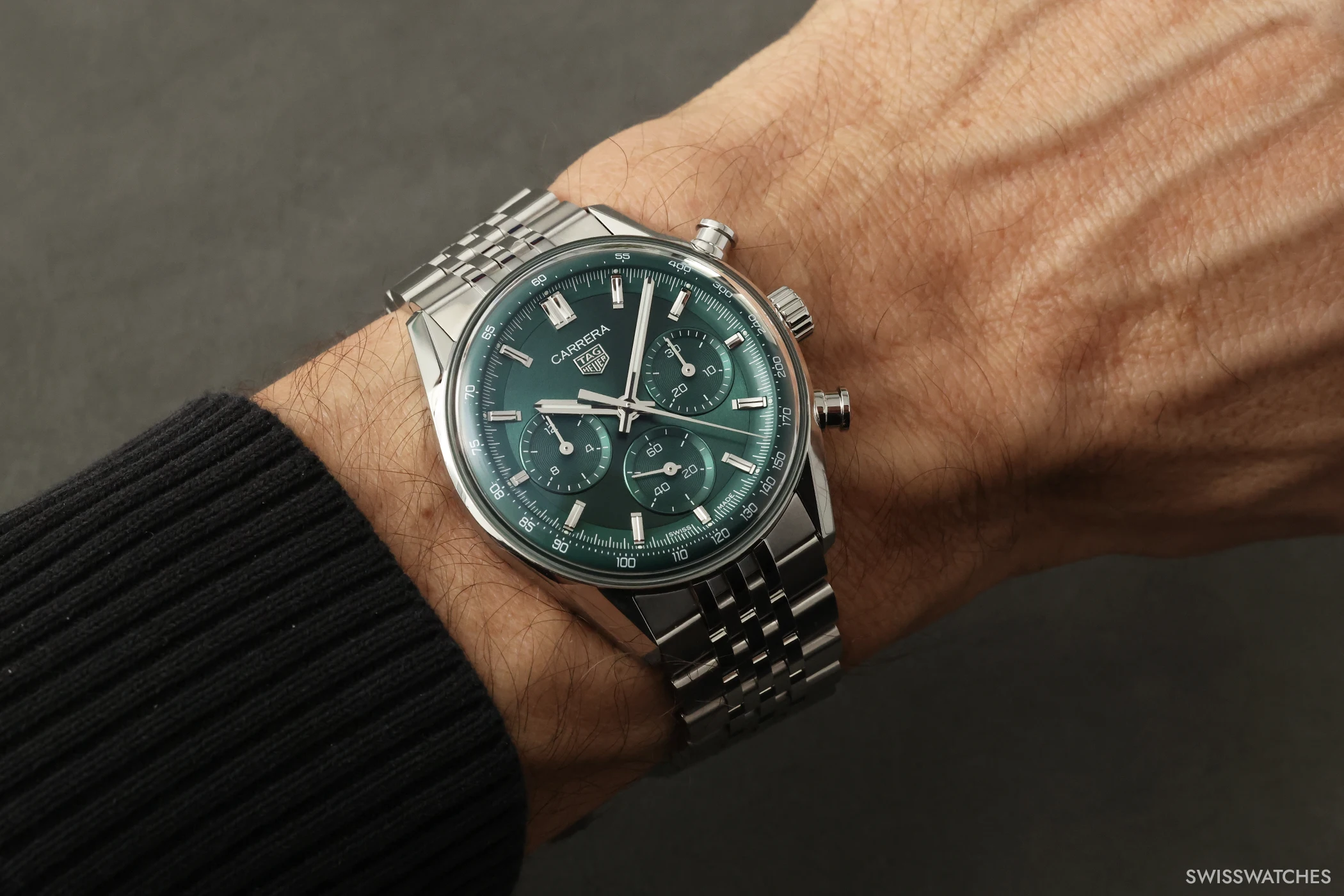
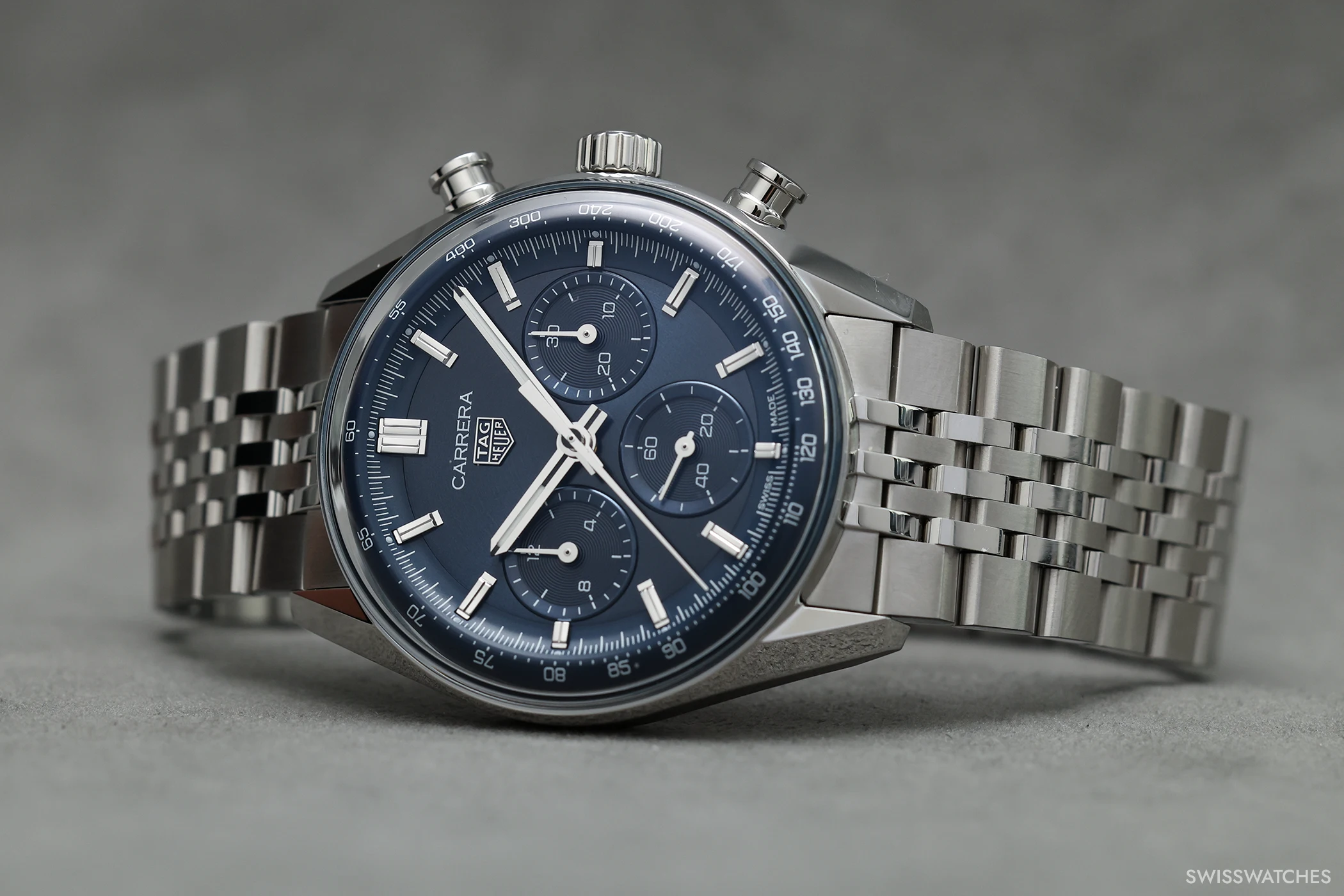
The new TAG Heuer Carrera chronographs, references CBS2113.BA0053 (blue), CBS2115.BA0053 (green), and CBS2114.BA0053 (black with red accents), will be available from January 2026. Each model is priced at CHF 7,500.
In addition to the revival of the Seafarer and the three Carrera models in new 41 mm cases, TAG Heuer presents another highlight at TAG Heuer LVMH Watch Week 2026: the debut of the first Carrera equipped with a split-seconds chronograph complication. The TAG Heuer Carrera Split-Seconds Chronograph features an entirely newly developed case crafted from Grade 5 titanium, measuring 42 mm in diameter with a case height of 15.17 mm. Finely executed chronograph pushers are positioned above and below the crown at 3 o’clock.
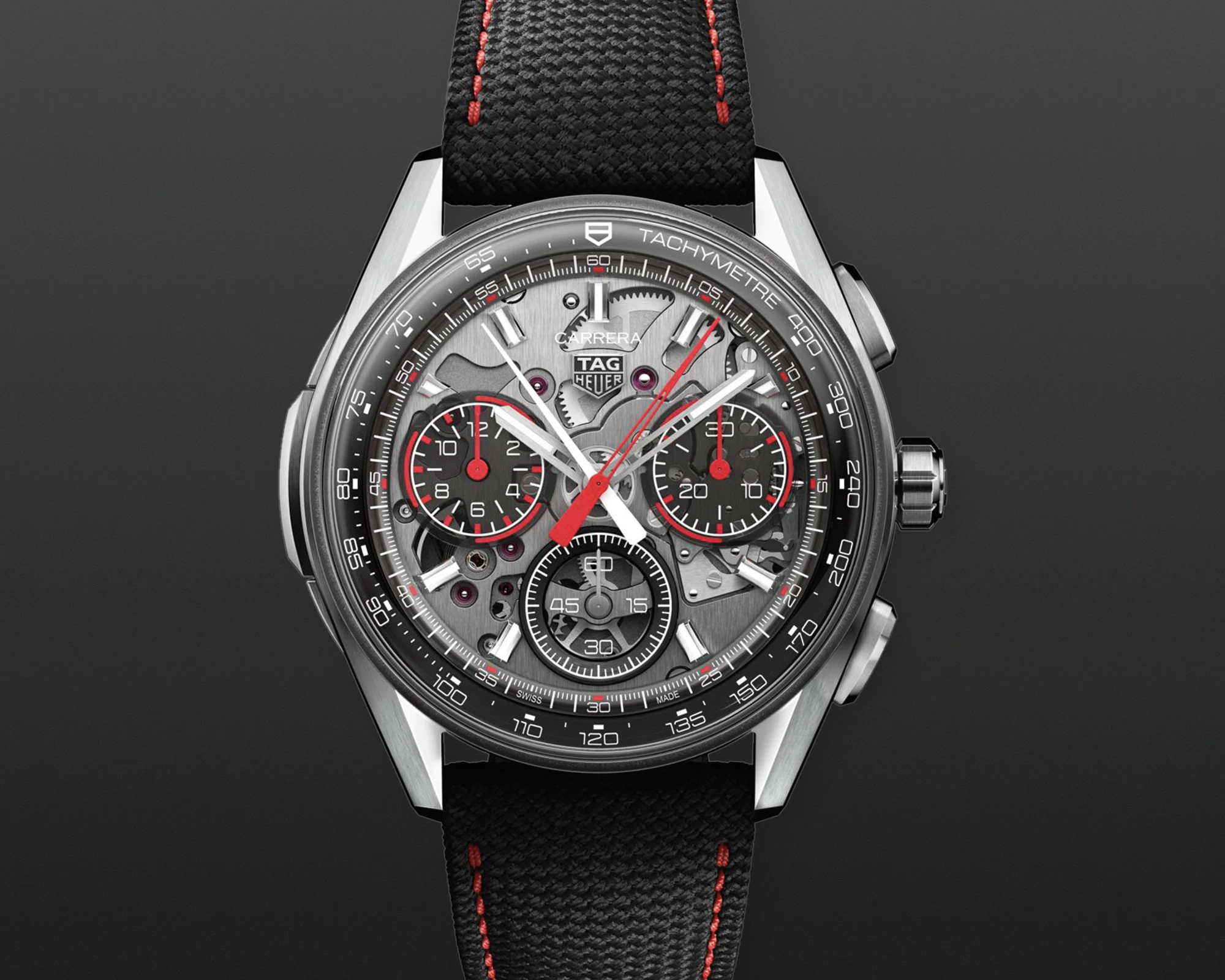
Unlike a conventional chronograph, a rattrapante—or split-seconds—chronograph is equipped with two superimposed chronograph seconds hands that start simultaneously. One of these is the primary chronograph seconds hand, which continues to run uninterrupted, while the second—the so-called rattrapante hand—can be stopped independently via a dedicated mechanism. On the Carrera Split-Seconds Chronograph, the rattrapante hand is highlighted in red, and the split-seconds function is activated via a pusher integrated into the case band at 9 o’clock.
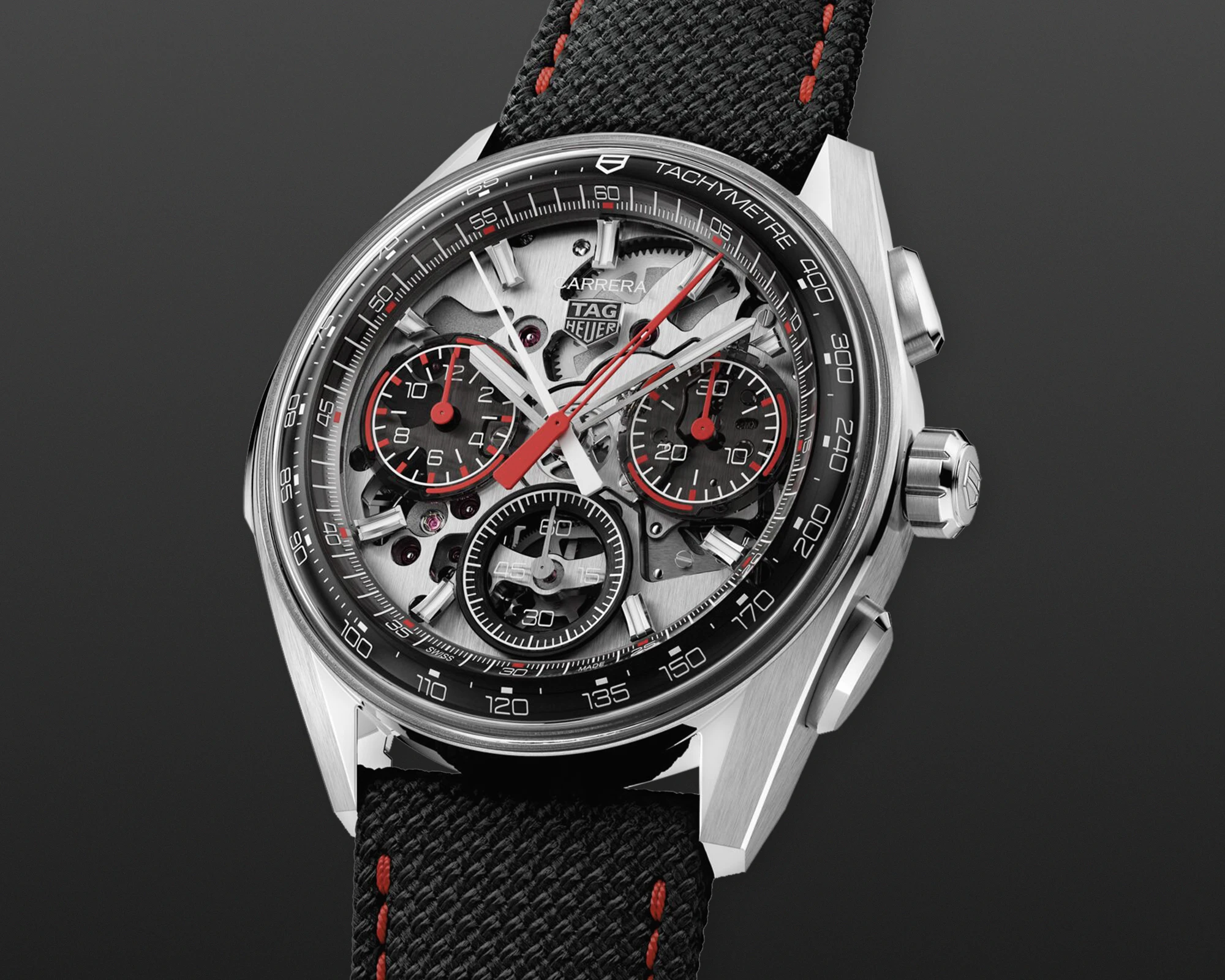
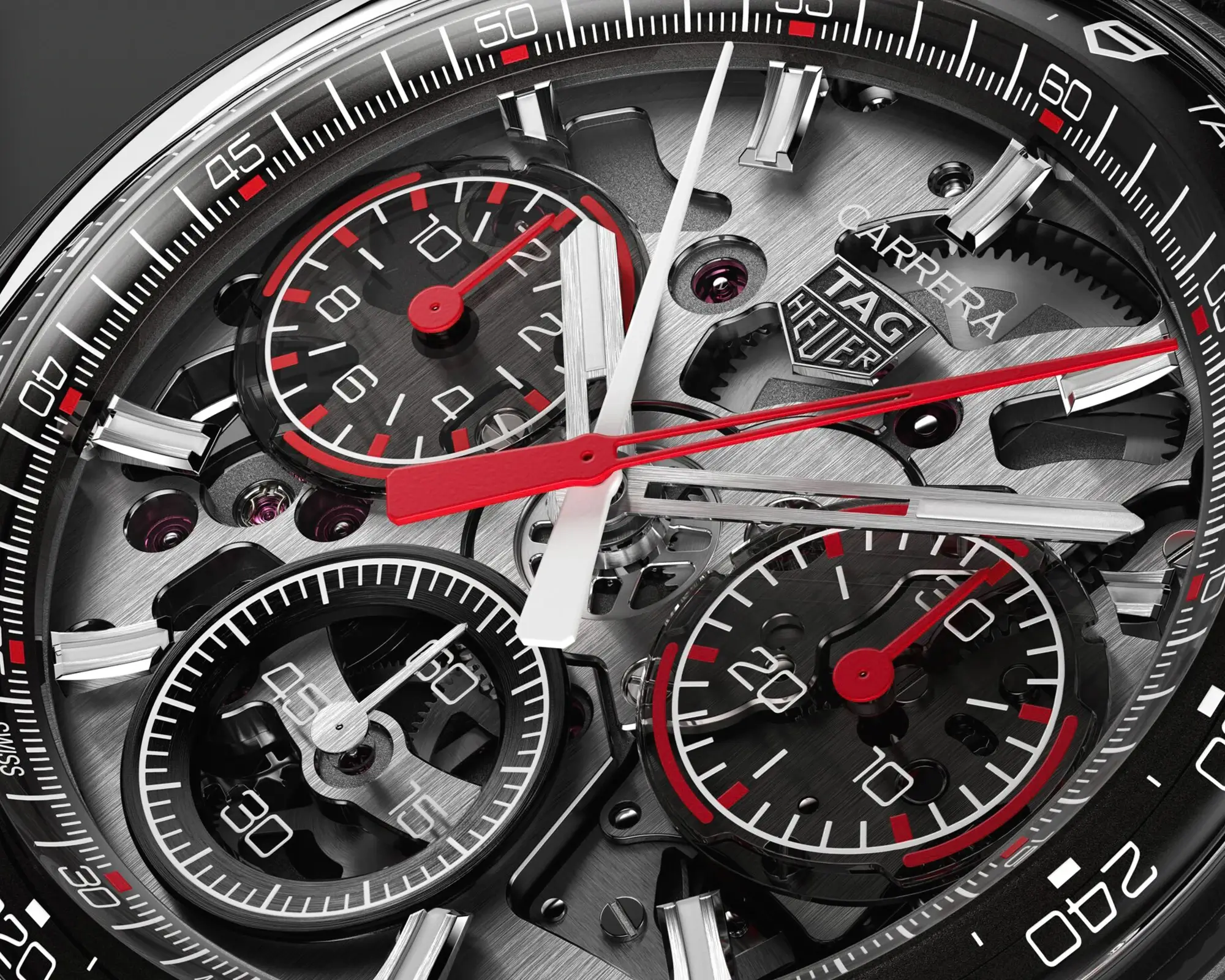
The dial design is equally distinctive. Both the main dial and the sub-dials are made from smoky anthracite sapphire crystal, revealing a view of the finished reverse side of the movement beneath. The rattrapante chronograph calibre TH81-01, developed in close collaboration with Vaucher Manufacture Fleurier, is based on the technical foundations of the TH81-00—which already powered the Monaco Split-Seconds Chronograph—and operates at a frequency of 5 Hz, enabling precise split-seconds timekeeping.
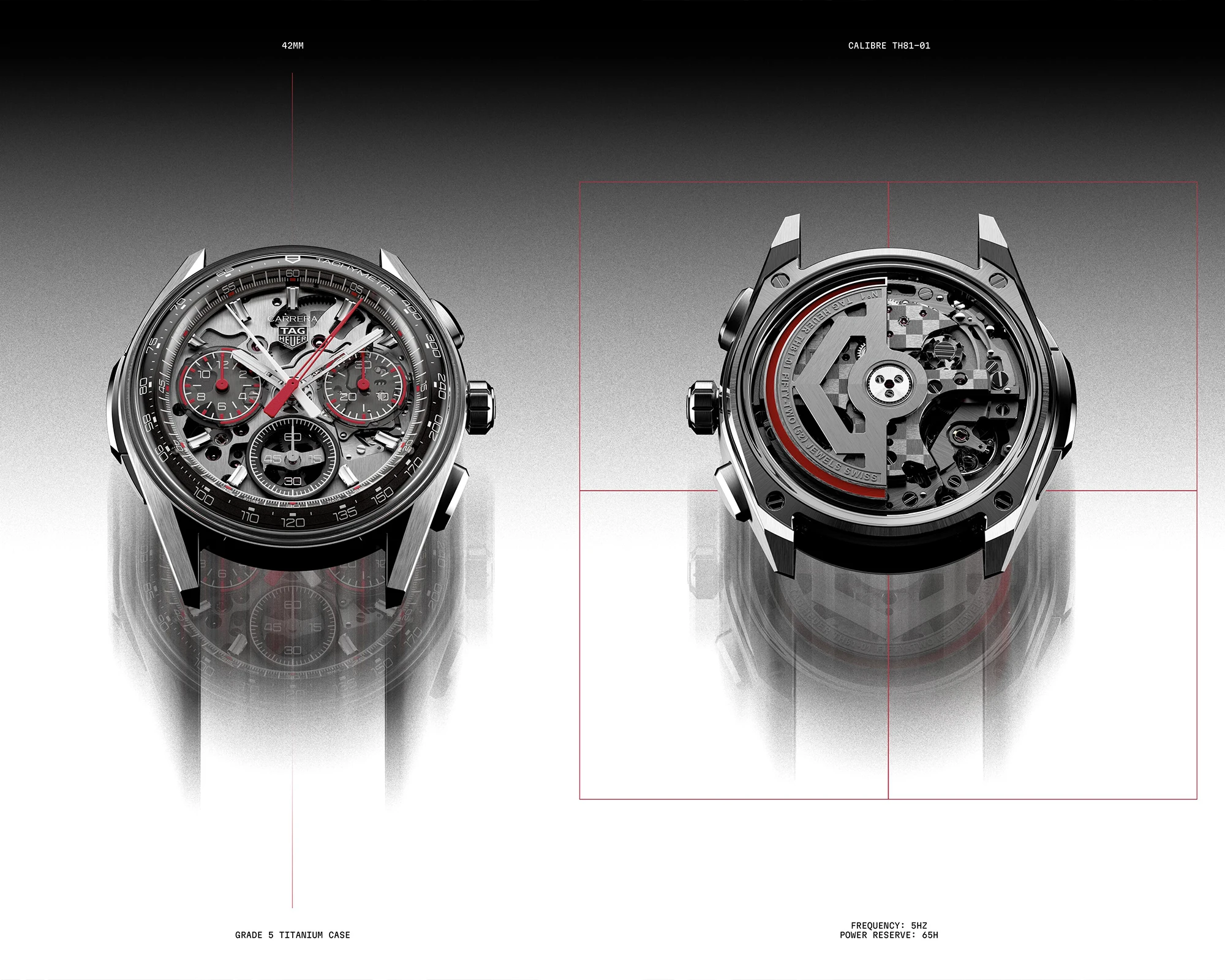
The power reserve varies depending on the selected function: with the chronograph disengaged, it offers 65 hours of autonomy, while activating the chronograph reduces this to 55 hours. The model is scheduled to become available for the first time in June 2026 and is priced at CHF 110,000.