Inhorgenta 2026 will offer exciting new mechanical innovations and a Swisswatches Magazine Talk with international watch experts on new collector trends

Independent watchmakers have been gaining increasing prominence within the world of fine watchmaking. The particular appeal of their creations lies in the fact that, unlike those working under the constraints of a corporate parent group, independent horologists are largely free to determine the design, the amount of time invested, and the level of craftsmanship that goes into each piece. One watchmaker in whom this philosophy of devotion to detail and hands-on craftsmanship is especially evident is François-Paul Journe. Today, he is regarded as one of the defining figures of contemporary haute horlogerie and ranks among the most awarded watchmakers at the prestigious Grand Prix d’Horlogerie de Genève, often referred to as the “Oscars of Watchmaking.” His timepieces are produced in a converted former gas-lamp factory on Geneva’s Rue de l’Arquebuse, where, surrounded by a carefully selected team of highly skilled specialists, he conceives and develops innovative mechanical solutions. Another distinctive feature of these rare creations lies in their method of manufacture: each calibre is overseen by a single watchmaker from start to finish.

In this article, we examine the most expensive F.P.Journe watches ever sold at auction, exploring their individual origins in detail and analysing the factors that have led to their sometimes extraordinary prices. This article is part of our series “The Most Expensive Wristwatches of All Time”, in which we have previously explored wristwatches from brands such as Richard Mille, Patek Philippe and Rolex.
François-Paul Journe founded his eponymous brand in 1999 under the motto “Invenit et Fecit” — Latin for “invented and made” — and introduced his first model with the Tourbillon Souverain Remontoire d’Égalité, known simply as the “T”. In 2003, he developed this creation further with the “TN” (Tourbillon Nouveau), officially designated the Tourbillon Souverain Remontoire d’Égalité avec Seconde Morte. The seconde morte, or “deadbeat seconds”, is a complication in which the seconds hand appears to pause and advance precisely once per second, while the escapement continues to operate smoothly and continuously in the background. Fitted with an 18-carat pink-gold movement and cased either in platinum or pink gold, the 40-millimetre Tourbillon Souverain was produced until 2018.
Credit © Phillips
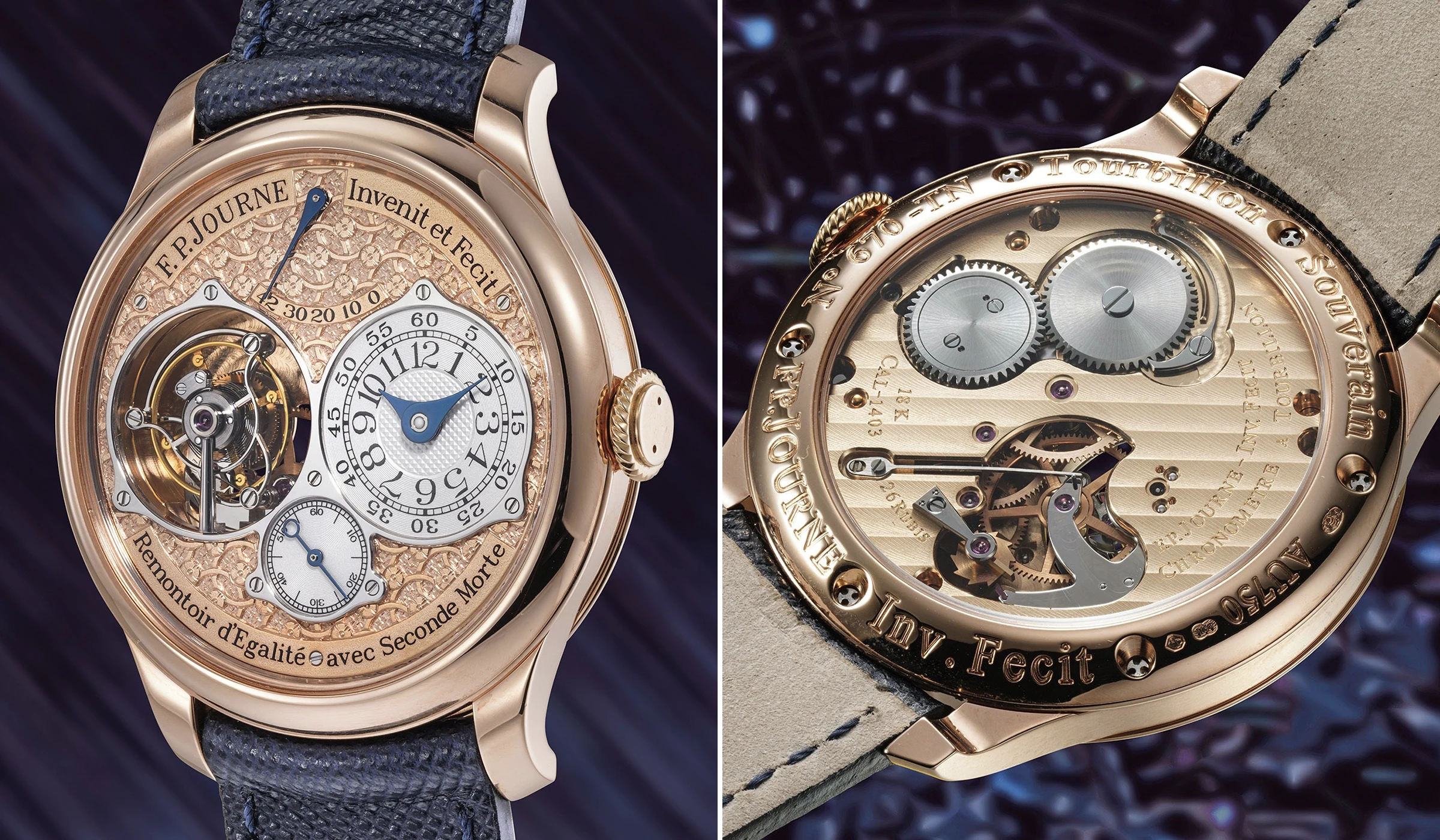
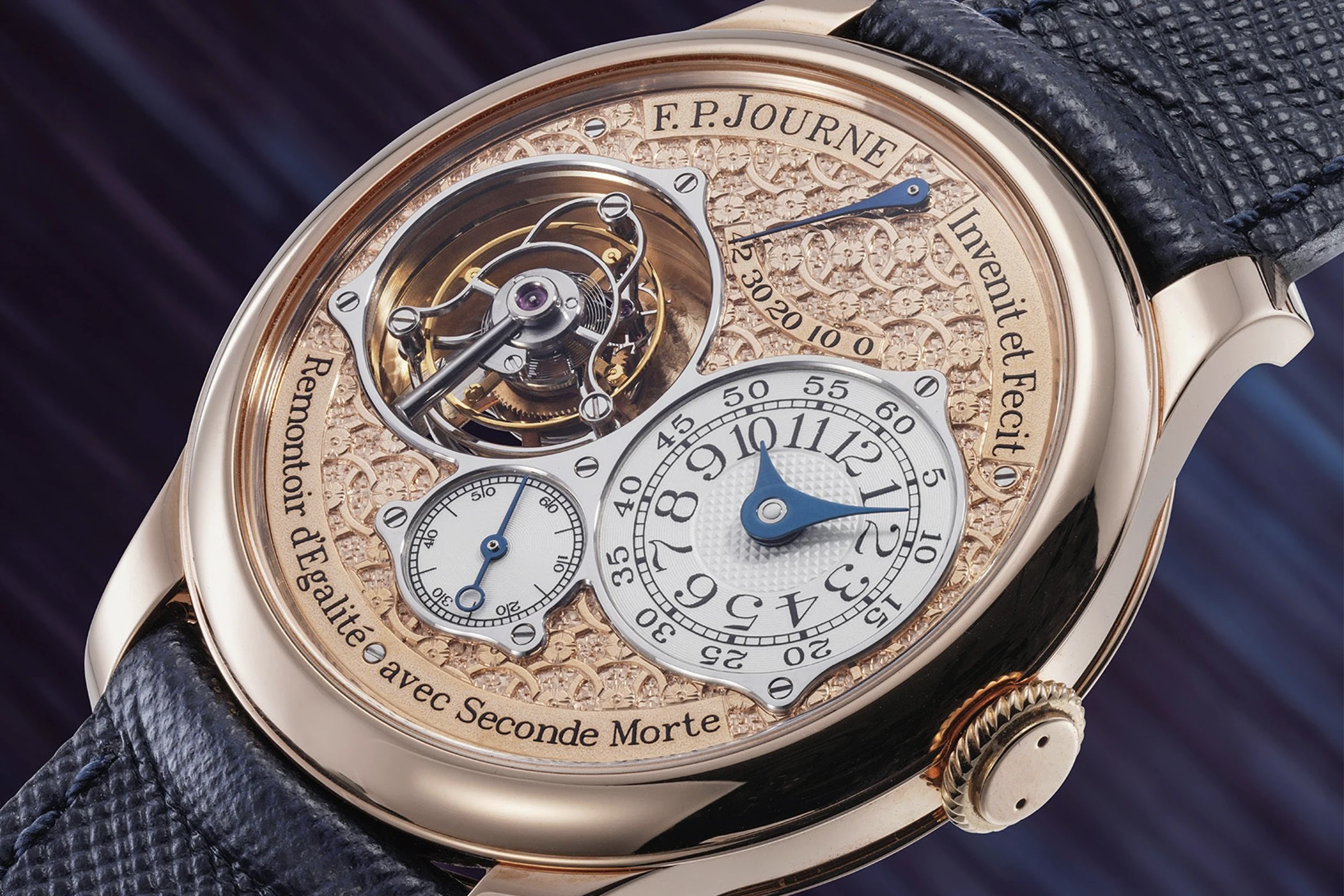
Among the visually most exceptional and rare versions of the Tourbillon Souverain Remontoire d’Égalité avec Seconde Morte is number 15 on our list of the most expensive F.P.Journe watches ever sold at auction: the Tourbillon Souverain “Régence Circulaire”. Launched as a boutique edition with a pink-gold case and a matching pink-gold dial, this model features an elaborately hand-engraved dial whose geometric motifs are inspired by the French Régence period of the early 18th century. Completing a single dial required a full two working days by a Geneva-based artisan.
Credit © Phillips
As the first example with a pink-gold case and pink-gold dial ever to be offered in an international auction setting, the watch achieved a total price, including buyer’s premium, of €1,817,738 at the Phillips Watches: Decade One (2015–2025) auction in 2025.
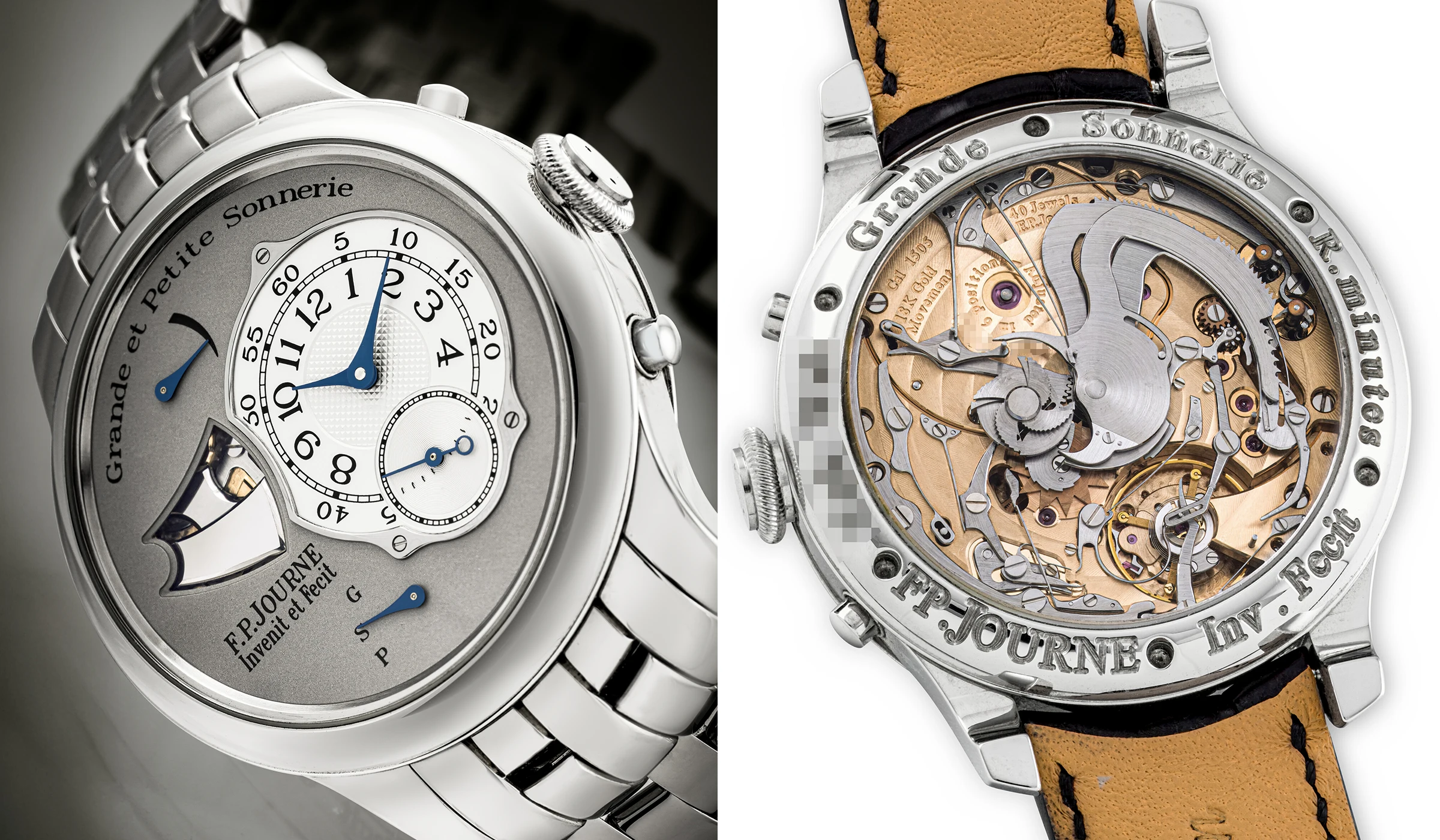
The Grande and Petite Sonnerie Minute Repeater Souveraine by F.P.Journe, housed in a stainless-steel case, is a timepiece whose realisation lies within the reach of only a very small number of watchmakers worldwide. Indeed, the complexity of this complication is such that the first successfully executed grande and petite sonnerie wristwatch was not achieved until 1992, when it was created by Philippe Dufour. Produced between 2006 and 2018, almost all examples of the F.P.Journe Grande et Petite Sonnerie Minute Repeater Souveraine were made in stainless steel; only one or two pieces were executed in pink gold with special dials. Production was limited to just four watches per year, with fewer than 60 examples made in total.
Credit © Christies
The hand-wound gold calibre 1505 of the Sonnerie Souveraine was also the first movement by F.P.Journe to be manufactured entirely in its own Geneva workshops. A single watchmaker requires more than three months to assemble the 582 individual components. Both the case and the dial are likewise produced entirely in-house. The minute repeater is activated via the pusher at two o’clock, while the selection between grande sonnerie, petite sonnerie, or silent mode is made using the pusher at four o’clock, in conjunction with the corresponding indicator sector on the dial.
The watch was sold at the Christie’s Important Watches: Featuring “The Chronicle” and “The Generations” Collections auction in 2025 for a total price, including buyer’s premium, equivalent to €1,969,939.
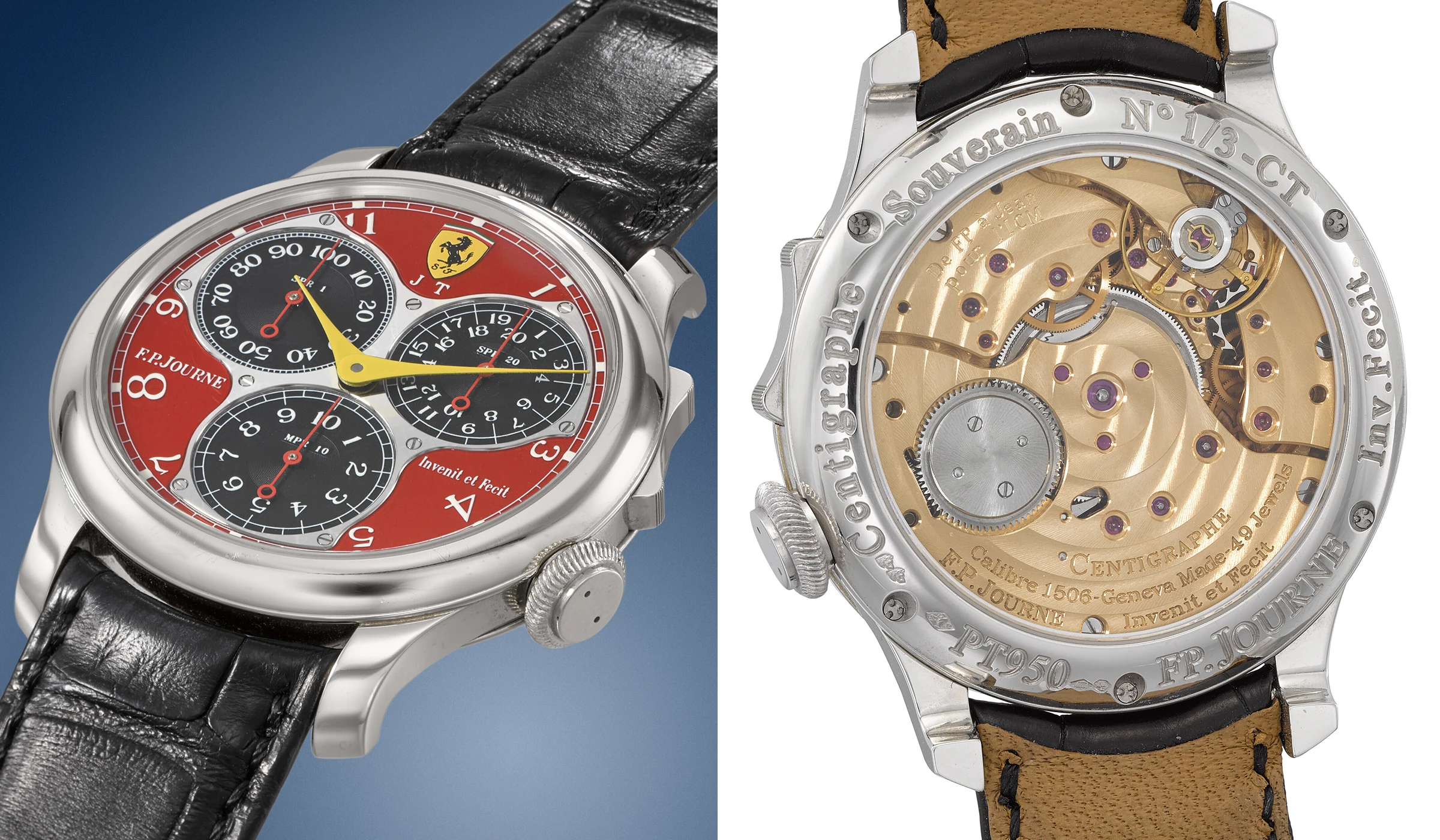
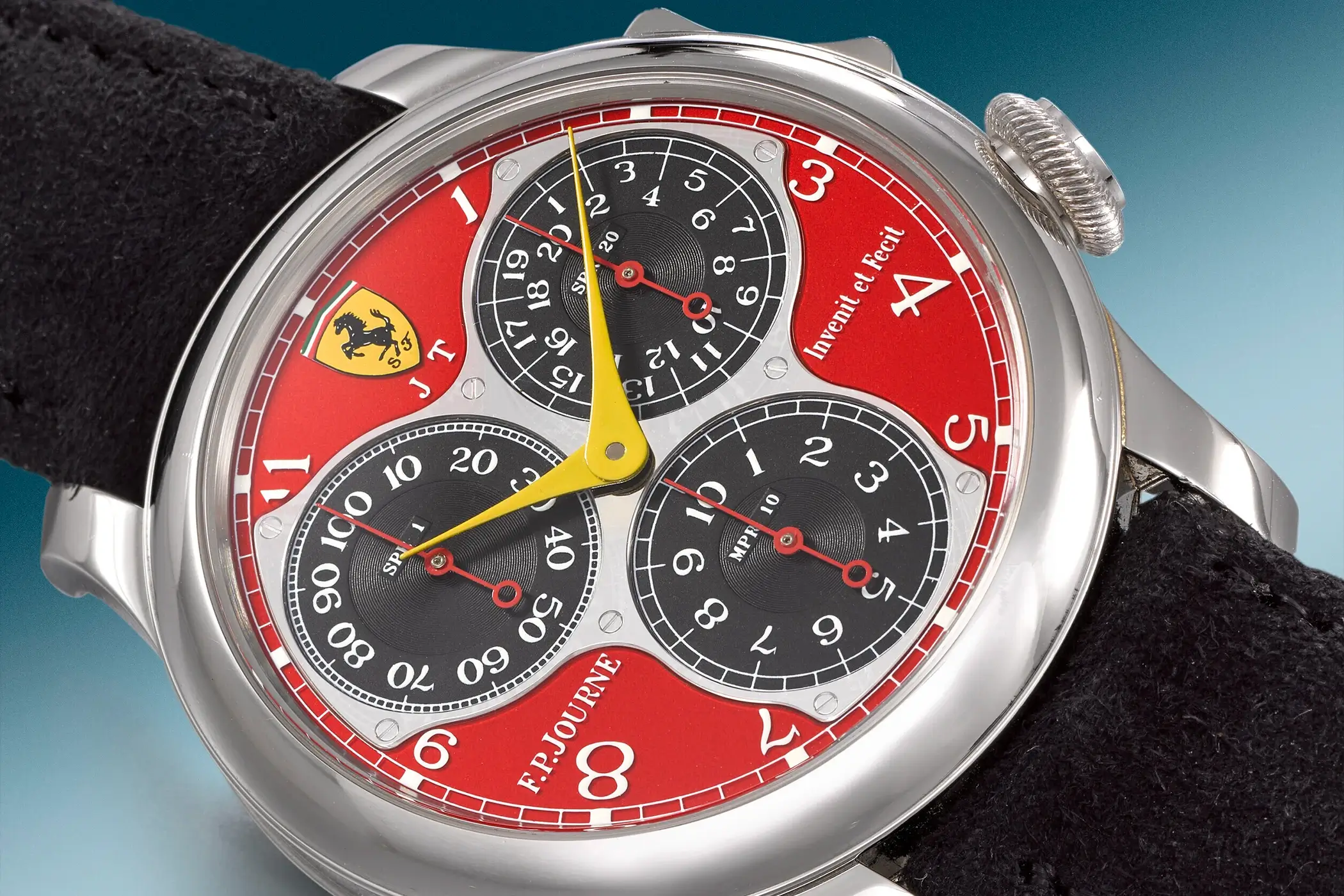
Produced between 2008 and 2018, the Centigraphe Souverain emerged from an encounter between François-Paul Journe and the collector Jean Todt within the circle of the ICM Foundation. The objective was to create the ideal chronograph for motorsport, and the result was a hand-wound movement that, at the time of its launch, was the first of its kind capable of measuring intervals ranging from one hundredth of a second up to ten minutes. These capabilities are expressed on the dial as follows: the hand of the sub-dial at two o’clock completes one revolution every 20 seconds, while the hand of the register at six o’clock requires ten minutes for a full rotation. The hand on the dial at ten o’clock, by contrast, circles its scale in just one second, which is divided into hundredths. The movement’s barrel is equipped with a constant-force mechanism that ensures the driving torque does not diminish during winding. Without use of the chronograph function, the watch offers a power reserve of at least 100 hours; with the chronograph running continuously, 24 hours remain available.
Credit © Christies
Number 13 on our list of the most expensive F.P.Journe watches ever sold at auction is the first timepiece from a small series of three, with the first made for Jean Todt, the second for Michael Schumacher, and the third for F.P.Journe himself. The example described here is distinguished by its Ferrari-red dial, bearing a Ferrari emblem at twelve o’clock as well as the initials “JT”.
Credit © Christies
The watch achieved a total price, including buyer’s premium, of €1,985,267 at the Christie’s Legendary and Unique Watches auction in 2022.
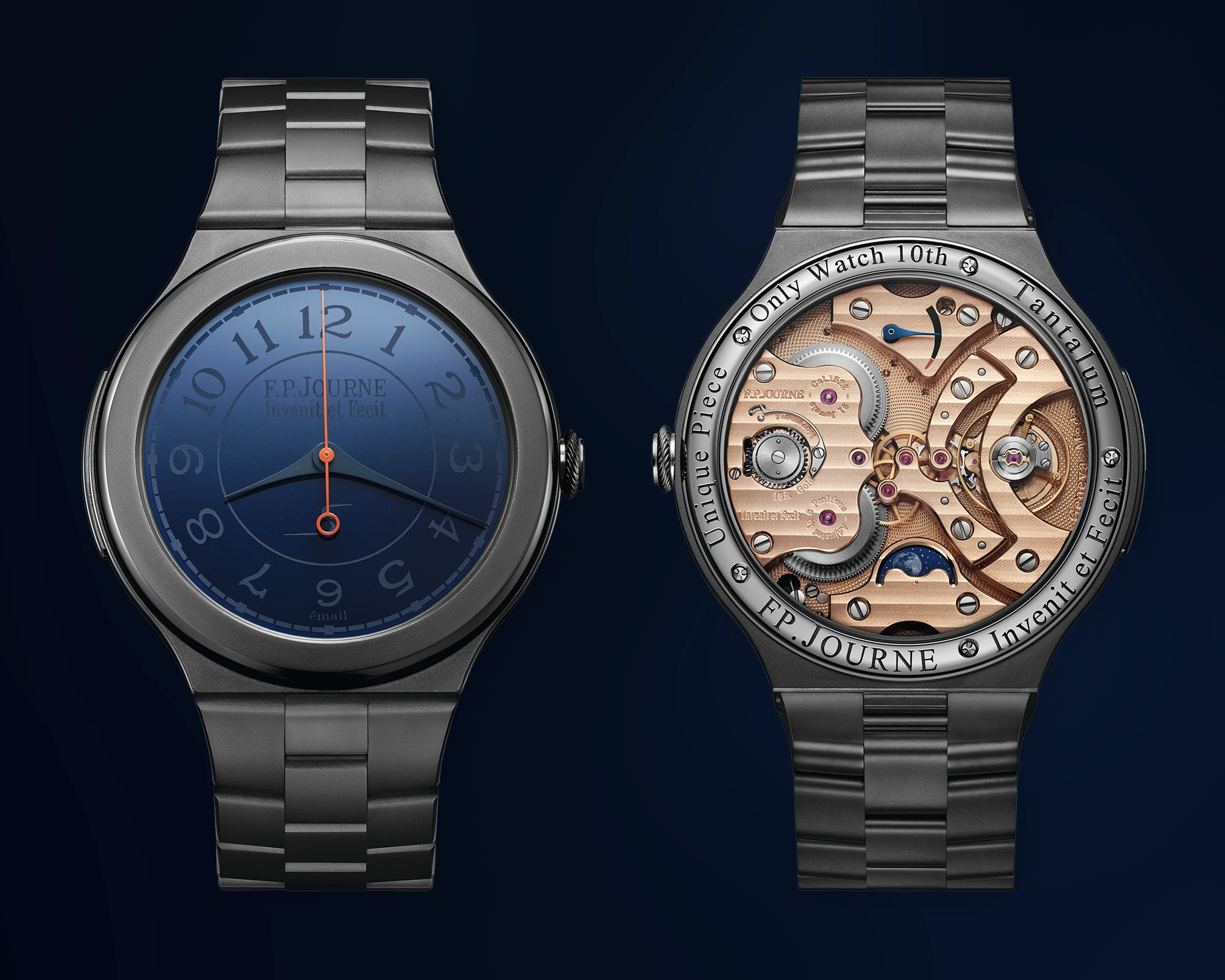
Ordinarily, the last thing a watch owner would wish for is that an observer is unable to recognise the piece of fascinating craftsmanship on their wrist. With the Chronomètre Furtif, however, F.P.Journe achieves precisely that. Crafted entirely from tantalum — with both case and bracelet produced in the in-house workshops of Les Boîtiers de Genève — the timepiece owes its name to the deliberate restraint of its indications. The deep blue, fired enamel dial appears almost uniform from many angles, as numerals and scales are rendered tone-on-tone and reveal themselves only under the right incidence of light; the sole deliberate accent is provided by the orange seconds hand. The power-reserve and moon-phase displays are visible only through the sapphire crystal on the caseback and form part of the then-new hand-wound calibre 1522, which, for the first time in the history of F.P.Journe, incorporated a central seconds display.
Credit © Christies
The Furtif is thus a watch that eludes the fleeting glance, and at the Only Watch auction in 2024 it achieved a total price, including buyer’s premium, of €2,048,233.
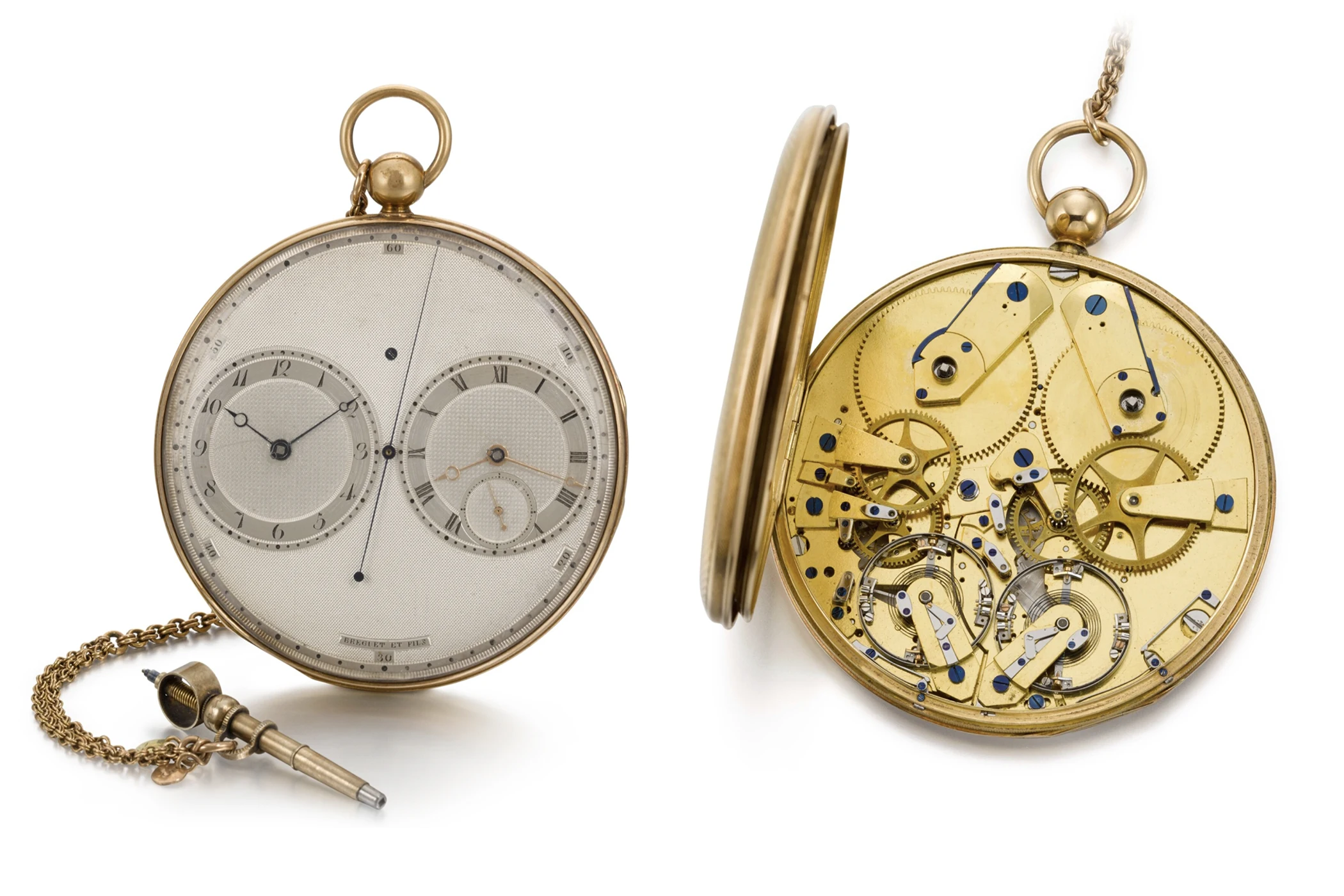
The story behind the development of the Chronomètre à Résonance, the second wristwatch model ever produced by F.P.Journe, is as fascinating as it is complex. After Journe’s initial exposure to watchmaking through the horological training programme run by his cousin, he joined the Paris restoration workshop of his uncle, Michel Journe. There, he studied historical timepieces by makers such as Breguet and Janvier, whose work was instrumental in advancing the so-called principle of resonance in horology — a concept that would later play a defining role in Journe’s own work. This natural physical phenomenon, first described in 1665 by Christiaan Huygens, refers to the observation that two pendulum clocks suspended from the same beam will gradually begin to oscillate in perfect synchronisation. Building on this principle, the 18th-century French court clockmaker Antide Janvier and Abraham-Louis Breguet conducted further research, culminating, on the one hand, in Janvier’s double-pendulum clocks and, on the other, in Breguet’s resonance pocket-watch movement — a construction featuring two balances and two separate going trains mounted on a single plate — both of which served as key sources of inspiration for Journe’s Chronomètre à Résonance.
Credit © Sothebys
In 1983, after five years of work, Journe presented his first watch: a tourbillon pocket watch with a chronometer escapement. Just one year later, this was followed by his first resonance pocket watch. With this initial resonance timepiece, Journe succeeded in miniaturising the principle of Antide Janvier’s double-pendulum clocks to the format of a pocket-watch movement. The mechanism consists of two independent balances that alternately act as “exciter” and “resonator”, mutually stabilising one another and thereby compensating for rate deviations while achieving enhanced chronometric stability. This milestone laid the groundwork for Journe’s achievement 17 years later, when he succeeded in reducing the resonance principle once more — this time in the form of the Chronomètre à Résonance as a wristwatch. At the time of its introduction, the Chronomètre à Résonance was the world’s first wristwatch whose movement was conceived and realised from the outset on the basis of the resonance principle.
Credit © Phillips
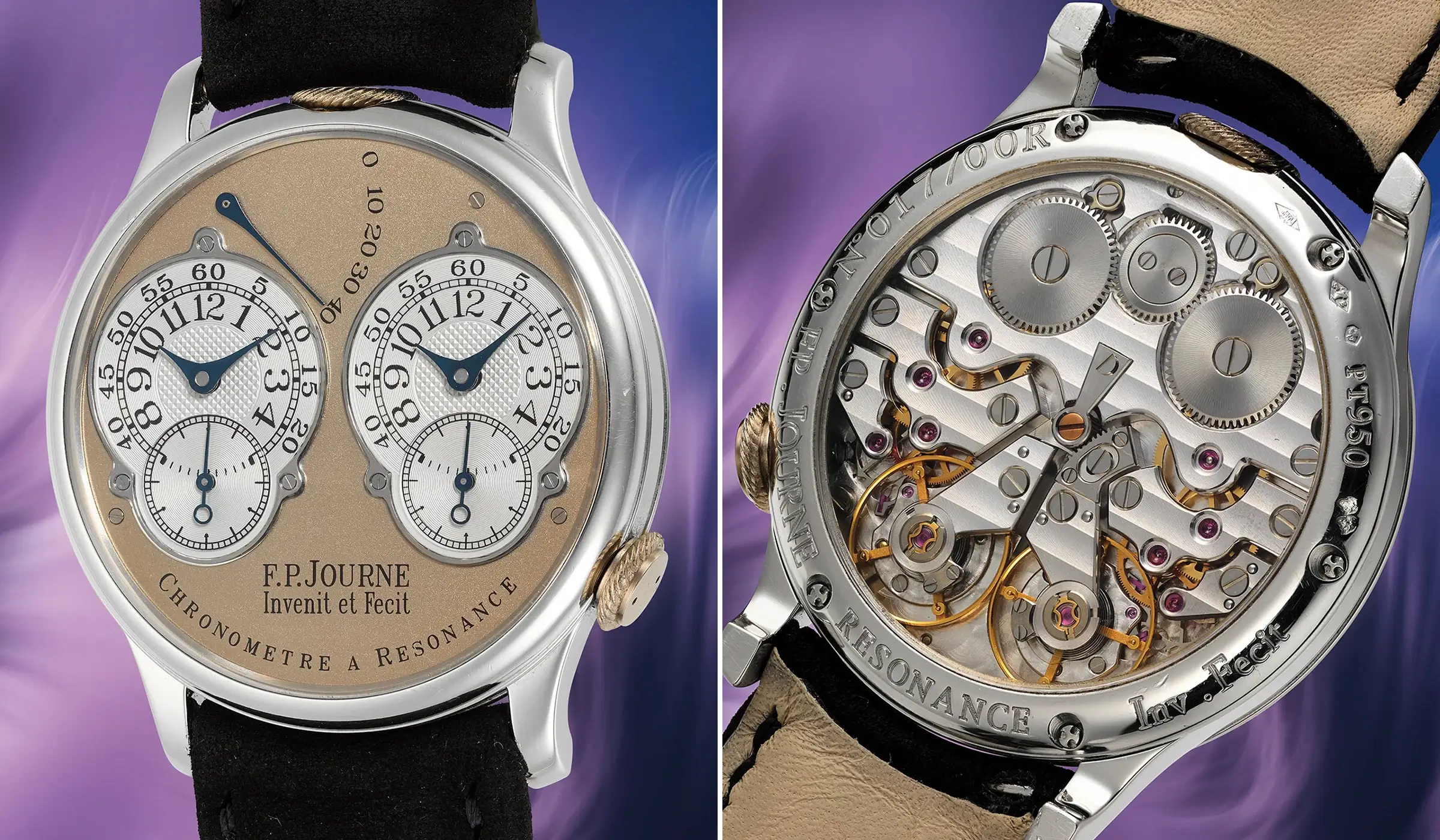
The Chronomètre à Résonance was officially unveiled in 2000, beginning with a series of twenty so-called “Souscription” watches, numbered from 1 to 20 and engraved with the designation 00R for the year 2000. These first twenty pieces took their name from the fact that they were pre-ordered as part of the Souscription series — a concept whereby buyers, through an advance payment, provided François-Paul Journe with the financial means required to manufacture and deliver their watches. The twenty Chronomètre à Résonance watches were initially offered to those twenty clients who had previously acquired Journe’s inaugural Tourbillon Souverain through a Souscription. Contrary to earlier assumptions, however, the delivery of the Souscription Chronomètre à Résonance watches did not necessarily follow numerical order, even though many collectors ordered matching pairs of Tourbillon and Résonance.
At number 11 on our list of the most expensive F.P.Journe watches ever sold at auction is No. 017/00R, whose appeal is further enhanced by the fact that its authenticity as a genuine Souscription watch is explicitly confirmed in the accompanying certificate of authenticity, personally signed by François-Paul Journe. The watch achieved a total price, including buyer’s premium, of €2,441,930 at the Phillips New York Watch Auction: XIII in 2025.
As is so often the case, a turning point in F.P.Journe’s career also marked a new beginning. After Journe was expelled from school, his parents enrolled him in a watchmaking training programme run by his cousin. Recognised early on for his exceptional aptitude, he continued his education in Paris and, after graduating from the École d’Horlogerie de Paris, joined the restoration workshop of his uncle. There, he was granted the rare opportunity to restore some of the most important timepieces in the history of watchmaking. In 1985, Journe founded his first independent workshop on Rue de Verneuil in Paris, where he produced bespoke pocket watches for collectors and developed movements for other brands. Inspired by tourbillon watches — his very first pocket watch was already fitted with a tourbillon — he ultimately created his first wristwatch in 1991: the “prototype” of the Tourbillon Souverain à Remontoir d’Égalité.
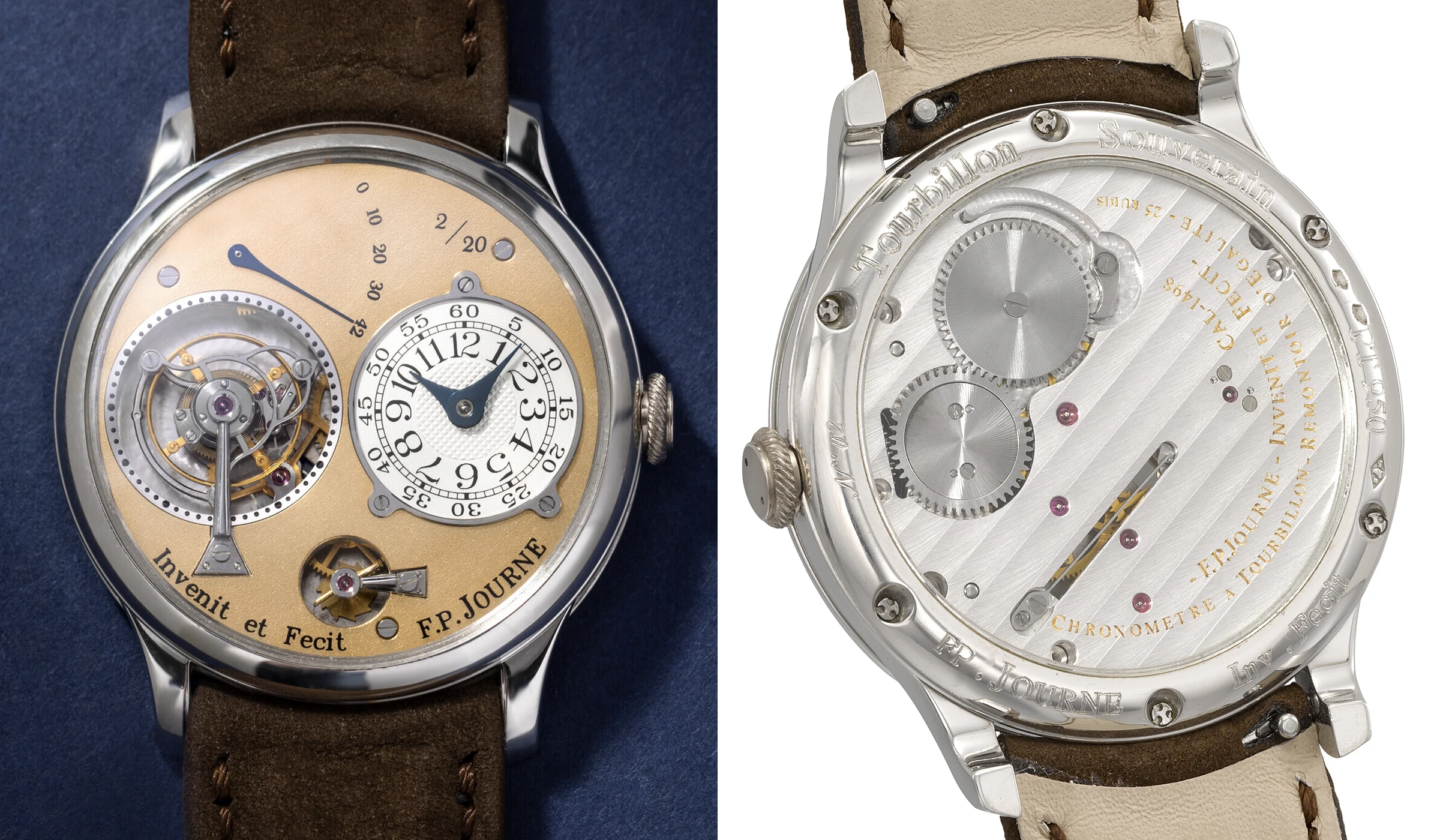
Credit © Christies
With the various components of the Tourbillon Souverain à Remontoir d’Égalité, Journe paid tribute to historic watchmakers while adapting their spirit through targeted refinements into a more modern form. At its heart lies the tourbillon invented in 1801 by Abraham-Louis Breguet, whose cage design in the Souverain is inspired by Ernest Guinand. With the Tourbillon Souverain, Journe was the first to combine a tourbillon in a wristwatch with a remontoir system — a constant-force mechanism employed by John Harrison in his marine timekeeper H2, produced between 1737 and 1739, which delivers a consistent amount of energy regardless of the state of wind of the mainspring. The result is improved rate accuracy and a more stable balance amplitude.
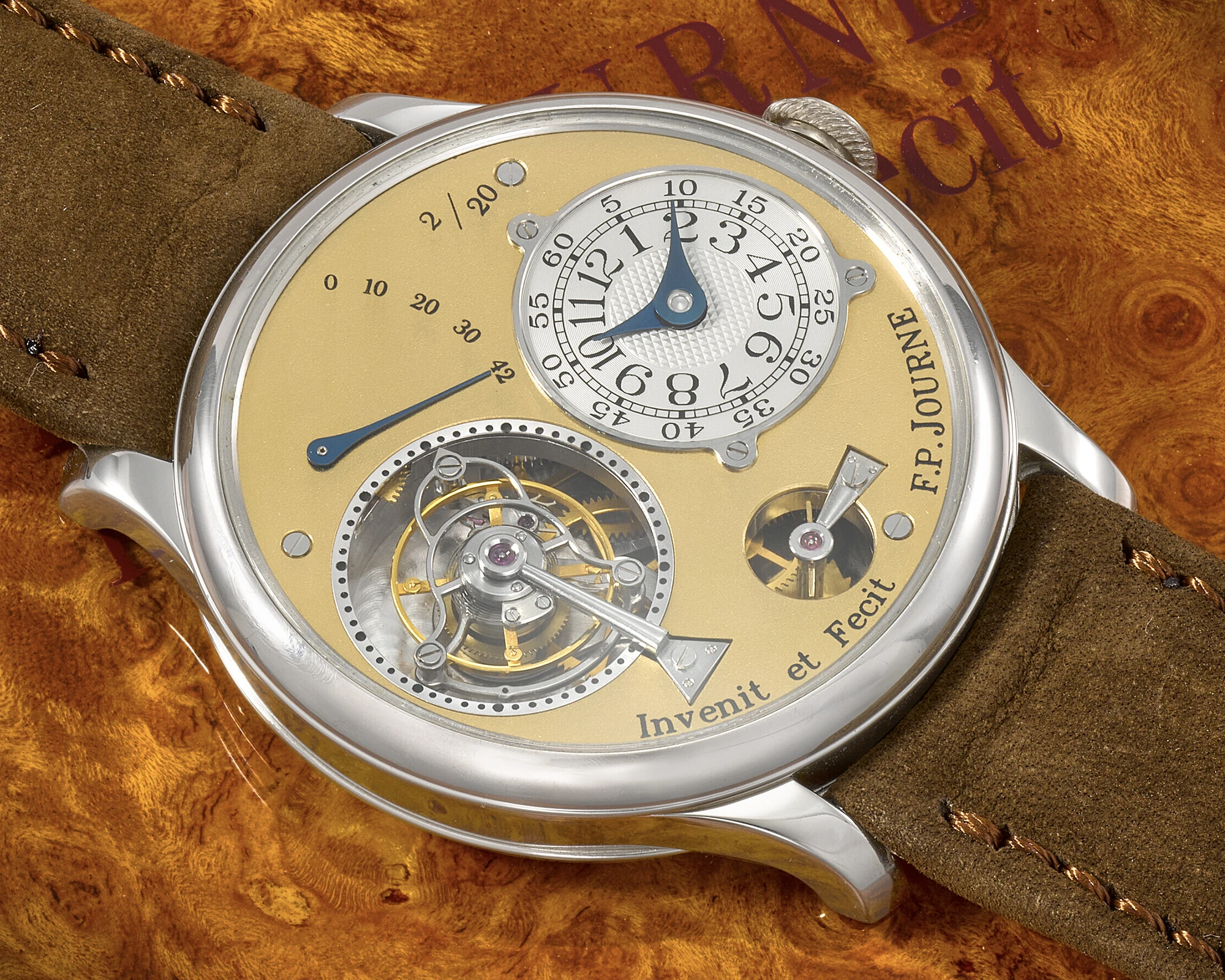
Credit © Christies
In the mid-1990s, Journe decided to move away from one-off commissions and establish his own brand under his name. He left Paris for Geneva, where he saw better conditions for serial production, and opened his first atelier on Rue des Maraîchers. The greatest challenge, however, was financing the launch of the brand and the development of its first model. On the advice of a friend, Journe turned to the Souscription system practised by Abraham-Louis Breguet, whereby clients paid a 50 per cent deposit on a watch yet to be produced in return for a preferential price. This Souscription model of the Tourbillon Souverain à Remontoir d’Égalité enabled Journe to finance workshops, tools and components — and it leads directly to number 10 on our list of the most expensive F.P.Journe watches ever sold at auction. The example in question is number 2 of a total series of 20 Souscription watches, whose movements are made of rhodium-plated brass.
The watch achieved a total price, including buyer’s premium, of €2,779,549 at Christie’s The Art of F. P. Journe auction in 2023.
Number 9 on our list of the most expensive F.P.Journe watches ever sold at auction is the result of extensive personalisation by its former owner, the former Formula One team principal Jean Todt. This timepiece is a unique example of the Grande et Petite Sonnerie Minute Repeater Souveraine produced between 2006 and 2018, a model of which — with the exception of one or two pieces in pink gold with special dials — almost all examples were executed in stainless steel. The level of personalisation applied to the watch described here extends from the dial to the case and caseback, and even to the movement itself, making this Grande et Petite Sonnerie Minute Repeater Souveraine a true one-off within the Sonnerie Souveraine collection.
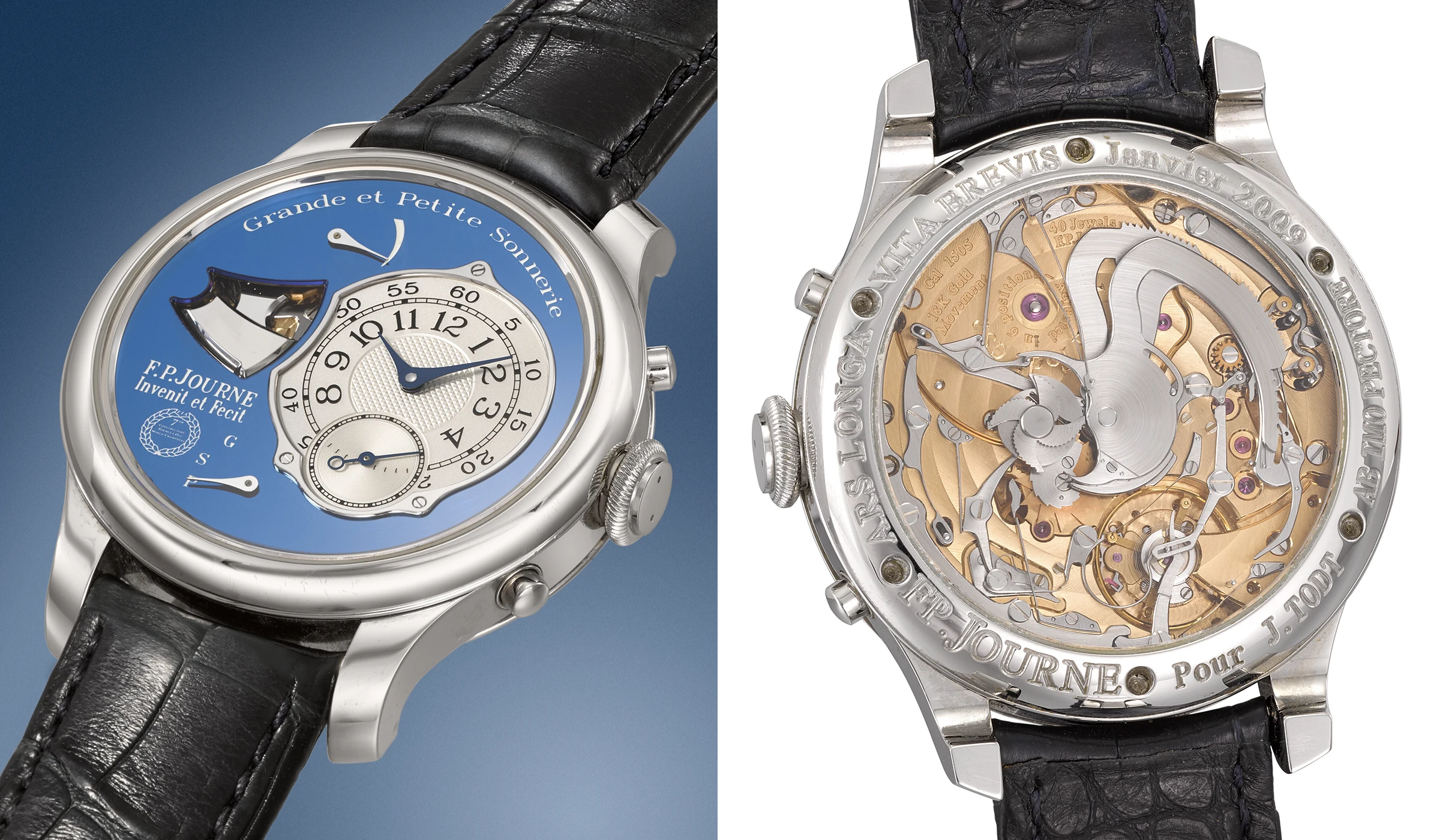
Credit © Christies
At the forefront is the collection-unique, mirror-polished petrol-blue dial, which is additionally adorned with the logo commemorating the seventh FIA Formula One Constructors’ World Championship title. The caseback bears, alongside the name of the original owner, the Latin inscription “ARS LONGA, VITA BREVIS”, taken from the opening lines of the Aphorismi by the ancient Greek physician Hippocrates and commonly understood to mean “art is long, life is short”. Inside the watch is the hand-wound gold calibre 1505 of the Sonnerie Souveraine, likewise engraved with the name of the first owner and notable as the first movement by F.P.Journe to be manufactured entirely in the brand’s own Geneva workshops. The movement combines a grande and petite sonnerie with a minute repeater, enabling both the automatic acoustic striking of the hours and quarter-hours — depending on the selected operating mode — and a minute repeater on demand.
The watch was sold at the Christie’s Legendary and Unique Watches auction in 2022 for a total price, including buyer’s premium, of €3,071,431.
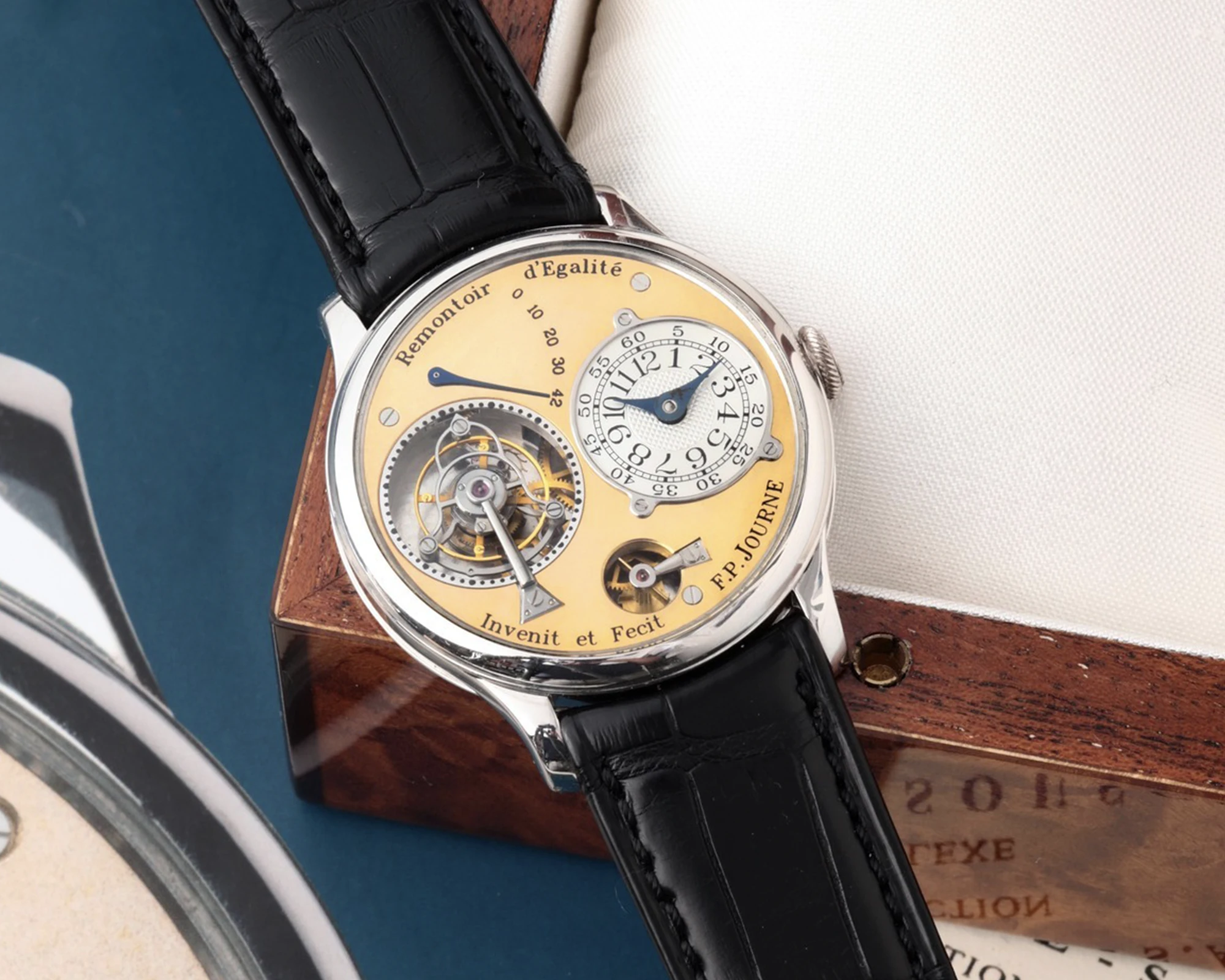
The early Tourbillon Souverain à Remontoir d’Égalité models fitted with brass movements — among which number 8 on our list of the most expensive F.P.Journe watches ever sold at auction is counted — can be divided into four clearly distinguishable series. Foremost among these is the first series, comprising the so-called Souscription models of 1999. Initially, twenty numbered examples in platinum were produced and sold directly by François-Paul Journe himself. This group was expanded later that same year by a second Souscription phase consisting of just two unique pieces: one in pink gold and one in platinum — the watch discussed here. Both featured the inscription Remontoir d’Égalité on the dial and were likewise sold personally by François-Paul Journe.
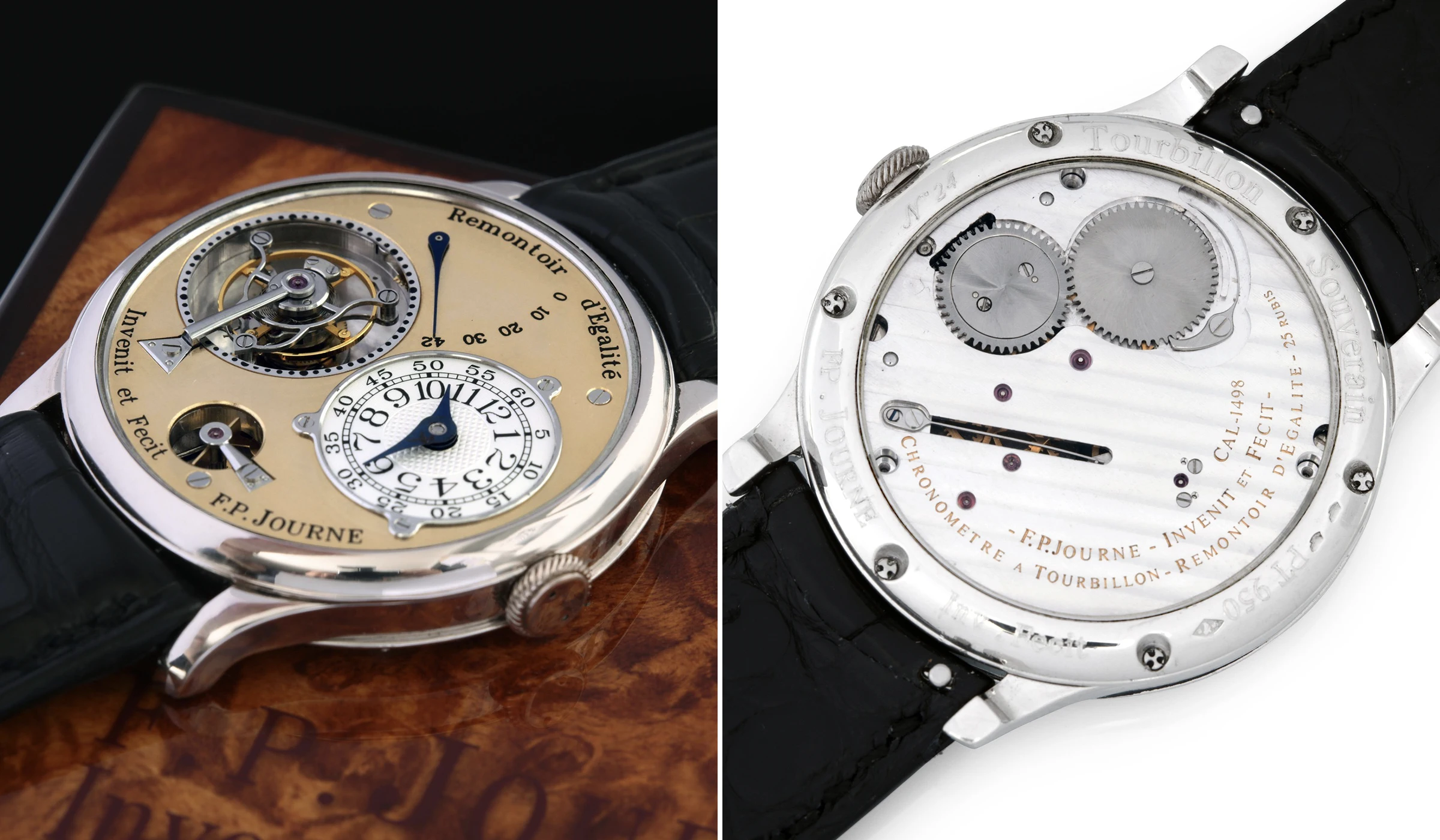
Credit © Antiquorum
This was followed by the second series, also produced in 1999, which comprised an estimated 17 examples in platinum. This series is characterised by a rounded remontoir bridge and the additional Remontoir d’Égalité inscription on the dial. These watches were sold for the first time through authorised retailers. The third series, produced between 1999 and 2001 and estimated at around 60 examples, was offered in both platinum and pink gold and can be identified by its flat remontoir bridge and the larger numerals used for the power-reserve display. Distribution of this third series likewise took place via authorised dealers. The fourth series, manufactured from 2001 until approximately 2003, represents the largest group numerically, with an estimated total of around 320 examples. It, too, was available in both platinum and pink gold and differs from the preceding series through the use of smaller screws on the dial. As with the earlier series, sales were conducted exclusively through authorised retailers.
Credit © Antiquorum
Number 8 on our list combines several distinctive features that help to explain its high auction result. The Tourbillon Souverain à Remontoir d’Égalité bearing case number 24 is not only a unique piece housed in a 38 mm platinum case; it is also the final watch ever sold directly by François-Paul Journe himself. In addition, the watch displays several noteworthy aesthetic details. The inscriptions on the caseback were hand-engraved and are noticeably shallower than the deeper laser engravings applied to later examples. The yellow-gold dial is comparable to those found on hand-finished versions of the Tourbillon Souverain à Remontoir d’Égalité — such as examples numbered 13 and 15 — and, finally, the small-seconds indications arranged around the tourbillon cage are larger in scale and hand-finished.
The watch was sold at Antiquorum in 2024, achieving a total price, including buyer’s premium, of €3,121,290.
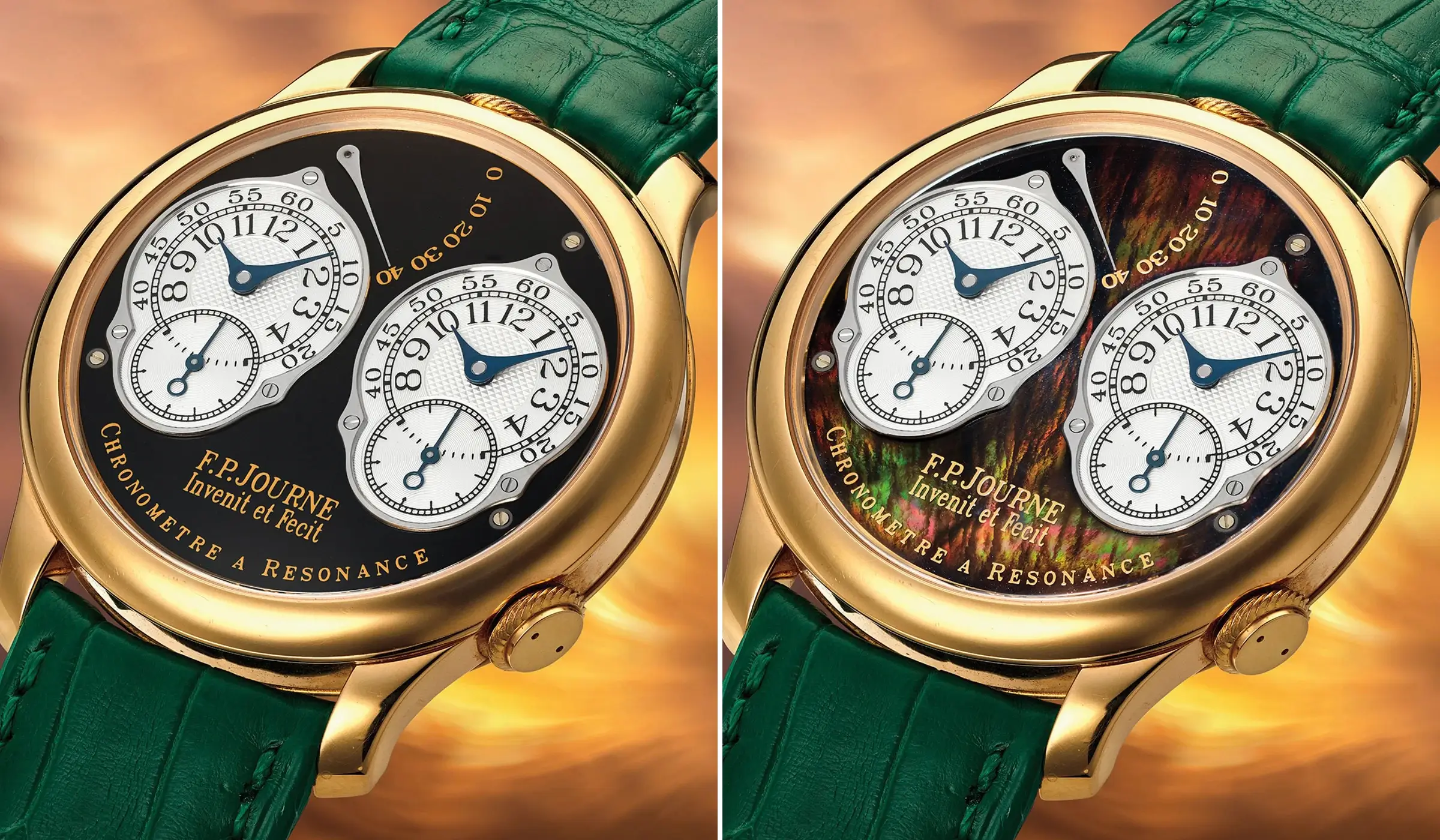
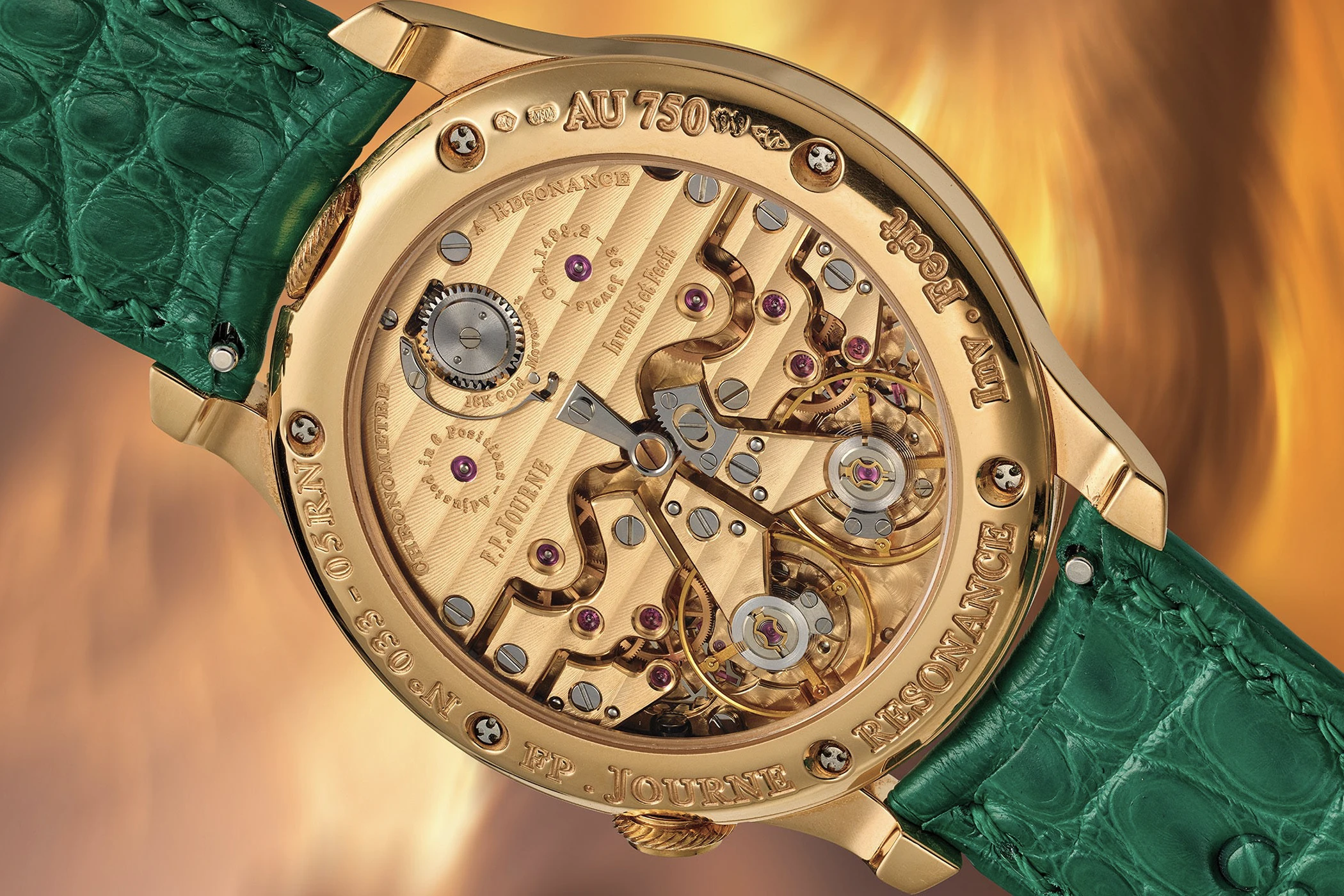
The significance of number 7 on our list of the most expensive F.P.Journe timepieces ever sold at auction lies in its role as part of a limited series created to mark the 50th anniversary of the Singapore-based specialist retailer Sincere Fine Watches. This commemorative series comprised ten examples of the Chronomètre à Résonance in 18-carat pink gold (RN), five Tourbillon Souverain (TN), ten Calendrier (Q), and five Octa Divine (D). A single factor, above all others, played a decisive role in achieving the exceptional total price, including buyer’s premium, of €3,169,441: the 40 mm pink-gold case serves as the setting for a dial crafted from black mother-of-pearl. At first glance, the dial appears uniformly black; when the watch is tilted towards a light source, however, the structure of the black mother-of-pearl reveals itself, allowing its iridescent grain to emerge.
Credit © Phillips
Produced around 2006, the Chronomètre à Résonance “Sincere Fine Watches, Black Mother-of-Pearl” is further distinguished by the fact that the combination of a pink-gold case with a black dial did not enter regular F.P.Journe production until four years later.
At the Phillips New York Watch Auction: XIII in 2025, the watch achieved a total price, including buyer’s premium, of €3,169,441.
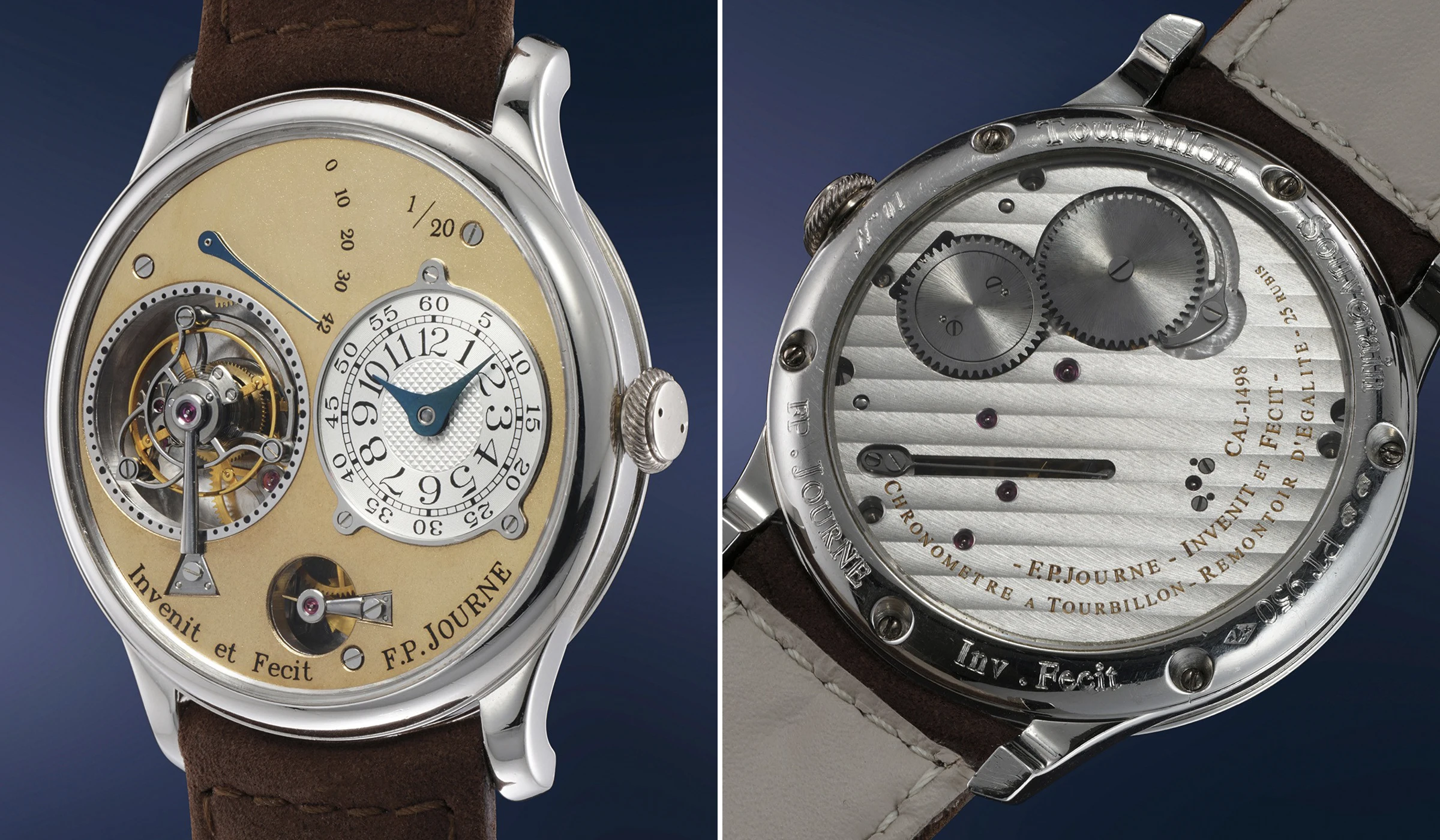
Number 6 on our list of the most expensive F.P.Journe wristwatches ever sold at auction is the first ordered example of the Tourbillon Souverain à Remontoir d’Égalité Souscription series, bearing the designation 01/20 on the dial. It is also the first serially produced wristwatch by F.P.Journe — even if the series itself, comprising just 20 pieces, was admittedly very small. Notably, both Souscription No. 1 and No. 2 of the Tourbillon Souverain à Remontoir d’Égalité Souscription series were acquired by the same buyer.
Credit © Phillips
The watch was sold at the Phillips Geneva Watch Auction: XIV in 2021 for a total price, including buyer’s premium, of €3,353,866.
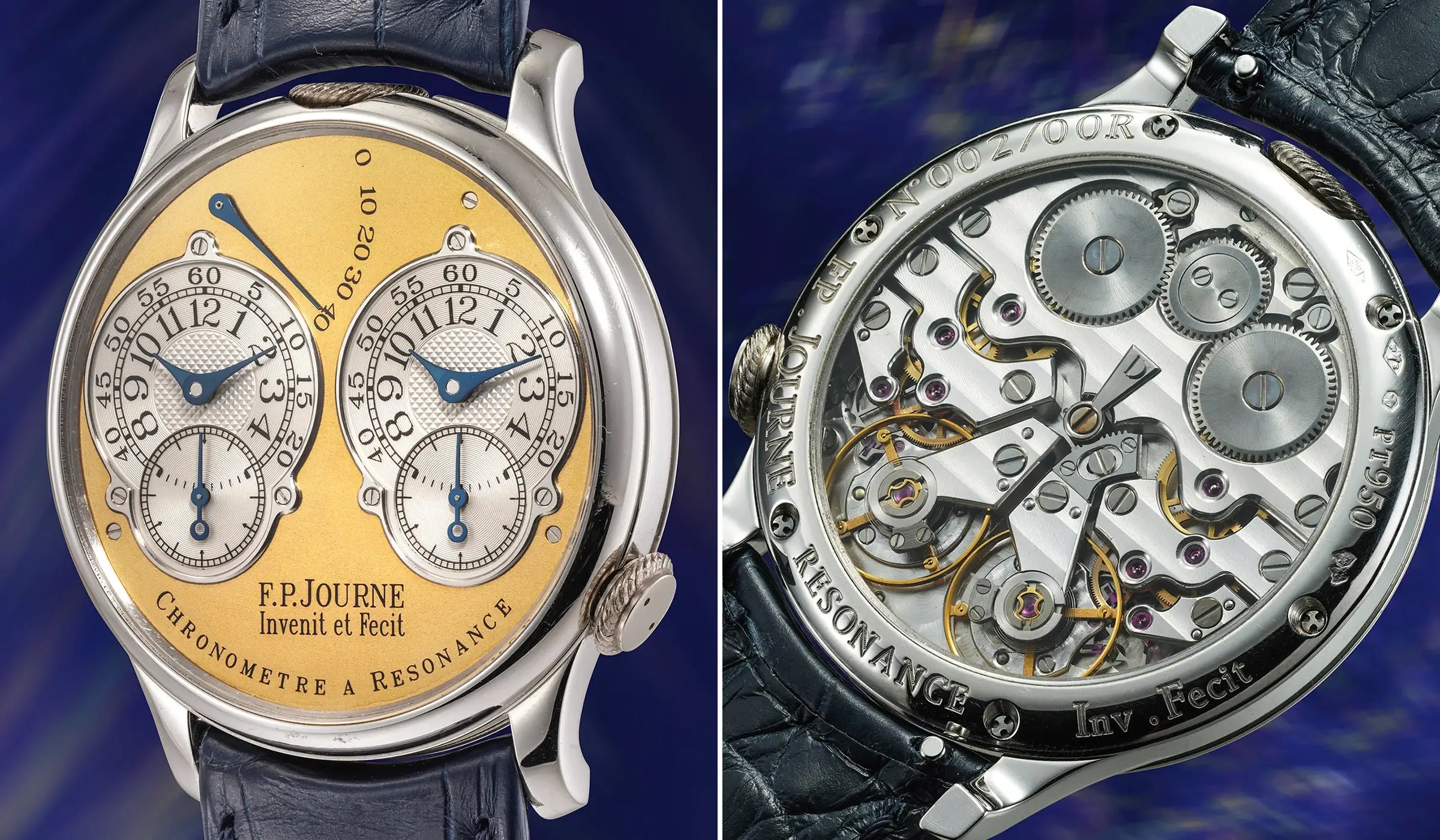
The early examples of the Chronomètre à Résonance can be divided into three distinct groups: first, the pre-production watches bearing the suffix 99R and serial numbers 021–03X; second, the pre-Souscription watches with the suffix 00R and serial numbers ranging from 03X to 05X; and third, the Souscription watches, which also carry the 00R suffix but are numbered from 1 to 20. Number 5 on our list of the most expensive F.P.Journe watches ever sold at auction belongs to this latter Souscription category.
Credit © Phillips
The Chronomètre à Résonance Souscription watches were originally offered to the twenty clients who had previously acquired Journe’s first wristwatch model, the Tourbillon Souverain, thereby helping to finance the establishment of the brand. This special status is reflected not only in the numbering engraved on the caseback, but also in the /00R suffix, which denotes the year of production, 2000. The watch ranked number 5 on our list is the second Chronomètre à Résonance “Souscription” (No. 002/00R) and, at the same time, only the second Résonance Souscription example ever to appear on the auction market.
Owing to these exceptional circumstances, the timepiece achieved a total price, including buyer’s premium, of €3,571,075 at the Phillips Watches: Decade One (2015–2025) auction in 2025.
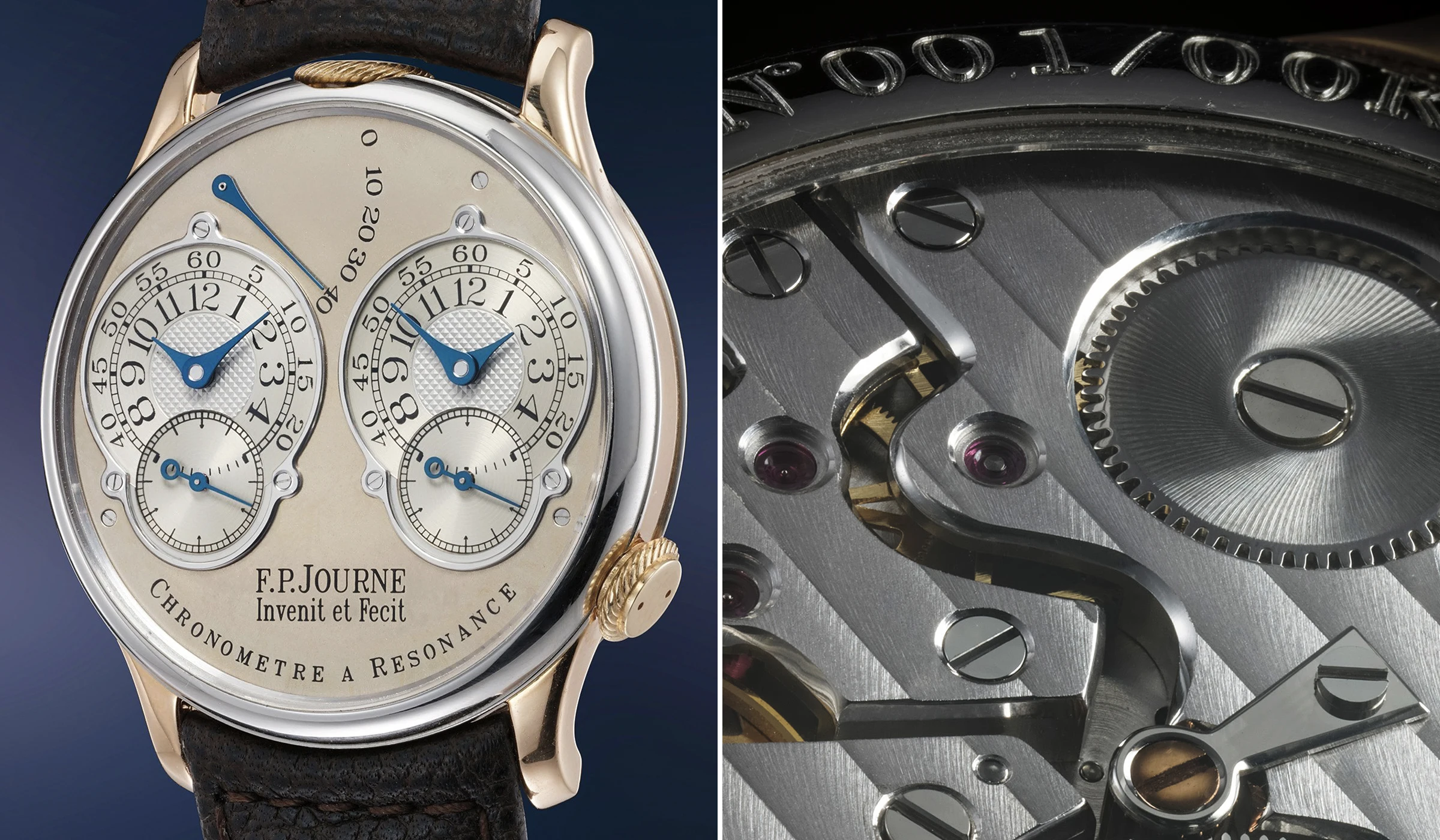
Following the principle of resonance, the F.P.Journe Chronomètre à Résonance is defined by its characteristic twin balances, which naturally synchronise — or oscillate in “resonance” with one another — thereby reducing the negative effects of wrist and body movement on rate accuracy. This dual construction is also reflected on the dial: the silvered dial features two separate, silver guilloché displays for hours and minutes, whose arrangement allows for the indication of two different time zones. Beneath them are two small seconds sub-dials. Below these twin seconds registers, the inscription “Invenit et Fecit” is engraved in classic F.P.Journe fashion — Latin for “invented and made” — a deliberate reference to the signature traditions of past centuries.
Credit © Phillips
At twelve o’clock sits a 40-hour power-reserve indicator, whose numerals are rendered in a finer typography than those found on later models. What makes number 4 on our list of the most expensive F.P.Journe watches ever sold at auction particularly remarkable, however, is its numbering and case configuration. Bearing the designation “001/00R”, it is the very first of the twenty Chronomètre à Résonance “Souscription” watches produced. Moreover, of the total twenty Souscription Chronomètre à Résonance watches made, only five feature a two-tone case combining platinum and pink gold, as seen on the example described here. In addition, the watch is one of just three two-tone Résonance models to be fitted with a silvered dial.
As a result of these factors, the Chronomètre à Résonance achieved a total price, including buyer’s premium, of €3,697,876 at the Phillips Geneva Watch Auction: XIV in 2021.
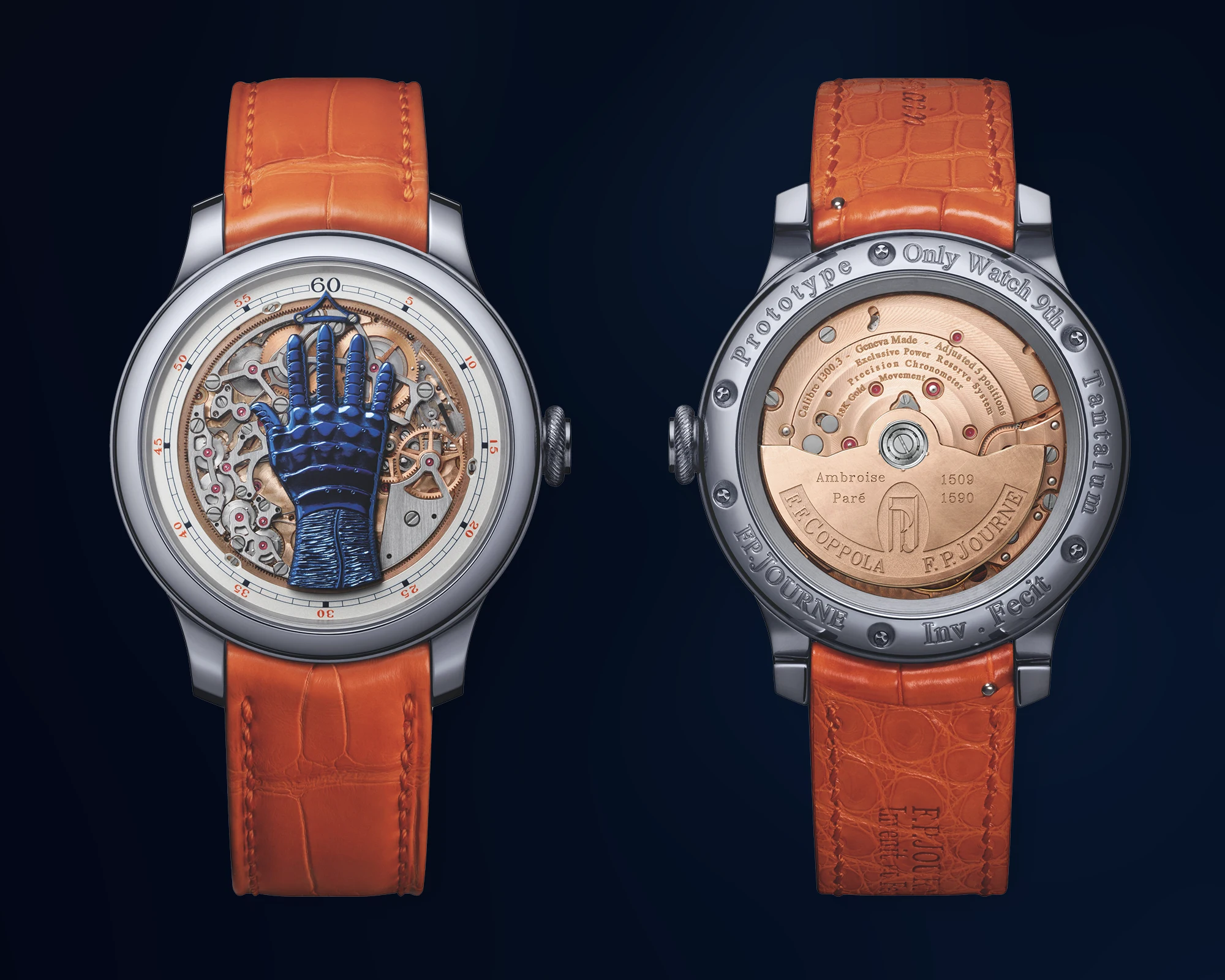
Presented at the Only Watch charity auction in 2021, the F.P.Journe FFC Blue followed a well-established principle within the brand’s oeuvre. As with the Tourbillon Souverain Bleu (2015), the Split-Seconds Chronograph Bleu (2017), the Astronomic Blue (2019), and the Chronomètre Furtif Blue (2024), it was conceived as a unique piece featuring a tantalum case paired with blue accents. The concept of the FFC dates back to 2012, when film director Francis Ford Coppola approached François-Paul Journe with the idea of a watch that would indicate time by means of a human hand—a mechanism that had never before been realised in a wristwatch. After seven years of development, a timepiece emerged whose centrepiece is a hand with five individually extending fingers, used to display the hours from one to twelve. For the design of this hand, Journe drew inspiration from a prosthetic hand known as Le Petit Lorrain, developed in 1551 by Ambroise Paré (1509–1590), the French surgeon widely regarded as a pioneer of modern surgery and prosthetics. The FFC Blue differs from the regular production versions above all through the blue execution of the central hand, which is rendered in anthracite on the series pieces.

Credit © Christies
At the Only Watch auction in 2021, the FFC Blue achieved a total price, including buyer’s premium, of €4,293,443, making it the third most expensive F.P.Journe watch ever sold at auction. Several factors contributed to this result. First, as with previous Only Watch uniques, it is a genuine prototype, whose rotor bears visible signs of use typical of a development model. Second, François-Paul Journe personally produced only three FFC examples: one for himself, one for Francis Ford Coppola—today the most expensive F.P.Journe watch ever auctioned—and the FFC Blue prototype described here for Only Watch 2021. Within the FFC lineage, the FFC Blue therefore ranks among the very few examples assembled entirely by Journe’s own hand.

Credit © Christies
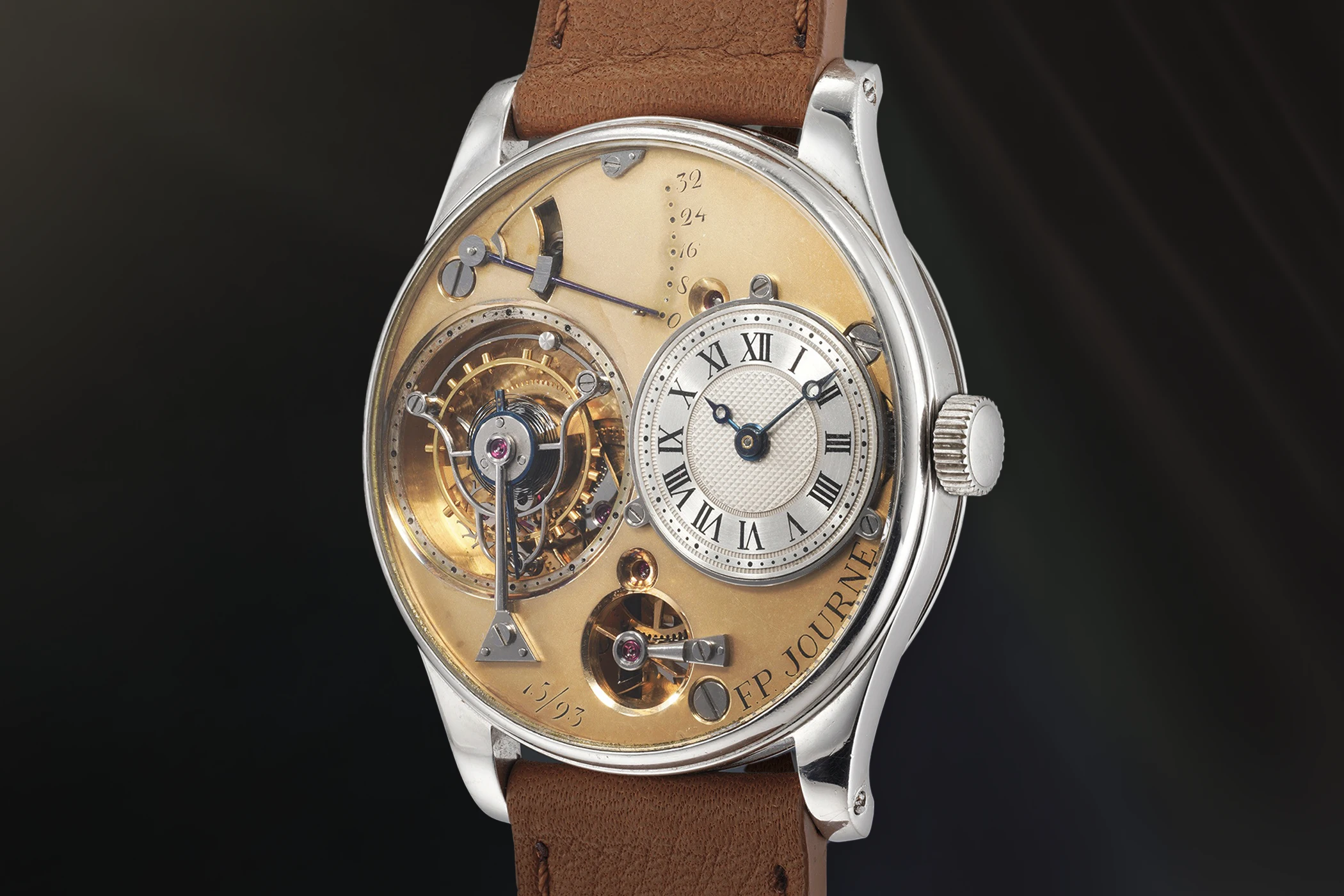
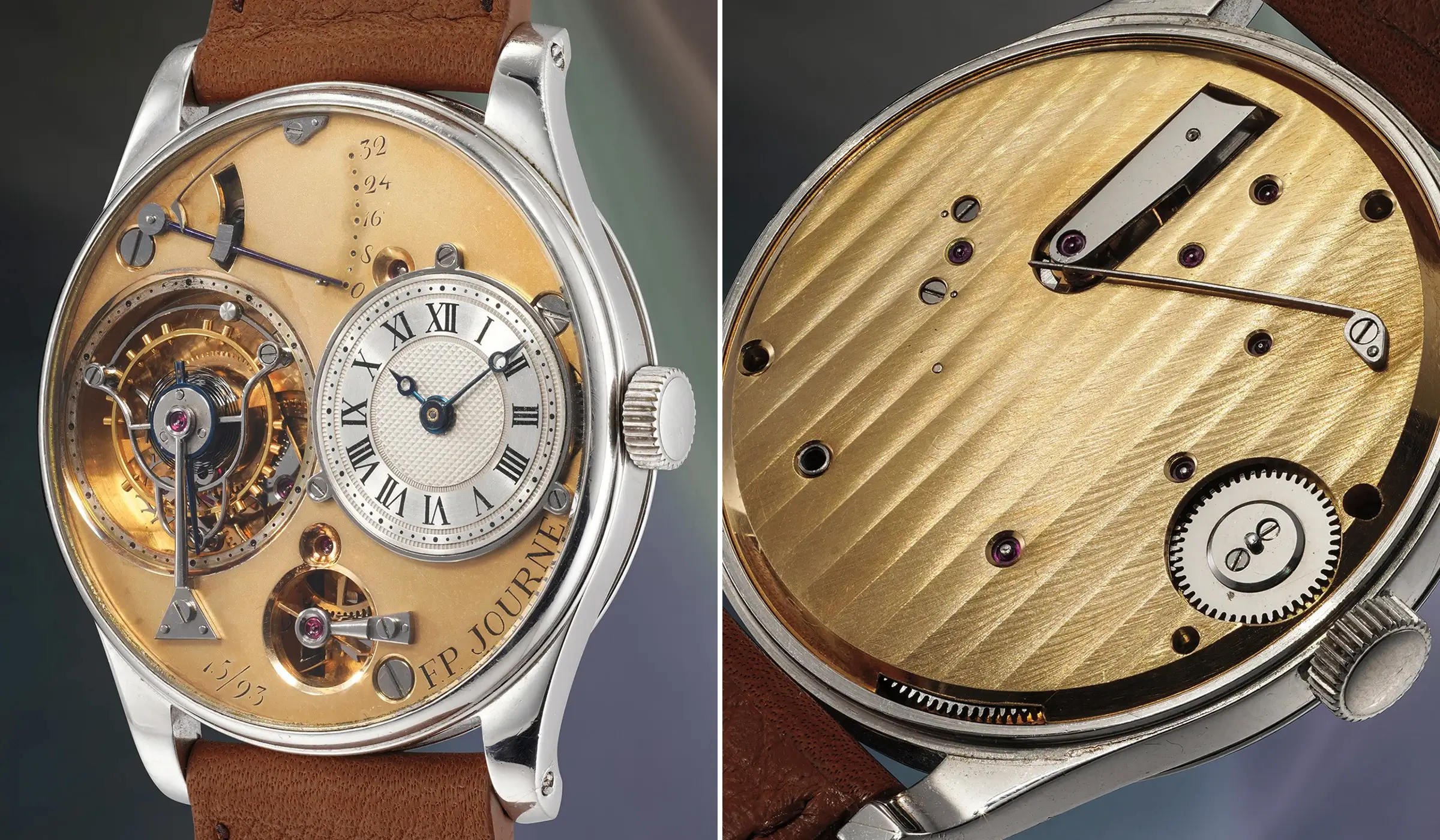
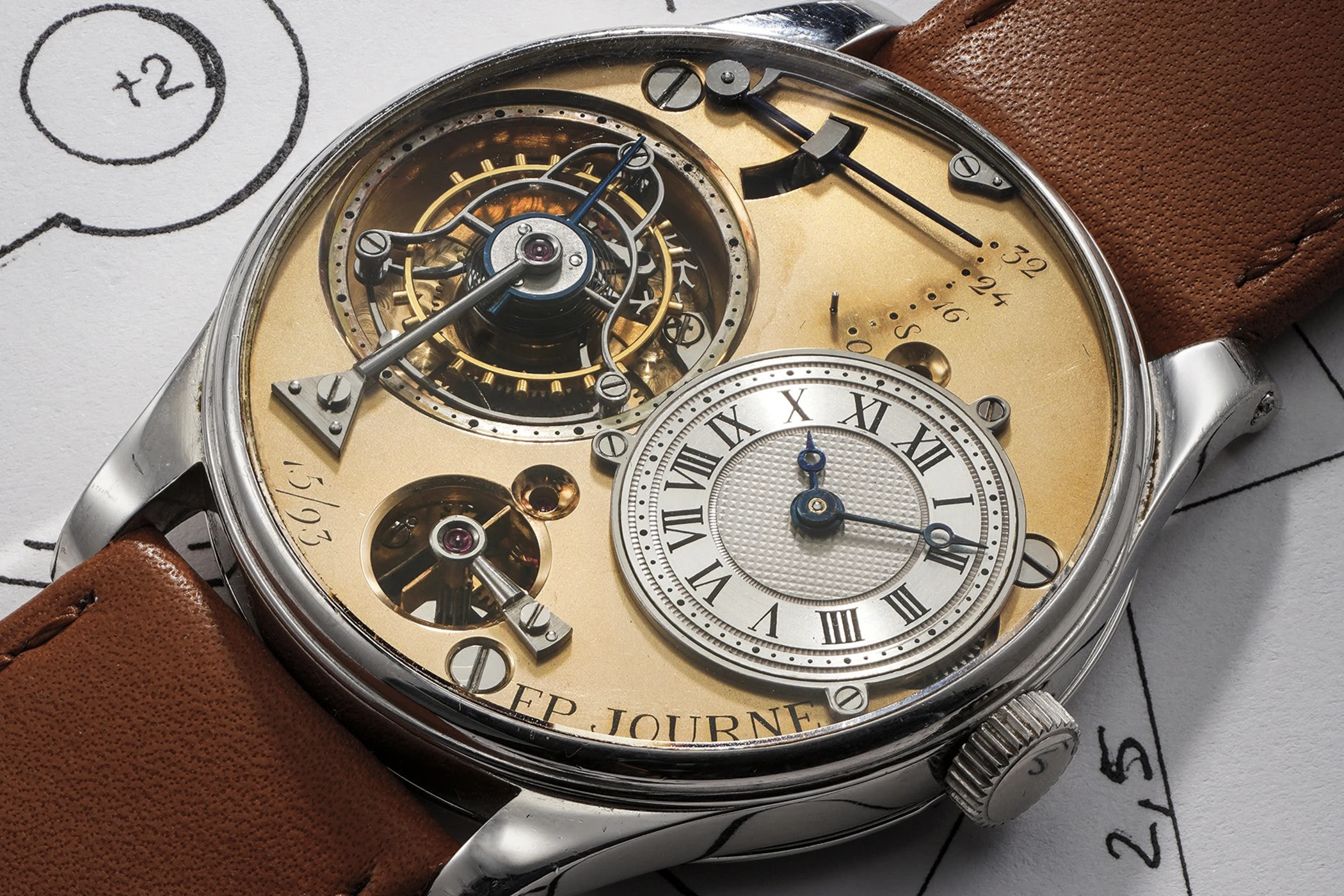
Few watches are as closely associated with François-Paul Journe from multiple perspectives as number 2 on our list of the most expensive F.P.Journe watches ever sold at auction. The F.P.Journe Tourbillon à Remontoir d’Égalité “15/93” is, on the one hand, the second wristwatch Journe ever made and the very first watch he ever sold. On the other hand, it is regarded as one of three early development pieces that paved the way for the later series of 20 limited Tourbillon à Remontoir d’Égalité Souscription watches, which reached commercial maturity in 1999 and laid the foundation for Journe’s career as an independent watch brand. The first “prototype”, the Remontoir d’Égalité “11/91”, was worn by Journe himself and remains in his private collection to this day. In 1993, he produced two further identical examples: the watch described here, “15/93”, and another piece engraved “16/93”. The number “15” denotes that this was the fifteenth timepiece made by Journe in total—pocket watches and wristwatches combined—while “93” refers to the year of manufacture, 1993.
Credit © Phillips
Before becoming one of the most influential and highly decorated watchmakers of his generation, Journe underwent formative years that are also reflected in the Tourbillon à Remontoir d’Égalité “15/93”. After graduating from the École d’Horlogerie de Paris in 1976, he designed a planetarium mechanism for Asprey in London in 1979, commissioned by the Paris-based ateliers P.-G. Brun. Two milestones followed in 1983: after five years of work, he completed his first timepiece, a tourbillon pocket watch with a chronometer escapement; in the same year, he began researching the remontoir principle, which culminated in the creation of a tourbillon pocket watch with a remontoir, conceived as a tribute to the great watchmakers of the 18th century. His first wristwatch, the “prototype” Remontoir d’Égalité “11/91”, followed in 1991. This timepiece was the first to combine a tourbillon with an integrated remontoir system in a wristwatch, together with a movement and gear train made entirely from 18-carat gold. Through this unprecedented combination of tourbillon and remontoir system, Journe sought to further develop Abraham-Louis Breguet’s invention: the remontoir is a constant-force mechanism that delivers the same amount of energy regardless of the state of wind of the mainspring, thereby improving rate accuracy.
Credit © Phillips
In 1993, Journe produced the Tourbillon à Remontoir d’Égalité “15/93”, now the second most expensive F.P.Journe watch ever sold at auction. Journe himself described this watch in the following terms: “This first tourbillon wristwatch pays tribute to five watchmakers: Abraham-Louis Breguet as the inventor of the tourbillon, Ernest Guinand for the shape of the tourbillon cage, Jost Bürgi for the remontoir system, Ferdinand Berthoud for the overall aesthetic—and myself, as it reflects decades of experience and learning.” Many of the features visible here would later become defining characteristics of Journe’s subsequent timepieces. Chief among them is the golden “dial”, which is not a dial in the conventional sense but rather the mainplate of the movement itself. As both the mainplate and bridges are made from solid gold, the visible yellow-gold dial corresponds to the underside of this mainplate. In later serially produced versions of the Tourbillon à Remontoir d’Égalité, François-Paul Journe initially switched to brass bridges. Only in 2004 did he return to a fully gold movement architecture—a feature that has since become one of the central hallmarks of the brand. The case, with a diameter of 38 millimetres, already anticipates the proportions of later models, yet it differs in several details, most notably through a more pronounced stepped bezel, wider lugs, and screwed strap bars.
The F.P.Journe Tourbillon à Remontoir d’Égalité “15/93” remained in the possession of its original owner for more than three decades before being sold in 2024 at Phillips’ auction Reloaded: The Rebirth of Mechanical Watchmaking, 1980–1999 for a total price, including buyer’s premium, of €7,805,082.
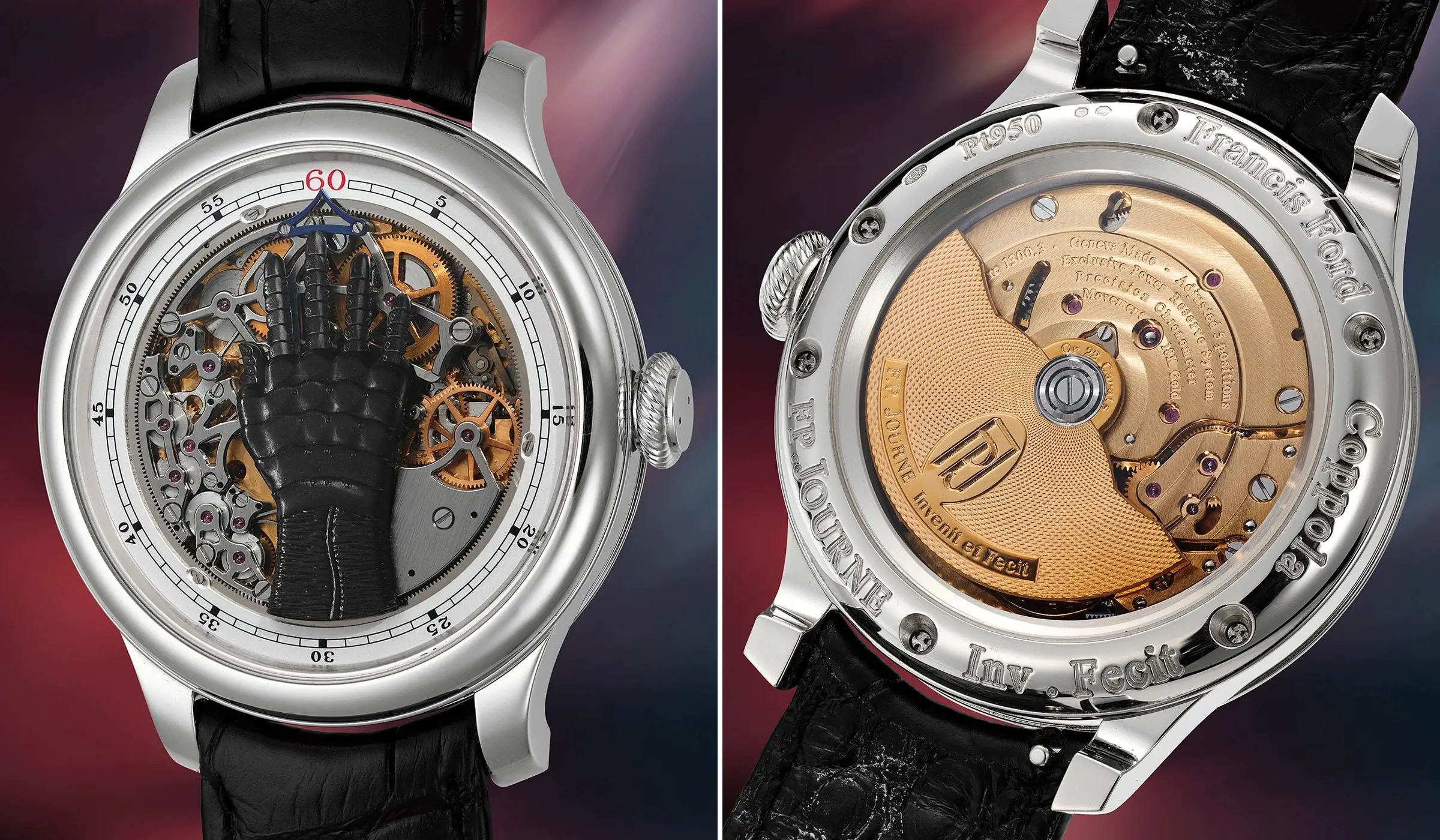
The story of the most expensive F.P.Journe watch ever sold at auction — offered as Lot 17 at the Phillips New York Watch Auction: XIII — begins in 2009 with Mrs Eleanor Coppola. She presented her husband, film director Francis Ford Coppola, with a Chronomètre à Résonance, the very model that would also be sold at the Phillips New York Watch Auction: XIII, achieving a hammer price of US$584,200. Captivated by the watch, Coppola invited its creator, François-Paul Journe, to meet him in 2012 at his Inglenook estate in Napa Valley. There, he posed Journe an extraordinary question: whether a watchmaker had ever displayed the hours as they had been counted in ancient times — by using the fingers of a hand.
Credit © Phillips
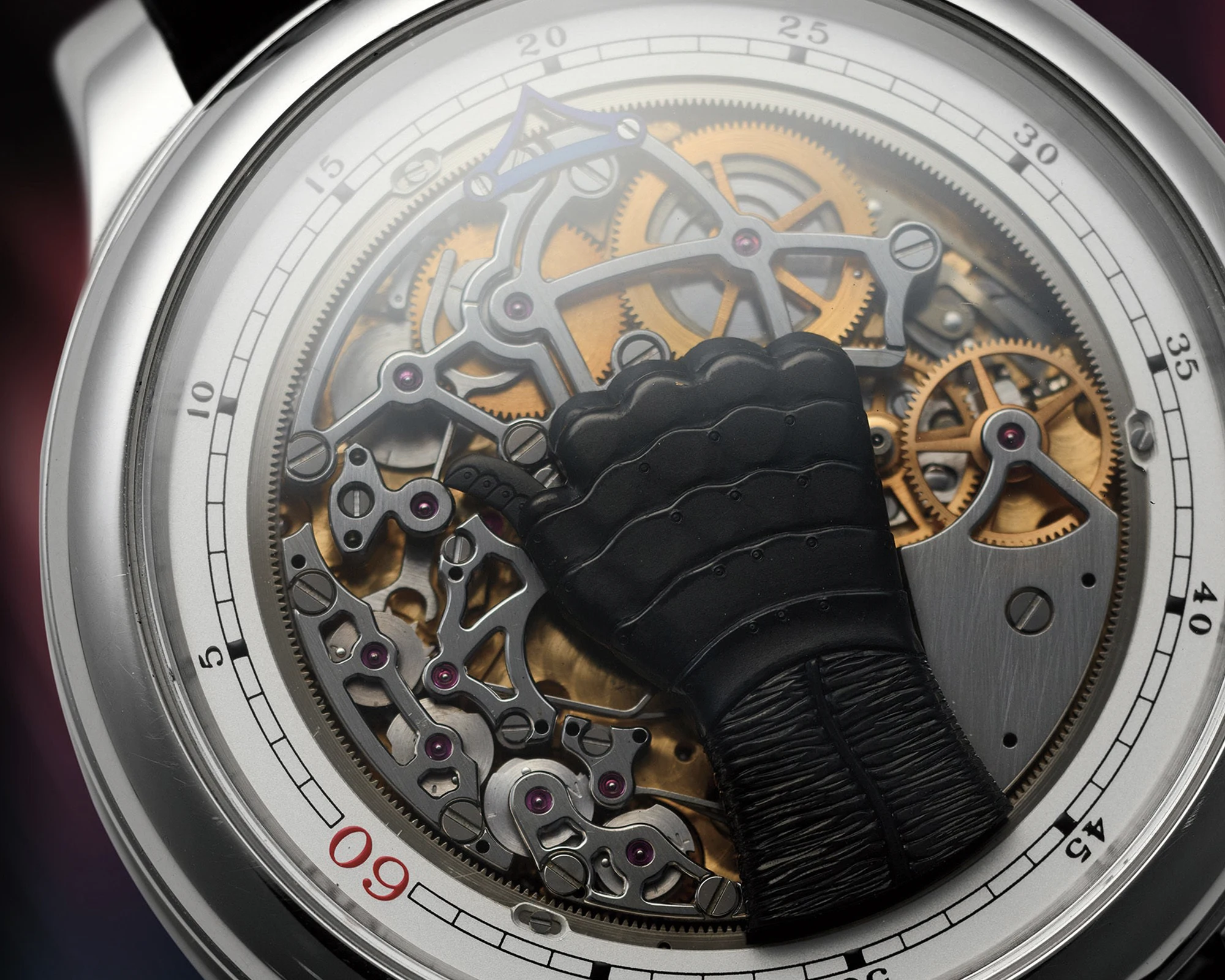
In 2014, Journe began conceiving a timepiece capable of realising this form of time display, yet he encountered two fundamental challenges. First, the architectural execution of the hand and pointer mechanism had to be resolved; second, the mechanism needed to be supplied with sufficient and consistent energy without prematurely depleting the gradually unwinding mainspring. After seven years of development, the FFC emerged as a fully realised timepiece that convincingly solved both problems. Journe produced only three unique examples: one for himself, one for Francis Ford Coppola — today recognised as the most expensive F.P.Journe watch ever auctioned — and a third FFC Blue prototype for the Only Watch 2021 charity auction. These three are the only FFC watches assembled entirely by François-Paul Journe’s own hand.
Credit © Phillips
Coppola’s personal example is distinguished by several unique features. The hand inspired by Ambroise Paré is crafted from titanium and finished in black rather than anthracite; the rotating minute ring appears in white instead of grey. In addition, the Octa calibre is fitted with a rotor in 18-carat pink gold — rather than the name-engraved rotor used on series models — and steel bridges. These characteristics, combined with the fact that no FFC example had previously appeared at public auction aside from the FFC Blue prototype, led to a total price, including buyer’s premium, of €9,237,761 at the Phillips New York Watch Auction: XIII in 2025.
This article features the most expensive F.P.Journe wristwatches to date,
as of January 2026.
| Model | Price realised |
|---|---|
| 15. Tourbillon Souverain “Régence Circulaire”, 670-TN | EUR 1,817,738 |
| 14. Grande et Petite Sonnerie Minute Repeater | EUR 1,969,939 |
| 13. Centigraphe Souverain, No. 1/3-CT, Jean Todt | EUR 1,985,267 |
| 12. Chronomètre Furtif Bleu “Only Watch 2024” | EUR 2,048,233 |
| 11. Chronomètre à Résonance „Souscription“, No. 17/20 | EUR 2,441,930 |
| 10. Tourbillon Souverain à Remontoir d‘Egalité „Souscription“, No. 2/20 | EUR 2,779,549 |
| 09. Grande et Petite Sonnerie Minute Repeater, Jean Todt | EUR 3,071,431 |
| 08. Tourbillon Souverain à Remontoir d’Egalité “Souscription”, No. 24 | EUR 3,121,290 |
| 07. Chronomètre à Résonance “Sincere Fine Watches, Black Mother-of-Pearl”, 033-05RN | EUR 3,169,441 |
| 06. Tourbillon Souverain à Remontoir d’Egalité “Souscription”, No. 1/20 | EUR 3,353,866 |
| 05. Chronomètre à Résonance „Souscription“, No. 2/20 | EUR 3,571,075 |
| 04. Chronomètre à Résonance „Souscription“, No. 1/20 | EUR 3,697,876 |
| 03. FFC Blue “Only Watch 2021” | EUR 4,293,443 |
| 02. Tourbillon Souverain à Remontoire d’Egalité, No. 15/93 | EUR 7,805,082 |
| 01. FFC Prototype, “Francis Ford Coppola” | EUR 9,237,761 |
The auction data used for this article is sourced from everywatch.com.