To mark the 100th anniversary of its historic boutique in Piazza San Giovanni in Florence, Panerai launches the Radiomir Viaggio Nel Tempo Experience Set.
Rolex is widely regarded as perhaps the most recognisable – and simultaneously one of the most sought-after – watch manufacturers in the world. In many parts of the globe, a timepiece bearing the crown on the wrist is considered synonymous with success and prosperity. Yet within the exclusive circle of wealthy collectors, not every Rolex will suffice. The focus instead lies on those exceptional examples distinguished by remarkable provenance, extreme rarity, or technical particularities that set them apart from standard series production. This brings us to the most expensive Rolex wristwatches ever sold at auction. They range from iconic “Paul Newman” Daytonas and the legendary “Bao Dai” to off-catalogue pieces such as the “Rainbow Zenith Daytona”, as well as special commissions created for the former Sultan of Oman, Qaboos bin Said Al Said. What unites this select group of watches is not merely the extraordinary stories that surround them, but also the often staggering total prices they have achieved. In this article, we take a closer look at these timepieces – and the figures that secured their place in auction history.
This article is part of our series “The Most Expensive Wristwatches of All Time”, in which we have previously explored wristwatches from brands such as Richard Mille, F.P.Journe and Patek Philippe.
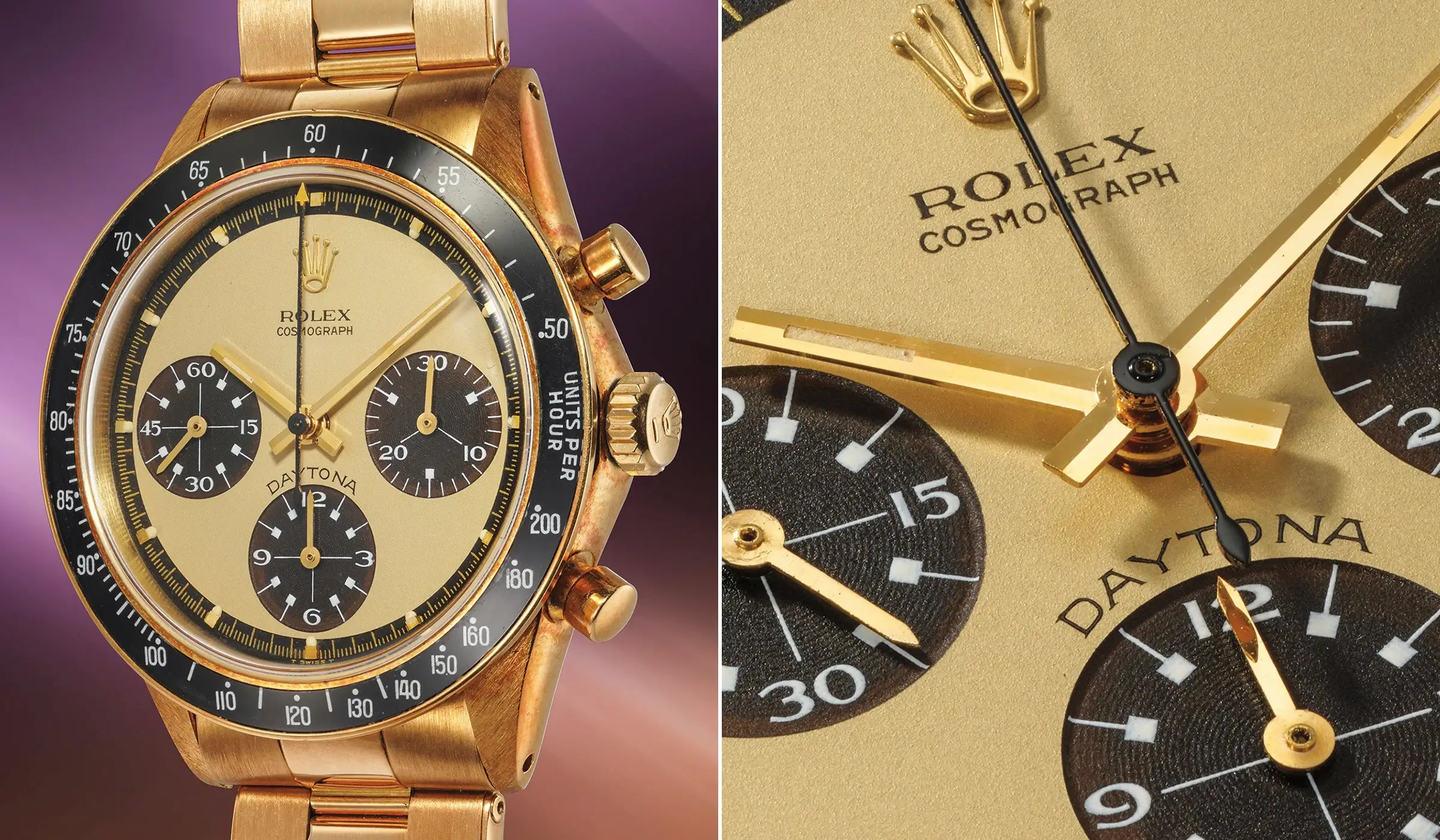
Ranked 15th among the most expensive Rolex wristwatches ever sold at auction is a Rolex Cosmograph Daytona Ref. 6264 featuring a so-called “Lemon” Paul Newman dial. In order to be classified as a Cosmograph Daytona with a “Lemon” Paul Newman dial, the main dial must display a matte, finely grained surface and be distinguished by a pronounced creamy yellow tone, leaning distinctly towards lemon rather than the more commonly encountered champagne variants. In addition, the subsidiary registers feature white-printed Art Deco numerals instead of the usual champagne-coloured text.
Credit © Phillips
Further significant characteristics of the watch described here – which also help explain its particularly high sale price – include the case, preserved in notably good condition with well-defined and sharp edges. The dial also exhibits the early stages of a “tropical” transformation, whereby the subsidiary dials have developed a brown hue, while the outer minute track has shifted towards a warm, light-brown tone. The appeal of this example was further enhanced by the presence of its original guarantee, issued on 18 February 1974 by Brunati, a former Zurich-based retailer that no longer exists.
The Cosmograph Daytona Ref. 6264 with “Paul Newman Lemon” dial was sold at Phillips’ “Geneva Watch Auction: XX” in 2024 for a total price, including buyer’s premium, of €2,641,911.
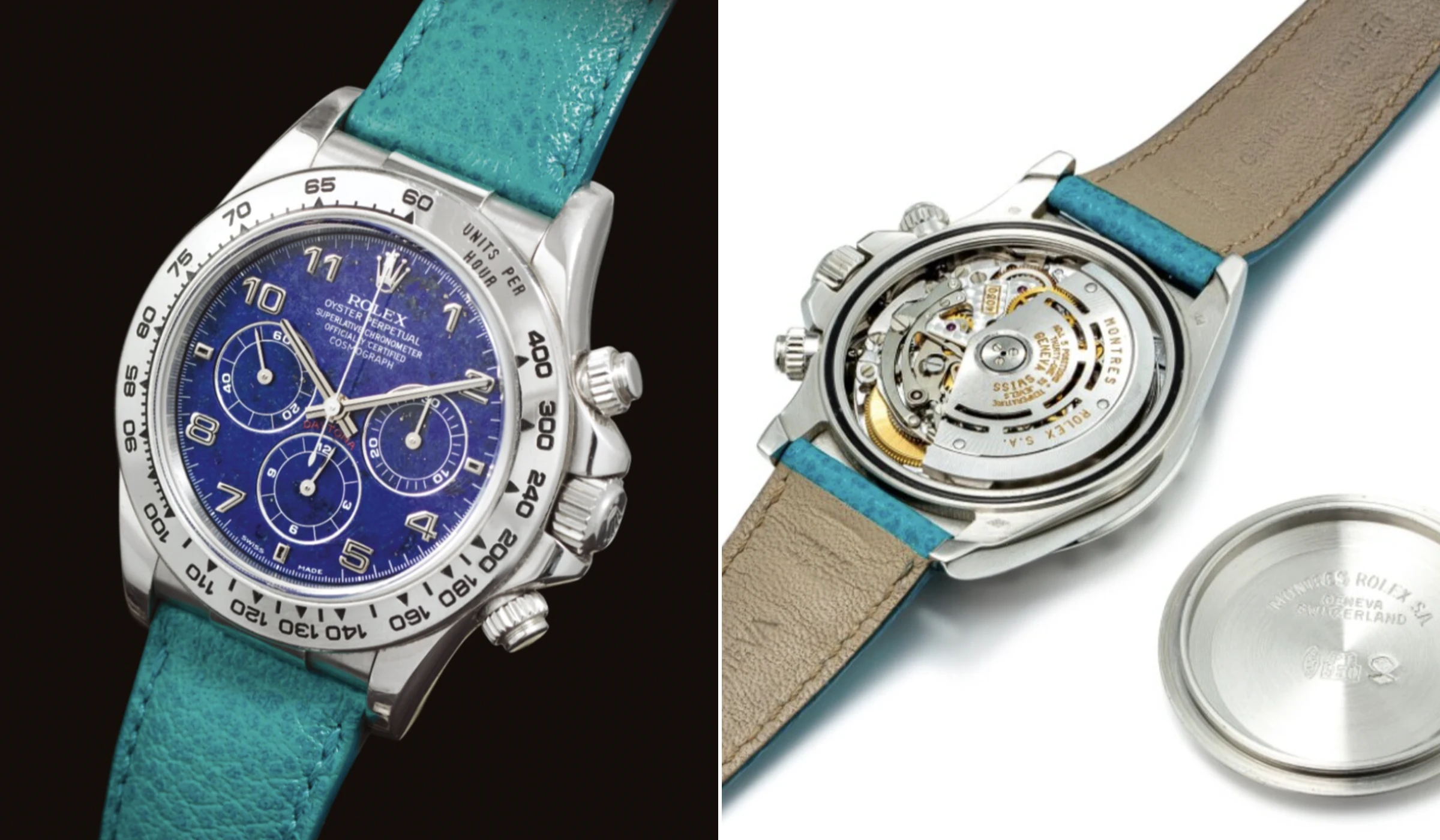
Ranked 14th among the most expensive Rolex wristwatches ever sold at auction is, to date, the only known Daytona combining a 40 mm platinum case with a hardstone lapis lazuli dial. According to Sotheby’s, the watch, bearing the reference number 16516 and an A-series serial number, was manufactured in 1999. An engraving on the case back is dated “XII 1998”.
Credit © Sothebys
Inside the watch is the calibre 4030, based on Zenith’s El Primero calibre 400 – the first high-frequency automatic chronograph movement ever produced. Before meeting Rolex’s standards, the Zenith El Primero calibre 400 underwent around 200 modifications. Revised components included, among others, the balance bridge incorporating Rolex’s proprietary Microstella fine-regulation system, as well as the shock-absorption system. In addition, the power reserve was increased from 42 to 52 hours. Rolex also reduced the frequency of the original Zenith El Primero movement from 36,000 vibrations per hour to 28,800.
The Cosmograph Daytona Ref. 16516 with lapis lazuli dial was sold at Sotheby’s “Important Watches” auction in 2020 for a total price, including buyer’s premium, of €2,897,610.
The Rolex split-seconds chronograph Ref. 4113 occupies an exceptional position in the brand’s history for several reasons. It is the only split-seconds chronograph ever produced by Rolex, manufactured exclusively in 1942, never featured in official product catalogues and never promoted in advertising material. With a case diameter of 44 mm, it not only represents the largest chronograph case ever made by Rolex, but was also among the flattest split-seconds chronographs of its era. Production was strictly limited: only twelve examples were made, bearing serial numbers ranging from 051313 to 051324. Powering the watch is the Valjoux 55 VBR calibre, modified for Rolex.
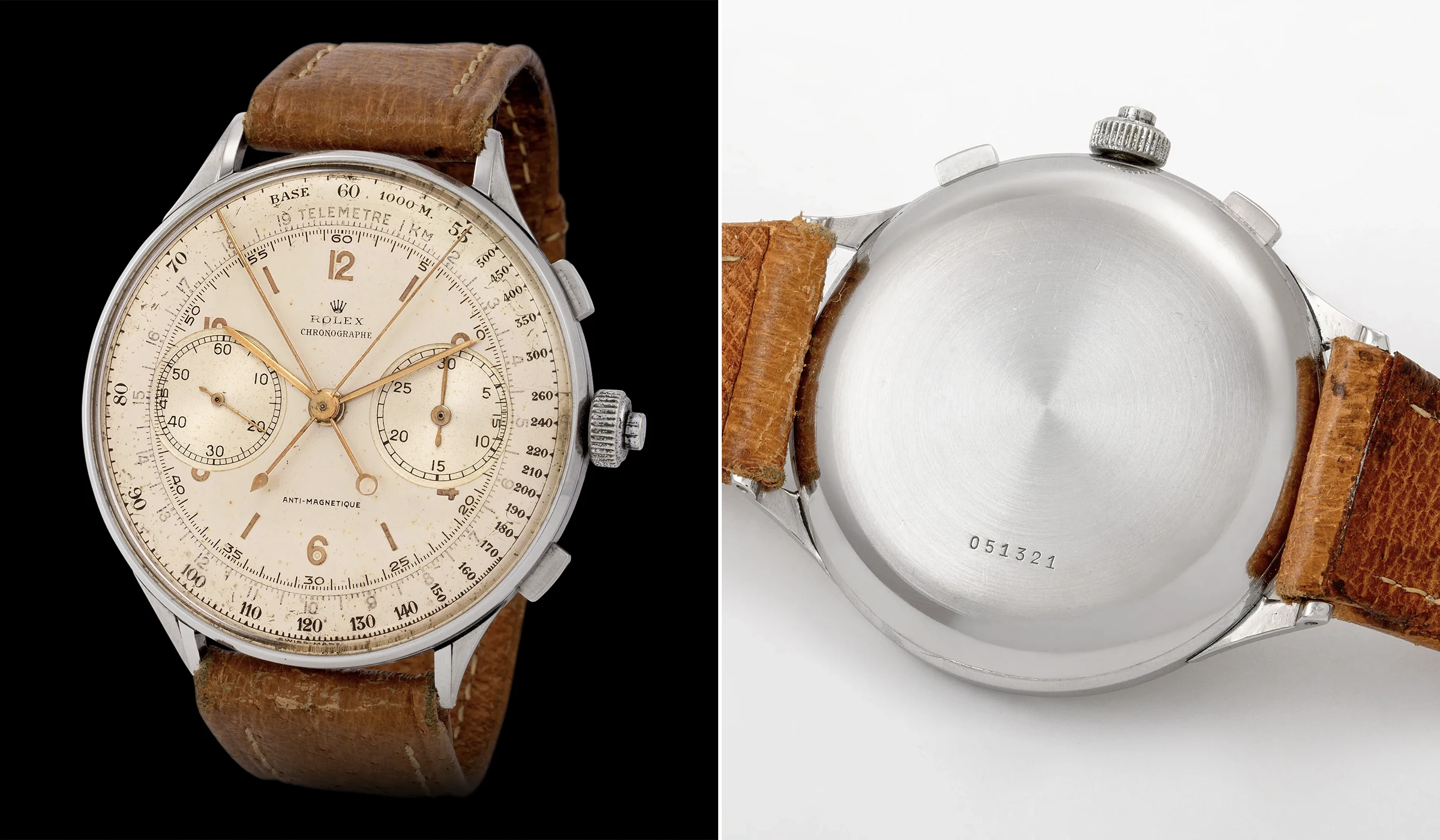
Credit © Monaco Legend Auctions
Despite extensive research, the complete origin story of the Ref. 4113 has yet to be conclusively clarified. Although it appears to have been originally conceived for aviation use, most known examples seem to have found their way to Italy at an early stage, where they were reportedly used in automotive contexts. This assumption is reinforced by the dial’s dual scale configuration: it features both a telemeter scale, typically associated with military or aeronautical applications, and a tachymeter scale, more commonly linked to motor racing. With only eight publicly documented examples known today, the Ref. 4113 ranks among the rarest – and most sought-after – collector’s pieces in the brand’s history.
The example described here originated from the collection of Auro Montanari, better known as John Goldberger, and was sold at Monaco Legend Auctions’ “Exclusive Timepieces” sale in 2024 for a total price, including buyer’s premium, of €3,284,000.
Ranked 12th among the most expensive Rolex wristwatches ever sold at auction is the third publicly known example of the gold Cosmograph Daytonas fitted with screw-down chronograph pushers and so-called “Oyster Lemon Paul Newman” dials. The watch described here bears the case number 2,330,529, making it the third known example in the sequence. This particular configuration of the Cosmograph Daytona occupies a distinctive place within the broader lineage of Rolex Cosmograph Daytonas, as its existence had not been conclusively documented until its first public appearance at auction in 2013. The earliest known example of this configuration carries the serial number 2,330,402; it ranks 11th among the most expensive Rolex watches ever sold and will be examined in detail in the following section.
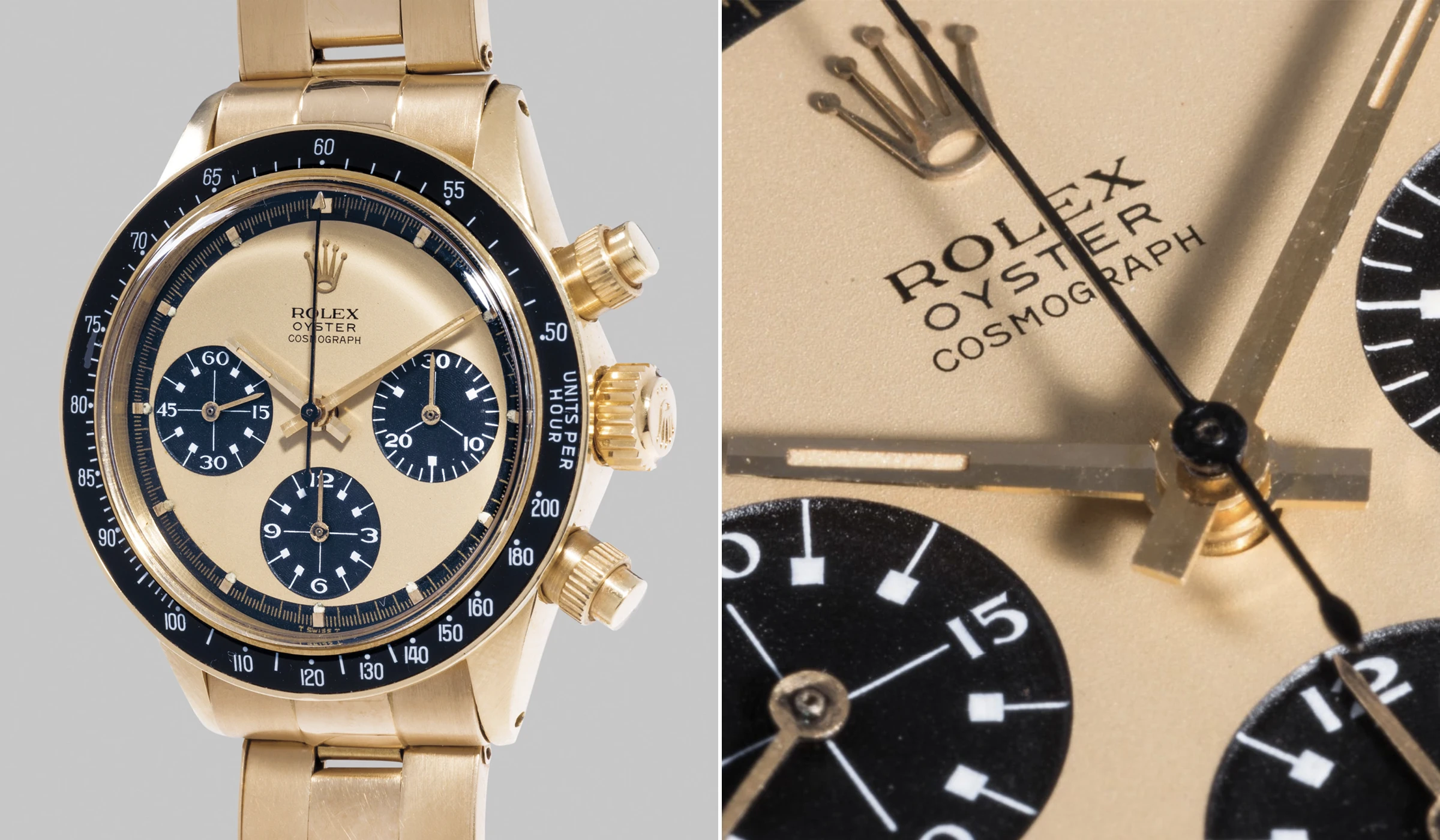
Credit © Phillips
The Oyster Cosmograph Ref. 6263 with “Paul Newman Lemon” dial and case number 2,330,529 was sold at Phillips’ “Geneva Watch Auction: FIVE” in 2017 for a total price, including buyer’s premium, of €3,401,681.
The significance of the watch ranked 11th among the most expensive Rolex wristwatches ever sold at auction lies in the fact that, until its first public appearance at auction in 2013, it had long been assumed that no gold Cosmograph Daytonas with screw-down chronograph pushers and an “Oyster Lemon Paul Newman” dial existed. The Ref. 6263 in gold with “Lemon” Paul Newman dial, unveiled publicly for the first time in 2013, therefore caused considerable attention. Its notably high sale price is further explained by the fact that the example described here, bearing case number 2,330,402, is the earliest of only three publicly known 18-carat gold Ref. 6263 “Paul Newman” Daytonas with a “Lemon” dial.
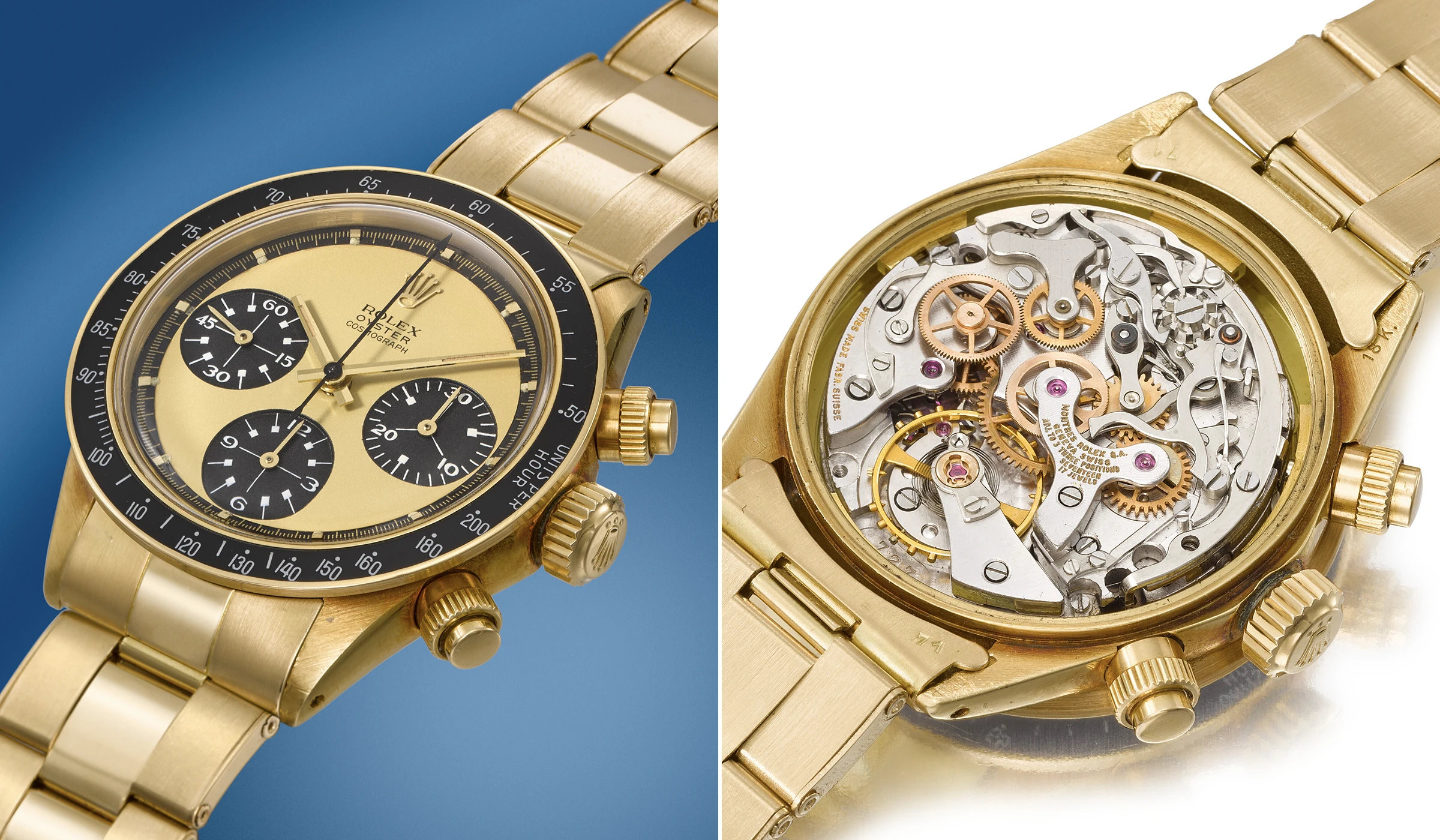
Credit © Christies
Since 2013, two additional examples of the Ref. 6263 with identical characteristics and similarly early serial numbers in the 2,330,*** range have become publicly known:
• 2,330,402 – the present example
• 2,330,*** – documented in Ultimate Rolex Daytona by Pucci Papaleo, pp. 356–359
• 2,330,529 – sold for €3,401,681 at Phillips Geneva, 13–14 May 2017, Lot 237 – ranked 12th
These three confirmed examples of the 18-carat gold Ref. 6263 with “Lemon Paul Newman” dial are therefore among the rarest Cosmograph Daytonas in existence. With its black bezel and screw-down chronograph pushers, the Ref. 6263 continued the lineage of the Ref. 6240 – the first Daytona fitted with screw-down pushers and likewise a black bezel. While the external resemblance is evident, there are technical differences: the case of the 6263 is slightly larger in dimension, and it houses the updated calibre 727, whereas the 6240 was generally fitted with the earlier calibre 722. The designation “Lemon” refers to the intense, saturated yellow tone of the dial background, clearly distinct from the more common cream or champagne shades. Characteristic features also include the white-printed scales and numerals on the engine-turned subsidiary dials.
The watch was sold at Christie’s “Rare Watches” auction in 2022 for a total price, including buyer’s premium, of €3,447,420.
Ranked 10th among the most expensive Rolex wristwatches ever sold at auction is a model linked to the former Sultan of Oman, Qaboos bin Said Al Said, who was known for commissioning some of the finest timepieces from leading watchmakers such as Rolex and Patek Philippe to present as gifts to loyal servants and foreign dignitaries. This watch formed part of a series of yellow-gold Daytona models set with gemstones, commissioned by Qaboos through the historic London jeweller Asprey. Acting as official retailer and intermediary between the Sultanate of Oman and the Swiss manufactures, Asprey was entrusted with fulfilling Qaboos’ demand for watches in highly specific configurations. As no gem-set Daytona had previously existed, Rolex assigned the new reference number 6270 to this model, with the first deliveries commencing around 1984.
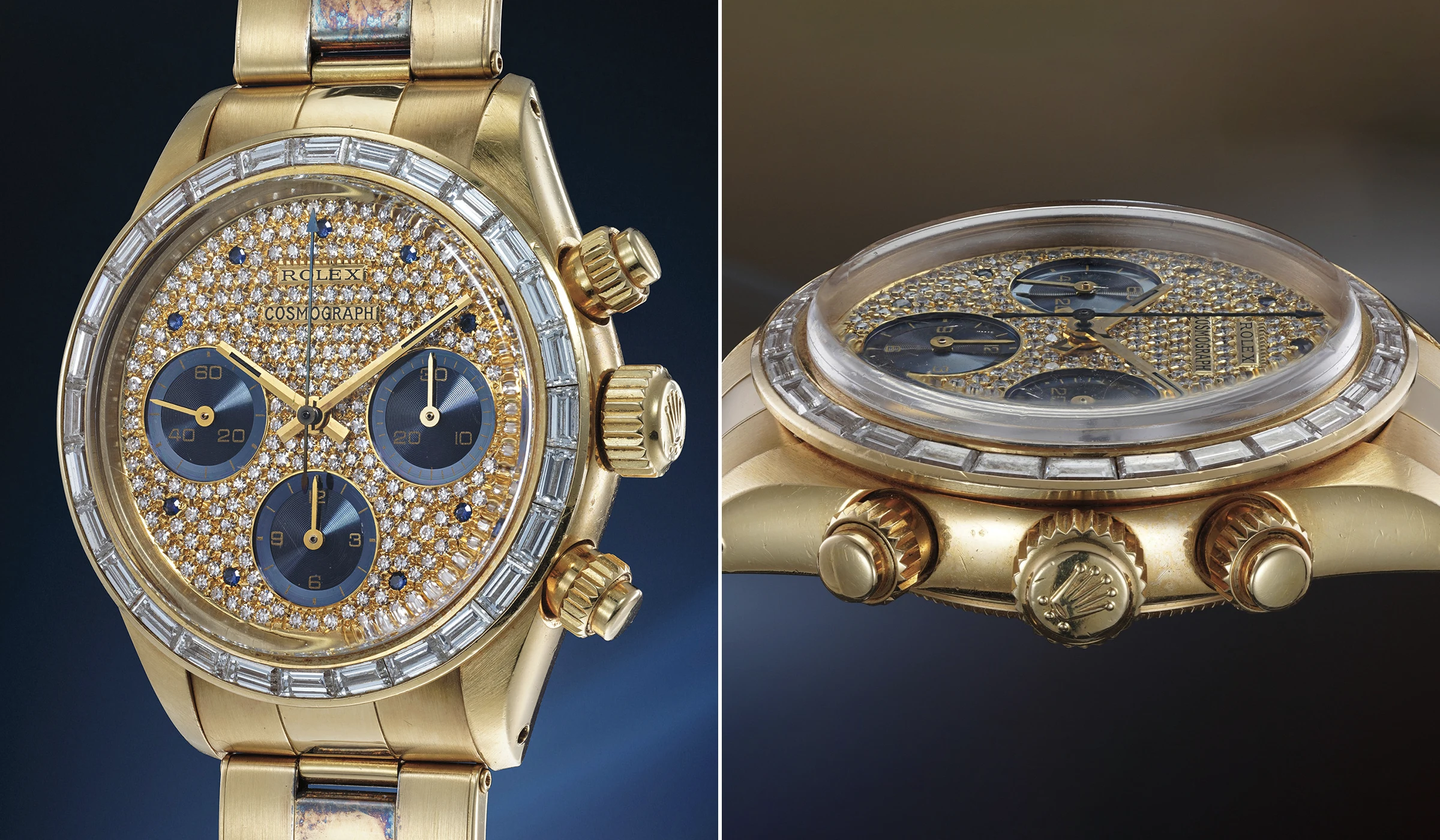
Credit © Phillips
According to Phillips, the example described here belongs to the three earliest known case numbers of this reference – 8,439,967; 8,439,968; and 8,439,969 – the latter being the present watch. Other documented examples bear the serial numbers 9,091,4xx (two pieces), 9,827,95x (two pieces), as well as a single example numbered 8,761,106. With only eight examples recorded on the market – including the present one – this reference ranks among the rarest Rolex models ever produced in series.
The Daytona Ref. 6270 described here features a 37 mm yellow-gold case, a bezel set with baguette-cut diamonds, and a dial adorned with pavé-set diamonds. Particularly noteworthy are the cobalt-blue subsidiary dials, a configuration never used before or since, harmonising with the blue gemstone hour markers.
The Cosmograph Daytona Ref. 6270 was sold at Phillips’ “Geneva Watch Auction: XVII” in 2023 for a total price, including buyer’s premium, of €3,773,444.
Ranked 9th among the most expensive Rolex wristwatches ever sold at auction is the Ref. 4113 – as already described above in record watch no. 13, the only split-seconds chronograph ever produced by Rolex, manufactured exclusively in 1942. Housed in a stainless-steel case measuring 44 mm in diameter and approximately 11.3 mm in height, the Ref. 4113 represents the largest chronograph case ever made by Rolex and, at the same time, one of the flattest split-seconds chronographs of its era. Production was extremely limited. According to the auction platform FutureGrail, only twelve examples were made, bearing serial numbers ranging from 051313 to 051324. The reference was never included in official Rolex catalogues, and all indications suggest that it was produced as a special order, further reinforcing its rarity. The split-seconds mechanism allows for the temporary disengagement of a second, centrally mounted chronograph seconds hand in order to measure intermediate times. By means of an additional pusher, the split-seconds hand can be stopped while the primary chronograph hand continues running. When the pusher is pressed again, the halted hand “catches up” and resumes running in perfect alignment with the main chronograph hand.
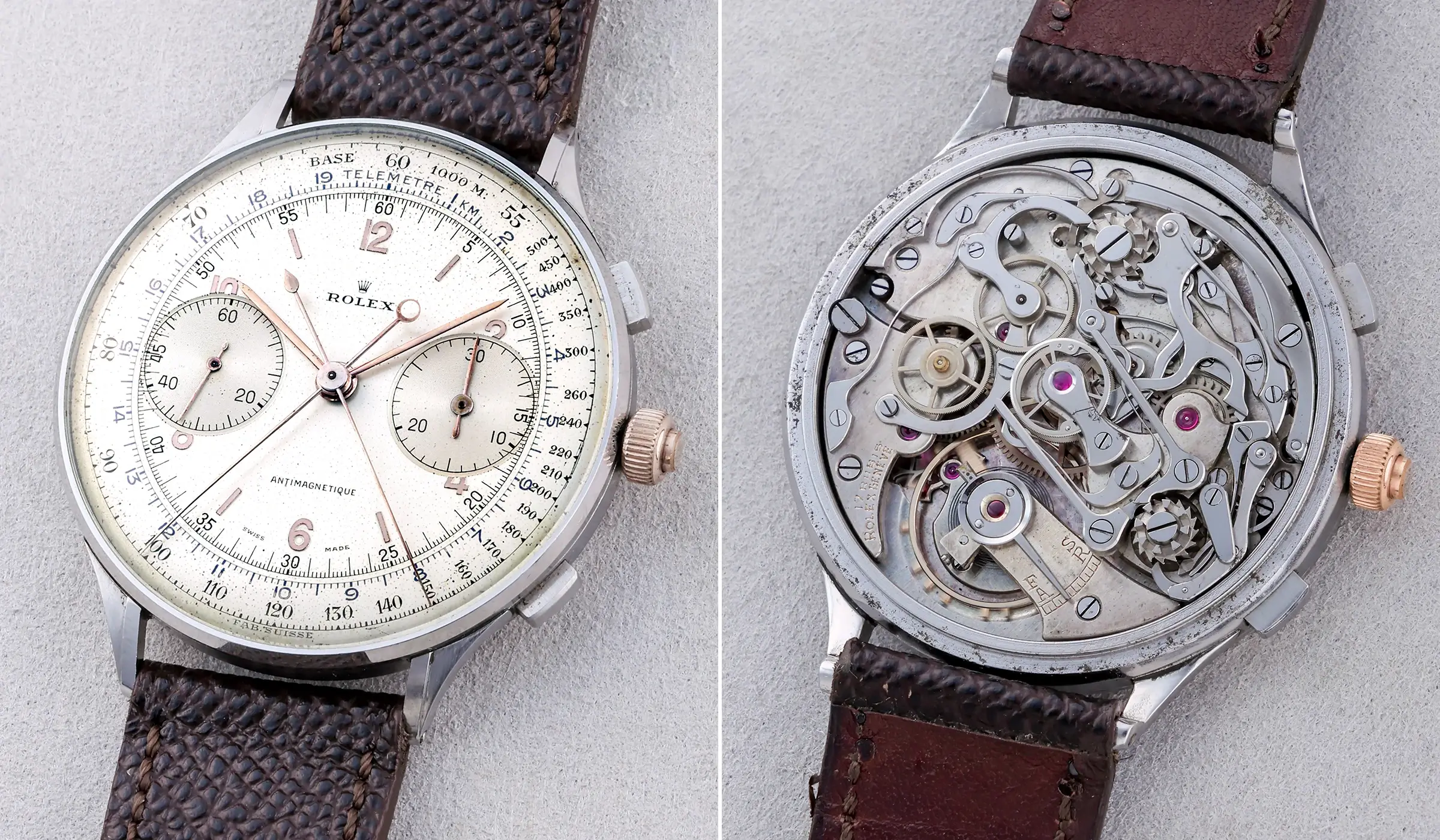
Credit © FutureGrail
Also noteworthy is the particularly narrow bezel, which frames a dial attributed to the workshops of Beyeler. The dial, executed on a silvered metal base, features Arabic numerals at 2, 4, 6, 8, 10 and 12 o’clock. These are surrounded by an outer minute track subdivided in five-minute increments from 5 to 60, complete with corresponding scale divisions. Along the outermost edge of the dial are a tachymeter scale calibrated to 1,000 units and a telemeter scale divided into 20 increments. With only eight examples of the Ref. 4113 publicly documented today – all held in significant private collections – the appearance of such a watch at auction invariably attracts considerable attention.
The Split-Seconds Chronograph Ref. 4113, case number 051319, was sold via the FutureGrail auction platform for a total price, including buyer’s premium, of €4,077,380.
Ranked 8th among the most expensive Rolex wristwatches ever sold at auction is another model linked to the former Sultan of Oman, Qaboos bin Said Al Said. He was known for commissioning some of the finest timepieces from leading houses such as Rolex and Patek Philippe, presenting them as gifts to loyal servants and foreign dignitaries. The manufactures not only accommodated his requests for highly individual configurations, but also authorised the application of a symbol that has since become iconic in horology: two crossed swords surmounted by a dagger – the national emblem of Oman, known as the Khanjar. Watches bearing this emblem are therefore referred to as “Khanjar watches”.
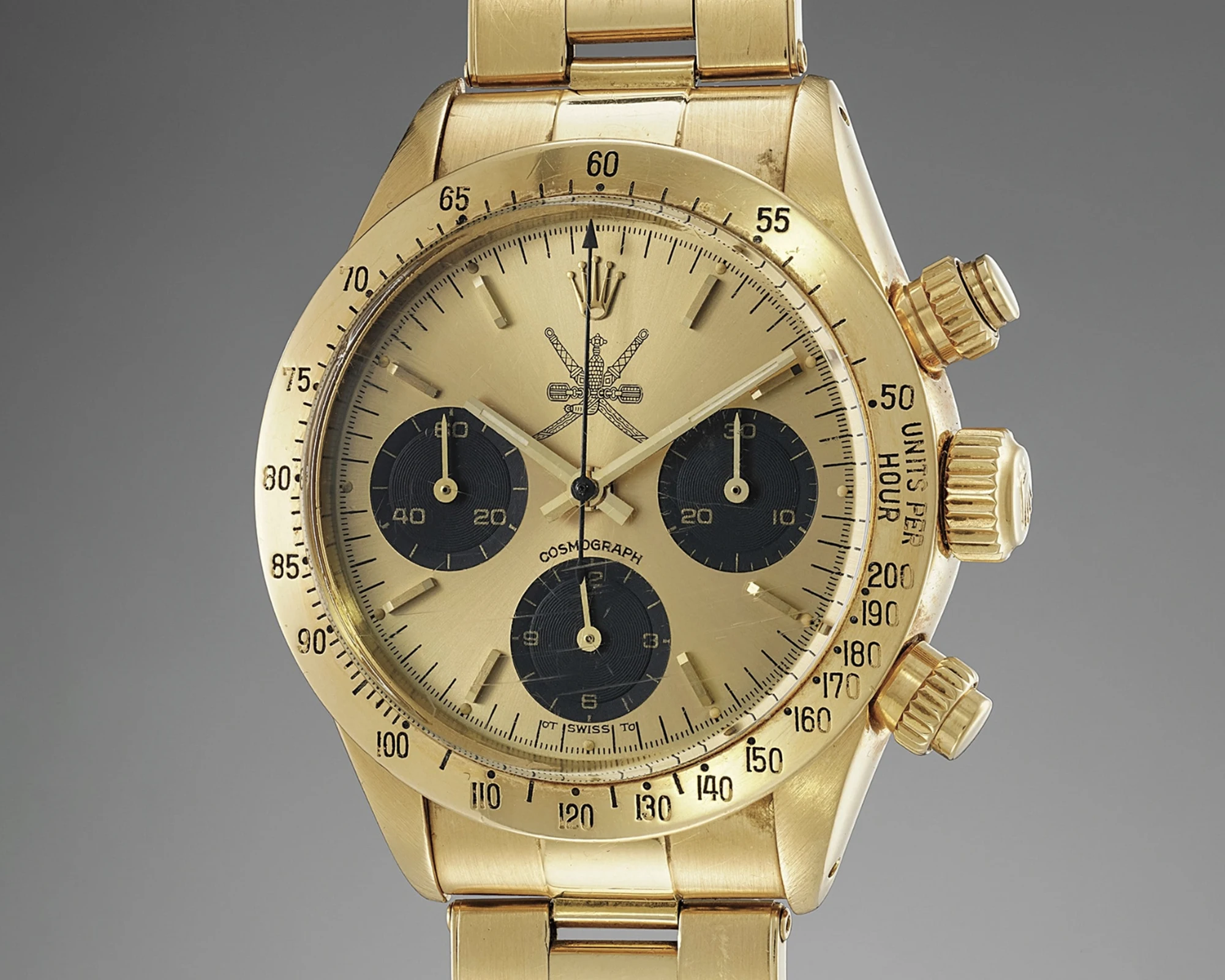
Credit © Phillips
The origins of these exceptional commissions can be traced back to Qaboos’ youth. Having attended the Royal Military Academy Sandhurst, he lived in London in his early twenties, where he met Tim Landon, who would later become one of Britain’s wealthiest men and play a significant role in the development of Oman. Through Landon, Qaboos was introduced to the key figure behind the “Khanjar” watches: John Asprey. Acting as official retailer and intermediary between the Sultanate of Oman and Swiss manufactures, Asprey was tasked with fulfilling Qaboos’ demand for double-signed “Khanjar” watches and timepieces in bespoke configurations.
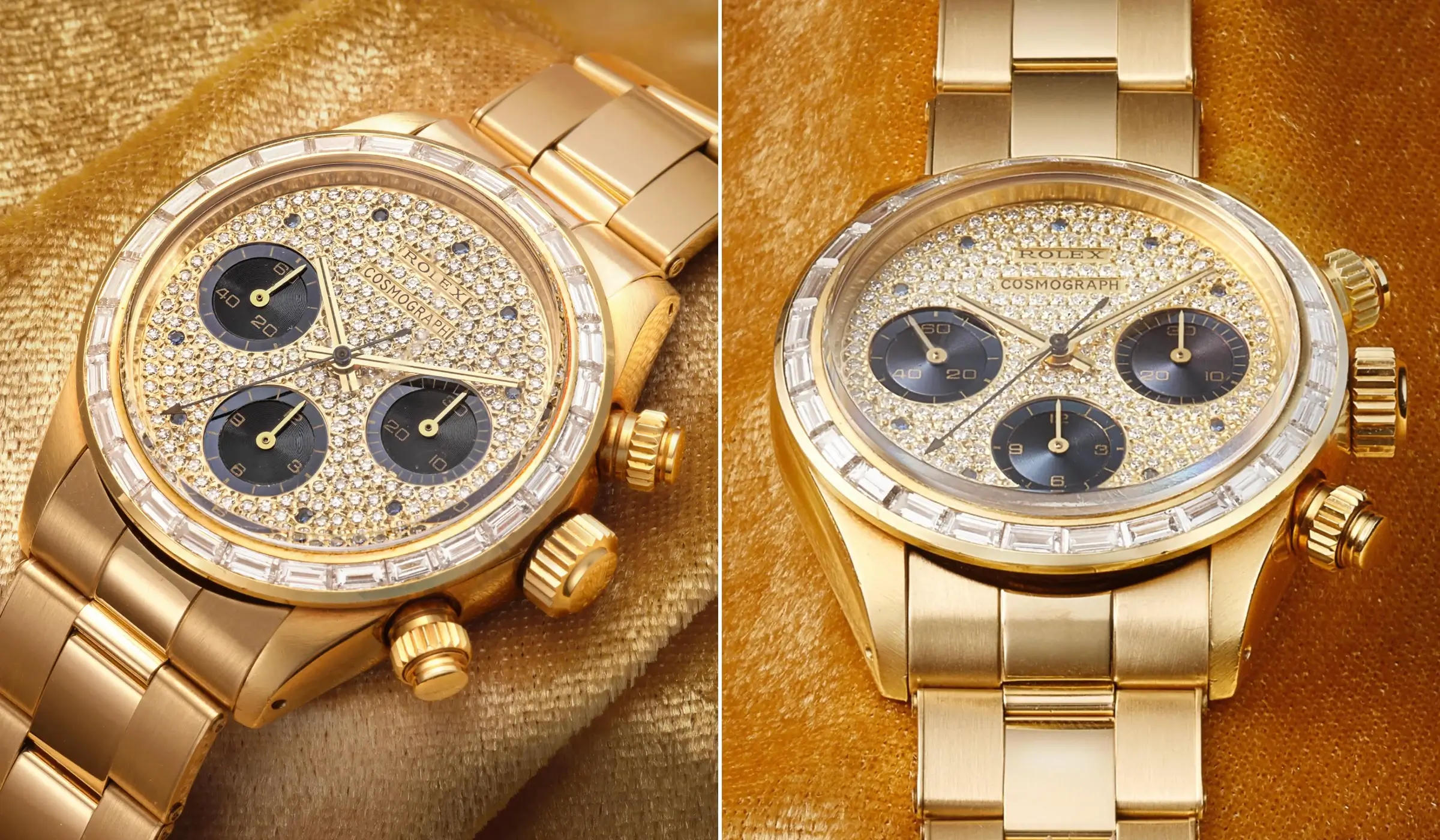
Credit © Sothebys
It was through Asprey that Qaboos ordered the watch ranked 8th on this list: a series of yellow-gold Daytona models. According to Sotheby’s, Rolex combined for the first time – and never again in this exact form – a bezel set with baguette-cut diamonds with a fully pavé-set diamond dial, complemented by sapphire hour markers and dark blue subsidiary dials. As no gem-set Daytona had previously existed, Rolex assigned the new reference number 6270 to this model, with the first deliveries commencing in 1984. To date, only eight examples of the Ref. 6270 are documented, making it one of the rarest Rolex models ever produced in series.
The Cosmograph Daytona Ref. 6270, “The King”, was sold at Sotheby’s “Important Watches” auction in 2025 for a total price, including buyer’s premium, of €4,502,167.
From 1968 onwards, Paul Newman was photographed throughout his life wearing a small selection of Rolex Cosmograph Daytona models. Among them, the Ref. 6263 “Big Red” described here holds a particular significance, as Newman wore it from 1983 until 2008. It thus became not only the watch he owned for the longest period, but also the one he wore longer than any other. The watch, bearing the serial number 6,392,137, dates the timepiece to approximately 1981. Newman presented it to his daughter, Clea Newman Soderlund, in 2008, shortly before his death. It is highly likely that Paul Newman himself received the Rolex Daytona Ref. 6263 “Big Red” from his wife, Joanne Woodward, in 1983 to mark their 25th wedding anniversary. She had the case back engraved with the inscription “Drive slowly Joanne”.
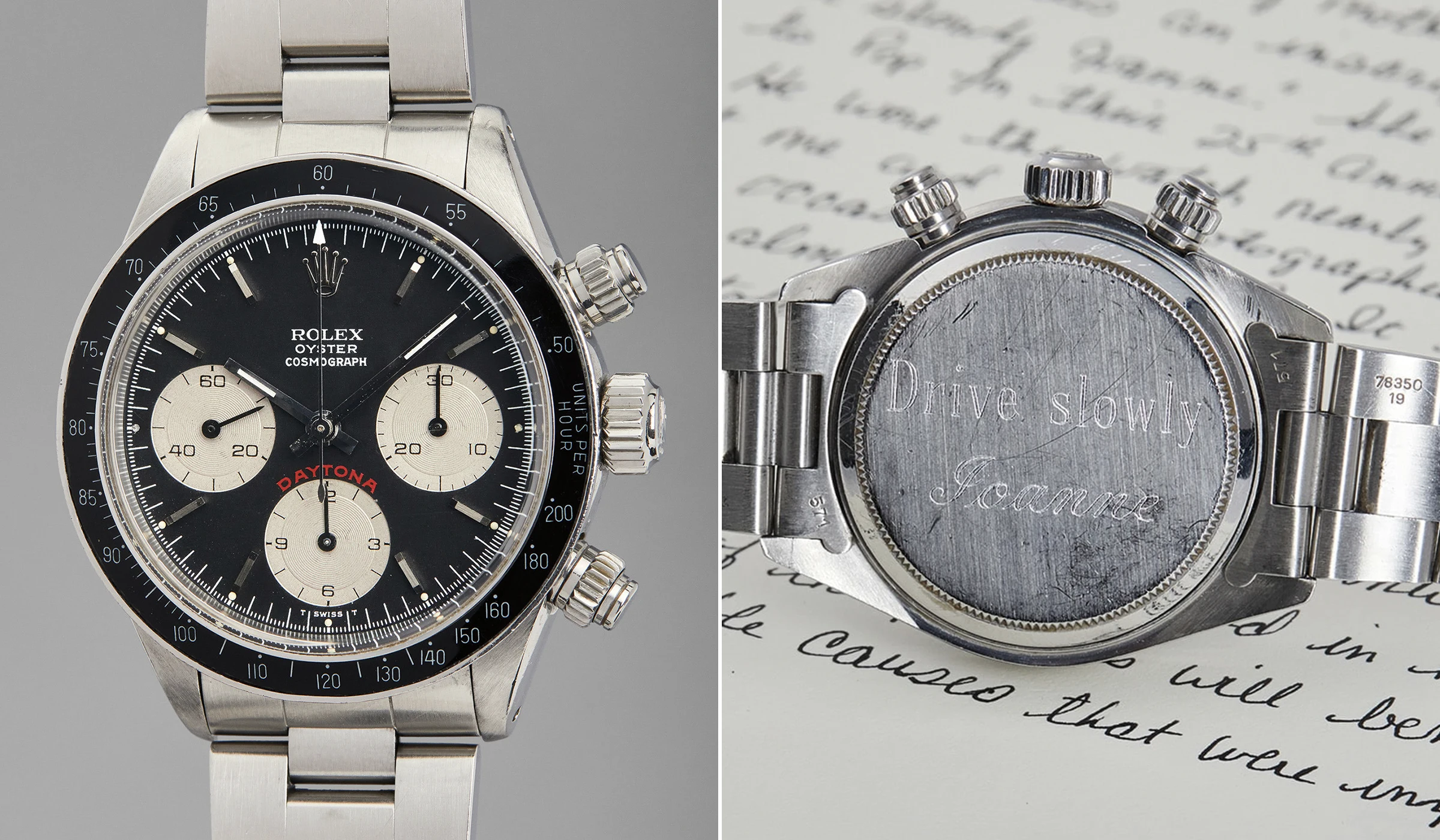
Credit © Phillips
Introduced in 1969, the Ref. 6263 houses the Rolex calibre 727 and features screw-down chronograph pushers. Together with the Ref. 6265 – the version fitted with a steel bezel – it ranks among the most important Rolex chronographs. Both references were offered with either silver-coloured or black dials, as is the case with the example described here. The designation “Big Red” refers to the prominent red “Daytona” signature on the dial, creating a distinctive black, red and white colour scheme.
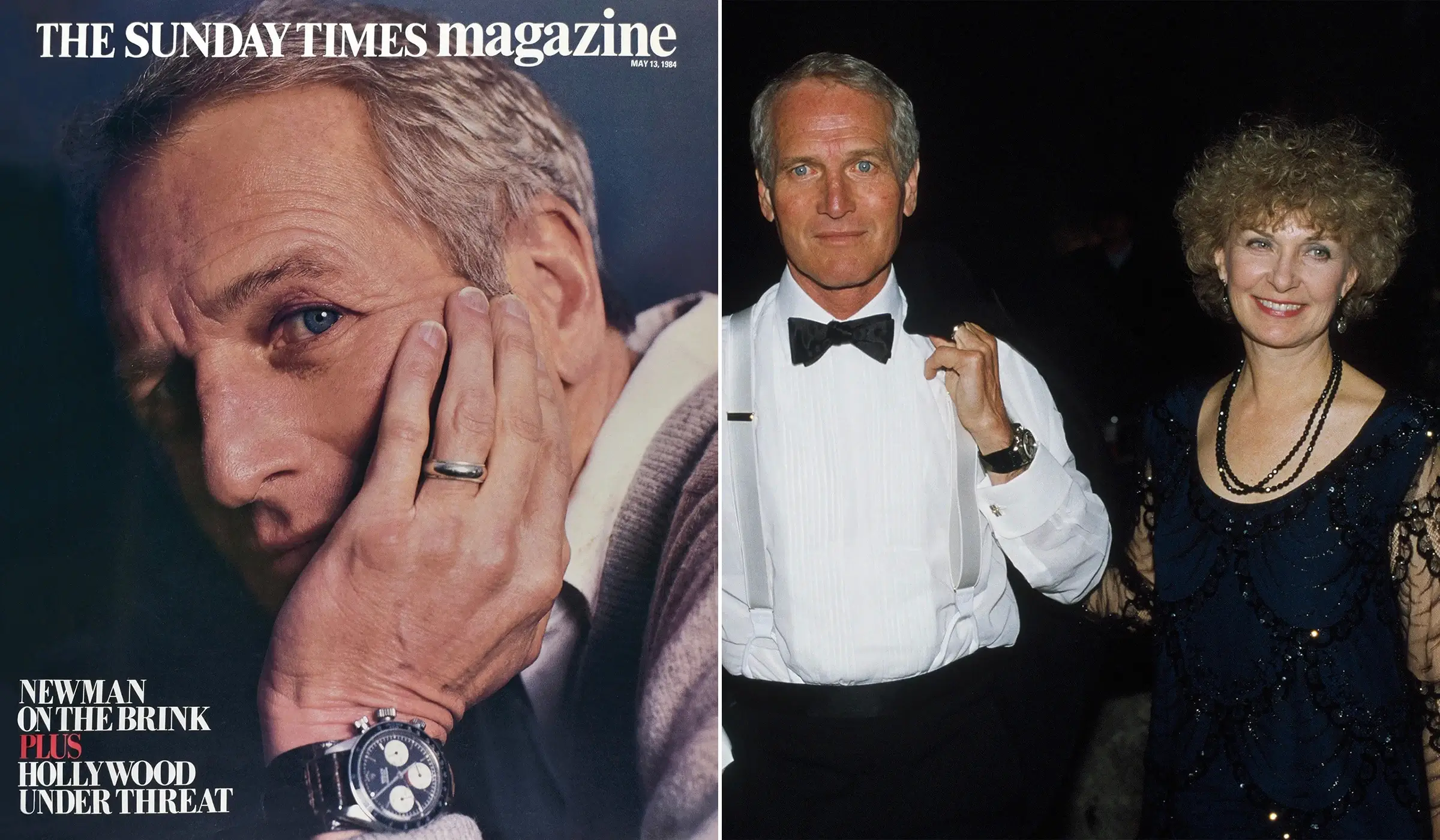
Credit © Phillips
The Cosmograph Daytona Ref. 6263, “Big Red”, was sold at Phillips’ “Racing Pulse” auction in 2020 for a total price, including buyer’s premium, of €4,519,875.
The story behind the watch ranked 6th among the most expensive Rolex wristwatches ever sold at auction is recounted by Phillips as follows: The year is 1954. The First Indochina War has come to an end, and the world powers, together with the Viet Minh, have gathered in Switzerland to negotiate the future of Vietnam. During a break in one of the sessions, a man steps out of the Hôtel des Bergues, where informal discussions are taking place, to take some fresh air. Unaware that his country will soon be divided in two – and that he himself will enter history as the last Emperor of Vietnam – he crosses the street to Chronométrie Philippe Beguin, a respected Rolex retailer. There, he formulates a request as simple as it is exacting: he wishes to acquire the rarest and most precious Rolex ever made. When even several of the models initially presented fail to satisfy him, Rolex is contacted directly. The manufacture promptly dispatches an employee from its workshops on the outskirts of Geneva, carrying an extraordinary watch. That watch is the Rolex Ref. 6062 described here – and the man who purchased it was Nguyễn Phúc Vĩnh Thụy, the 13th and final emperor of the Nguyễn dynasty. Having ascended the throne in 1925 at the age of twelve, he adopted the name Bao Dai, meaning “Keeper of Greatness”.
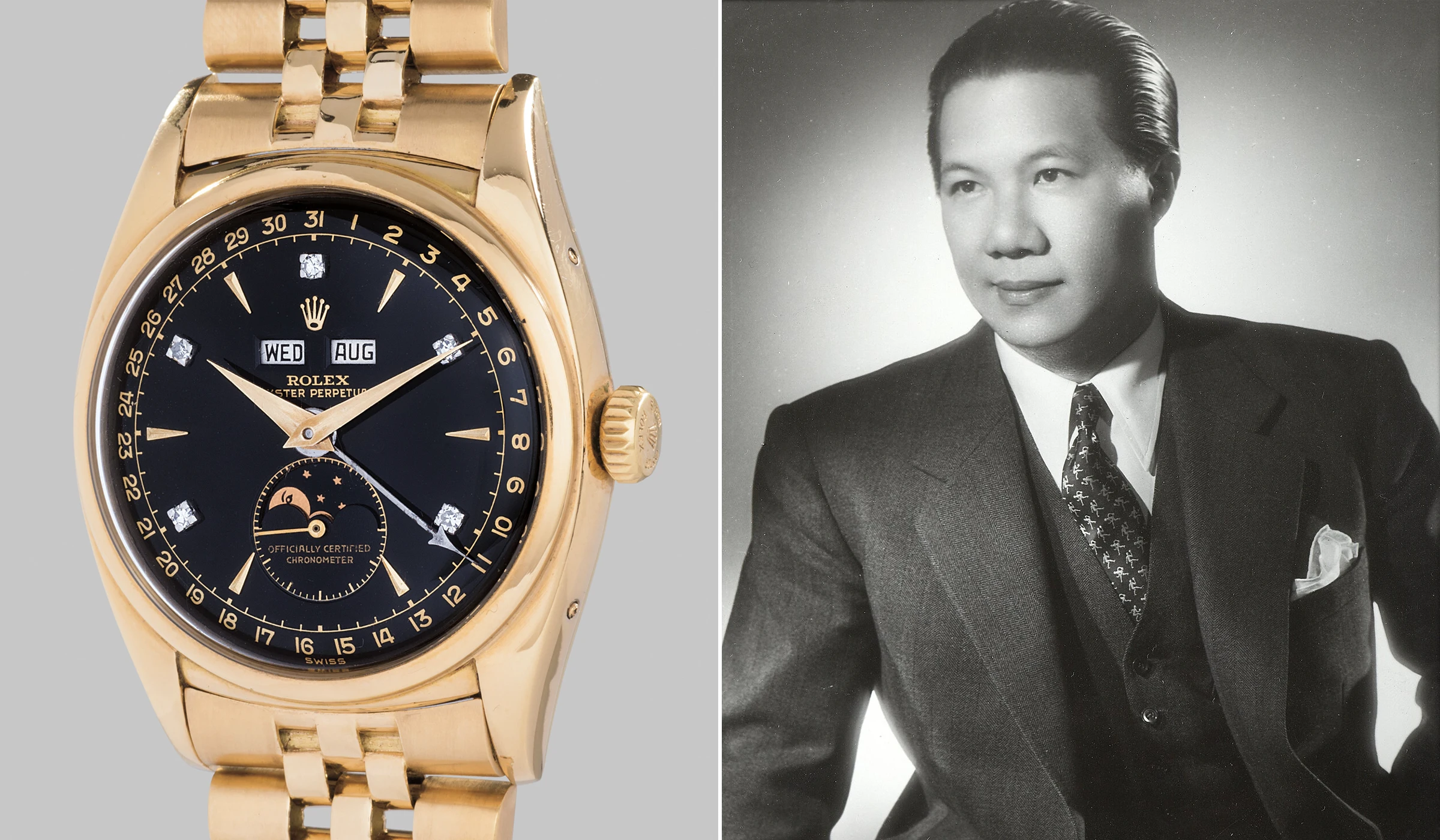
Credit © Phillips
According to Phillips, the Rolex Ref. 6062 later known as the “Bao Dai” was produced around 1952. It features a 36 mm yellow-gold Oyster case, an in-house automatic calibre 9¾”’ and – particularly rare for Rolex – a complete calendar complication with moon-phase display. The Ref. 6062 “Bao Dai” is one of only three known examples of this reference combining a black dial with diamond hour markers. While two of these watches feature six diamonds set at the odd hour positions, the “Bao Dai” is distinguished by five diamond markers placed at the even hours, resulting in a unique dial layout. Owing to the presence of a diamond at 12 o’clock, the Rolex coronet and signature had to be positioned lower on the dial, eliminating the usual “Rolex Oyster Perpetual” arrangement above the day and month apertures. In addition, the designation “Officially Certified Chronometer” was removed from the centre of the dial and relocated beneath the moon-phase display.
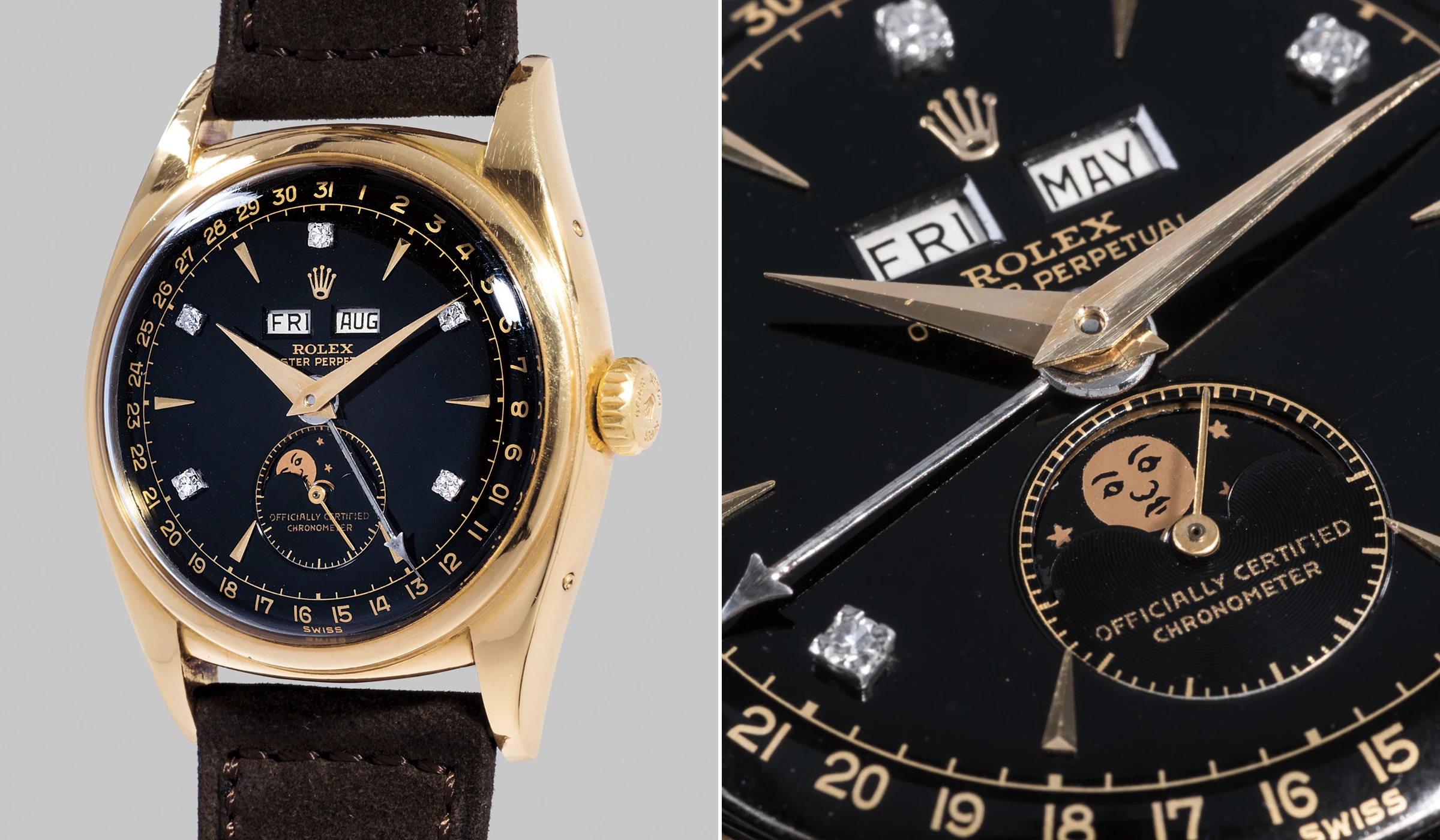
Credit © Phillips
The “Bao Dai” first appeared on the market in 2002, consigned by the emperor’s family. On that occasion, it achieved CHF 370,000 at Phillips, setting a record at the time as the most expensive Rolex ever sold at auction. Fifteen years later, it was offered again, now from the collection of its second owner. The Ref. 6062 “Bao Dai” was sold at Phillips’ “Geneva Watch Auction: FIVE” in 2017 for a total price, including buyer’s premium, of €4,630,015.
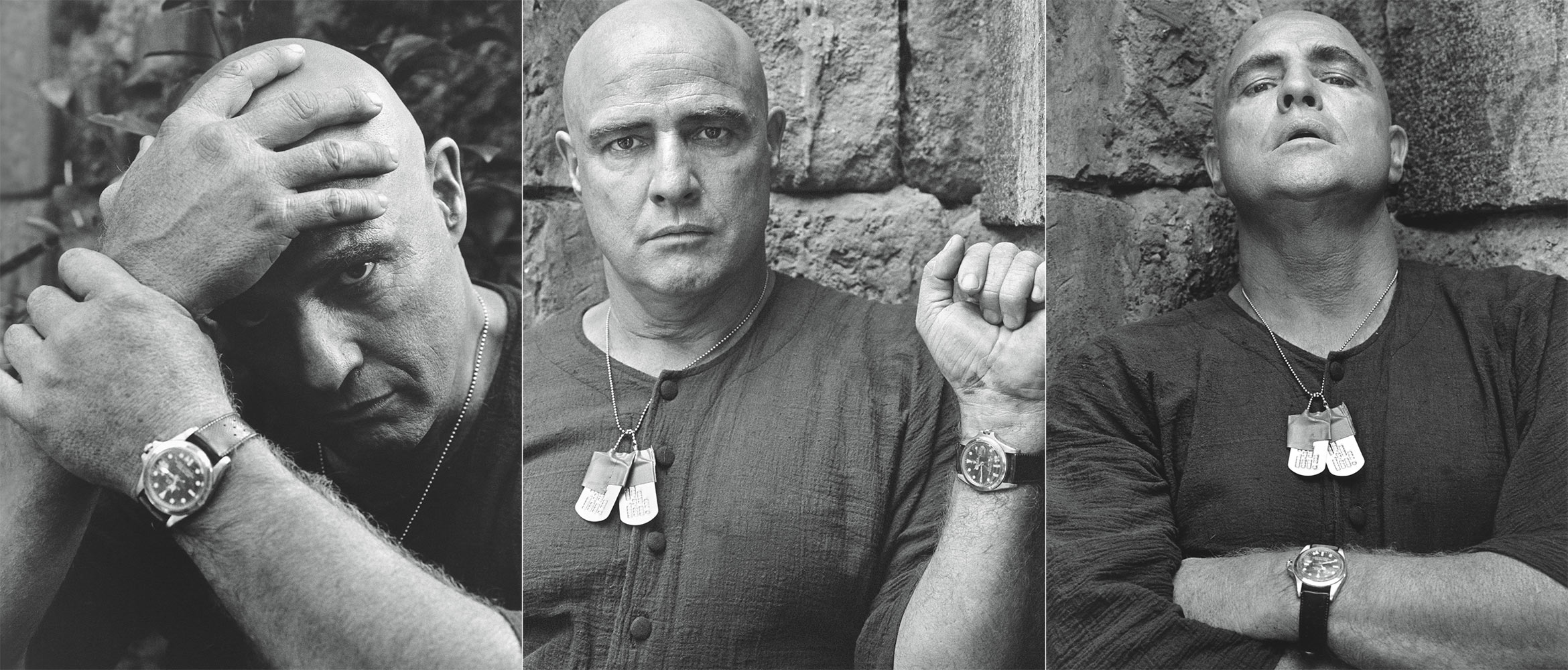
Ranked 5th among the most expensive Rolex wristwatches ever sold at auction is a timepiece once owned by Marlon Brando, the actor renowned for films such as The Godfather and A Streetcar Named Desire. This Rolex GMT-Master Ref. 1675, long considered lost, bears the nickname “Apocalypse Now”, as it was worn by Brando in the 1979 film of the same name, in which he portrayed Colonel Walter E. Kurtz. Brando had “M. Brando” engraved on the case back – a detail that went unnoticed prior to the watch’s auction in 2019. The watch remained in his possession until 1995, when, nearly twenty years after the filming of Apocalypse Now, he presented it to his adopted daughter, Petra Brando Fischer, following her graduation from Brown University in 1994. Together with the watch, he gave her a handwritten letter addressed to “Petra (dream girl)”, expressing his pride in her achievements. Referring to his Rolex, he wrote: “This watch is like a tank. You can do anything with it and it keeps on going. I want you to keep it as a reminder of how proud I am of you.”
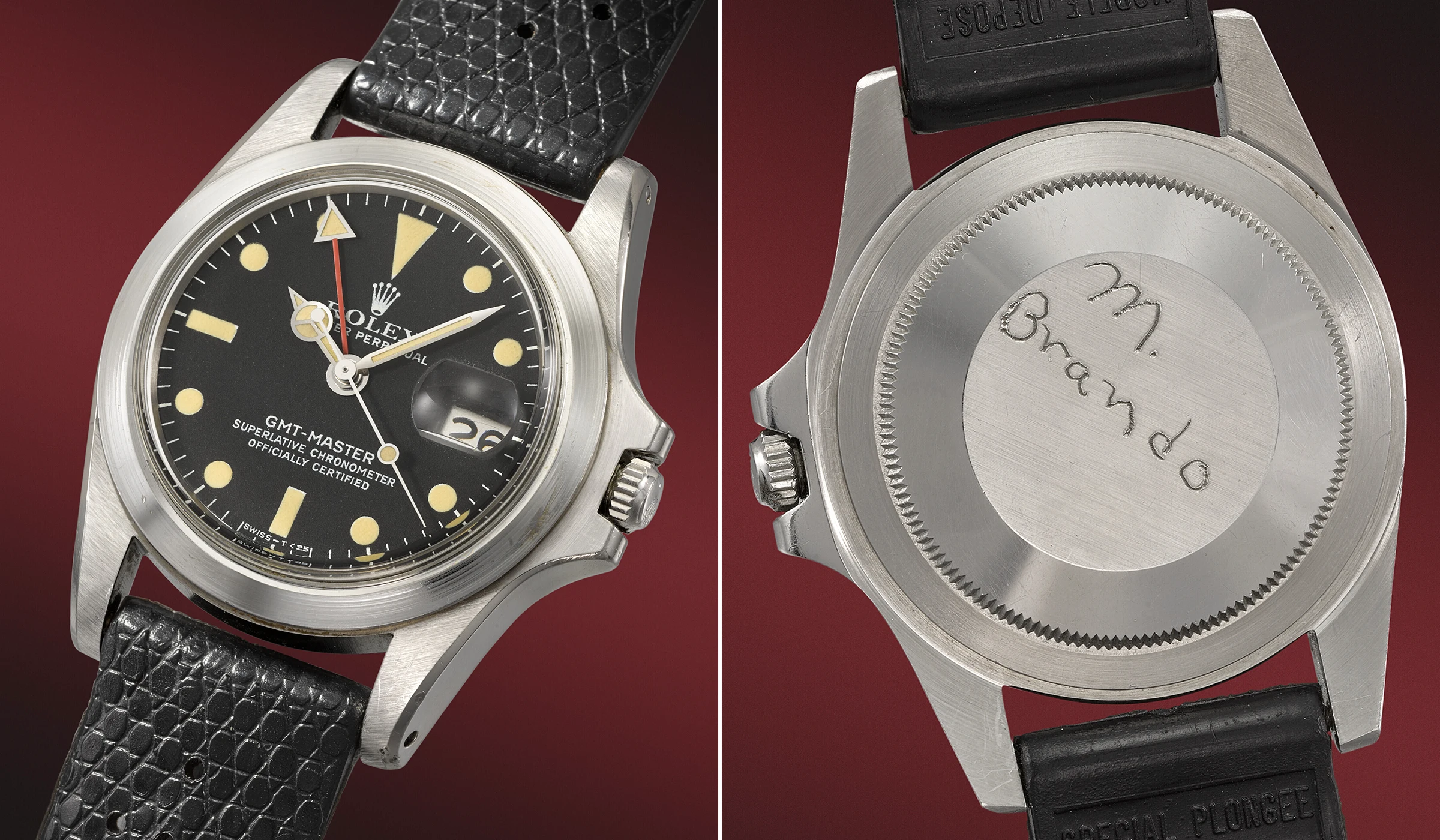
Credit © Christies
Beyond its provenance, the watch possesses further distinguishing characteristics. A notable feature of this Ref. 1675, dating to approximately 1972, is Brando’s decision to remove the bezel – a modification that may also help explain its considerable value. According to Petra Brando Fischer, he brought the watch to the film set in the Philippines but was told it appeared too conspicuous during shooting. Brando reportedly replied: “If they’re looking at my watch, then I’m not doing my job as an actor.” The watch was offered in the same condition in which Petra Fischer received it, including the black rubber strap. The case has never been polished, and the luminous hour markers and hands of the Mark IV dial have aged to a warm tone.
Credit © Christies
The GMT-Master Ref. 1675 worn by Marlon Brando during the filming of Apocalypse Now achieved a total price, including buyer’s premium, of €4,754,112 at Christie’s “Passion for Time” auction in 2023.
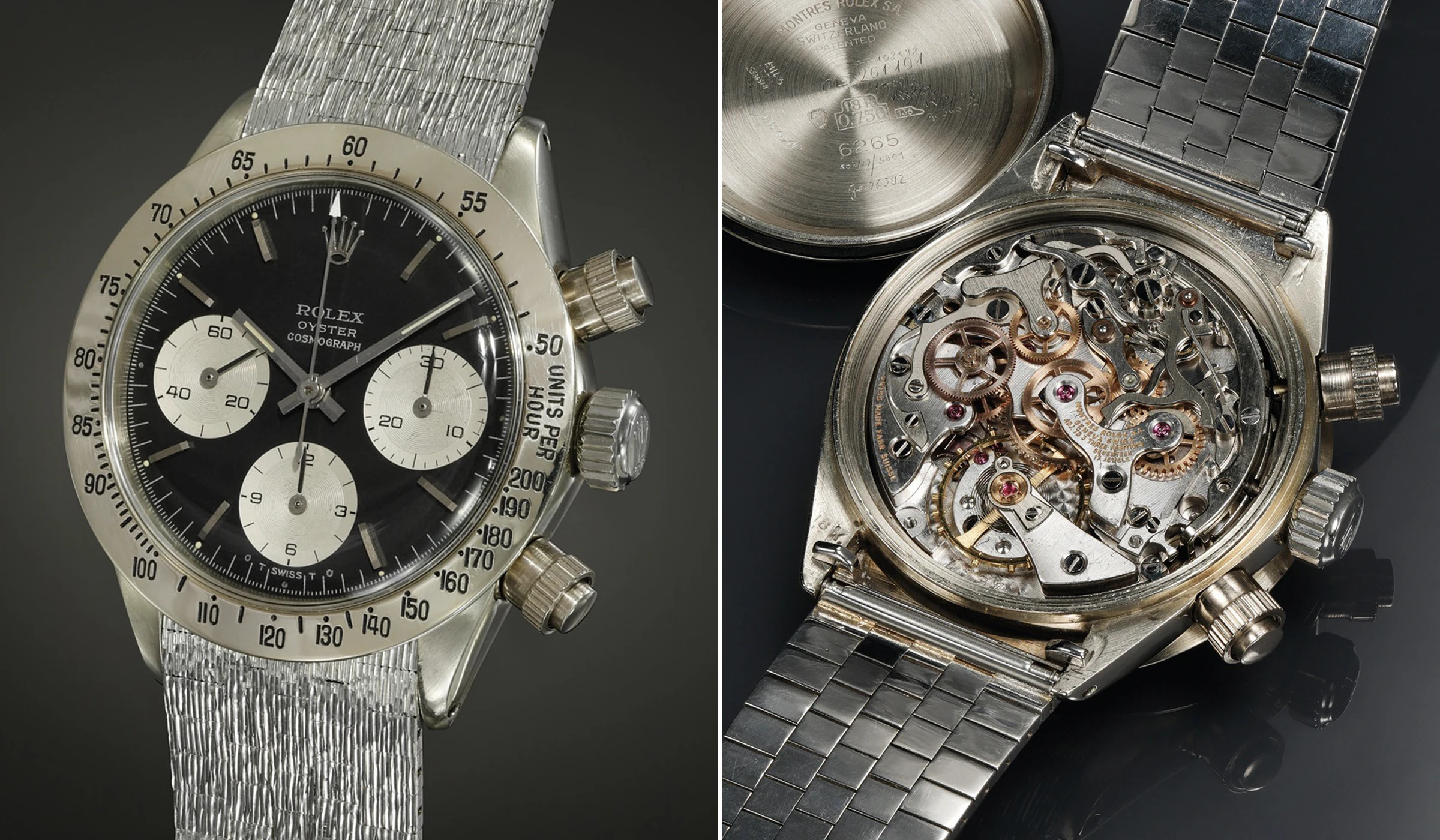
For decades, it was widely assumed that Rolex produced hand-wound Cosmograph models exclusively in stainless steel or yellow gold, but never in platinum, white gold or pink gold. Although a two-tone Cosmograph was discovered and auctioned at Phillips in 2017, the notion that Rolex had departed from its traditional material policy was long considered improbable. This assumption was overturned in 2013, when the watch platform Hodinkee publicly presented a unique and highly significant piece: a Cosmograph Daytona Ref. 6265 in a white-gold case. Research suggests that it was manufactured as a special order for a German retailer in 1970 and delivered in 1971. According to Phillips, the model was internally designated as Ref. 6265/9. Historically, Rolex used the suffix 8 to denote yellow-gold models, while the suffix 9 indicated white-gold cases. This nomenclature is corroborated by contemporary product documentation listing yellow-gold Cosmographs as Ref. 6265/8.
Credit © Phillips
The watch originated from the collection of John Goldberger, who complemented the piece – originally delivered on a leather strap – with a solid white-gold bracelet, further emphasising its material character. Its desirability was further enhanced by the presence of a black “Sigma” dial consistent with the period of production, featuring silver-coloured subsidiary dials that stand out in sharp contrast against the dark background.
The Oyster Cosmograph Ref. 6265, “The Unicorn”, was sold at Phillips’ “Daytona Ultimatum” auction in 2018 for a total price, including buyer’s premium, of €4,970,233.
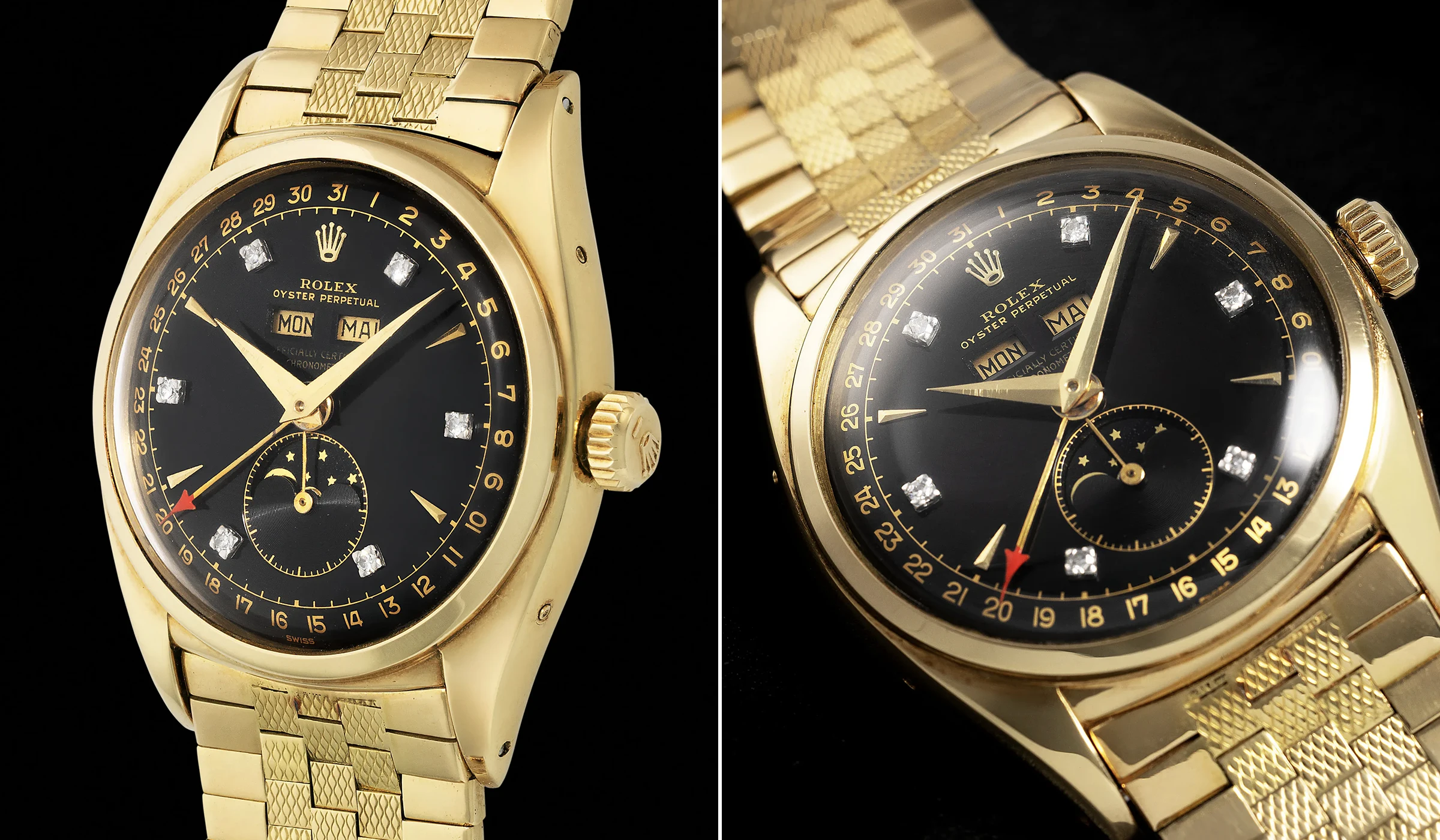
Complications have traditionally been rare within Rolex’s portfolio. The Rolex Ref. 6062 described here, ranked 3rd among the most expensive Rolex wristwatches ever sold at auction, combines no fewer than four indications – day of the week, month and date of a classical complete calendar, together with a moon-phase display – all integrated into a waterproof 36 mm yellow-gold Oyster case with screw-down case back and screw-down crown. The watch is accompanied by an original yellow-gold “Tile” bracelet. The estimated production of the Ref. 6062 amounts to only around 350 examples. Within this already highly limited series, several dial variations can be distinguished. A particularly sought-after version among collectors is the two-tone dial. The so-called “Stelline” or star dial, produced by Stern Frères, is characterised by faceted, star-shaped hour markers. Rarest of all, however, is the black lacquered dial, as found on the watch ranked 3rd in this list. Its design culminates in six diamond hour markers positioned at 1, 3, 5, 7, 9 and 11 o’clock, as well as in the red-tipped date hand, which points to numerals rendered in a golden tone that forms a harmonious contrast against the black background.
Credit © Monaco Legend Auctions
The principal distinctions between the Ref. 6062 described here and the “Bao Dai” (ranked 6th) lie in its gold-backed date discs, the red tip of the date hand, and the presence of six diamonds instead of five. Within the exclusive circle of Ref. 6062 watches featuring black dials with diamond hour markers, only one additional example is known alongside the present six-diamond version and the five-diamond Ref. 6062 “Bao Dai”. This third example likewise features six diamonds at the odd hour positions – 1, 3, 5, 7, 9 and 11 o’clock. The Ref. 6062 described here was first sold on 14 May 2006 at the Antiquorum auction “Mondani Collection of Rolex Wristwatches”. It remained in private hands for nearly two decades before reappearing in October 2025 at Monaco Legend Auctions’ “Exclusive Timepieces” sale. There, the Ref. 6062 achieved a total price, including buyer’s premium, of €5,330,000.
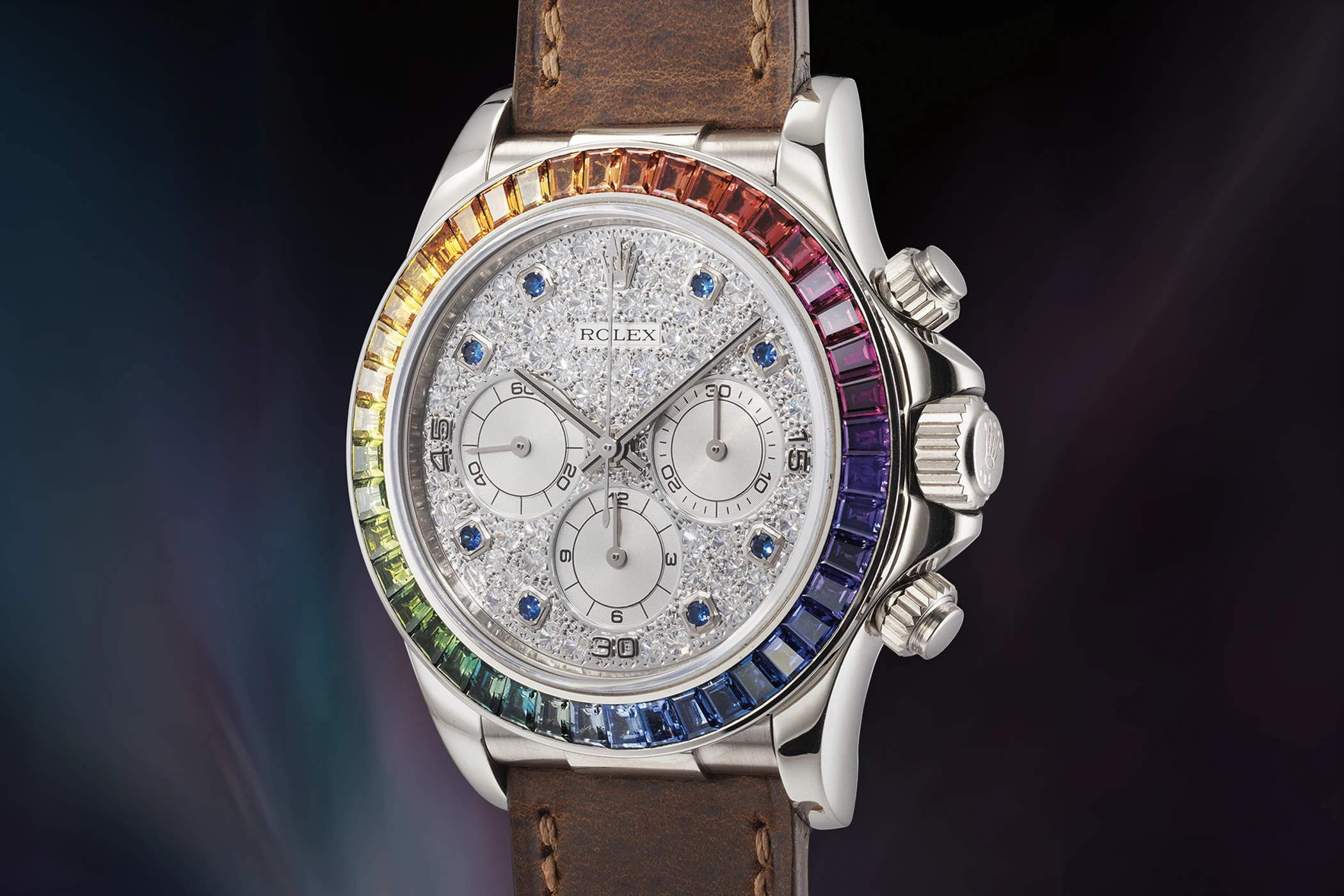
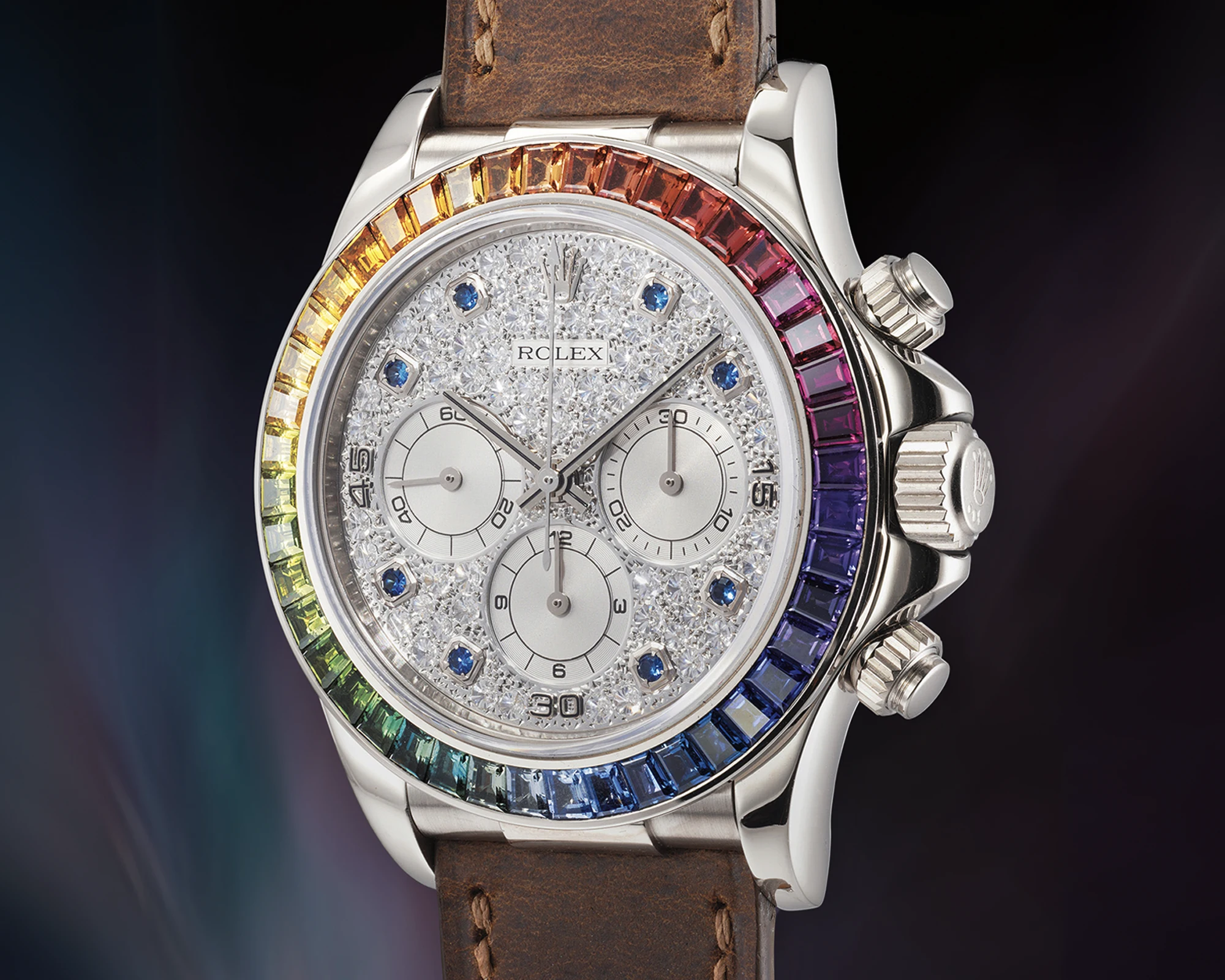
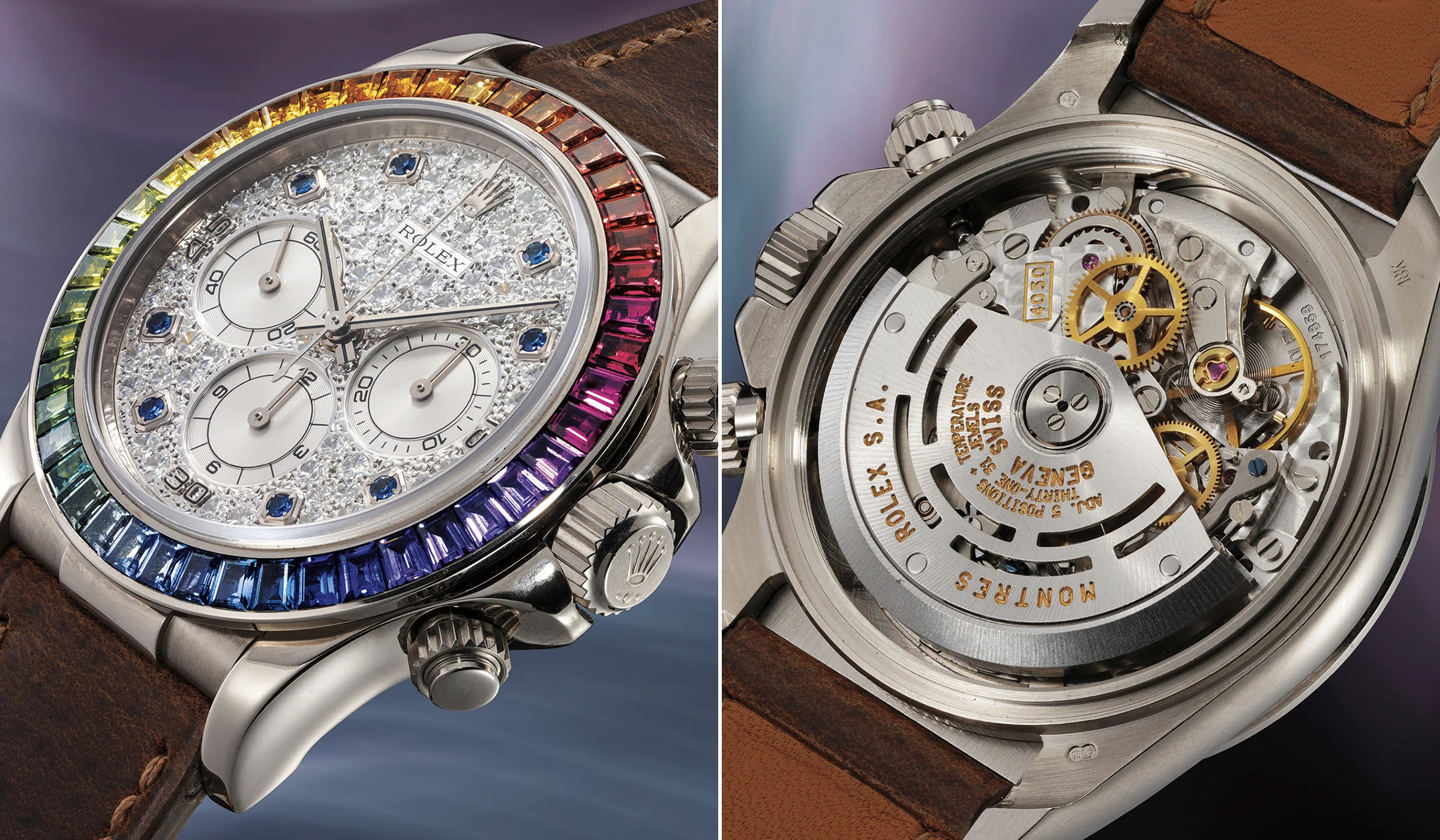
Although Rolex is widely regarded as the most recognisable watch brand in the world, producing an estimated over one million watches per year and accounting for roughly one third of total Swiss watch production, the Crown maintains an aura of both prestige and mystery through its calculated discretion. Part of this mystique surrounds the so-called “off-catalogue” Rolex models – pieces not included in the regular product catalogue, reserved for VIP clients and often set with vividly coloured gemstones that command correspondingly high prices. Among the most prominent of these off-catalogue creations is a unique white-gold Rolex Cosmograph Daytona, Ref. 16599SAAEC, produced as early as around 1994. Its bezel is set with 44 baguette-cut sapphires in a sequence of graduating colours forming the spectrum of a rainbow – hence the designation “Rainbow” Daytona. The dial is further adorned with blue sapphire hour markers and fully pavé-set diamonds.
Credit © Phillips
The Rolex Cosmograph Daytona “Rainbow” Ref. 16599SAAEC is considered exceptional for two principal reasons. Firstly, while it had long been established that Rolex produced automatic Cosmographs with a variety of gem-set bezels – some with diamonds, others with different coloured sapphires, and in particularly exclusive cases even with emeralds – the market had only ever seen models set with a single type of baguette stone. It was not until 2012 that Rolex officially introduced the “Rainbow” Daytona in yellow gold (Ref. 116598RBOW) and white gold (Ref. 116599RBOW), followed by a rose-gold version (Ref. 116595RBOW) in 2018. The Ref. 16599SAAEC therefore predates the catalogue “Rainbow” models by nearly two decades. Notably, the colour sequence on the Ref. 16599SAAEC runs in the reverse direction compared to all subsequently produced Rainbow Daytonas.
Credit © Phillips
Secondly, the Ref. 16599SAAEC is distinguished by its calibre 4030, which is not a fully in-house Rolex movement but is based on Zenith’s El Primero calibre 400 – the first high-frequency automatic chronograph movement ever produced. Before meeting Rolex’s standards, the Zenith El Primero calibre 400 underwent approximately 200 modifications. Among the revised components were the balance bridge incorporating Rolex’s proprietary Microstella fine-regulation system, as well as the shock-absorption system. In addition, the power reserve was increased from 42 to 52 hours, and the frequency was reduced from 36,000 to 28,800 vibrations per hour.
The white-gold Ref. 16599SAAEC – better known as the “Rainbow Zenith Daytona” – was sold at Phillips’ “Reloaded: The Rebirth of Mechanical Watchmaking, 1980–1999” auction in 2024 for a total price, including buyer’s premium, of €5,869,805.
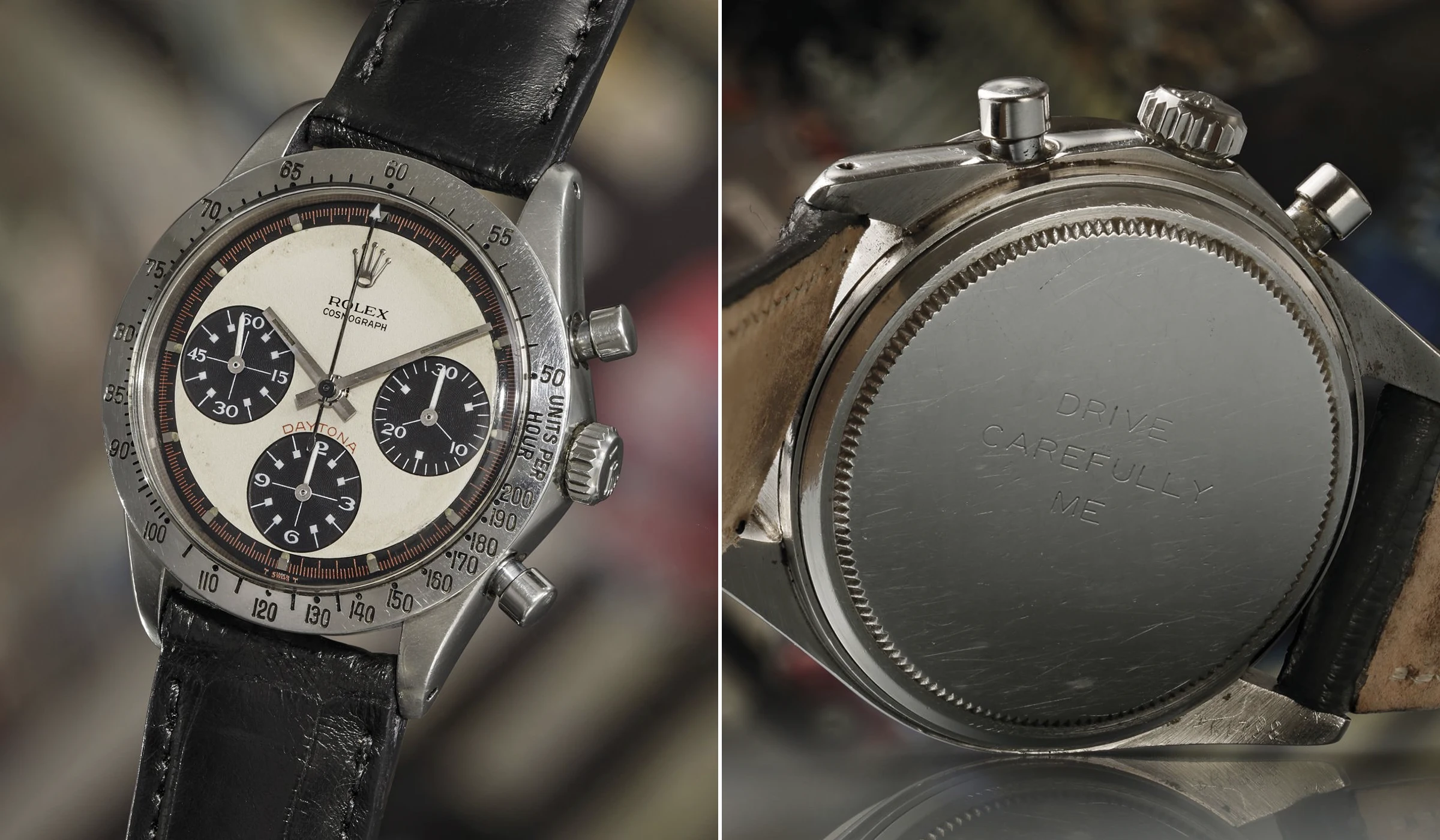
On 26 October 2017, Phillips held the auction “Winning Icons – Legendary Watches of the 20th Century” in New York. Among the 49 lots offered, however, Lot 8 attracted particular attention. It comprised the Rolex Daytona Ref. 6239 with so-called “Exotic” dial – later known as the “Paul Newman” dial – which, according to Phillips, had been presented by Joanne Woodward to her husband Paul Newman during the filming of Winning in 1969. A video recording of the approximately twelve-minute bidding battle captures what followed once the lot was called. The sale opened with a dramatic opening bid of US$10 million and concluded at US$15,500,000, placed by an anonymous telephone bidder. The result not only established the watch as the most expensive Rolex ever sold at auction, but also as the most valuable film prop in the world.
Credit © Phillips
What, then, lies behind this watch – and which circumstances justified its exceptional price? According to Phillips, Joanne Woodward purchased the Rolex Daytona Ref. 6239 for her husband during the filming of Winning in 1969. In the film, Paul Newman portrayed racing driver Frank Capua, while Woodward fittingly played Capua’s wife. The watch, fitted with an “Exotic” dial later renamed the “Paul Newman” dial, was acquired around 1968 from Tiffany & Co. on Fifth Avenue in New York, as suggested by a hand-engraved inventory number on the reverse of one of the lugs. Over the course of his life, Newman was photographed wearing several generations of the Daytona; however, the present watch is the first and only Daytona with an “Exotic” dial that he wore. The case back bears the affectionate inscription “DRIVE CAREFULLY ME”. Around 1984, the watch was entrusted to James Cox – then the boyfriend and today a close confidant of Newman’s daughter Nell Newman – who preserved it before ultimately consigning it to auction.
The Cosmograph Daytona Ref. 6239, “Paul Newman”, was sold at Phillips’ “Winning Icons – Legendary Watches of the 20th Century” auction in 2017 for a total price, including buyer’s premium, of €15,170,911.
This article features the most expensive Rolex wristwatches to date,
as of February 2026.
| Model | Price realised |
|---|---|
| 15. Cosmograph Daytona Ref. 6264 with “Paul Newman Lemon” Dial | EUR 2,641,911 |
| 14. Cosmograph Daytona Ref. 16516 with Lapis Lazuli Dial | EUR 2,897,610 |
| 13. Split-Seconds Chronograph Ref. 4113, Case No. 051321 | EUR 3,284,000 |
| 12. Oyster Cosmograph Ref. 6263 with “Paul Newman Lemon” Dial, “The Legend”, Case No. 2,330,529 | EUR 3,401,681 |
| 11. Oyster Cosmograph Ref. 6263 with “Paul Newman Lemon” Dial, “The Legend”, Case No. 2,330,402 | EUR 3,447,420 |
| 10. Cosmograph Daytona Ref. 6270 | EUR 3,773,444 |
| 9. Split-Seconds Chronograph Ref. 4113, Case No. 051319 | EUR 4,077,380 |
| 8. Cosmograph Daytona Ref. 6270, “The King” | EUR 4,502,167 |
| 7. Cosmograph Daytona Ref. 6263, “Big Red” | EUR 4,519,875 |
| 6. Ref. 6062, “Bao Dai” | EUR 4,630,015 |
| 5. GMT-Master Ref. 1675, worn by Marlon Brando during the filming of Apocalypse Now | EUR 4,754,112 |
| 4. Oyster Cosmograph Ref. 6265, “The Unicorn” | EUR 4,970,233 |
| 3. Ref. 6062 | EUR 5,330,000 |
| 2. Cosmograph Daytona Ref. 16599SAAEC, “Rainbow Zenith Daytona” | EUR 5,869,805 |
| 1. Cosmograph Daytona Ref. 6239, “Paul Newman” | EUR 15,170,911 |
The auction data used for this article is sourced from everywatch.com.