Breguet is celebrating the brand's 250th with a spectacular and ultra-precise watch. The brand plans to manufacture 75 copies of the Expérimentale 1.
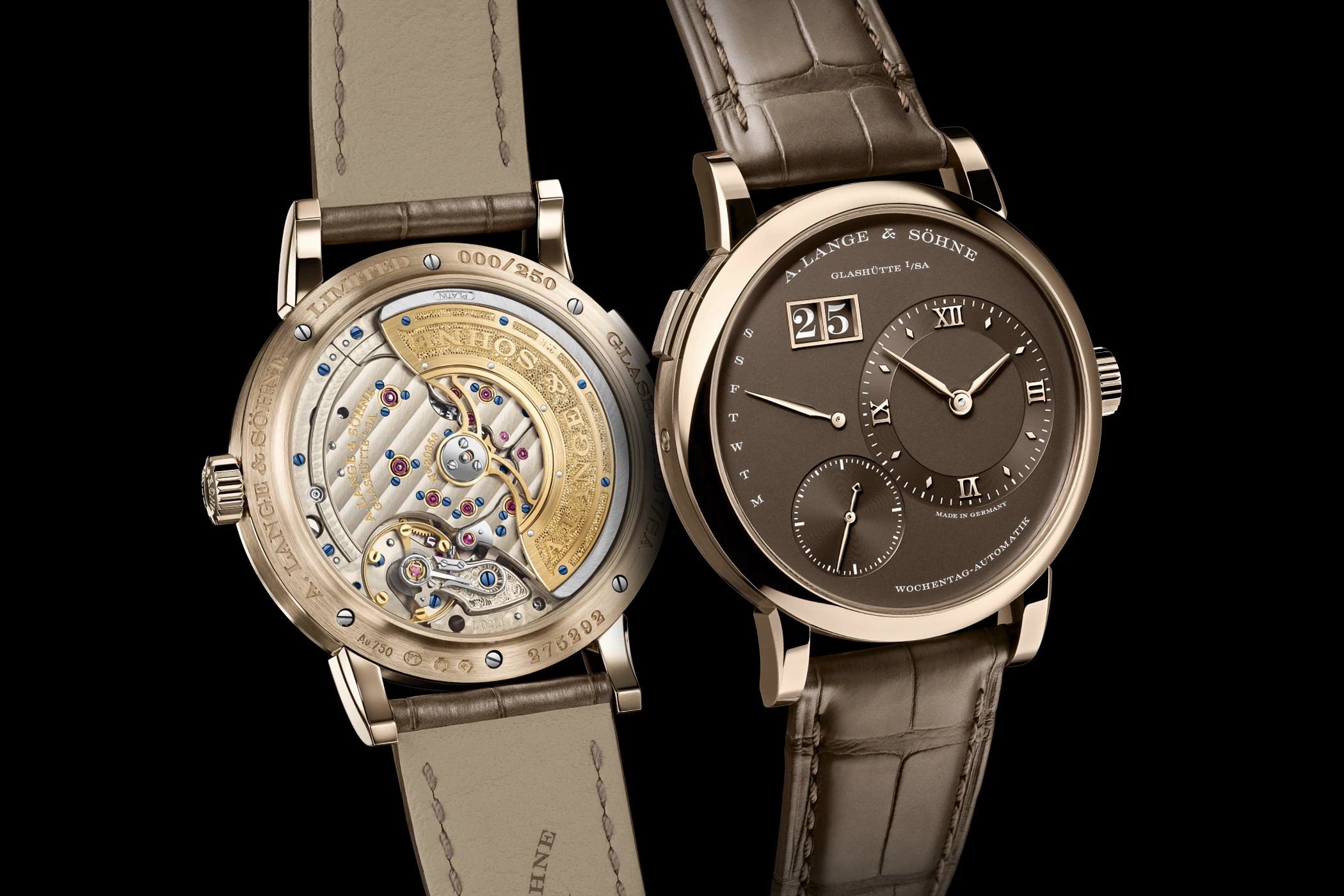
With the new Lange 1 Daymatic Honeygold, the manufacture marks 7 December – a date that represents two historical milestones for A. Lange & Söhne.
7 December holds particular significance for the German watch manufacturer A. Lange & Söhne for several reasons. It marks, first of all, the day in 1845 on which Ferdinand Adolph Lange laid the foundations of German fine watchmaking in Glashütte by establishing the workshop “Lange & Cie.” From then on, Lange introduced a division-of-labour manufacturing system supported by precision tools to enable the economical production of high-quality pocket watches, advanced the training of local apprentices, set technical standards, and ultimately transformed Glashütte into Germany’s centre of fine watchmaking. The date also signifies a modern turning point: on 7 December 1990, the year of German reunification, his great-grandson Walter Lange registered Lange Uhren GmbH in Glashütte and reinstated the brand name A. Lange & Söhne.
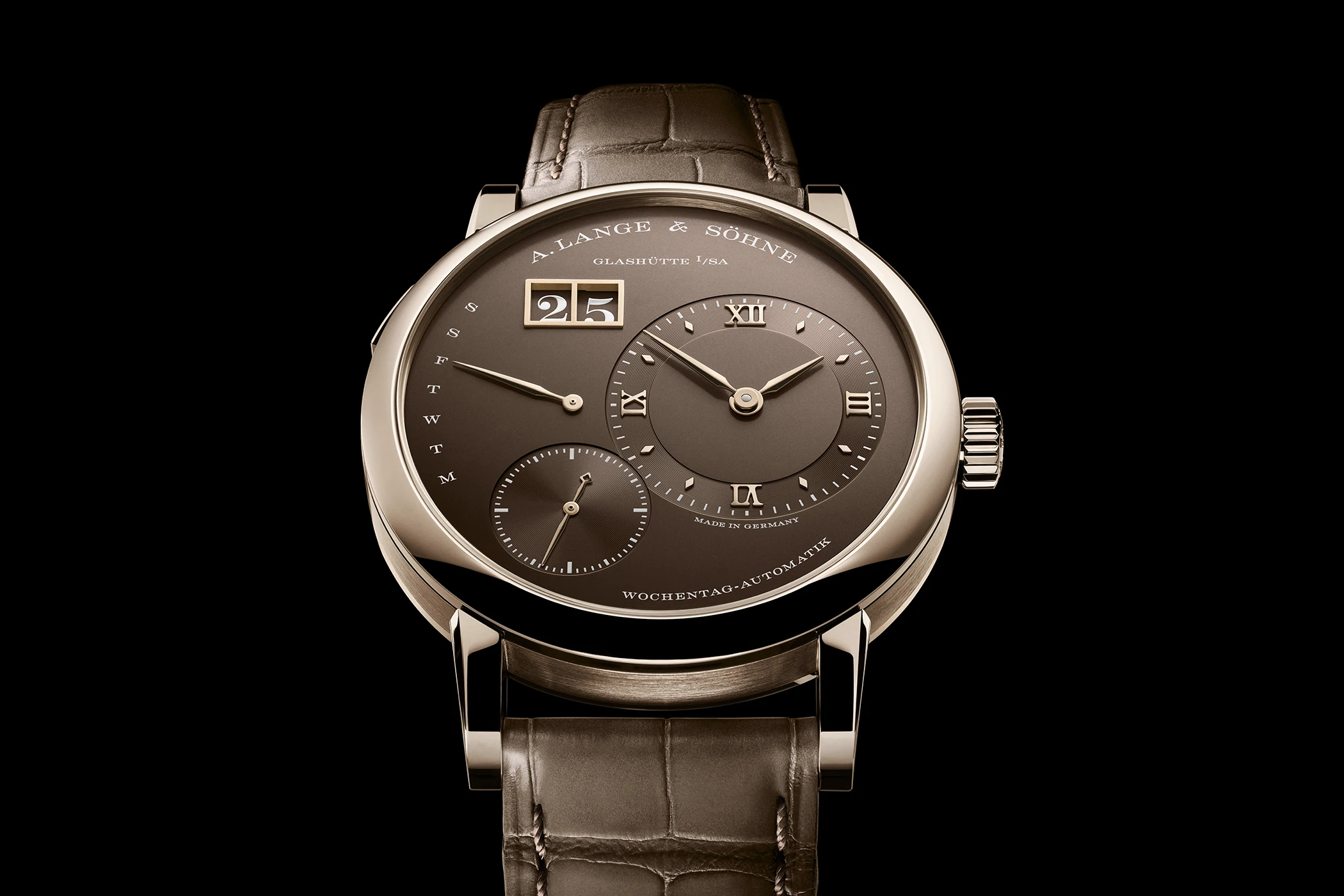
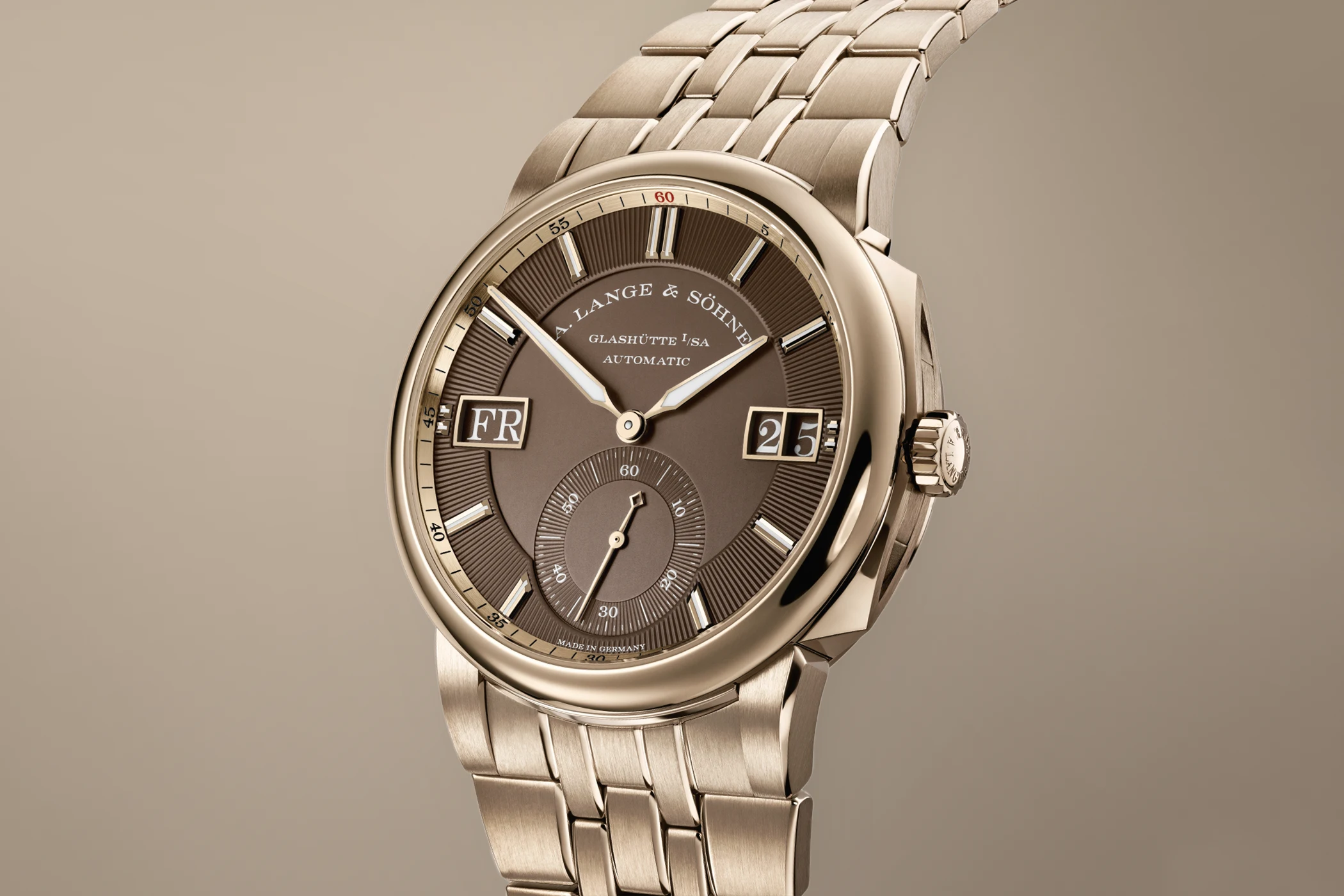
This year, the manufacture uses this historically charged day to unveil a new limited edition of the Lange 1 Daymatic—restricted to 250 pieces—presented for the first time in a case made of Honeygold and paired with a brown dial. The new A. Lange & Söhne Lange 1 Daymatic Honeygold thus follows in the footsteps of the sporty-elegant Odysseus, which A. Lange & Söhne introduced at this year’s Watches & Wonders in April, likewise featuring a 750-Honeygold case combined with a brown dial. The Honeygold alloy was first used in 2010 and remains reserved exclusively for select high-end pieces within the Lange portfolio. However, this article aims not only to examine the new A. Lange & Söhne Lange 1 Daymatic Honeygold, but also to take a closer look at the Lange 1 collection and its current models.
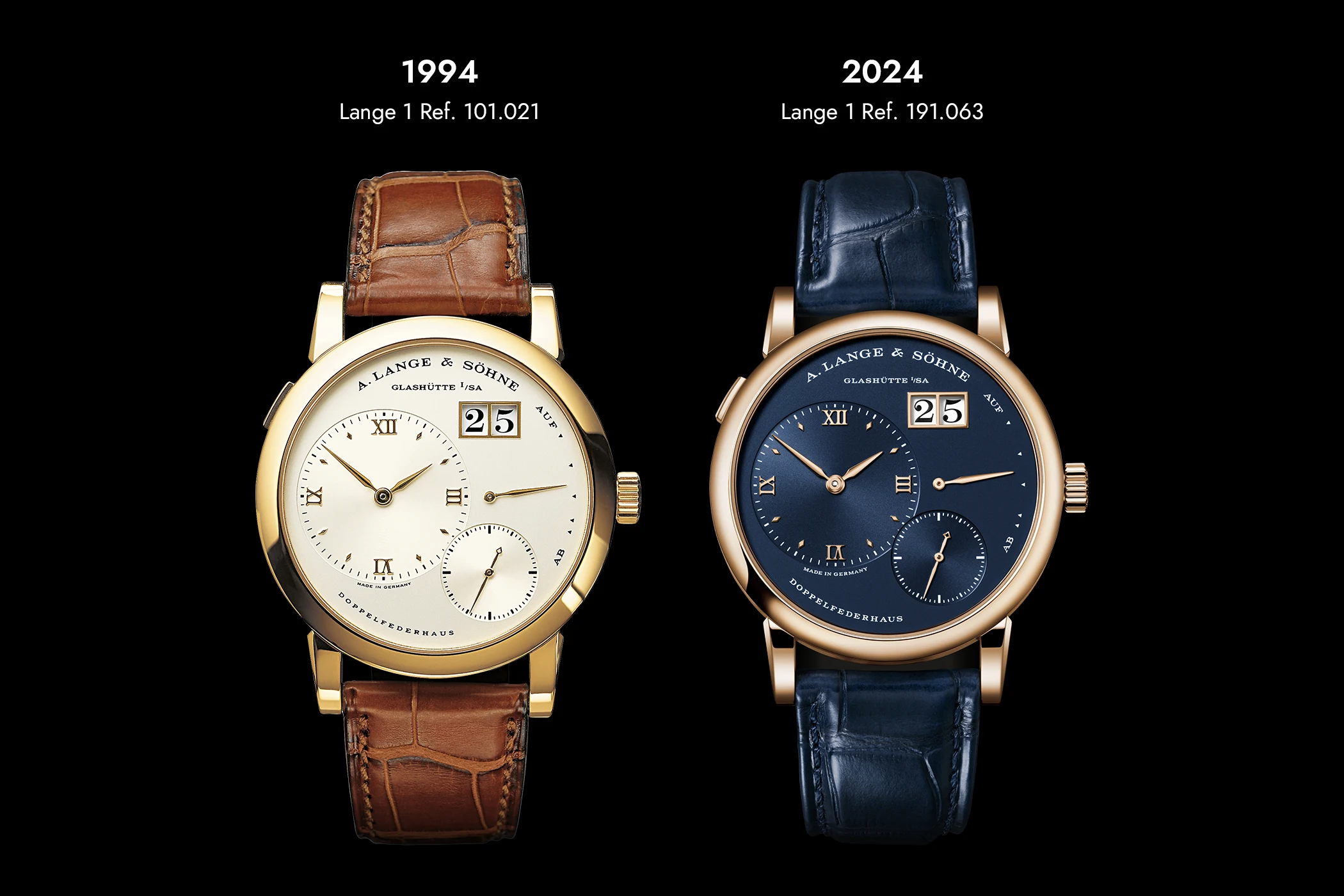
Since its debut on 24 October 1994, the Lange 1 collection has undergone several important technical milestones, reflected in the numerous complications that have been incorporated into the line over the years. The family currently comprises ten models featuring different case diameters, either hand-wound or automatic movements, and additional functions such as a moon-phase display, a second time zone, or the combination of a tourbillon with a perpetual calendar. Below is an overview of all current Lange 1 models.
Every Lange 1 is constructed according to a defined principle: its dial layout, despite the decentralised displays, is governed by clear proportions. Central to this is the Golden Ratio, in which two dimensions relate to one another by approximately 1 to 1.618. This principle appears on the Lange 1 not only in the relationship between the diameters of the main dial and the hour-and-minute subdial, but also in the proportions of the outsize date aperture. It is complemented by a rigorously applied axis symmetry: the centres of the outsize date, power-reserve indicator and small seconds lie on a shared vertical axis, which, together with the centre of the hour and minute hands, forms an isosceles triangle. This interplay results in the characteristic equilibrium of the dial—and thus defines the Lange 1. Since its introduction on 24 October 1994, Lange has produced more than twenty variations of the model. In 2015, the Lange 1 received a technically updated movement, the hand-wound calibre L121.1, featuring a double mainspring barrel and a 72-hour power reserve. It incorporates an in-house–developed balance spring and a free-sprung eccentric balance. Since then, the outsize date has also advanced precisely at midnight.
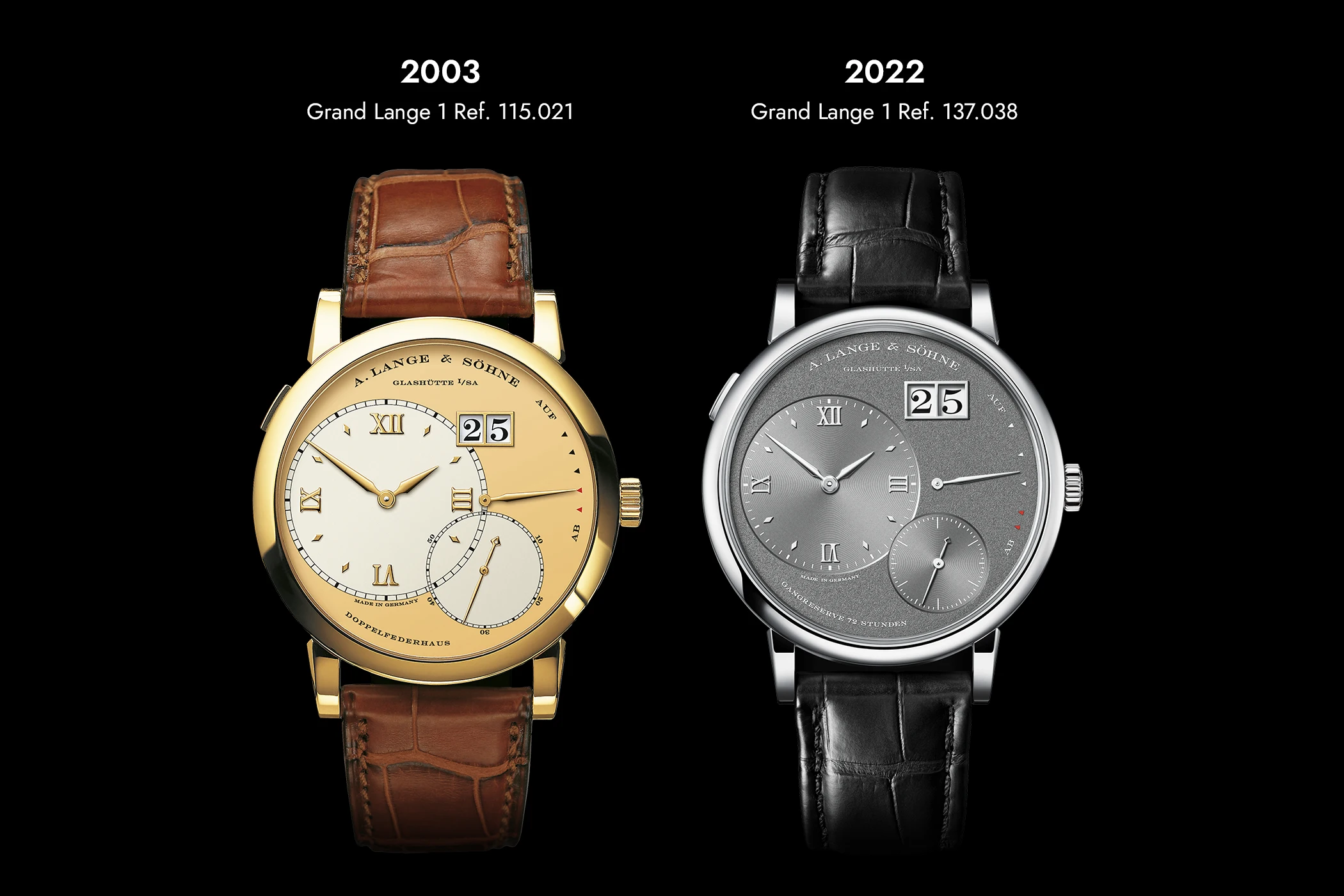
Owing to the model’s immediate success, the manufacture introduced two further developments of the concept. The Little Lange 1, presented in 1998, offered a reduced diameter—2.4 mm smaller than the original. Since 2018, it too has been powered by the newly conceived in-house calibre L121.1. In 2003, the Grand Lange 1 followed, increasing the diameter by 3.4 mm compared with the original. With its 41.9 mm case and two-tone dial design, it delivered significantly more presence on the wrist. In 2012, it also received a new hand-wound calibre—the L095.1 with a 72-hour power reserve—which allowed the case height to be reduced from 11.0 to 8.8 millimetres.
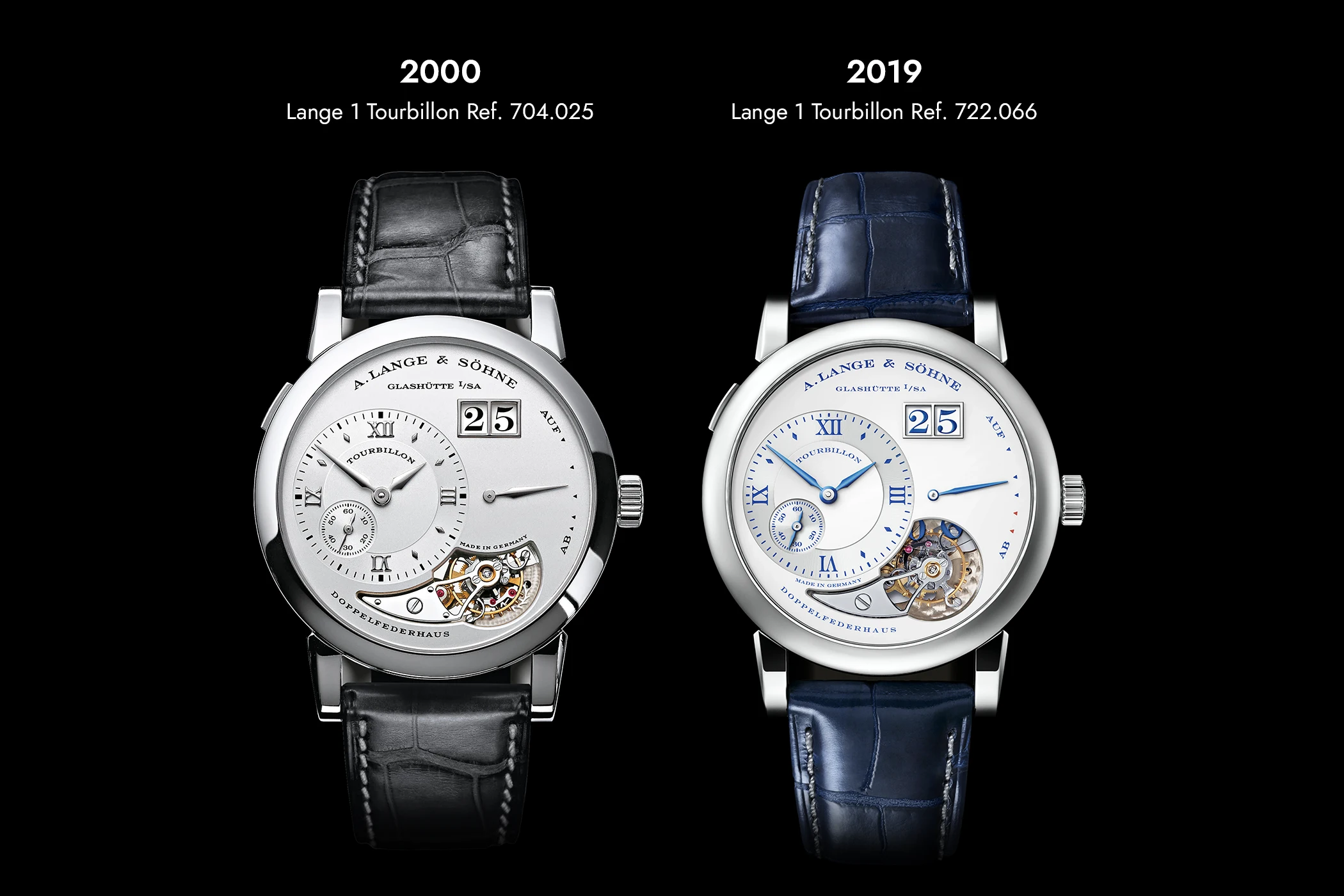
When it was introduced in 2000 under reference 704.025, the Lange 1 Tourbillon was the first wristwatch in the world to combine a tourbillon with an outsize date, a double mainspring barrel providing a 72-hour power reserve, and a progressive power-reserve indicator. This was made possible by the newly developed hand-wound calibre L961.1, which positions the tourbillon by means of a long, mirror-polished cock, moving it out of the movement’s natural symmetry to the position where the small seconds sits on the standard Lange 1. However, what could not yet be achieved in 2000 was later realised in the subsequent Lange 1 Tourbillon models bearing the designations “165 Years – Homage to F.A. Lange” and “Handwerkskunst”. Their improved calibres L961.2 and L961.3 made it possible to brake the balance inside the rotating tourbillon cage directly and without delay—thus enabling a stop-seconds mechanism for the tourbillon.
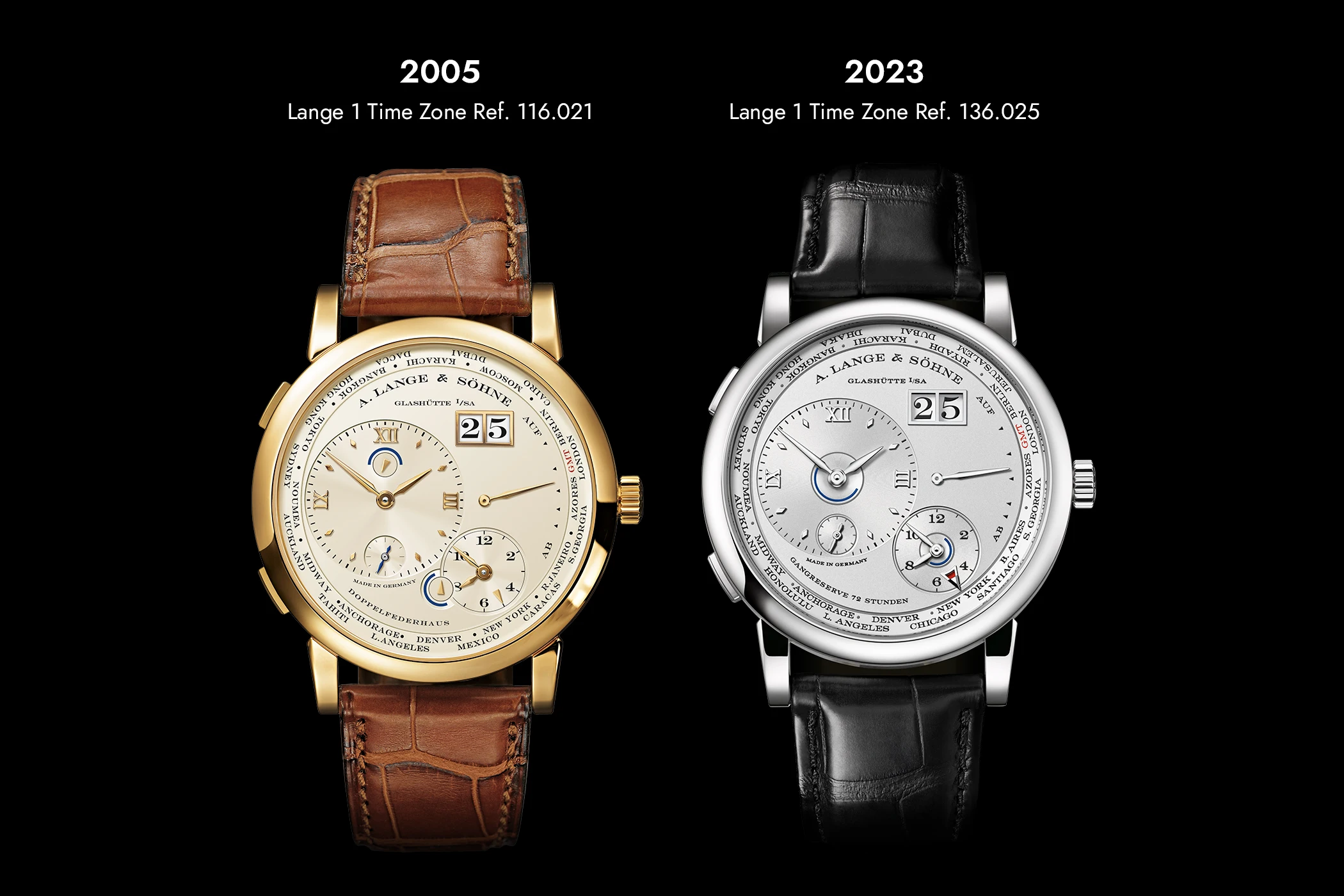
The Lange 1 Time Zone was first introduced in 2005 under reference 116.021 and is defined by its innovative display of home time and zone time, complemented by a rotating city ring. The dial allows the wearer to read the home time via the larger hour-and-minute subdial, while the time of a second zone is shown on the smaller subdial at 5 o’clock in combination with the city ring. A switching mechanism also makes it possible to swap the two time indications should the selected zone time become the new home time. Fifteen years after its debut, the Lange 1 Time Zone received an update in 2020 with the new in-house calibre L141.1 featuring a 72-hour power reserve. The redesign introduced ring-shaped day/night indicators and an additional daylight saving time indication, providing improved clarity and orientation.
A. Lange & Söhne has presented the Lange 1 with a perpetual calendar in two distinct versions. The first is the Lange 1 Tourbillon Perpetual Calendar, introduced in 2012 under reference 720.025, whose tourbillon—equipped with a patented stop-seconds mechanism—can be viewed through the sapphire-crystal caseback. The second is the Lange 1 Perpetual Calendar, launched in 2021 under reference 345.033, which forgoes the tourbillon and introduces a significant redesign of the day/night indication.
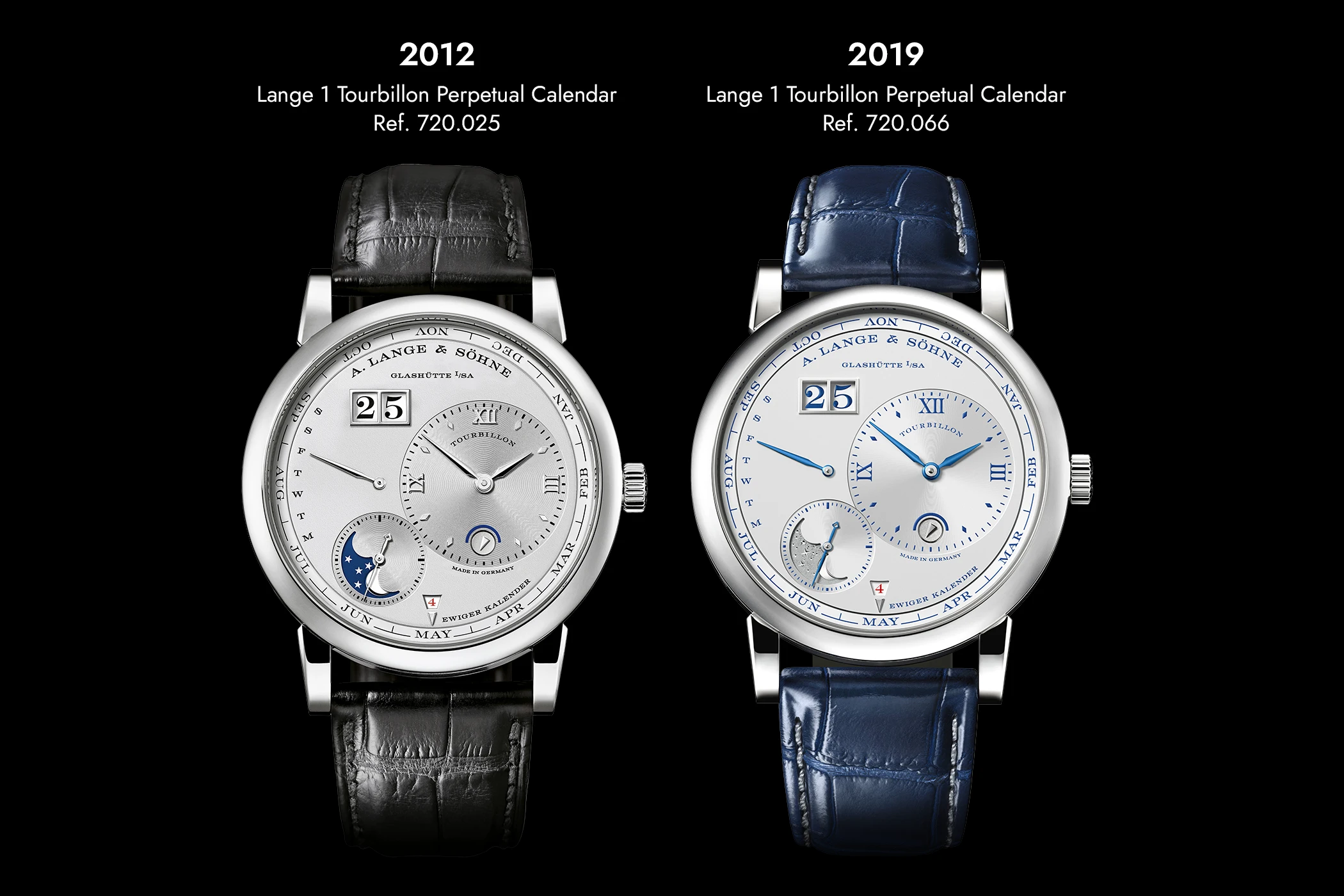
The perpetual calendar of the Lange 1 is arranged as follows: beginning on the left side of the dial and proceeding clockwise, a retrograde scale displays the day of the week. Once the hand reaches the end of the scale, it snaps back instantaneously to its starting point and begins the cycle anew. Above it sits the outsize date, inspired by the famous five-minute clock of Dresden’s Semper Opera House. To its right, the hour-and-minute display with Roman numerals occupies the largest section of the dial. At 6 o’clock, a small aperture indicates the leap year. One of the most distinctive elements is the rotating peripheral month ring that encircles the dial. This ring format was essential to integrating a perpetual calendar into the asymmetric layout of the Lange 1. The mechanism is completed by a moon-phase display that, once set, is mathematically accurate to within one day over 122.6 years. The complex calendar mechanism autonomously accounts for the irregularities of the Gregorian calendar—including leap years and months of varying lengths—and will require manual correction only in the year 2100.
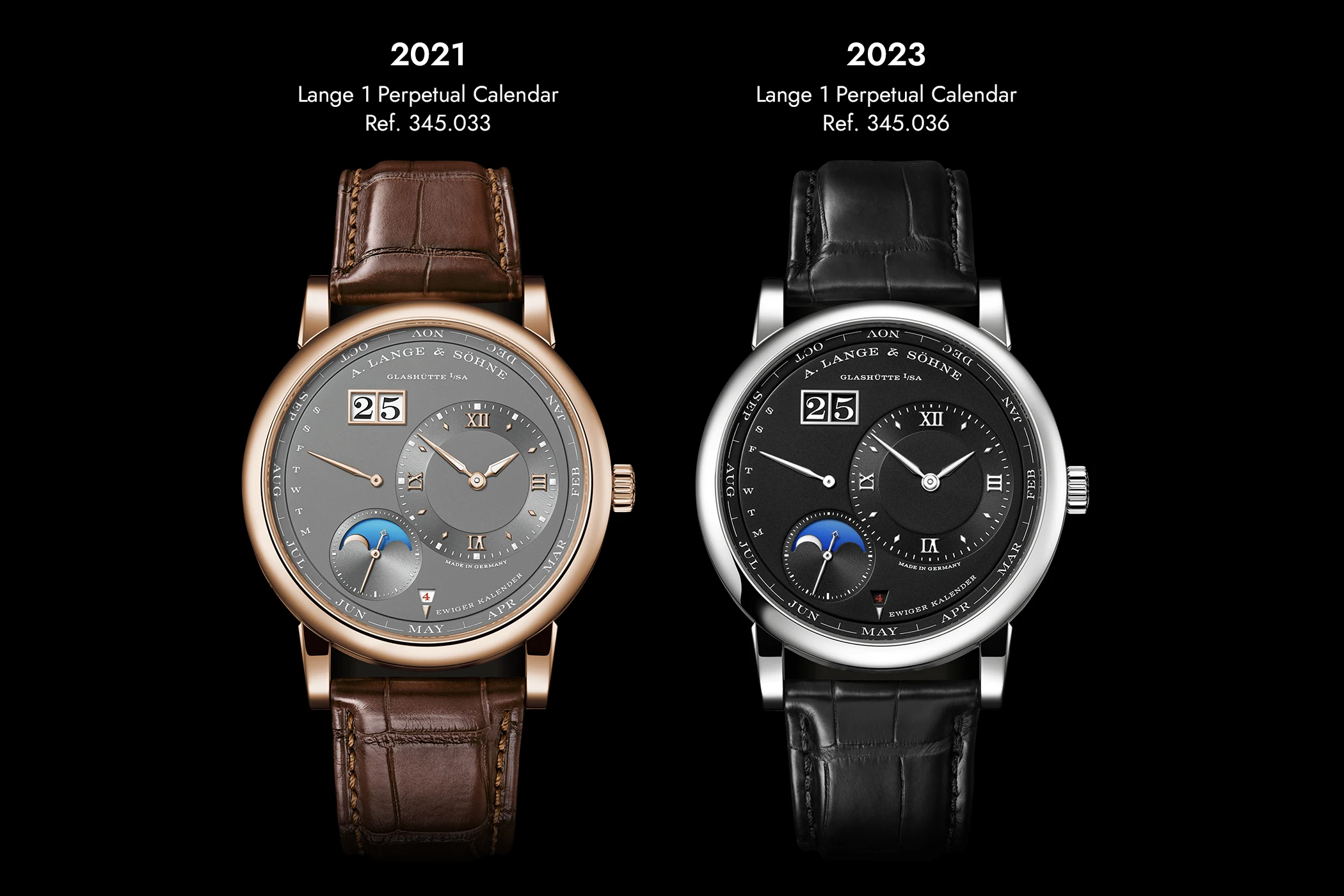
Another key distinction between the two perpetual calendar models within the Lange 1 family is the day/night indication. On the Lange 1 Tourbillon Perpetual Calendar, it is positioned within the hour-and-minute subdial. On the Lange 1 Perpetual Calendar, however, it is integrated into the two-level construction of the moon-phase display: during the day, the moon appears against a light-blue sky; in the evening and at night, it moves in front of a dark blue, star-studded backdrop.
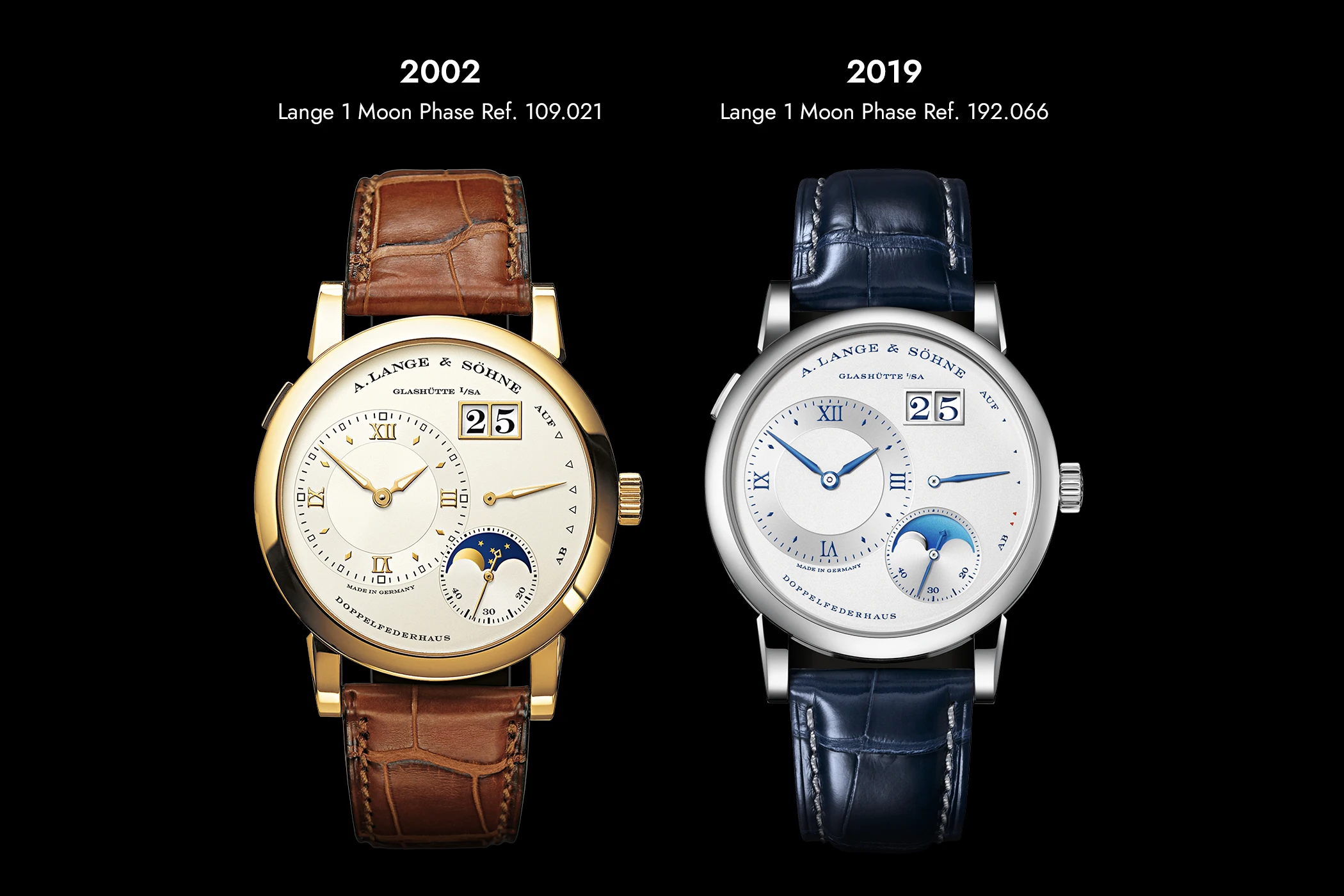
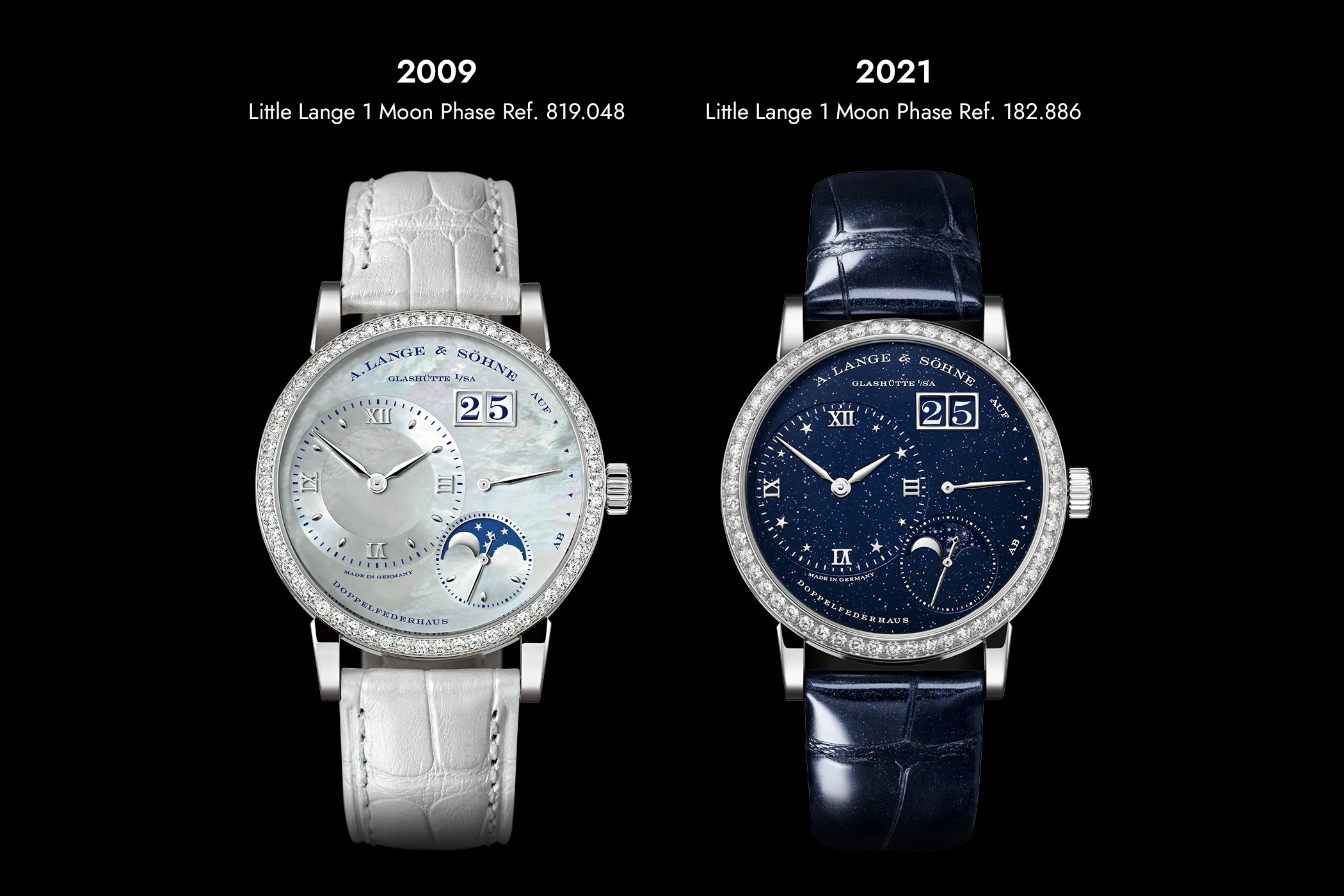
The first Lange 1 Moon Phase entered the Lange portfolio in 2002 under reference 109.021. From the outset, every Lange 1 with a moon-phase display has shared two defining characteristics: a moon-phase mechanism that deviates from the actual lunar cycle by only one day in 122.6 years, and a moon-disc made of solid gold—except on the “Lumen” models, where the disc is made of glass. Fifteen years later, the Lange 1 Moon Phase received the new hand-wound calibre L121.3. Since 2009, the Little Lange 1 Moon Phase has complemented A. Lange & Söhne’s most successful watch family with a smaller-format model that presents the astronomical complication within a 36.8 mm case. Following the update of the Lange 1 Moon Phase, the Little Lange 1 Moon Phase also received a new movement—the hand-wound calibre L121.2—in 2017.
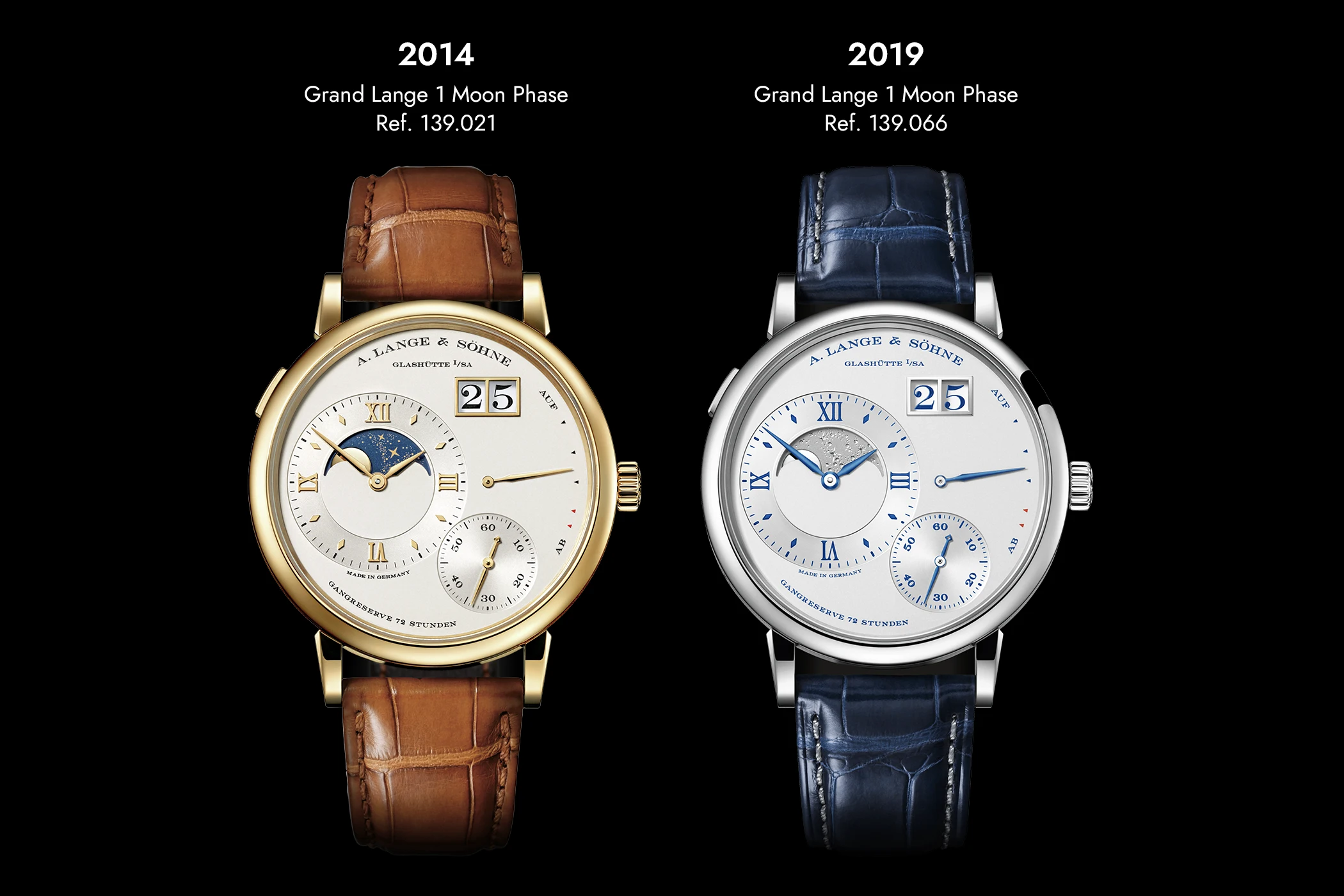
First released in 2014, A. Lange & Söhne introduced the Grand Lange 1 Moon Phase as yet another interpretation of what is arguably the most classically poetic of all complications, integrated here into the decentralised display architecture of the Lange 1. In this most recent member of the Lange 1 Moon Phase family, the brand places the Earth’s satellite at the centre of the hour display via a large moon-phase indication calculated to the same 122.6-year accuracy, while the opposite side of the dial hosts the outsize date—adjustable via the pusher on the case flank—alongside the power-reserve indicator and running seconds. The design is defined by the Roman hour numerals encircling the moon-phase display and by the moon disc itself, traditionally crafted from solid gold at Lange. In 2016, the model line was complemented by the “Lumen” edition of the Grand Lange 1 Moon Phase, limited to 200 pieces, which brought both the moon-phase display and the outsize date to life through luminous elements.
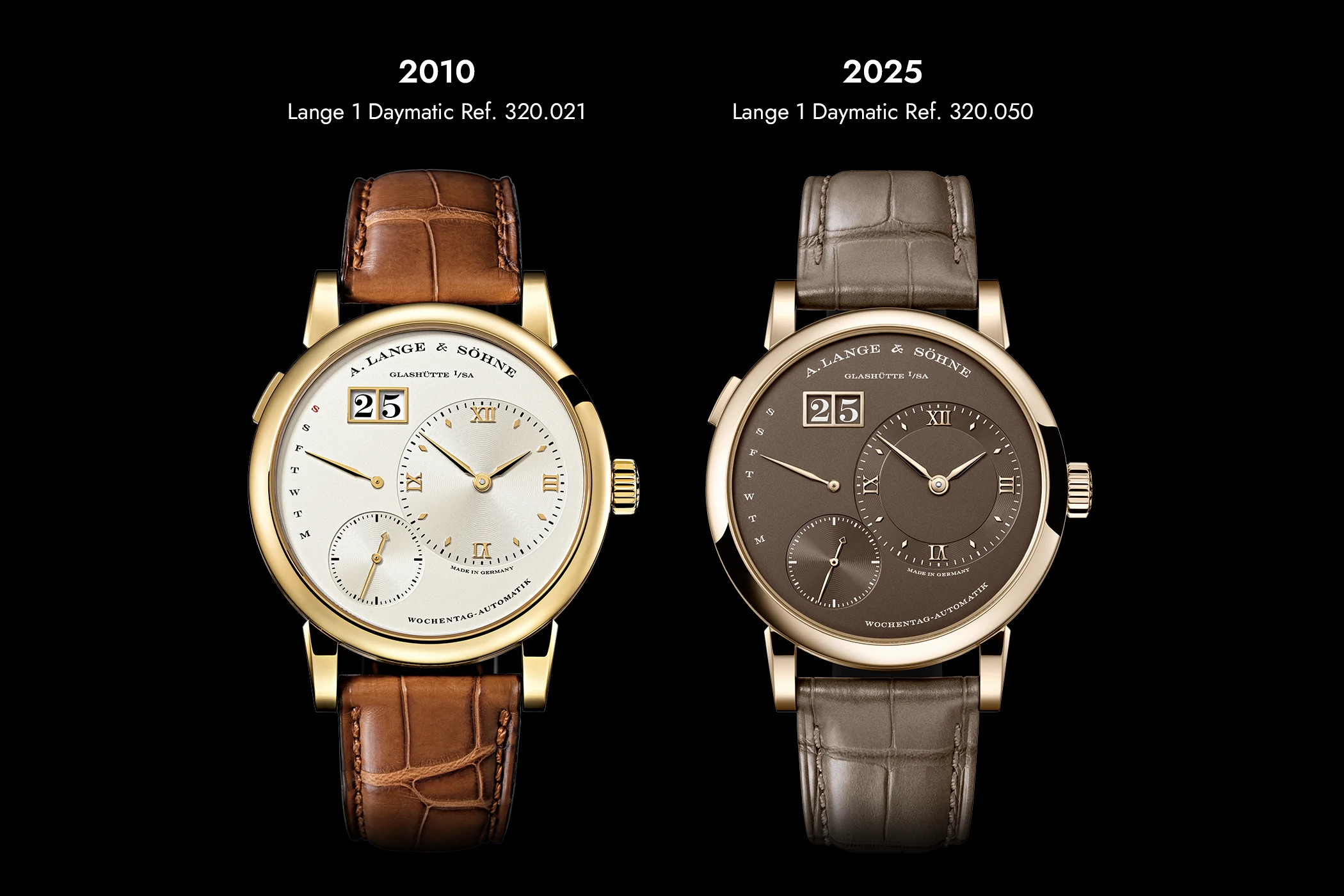
The final key model within the Lange 1 family—the Lange 1 Daymatic—brings us to the new A. Lange & Söhne Lange 1 Daymatic Honeygold now presented by A. Lange & Söhne. When the Lange 1 Daymatic was launched in 2010 under reference 320.021, it became the first Lange 1 to be equipped with an automatic movement, introducing several notable changes to the dial layout as well—but more on that in a moment.
With the new A. Lange & Söhne Lange 1 Daymatic Honeygold, the brand now presents the seventh iteration of the Lange 1 Daymatic since 2010—this time using the proprietary Honeygold alloy, which appears for the first time within the Daymatic line. Honeygold, a patented material named after its warm hue that sits between pink and white gold, was first introduced in 2010 in three watches of the anniversary edition “165 Years – Homage to F. A. Lange”. The alloy, reserved exclusively for select models, is notable for its particular hardness, which, according to the manufacture, surpasses that of all other gold alloys used by Lange.
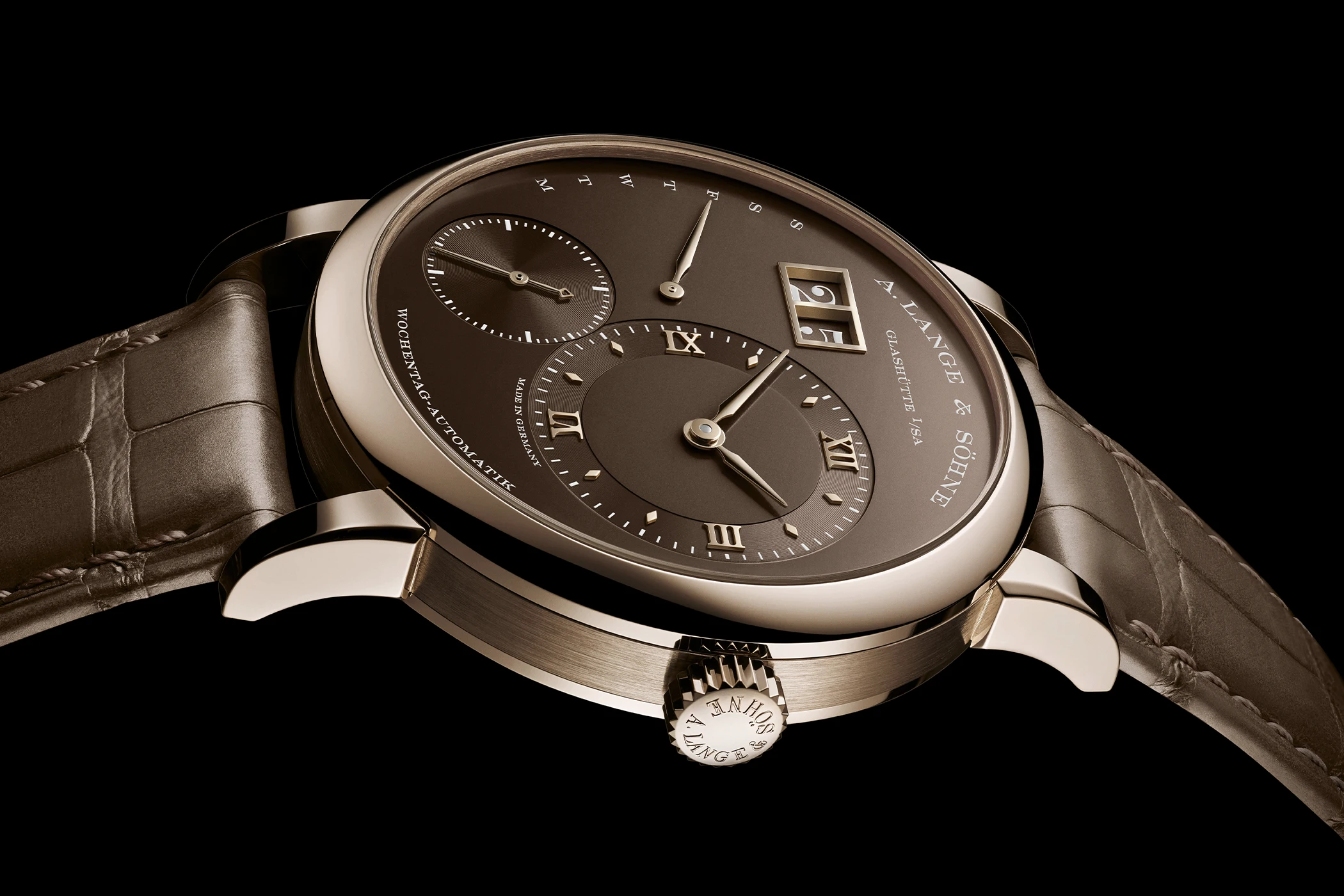
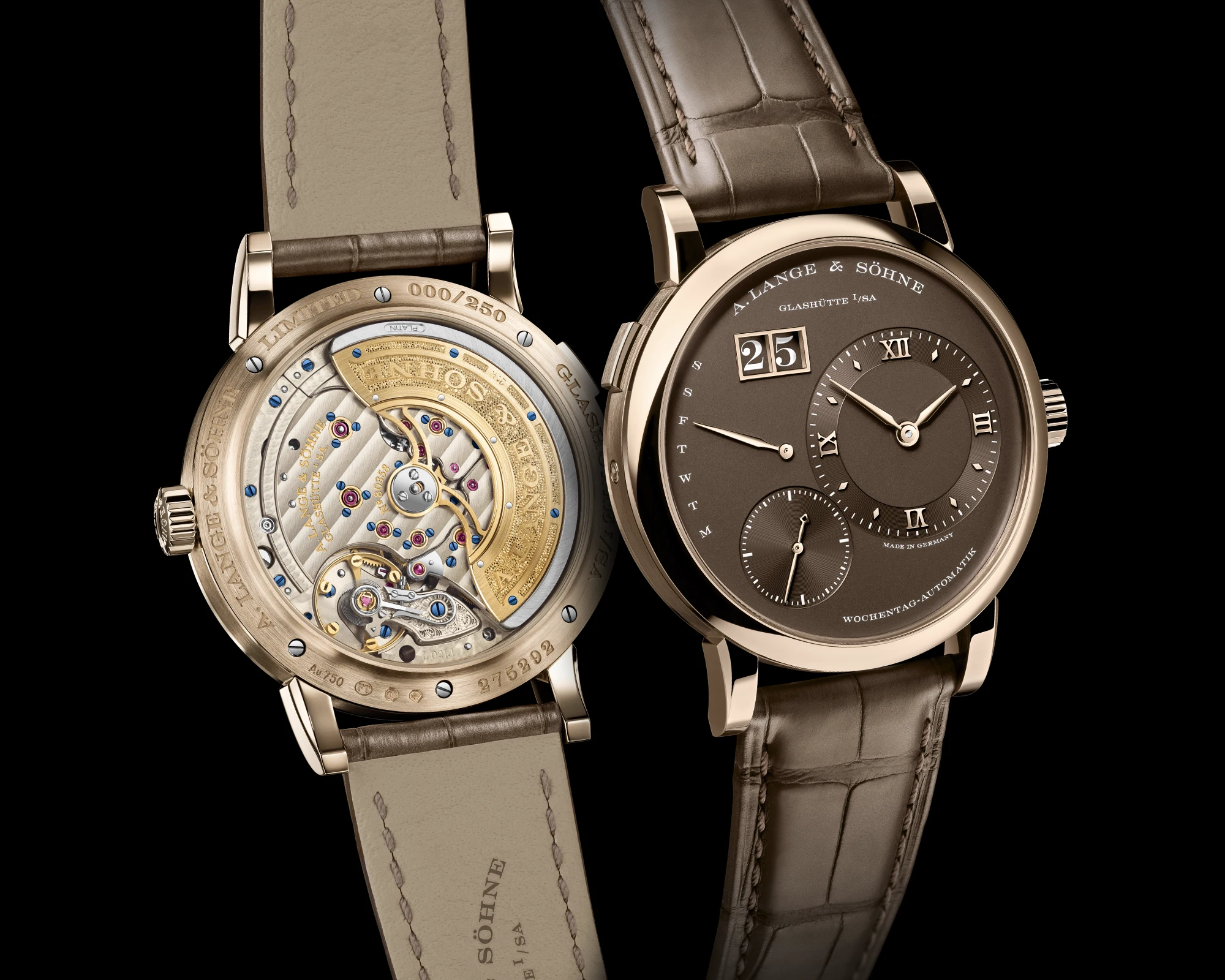
On the new A. Lange & Söhne Lange 1 Daymatic Honeygold, the case elements blend together with a particularly coherent appearance. The watch features balanced proportions, with a diameter of 39.5 mm and a height of 10.4 mm, giving it a comfortable presence on the wrist while allowing it to slip easily under a shirt cuff. The case middle is horizontally satin-finished, while the straight lugs and the domed bezel are fully polished in typical Lange fashion. At 39.5 mm, the A. Lange & Söhne Lange 1 Daymatic Honeygold is only slightly larger than the 38.5 mm Lange 1, and its case height exceeds that of the original model by just 0.4 mm.
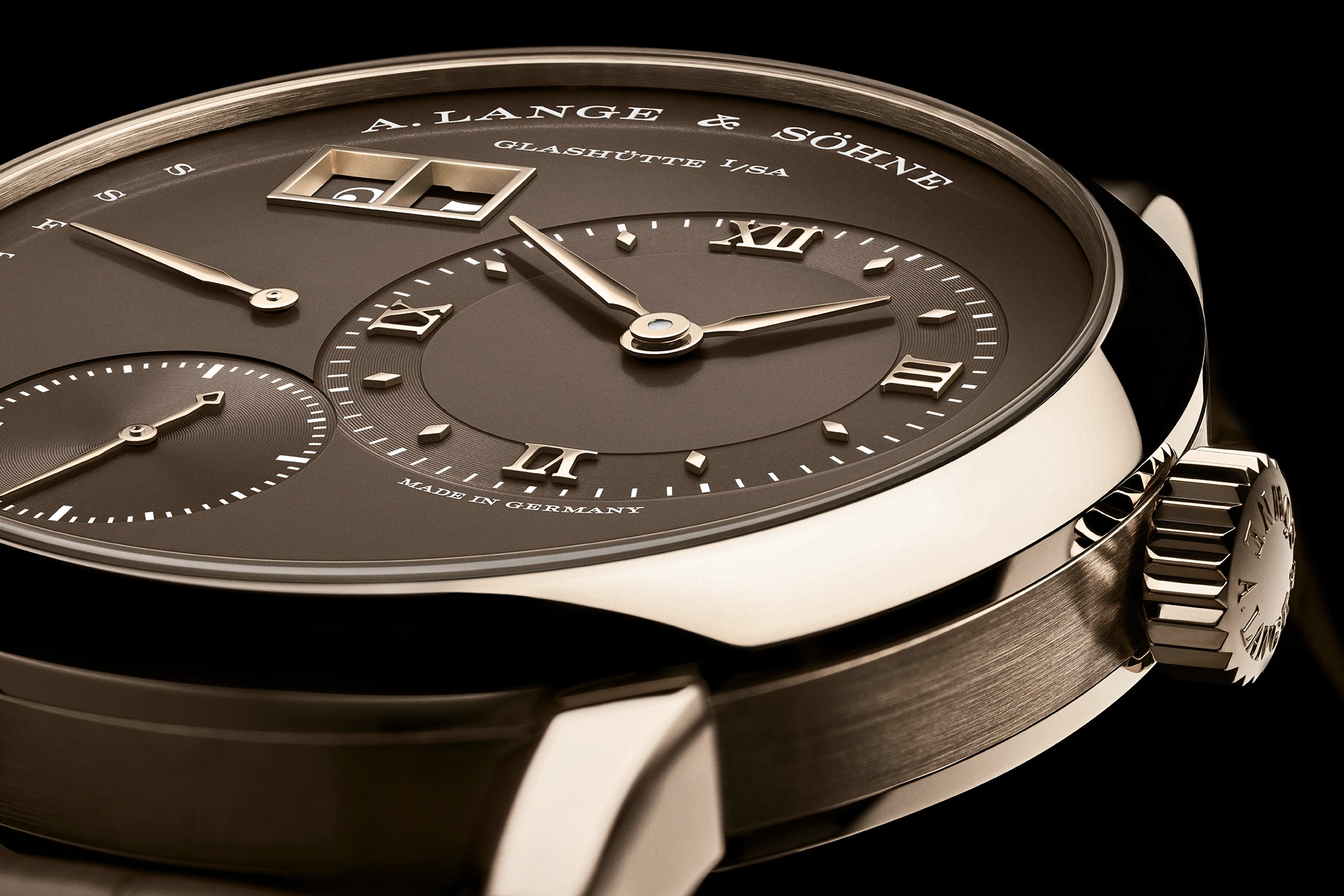
The changes introduced with the Lange 1 Daymatic—being the first Lange 1 to feature an automatic movement—were not limited to the interior; they also extended to the dial and thus to the watch’s external appearance. While the Daymatic retained the decentralised positioning typical of the Lange 1, its indications were arranged in a mirrored configuration. On the Daymatic, the hour-and-minute display appears on the right side of the dial, while the small seconds and the outsize date are positioned on the left. As the power-reserve indicator of the hand-wound Lange 1 played no significant role on the automatic model, Lange replaced it with a retrograde day-of-week display, which is likewise positioned on the left.
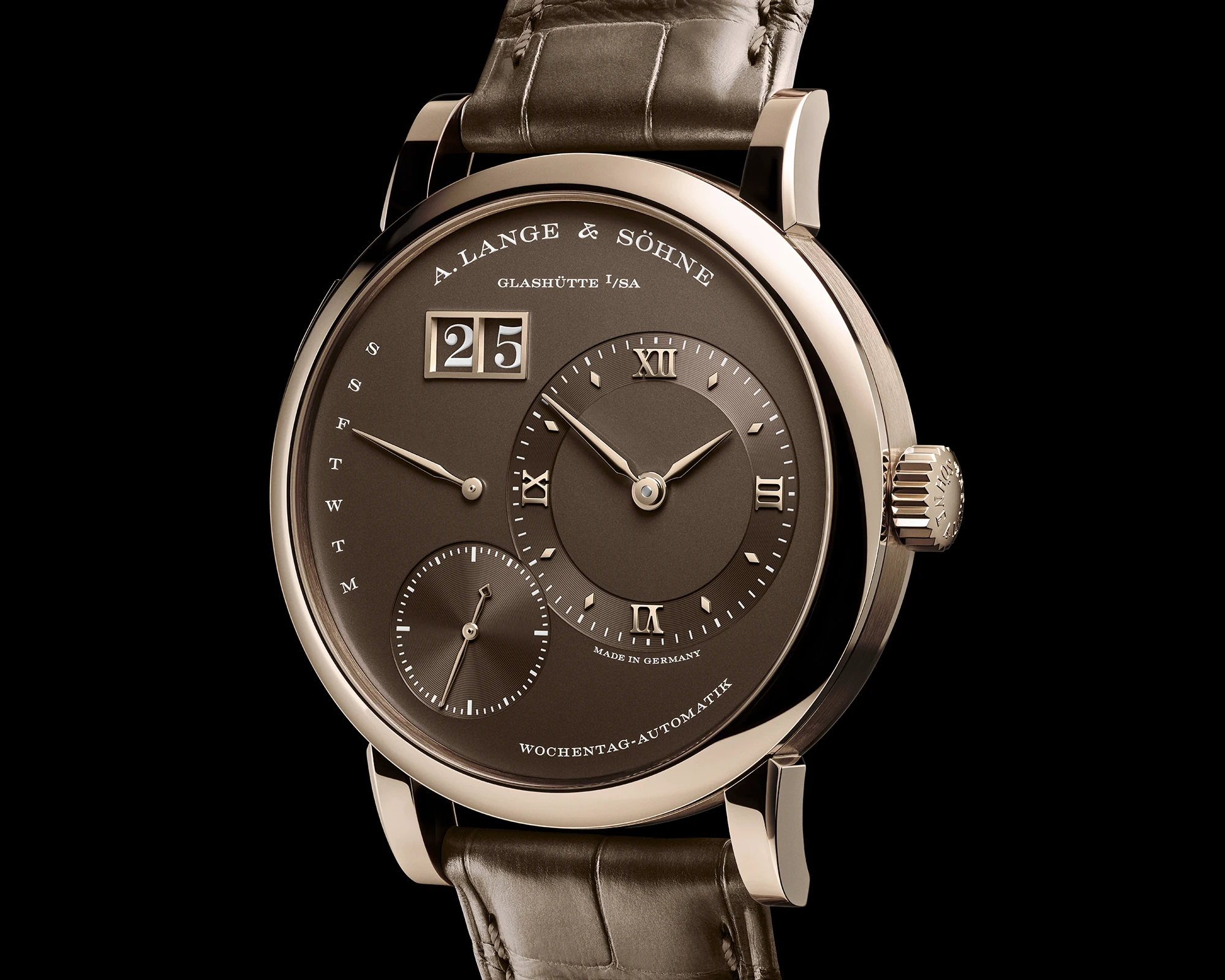
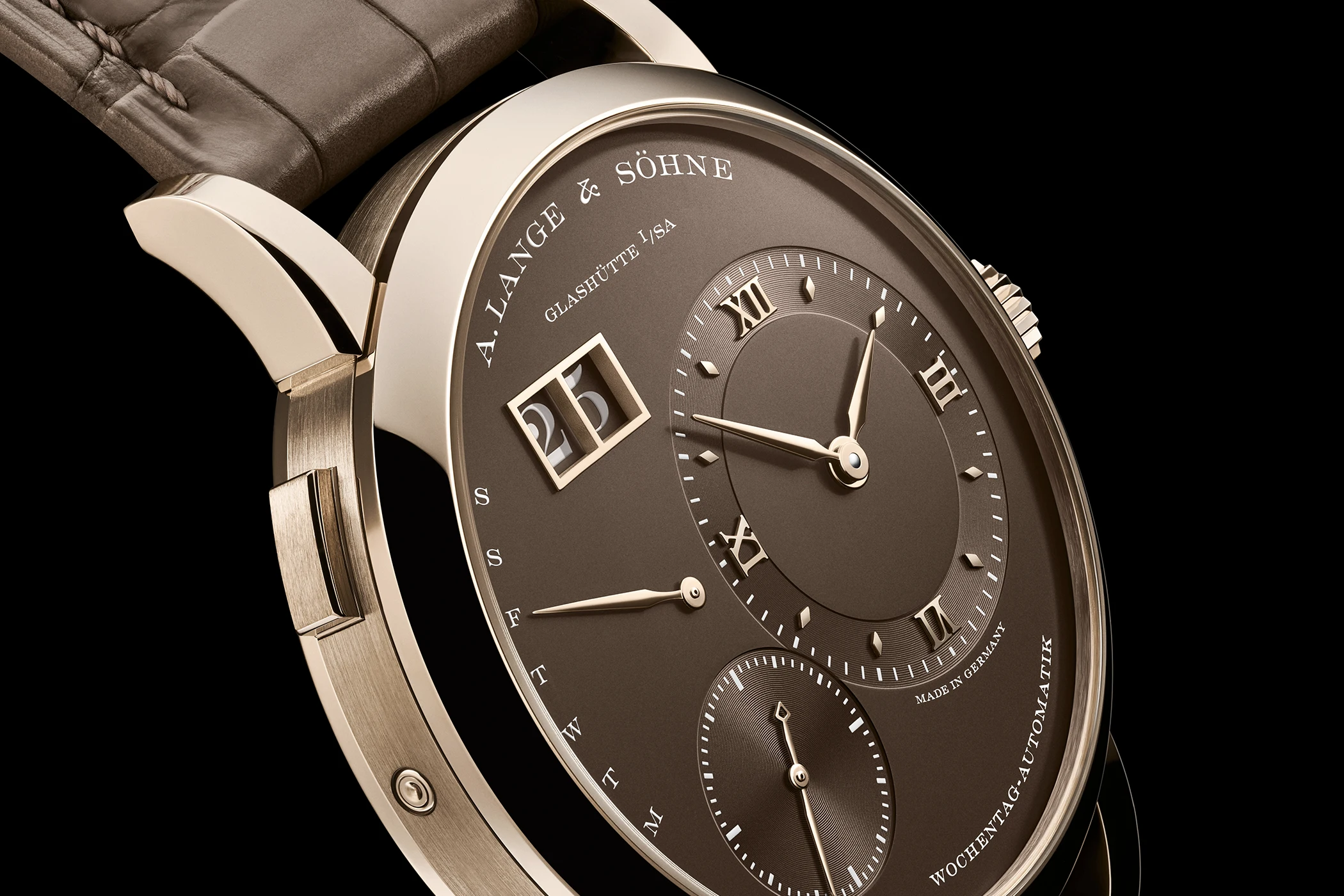
The new A. Lange & Söhne Lange 1 Daymatic Honeygold follows this layout and pairs it with an aesthetic combination of a Honeygold case and a brown dial, the latter based on a solid-silver disc. The dial features subtle recesses for the hour-and-minute display and for the subsidiary seconds, each finished with a concentric circular graining that distinguishes them visually from the rest of the dial. Rising above these subdials are the hands, crafted—like all applied indices, Roman numerals, and the frame of the outsize date—from 18-carat gold, extending the aesthetic language of the case onto the dial of the A. Lange & Söhne Lange 1 Daymatic Honeygold.
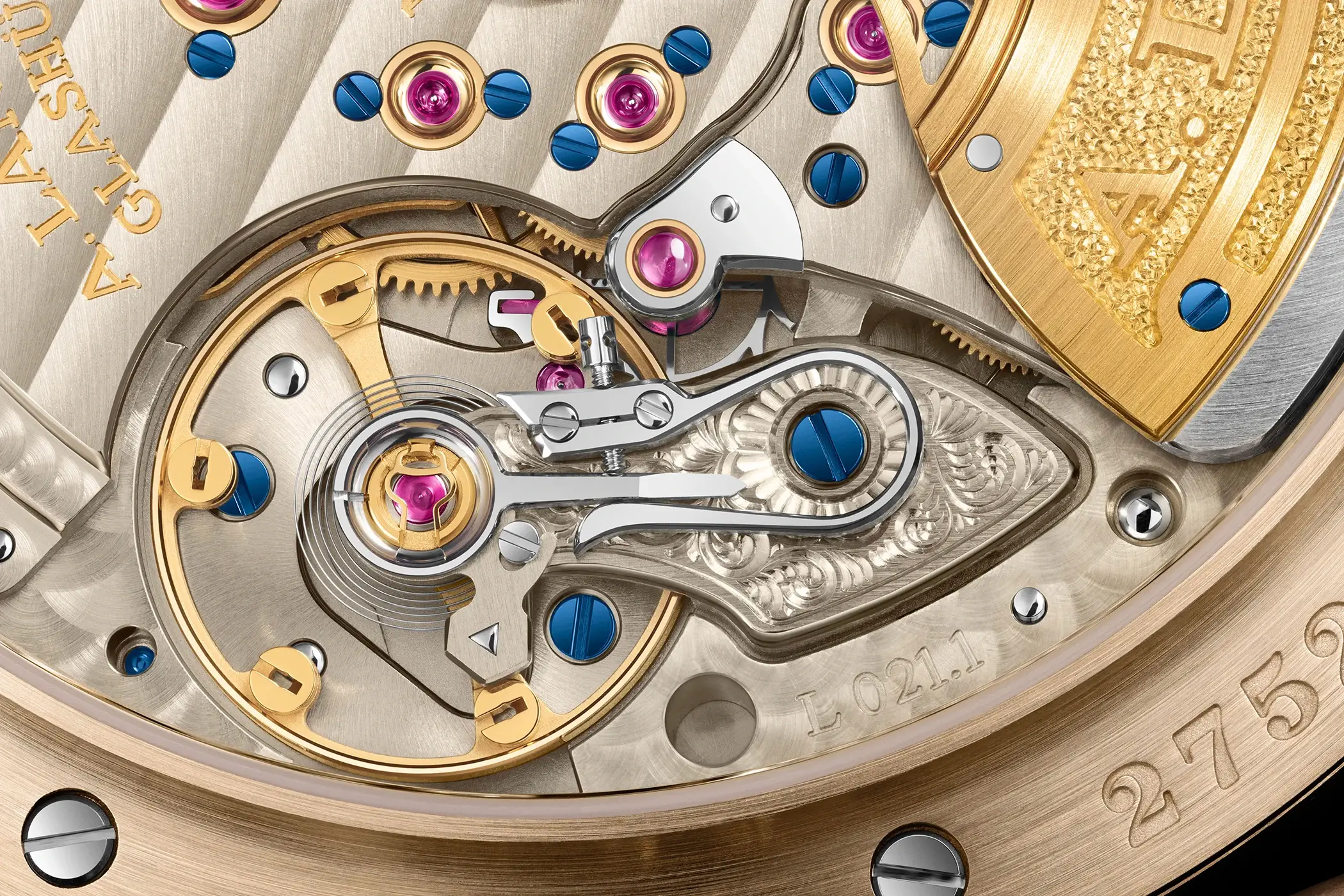
Turning the A. Lange & Söhne Lange 1 Daymatic Honeygold over reveals the movement developed specifically for this model: the automatic calibre L021.1. The balance operates within a free-sprung construction featuring a large eccentric balance. It is one of A. Lange & Söhne’s more recent balance designs and incorporates an in-house–developed and –manufactured balance spring oscillating at 21,600 vibrations per hour. The black-polished swan’s neck is used primarily to correct beat error, while variable inertia weights along the balance rim allow for the fine adjustment of the balance mass.
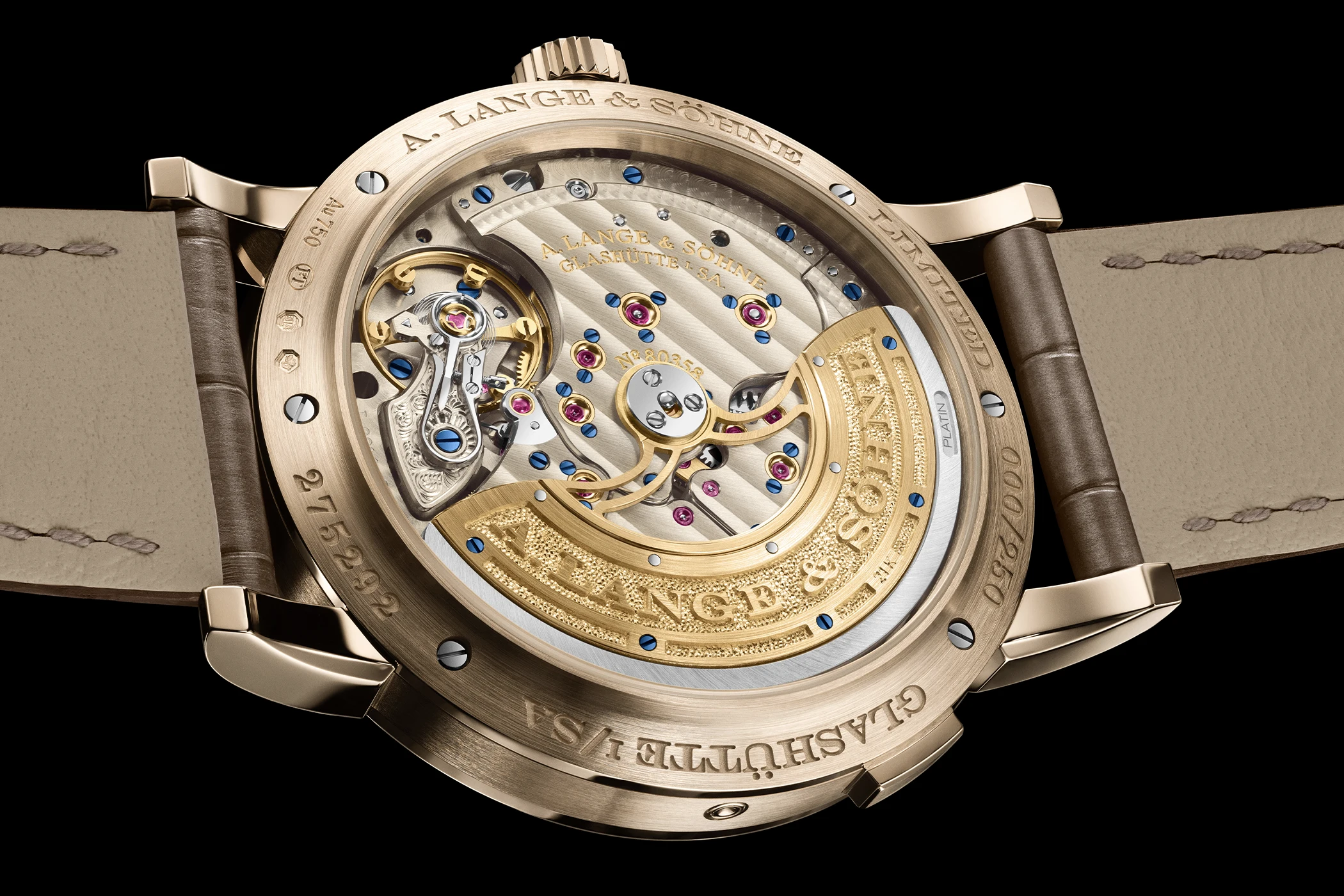
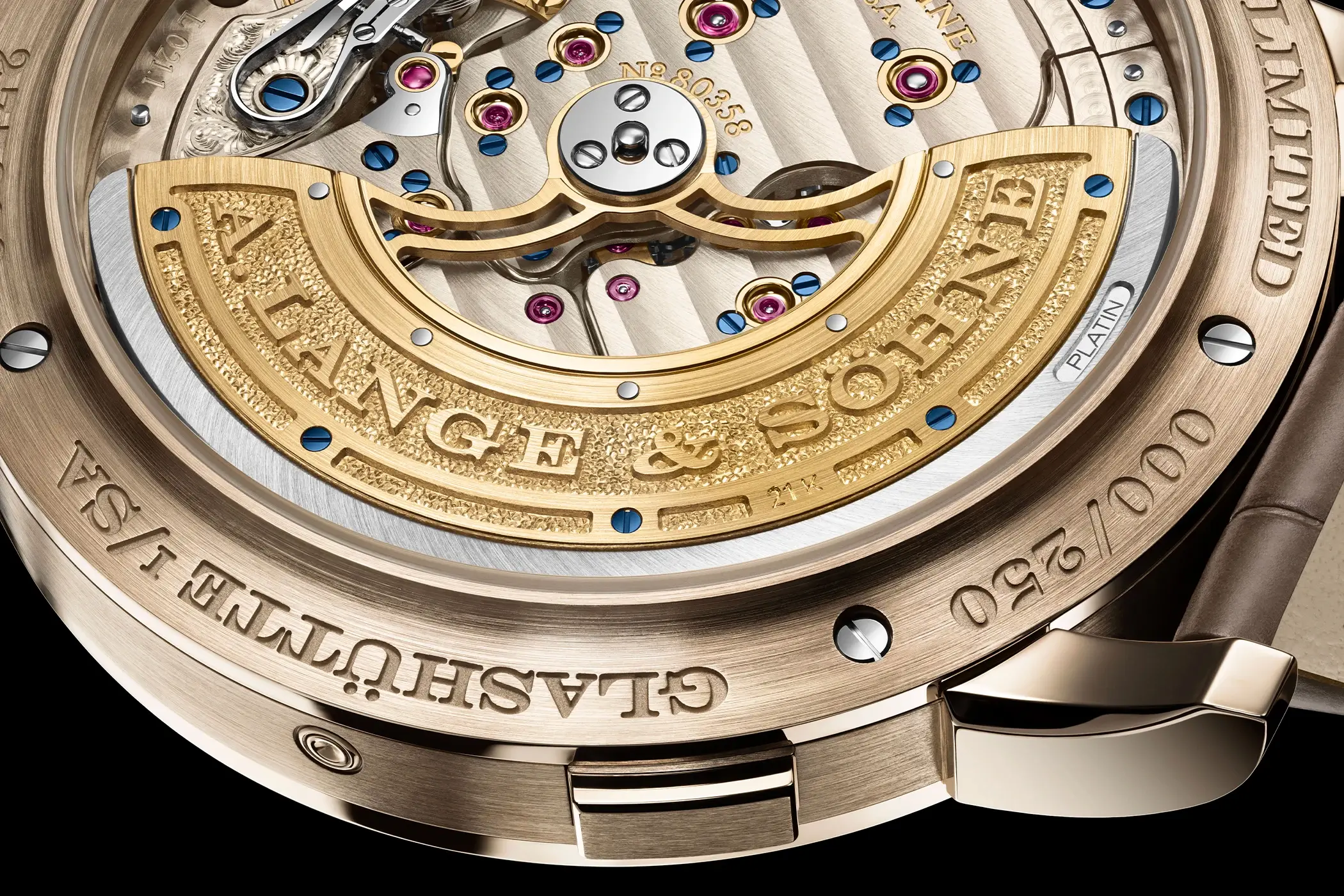
The depth of manufacture becomes particularly evident when examining the winding rotor of the A. Lange & Söhne Lange 1 Daymatic Honeygold: the calibre combines a 21-carat gold rotor with a platinum centrifugal mass—an uncommon construction—finished with multiple surface treatments. The top is satin-brushed; the recessed areas around the engraved “A. Lange & Söhne” inscription feature fine decorative structures; the platinum mass is secured with heat-blued screws; and black-polished steel pins connect the rotor to its swing arms at the centre.
The architecture of calibre L021.1 is based on four separately screwed plates which, when assembled, form the classic Glashütte three-quarter plate. The bridges are made of German silver—a nickel-copper-zinc alloy whose high copper content produces the characteristic warm, golden hue. The finishing continues throughout: black-polished pins, numerous blued screws securing the jewel bearings, the hand-engraved balance cock, and the Glashütte ribbing on the bridges, all of whose edges are finished with polished bevels. Like all Lange calibres, the automatic L021.1—comprising 426 individual components—is assembled twice. It is also regulated in five positions to chronometer standards. Once the rotor has fully wound the mainspring barrel, the movement delivers a power reserve of 50 hours, according to A. Lange & Söhne.
With the Lange 1 Daymatic, A. Lange & Söhne presents the slightly larger, automatic version of the Lange 1 for the first time in Honeygold and with a brown dial. The new A. Lange & Söhne Lange 1 Daymatic Honeygold is priced at EUR 75,000 and will be limited to 250 pieces.