Jaeger-LeCoultre is unveiling three highly complex new models at W&W 2026: the Gyrotourbillon, the Minute Repeater and the Tourbillon Jumping Date.
Hermès isn’t merely unveiling a skeletonised movement; they are introducing the latest technical generation from the movement specialist Vaucher. A new 10-year-test underscores just how serious they are about this step. We headed to Fleurier to discover for ourselves.
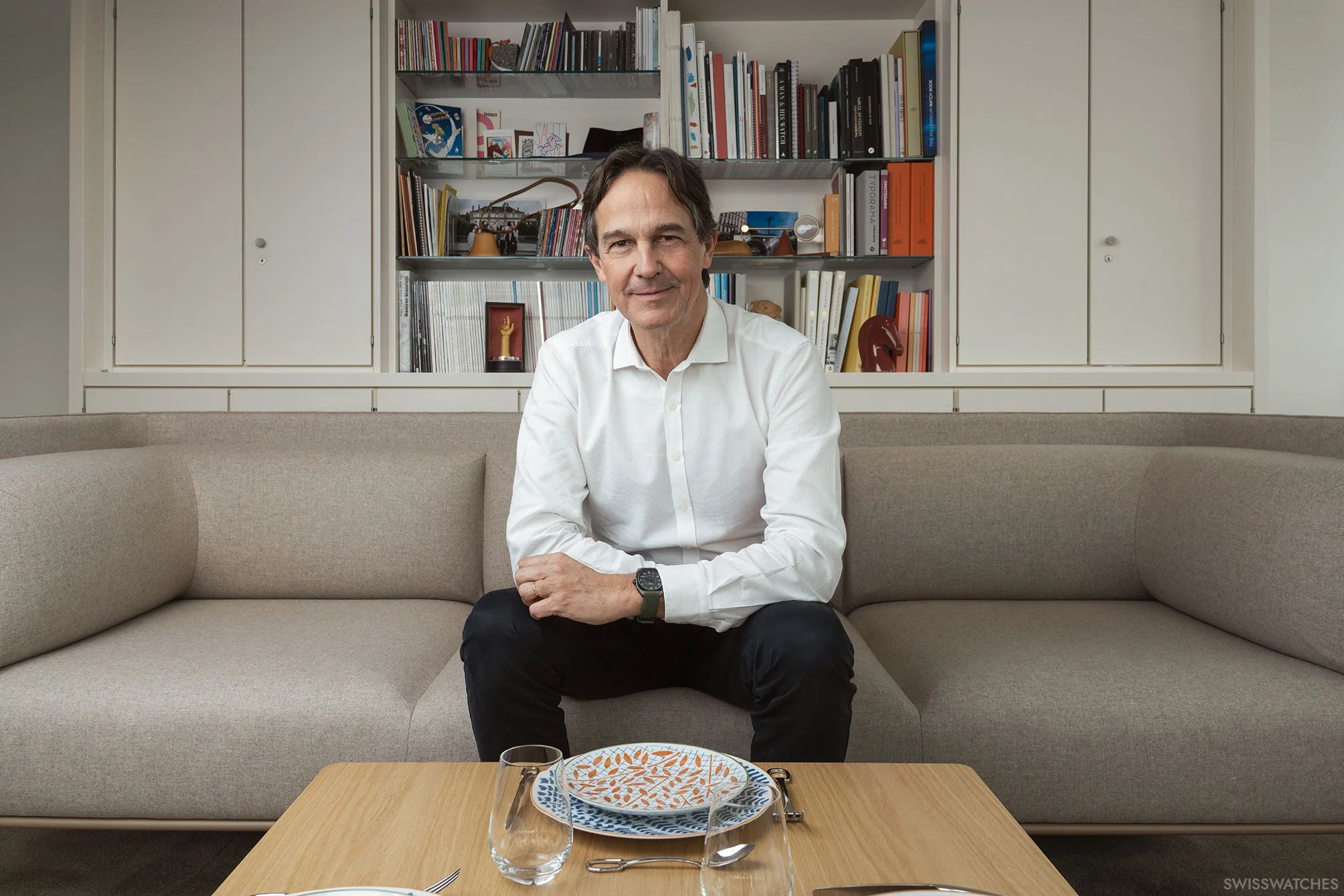
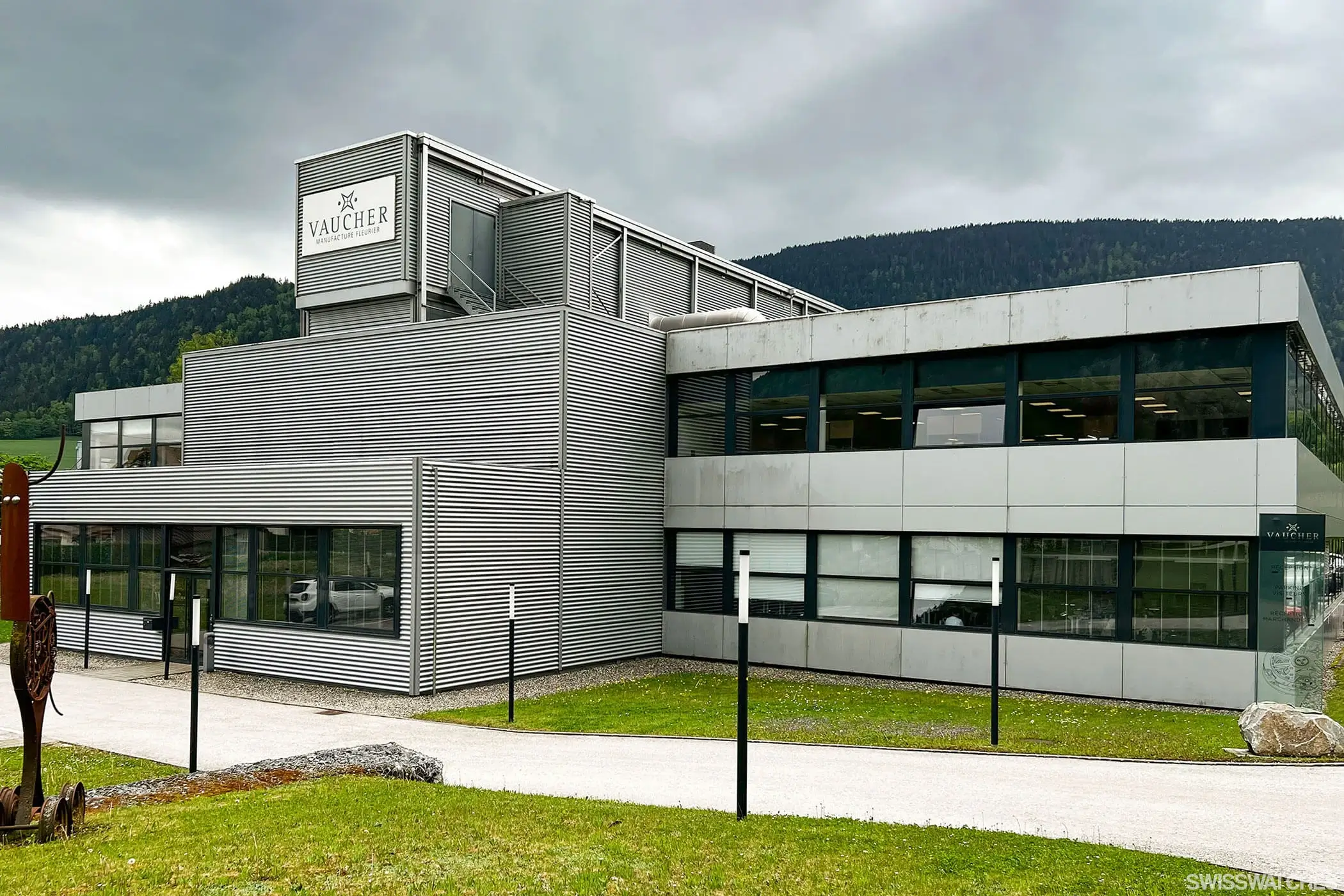
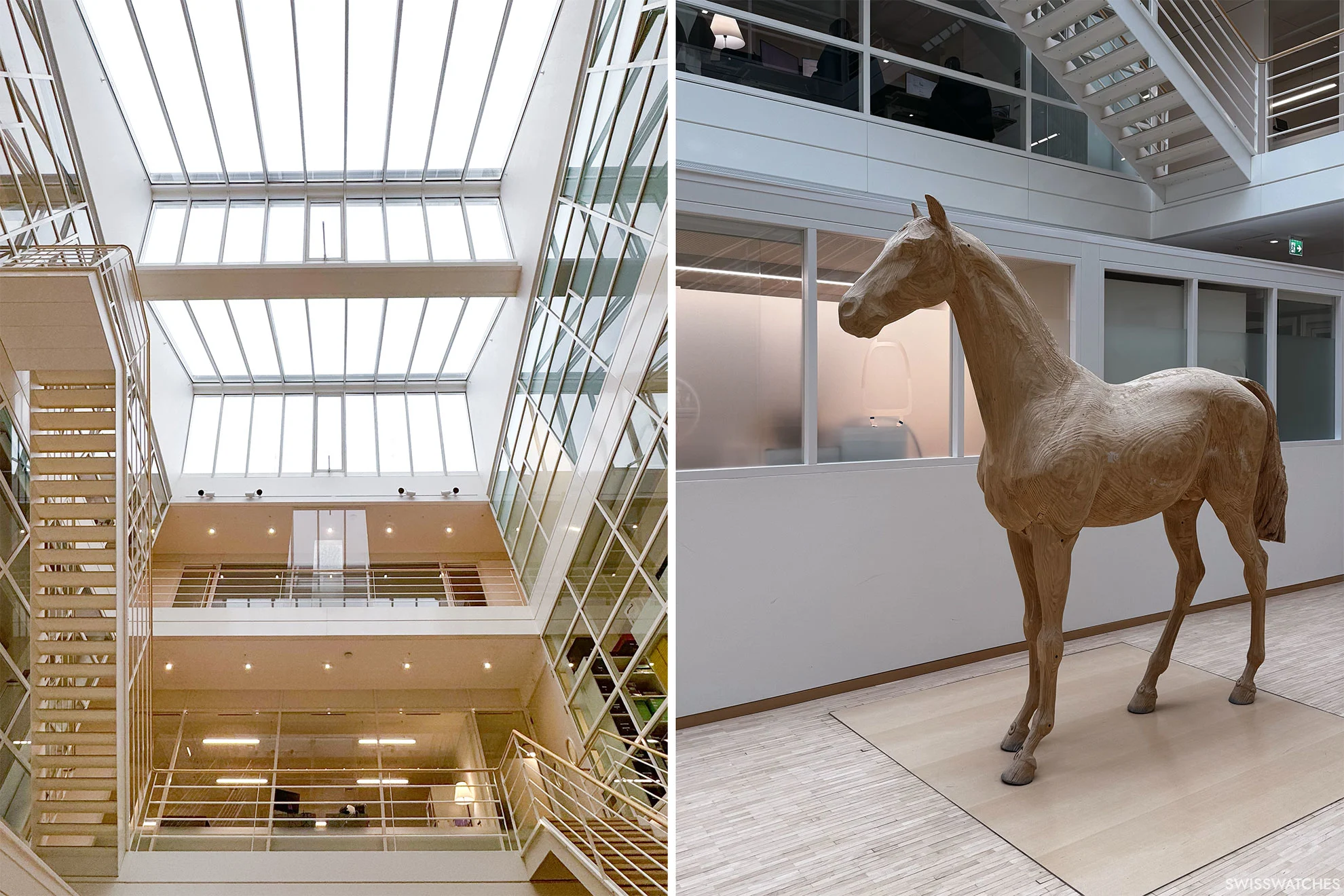
A few weeks ago, we had the honour of being among a small group of selected journalists who, under strict embargo, were given a preview of one of this year’s Watches & Wonders novelties. We travelled to Neuchâtel in Switzerland for the occasion, where Hermès Watches CEO Laurent Dordet was waiting for us; he had already been raving about the new model over dinner the previous evening, further heightening the anticipation of what awaited us the following day. When we set off for Fleurier the next morning, it was clear that we would be spending the day at Vaucher Manufacture Fleurier (VMF), where the movements are produced not only for Hermès but also for several other renowned brands such as Richard Mille, TAG Heuer, Audemars Piguet and Parmigiani Fleurier. Hermès even holds a 40% stake in Vaucher since April 2026. Bevor they held 25 % since 2006.
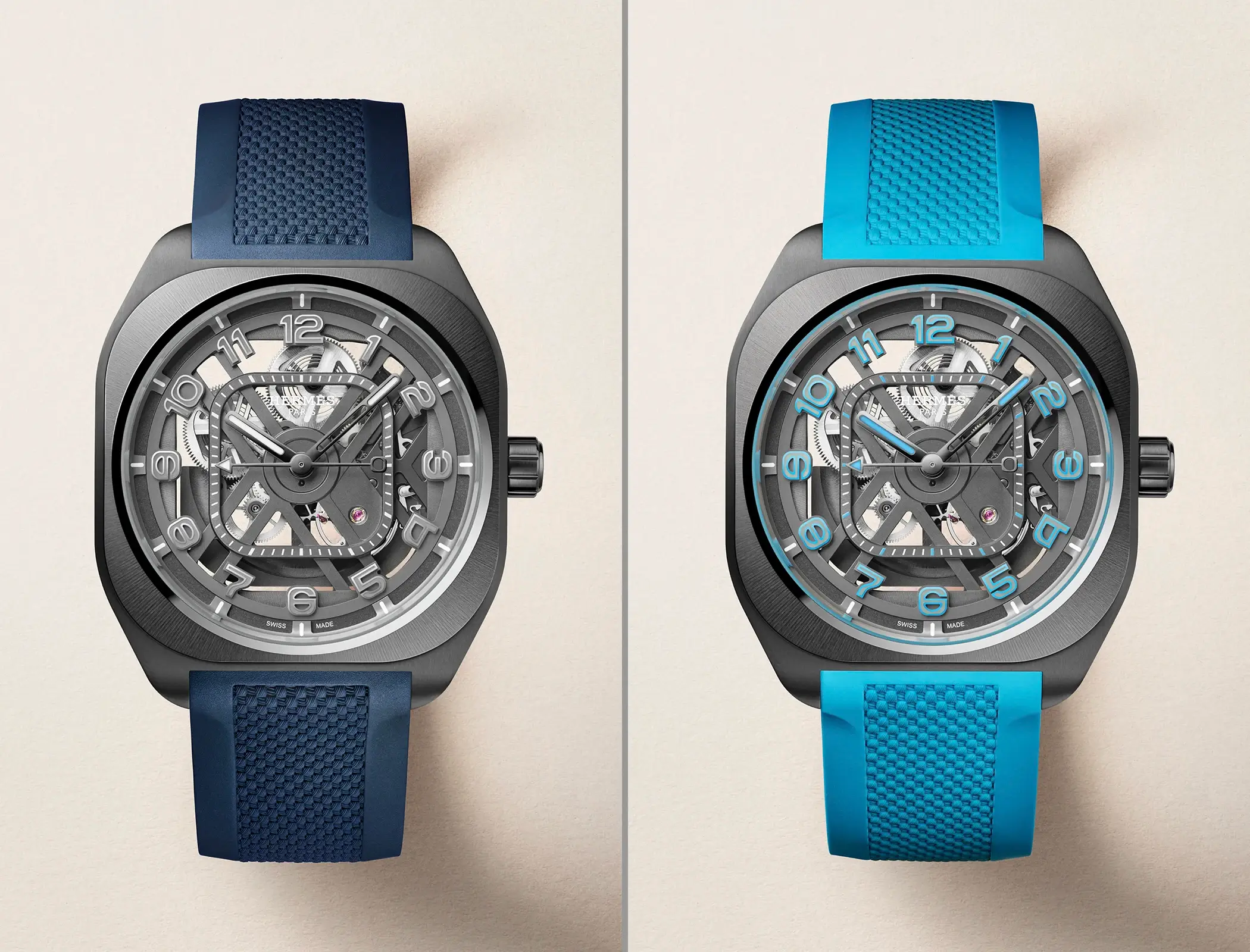
In a presentation room at Vaucher, a watch box has already been placed conspicuously on the table. Of course, we are not yet allowed to open it. First, there is a detailed tour of the origins of watchmaking at Hermès, which go back further than one might think. Then things get serious. Philippe Delhotal, Creative Director of Hermès Horloger, delves into the concept and details of the new model. It is an H08, presented for the first time as a skeletonised version. The Hermès H08 Squelette will be available in five different colour variants. Now, skeletonised watches are, God knows, nothing out of the ordinary these days, not even when a comparatively young watchmaker like Hermès Horloger turns its hand to them. But this is not simply another skeletonised movement – after years of development and testing, the engineers and watchmakers at Vaucher have developed a new generation of skeletonised movement for Hermès that is technically extremely impressive. So good, in fact, that they are offering a ten-year manufacturer’s warranty on it straight away. But before we delve into the details of the Hermès H08 Squelette, let’s begin with a brief excursion into the history of watchmaking at Hermès.
To understand the technological significance of the new H08 Squelette, it is worth knowing the historical development of Hermès Horloger. Although Hermès had been offering watches in collaboration with renowned manufacturers such as Jaeger-LeCoultre for over a century, the era of true independence began in 1978. Jean-Louis Dumas, the CEO at the time, recognised that full control over quality and design could only be achieved through in-house manufacturing in Switzerland. The founding of La Montre Hermès in Biel was a clear commitment to Swiss excellence, combined with the Parisian spirit of the parent company.
Dumas imparted two core messages to his team, which to this day form the foundation of every new development: firstly, the watches must be able to compete technically and in terms of quality with the world’s best competitors. Secondly, Hermès must never simply imitate traditional Swiss watchmaking. Instead, the house should infuse its own DNA – shaped by equestrian roots, imagination and a certain sense of humour – into watchmaking. This philosophy means that timekeeping at Hermès is not taken too seriously, but rather understood as a ‘cheerful companion’.
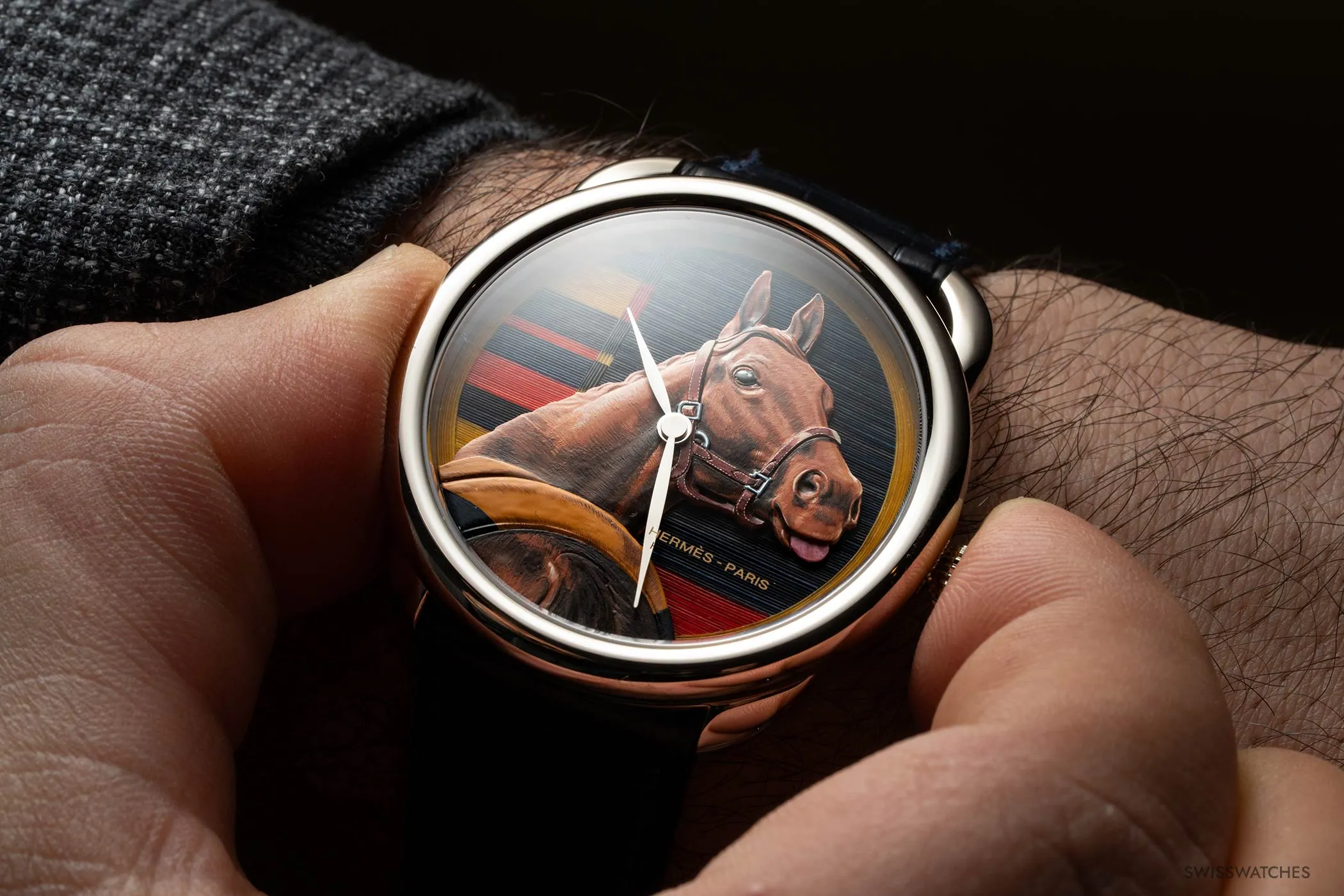
Hermès’ strategy has been characterised by consistent vertical integration for decades. A decisive turning point came in 2006, when Hermès acquired a 25% stake in Vaucher Manufacture Fleurier (VMF). This investment secured the house access to exclusive mechanical movements of the highest calibre. Vaucher is no ordinary supplier; the manufacture, which is majority-owned by the Sandoz Family Foundation, also supplies industry giants such as Richard Mille, Audemars Piguet, TAG Heuer and Parmigiani Fleurier.
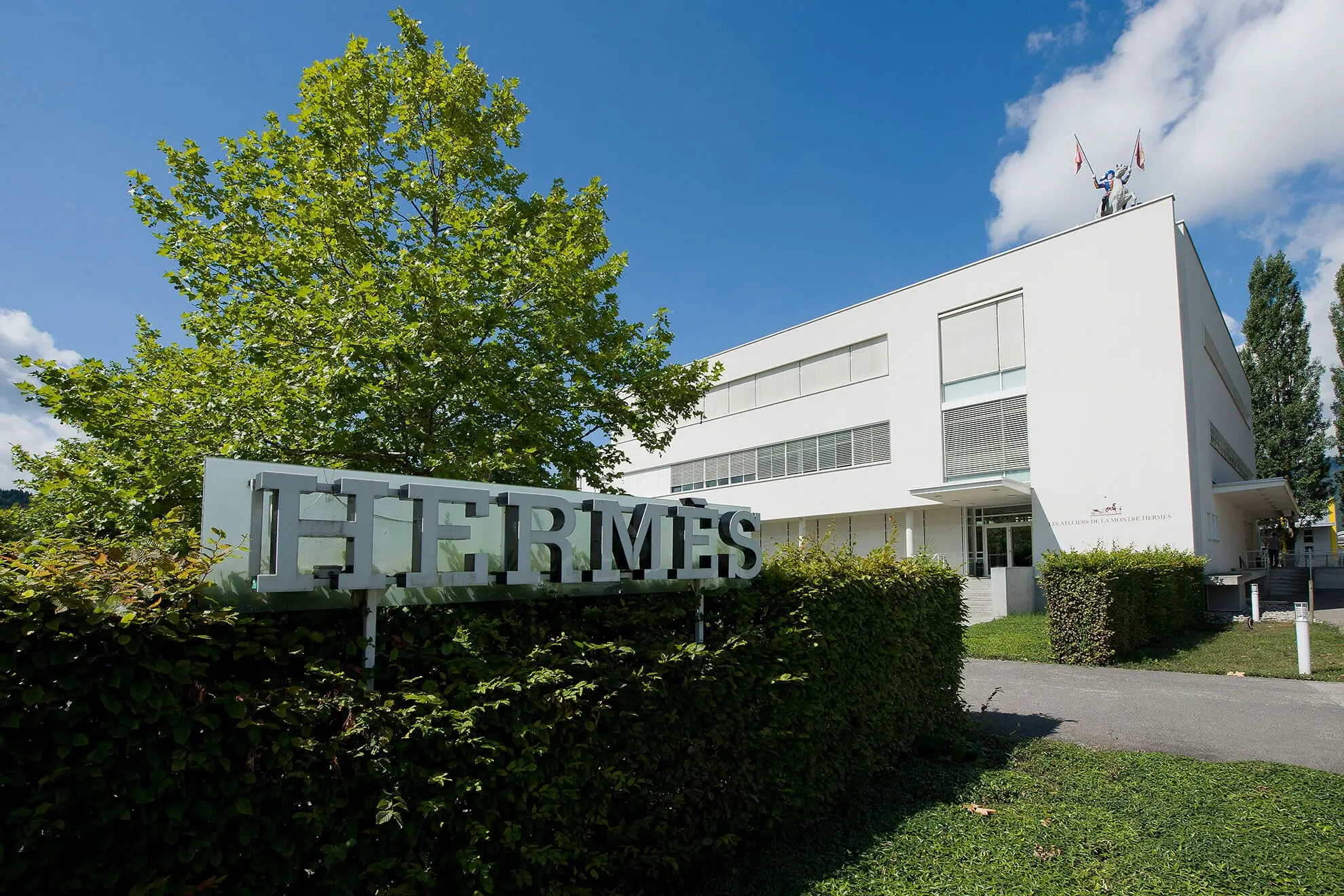
In the years that followed, Hermès systematically expanded its capabilities through further acquisitions. With the takeover of the dial specialist Natéber in La Chaux-de-Fonds in 2012, Hermès laid the foundations for greater vertical integration, a process that was consistently continued as early as 2013 with the acquisition of the case manufacturer Joseph Érard in Le Noirmont. In 2017, this strategy was further expanded with the inauguration of the Ateliers d’Hermès Horloger in Le Noirmont, which now efficiently brings together the expertise in case and dial manufacturing under one roof.
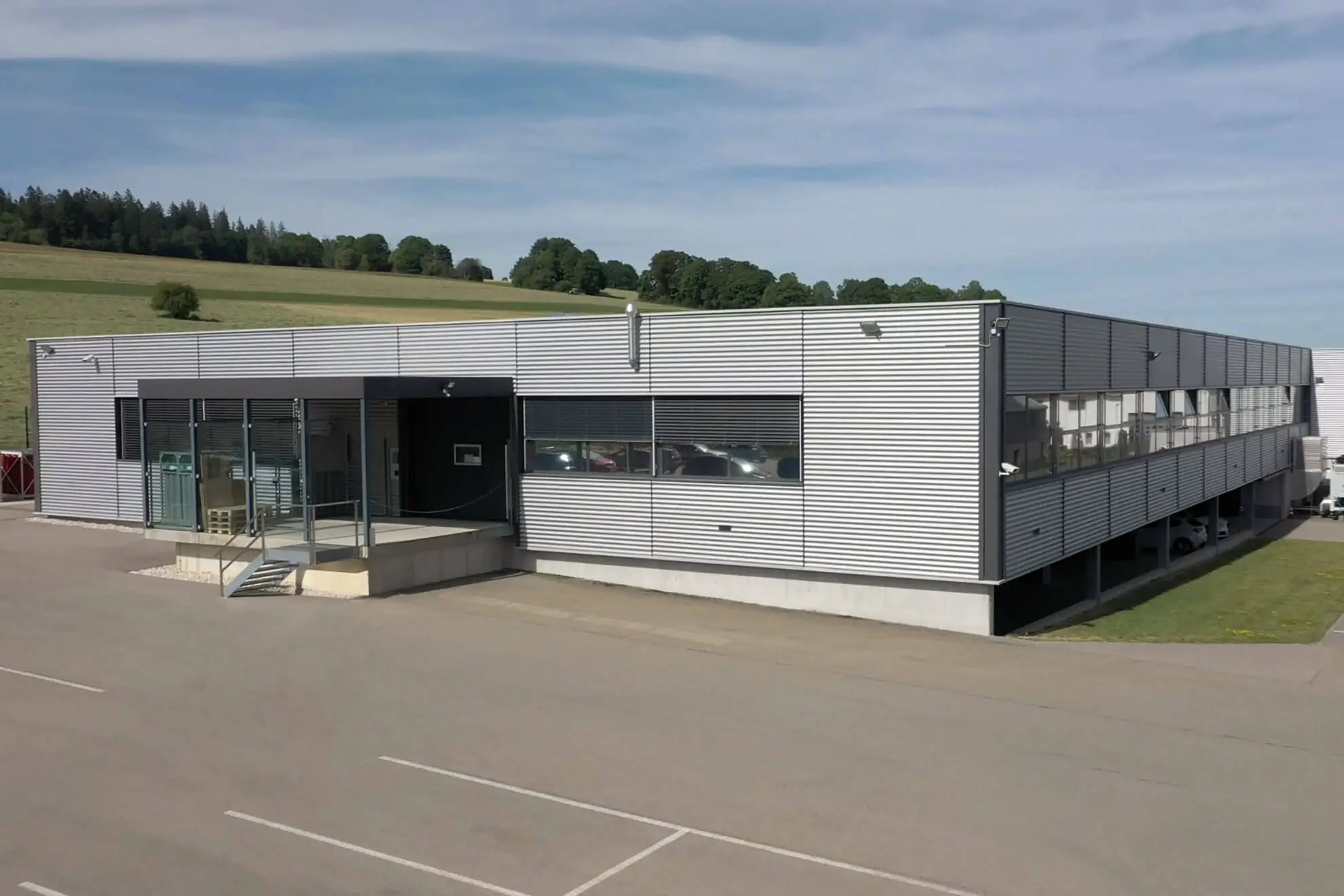
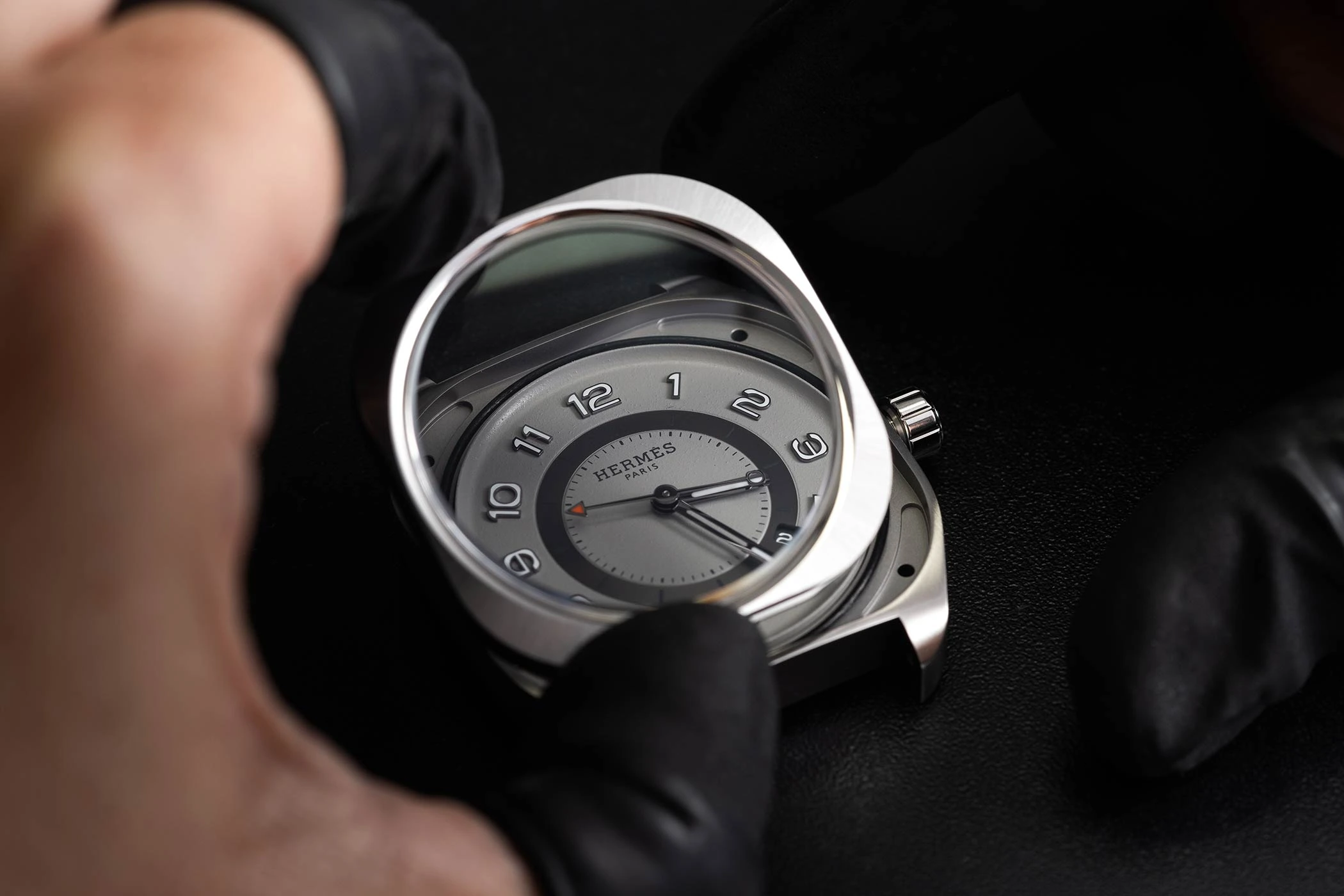
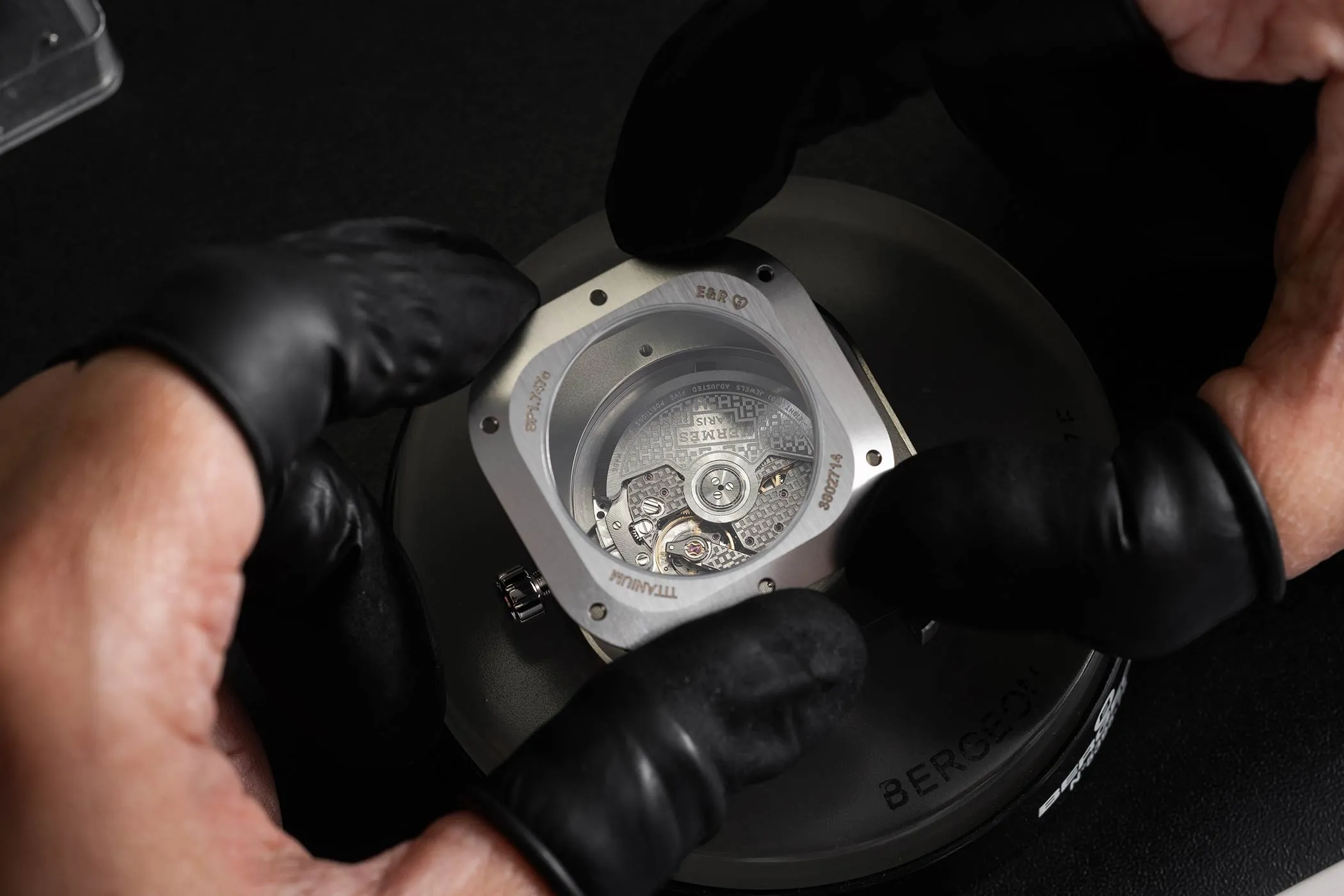
This structure now enables Hermès to operate as a fully integrated manufacture. Whilst the basic components of the movements are produced at Vaucher in Fleurier, final assembly and fine regulation take place in the brand’s own workshops in Brügg (near Biel). In Fleurier, the watchmakers work across brands on high-precision calibres for various prestigious clients, but in Brügg, Hermès employs its own watchmakers who are dedicated exclusively to the assembly and quality control of Hermès timepieces. This ensures that every H08 Squelette bears the brand’s distinctive signature and meets its exacting standards.
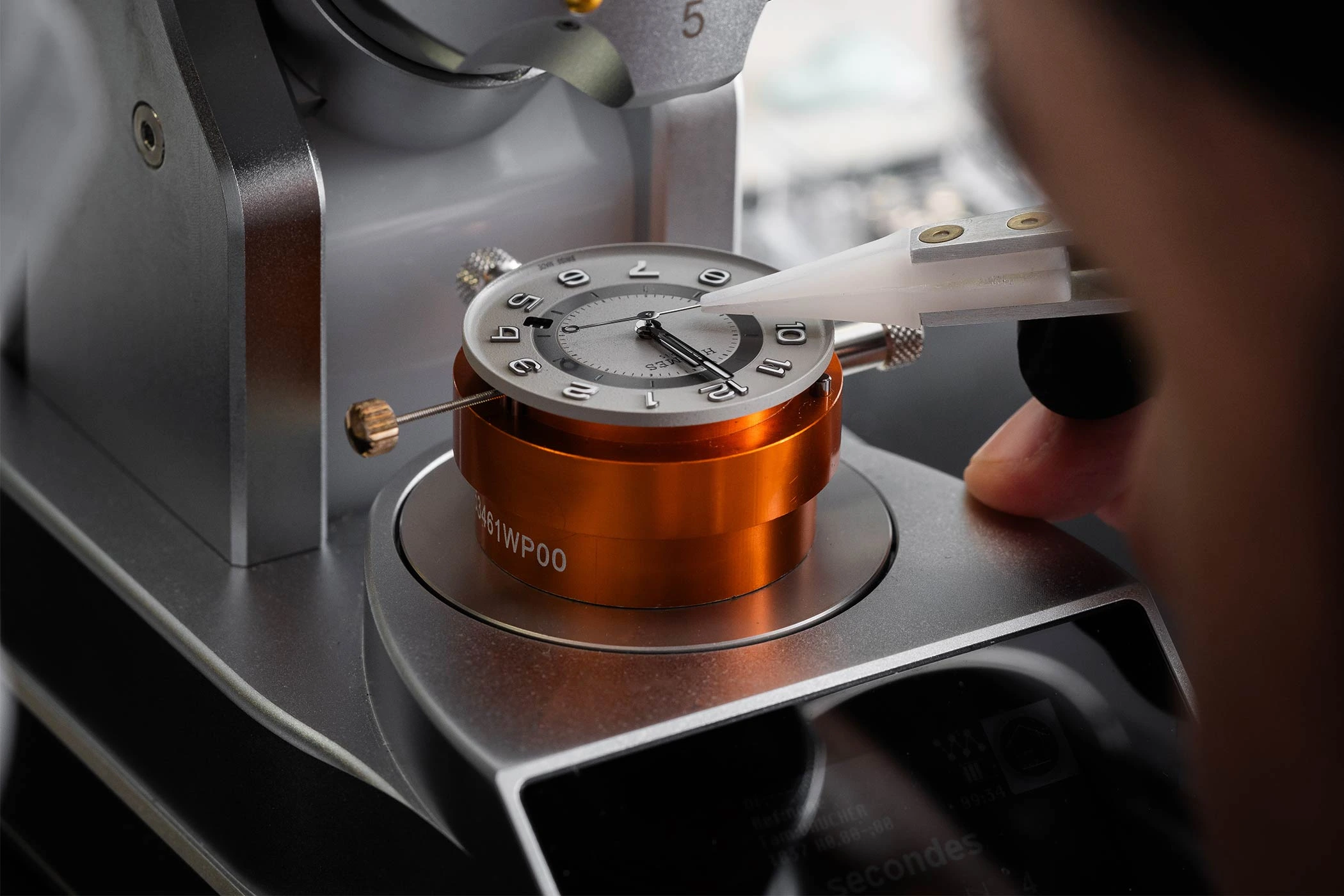
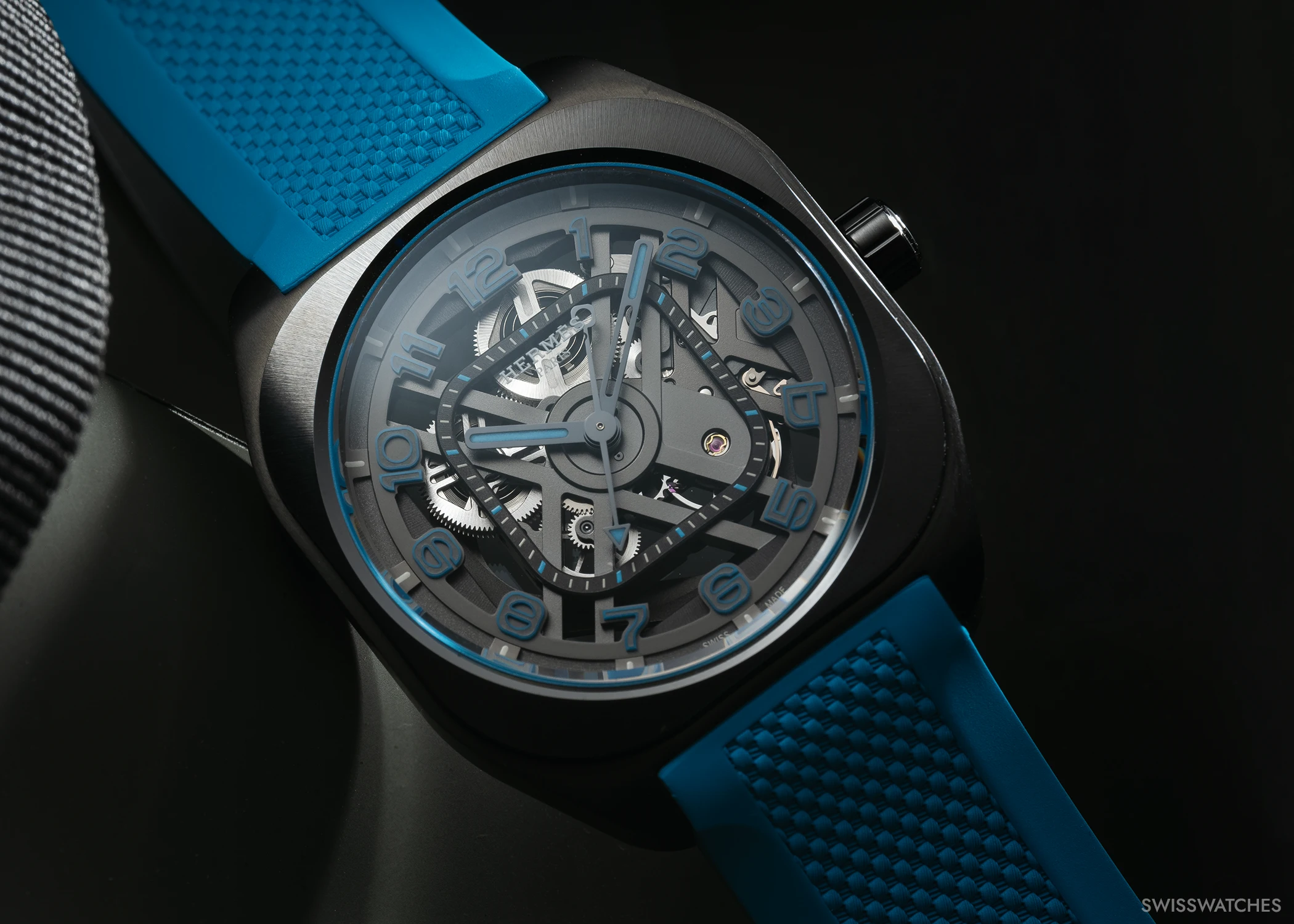
The H08 line itself, launched around five years ago, has quickly become the face of modern, masculine watchmaking at Hermès. Yet whilst previous models stood out primarily for their use of materials such as graphene, titanium and ceramic, as well as their striking typography, the Squelette version takes a far more technical approach. Going beyond the mere function of timekeeping, Hermès emphasises the visual design of the mechanics with the skeletonised Calibre H1978S. With technical features such as the titanium movement plate, the tungsten rotor and the ten-year warranty, the brand aims to reinterpret the traditions of Swiss watchmaking through its own distinctive design impulses.
At the heart of the Hermès H08 Squelette lies the self-winding mechanical movement, designated internally as the H1978S. It is based on the new 4100 calibre family from Vaucher Manufacture, but has been further developed specifically to meet the requirements and the aesthetic of Hermès. Unlike many conventional skeletonised movements, where material is simply removed from an existing plate, the H1978S represents a ‘new generation’ of skeletonised movements.
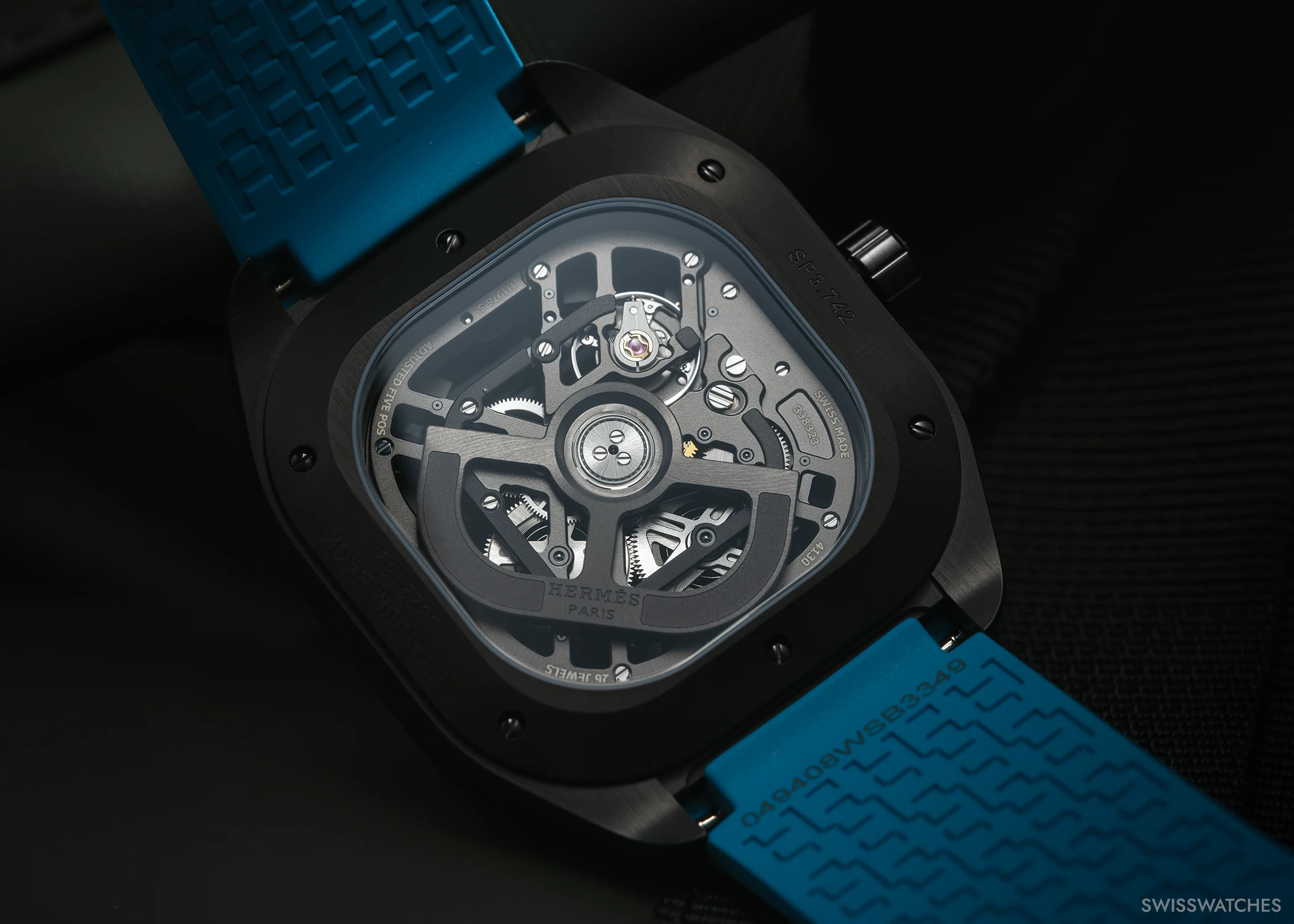
One of the most technically sophisticated features of the H1978S is the use of titanium for the movement plate. Whilst most movement plates in the industry are made of brass, which is subsequently electroplated, Hermès has opted for titanium to maintain the lightness and robustness of the Hermès H08 Squelette case on the inside.
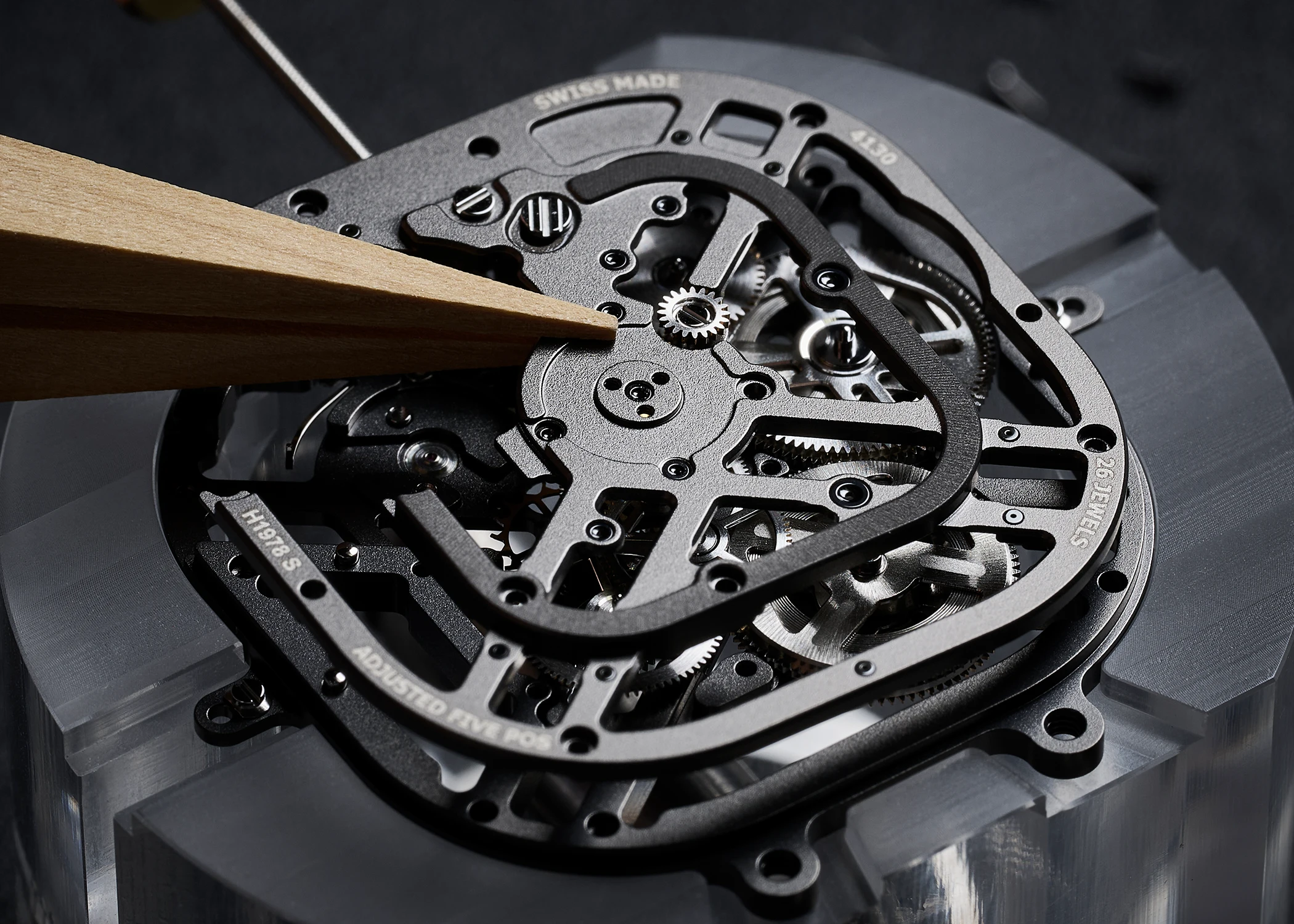
However, machining titanium at this micromechanical level presents extreme challenges. Titanium is known for its toughness and poor thermal conductivity during machining, which leads to high tool wear. The production of a single plate for the H1978S takes around two hours. This represents a production time three times longer than that required for conventional brass plates. This additional effort is direct evidence of Hermès’ industrial ambition to use materials that are not only decorative but also functionally superior. Titanium is corrosion-resistant, non-magnetic and offers an excellent strength-to-weight ratio, making the watch as a whole more resistant to shocks.
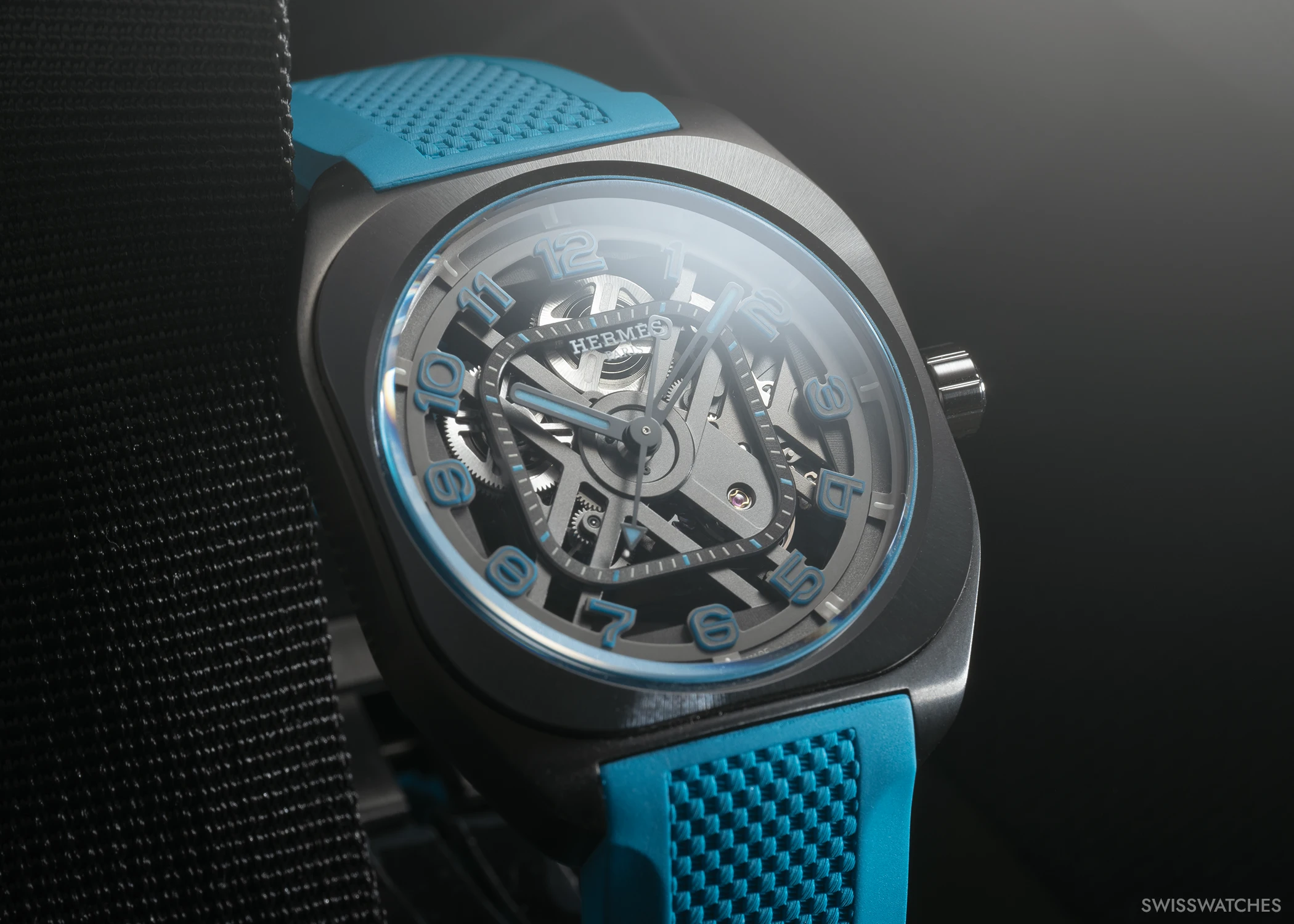
In parallel with the choice of materials, key mechanical components have been optimised. The movement of the Hermès H08 Squelette features a redesigned mainspring barrel and improved gear geometry. The optimisation of the tooth profile serves to minimise friction within the gear train and make the energy transfer from the mainspring barrel to the escapement more efficient.
Particular attention has been paid to the power reserve and the consistency of energy delivery. The H1978S utilises two mainsprings. This system ensures a more stable torque curve throughout the entire running time of approximately 65 hours. A more consistent energy delivery directly results in greater timekeeping accuracy, as the amplitude of the balance remains stable over a longer period.
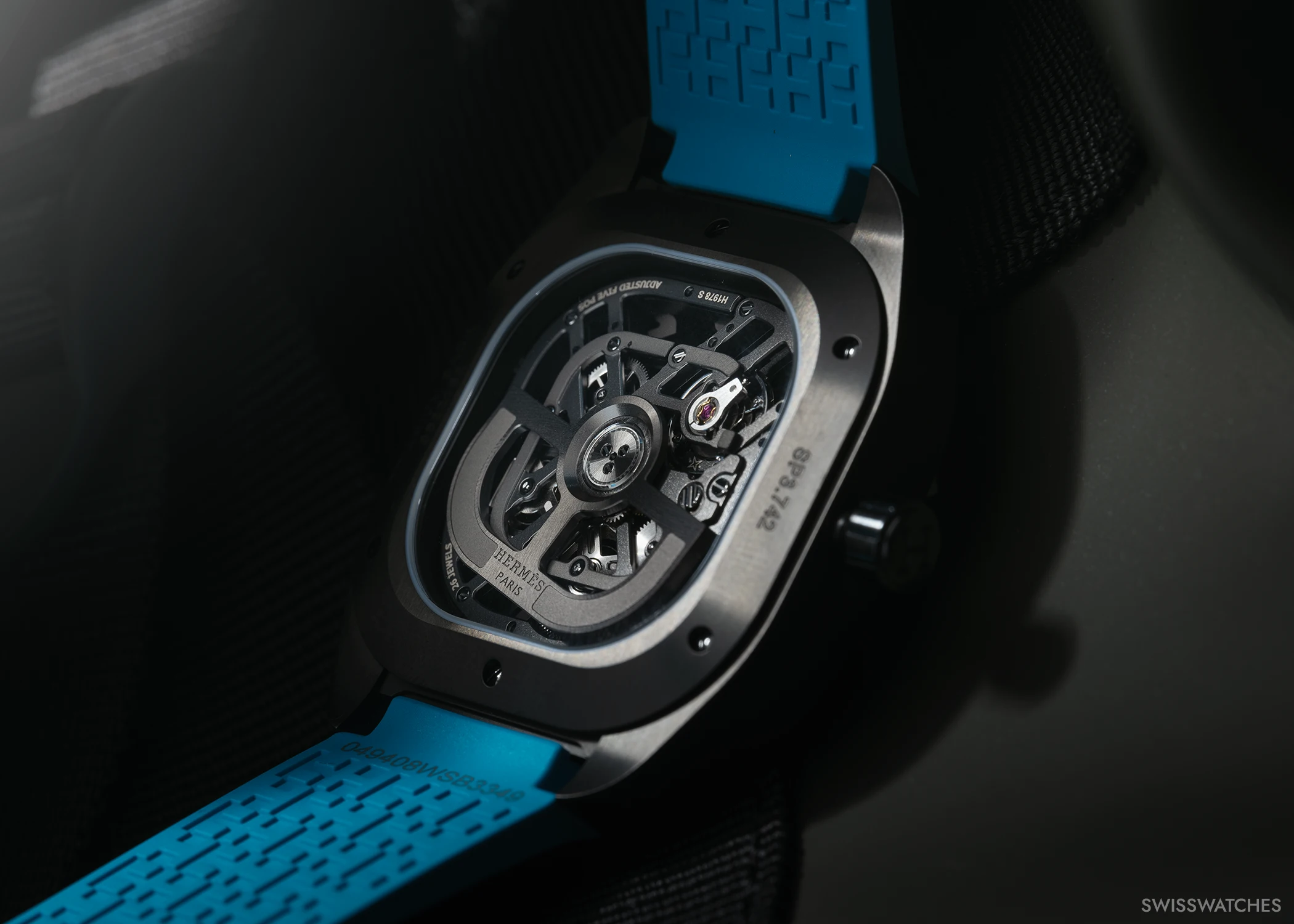
A skeletonised movement requires an equally transparent rotor so as not to obstruct the view of the mechanics. Here, the engineers faced a particular challenge: a rotor requires mass to generate sufficient kinetic energy for winding through the wearer’s arm movements. However, if a rotor is heavily skeletonised, it loses weight.
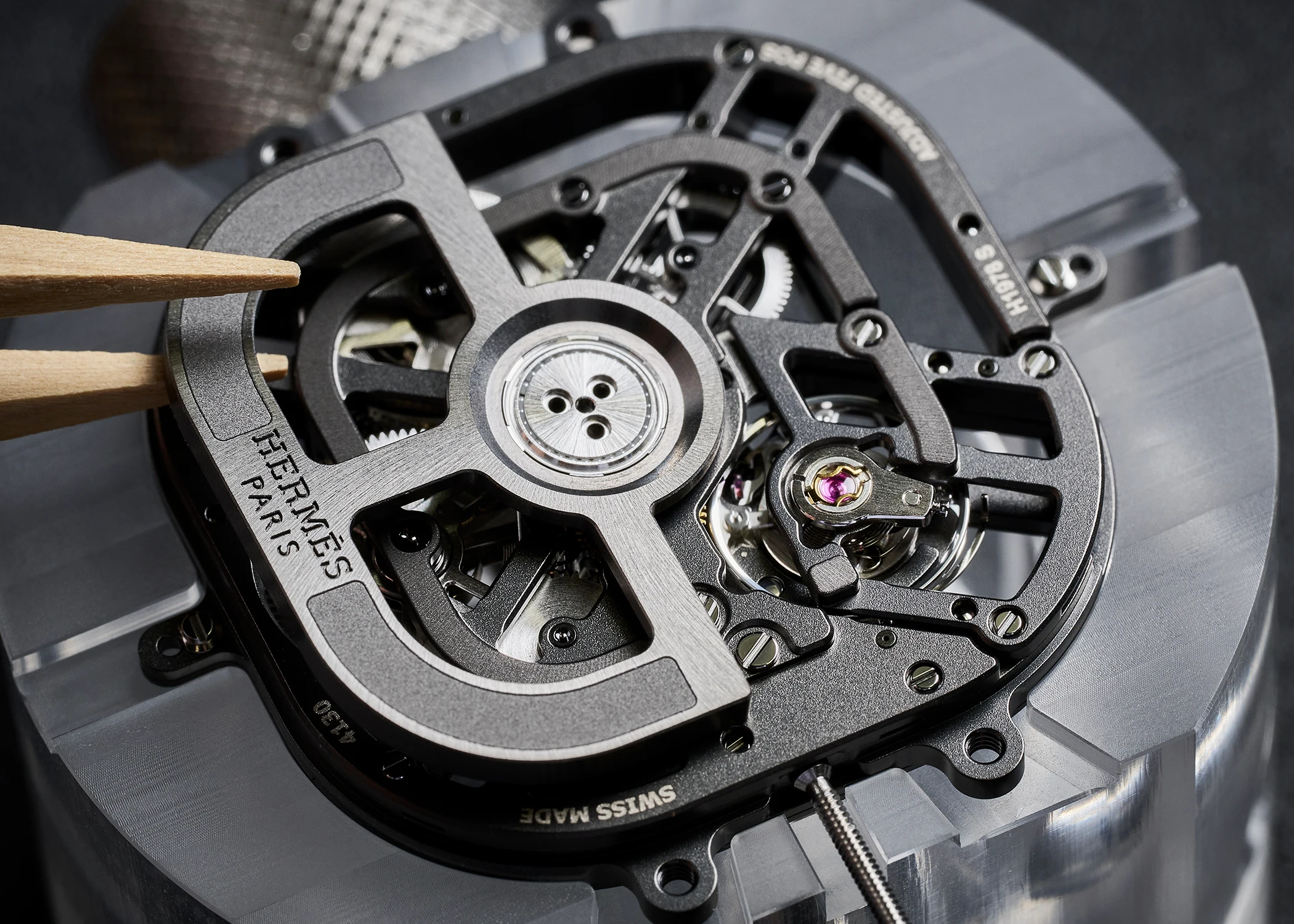
The solution for the Hermès H08 Squelette is based on a combination of carefully selected materials and precise shaping: as the rotor is made of tungsten – a material whose density is significantly higher than that of steel or titanium and comparable to gold – the necessary moment of inertia for efficient winding is retained despite the delicate, skeletonised structure. In parallel, the design challenge was solved by harmonising the rotor visually with the H08’s characteristic cushion-shaped case, without compromising the technically required, precisely circular winding motion.
In addition, Hermès implemented an innovative protection system, the so-called “zirconium galley”. As the skeletonised rotor is wider than standard models due to its construction and the bridges are made of titanium, there was a theoretical risk that the rotor might touch the bridges during strong vibrations and cause scratches. To prevent this, small zirconium balls were strategically placed as spacers. These ceramic elements act as buffers and prevent any direct metal-to-metal contact between the rotor and the movement bridges, which is intended to ensure the movement’s longevity for decades.
the calibre has been tested to the equivalent of 10 years of continuous wear. Laurent Dordet, CEO of Hermès Horloger, emphasised at the presentation that the movement has undergone stress tests simulating daily, intensive sporting use.
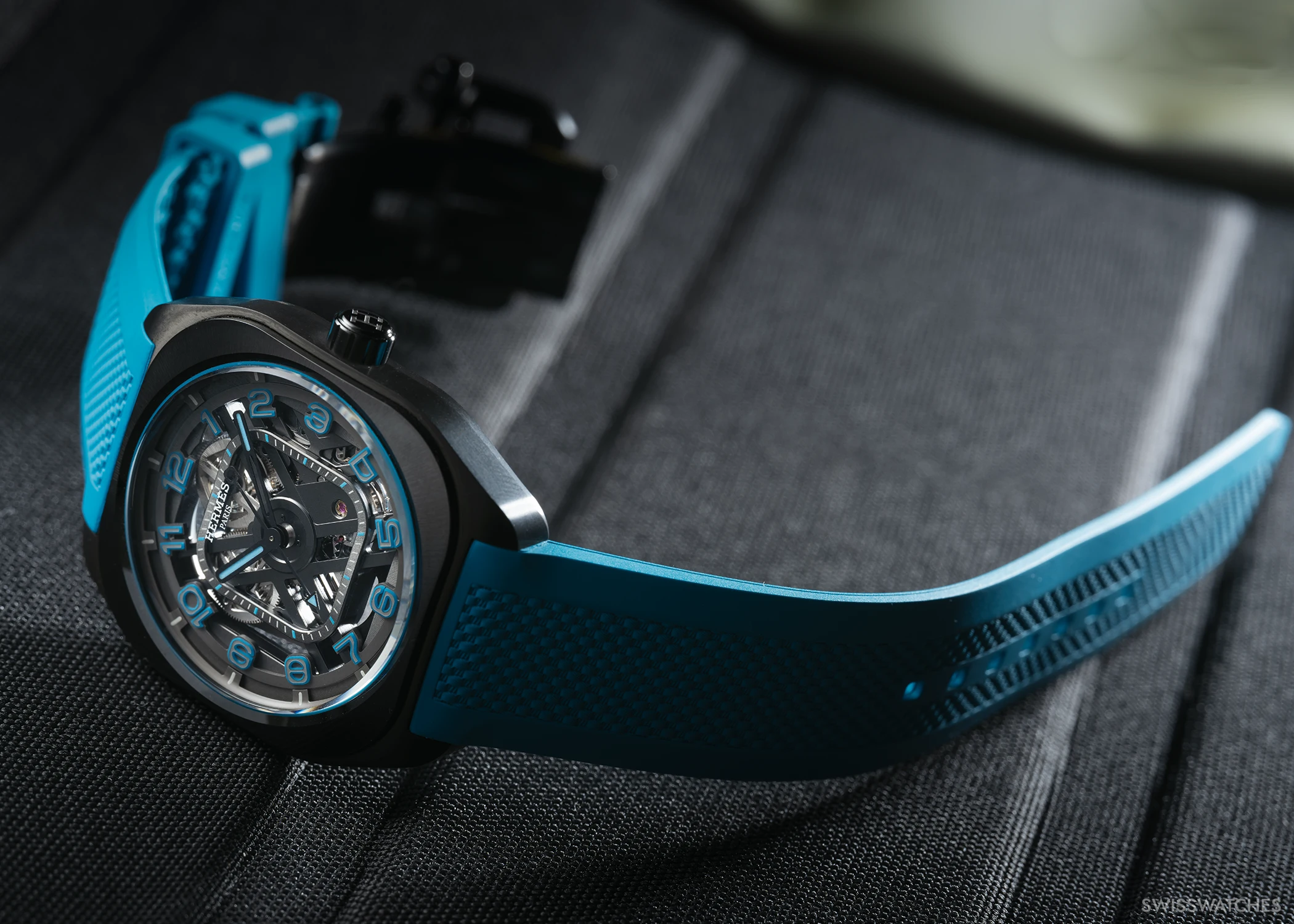
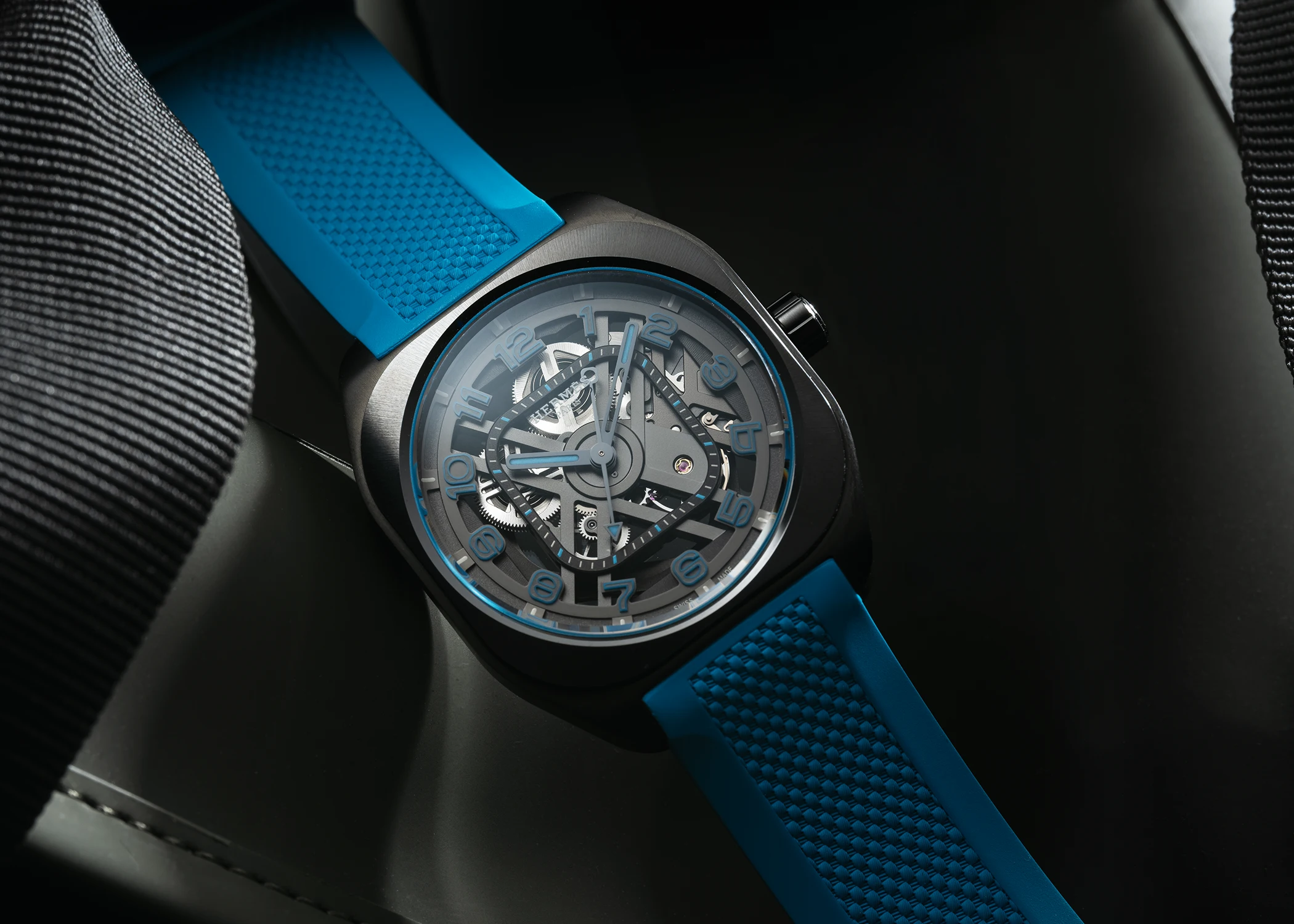
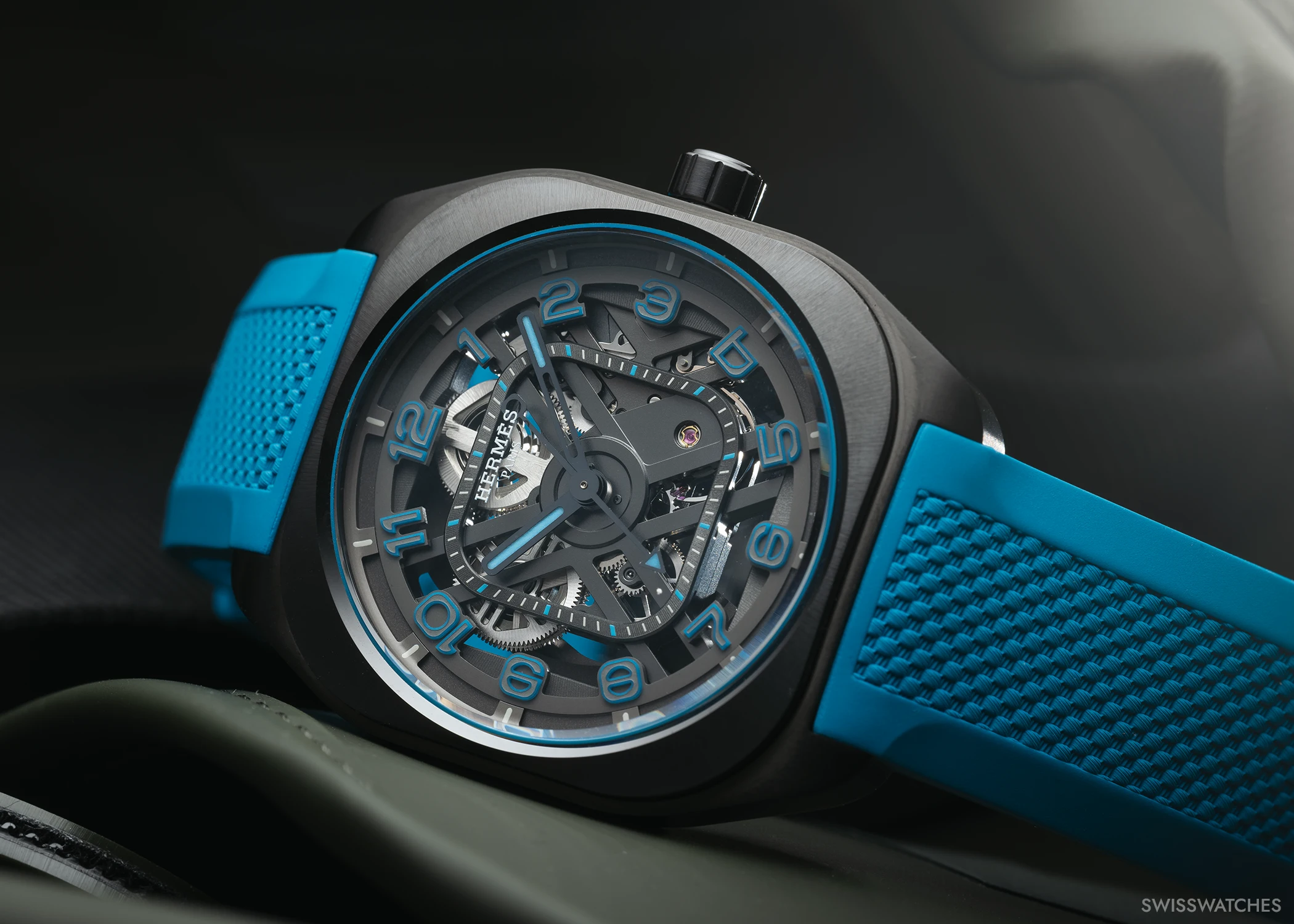
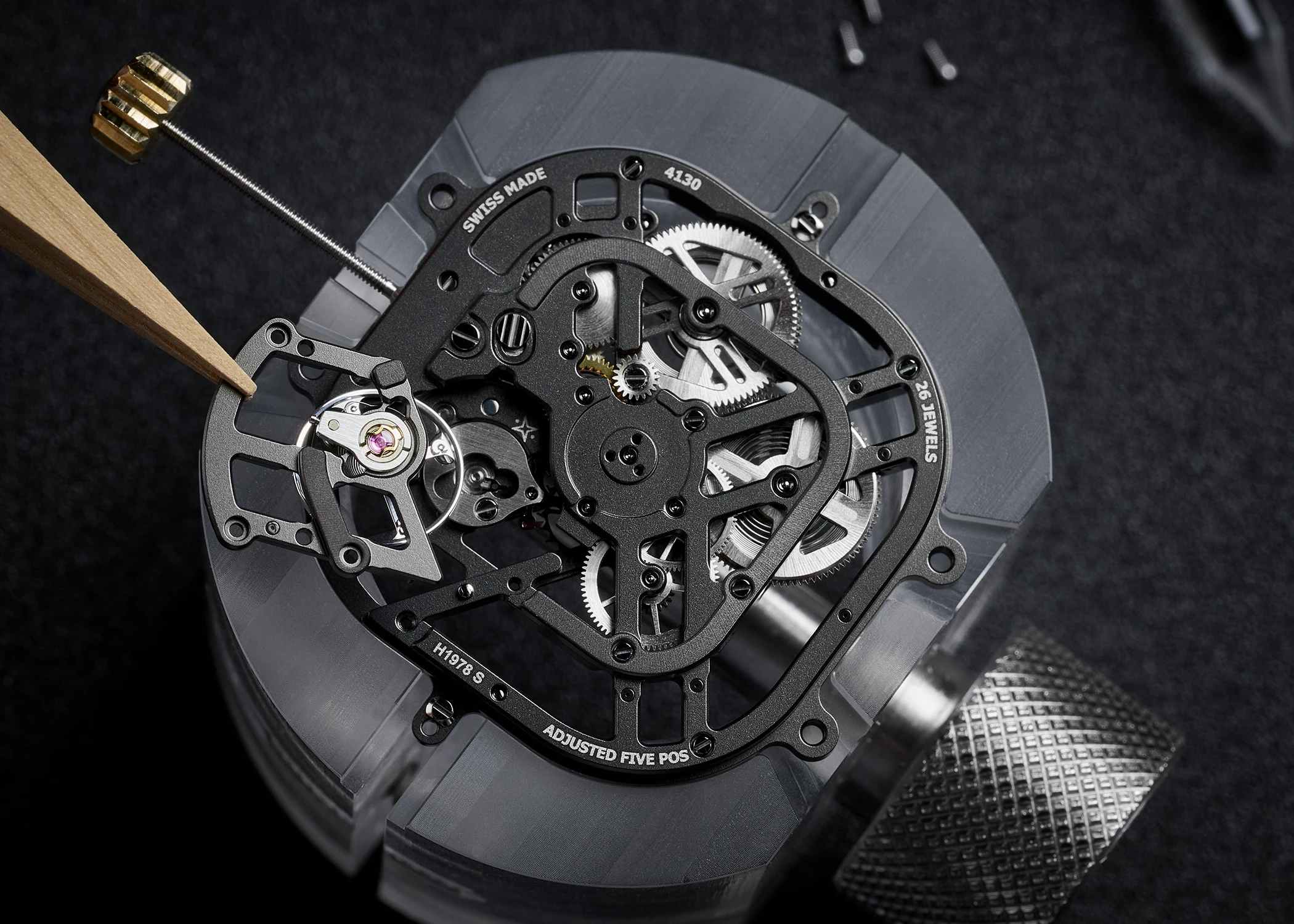
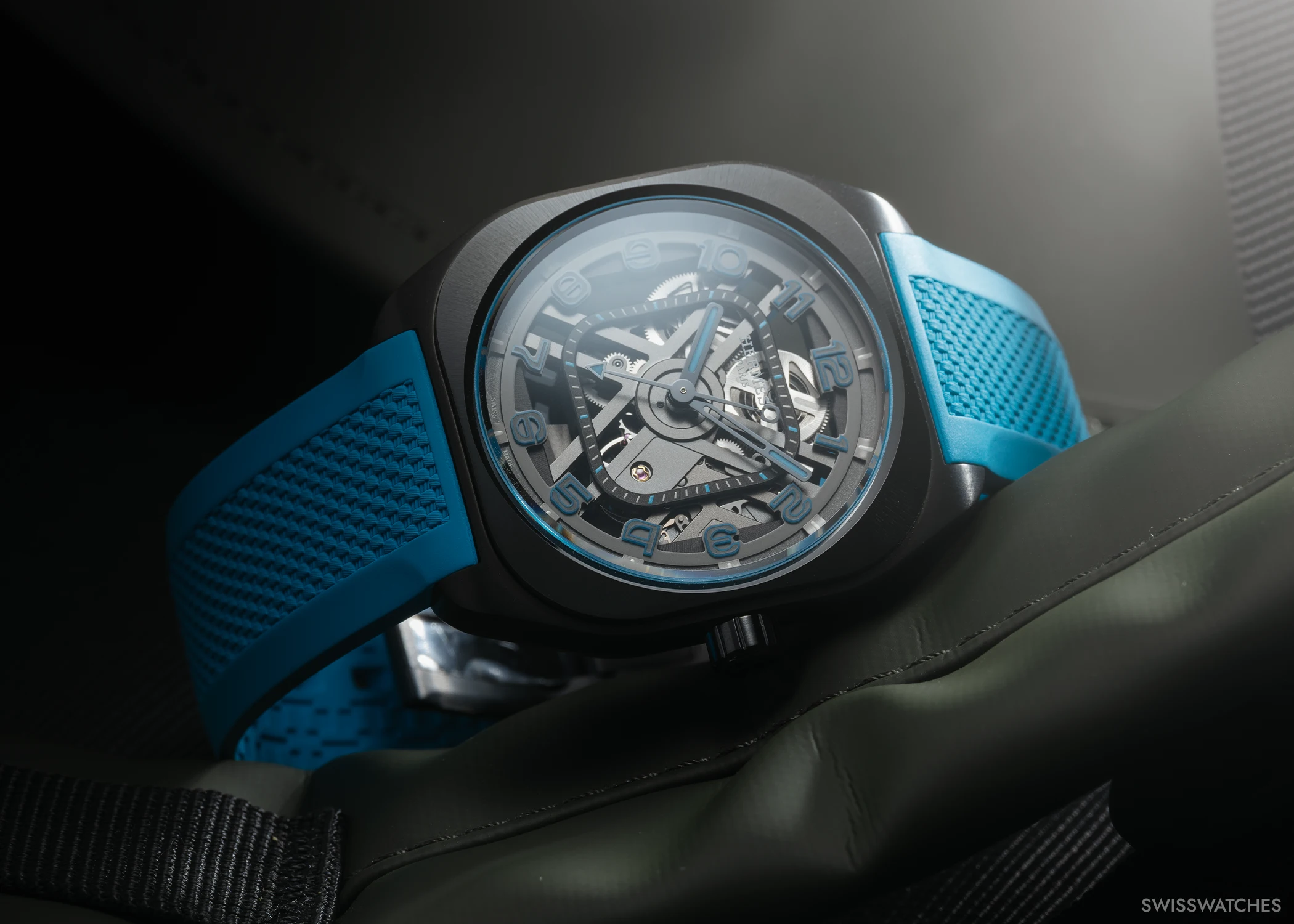
The Hermès H08 Squelette remains true to the design ethos created by Philippe Delhotal, yet takes it to a new dimension through the radical exposure of the mechanics. The 39 mm wide cushion-shaped case of the Hermès H08 Squelette is crafted from DLC-coated titanium, renowned for its dark, matt finish and extreme hardness. The bezel, made of satin-finished ceramic with mirror-polished chamfers, frames the skeletonised spectacle and lends the watch an architectural depth.
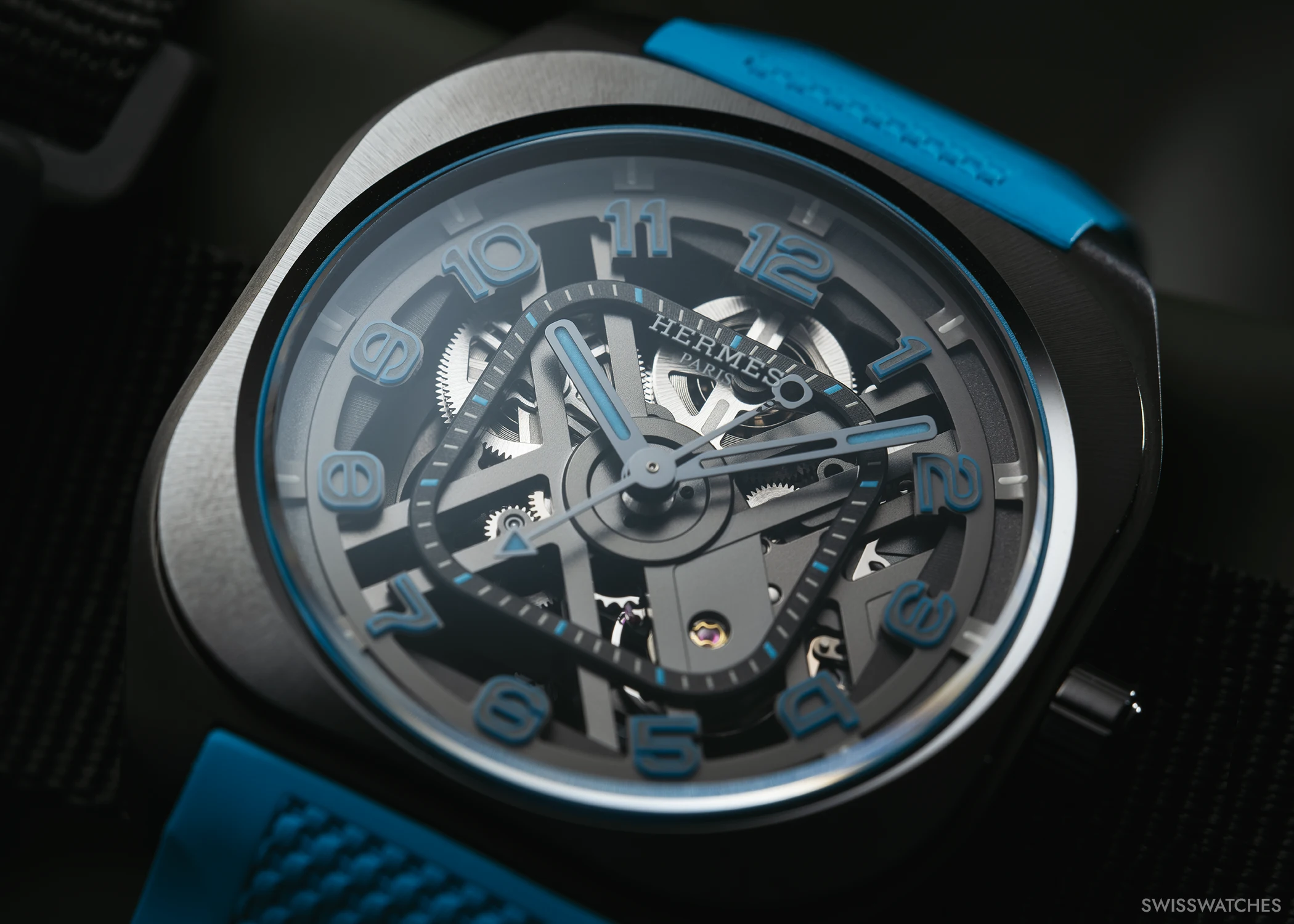
A central feature of every Hermès watch is the typography. On the Hermès H08 Squelette, the Arabic numerals are applied to a grey, transferred minute ring that appears to float above the openwork movement. The numerals themselves are coated with Super-LumiNova, which not only ensures legibility at night but also creates an interesting contrast with the black PVD-coated hands. In the ‘Bleu Saint-Cyr’ version, the numerals and hands glow in a vibrant blue, lending a playful touch to the technical rigour of the movement.
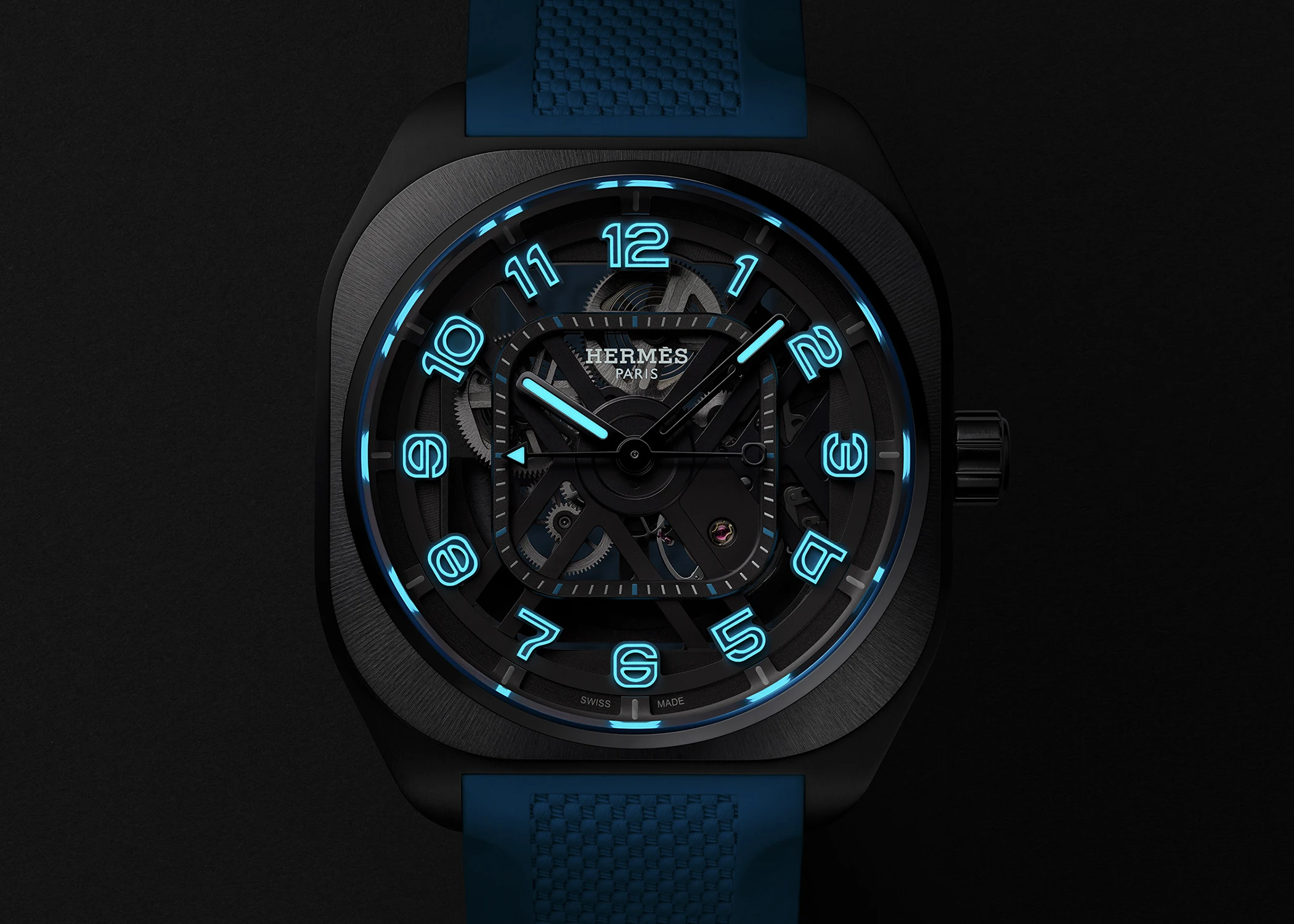
The skeletonisation of the H1978S is designed to create a play of light and shadow. The bridges are coated in black, which particularly highlights the silver tones of the gears and the black zirconium jewels. Instead of traditional Côtes de Genève, one often finds a fine graining or ‘ ’ satin finish here, which emphasises the Hermès H08 Squelette’s modern, industrial character. The transparency is taken so far that one can see right through the movement without compromising the structural stability of the timepiece.
The Hermès H08 Squelette is more than just a skeletonised watch; the Hermès H08 Squelette is the physical manifestation of the mechanical maturity of a house that has fought for its independence over decades.
The technical innovations of the H1978S calibre – from the extremely intricate titanium plate (2 hours of manufacturing time) to the efficient tungsten rotor and the protective zirconium cage – demonstrate that Hermès makes no compromises on quality. The fact that this watch also comes with a 10-year warranty is a bold and confident move that sets it apart from the competition and offers customers peace of mind.
With the H08 Squelette, Hermès not only offers a glimpse into the heart of time; they have also given it a new, transparent and extremely reliable architecture.