In this article, we showcase the most exciting perpetual calendars currently available and how different brands solve the same challenge differently.


Watches & Wonders is traditionally considered the highlight of the watchmaking year. At the fair, which takes place this year from 14 to 20 April, the manufacturers represented there present their most important novelties. At least in normal circumstances. Audemars Piguet is also back in Geneva for the first time since 2019 (when it was still the SIHH) – and is approaching its premiere in a completely new way. Perhaps because ‘normal’ sounds average, but more likely because February ensures the undivided attention of the watch world, which is still dreamily basking in the glow of the New Year. The major manufacturing offensive was therefore presented in Switzerland at the ‘Audemars Piguet Social Club’.
A total of 22 new models will complete the collection or replace existing models: from a historically inspired model with jumping hour to a pocket watch with universal calendar to new Royal Oak models, Offshore Diver variants and a Code 11.59 by Audemars Piguet with flying tourbillon and ivory-coloured dial. The brand is deliberately presenting itself as diverse. Or, as CEO Ilaria Resta put it during the presentation: ‘We need to have the right offering for four very different generations.’ However, the fact that 11 per cent of the customer database now consists of members of ‘Gen Z’ – those born between 1995 and 2020 – gives cause for optimism. In April, these new launches will be presented to a wider audience in Geneva, but Swisswatches Magazine was already on site for the launch. So these are the AP novelties of the year – in a subjective, personally selected order.
As much as Audemars Piguet as a brand and company is shaped by the Royal Oak today, the history of the house is rich in references with a completely different aesthetic and history. Established collectors, who lost their hearts to the manufacturer long before the current ubiquitous desire for a Royal Oak, never tire of pointing this out. In Le Brassus, the collection name [RE]Master has been used for historically inspired new launches. Model 01 was introduced in 2020, followed by Model 02 in 2024. However, this year’s new model with jumping hour does not belong to this group, even though the concept follows a similar path, but unlike the two [RE]Master models, it does not have a predetermined limited edition. The model is powered by calibre 7122, the first automatic manufacture movement with jumping hour, which is based on the automatic calibre 7121 used in the Royal Oak ‘Jumbo’. Visually, the ‘Neo Frame Jumping Hour’ is inspired by the 1271 reference from 1929.
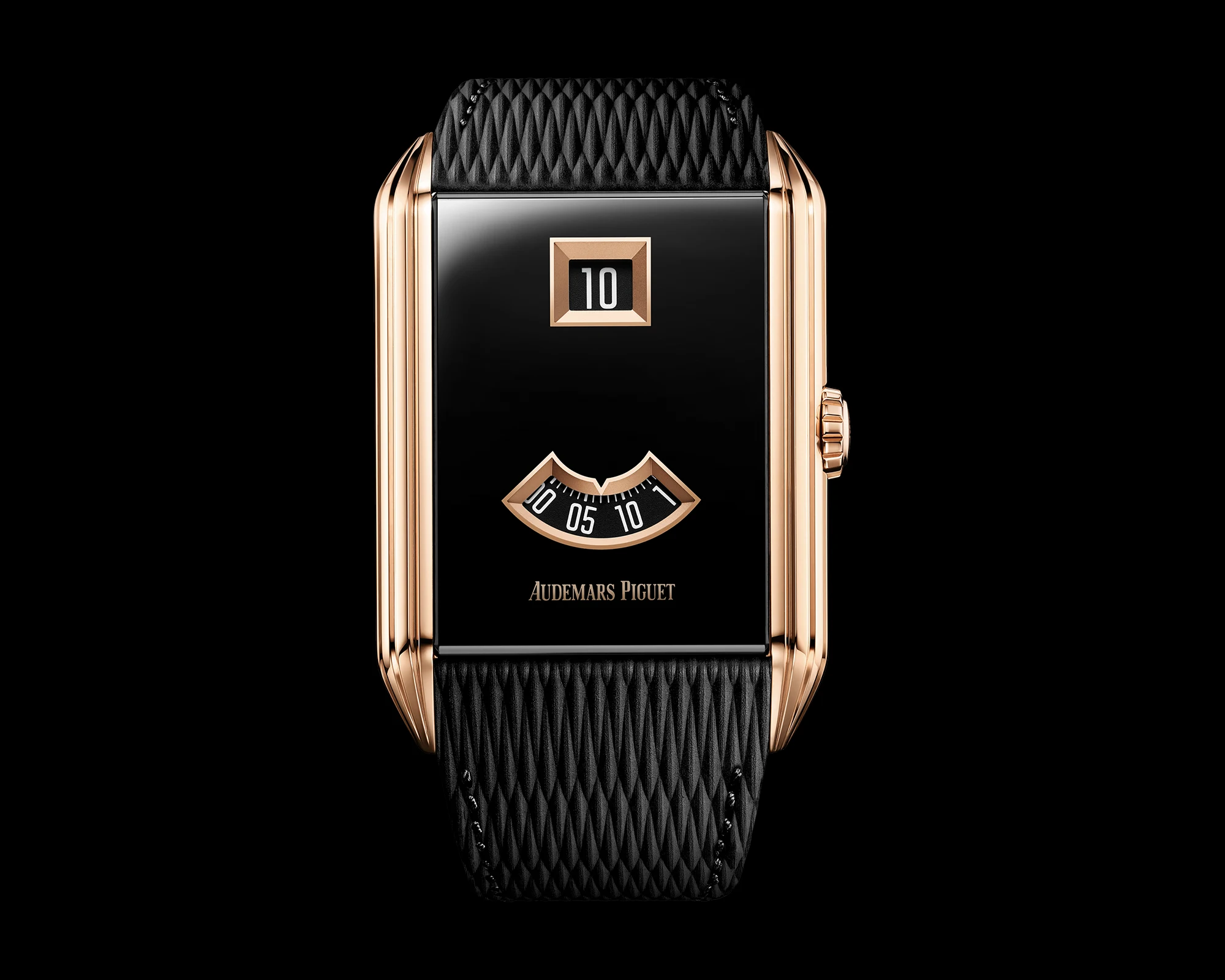
Rectangular timepieces were very popular back then – think of Cartier’s Tank from 1917 or Jaeger-LeCoultre’s Reverso, launched in 1931 – and this shape is currently enjoying a resurgence in popularity, from Patek Philippe’s Cubitus to Hublot’s Square Bang. However, Audemars Piguet’s ‘Jumping Hour’ takes a much more graceful approach, combining its classic look with the advantages of modern manufacturing: the 34-millimetre case, 8.8 millimetres high, with its Art Deco-style stepped sides, is made of rose gold, while the strap and face of the watch are black. The dial – or should we rather refer to it as the top of the case in this case? – is made of PVD-treated sapphire crystal. Whereas collectors of a Cartier Tank à Guichets from last year’s Privé collection have to worry about scratches on the gold case, future owners of an AP Jumping Hour can remain more relaxed. The dimensions of the case are more generous than the 34 millimetres on paper would suggest, yet it is clearly a watch that fits in with the trend towards more discreet timepieces.
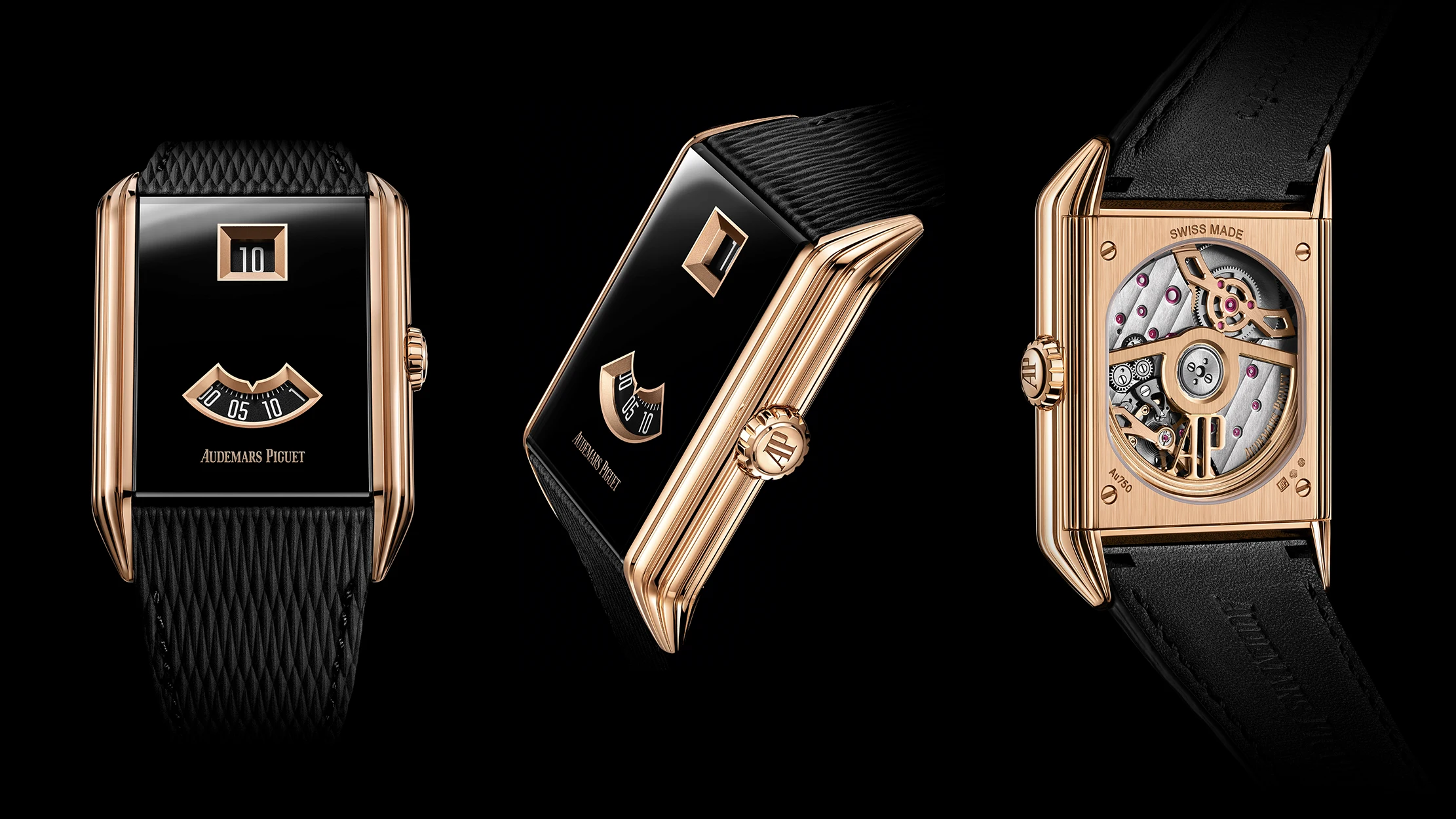
This new model is probably the most surprising of the 22, and at first glance, hardly anyone would immediately think of Audemars Piguet. At the same time, the colour combination is expressive and ultra-modern, and in this implementation more than lives up to the expectations of CEO Ilaria Resta and her colleagues: it is unmistakably a watch of the year 2026, which can and should find its place in pop culture and on the wrists of prominent collectors, while pleasantly emphasising the brand’s rich heritage.
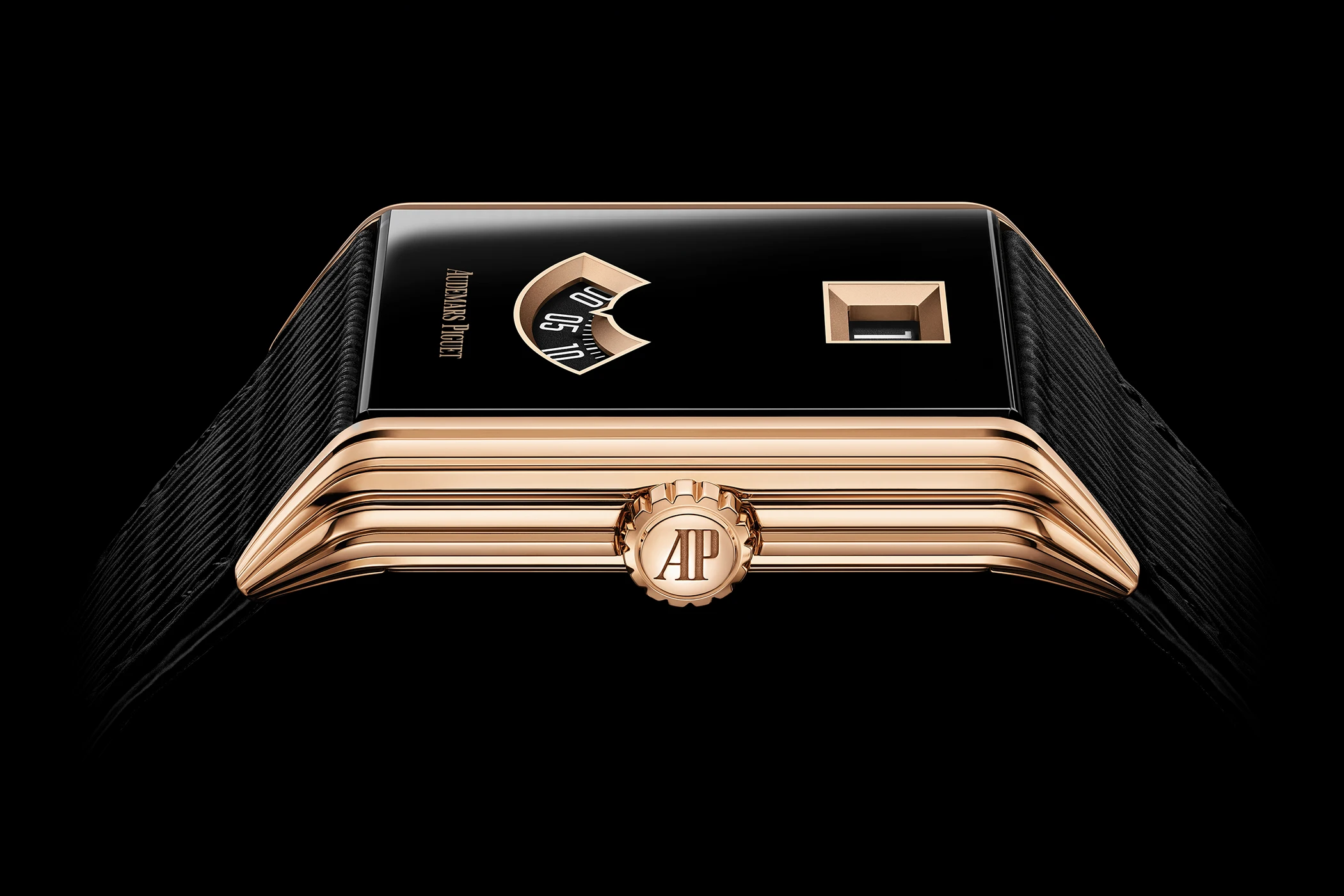
Of course, there are also new Royal Oak models, and naturally, these are appealing in many different ways. So where to start? Best to begin with the model that will give you sleepless nights.
The 39-millimetre Royal Oak ‘Jumbo’ extra-thin skeleton in titanium (reference 16204XT.OO.1240XT.01), equipped with a bezel made from the company’s own ‘Bulk Metallic Glass’ (BMG). Together with a skeletonised version of the perpetual calendar launched last year (reference 26685XT. OO.1320XT.01) and a smaller 37-millimetre yellow gold version (reference 15467BA.OO.1256BA.01), the trio of new models appeals to admirers of the skeletonisation expertise in Le Brassus. Hardly any other brand has mastered this technique so skilfully, and hardly any other model suits it so well.
Technically, nothing has changed in the titanium model compared to the familiar white gold version; both are powered by the calibre 7124. Nevertheless, even those who already own a skeletonised Royal Oak will check their bank balance when putting on this titanium version, or consider where they can cut back on other expenses to afford this exceptional Royal Oak. The titanium gives the watch a pleasantly understated matt finish, while the BMG gives the bezel and bracelet links an almost scratch-resistant shine. The lightness of the metal not only increases wearing comfort, but ultimately makes it the most suitable material for a skeletonised watch: reduced to the absolute minimum, less is definitely more here. The consistently monochrome look of the skeletonised dial distinguishes the titanium version from the white gold model with black accents.



The yellow gold 37-millimetre Royal Oak is the choice for more delicate wrists in this trio, or in other words: a more feminine interpretation. Unlike the ‘Jumbo’, it is powered by the calibre 3132 and features the AP-typical double balance wheel. It requires a case with a height of 10 millimetres, while the extra-flat titanium version manages with 8.1 millimetres. Both models share a monochrome aesthetic, with the flange and skeletonised dial matching the colour of the case. The movement in the titanium version is rhodium-coloured, while the yellow gold version focuses entirely on the yellow 18K precious metal.

And the perpetual calendar? From a purely rational point of view, it is certainly the most important innovation for the brand. The 41-millimetre model is available for the first time with calibre 7139, a skeletonised version of calibre 7138, which was introduced last year. However, the watch itself should not be described as skeletonised; rather, it has an open dial. All complications can be controlled using the crown alone. Four different settings allow the movement to be wound and the time and all calendar functions to be set. In addition, the arrangement of the subdials has been changed: the date is now at twelve o’clock, the day of the week at nine o’clock and the month at three o’clock. This new model is also being launched in a titanium case with a BMG bezel, but unlike the ‘Jumbo’, it features rose gold hour markers and hands for an elegant contrast.


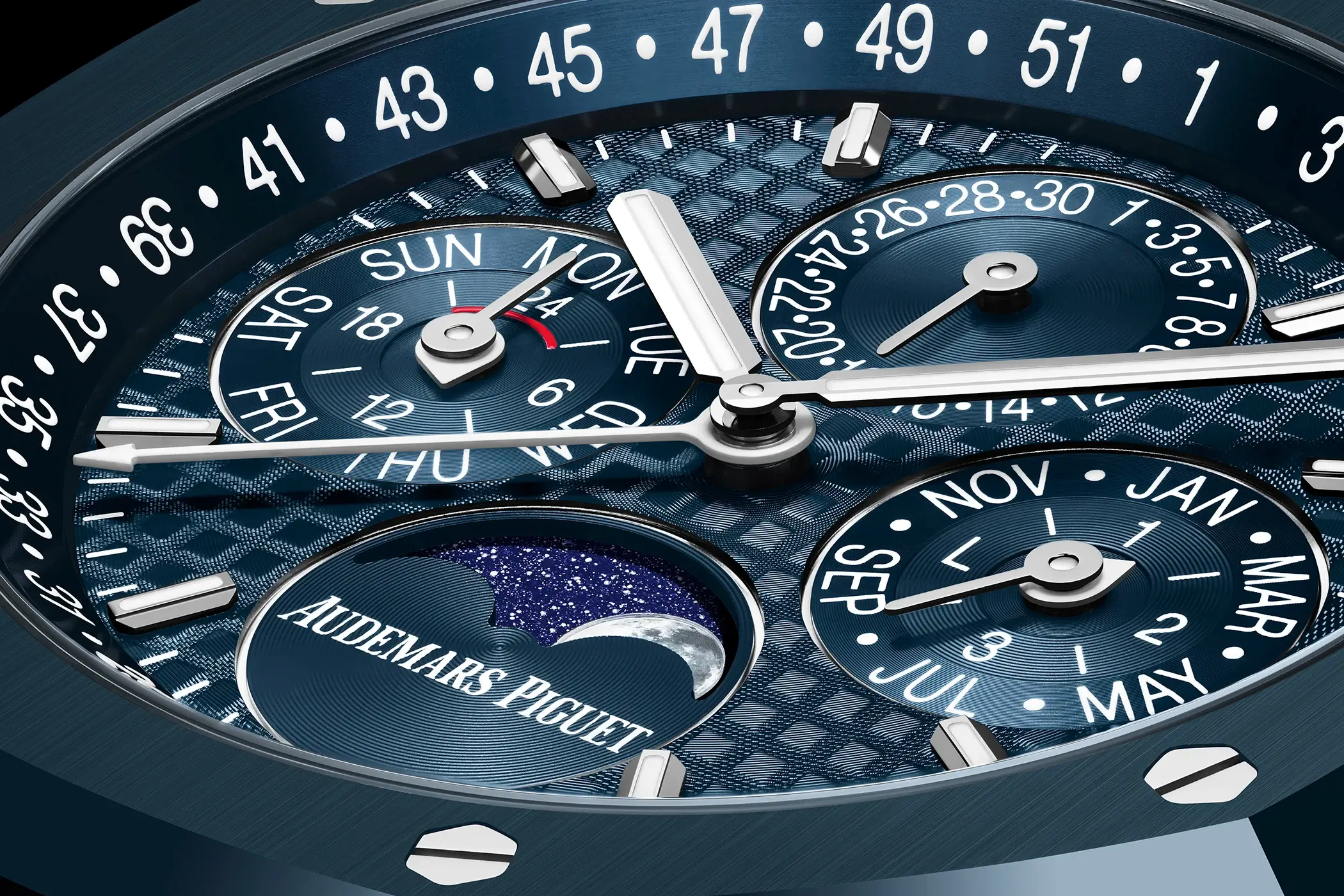
Four further innovations impressively demonstrate the remarkable balancing act achieved by Gerald Genta’s Royal Oak design. First, there is the perpetual calendar in deep dark blue ceramic (reference 26674CD.OO.1225CD.01), a shade known at Audemars Piguet as ‘Bleu Nuit, Nuage 50’, the dark blue shade introduced last year to mark the 150th anniversary, which has a completely different depth and elegance to its predecessor. Most recently, this colour attracted a lot of attention on Aryna Sabalenka’s wrist at the Australian Open. This new perpetual calendar is also equipped with an upgraded calibre, and the quality of the ceramic bracelet is considered the gold standard in the industry. The material makes the watch very light while retaining the product’s overall value. Where other ceramic bracelets can quickly appear somewhat flimsy and plain, the dark blue bracelet with its satin-finished surfaces is extremely impressive.


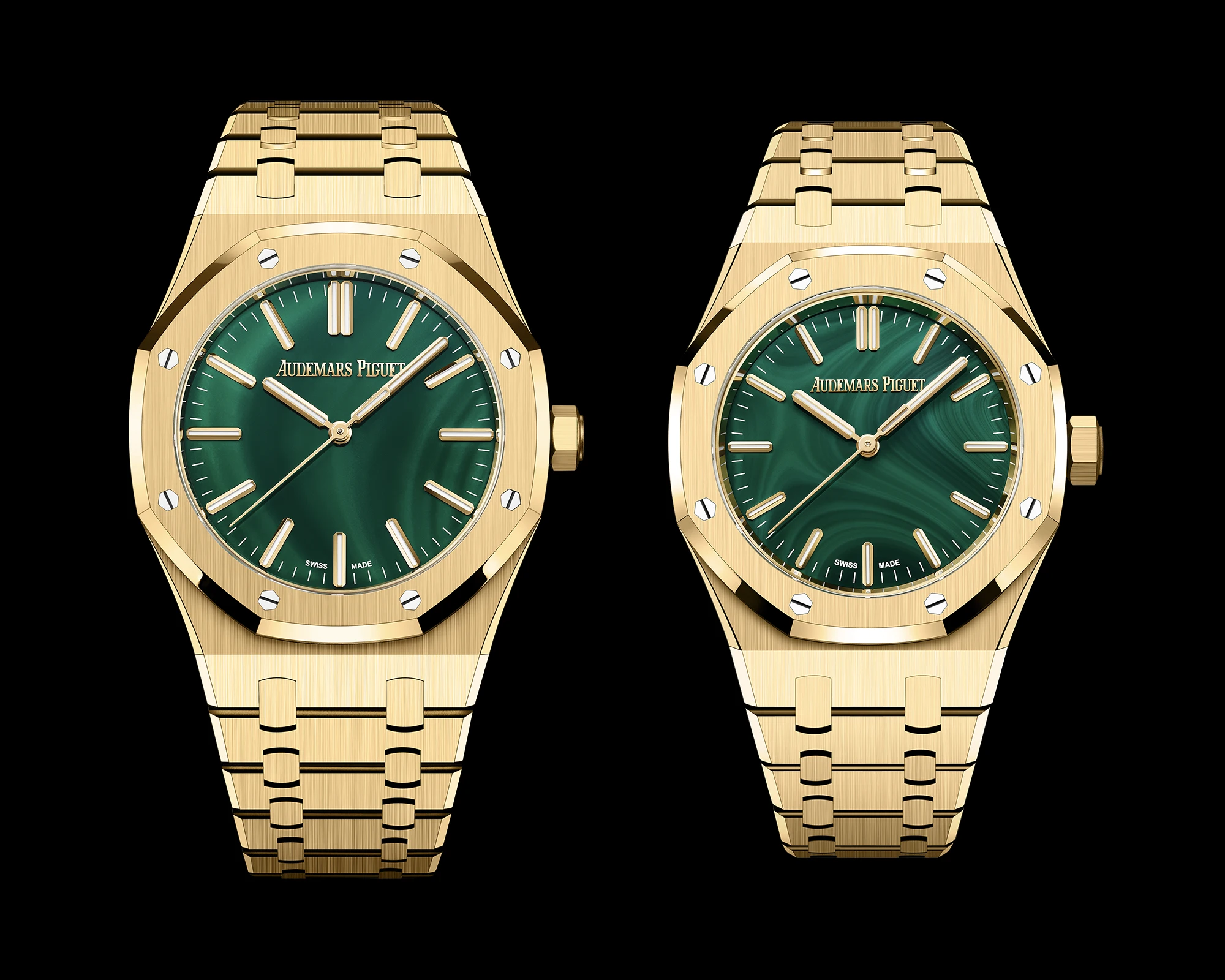
Two versions of the classic three-hand Royal Oak in yellow gold, with a choice of 41 or 37 millimetre diameters (references 15513BA.OO.1320BA.01 and 15552BA.OO. 1356BA.04) with stone dials made of malachite. The combination of yellow gold and dark green is a perennial favourite among collectors for good reason – and it works here too.
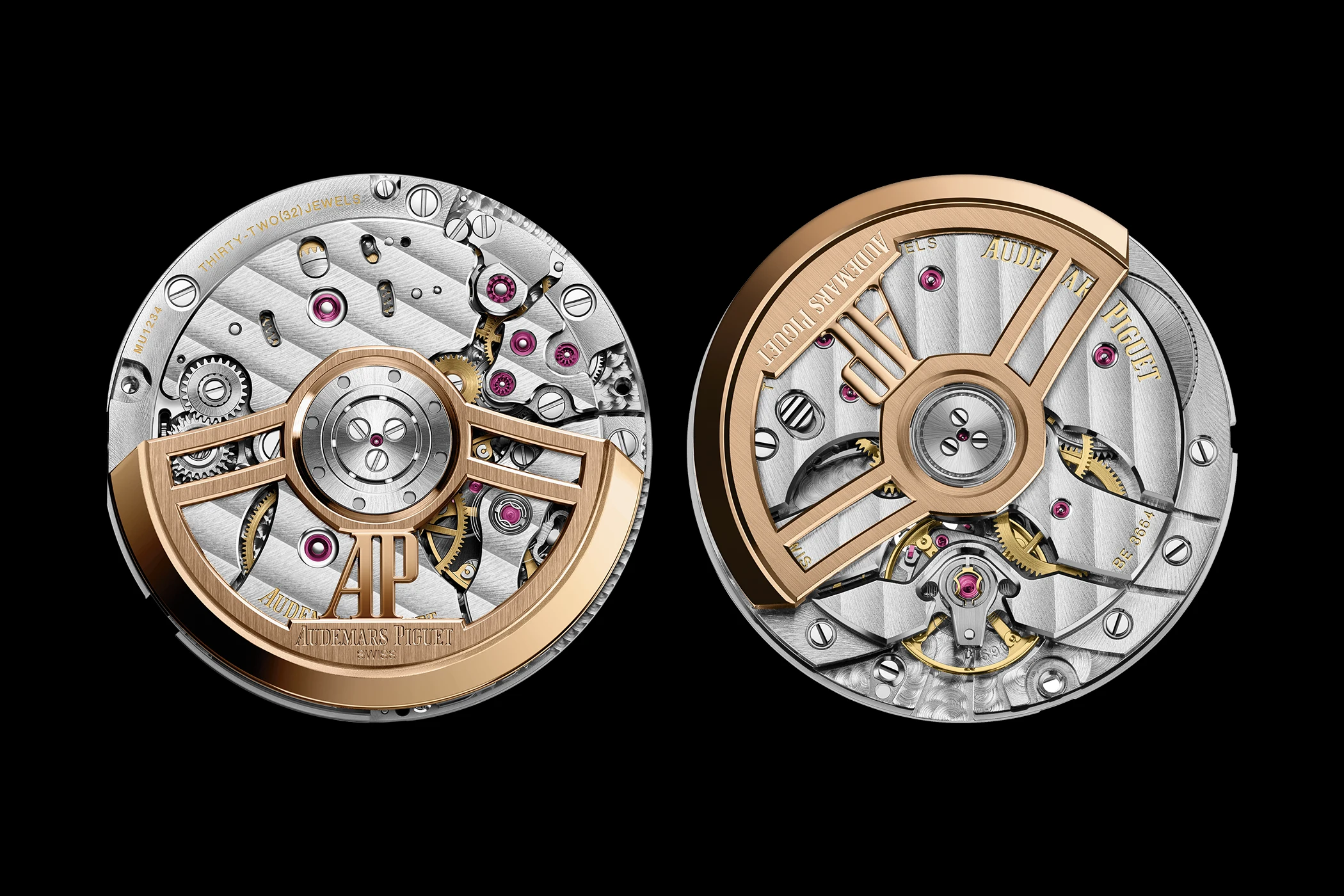
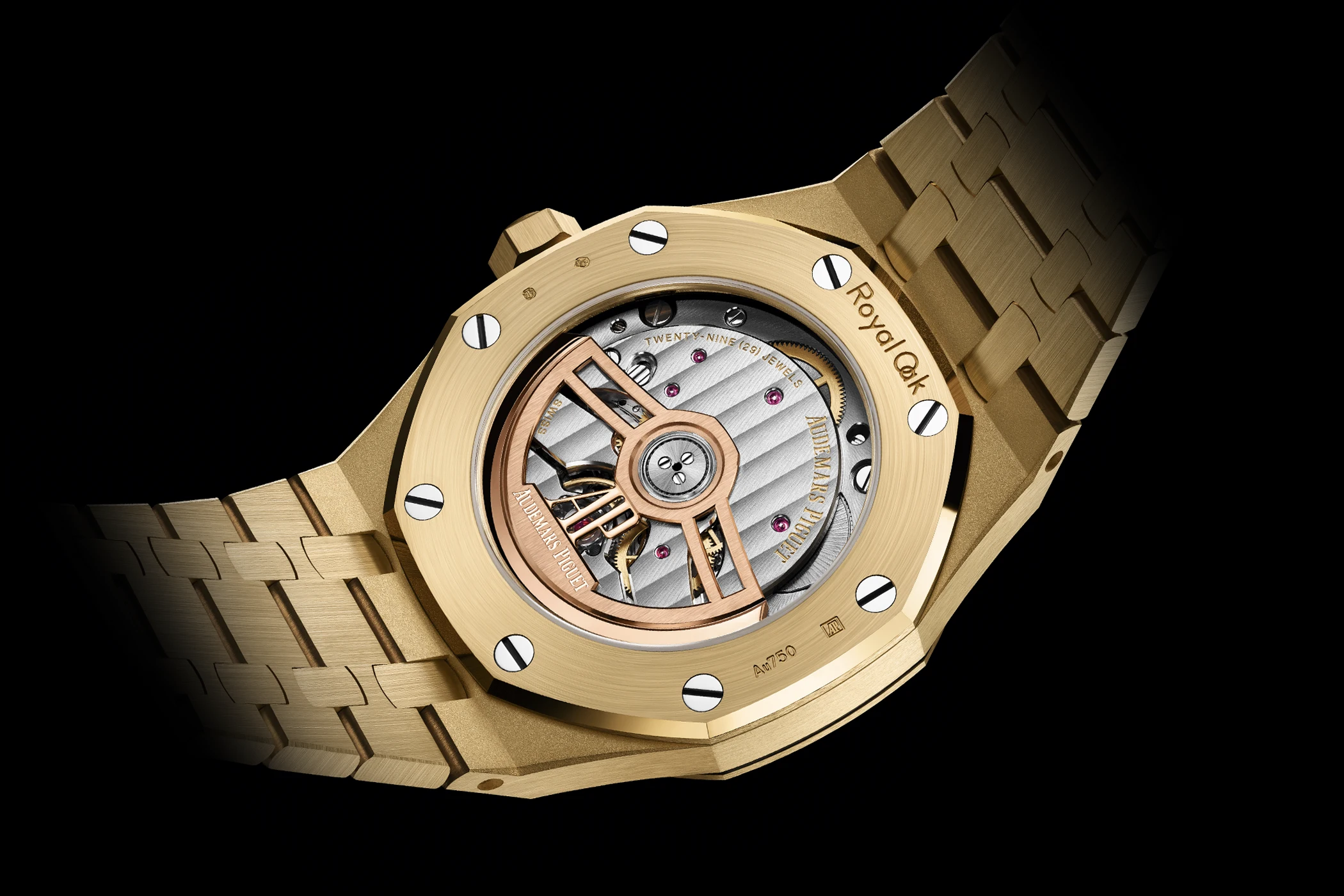
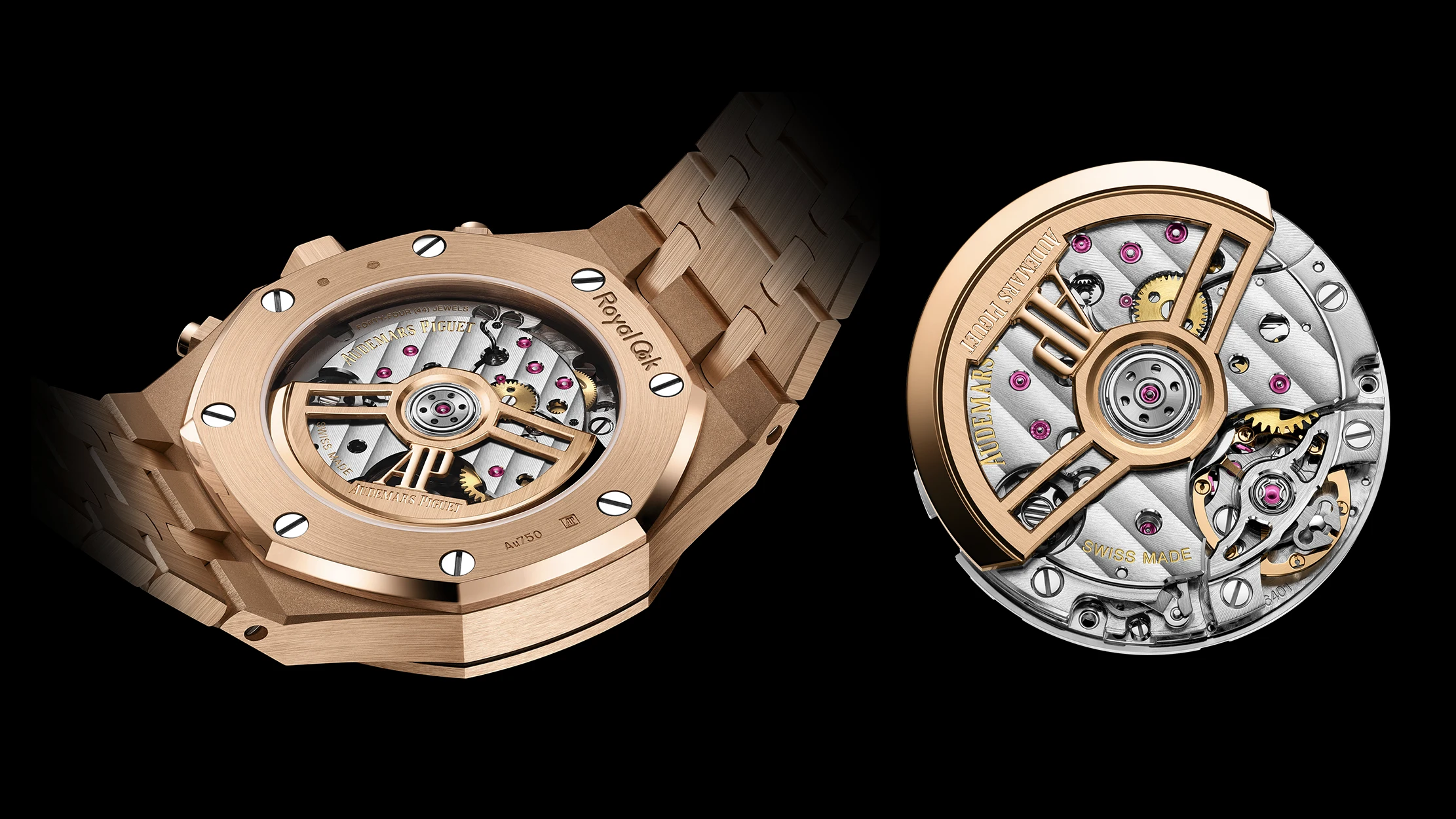
Watch enthusiasts with slimmer wrists know that the 41-millimetre versions of the Royal Oak feel significantly larger than other watches with this diameter due to the lugs. At the same time – and perhaps because of this? – the 39-millimetre ‘Jumbo’ is extremely sought-after and difficult to purchase. From this perspective, the 38-millimetre chronograph has a significance that should not be underestimated: it combines a compact unisex size with the popular complication of the chronograph. And it is precisely this model that has now been fundamentally redesigned and equipped with the new manufacture automatic calibre 6401. It replaces the calibre 2385, which was introduced in 1997. It boasts a 55-hour power reserve, which is an improvement of 15 hours, and features a date display that jumps immediately at midnight. In future, a sapphire crystal caseback will also allow a view of the movement and its finishing. Not only have the dimensions of the previous chronograph been retained, but the new model is even slightly narrower.

Meanwhile, the layout of the subdials on the dial has been revised. The seconds are now displayed at nine o’clock and the hours at three o’clock. At the same time, the date display has been placed more centrally between the hour indices for four and five o’clock.
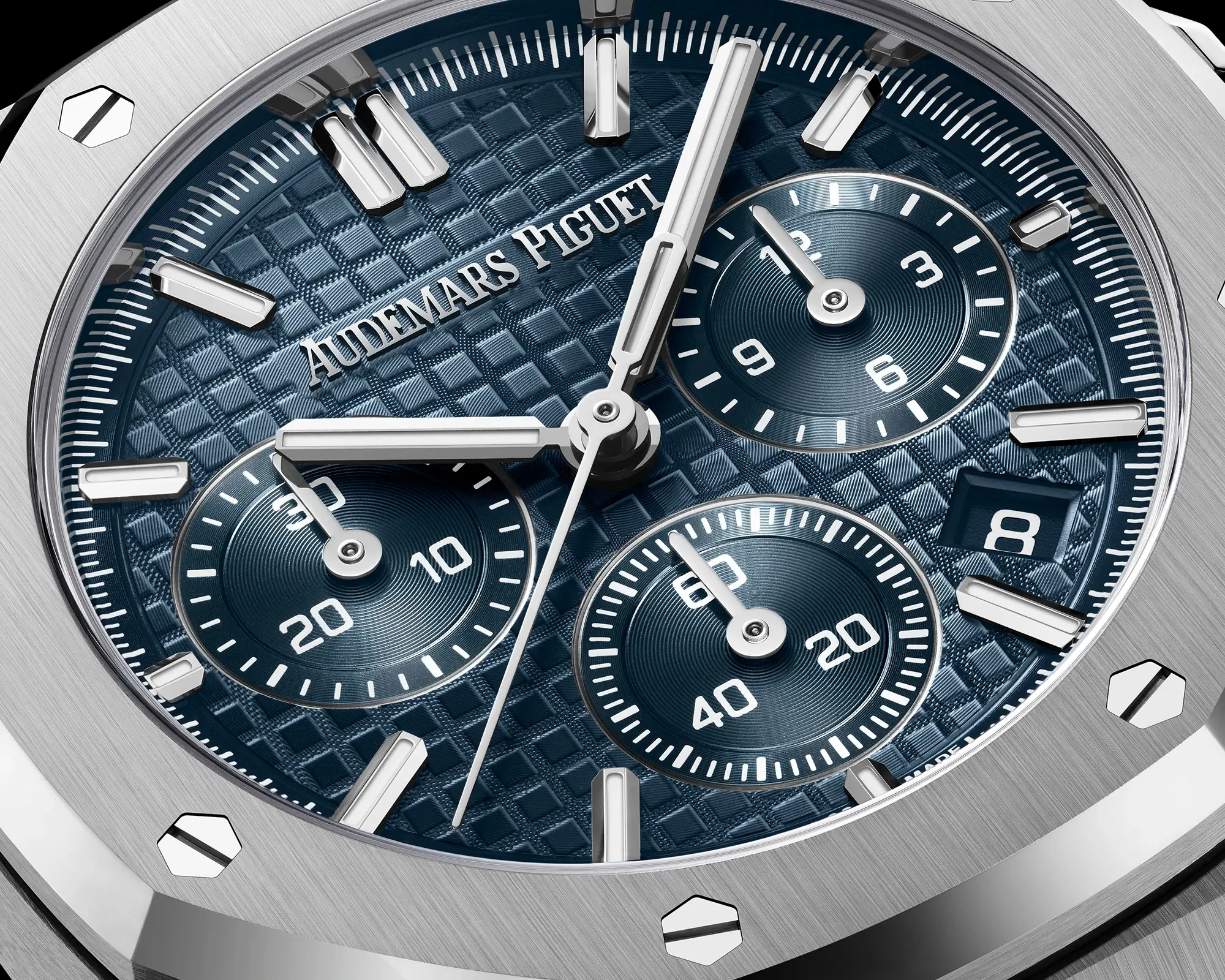
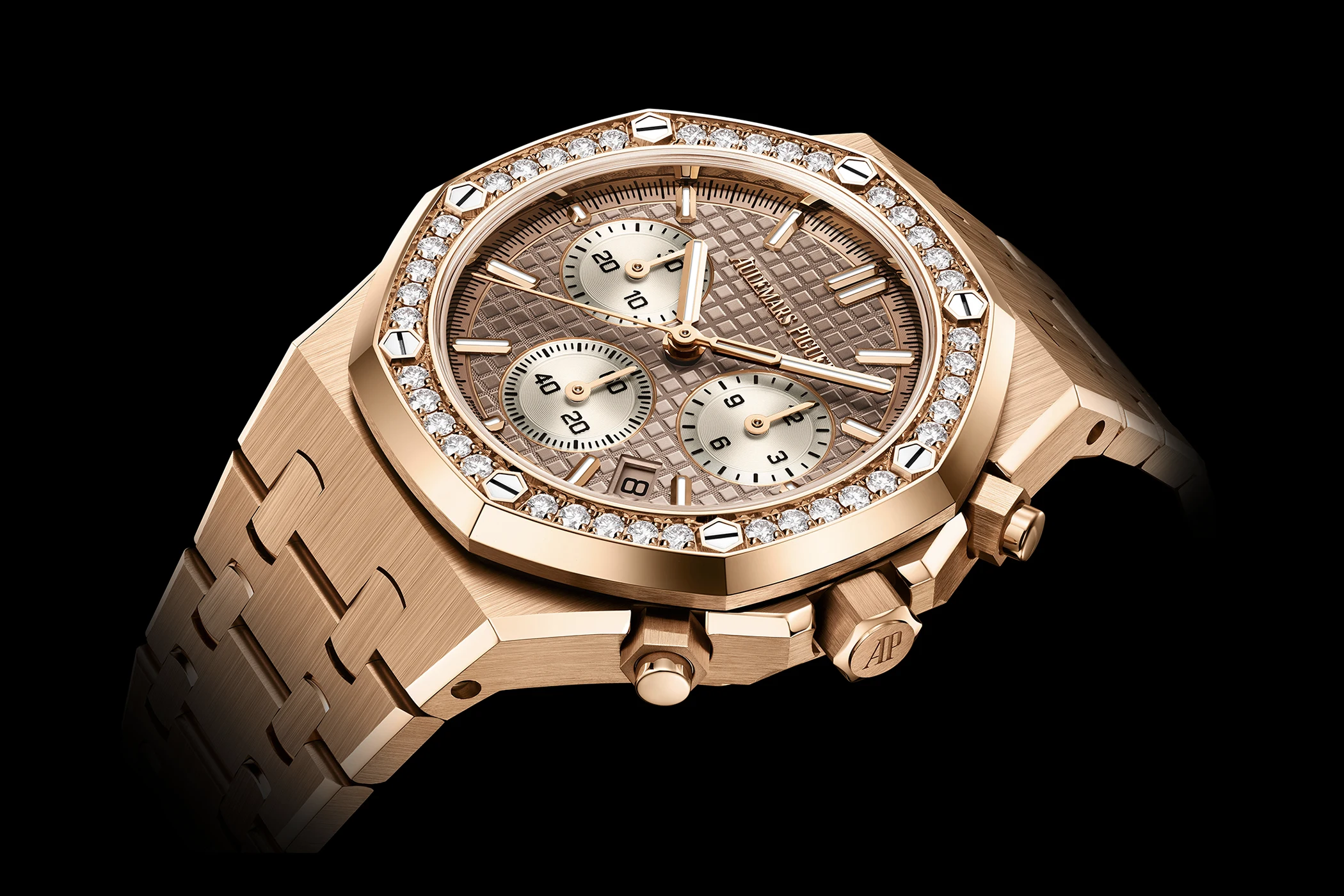
This new chronograph is initially available in three versions: stainless steel with a dark blue tapisserie dial for the sportiest interpretation (reference 26450ST.OO.1356ST.01), rose gold with a dark grey dial and silver subdials (reference 26450OR.OO.1356OR.01), and in another rose gold version with a ‘sand gold’ dial and beige subdials as well as a diamond bezel (reference 26450OR.ZZ.1356OR.01). As a fan of the steel Chronos with a grey dial, its demise is naturally regrettable from a personal point of view, but it is likely that the blue dial will find many fans, while the version with a gemstone bezel is an extremely elegant form of sporty jewellery watch.


They are the most striking way to wear an Audemars Piguet on your wrist: the Offshore models are hard to miss due to their agile, opulent dimensions. In 2026, two new chronographs and three variants of the Diver will be added to the range.

The dark blue shade ‘Bleu Nuit, Nuage 50’ is now also used in this collection: the deep blue 43-millimetre ceramic case contrasts sharply with the beige dial featuring a Méga Tapisserie pattern, while the subdials are also blue. This two-tone look is slightly broken up by titanium accents, including the screws on the bezel, the push-button guards and the clasp of the blue textile-look leather strap (reference 26420CD.OO.A0294VE.01). All of this gives this beefy timepiece a timeless touch. If any Offshore can be described as a classic beauty, then it is this one.

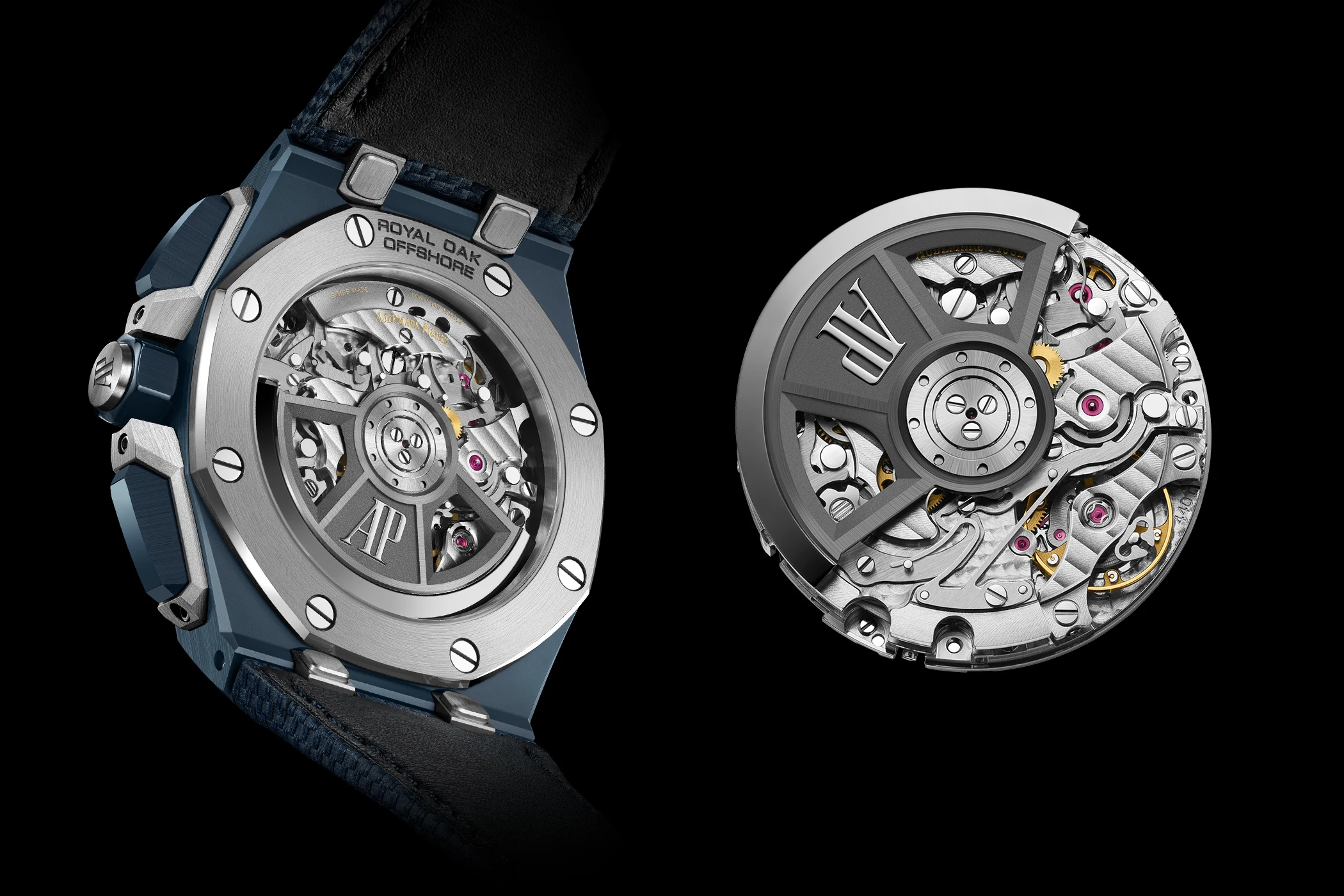
Meanwhile, Chrono No. 2 has a much more aggressive look with a titanium case, black ceramic bezel and green Méga Tapisserie dial with colour gradient and grey-green rubber strap (reference 26420IO.OO.A402CA.01). In this version, the Offshore is even more masculine. A watch for survival camp, while the blue and cream version feels more at home in the marina.

The Diver models also feature new colour combinations, including a steel version with a black Méga Tapisserie dial, turquoise 0-15 minute display and white gold hour indices and hands (reference 15720ST.OO. A355CA.01) and a steel alternative with a black dial, pink 0-15 minute display and rose gold hour indices and hands (reference 15720ST.OO.A010CA.01), the third is particularly appealing: The 42-millimetre case frames a deep petrol-coloured dial, the indices and hands are again white gold, and the 0-15 minute display is white (reference 15720ST.OO.A403CA.01). The result is a sports watch that looks just as good on the beach in summer as it does with a casual jeans look all year round. AP is thus remaining true to the current design trend for divers. The era of brightly coloured interpretations seems to be over for now.
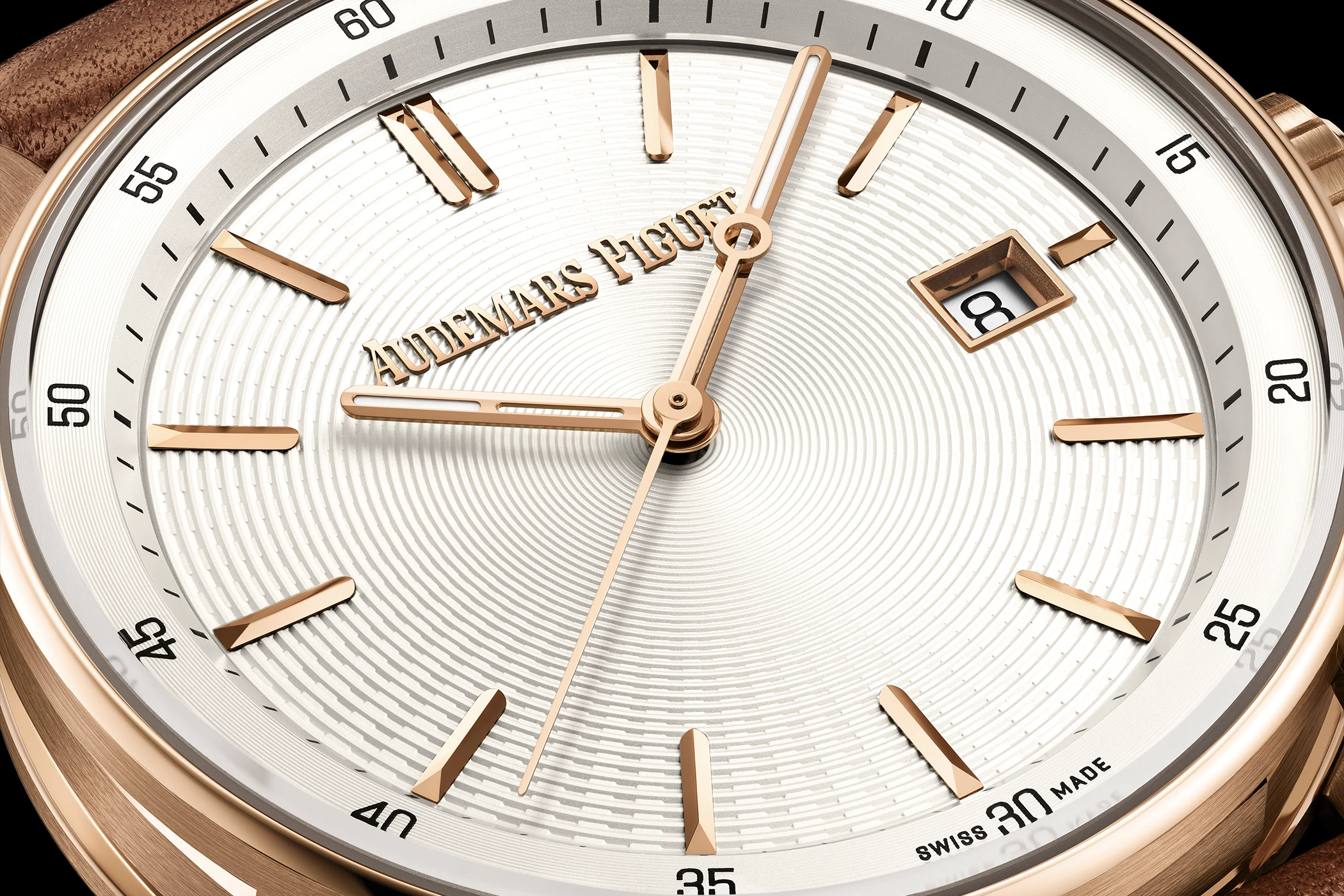
The manufacturer’s latest collection is, of course, also well represented: the Code 11.59 Perpetual Calendar with an open dial (reference 26443NB.OO.D002CR.01) is the undisputed showstopper from this years novelties launch. The combination of the white gold Code bezel, the black ceramic case middle and the calibre 7139 movement – just like in the corresponding Royal Oak – together with the black inner ring, the rehaut, is like looking at a snow-covered Alpine panorama at night: you lose yourself in the clear contours and details lying in the shadows. At first glance, the 41-millimetre Code is a cool-looking piece of craftsmanship that deserves the utmost attention for its finesse and attention to detail.


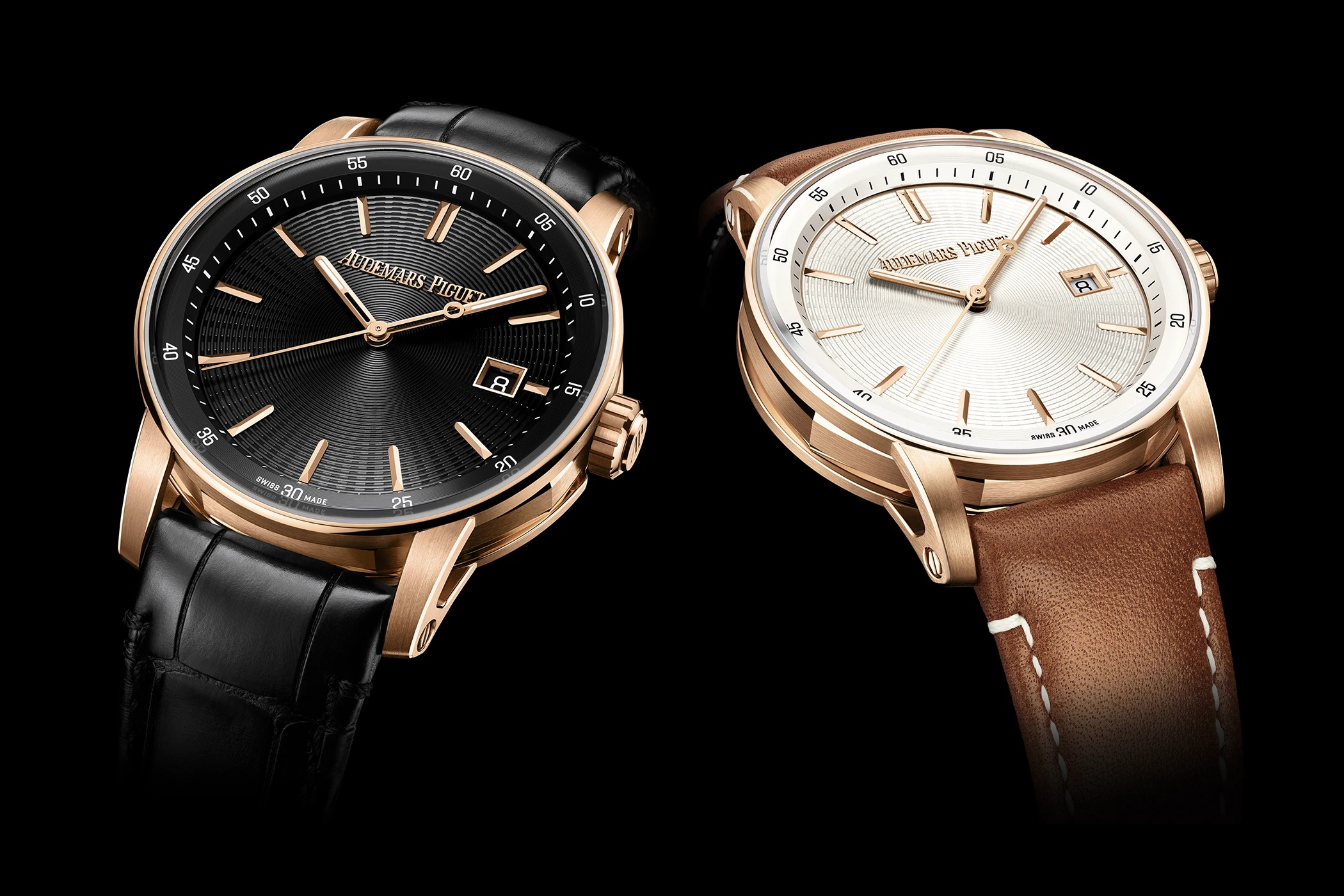
Next to this Code 11.59 by Audemars Piguet, the two new 38-millimetre versions almost fade into the background: both are in rose gold, one with a black dial (reference 77410OR.OO.A127CR.01), the other with a silver dial (reference 77410OR.OO.A402VE.01). This is unfair, of course, because as classic three-hand watches with a date function, these two timepieces are in a completely different segment, and in this segment they are quite unique with the aesthetics typical of the Code 11.59 by Audemars Piguet. After all, their competitors are usually either much more classic in design or completely futuristic. These two, however, offer a pleasant blend of both worlds, resulting in an appealing ‘fusion concept’ for a highly competitive category. They also demonstrate an uncompromising commitment to quality: to increase wearing comfort, the leather straps have been optimised for the 38-millimetre format and made narrower.
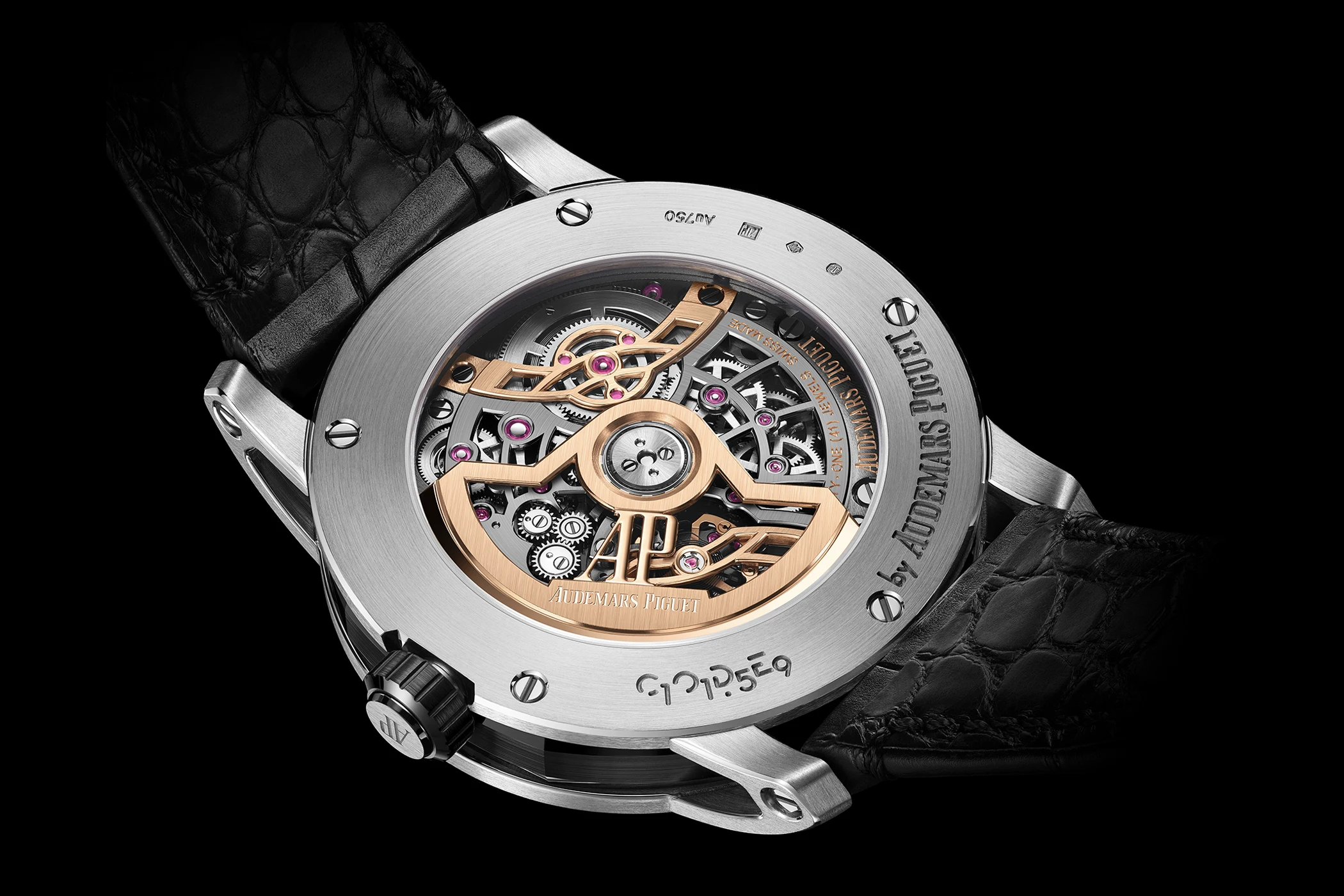
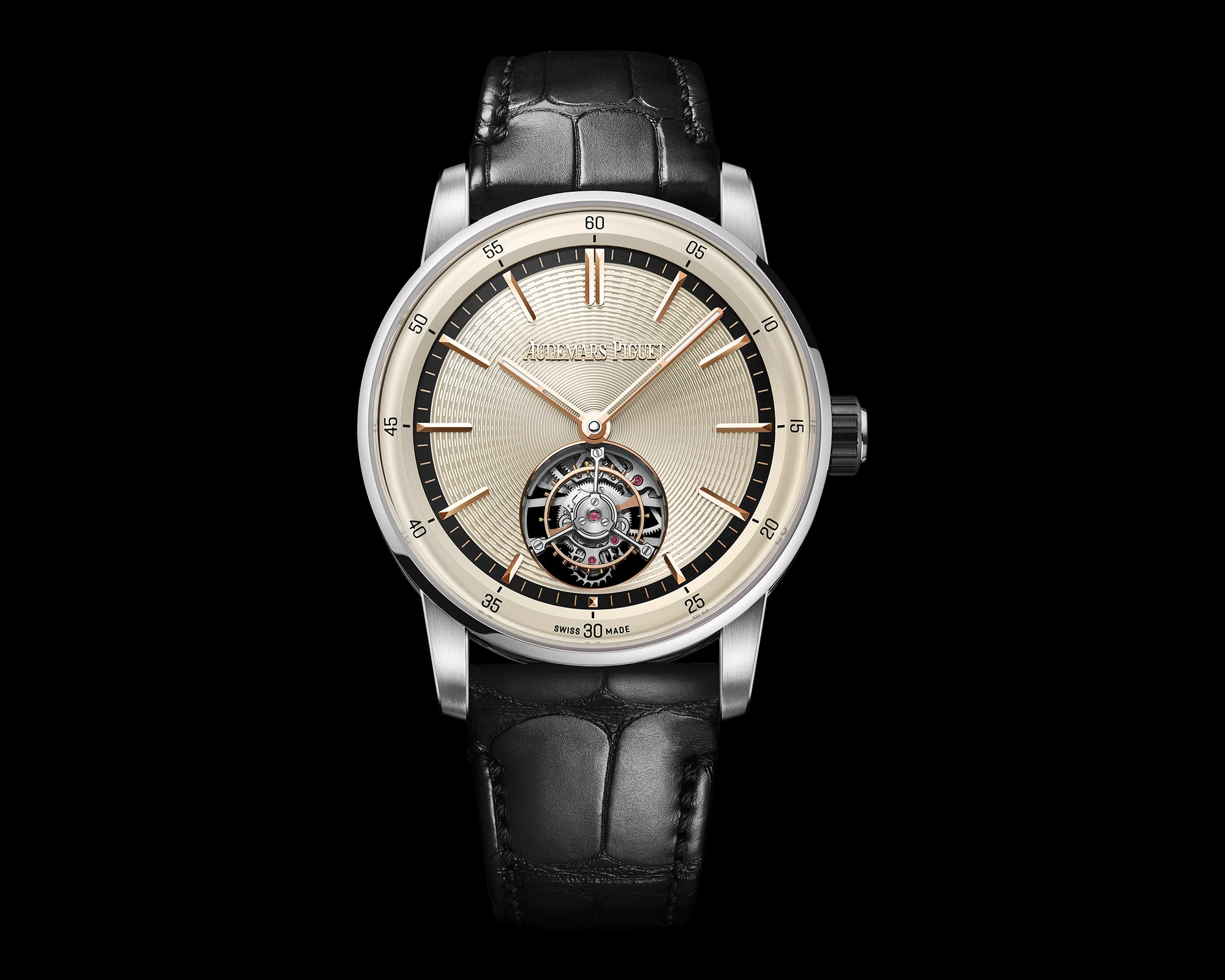
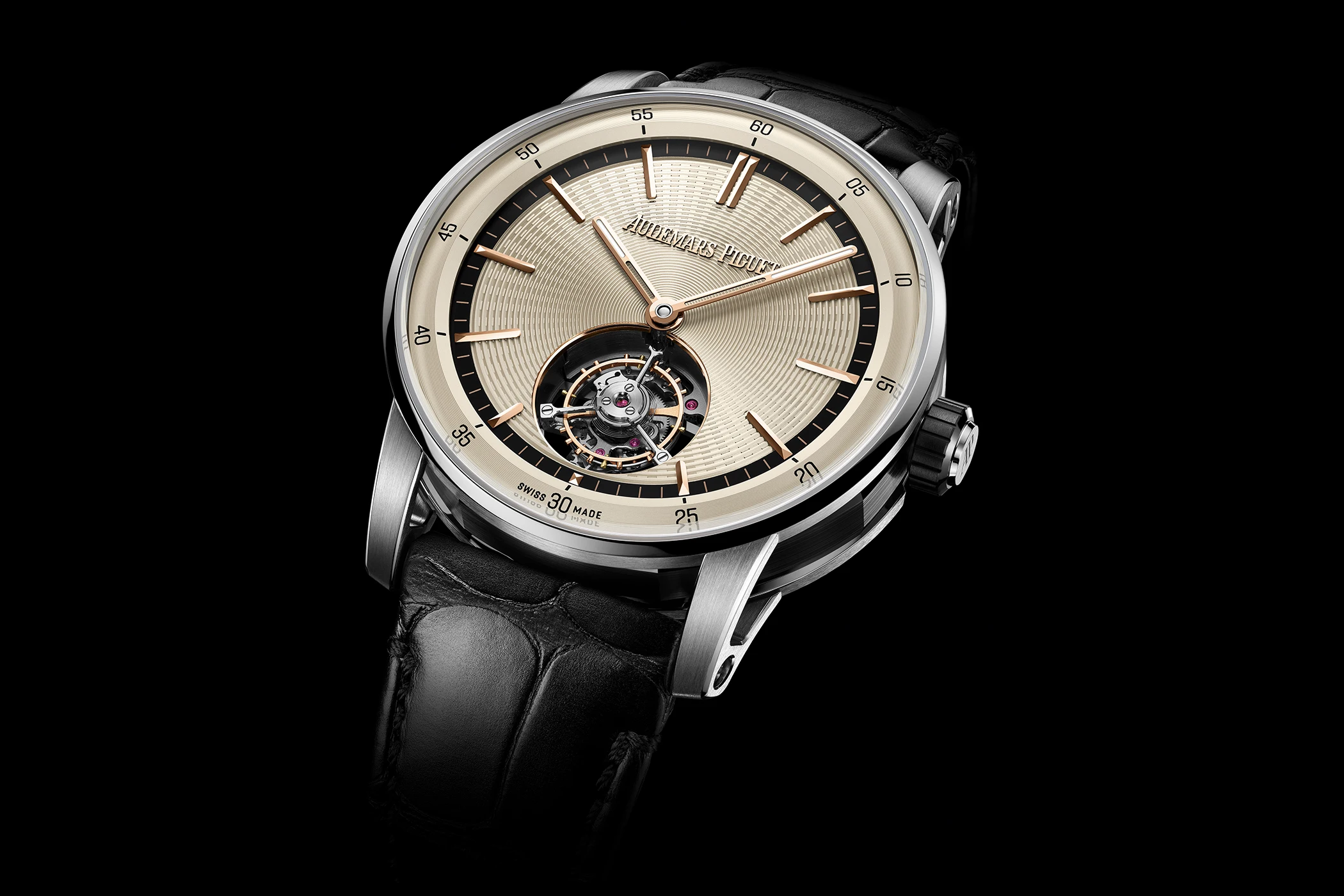
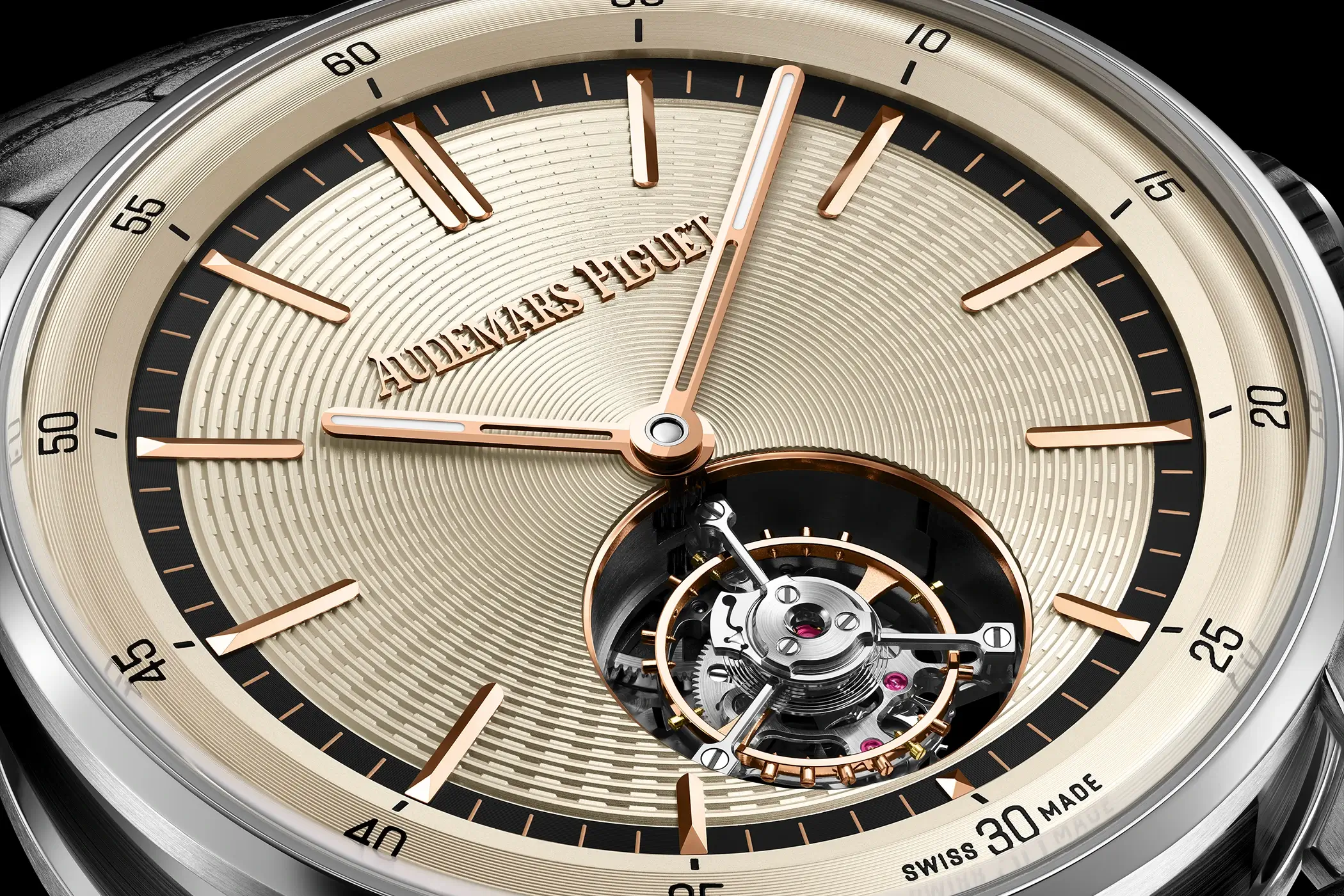
The latest version of the 41-millimetre automatic tourbillon, on the other hand, is something for connoisseurs: an ivory-coloured dial with the guilloché pattern typical of the collection is complemented by black accents and rose gold indices and hands (reference 26396NB.OO.D002CR.01). The case is a mixture of white gold and black ceramic, giving the watch a very contemporary two-tone vintage vibe. Compared to its predecessor with its black onyx dial, however, this flying tourbillon has a comparatively understated appearance.
Audemars Piguet’s line-up of novelties is rounded off with a very special showcase. The name ‘150 Heritage Pocket Watch’ (reference 75150PT.OO.01) suggests that the pocket watch may have originally been intended for last year’s big anniversary, but in any case, it makes it clear that even in its 151st year, the company has not abandoned the craftsmanship and constant pursuit of excellence that have characterised it for the past century and a half.
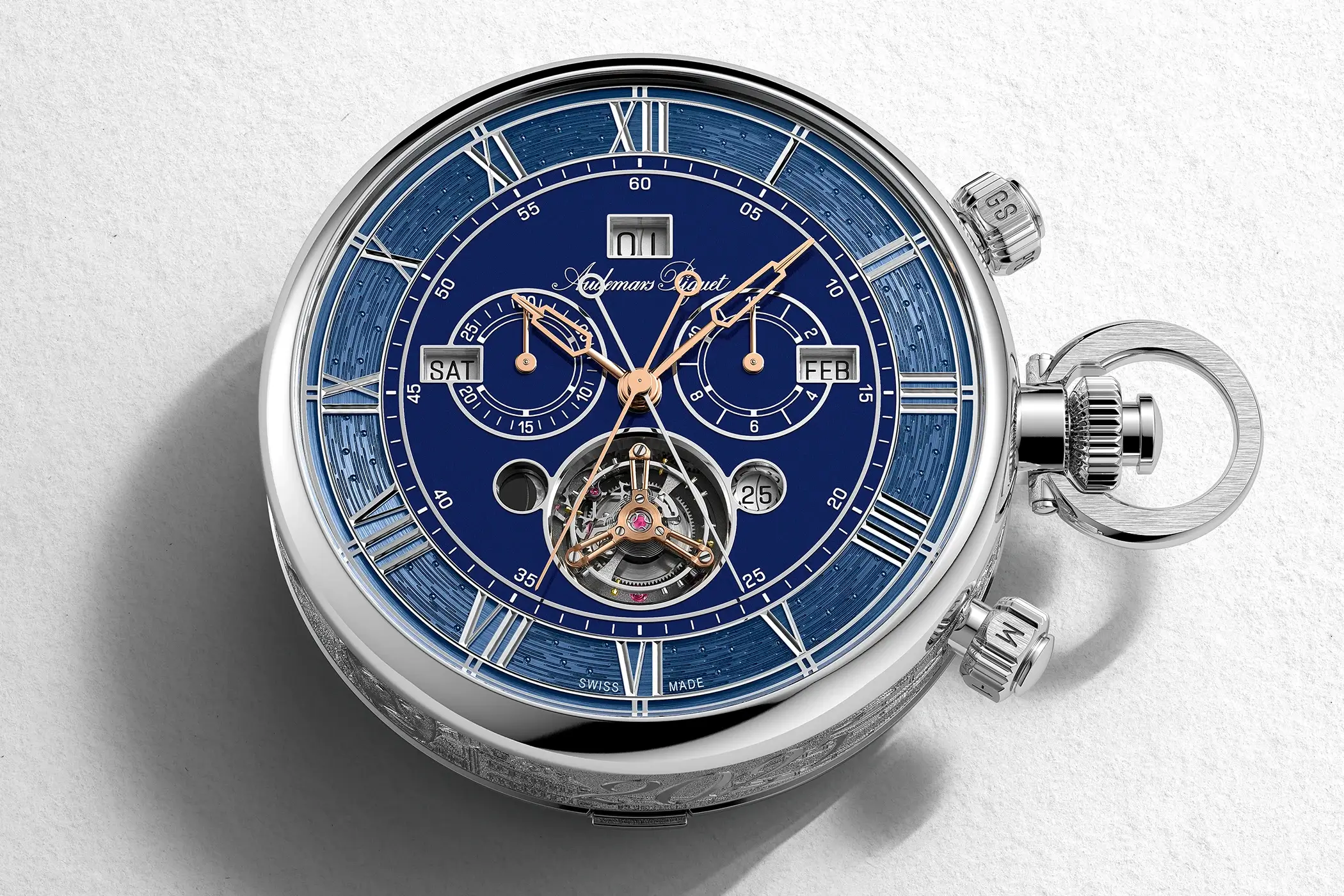
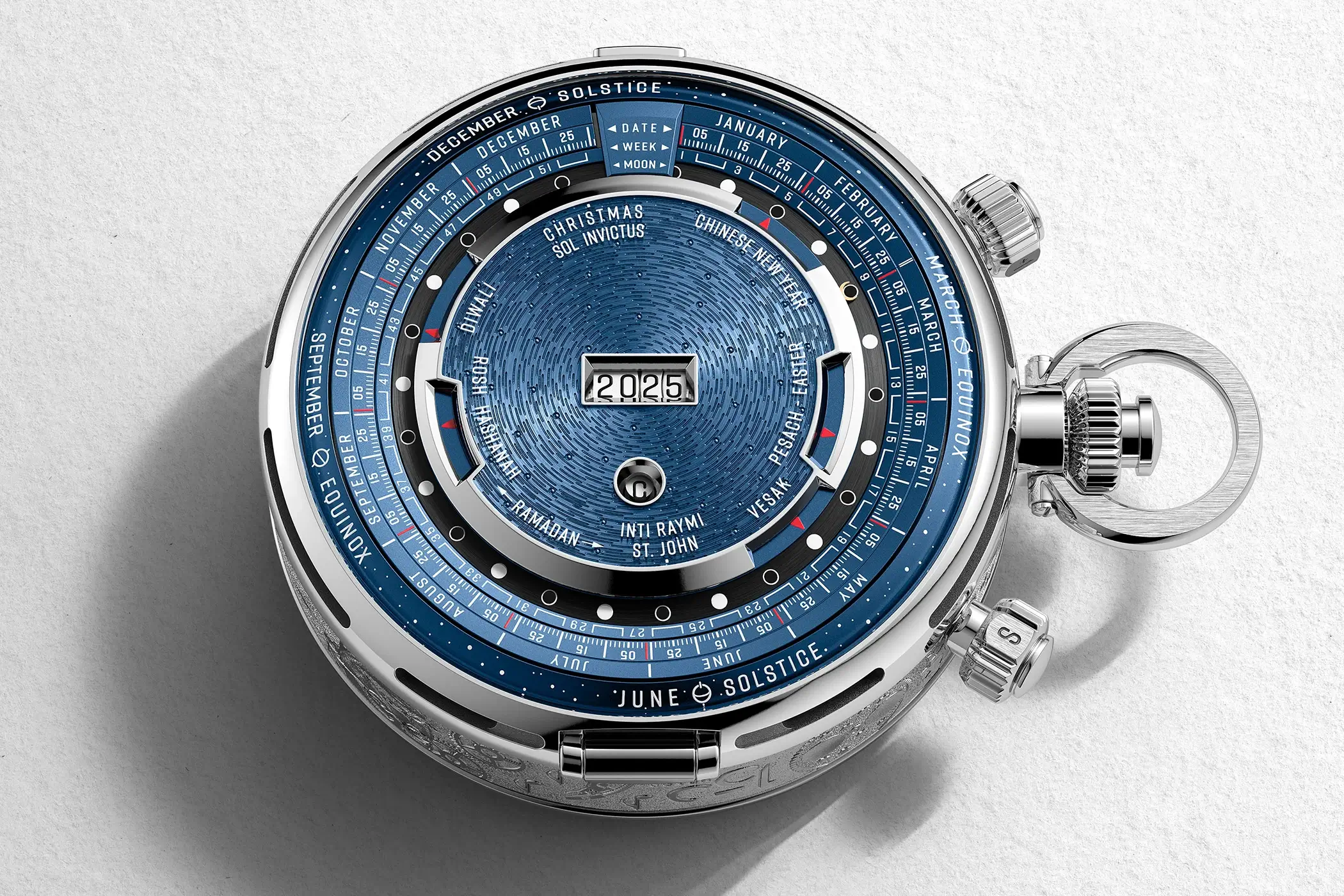
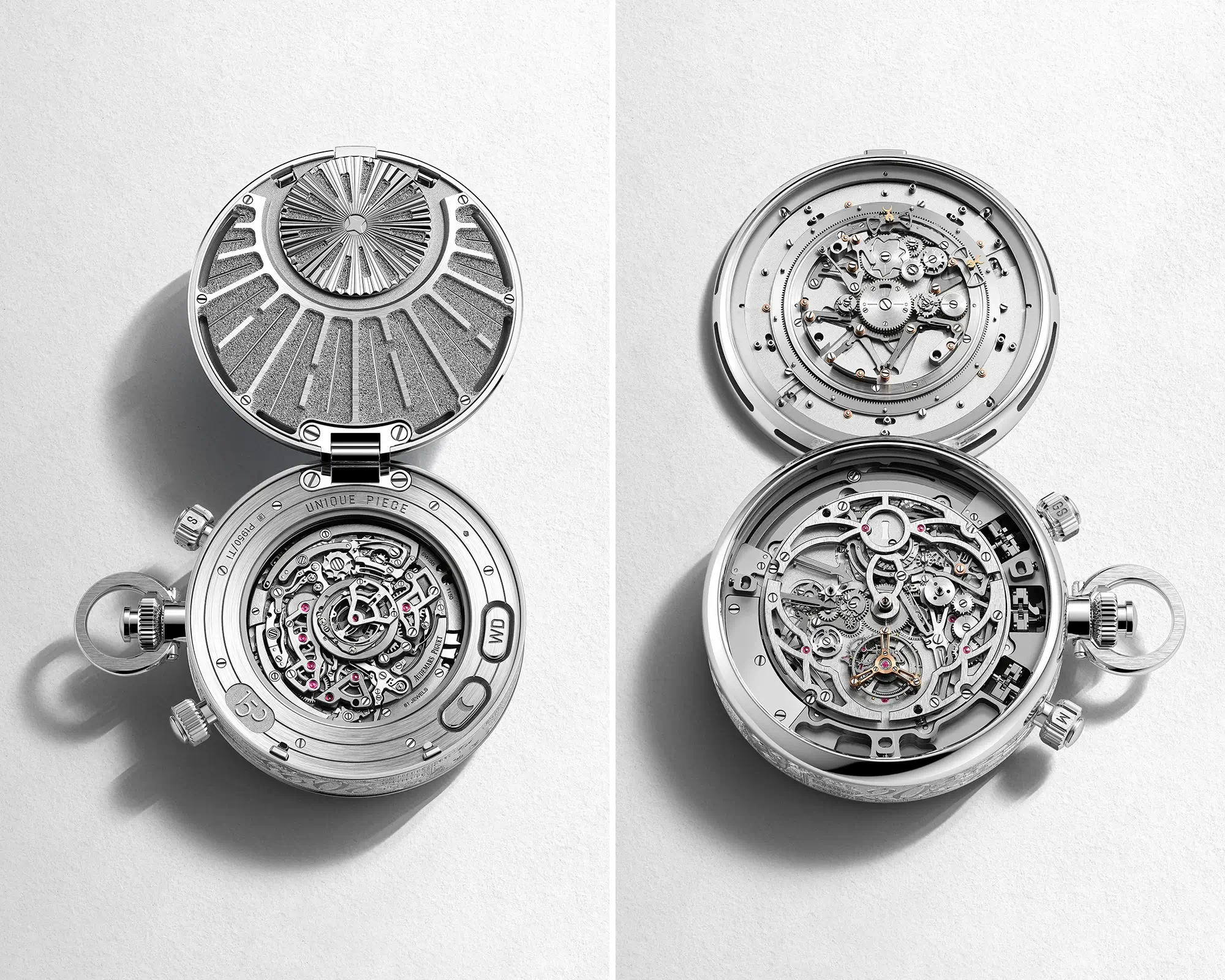
The platinum pocket watch follows in the tradition of its predecessors, such as the ‘L’Universelle’ from 1899 and ‘La Grosse Pièce’ from 1921, and is based on the automatic calibre 1000 from 2023. The new calibre 1150 is now designed as a hand-wound model and officially combines 47 functions and 30 complications. However, Audemars Piguet points out that this is a conservative estimate. Taking a more generous view, one could arrive at 60 functions.
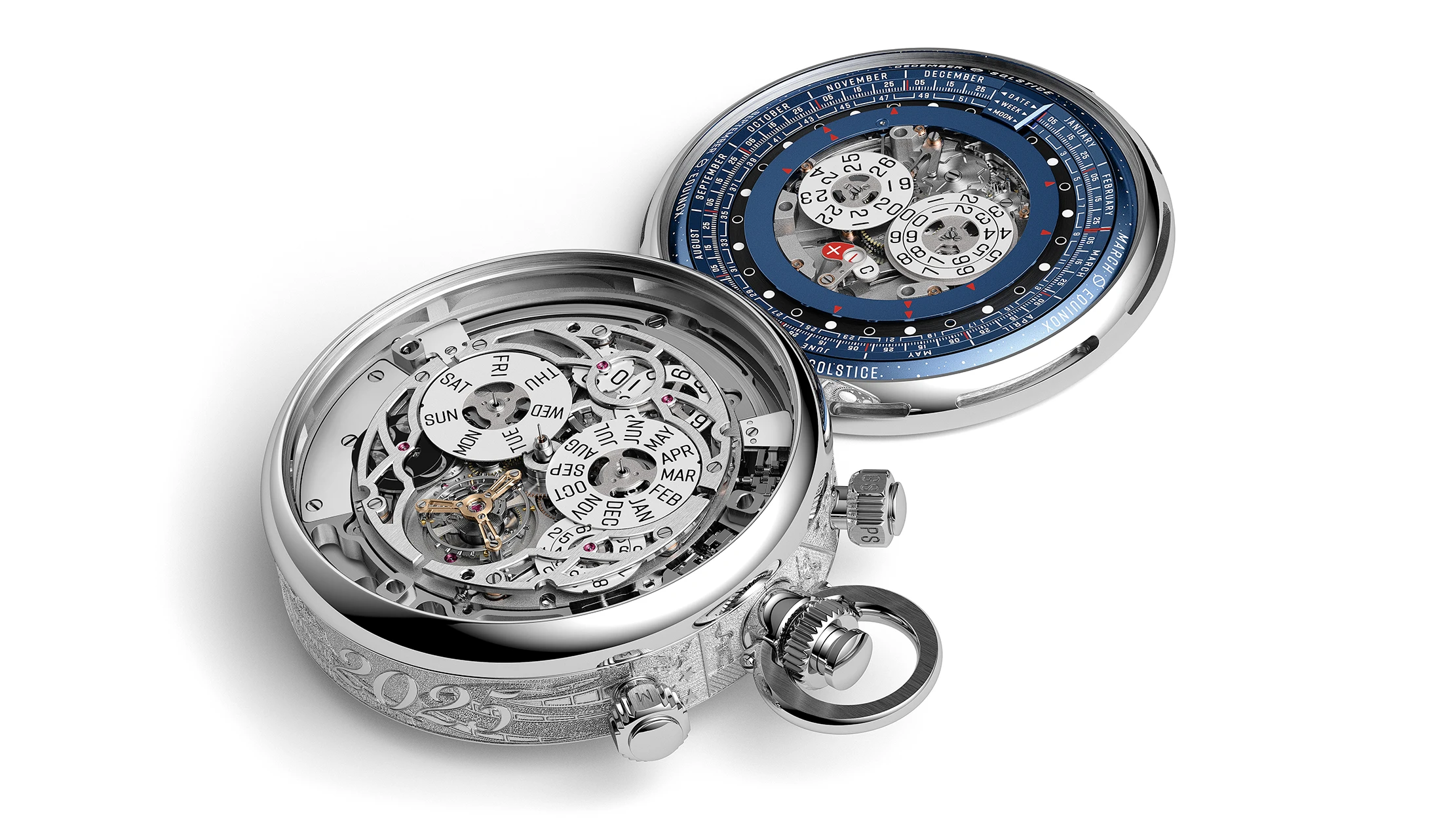
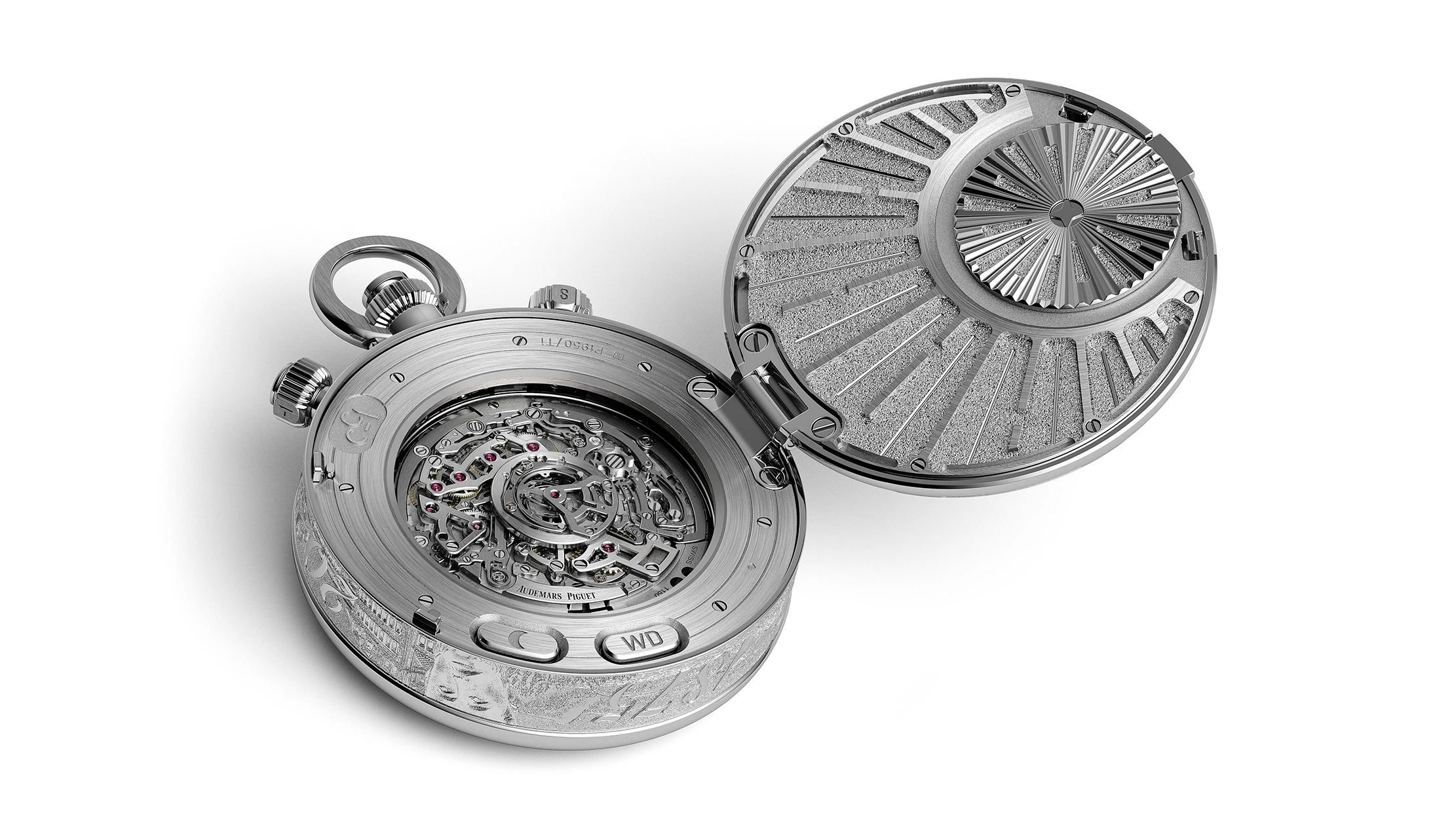
A total of 1,140 components are required to achieve this, and the result is impressive: among other things, the watch combines a grande sonnerie and minute repeater, a semi-Gregorian perpetual calendar, a split-seconds chronograph and a flying tourbillon. The universal calendar displays the solar and lunar cycles as well as the lunisolar cycle associated with both. Holidays closely linked to the solar calendar, such as Christmas, Easter, Ramadan, Rosh Hashanah, and Chinese New Year, are also displayed.
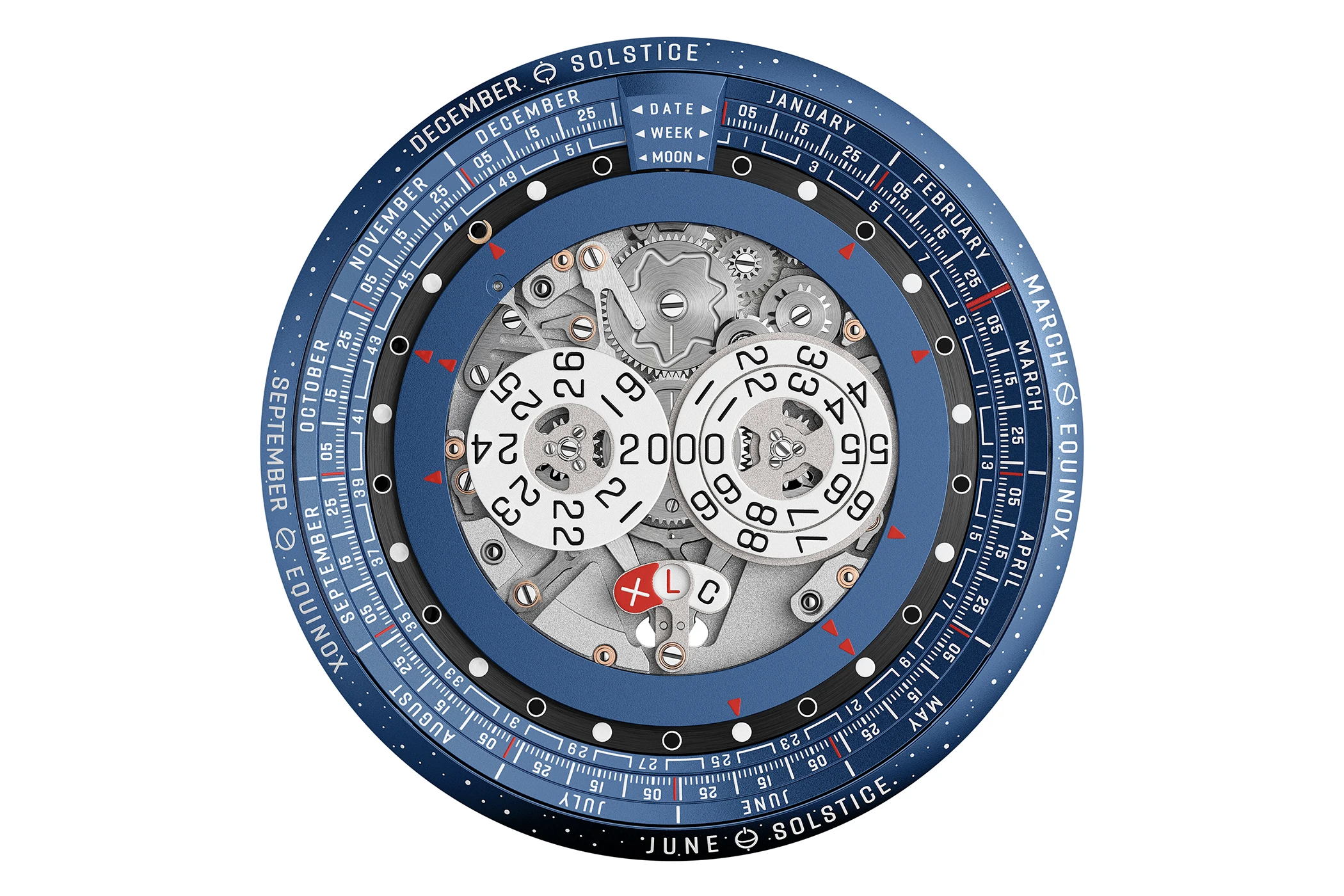
This exceptional astronomical pocket watch is operated via three crowns and pushers: the main pusher is located at three o’clock and is used to wind the movement, correct the date, set the time and activate the drag indicator. The push-button at two o’clock starts and stops the chronograph and selects the preferred striking function, from minute repeater to petite and grande sonnerie. The push-button at four o’clock resets the split-seconds chronograph and controls the month setting.
In keeping with the standards of this masterpiece, the case and dials are also crafted from the finest materials: the platinum case is engraved by hand, the hands are made of blue Grand Feu enamel and the white gold numerals are also hand-engraved.
The result is a watch whose exclusivity encapsulates everything that Audemars Piguet represents and is capable of producing today. This model is unique in platinum, but a very limited edition is to follow.
Twenty-two new models – that may seem like a lot at first glance, but considering the size of the overall collection, it is actually a very logical development. New materials such as deep blue ceramic and new movements such as the perpetual calendar, which can only be set via the crown, are being used more extensively and are increasingly finding their way into new variants across the various model lines.
Long before Watches & Wonders begins, Audemars Piguet has impressively documented a wide selection of its creative power. After all, a 38-millimetre Code 11.59 by Audemars Piguet in gold is something of an entry point into the brand’s world, while the platinum pocket watch with universal calendar is the exact opposite, namely proof of the boundless enthusiasm even for seemingly unthinkable or incompatible functions.
However, the reactions of watch buyers to the ‘Jumping Hour’ will be particularly interesting, as both technically and aesthetically, it deserves to be a collector’s item. Emancipation from the Royal Oak? It is not a priority, but it is progressing.