Following yellow and white gold versions, Piaget presents the Polo 79 Two-Tone watch in a limited edition two-tone version combining both alloys.


When Code 11.59 by Audemars Piguet was first unveiled in 2019, it made one thing very clear: this was not another nostalgic re-run, nor a cautious iteration of an existing hit that need not be named. It was a manifesto. A new design language. A deliberate attempt to push the boundaries of what a contemporary round watch can look and feel like. Over half a decade on, the Code 11.59 by Audemars Piguet collection has matured into one of the most ambitious collections in modern watchmaking.

Not too long after the Code 11.59 by Audemars Piguet first appeared, we published a detailed editorial on Audemars Piguet’s new collection. What inspired it? What did the manufacture hope to achieve with it? This time, we take a look at how the watches have developed since then, not least by focusing upon the latest models to emerge this year. If the Royal Oak defined the integrated luxury sports watch category, what does the Code 11.59 by Audemars Piguet bring to the game? What does – or indeed, what can – this round watch bring to Audemars Piguet in the 21st century?

The name Code 11.59 by Audemars Piguet carries a message. Eleven fifty-nine: the final minute before tomorrow. Code 11.59 by Audemars Piguet positions itself as the manufactures’ forward-looking pillar: a counterpoint to the enduringly popular bravado of the Royal Oak and the muscularity of the Royal Oak Offshore.
The Code 11.59 by Audemars Piguet took seven years to create – and with good reason. Spotted from across a room, Code 11.59 by Audemars Piguet can read as discreet, even conservative. Up close, it is anything but. The case is a feat of micro-architecture. A slim, round bezel sits on top of an octagonal mid-case – a quiet but unmistakeable nod to the brand’s portfolio – while the interplay of brushed and polished surfaces demonstrates how luxury finishing hides in plain sight. Rather than clamping to the side of the case, the lugs of the Code 11.59 by Audemars Piguet are open-worked, soldered only to the bezel, and appear to hover above the mid-case, leaving a deliberate sliver of empty space between the two. It is an unusual detail, and no doubt an expensive one to execute, but it gives the watch its character.
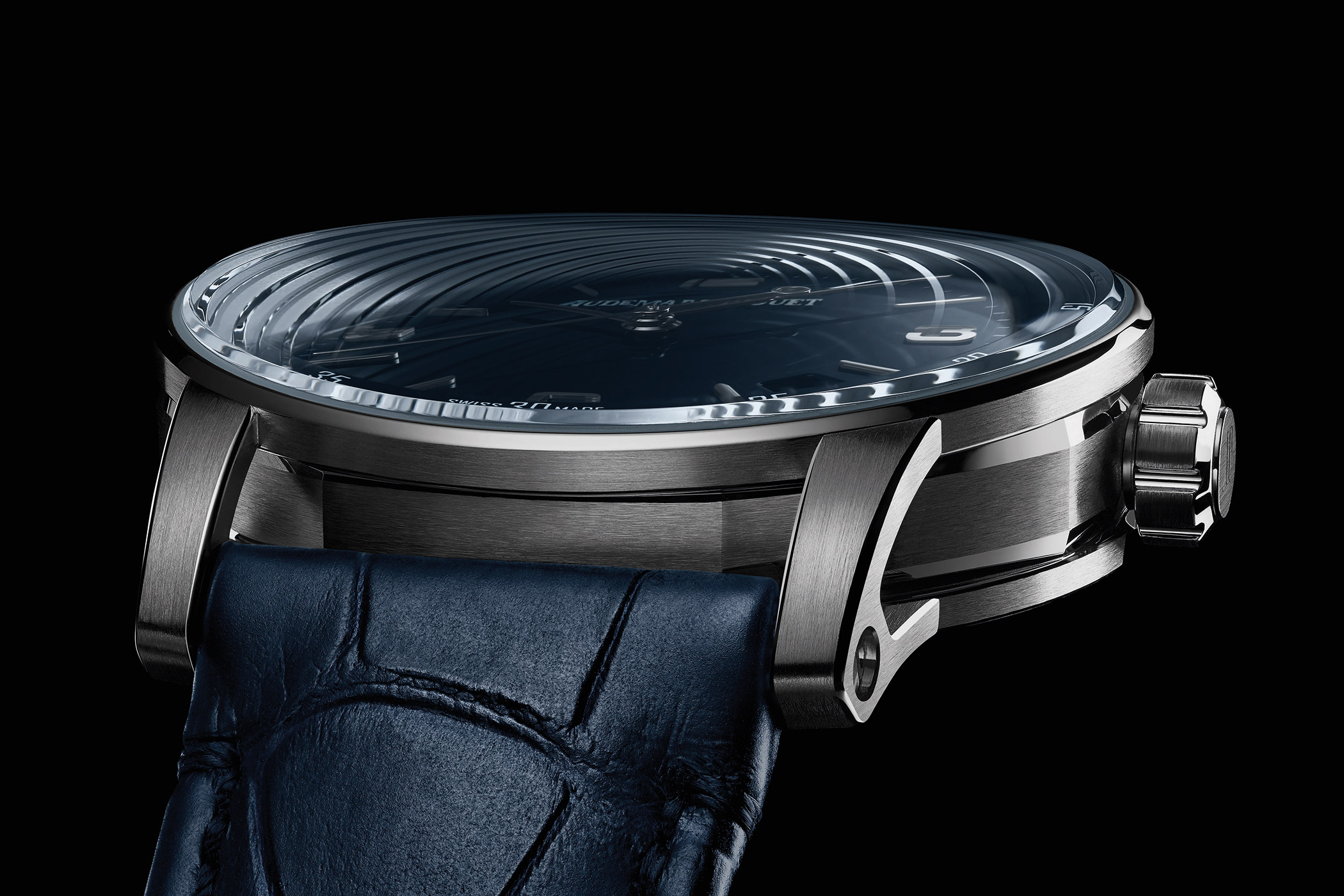
Then there is the sapphire crystal. For the Code 11.59 by Audemars Piguet, Audemars Piguet developed a sapphire glass that is curved in two directions at once – domed internally to enlarge and clarify the dial, and arched vertically from six to twelve o’clock to bend light and perspective as the wrist moves. It is one of the few modern sapphire crystals that justifies its existence the moment you see it in person. The dials appear deeper, indices seem to float, and reflections are more controlled. Combined with carefully executed typography (using the complicated galvanic growth process) and textured dials, the watch remains perfectly legible, even as it is constantly playing with light.
Both the dial and case of the Code 11.59 by Audemars Piguet embrace innovation in terms of materials. Following its debut at SIHH 2019, Audemars Piguet established its mainstream collection of three-hands and chronograph watches with a range of models showcasing smoked, lacquered dials with a sunburst pattern. Back then, the manufacture opted to work with pink gold, white gold, as well as bi-colour cases combining the two materials. The watches have come a long way since then.
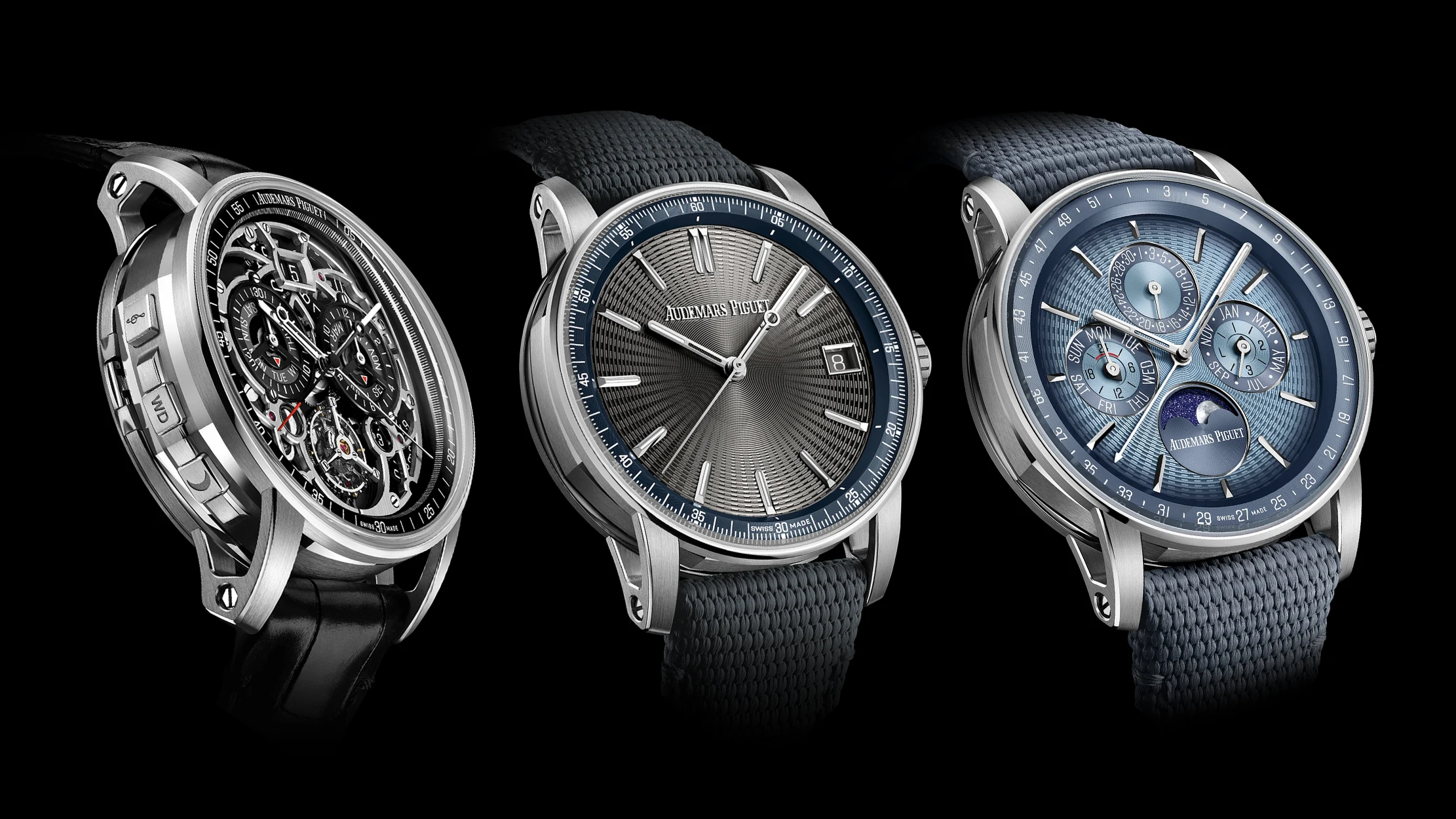

As our foray into the current collection and recent novelties will reveal, AP now works with numerous materials and plays with an array of unexpected dial variations. High-tech black ceramic cases sit alongside smoked sapphire and enamelled aventurine dials. In this sense, the collection allows Audemars Piguet to use Code 11.59 by Audemars Piguet as a horological playground for creativity.
If the case and crystal are where Code 11.59 by Audemars Piguet sets its tone, movement architecture is where it asserts its authority. Audemars Piguet used the launch of Code 11.59 by Audemars Piguet to introduce a new generation of self-winding movements: a three-hand automatic family with generous power reserves, an integrated chronograph with column wheel and flyback, and a suite of high complications that would eventually support flying tourbillons, perpetual calendars, and chiming mechanisms.

The result is a collection powered by a growing family of calibres defined by material mastery – from precious metals to performance-driven alloys – and by finishing that includes hand-bevelled bridges, polished internal angles, and open-worked geometries. There are chronographs, classical perpetual calendars, bejewelled flying tourbillons, artistic Grande Sonnerie Carillon Supersonnerie configurations and more eccentric expressions such as the wandering-hours Starwheel. Again: the Code 11.59 by Audemars Piguet watches are vessels that play host to Audemars Piguet’s technical ambition.
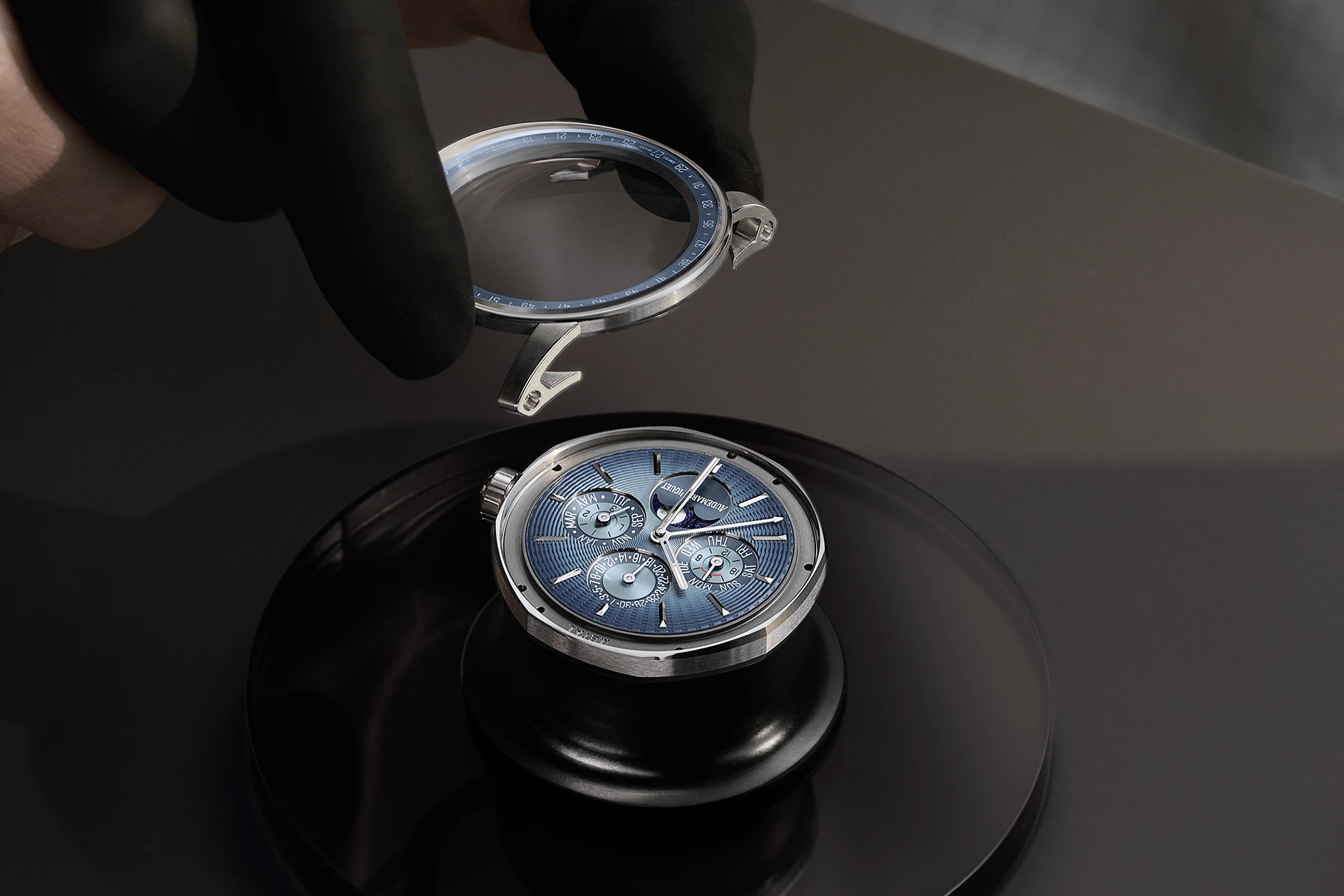
That ambition becomes tangible in the 2025 line-up. The perpetual calendar is the natural place to start. Historically, Audemars Piguet has used the complication as a calling card, from the ultra-thin automatic Quantième Perpétuel watches that weathered the quartz crisis era to more recent Royal Oak executions. In the Code 11.59 by Audemars Piguet collection, the perpetual calendar has been reframed as something more wearable and more contemporary.
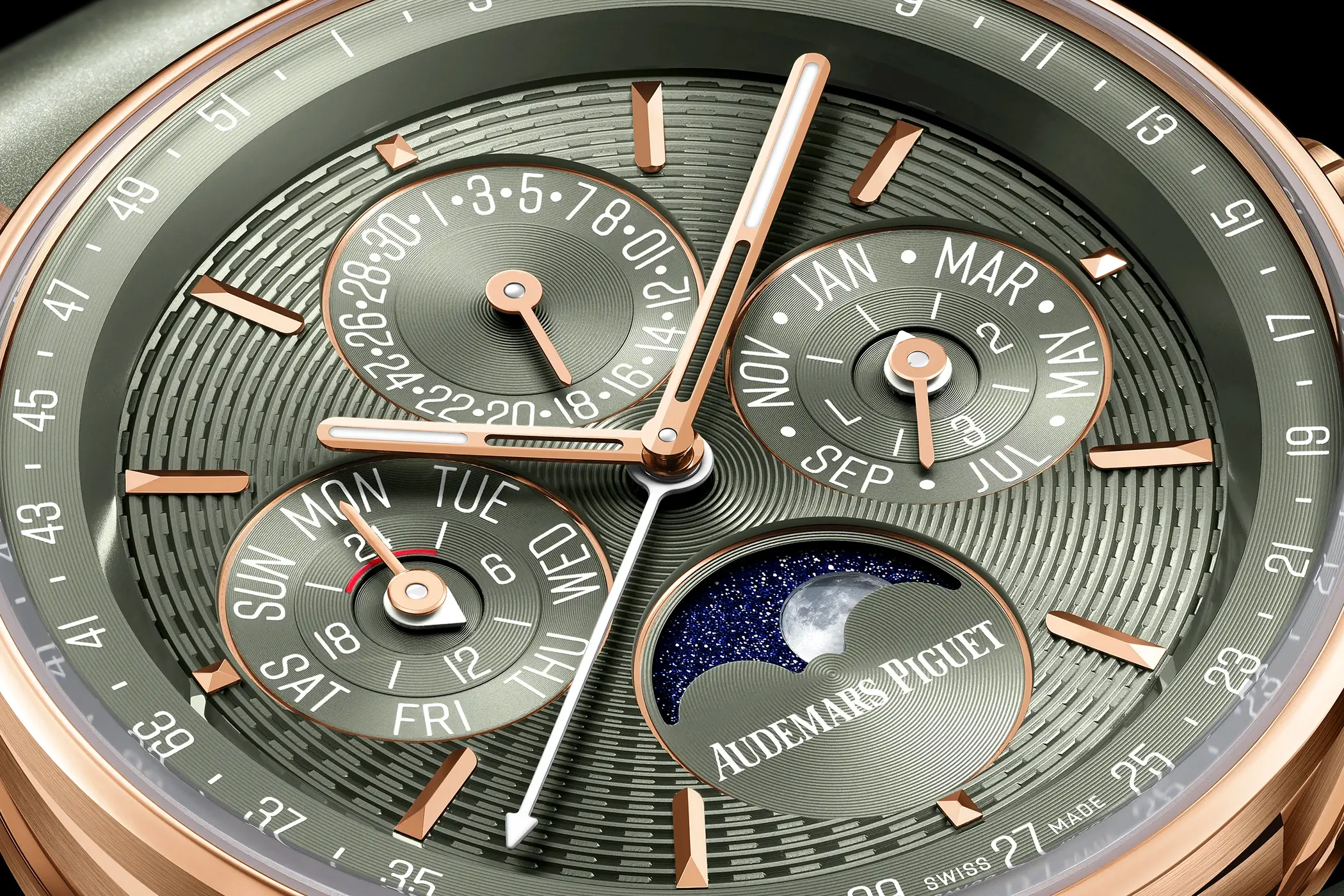
Celebrating Audemars Piguet’s 150th anniversary ushered in a notable shift for the perpetual calendar, offering up the complication in a compact 38 mm format for the first time within the Code 11.59 by Audemars Piguet collection. The Ref. 26441OR.OO.D405CR.01 comes in 18-carat pink-gold case framing a green embossed dial with matching counters, pink-gold luminescent hands and markers, and an azure-green inner bezel. Paired with a green textured rubber strap lined in calfskin, it turns astronomical timekeeping into theatre: its moonphase lifted from a NASA image and concentric dial texture give the complication a distinctly contemporary pulse.

Beneath the surface, the self-winding calibre 7138 does the heavy lifting. Measuring just 4.1 mm in height yet comprising 422 components, its arrival ushered in a new era for Audemars Piguet’s perpetual calendar. Developed over five years and protected by five patents, the movement replaces the traditional cluster of case-side correctors with a single “all-in-one” crown; an ergonomic breakthrough that makes adjusting one of watchmaking’s most complex mechanisms significantly easier.
The crown features four positions that control every function: winding, date and month setting, time adjustment, and finally corrections for the day, week and moonphase. Crucially, the system prevents the user from damaging the movement, even if adjustments are attempted during the automatic date-change window; typically a somewhat perilous moment for perpetual calendars. This newfound ease turns the complication into something that can be set anywhere, also without the need for tools.
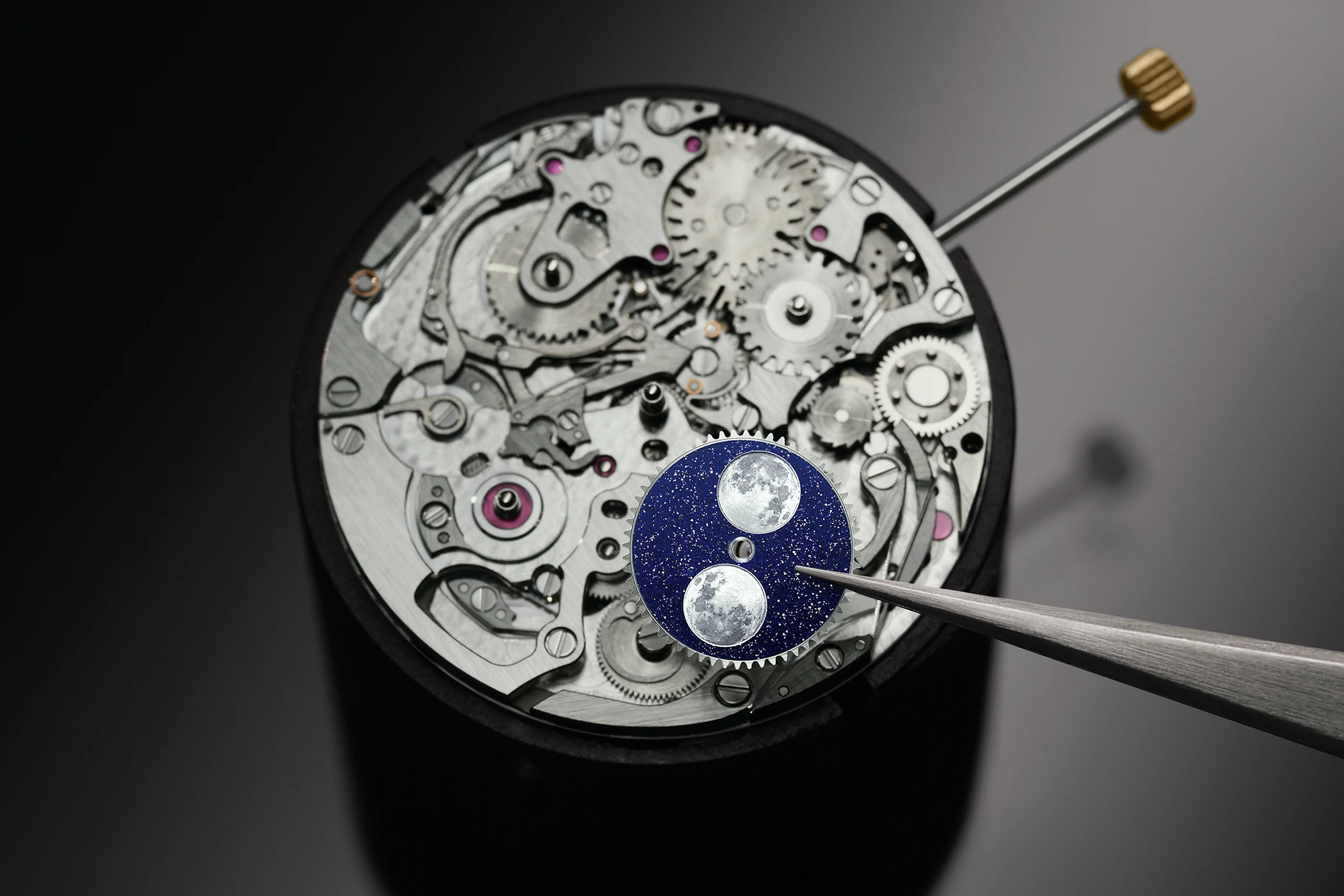
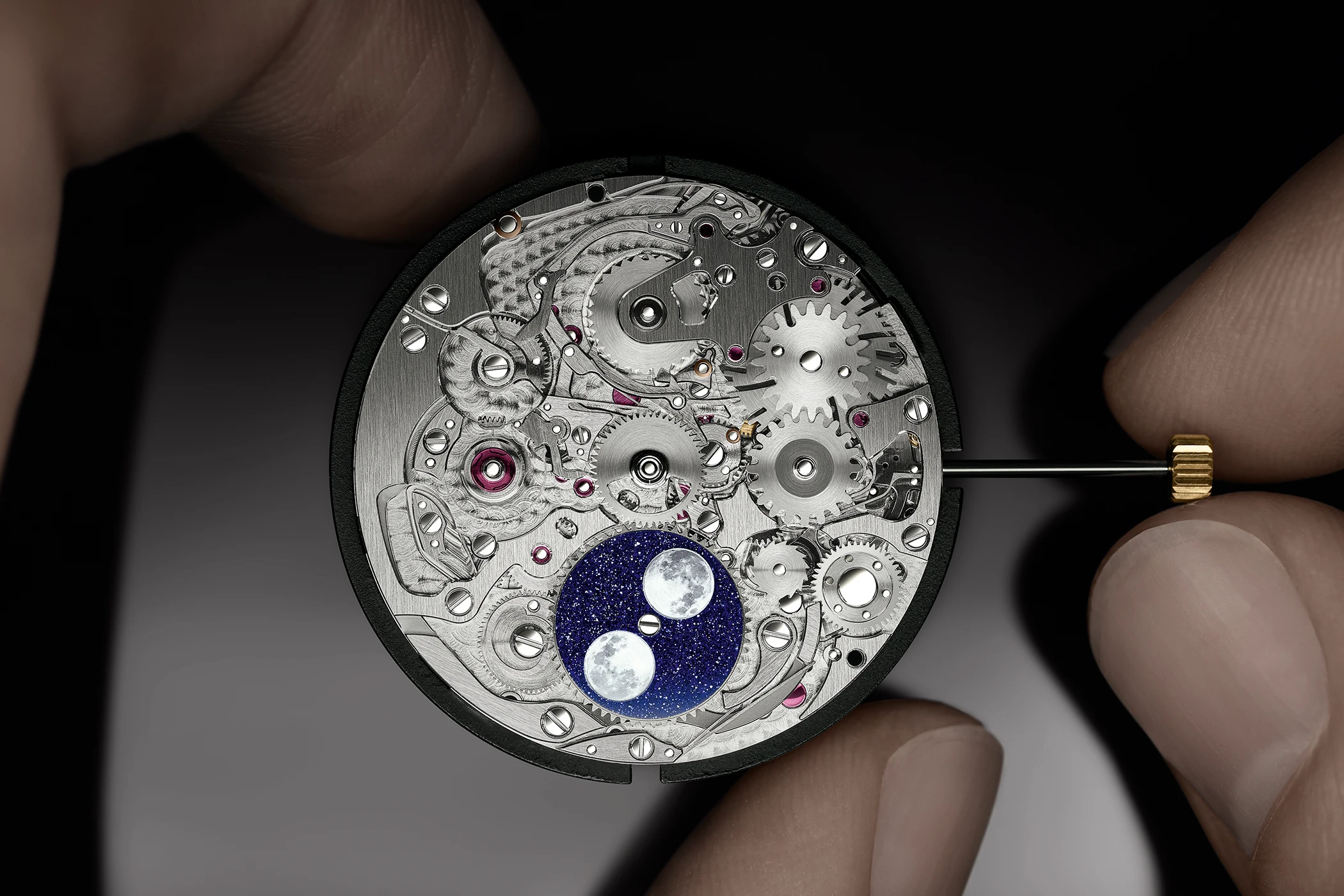
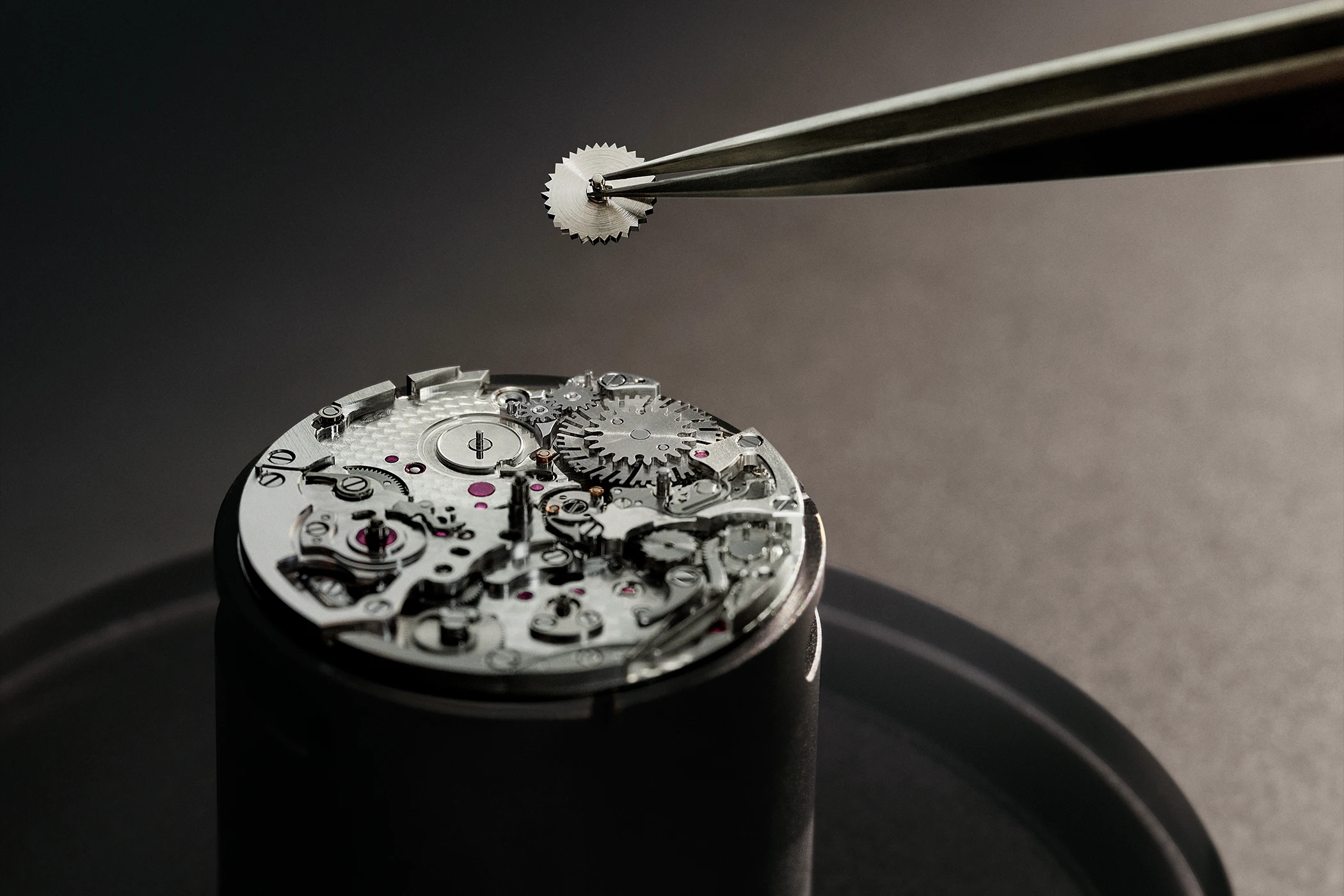
Calibre 7138 builds on the architecture pioneered in 2018’s ultra-thin RD#2, integrating key components, such as the month and end-of-month cams, directly into the corresponding wheels to conserve space. The movement retains a contemporary performance profile, beating at 4 Hz and offering a minimum 55-hour power reserve. Assuming it remains wound, no correction will be required until 2100, when the Gregorian calendar itself pauses for its centurial adjustment.
The dial layout has also been rethought for clarity, adopting a European date reading – day at 9 o’clock, date at 12, month at 3 – with week numbers around the periphery. A 24-hour indication is neatly tucked into the day subdial, while a hyper-realistic moonphase, based on NASA imagery, anchors the display at 6 o’clock.
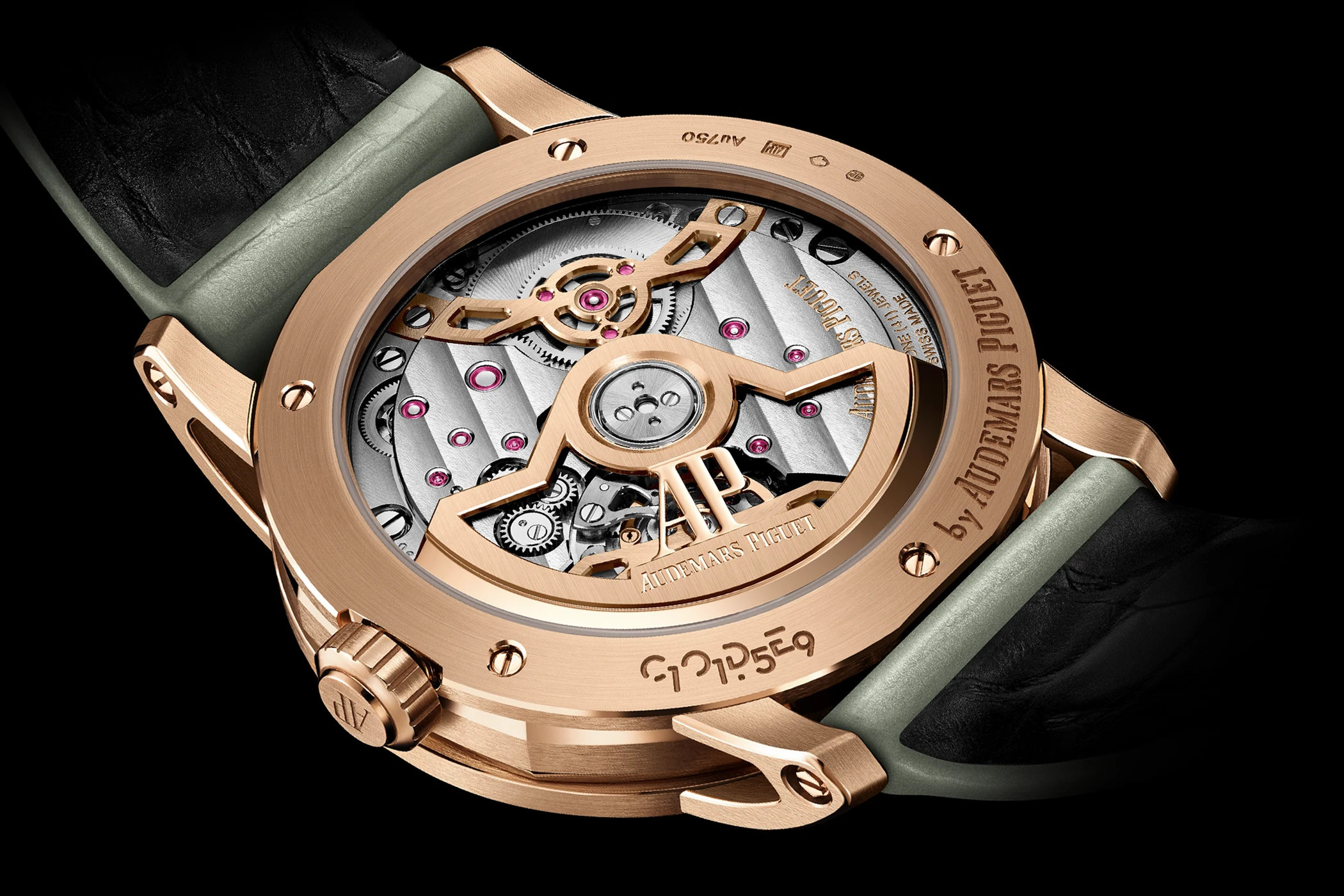
As is to be expected, the movement is also exquisitely decorated. Rhodium-toned bridges feature Côtes de Genève, snailing and sharply executed hand-chamfers, punctuated by pink-gold details, notably the openworked 22-carat rotor. It is technical innovation presented with the sort of finishing that leaves nothing to chance.
Launched as part of the brand’s 150th anniversary celebrations, calibre 7138 is not merely an incremental improvement – it is a strategic repositioning of the perpetual calendar for modern use. By uniting heritage, practicality and elegance, it reframes a historically demanding complication as something both desirable and wearable.
Audemars Piguet continued to push its calendar credentials with the 150th anniversary Code 11.59 by Audemars Piguet Selfwinding Perpetual Calendar in 41 mm (Ref. 26494BC.OO.D350KB.01). Released alongside two new Royal Oak models, the 18-carat white gold case frames a smoked blue embossed dial with blue subdials, luminescent 18-carat white-gold hands and hour markers, and a blue snailed inner bezel. A blue textured rubber strap with calfskin lining and a white-gold folding clasp completes the monochrome treatment. The watch delivers every calendar indication – week, day, date, month, leap year and astronomical moon – alongside hours and minutes, arranged with the clarity and symmetry that have become hallmarks of the latest Code 11.59 by Audemars Piguet generation.

Making this possible is once again the self-winding calibre 7138. To mark Audemars Piguet’s 150th anniversary, the model is offered in a limited edition of 150 pieces featuring subtle celebratory touches – proof that, even in a complication defined by centuries, AP remains focused on evolution rather than repetition.
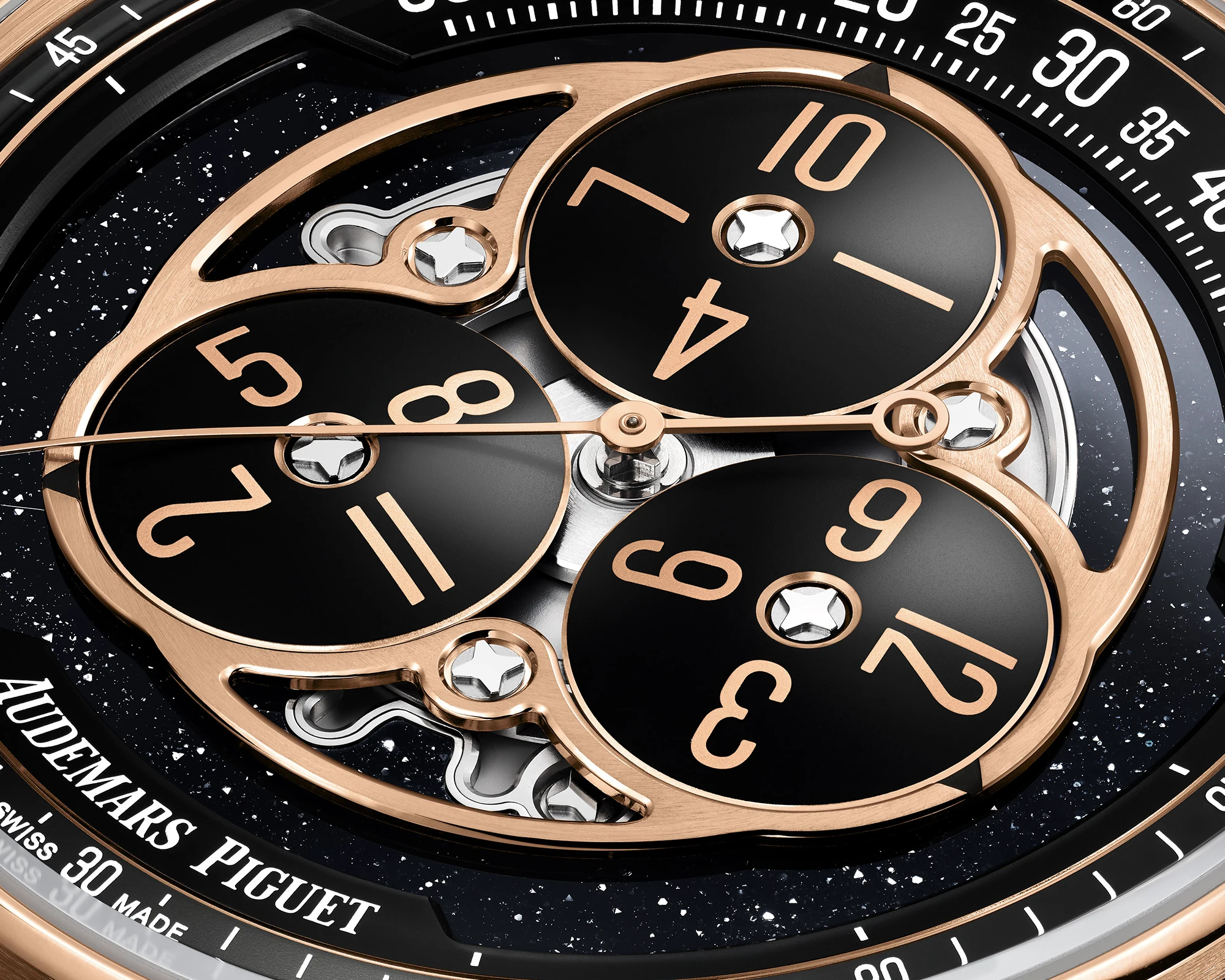
Back in 2022, Audemars Piguet resurrected one of horology’s most unusual displays in the form of the Code 11.59 by Audemars Piguet Starwheel, which uses the wandering hours system – born in the mid-1600s and revived by AP in 1991. In 2025, the horology house graced us with a new version of the watch, appearing in a 41 mm rose-gold case with a black ceramic middle. The 2025 model uses three rotating discs to display the hours across a 120-degree minute arc, with rose-gold printed numerals matching to case as well as the 18-carat pink gold seconds hand. The black hour discs align with the inner bezel, while the black aventurine dial sets off a pink gold-toned centre wheel and numerals.


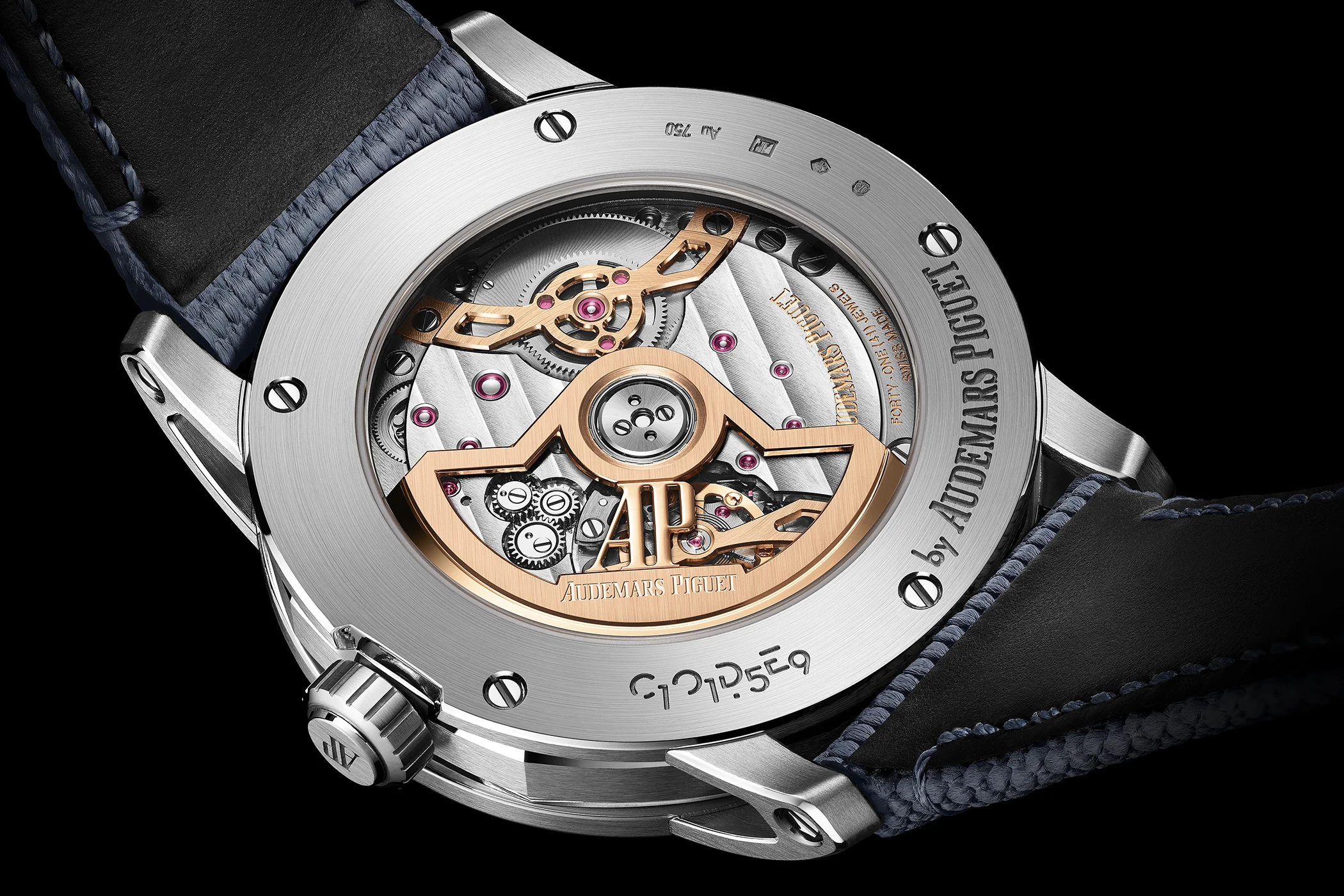
Powering this kinetic performance is the self-winding calibre 4310, a modernised evolution of the 4309 with an added ‘Starwheel’ module, 70 hours of power reserve and meticulous finishing visible through the sapphire caseback, complete with an open-worked pink-gold rotor. The mix of ceramic, rose gold and aventurine is executed with AP’s signature hand-finishing, and rounded off with a laidback canvas strap. The result is a complication from the past deployed with present-day appeal, proving that even centuries-old ideas can feel remarkably contemporary when Audemars Piguet gets involved.

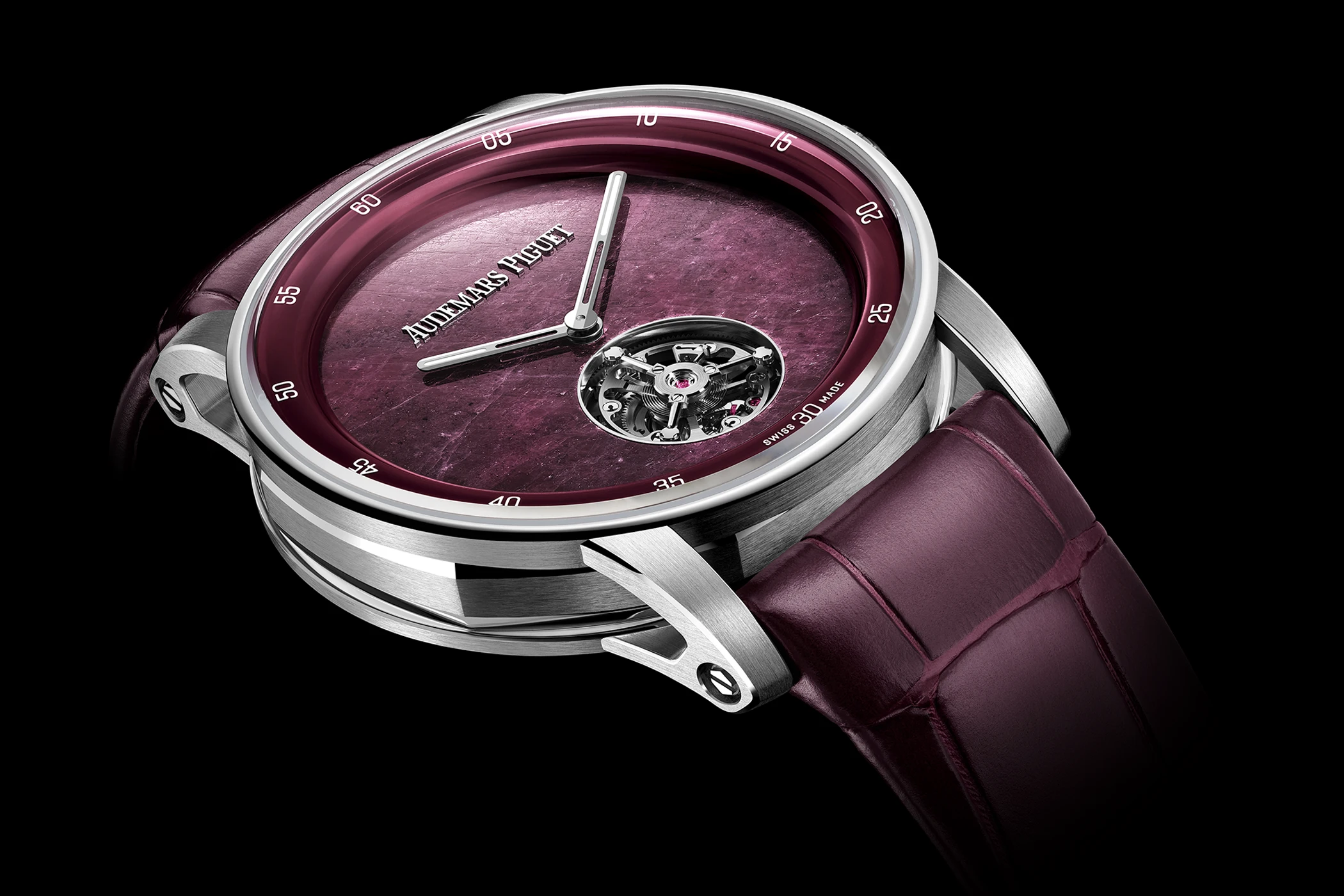
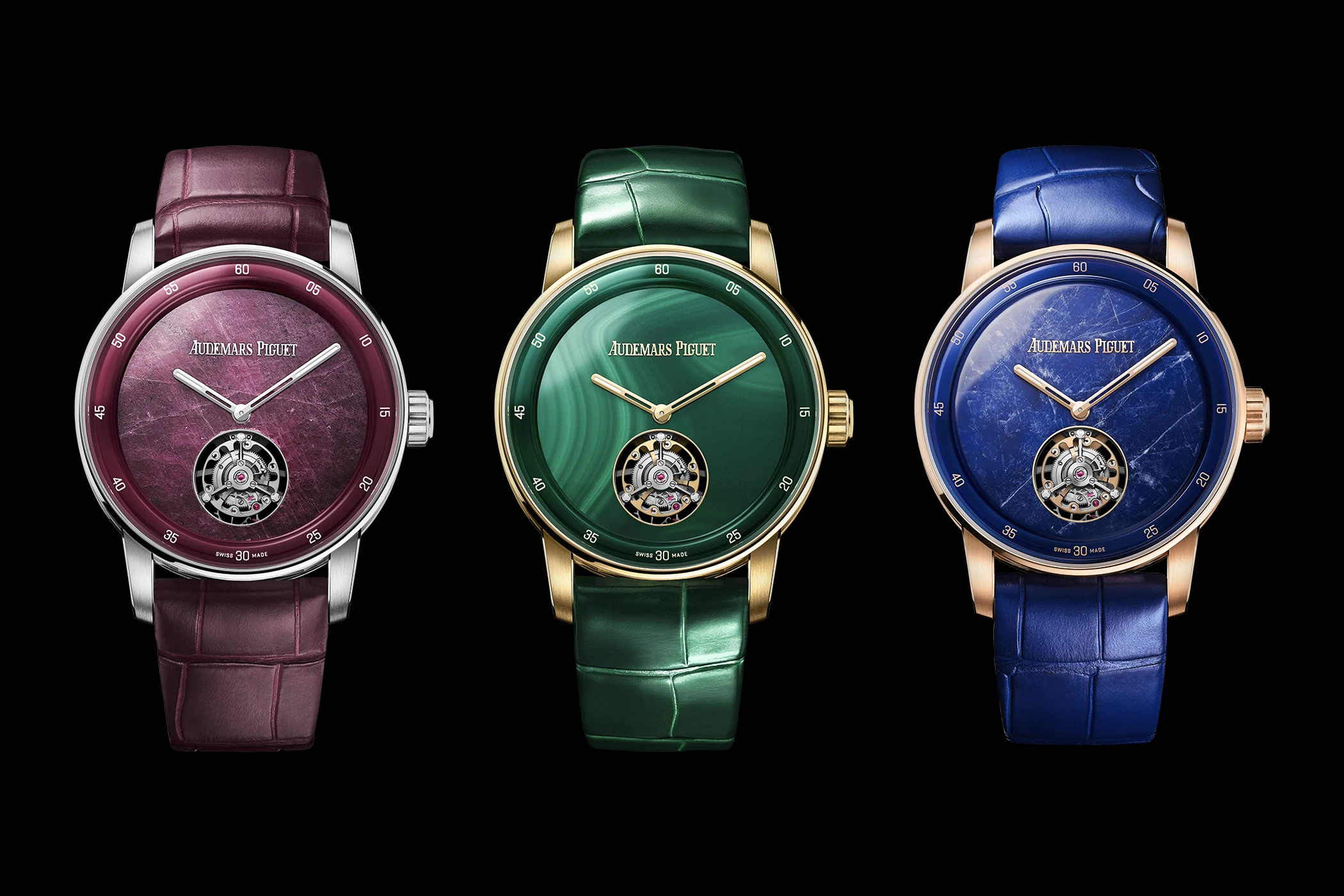
Audemars Piguet made a real statement earlier this year with a Code 11.59 by Audemars Piguet trio of 38 mm Selfwinding Flying Tourbillon models that abandon lacquer and decoration in favour of raw geology. Each dial – ruby root from Tanzania, sodalite from Brazil or malachite from Zambia – is sliced into an impossibly thin disc, then polished until the stone’s natural veining, mineral fractures and depth of colour erupt under the double-curved sapphire crystal. Each of these structural surfaces is unique. Audemars Piguet doubles down on that individuality by pairing every dial with a different gold case: white gold for ruby root (Ref. 26665BC.OO.D632CR.01), pink gold for sodalite (Ref. 26665OR.OO.D349CR.01), and yellow gold for malachite (Ref. 26665BA.OO.D412CR.01). The harmonious designs extend seamlessly into colour-matched alligator straps, turning each reference into a single, saturated chromatic statement.

To complete the flying tourbillon family, the manufacture also introduced a fourth execution this year (Ref. 26665SG.ZZ.D209CR.01) crafted in sand gold and set with diamonds, demonstrating how the flying tourbillon architecture can absorb jewellery codes without losing mechanical focus.
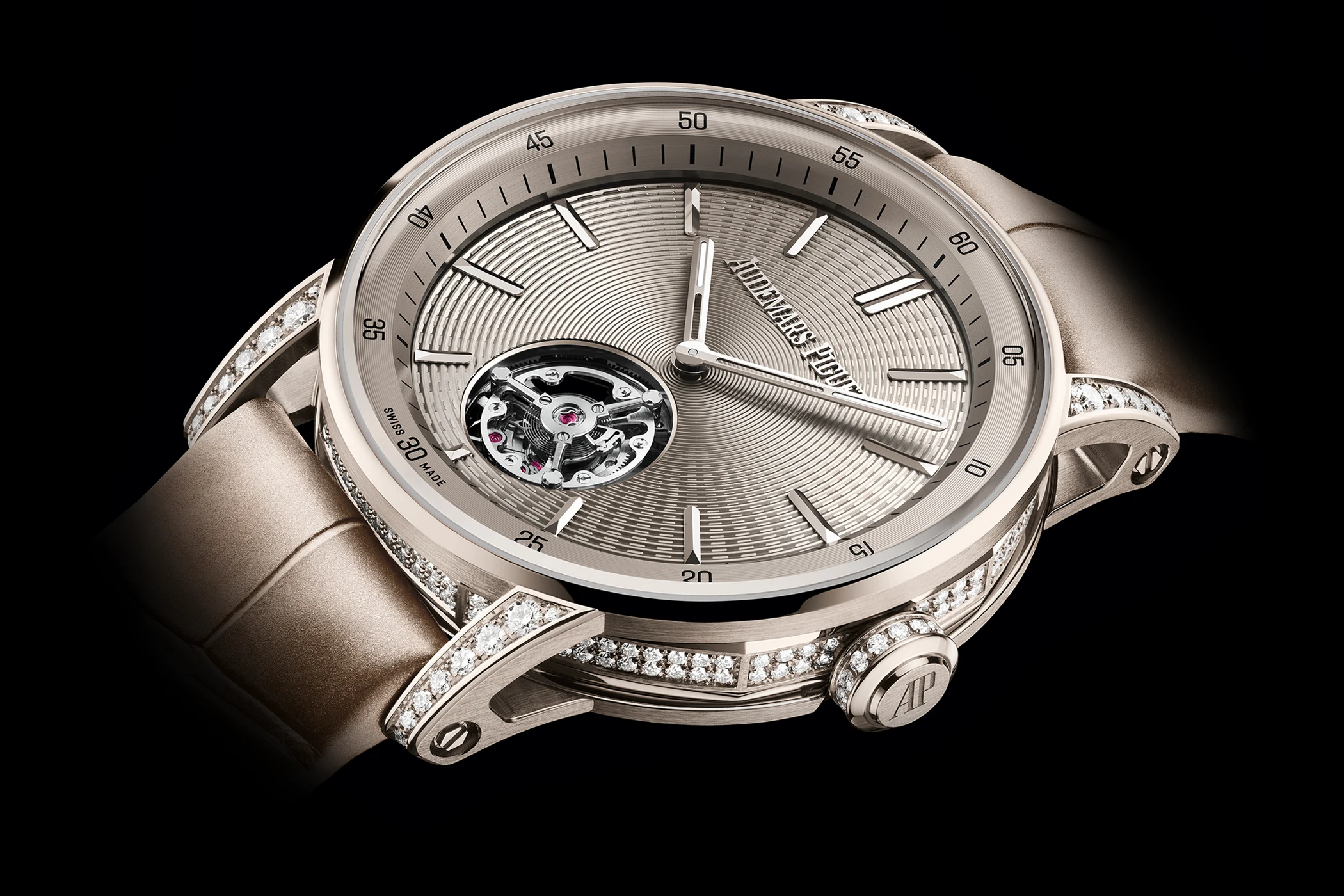
The dial of the Code 11.59 by Audemars Piguet Selfwinding Flying Tourbillon is likewise sand gold-toned, achieved through Physical Vapour Deposition (PVD). This rich hue lends brilliance to the snailed inner bezel and the embossed pattern of concentric circles that radiate from the centre of the dial. Hundreds of tiny holes add depth and character to the design, which was created in collaboration with Swiss guilloché artisan Yann Von Kaenel. The dial also features an aperture at 6 o’clock that reveals the flying tourbillon, offering a view of the intricate mechanism. The hour-markers and hands are made from 18-carat sand gold with only the hands coated with luminescent material.
These stone dial and sand-gold watches herald another important moment: for the first time, the ultra-thin calibre 2968 – originally introduced in a Royal Oak Jumbo – appears in a 38 mm Code 11.59 by Audemars Piguet case, bringing the spectacle of a flying tourbillon to an elegant, wearable scale. Measuring only 3.4 mm in thickness, the movement repositions the balance wheel and escapement within a titanium cage that performs one rotation per minute, counteracting gravitational errors without the need for an upper bridge, leaving the mechanism fully visible and seemingly suspended above the dial.

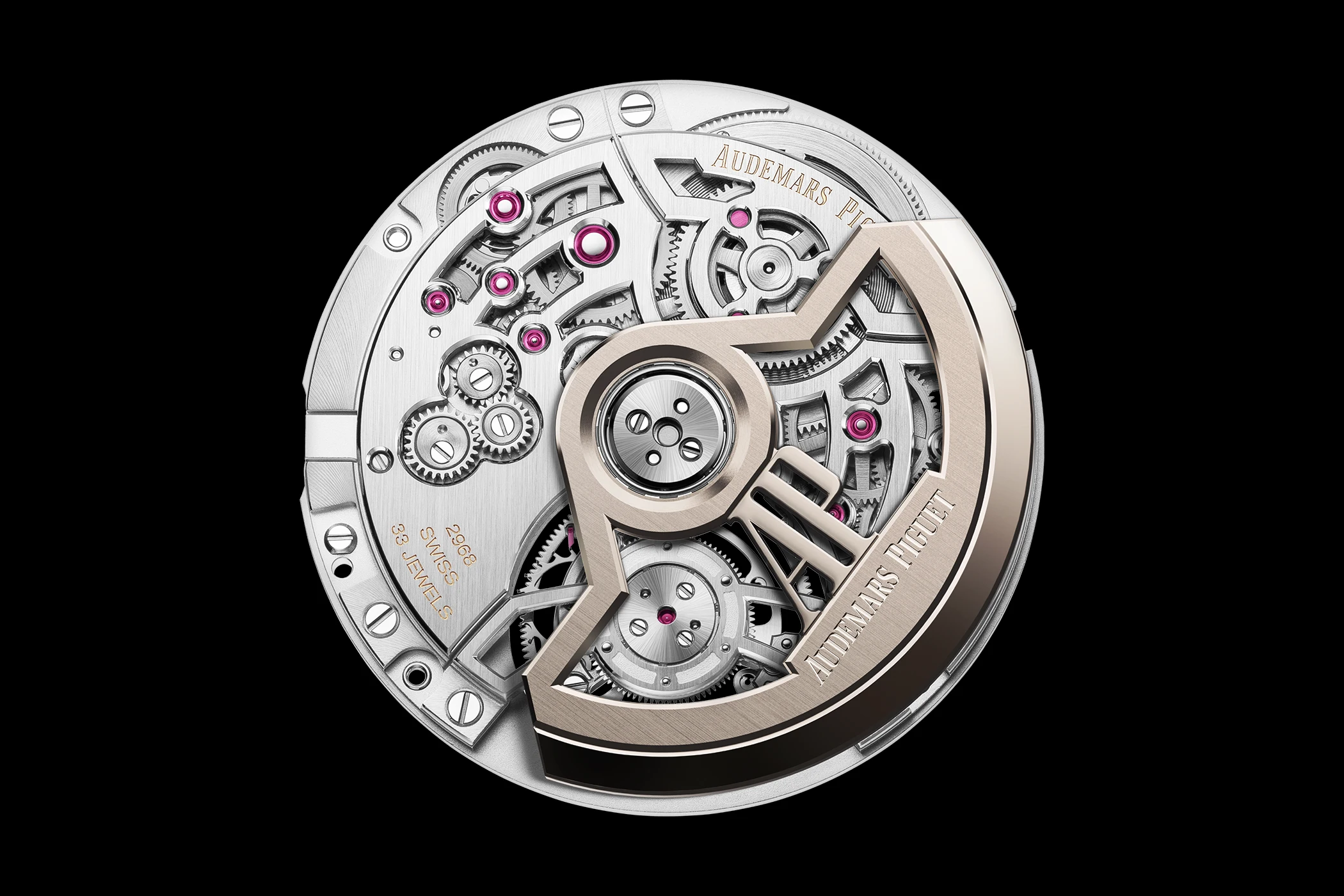
Rather than miniaturise and compromise, Audemars Piguet rebuilt the mechanism from the inside out, integrating a peripheral drive to maintain amplitude and energy flow despite the reduced volume. The cage uses a peripheral drive to shed weight, while a high-amplitude escapement boosts stability and energy distribution.
The Code 11.59 by Audemars Piguet Grande Sonnerie Carillon Supersonnerie introduces the manufacture’s most advanced chiming mechanism into a 41 mm case. It houses the hand-wound calibre 2956, a movement composed of 498 components that combines Grande Sonnerie, Petite Sonnerie and minute repeater functions. In Grande Sonnerie mode, the watch automatically strikes the hours and quarters; in Petite Sonnerie, it signals only the hours; and the repeater can be activated on demand.
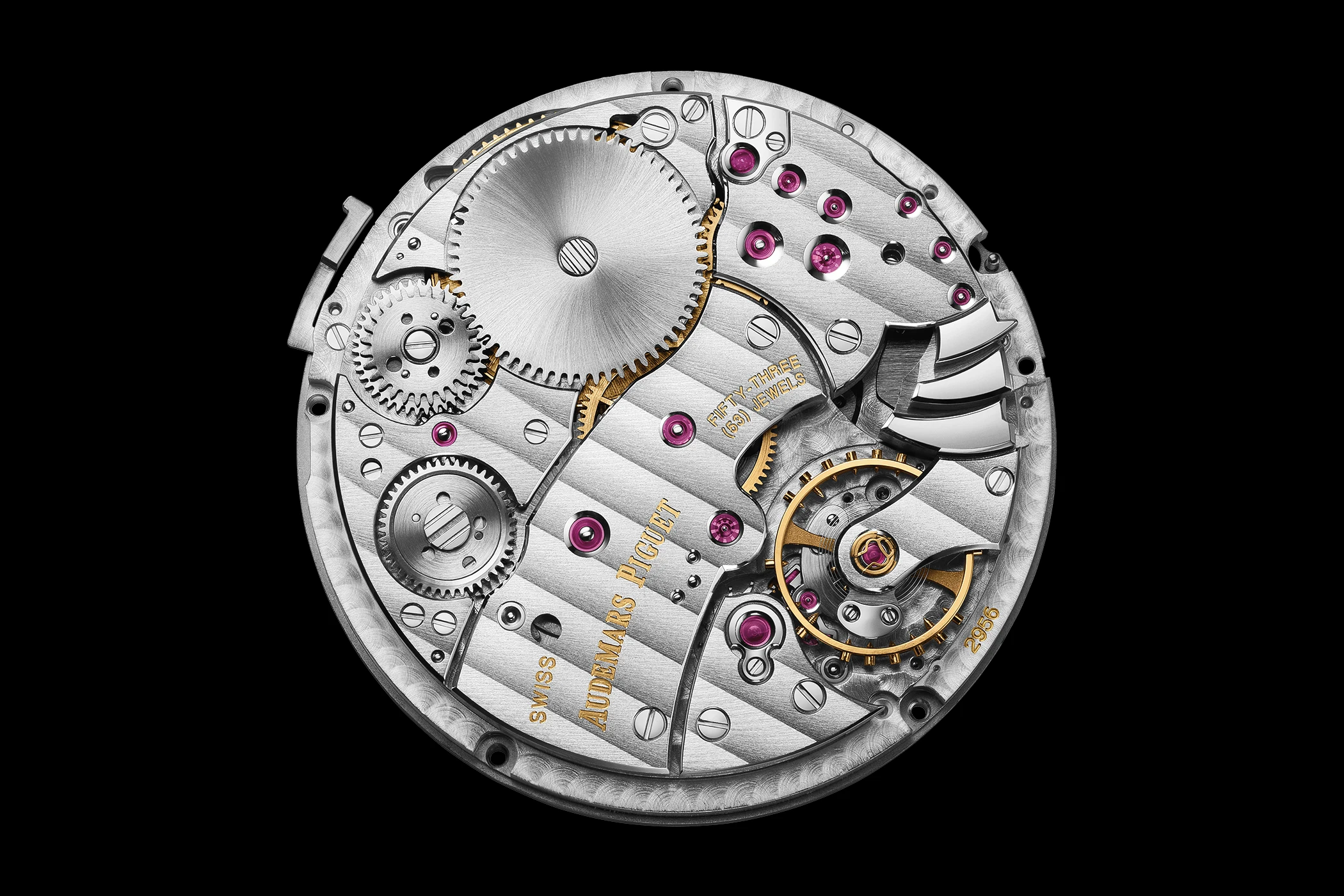
The calibre incorporates a carillon of three gongs and three hammers, delivering a triple chime for the quarters rather than the more common two-note sequence, and benefits from Audemars Piguet’s Supersonnerie technology, which improves the intensity, clarity and sustain of the sound by decoupling the gongs from the case structure.
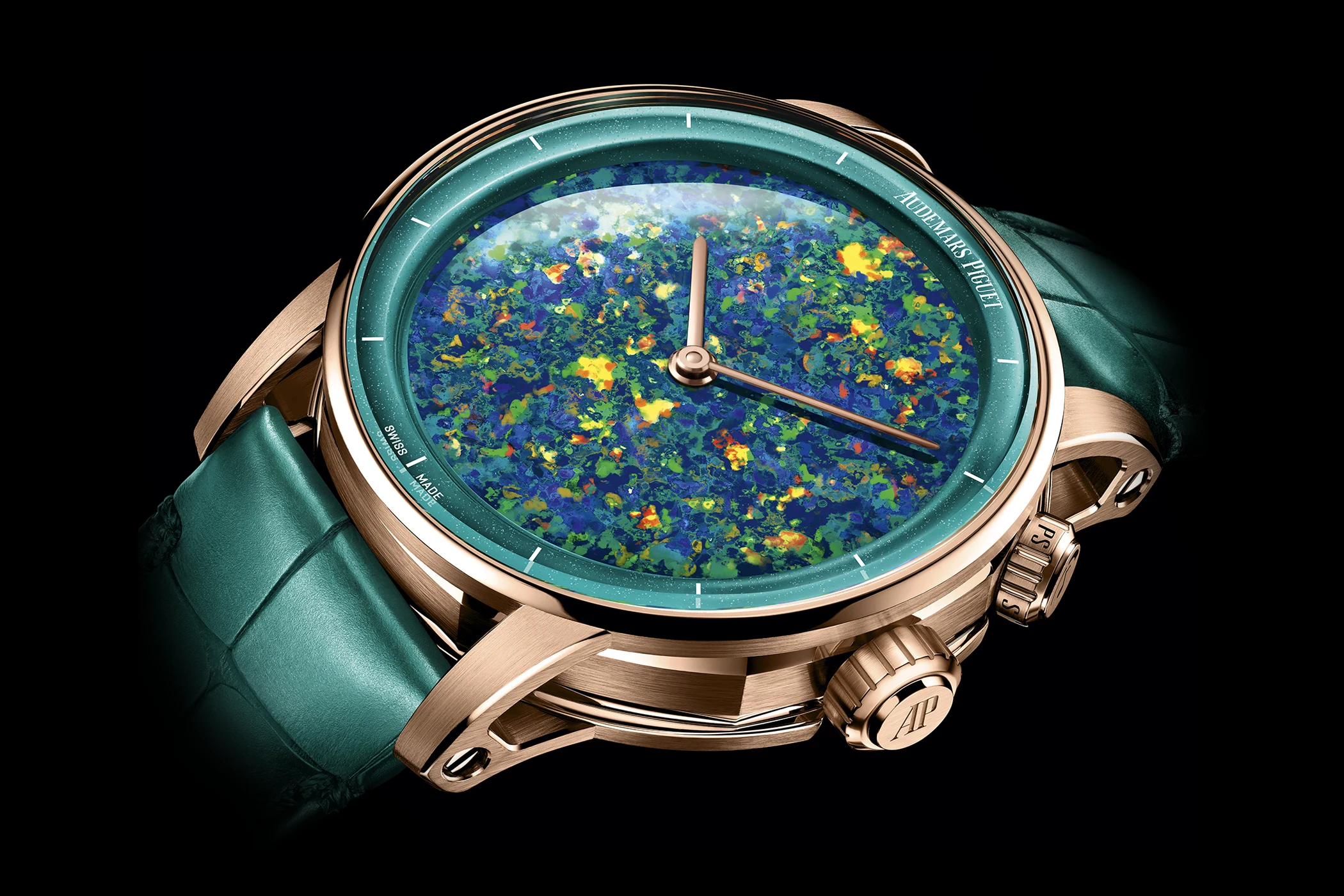
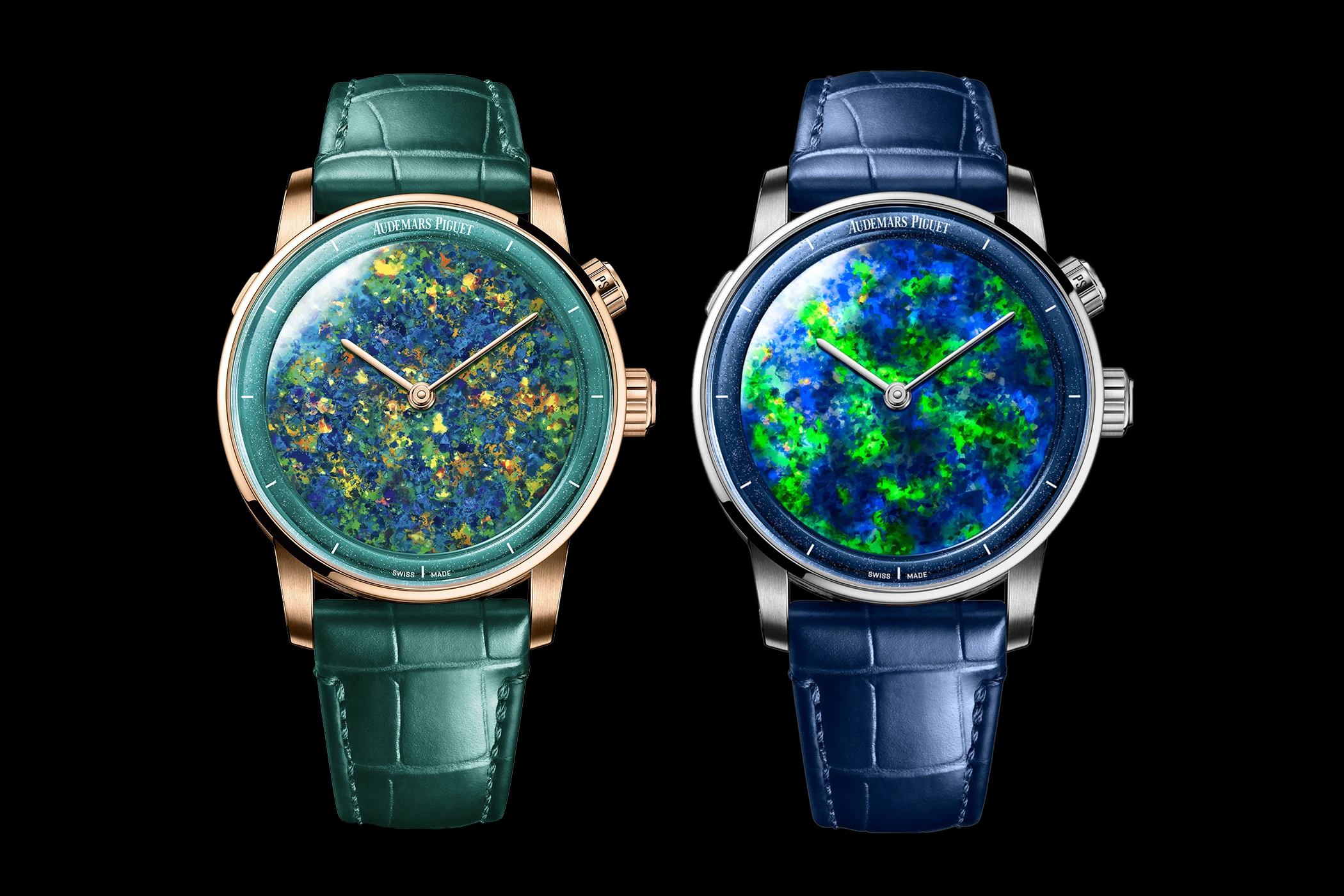
The 150th anniversary collection is presented in five stunning references distinguished by dial and case materials. Two versions, Ref. 26397OR.OO.D417CR.01 and Ref. 26397BC.OO.D357CR.01, feature opal dials – an 18-carat pink gold case with a rare harlequin opal dial, whose iridescent hues are enhanced by green details, and crystal opal displaying unique green and blue hues paired with a white-gold case.
The remaining three references, Ref. 26397PN.OO.D008KB.01, Ref. 26397CR.OO.D009KB.01 and Ref. 26397QS.OO.D002KB.01, use polished sapphire dials that reveal the chiming mechanism beneath. Cases range across platinum, white and pink gold, sand gold and ceramic combinations, each finished with the Code 11.59 by Audemars Piguet’s characteristic alternation of satin brushing and polished bevels. Regardless of execution, the Supersonnerie construction ensures consistent acoustic performance: the chime is notably loud, sharply articulated and free from case-induced damping, reflecting a level of acoustic engineering uncommon in wristwatches.
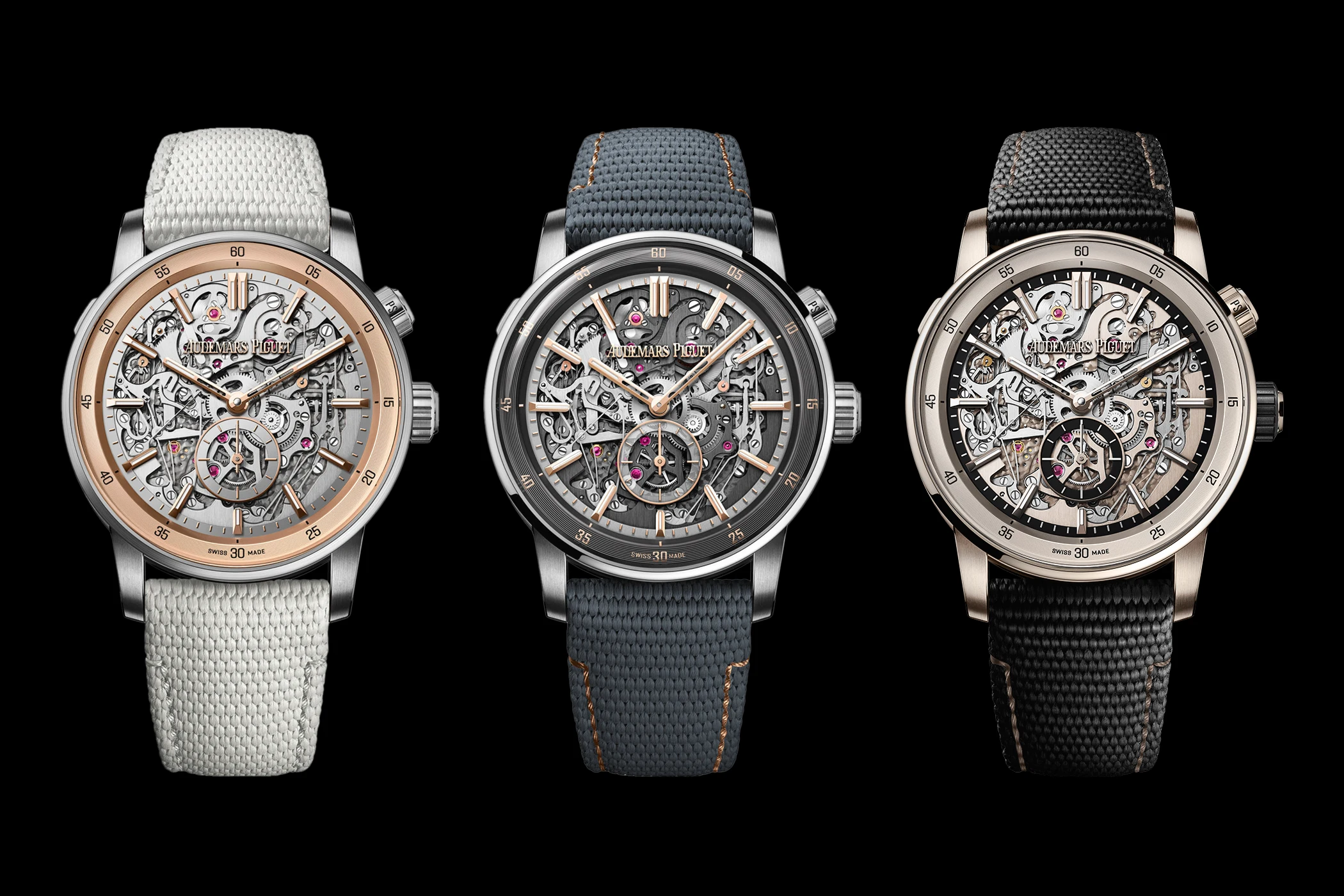
Audemars Piguet also took the opportunity in 2025 to introduce two new stainless steel models into the Code 11.59 by Audemars Piguet collection, expanding the 41 mm line with two new references that reposition the model’s design language in a more contemporary register, which started in 2023 with the introduction of the first Code 11.59 by Audemars Piguet stainless steel watches.
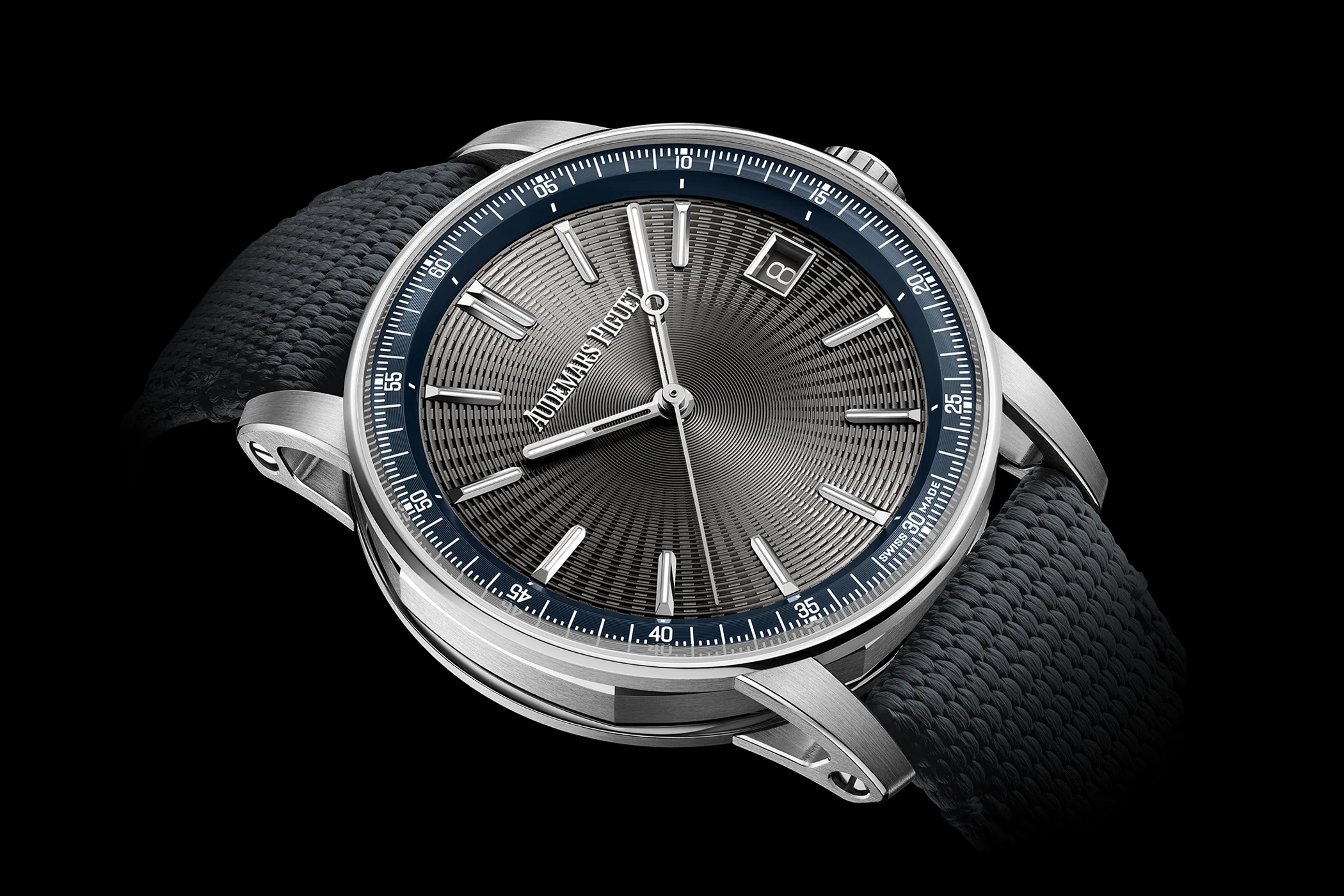
The Code 11.59 by Audemars Piguet case in the stainless-steel execution foregrounds the architecture of its stylised lugs, slim polished bezel and multi-faceted mid-case. The brand’s hallmark alternation of satin-brushed and mirror-polished surfaces plays differently in steel, sharpening the transitions and giving the watch a more technical, utilitarian edge without sacrificing refinement.
Particularly handsome editions include the Selfwinding Ref. 15210ST.OO.A009KB.01 and the Selfwinding Chronograph Ref. 26393ST.OO.A009KB.01, both of which introduce a new grey dial tone complemented by “Bleu Nuit, Nuage 50” accents; an Audemars Piguet signature dating back to the Royal Oak’s origins.
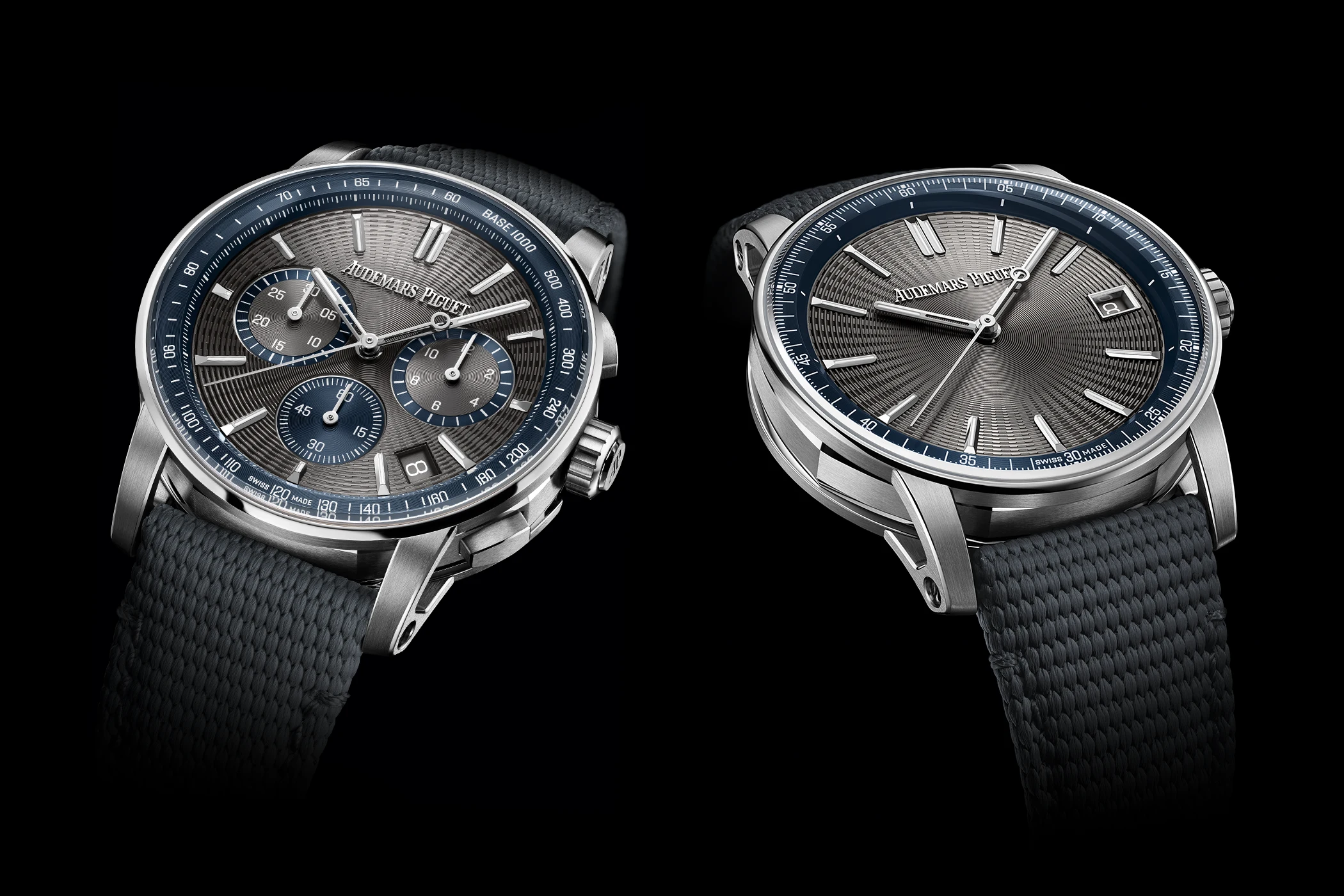
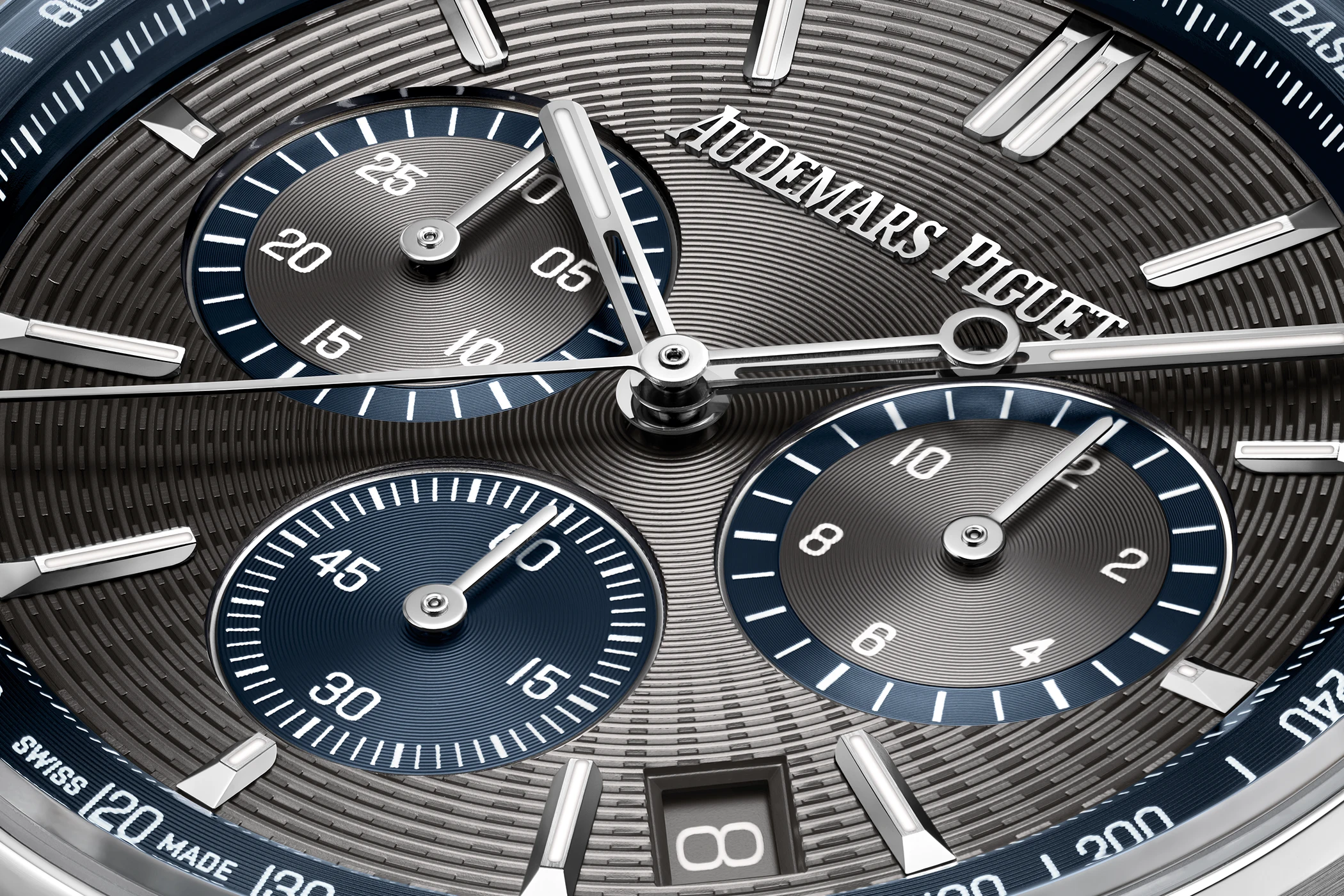
The watches’ dials feature an embossed motif developed in collaboration with guilloché artisan Yann Von Kaenel, whose hand-engraved tooling produces the concentric pattern that catches and fractures the light as the watch moves. The PVD-coloured dials’ design places particular emphasis on comfort and readability. To achieve this, new hour-markers and hands create a strong visual contrast with the textured dial. In addition, the inner bezel has been redesigned, alongside updates to the seconds scale, the typography of the numerals, the crown and the buckle. According to the horology house, this design evolution will not remain exclusive to steel models; it will be extended to gold versions and to watches with complications in the coming years.
On the chronograph version, galvanically treated counters maintain legibility against the slate-grey ground, while the double-curved sapphire crystal amplifies depth and shadow across the dial. Faceted white-gold hands and hour markers with luminescent coating ensure clarity, and a grey textured rubber strap with calfskin lining completes the monochrome aesthetic.
Producing the Code 11.59 by Audemars Piguet case in steel required a significant manufacturing rethink. Steel demands tighter tolerances than gold, stricter temperature control during machining and more time-consuming finishing processes. The lugs are individually crafted and later soldered to the case, then hand-finished to eliminate any visible transitions; a process that is both labour-intensive and technically unforgiving. With these two references, Audemars Piguet demonstrates not only material versatility but also its willingness to re-engineer existing components to preserve the visual and tactile codes of the original design. In doing so, the manufacture broadens the Code 11.59 by Audemars Piguet’s reach, giving the collection a more relaxed entry point while retaining the complexity and detail that have defined it since launch.
If earlier Code 11.59 by Audemars Piguet models demonstrated what Audemars Piguet could do with materials, proportions, and unusual dial treatments, the Code 11.59 by Audemars Piguet Ultra-Complication Universelle RD#4 introduced in 2023 reveals what happens when the manufacture removes every limitation. It is the clearest articulation yet of what this collection was built for: not just boundary-pushing design, but the full exercise of AP’s technical capability.


A stunning seven years in development – that’s the same amout of time it took to concieve the collection itself – the Universelle consolidates every major research milestone AP has released since 2015. The acoustic innovations of RD#1’s Supersonnerie, the ultra-thin perpetual calendar architecture of RD#2, and the flying tourbillon from RD#3 are all rebuilt and absorbed into the new automatic calibre 1000. The result is a movement with 40 functions, 23 complications, and 1,155 components, all housed in a 42 mm case that is only 1 mm larger than the standard Code 11.59.


What makes the Code 11.59 by Audemars Piguet Ultra-Complication Universelle RD#4 particularly striking is not the quantity of complications, but the way they are organised. Rather than scatter a labyrinth of hidden pushers around the caseband, Audemars Piguet redesigned the entire interface so that everything – from the Grand and Petite Sonnerie and minute repeater with a special sapphire ‘soundboard’ measuring a mere 0.6 mm to the semi-Gregorian perpetual calendar and flyback split-seconds chronograph – can be adjusted directly via crowns and pushers.

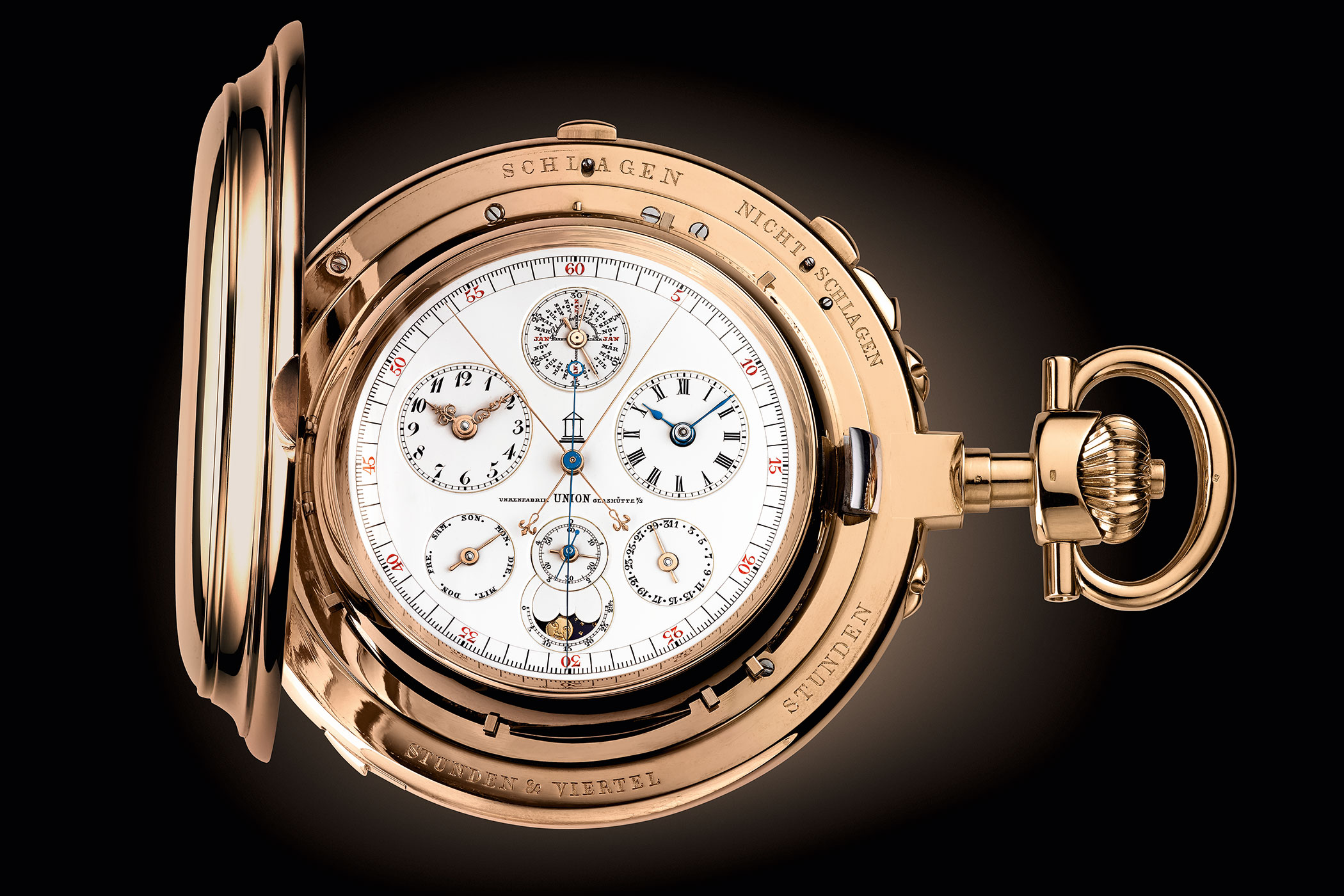
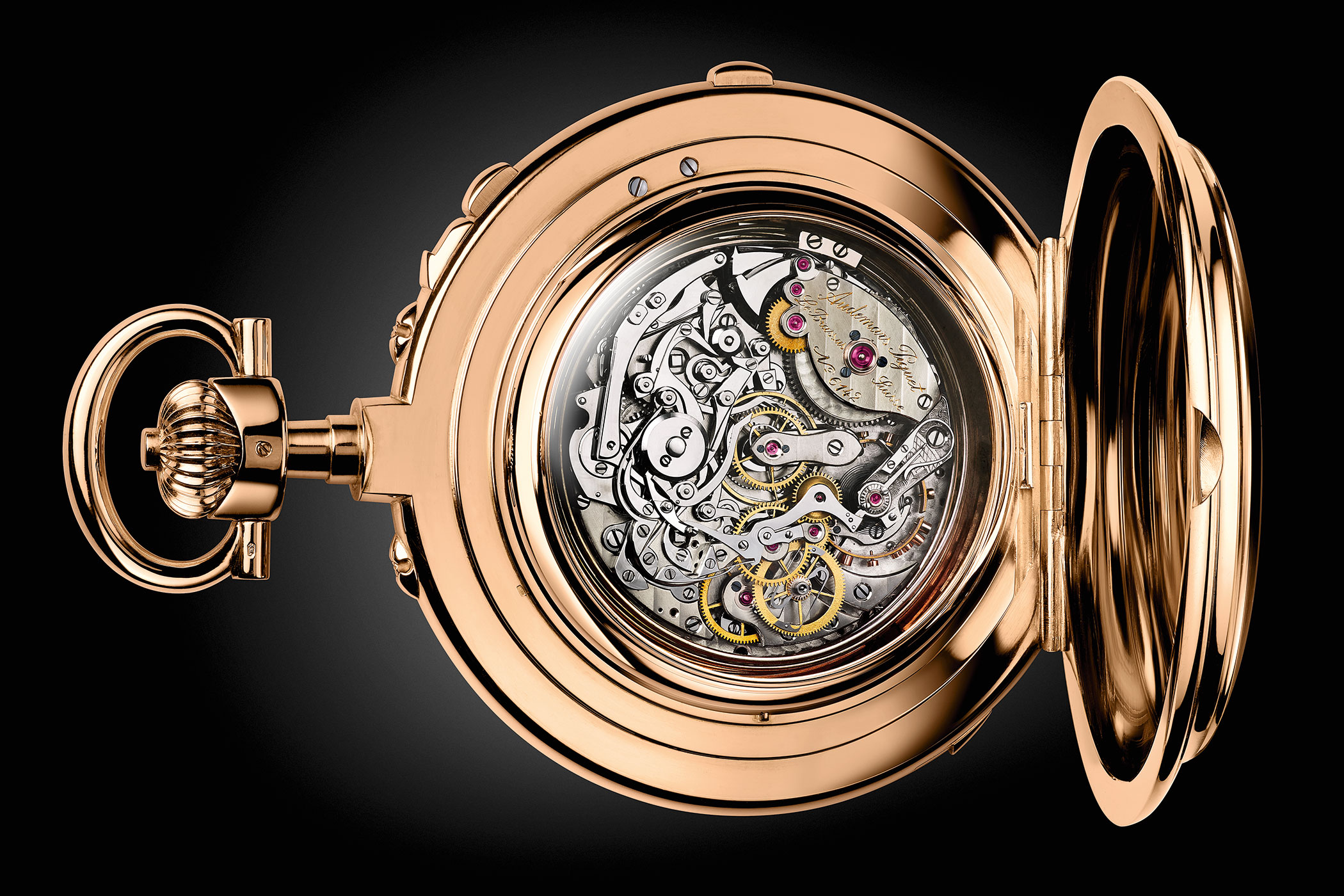
The watch also reaches back into Audemars Piguet’s archives; the name ‘Universelle’ references the 1899 pocket watch long considered one of the most complex timepieces ever made, now restored and displayed at the centre of the Musée Atelier in Le Brassus. Where that watch represented the pinnacle of 19th-century complication, the RD#4 reframes the idea for the 21st century: selfwinding, ergonomic, and engineered to be worn on the wrist.
Setting the Code 11.59 by Audemars Piguet against the Royal Oak and Royal Oak Offshore is tempting, but ultimately a fruitless thing to do. Today, the Royal Oak is as much a cultural artefact as a watch; the Royal Oak Offshore amplified that language into something more robust and more muscular, but still remains highly recognisable and definitive in its design.

Code 11.59 by Audemars Piguet operates on a different frequency. It is not trying to rewrite the integrated sports watch, but rather tries to answer a more demanding question: what does a modern round watch look like when it rejects vintage tropes and embraces boundary-pushing aesthetics? Where the Royal Oak’s value is reinforced through iconic design, the Code 11.59 by Audemars Piguet’s value is internal – hidden bevels, architectural lugs, double-curved crystal optics, and state-of-the-art movements conceived specifically for the collection. Its appeal lies not in instant recognition, but in the pleasure of discovery.

That distinction dictates its audience. The Royal Oak rewards the collector who seeks cultural shorthand and an object that, in many ways, speaks before its owner does. The Code 11.59 by Audemars Piguet speaks more quietly and requires its wearer to meet it halfway; its ideal collector is someone more interested in the finer details and less bothered by consensus.
The Audemars Piguet manufacture could have remained captive to its own success; issuing endless popular riffs on the Royal Oak and Royal Oak Offshore and allowing the market to applaud each sought-after novelty. Instead, it chose to invest time, capital and engineering resources for seven years in order to create something less guaranteed, and certainly more exposed. In doing so, the collection became a statement that demonstrates Audemars Piguet’s refusal to stagnate. It is a reminder that a brand becomes an icon not by repeating its best idea, but by demonstrating it has more than one.
There are other watch manufactures that have introduced new watches that have proved instant hits, while whether or not the Code 11.59 by Audemars Piguet becomes an enduring pillar of the brand remains to be seen. But as the past six years – controversy, recalibration, technical escalation, and now momentum – suggest, the collection evidently remains the next chapter Audemars Piguet intends to write. As then-CEO François-Henry Bennahmias framed it upon the collection’s launch, Code 11.59 by Audemars Piguet was created “to bring forward the history of the brand” – not necessarily by looking back, but by proving that history can continue to be written.