Rolex GMT-Master II Pepsi: History, model numbers, calibres, Cerachrom and tips for buyers and collectors.

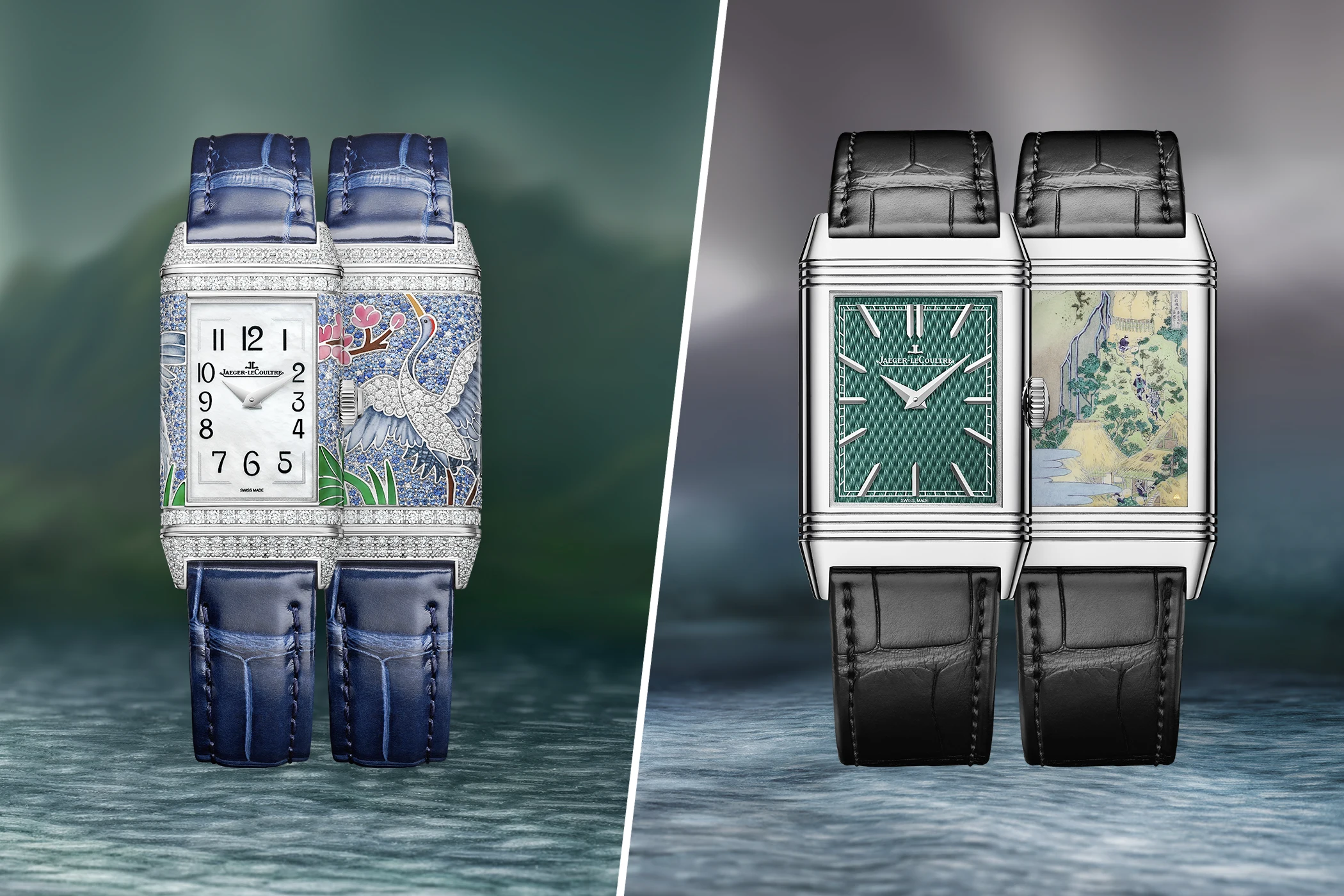
At Watches & Wonders 2026, Jaeger-LeCoultre is extending its exploration of Métiers Rares through two distinct but conceptually aligned releases: the introduction of La Vallée des Merveilles, a new series of capsule collections dedicated to artistic craftsmanship and the beauty of nature, and the continuation of its long-running and much-loved tribute to Japanese artist Katsushika Hokusai with the final chapter of the Reverso Tribute Enamel ‘Waterfalls’ series. In this article, we take a look at the Jaeger-LeCoultre Reverso Métiers Rares 2026 novelties.
While these timepieces do not pursue mechanical complexity in the conventional sense, they engage with a different dimension of precision, rooted in the control of material, colour and surface. In doing so, they reflect a broader philosophy that has long defined Jaeger-LeCoultre: precision not merely as a measure of timekeeping performance, but as a universal language that governs every stage of creation, from component manufacturing to decorative finishing.
This philosophy is inseparable from the history of the Vallée de Joux, where the manufacture remains based. As detailed in Jaeger-LeCoultre’s ‘Valley of Inventions’ narrative, the region’s isolation and harsh winters have long fostered a culture of resilience and ingenuity, leading early inhabitants to develop fine manual skills during the agricultural off-season. Over generations, these skills evolved into watchmaking, culminating in Antoine LeCoultre’s founding of his atelier in 1833 and his invention of the millionomètre in 1844 – an instrument capable of measuring components to the micron, and a decisive step in the industrialisation of precision.
From these origins emerged a manufacture that would go on to develop more than 1,400 calibres, secure over 430 patents and bring together 180 métiers under one roof. Crucially, this pursuit of precision has never been limited to mechanics. Rather, it has extended into the decorative arts, where the same demand for control and consistency must be applied to inherently unpredictable processes such as enamelling and gem-setting.
With La Vallée des Merveilles, Jaeger-LeCoultre introduces a new conceptual platform for its Métiers Rares creations, positioning nature as both subject and structural inspiration. Rather than presenting isolated artistic pieces, the series is conceived as an evolving sequence of capsule collections, each exploring a different expression of the natural world, from vast, untamed landscapes to the intricacy of individual flora.
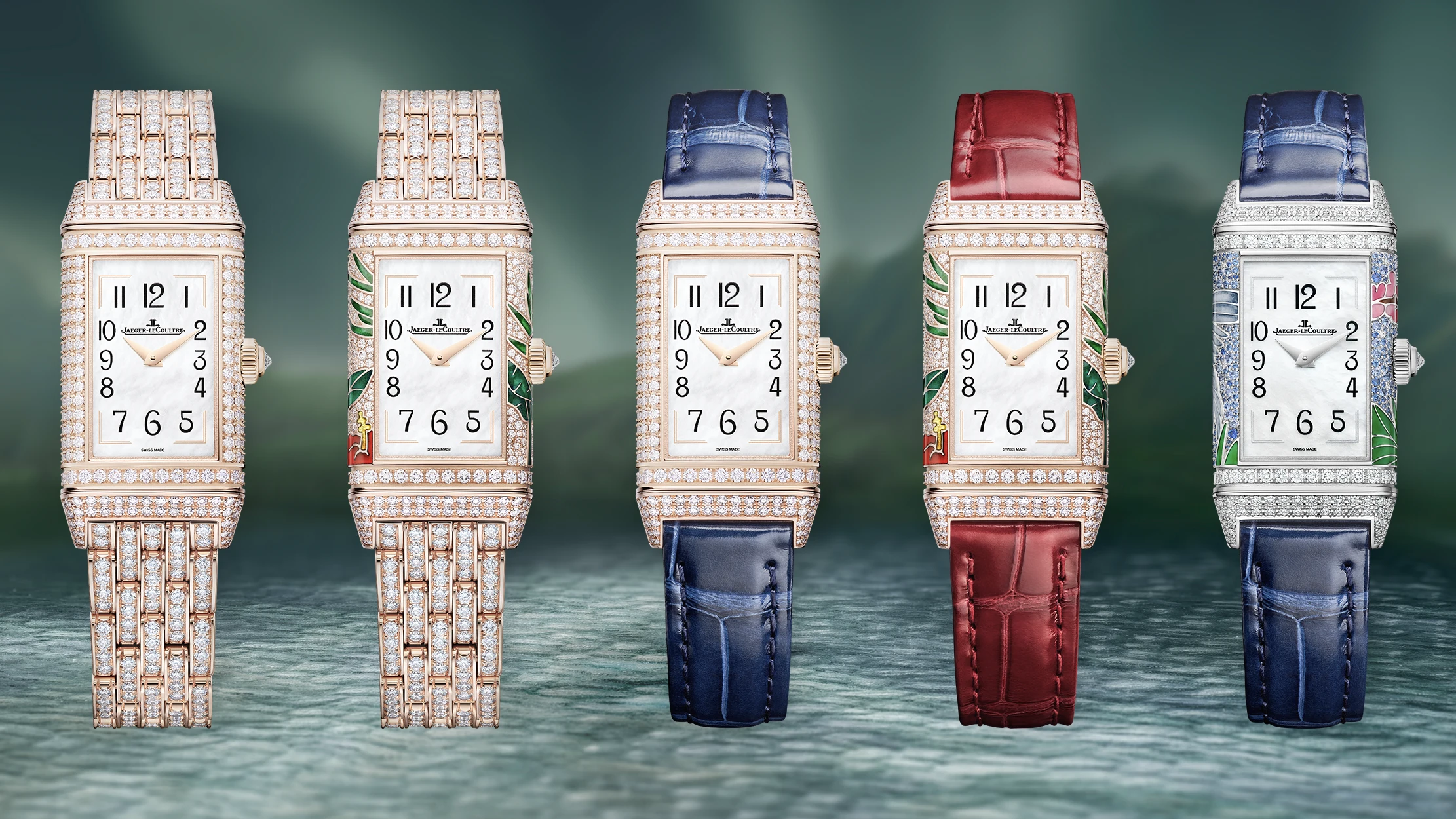
The first capsule is realised through the Reverso One, whose rectangular case, measuring 40 mm by 20 mm with a thickness of 9.09 mm , offers a highly defined surface for artistic work. Originally conceived in 1931 as a functional solution for polo players, the Reverso has since evolved into one of watchmaking’s most versatile artistic platforms. Its reversible case allows for a clear distinction between the front dial, which remains restrained and legible, and the reverse, which becomes a site for complex decorative composition.
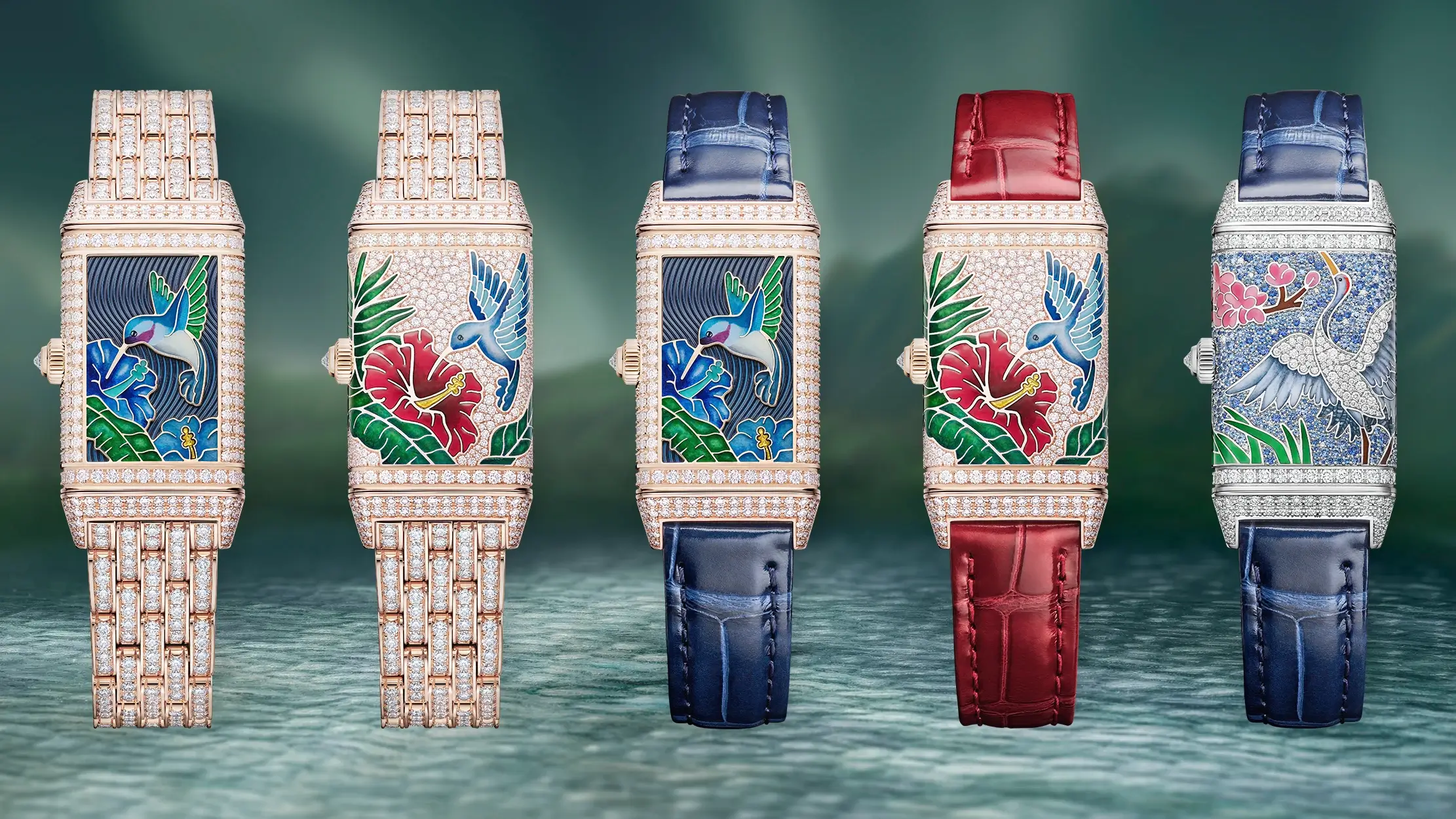
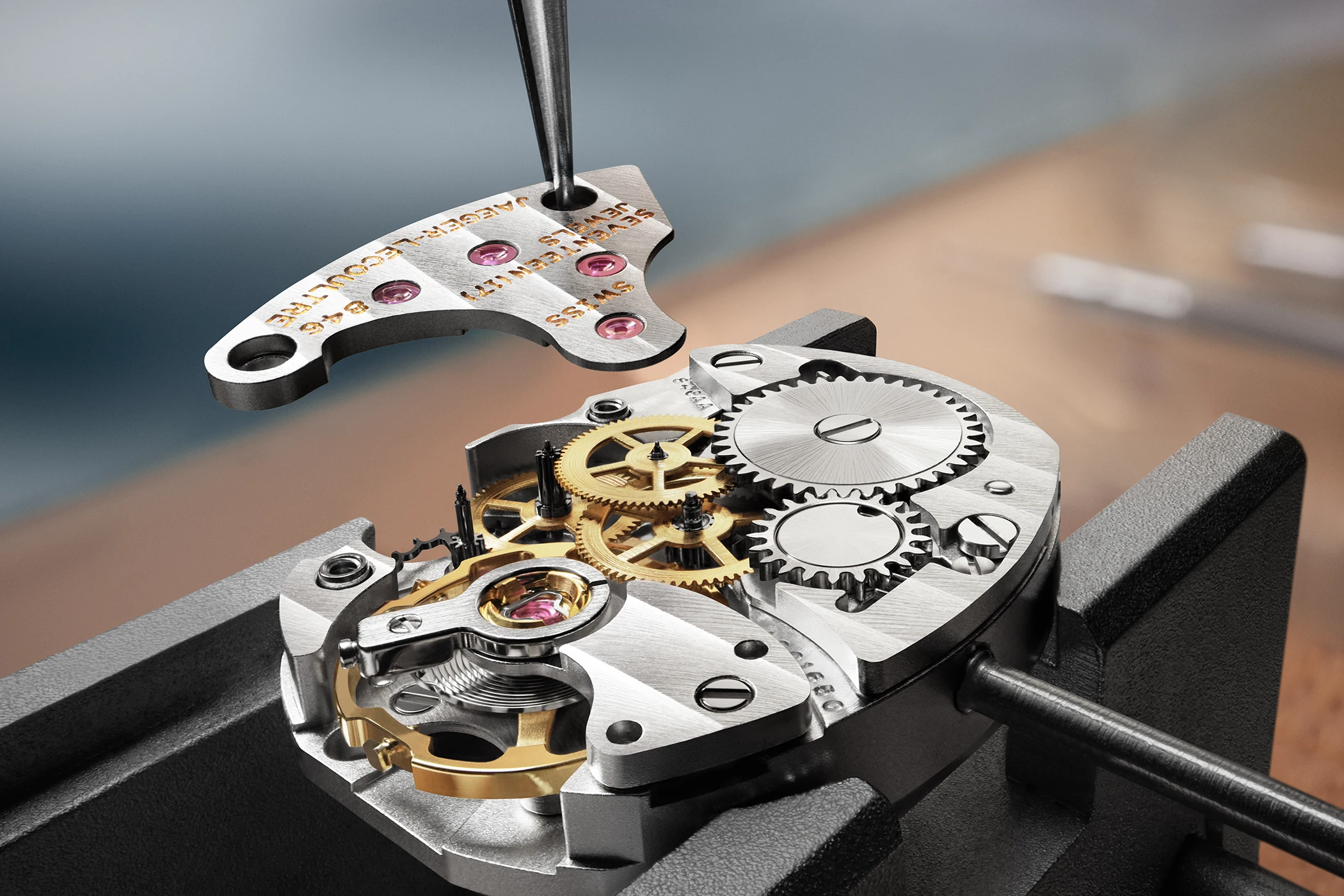
Across three limited editions of 20 pieces each, Jaeger-LeCoultre interprets two contrasting natural environments: the volcanic, fertile landscapes of Hawaii and the seasonal, ephemeral beauty of Japan. Each model is powered by the manually wound Calibre 846, a movement comprising 93 components, delivering a 50-hour power reserve and shaped to fit the Reverso’s rectangular architecture. The simplicity of its functions, limited to hours and minutes, reflects JLC’s deliberate decision to prioritise artistic expression on the reverse side, while maintaining mechanical reliability and proportion.
The two Hawaiian interpretations translate the islands’ dynamic environment, where volcanic formation meets dense vegetation, into layered enamel compositions that combine multiple Métiers Rares techniques.
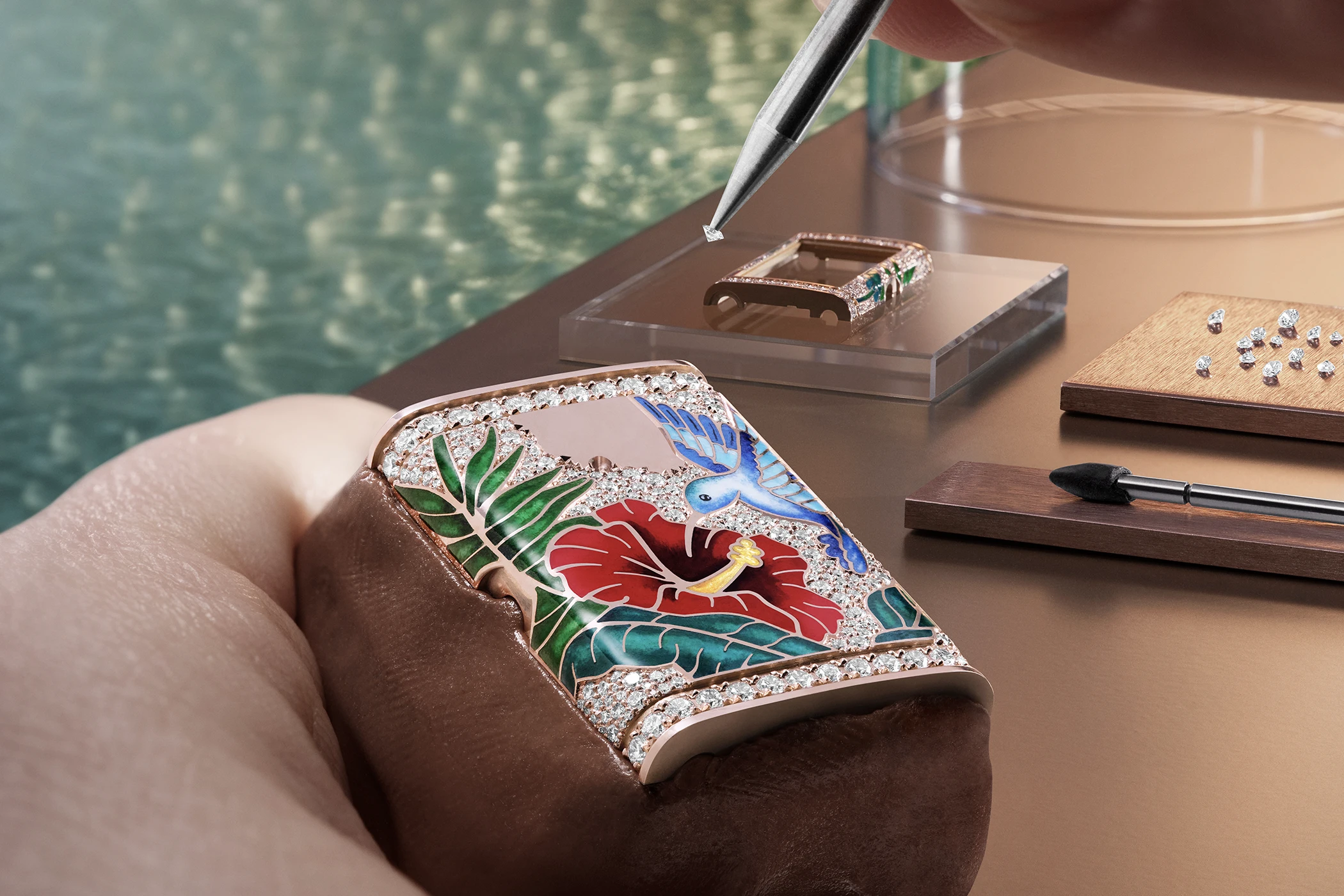
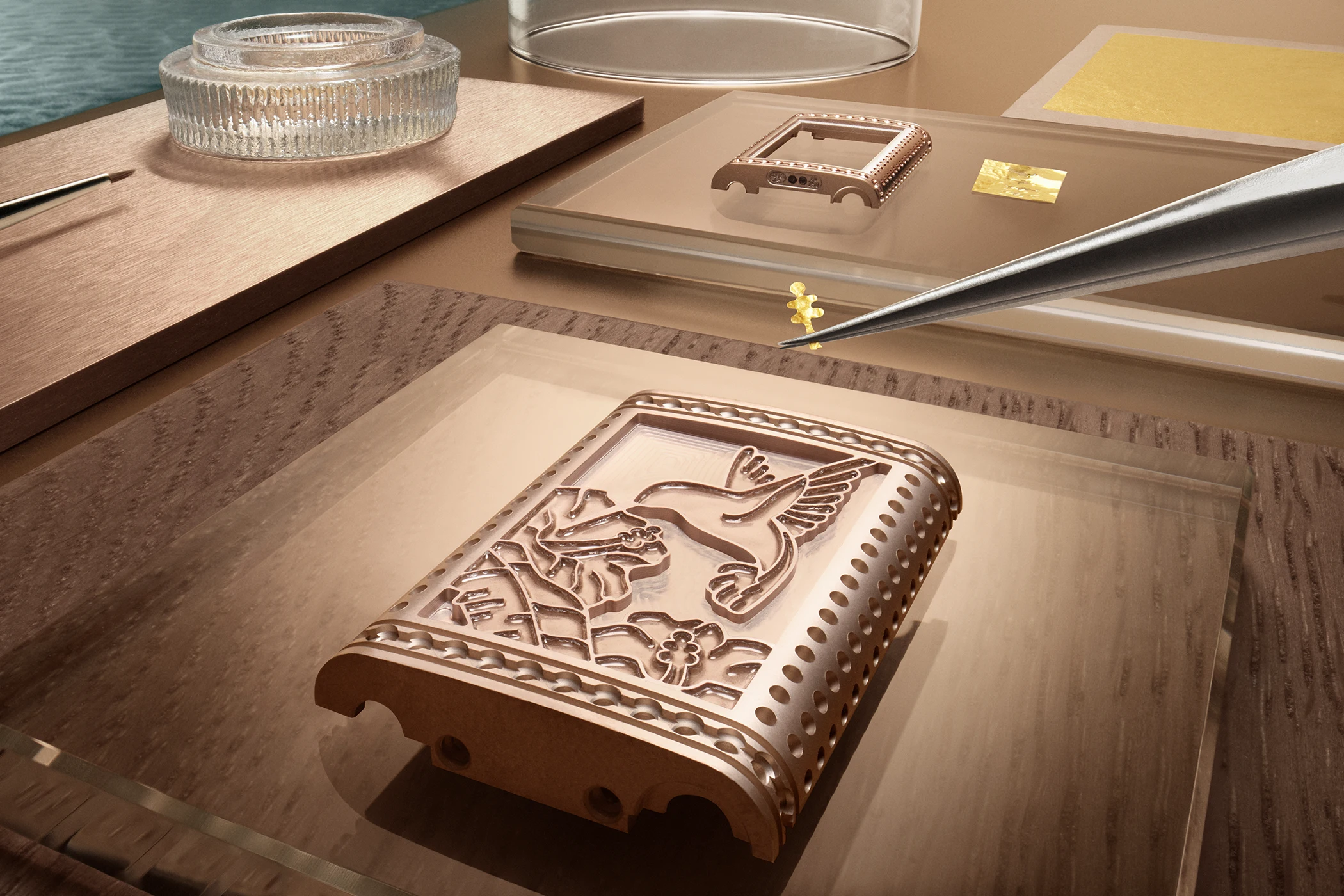
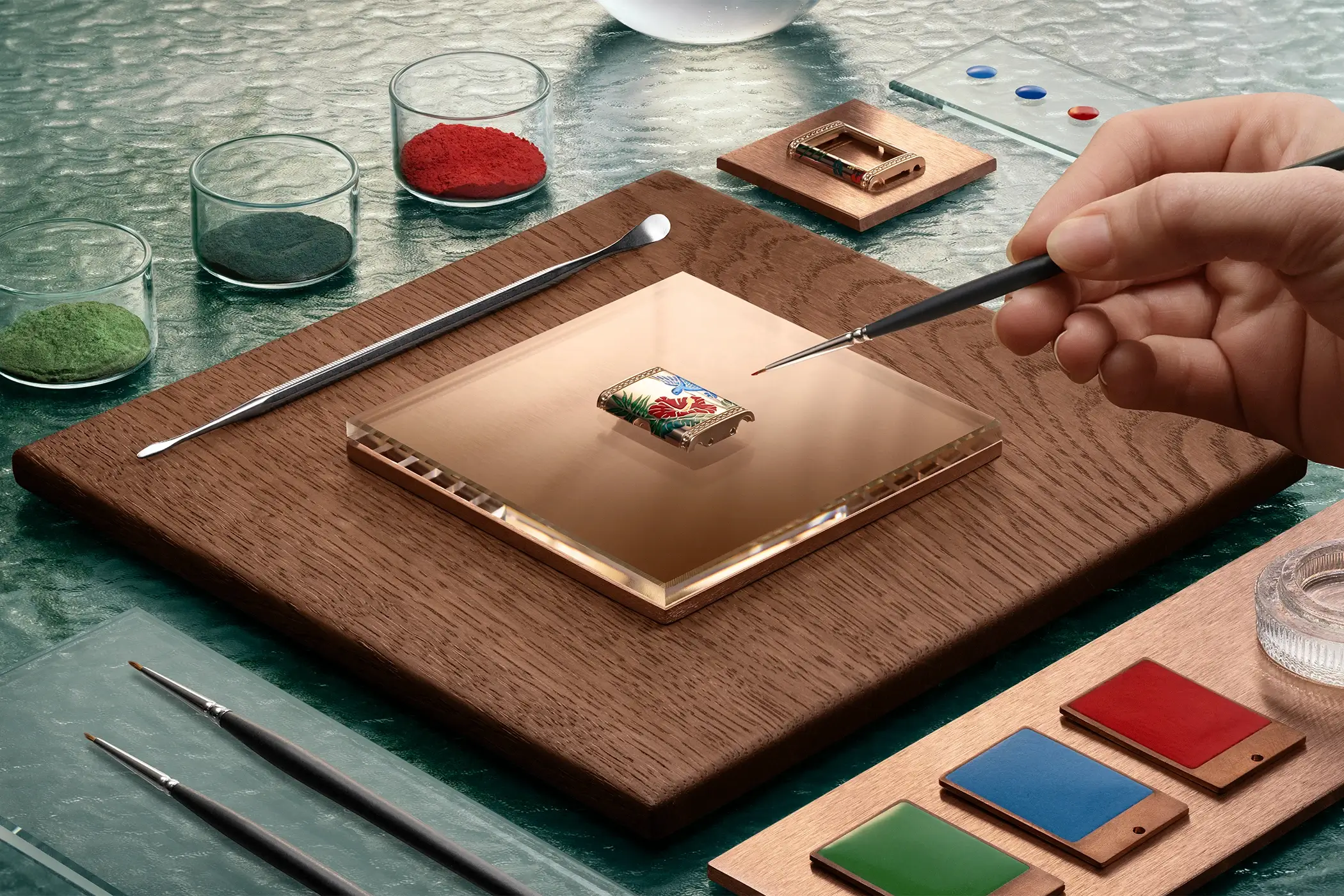
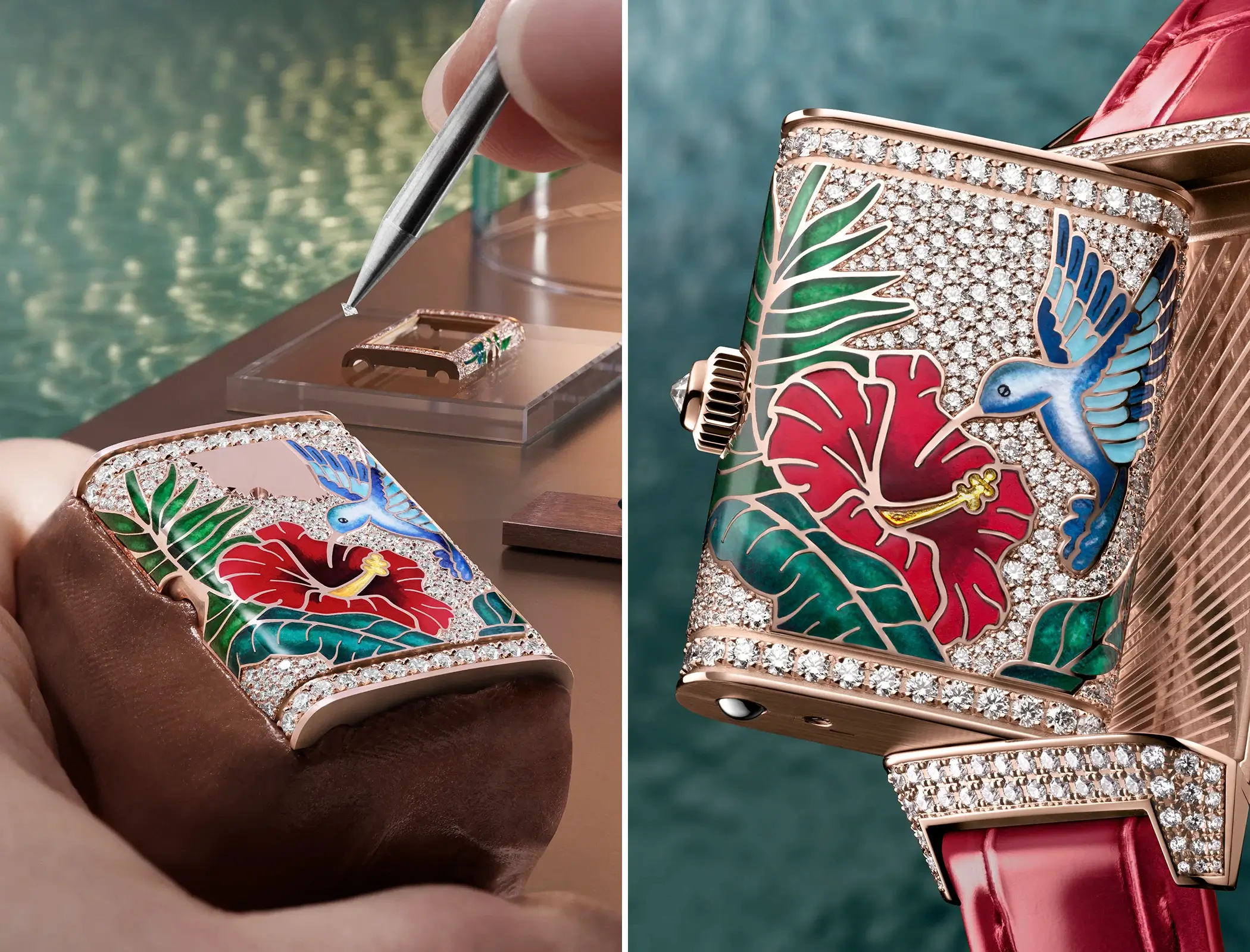
On the reverse of the Hibiscus Syriacus, an Akialoa bird is depicted hovering above a blue hibiscus flower within a two-level construction. The background, representing the sky, is engraved with undulating lines and covered with successive layers of blue lacquer, applied to independent components to create visual depth. Above this, the bird and floral motifs are hollowed directly into the 18-carat pink gold case and executed in Grand Feu champlevé enamel, fired at temperatures approaching 800°C.
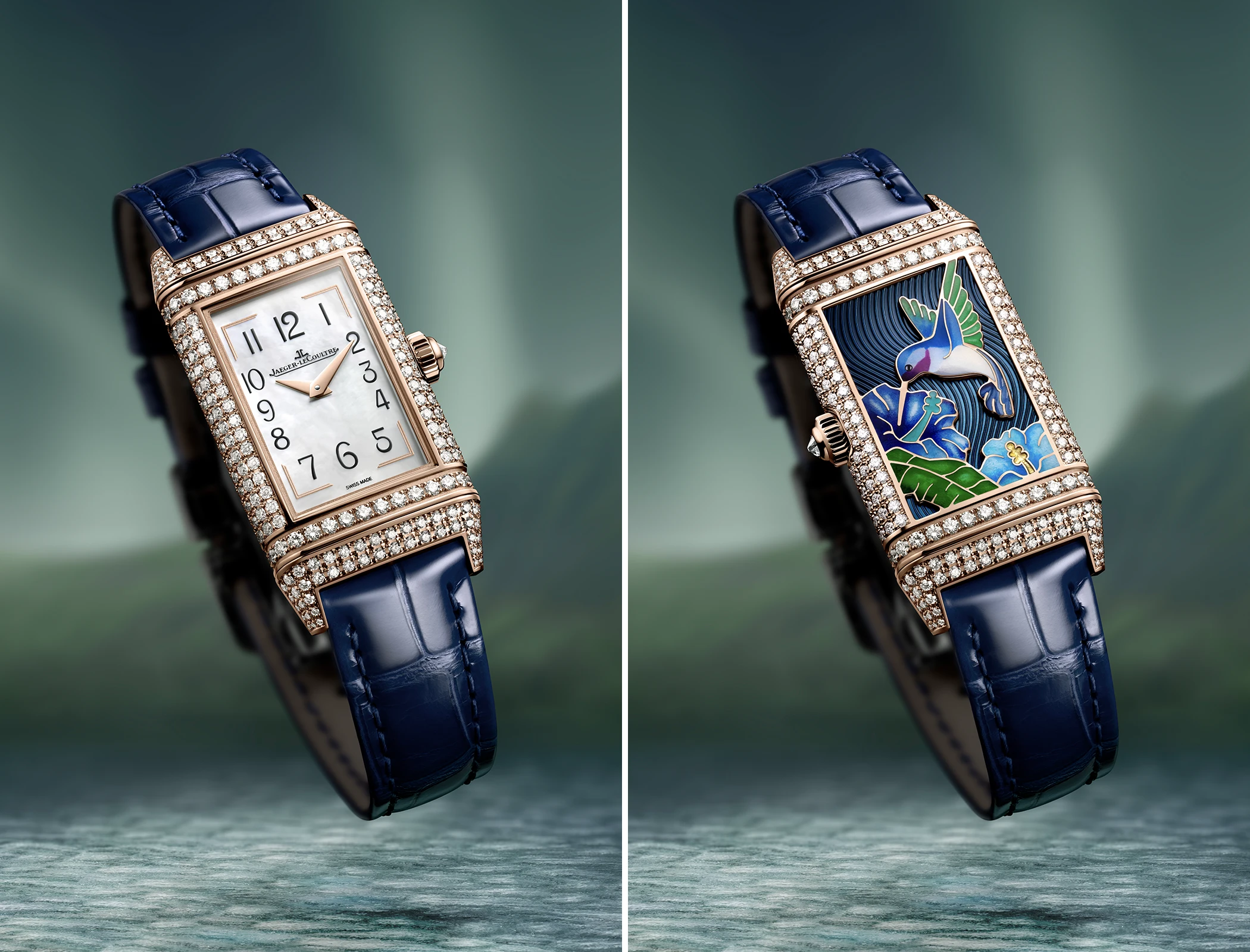
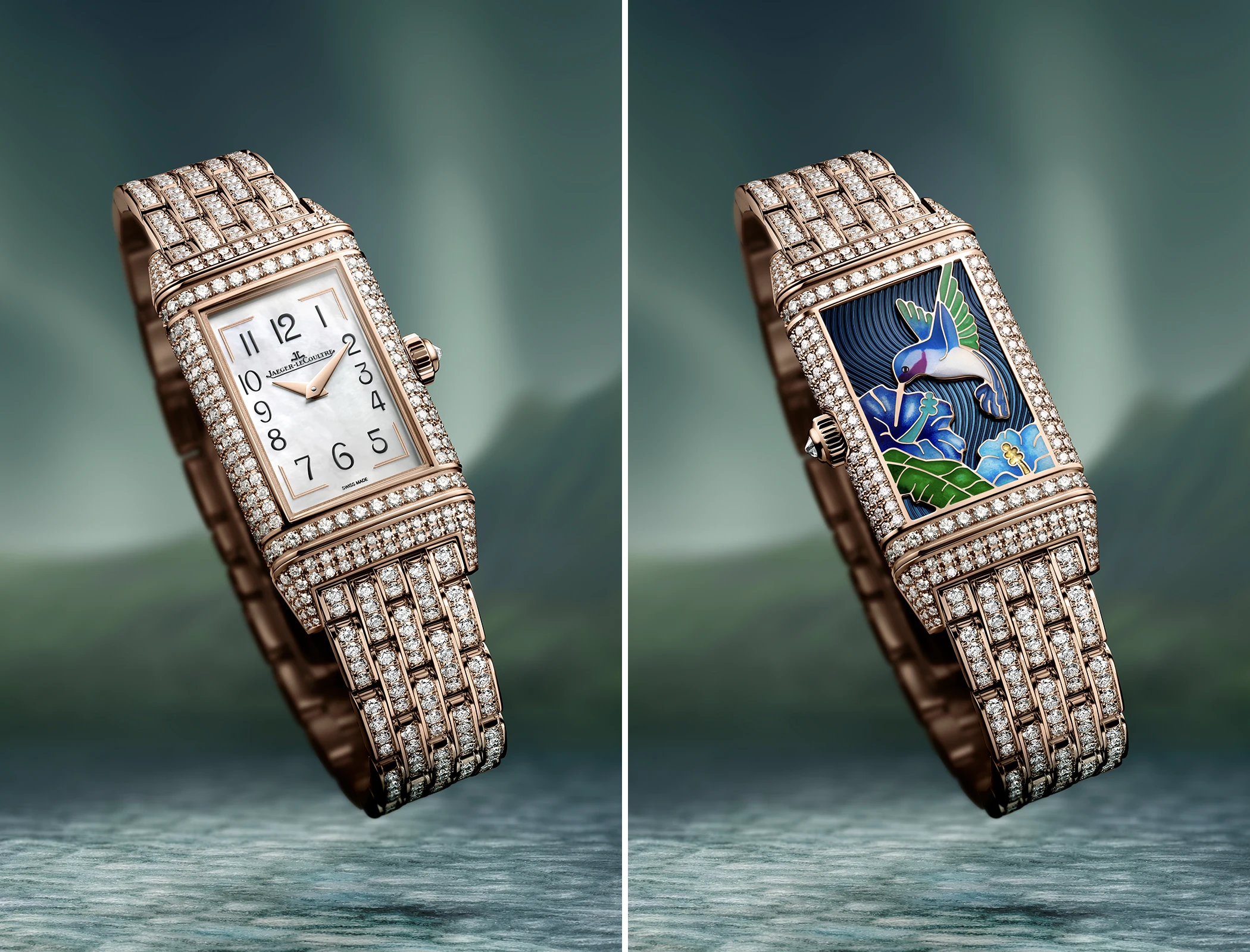
The execution requires the combination of miniature painting and enamel layering. The bird is rendered using nine different metal oxide pigments, while the surrounding foliage is built up through successive layers of opaque and translucent enamel. A gradient effect is achieved through the use of ten distinct enamel colours, each requiring precise control during firing. The pistil of the flower is further enhanced using paillonné enamel, in which fragments of 24-carat gold leaf are inserted beneath translucent enamel layers to produce a subtle luminous effect.

The dazzling case itself is set with 335 diamonds, contributing approximately 2.38 carats, while an optional fully diamond-set bracelet in 18-carat pink gold incorporates an additional 384 diamonds totalling around 5.7 carats. The watch is paired either with this bracelet or with a more lowkey blue alligator leather strap, and offers water resistance to 30 metres.
Its sibling, the Hibiscus Rosa, develops this composition further through a more chromatically demanding palette centred on a vivid red hibiscus flower. Achieving stable red enamel presents particular technical challenges, as metal oxides are highly sensitive to temperature variations and can easily discolour. The final result requires no fewer than nine layers of enamel, each fired separately at carefully controlled temperatures to preserve colour integrity.
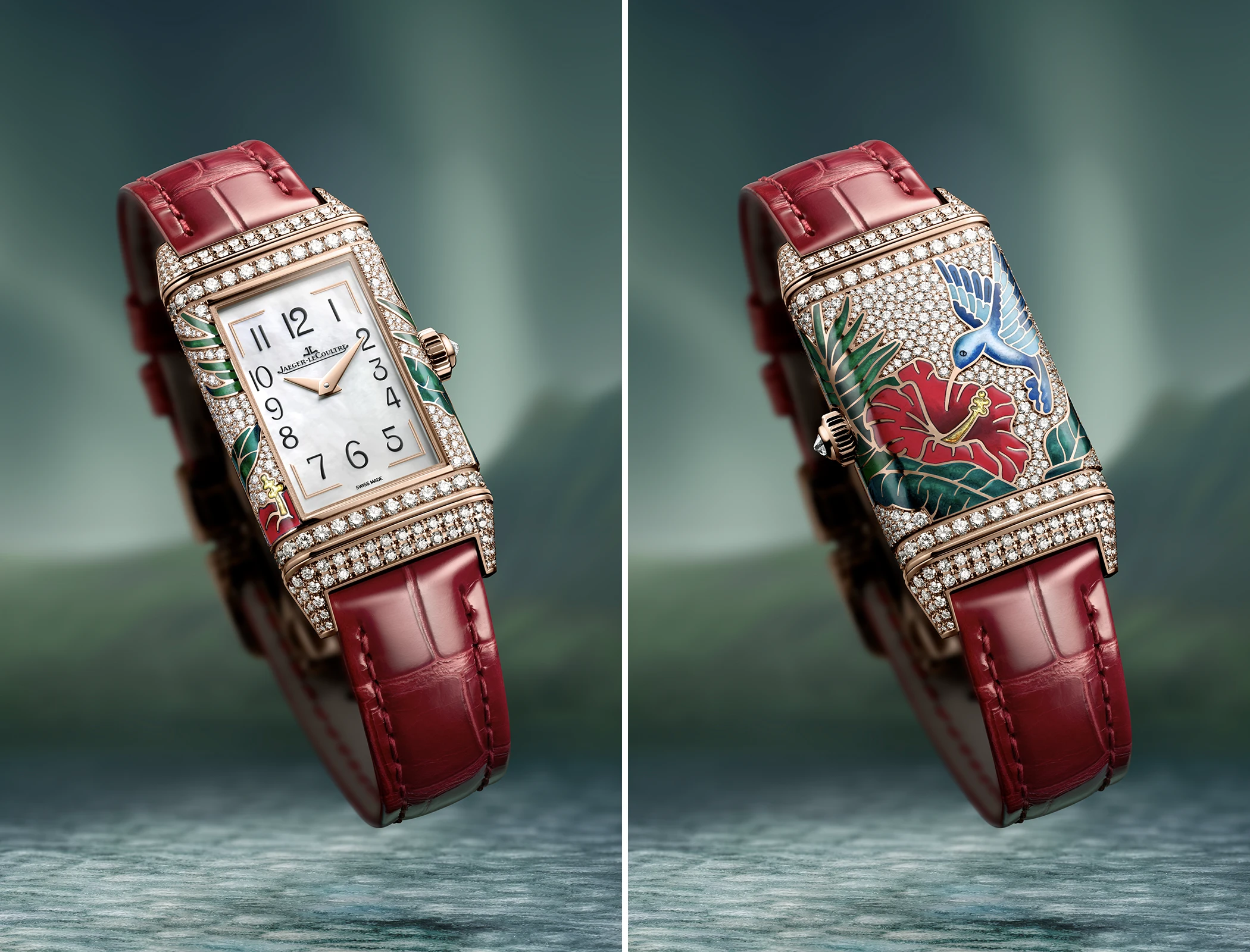
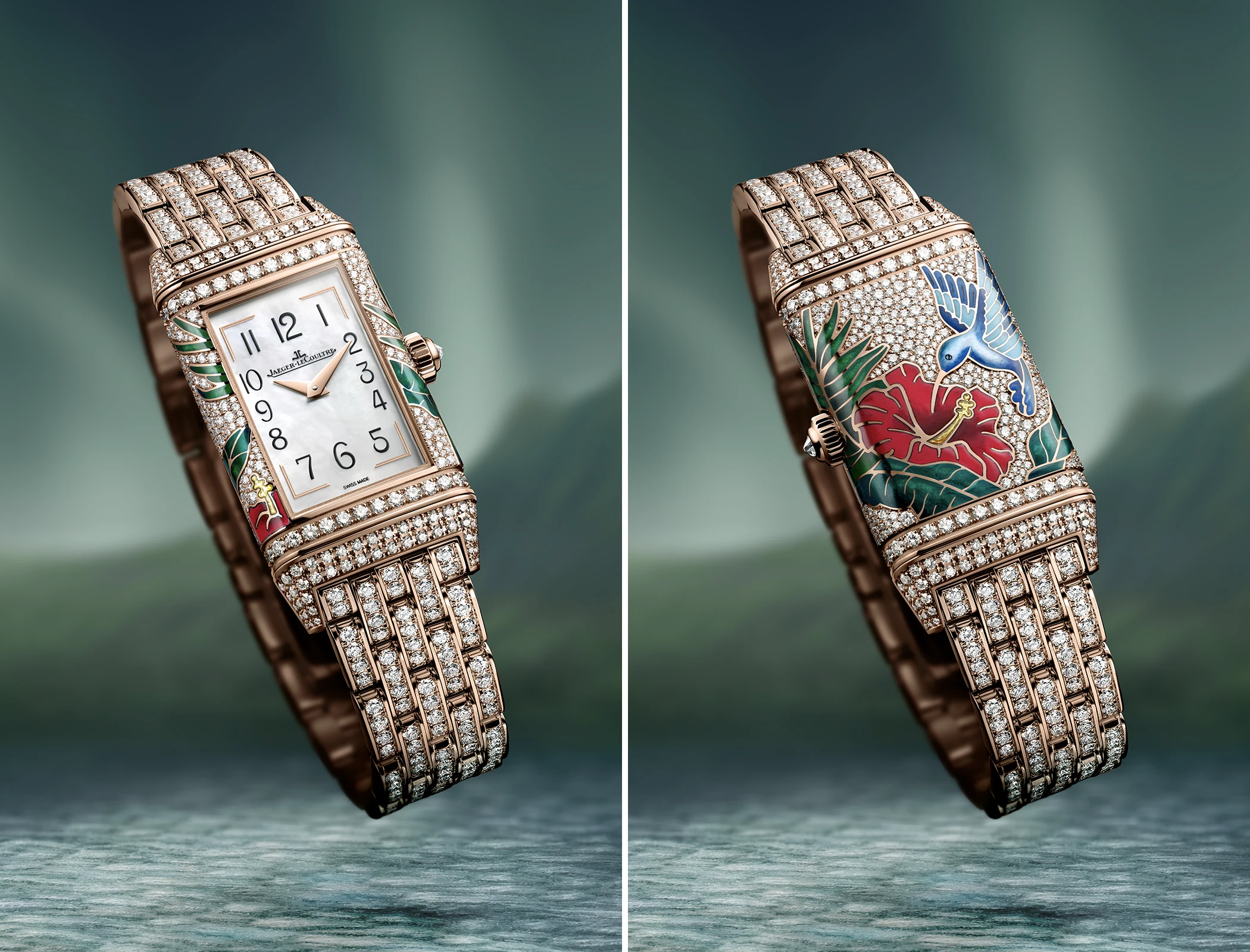
Here, the enamelled scene is complemented by snow-setting, a technique in which diamonds of varying sizes are positioned to minimise visible metal between them. A total of 489 diamonds are set into the curved surface of the case, requiring the gem-setter to adapt the technique to non-flat geometry while maintaining a continuous visual flow. Combined with the enamel work, the decoration of the case alone requires approximately 130 hours, with an additional 60 hours required for the bracelet when specified. No small feat.
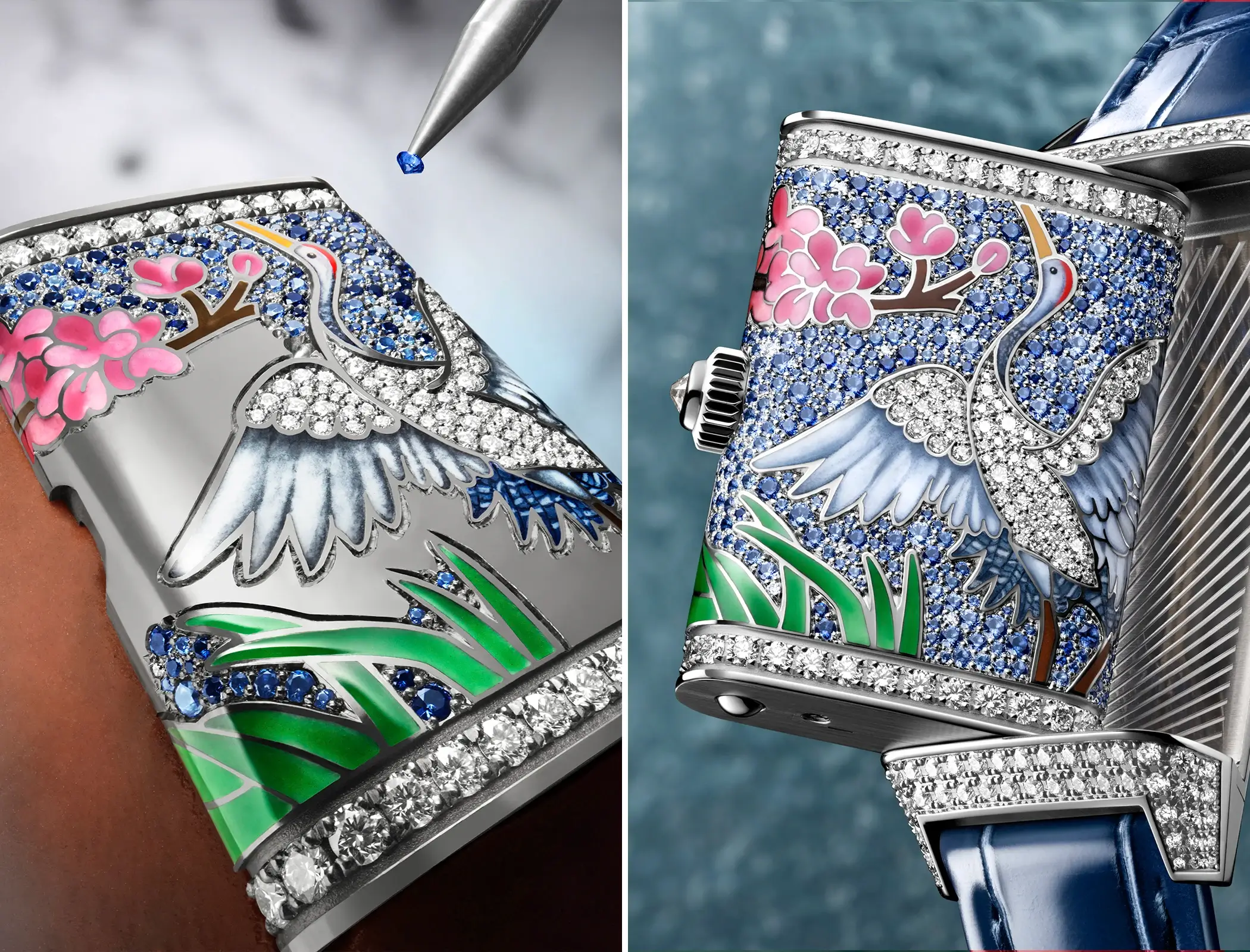
In contrast to the intensity of the Hawaiian models, the Reverso One ‘Sakura’ explores the concept of transience. Inspired by the gorgeous cherry blossoms of Hokkaido, the composition reflects the cultural symbolism of sakura in Japanese art, where the fleeting bloom represents the impermanence of life.
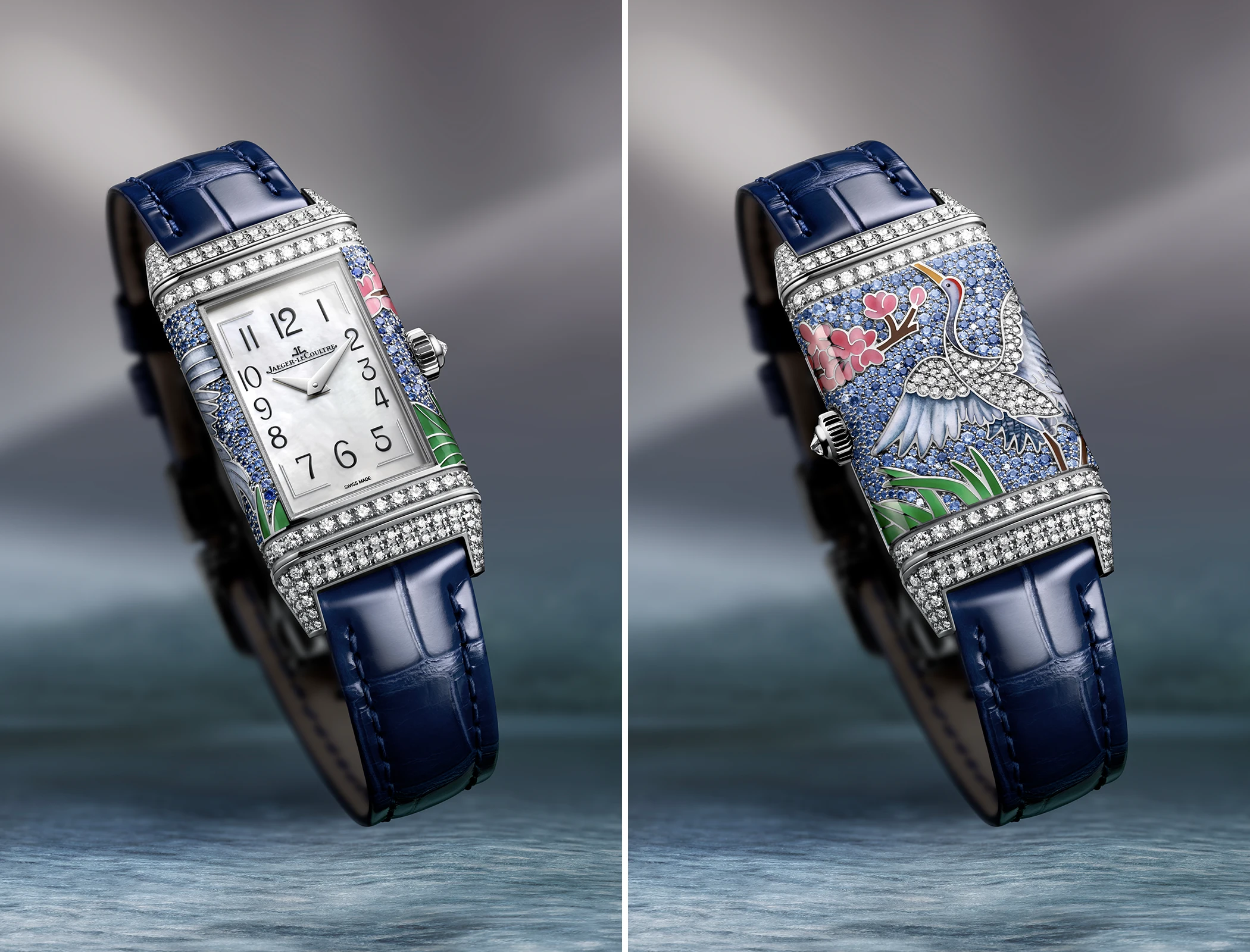
The reverse depicts a red-crowned crane standing at the edge of a lake beneath blossoming branches, rendered through a combination of Grand Feu champlevé enamel and gem-setting. The crane itself is executed using miniature painting, with artisans crafting bespoke brushes, including single-hair tools, to achieve the necessary level of detail. The surrounding composition incorporates 269 diamonds and 395 sapphires, totalling approximately 1.47 and 1.07 carats respectively, arranged using a snow-setting technique adapted here for coloured gemstones for the first time.
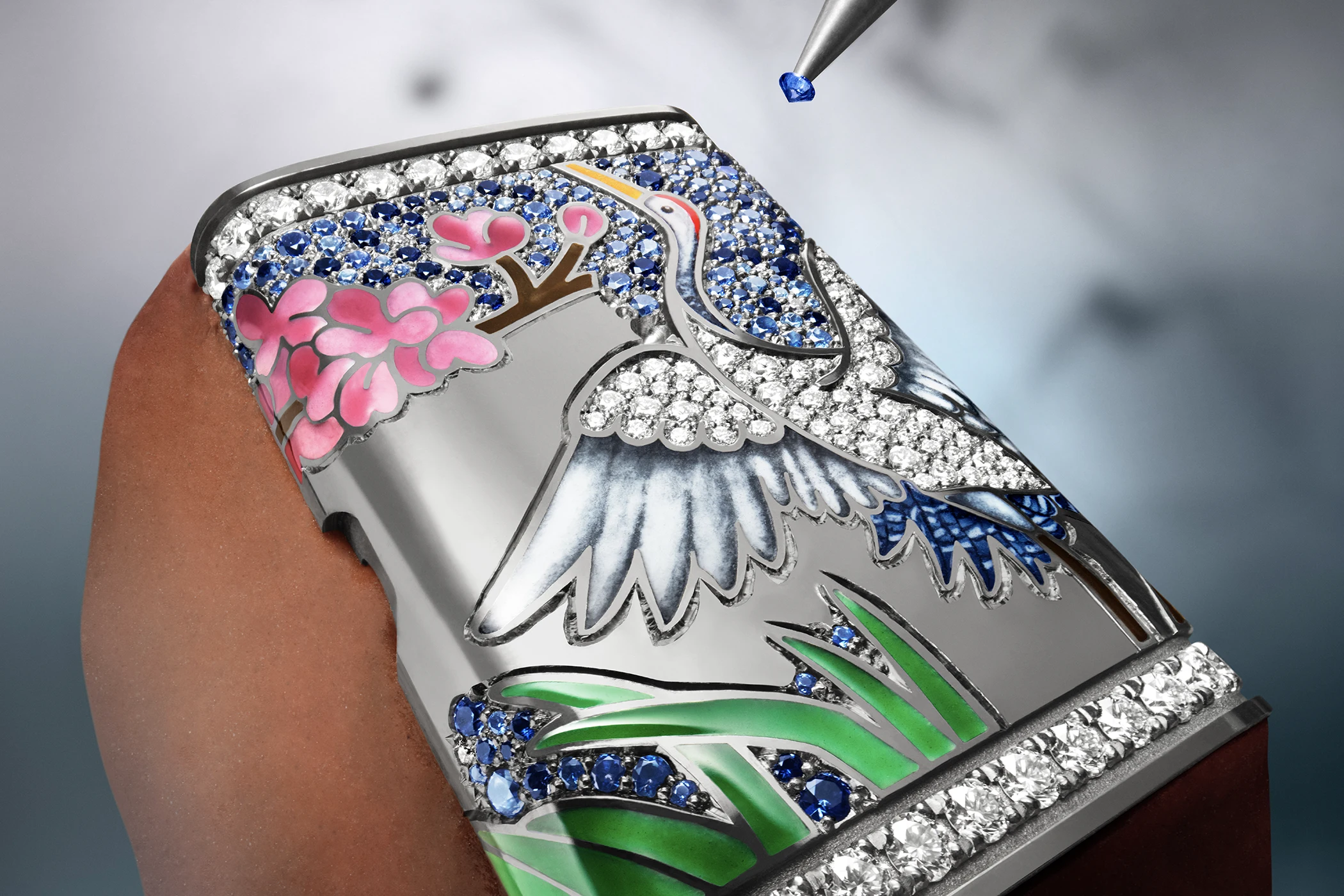
Two distinct shades of blue sapphire are used to evoke the reflection of light on water, while the cool tonality of the 18-carat white gold case enhances the chromatic balance of the composition. The gem-setting process alone requires approximately 125 hours, reflecting the complexity of integrating multiple stone types within a coherent visual structure.
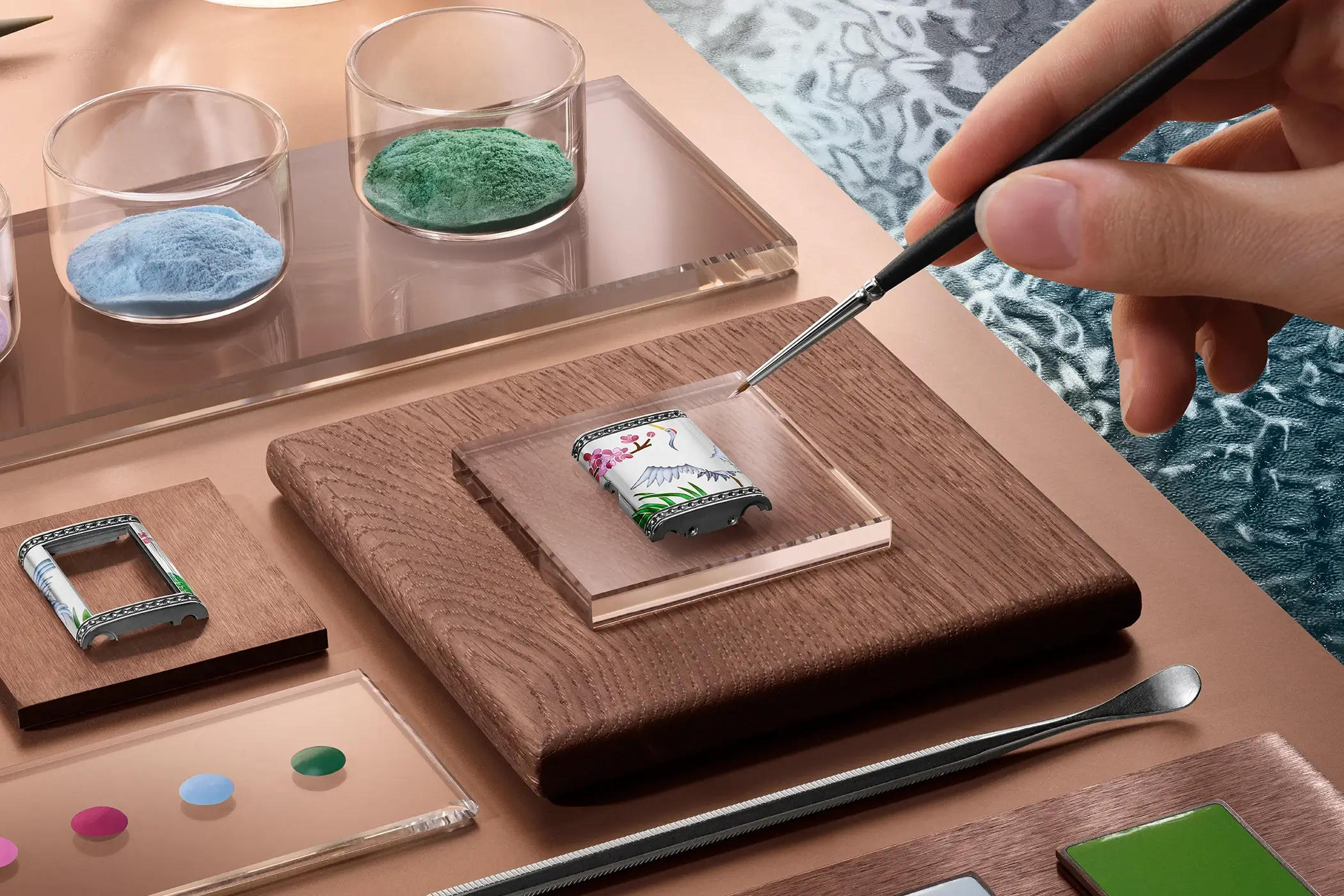
Like the two Hibiscus models, the Sakura is powered by Calibre 846 and sports a mother-of-pearl dial on the front, featuring transfer-printed numerals and the characteristic Reverso One floral typography. A diamond-set crown and blue alligator strap complete the watch.
Across all three models, the defining characteristic is not a single technique, but the integration of several, each of which introduces its own variables. Grand Feu champlevé enamel requires the artisan to hollow out the gold base and apply enamel layer by layer, firing each at temperatures of up to 800°C. The final colour is not entirely predictable, particularly for complex hues such as red, making experience and iterative control essential.
Paillonné enamel adds further complexity, requiring precisely cut fragments of gold leaf to be positioned beneath translucent enamel layers without distortion during firing. Snow-setting introduces a different form of precision, relying on the intuitive placement of stones to eliminate visible gaps while maintaining structural integrity.
What distinguishes Jaeger-LeCoultre’s approach is the integration of these crafts within a single atelier, allowing enamellers and gem-setters to work in close coordination. This collaborative structure reflects the broader organisation of the extraordinarily vast Swiss manufacture, where the coexistence of multiple specialised métiers enables both technical and artistic innovation.
Running parallel to La Vallée des Merveilles, Jaeger-LeCoultre completes its tribute to Katsushika Hokusai with the final four pieces of the ‘Waterfalls’ series, concluding a much-acclaimed project initiated in 2018.
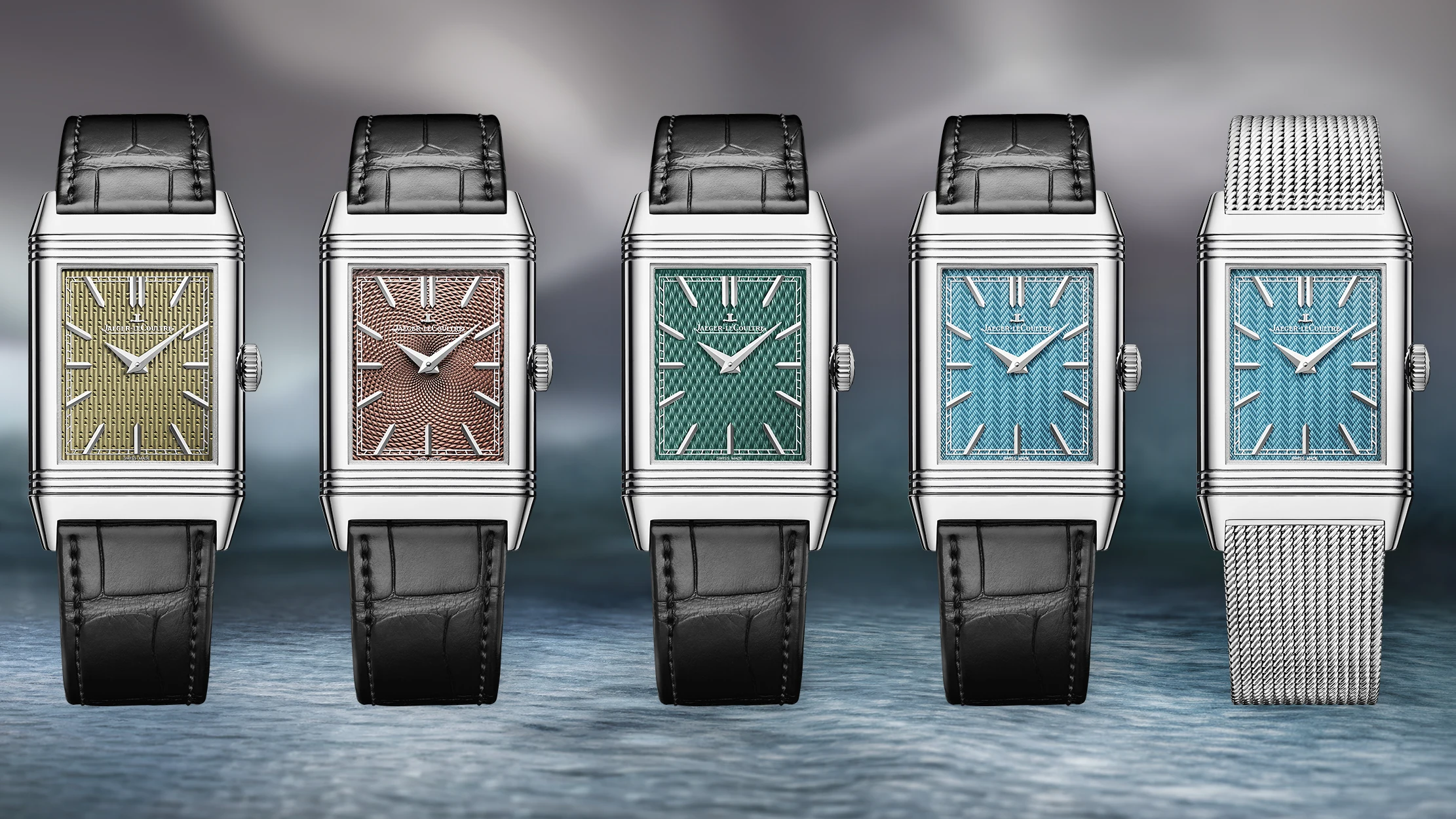
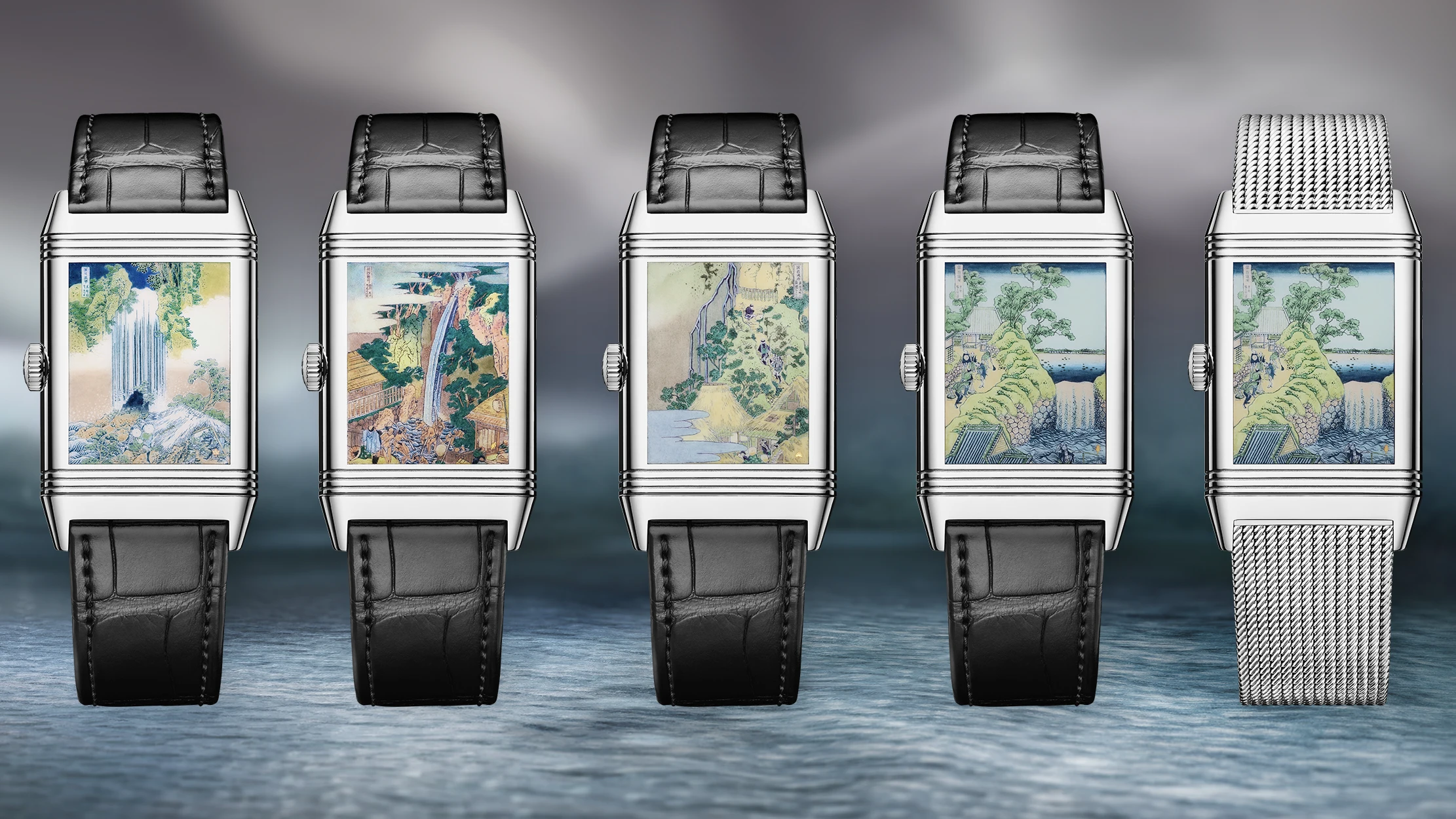
Hokusai’s work occupies a pivotal position in the history of art, not least for his role in bridging Eastern and Western artistic traditions. His adoption of Prussian blue, a synthetic pigment developed in 18th-century Europe and introduced to Japan in the early 19th century, marked a turning point in ukiyo-e (still life), enabling unprecedented depth and intensity in the depiction of natural elements such as water.
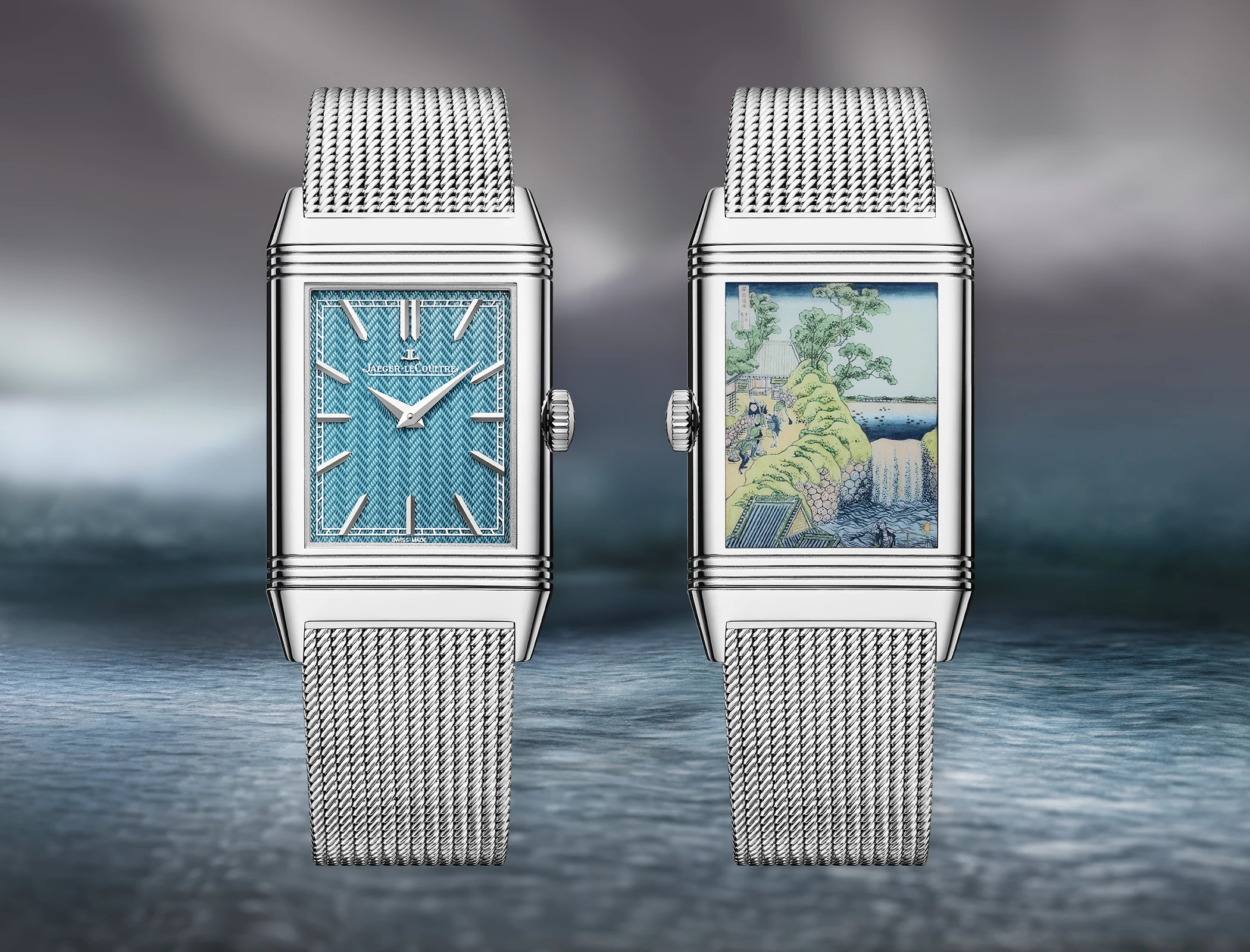
Each of the four new Reverso Tribute Enamel models reproduces one of the final works from Hokusai’s ‘A Tour of the Waterfalls of the Provinces’, translating compositions originally created for woodblock printing into miniature enamel paintings measuring approximately 2 cm squared. The process requires a minimum of 14 layers of enamel, each fired individually at around 800°C, with a total execution time of approximately 80 hours per piece.
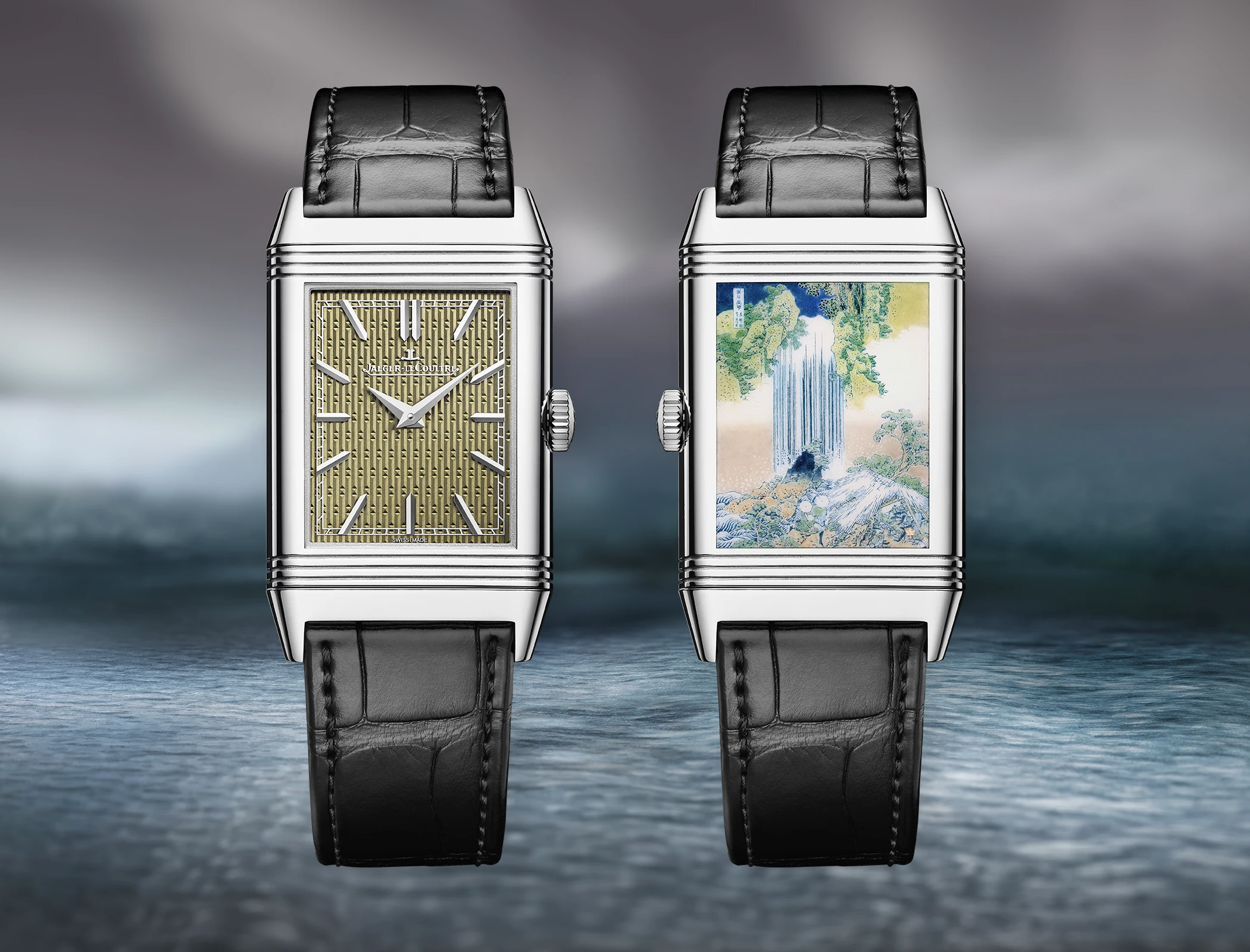
Beyond colour reproduction, the challenge lies in translating Hokusai’s printing techniques, including the bokashi gradient effect, into enamel. Even the original Japanese inscriptions are reproduced in miniature, remaining legible despite the scale.
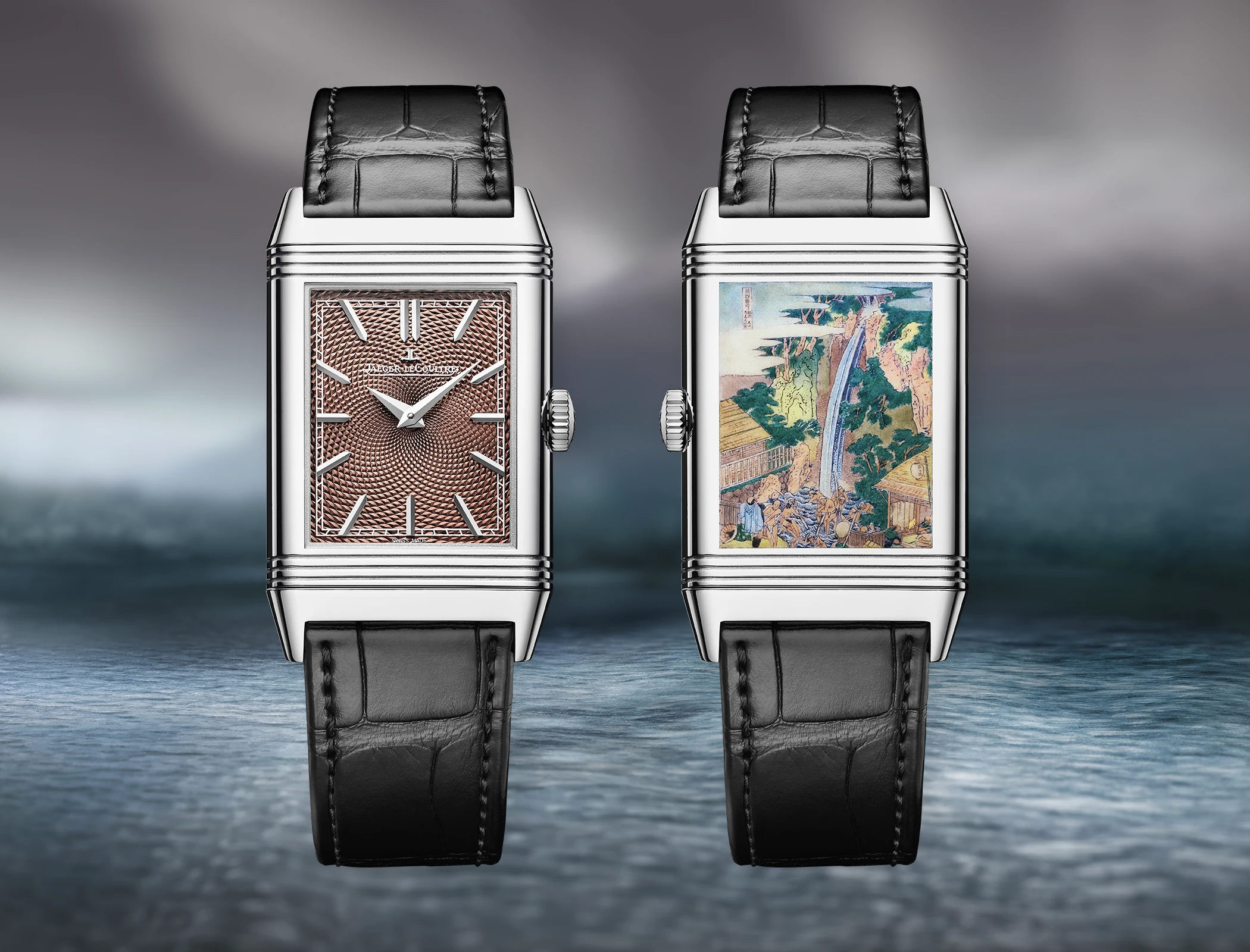
On the front, each watch features a hand-guilloché dial, with patterns ranging from barleycorn to herringbone, requiring between 144 and 360 passes of the rose-engine lathe. These are coated with multiple layers of translucent enamel, creating depth while maintaining legibility through applied hour markers, Dauphine hands and a chemin-de-fer minute track.
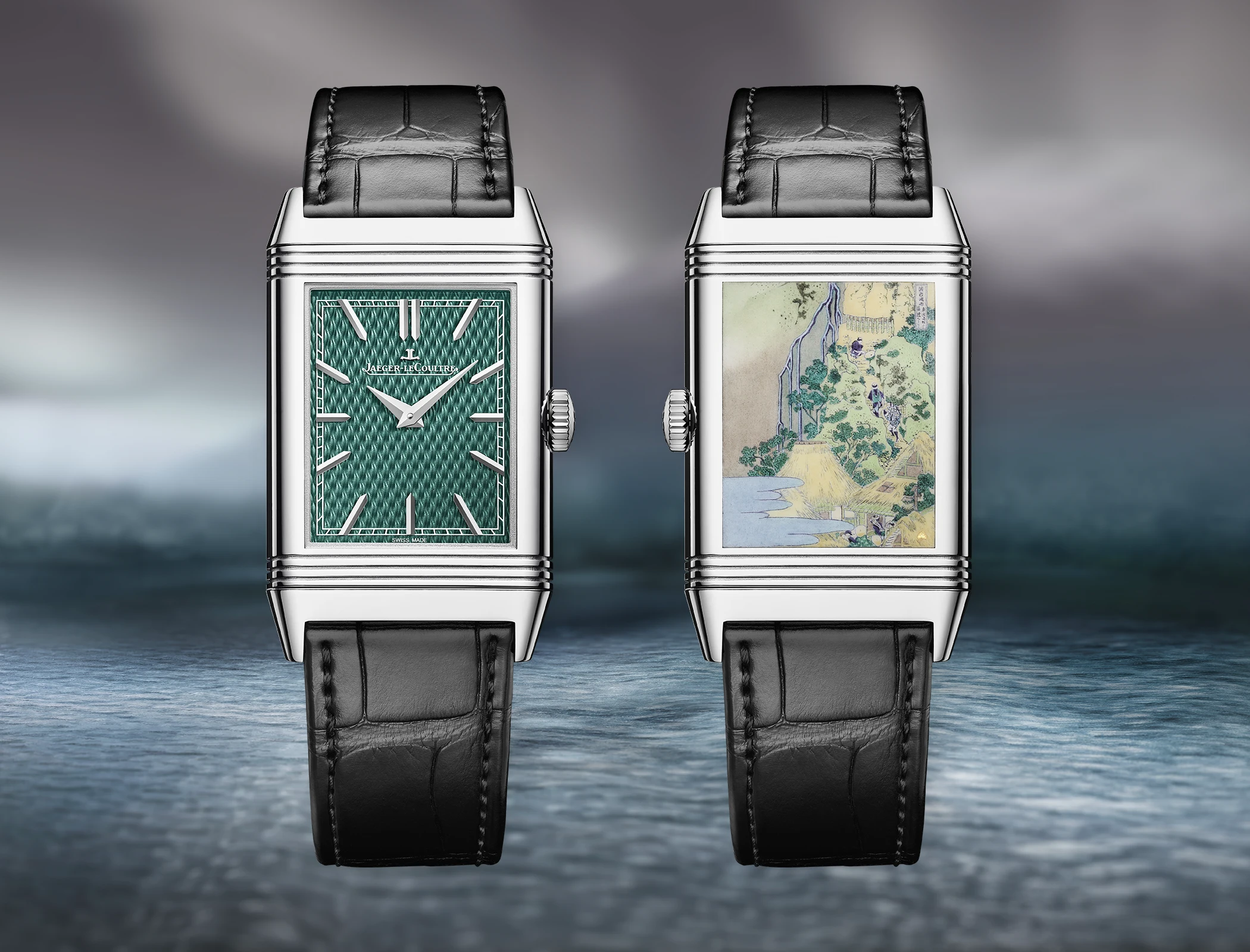
The watches are housed in 18-carat white gold cases measuring 45.6 mm by 27.4 mm with a thickness of 9.73 mm, and are powered by the manually wound Calibre 822. Measuring just 2.94 mm in height, the movement operates at a frequency of 3 Hz and delivers a 42-hour power reserve, ensuring both compactness and reliability. Each model is produced in a limited edition of 10 pieces and may be paired with either a black alligator strap or an 18-carat white gold Milanese bracelet.
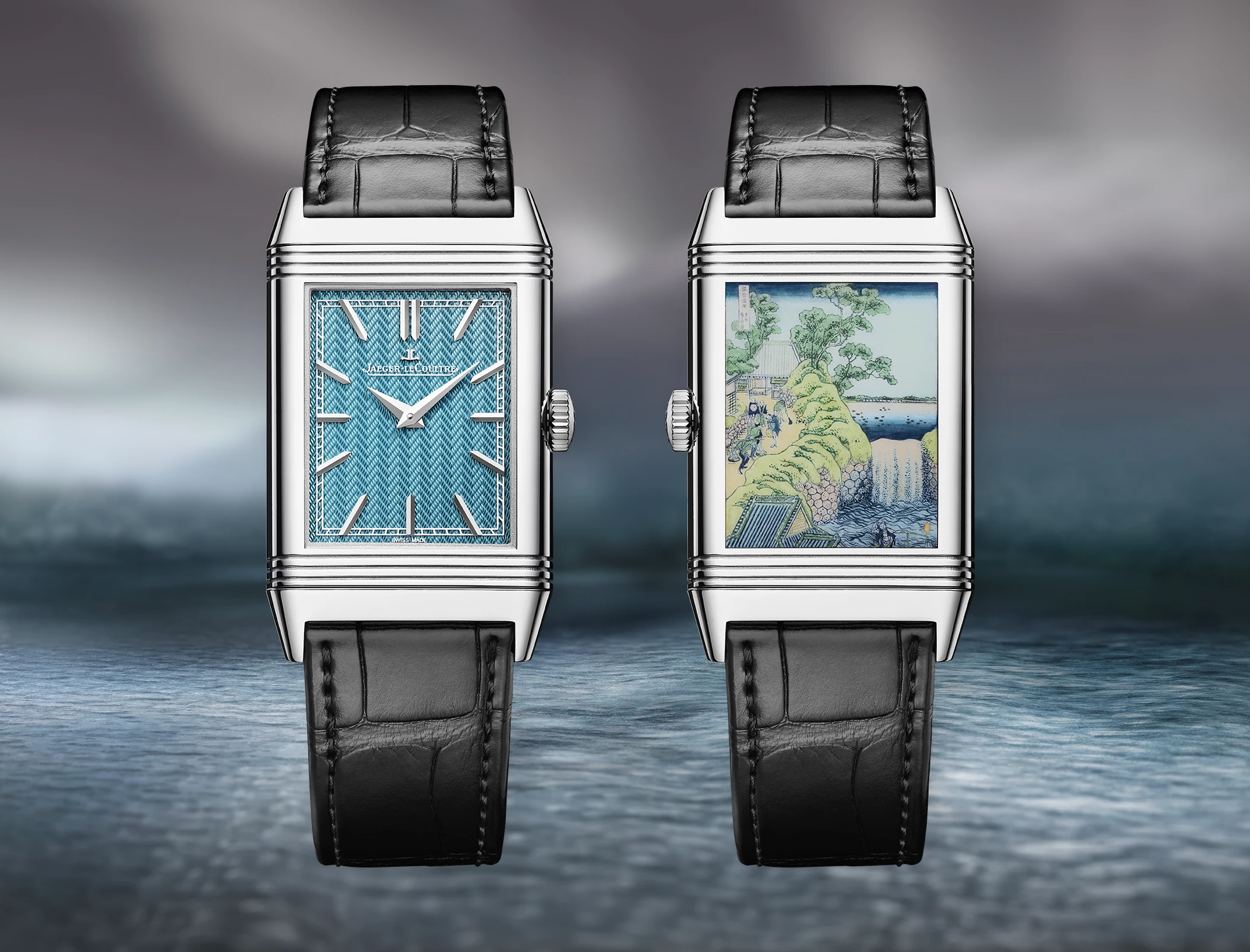
Taken together, the Jaeger-LeCoultre Reverso Métiers Rares 2026 collections demonstrate that precision at Jaeger-LeCoultre extends far beyond mechanical timekeeping. Whether in the measurement of components, the control of enamel during firing, or the placement of gemstones across curved surfaces, the same principle applies: the pursuit of exactness in processes that resist complete predictability.
In this special context, the Reverso becomes more than a functional design. It serves as a platform through which the manufacture can continue to explore the intersection of art and technique, reflecting a broader understanding of watchmaking in which aesthetics and mechanics are not separate disciplines, but parallel expressions of the same underlying pursuit.
As JLC continues to evolve its Métiers Rares programme through initiatives such as La Vallée des Merveilles, and we bid a sad farewell to the Hokusai series, it reinforces a central idea that has shaped its development since the 19th century: that precision is not limited to what can be measured, but also encompasses what can be controlled, refined and ultimately mastered by artisans.