100 years of the Panerai boutique in Florence: Discover the brand’s history, the ‘Immersion’ exhibition and its horological heritage.

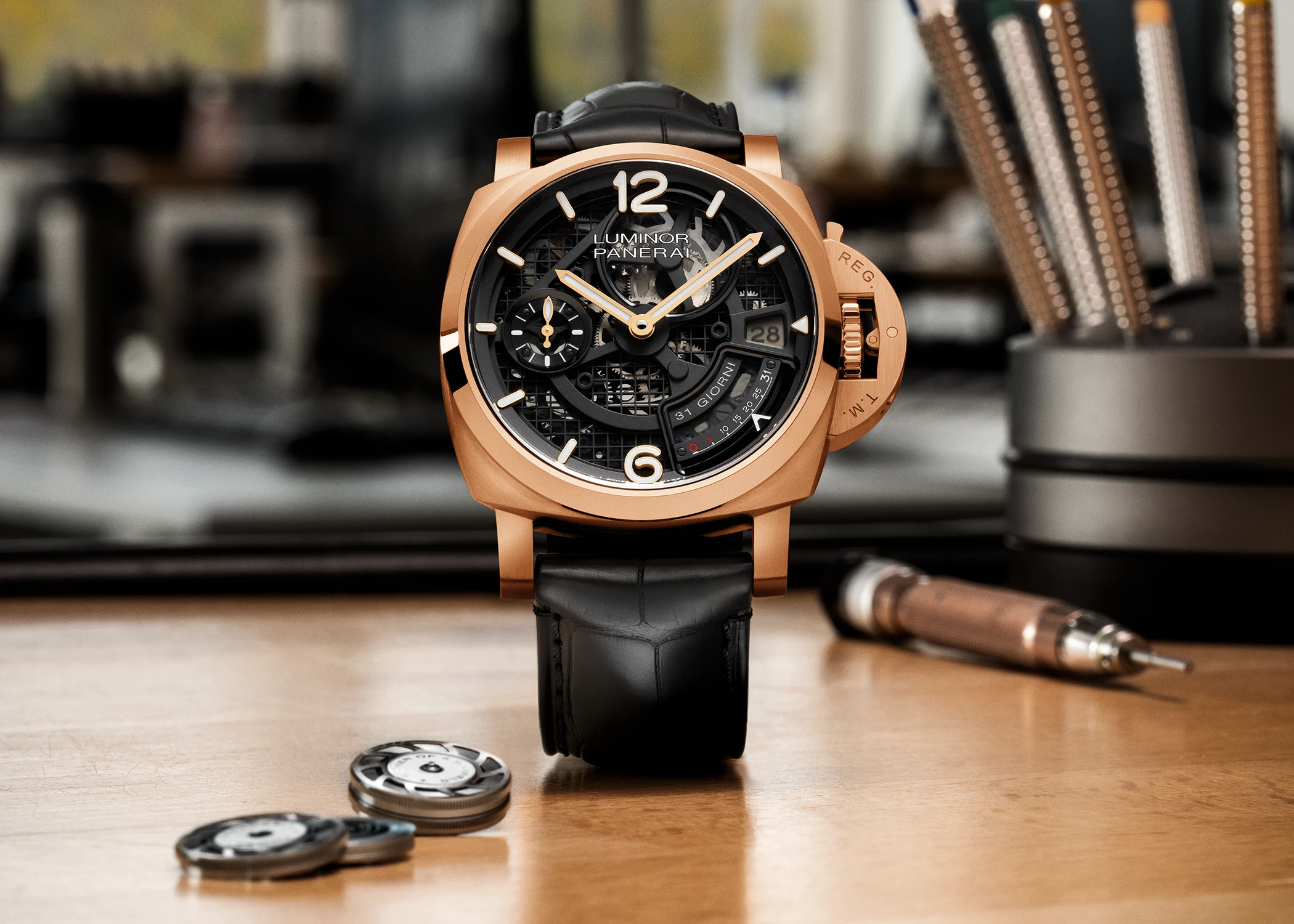
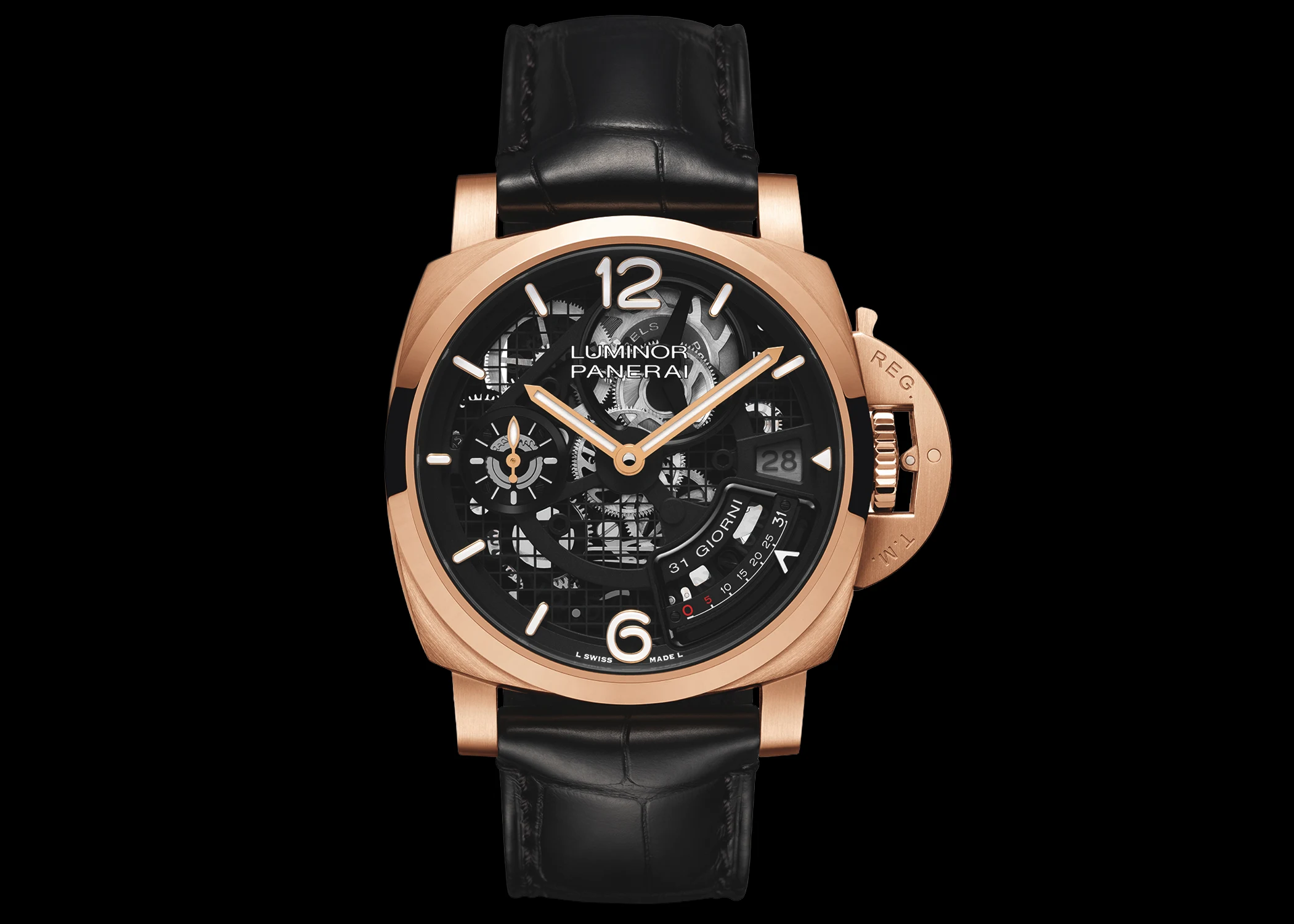
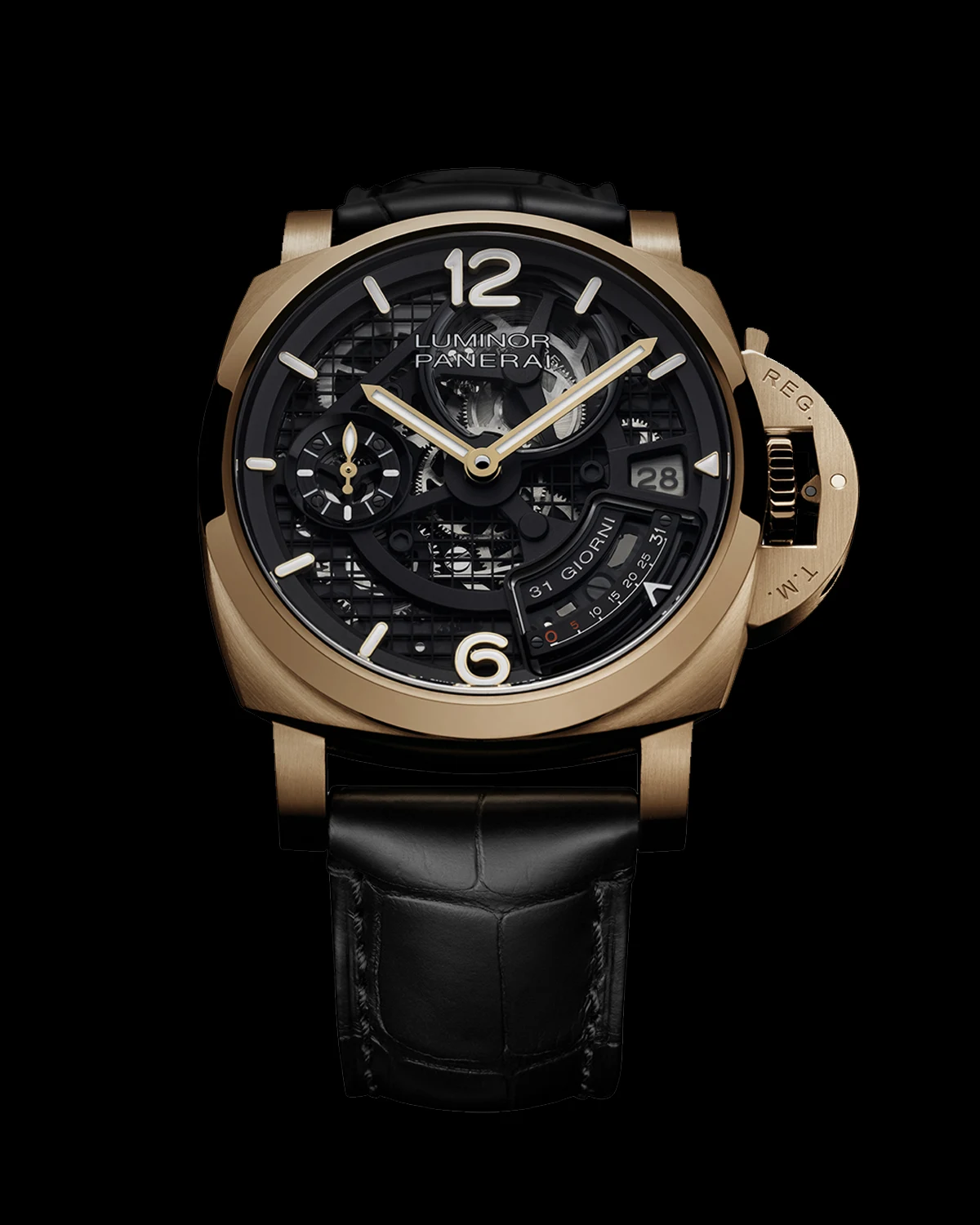
With the PAM1631, limited to 200 pieces, Panerai has unveiled a watch boasting a sensational power reserve of 31 days. How did the manufacturer achieve this despite the compact 44-millimetre case? And how does the technology of the PAM1631 differ from that of its long-runner rivals?
For Panerai, a long power reserve is not simply a complication through which the brand seeks to demonstrate its expertise in watchmaking. Long-running watches have been part of the brand’s history from an early stage, and for functional reasons.
Originally developed for Italian combat swimmers, Panerai’s watches were defined by their function as early as the 1930s: water resistance, legibility, accuracy and robustness. These were the key characteristics the watches had to possess in order to fulfil their purpose as effectively as possible in the field.
Panerai developed a number of innovations to enhance these characteristics, such as the sandwich dial to accommodate more luminous material, its own luminous paints to improve legibility, and the patented crown guard, which improved water resistance.
To improve accuracy, Rolex pocket watch movements from Cortébert were used, which kept time much more precisely than small wristwatch movements. At Panerai’s request, the power reserve was later extended by six hours to a maximum of 46 hours.
A major step forward came with the Angelus SF 240 table clock calibre, introduced in 1955: it featured an unusually long power reserve of eight days. This meant that combat swimmers did not have to wind their watches during a mission, and the infrequent need to wind them protected the crown seals, thereby contributing to long-lasting water resistance. A long-running movement thus enhanced the functionality of the tool watch at that time. The small seconds at nine o’clock, dictated by the Angelus movement, also became a signature design feature that continues to characterise Panerai to this day.
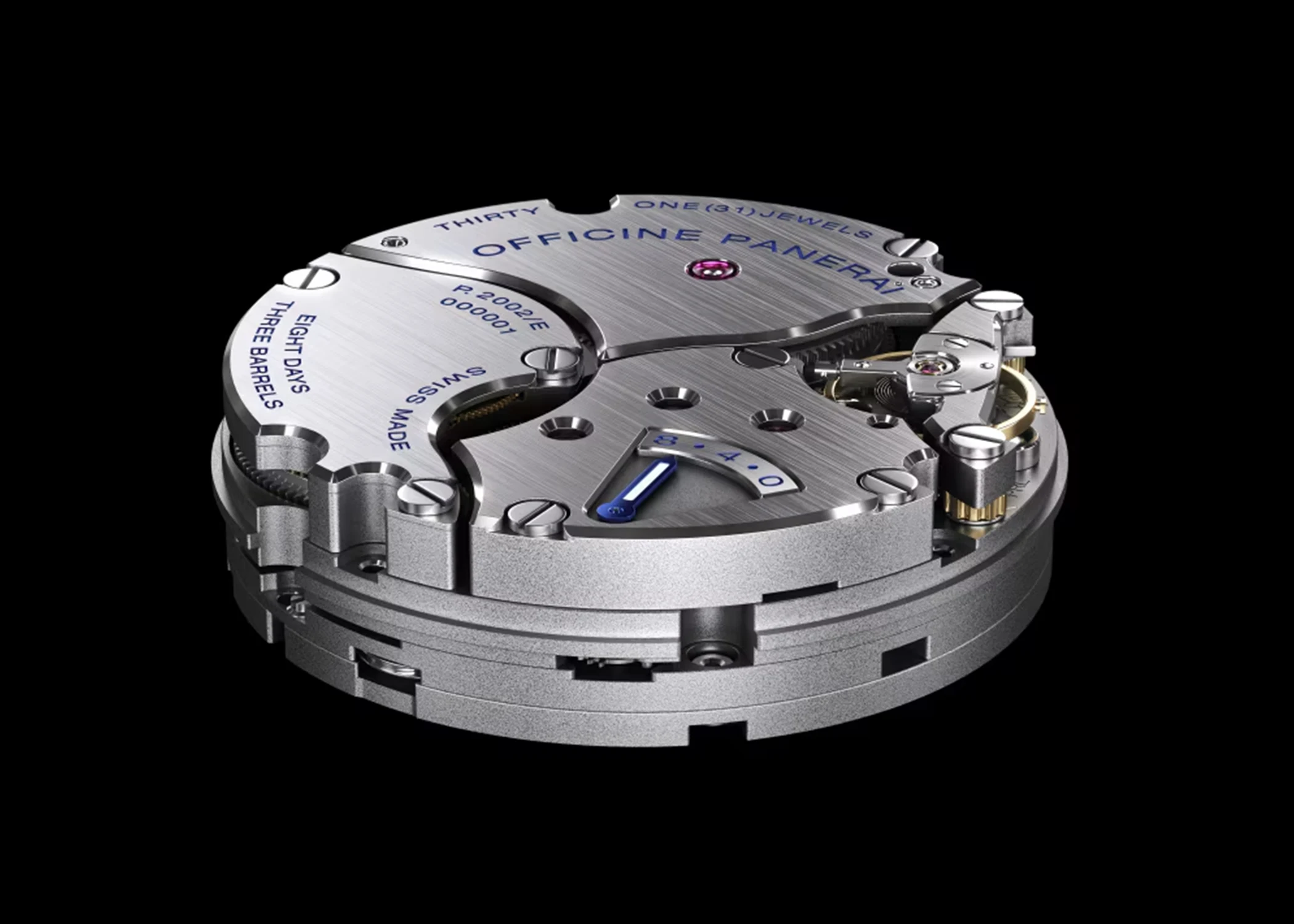
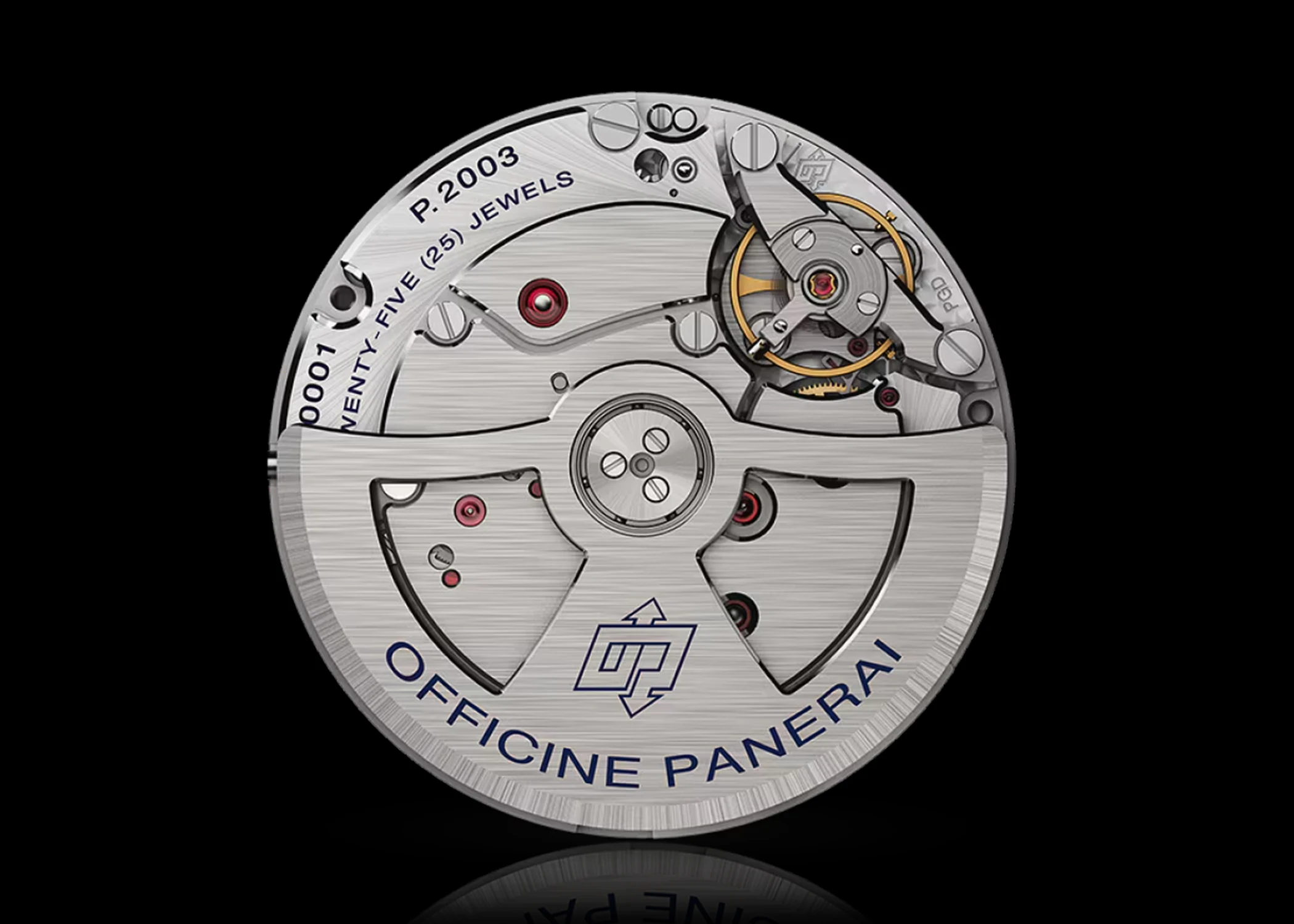
Panerai has also continued the tradition of long-running movements in more recent history: in 2005, the manufacture developed the P.2002, a hand-wound movement with an eight-day power reserve and a patented design featuring three mainspring barrels. In 2007, the brand followed this up with the P.2003: this automatic calibre achieved a power reserve of ten days.
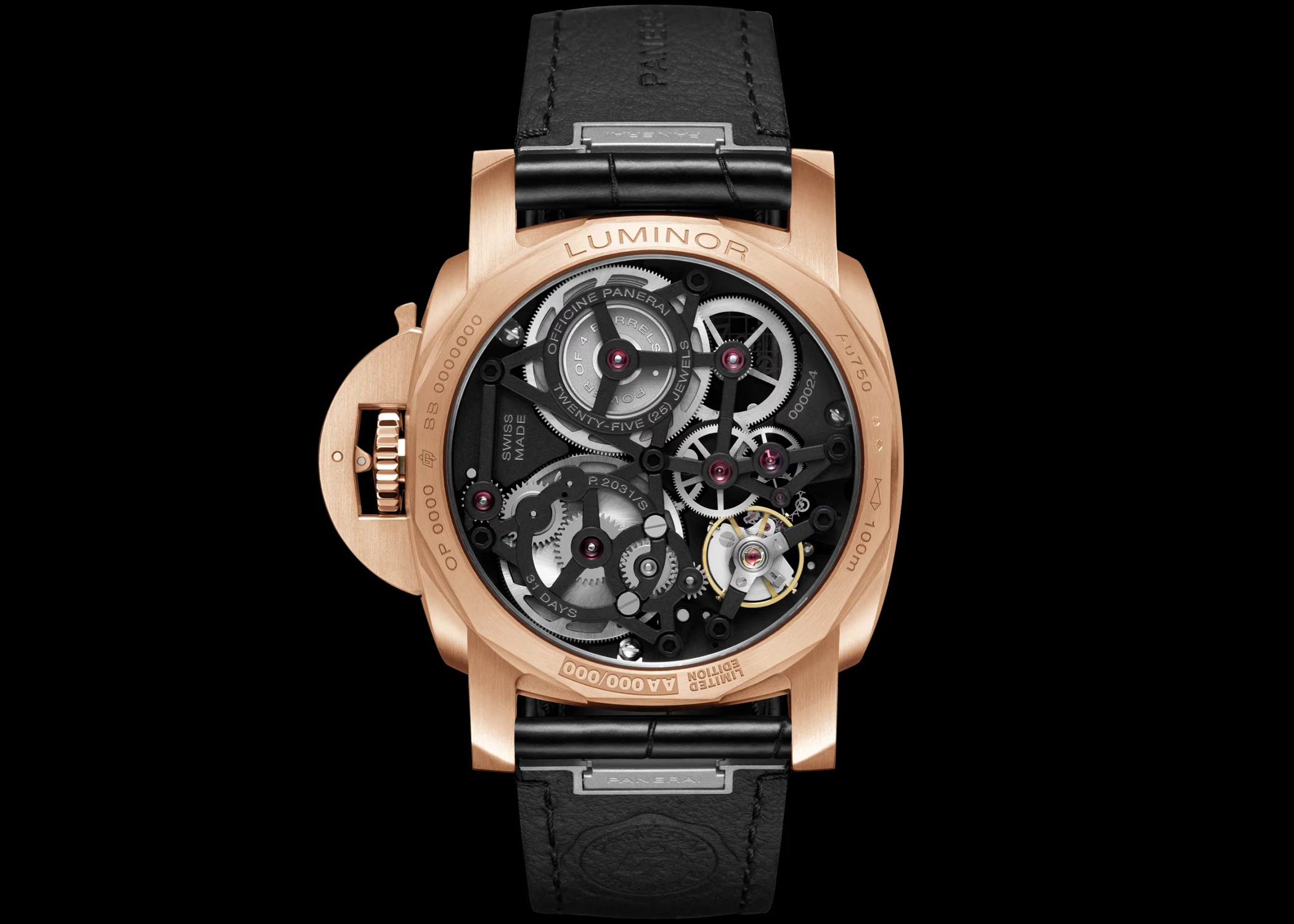
This year, Panerai is unveiling the Luminor 31 Giorni, a watch with a spectacular power reserve of 31 days.
It took seven years of development work and a number of innovations to design a movement that fits into a 44-millimetre case: a 16-ligne movement measuring 10.06 millimetres in height. The skeletonised hand-wound calibre P.2031/S comprises 276 components and 25 jewels.
A standard mainspring barrel stores energy for around 48 hours, or two days. To cover 31 days, you would therefore need 15.5 mainsprings – effectively 16, as you cannot fit half a mainspring. However, 16 mainsprings simply won’t fit into a wristwatch. How do you solve this space problem?
The same amount of energy can also be stored by housing a single long mainspring in one mainspring barrel, rather than many short mainsprings in separate barrels. Instead of 16 springs, each 25 centimetres long, one could wind a single spring 3.875 metres long, which is equivalent to 15.5 times 25 centimetres. This saves the space of 15 mainspring barrels; although the single mainspring barrel for the long spring is naturally larger than a normal one, it is not 15.5 times as large.
The problem with this is that, whilst mainsprings connected in series have the same torque as a single mainspring, the torque of a single long mainspring increases with every additional coil. There is therefore a world of difference between the initial and final torque.
You can think of it like water stored in several one-metre-deep tanks connected by pipes: the pressure at the outlet never exceeds one metre. If, instead, you build a single, 16-metre-deep tank of the same diameter, there will initially be 16 metres of water pressure at the outlet. This would require significantly sturdier pipes.
One way to reduce overall energy consumption is to lower the beat rate. Panerai has reduced this to 21,600 vibrations per hour, instead of the 28,800 that is standard today. This is acceptable. Even slower frequencies would make the watch more susceptible to movement and cause timing deviations when worn on the wrist.
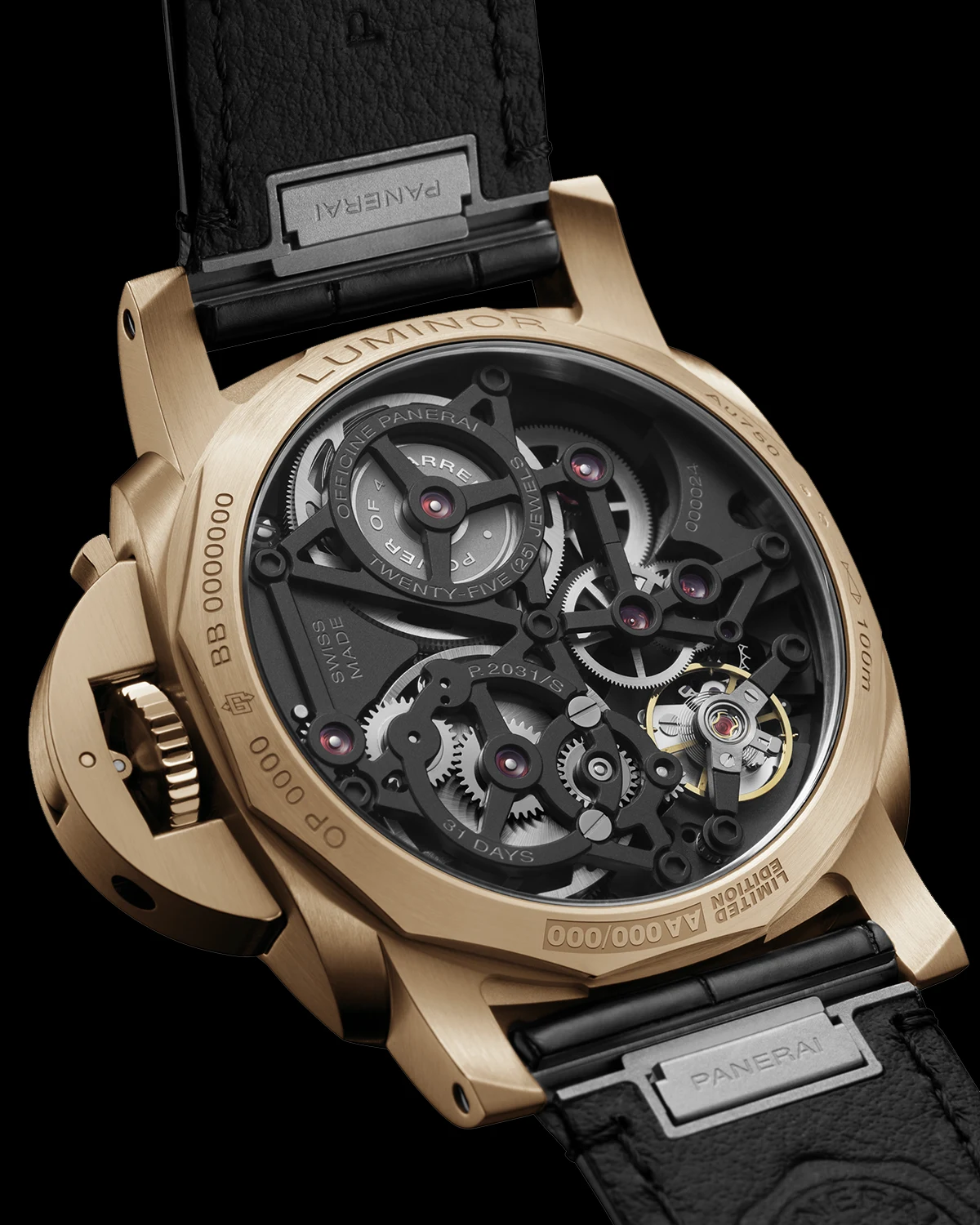
Panerai therefore requires a total length of mainsprings of 3.3 metres. The brand distributes these across four barrels connected in series, which already reduces the maximum torque. However, that alone is not enough.
The fundamental weakness of long-running watches remains: their power fluctuates particularly sharply between the start and end of the power reserve. During these phases, this would result in an excessively strong or weak impulse on the balance wheel, leading to a large or small amplitude of oscillation. The consequence would be a significant deviation in timekeeping. Furthermore, the high forces within the movement would lead to increased wear and tear.
Panerai additionally addresses this problem with two innovative, patent-pending mechanisms that manage the two extremes of torque. The watch’s theoretical power reserve is 36 days, but two mechanical mechanisms ensure that only the 31 days with a relatively constant torque are utilised: the days with the highest torque are avoided by the torque limiter, and as the power diminishes, the watch stops after 31 days rather than continuing to run inaccurately.
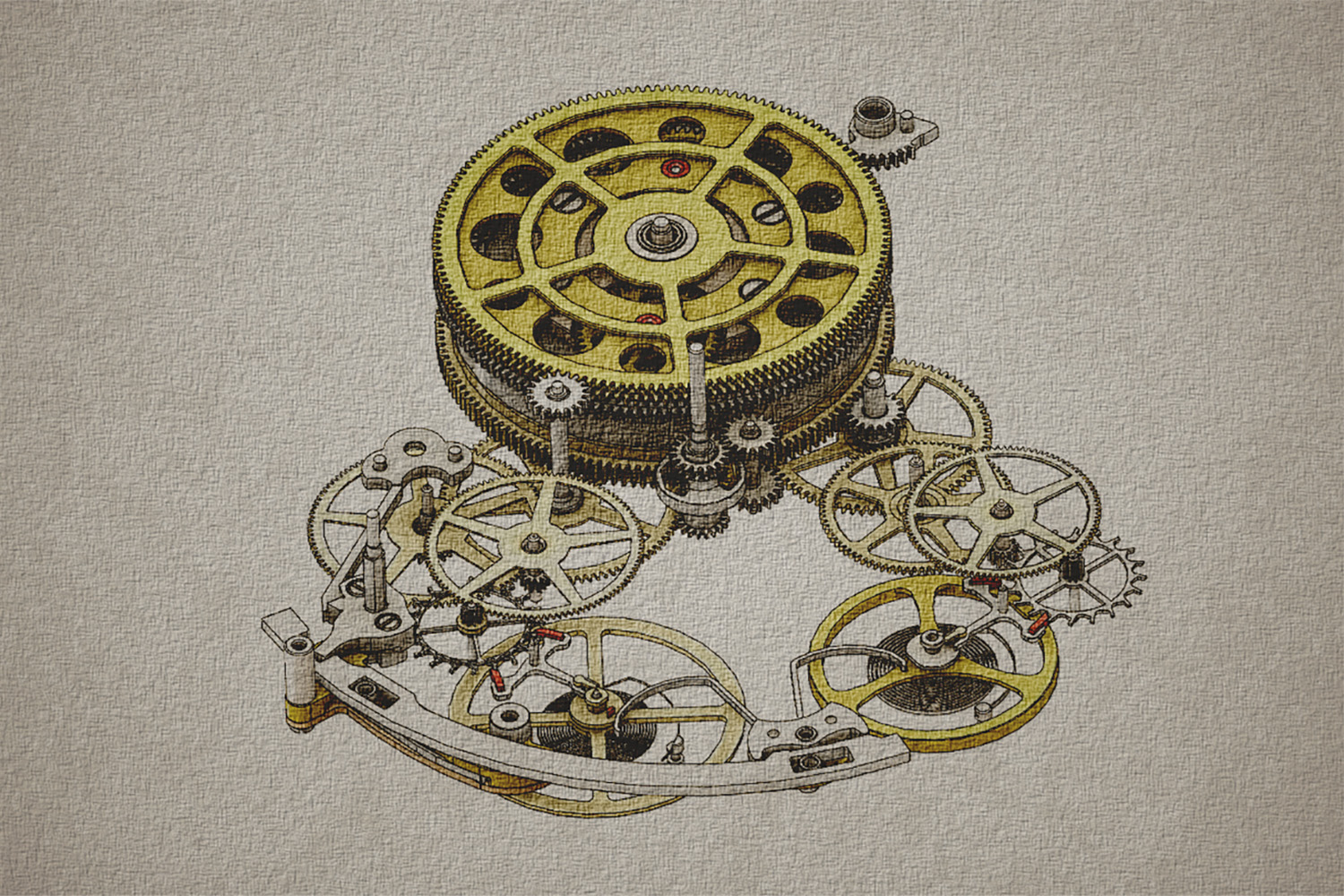
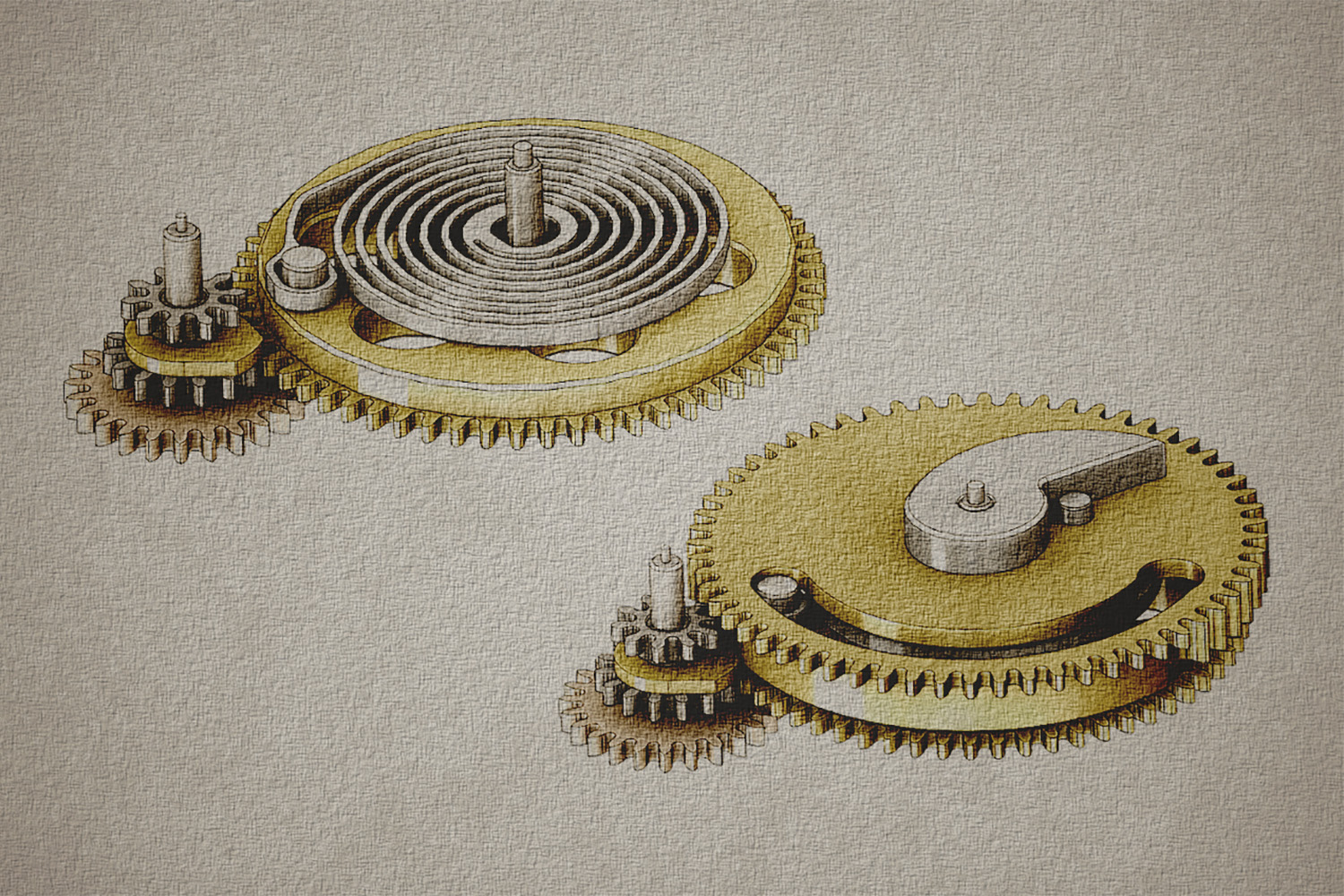
The torque limiter is situated between the lift shaft and the ratchet wheel. There is a wheel there which is actually made up of two wheels. The first wheel is rigidly connected to a tube. Inside this tube, a shaft rotates on which the second wheel is mounted. Initially, the two are only loosely connected to one another. The connection is established by several identical coupling elements, which lie stacked one on top of the other inside the tube like discs. Each element is positively locked onto the shaft from the inside and has two spring-loaded arms on the outside. The ends of these arms engage in notches on the inner wall of the tube.
As long as the torque during winding remains below a certain value, the arms remain in their notches and both wheels turn together. The spring is wound. If the torque exceeds the threshold, the arms bend far enough to pop out of the notches. The two wheels disengage, and the winding mechanism runs freely. It is not possible to wind it any further. In this way, the mainspring is wound only up to a certain torque and, consequently, cannot transmit any greater force to the gear train. The system also protects the gear train, as it reduces the forces acting on it and thus minimises wear.
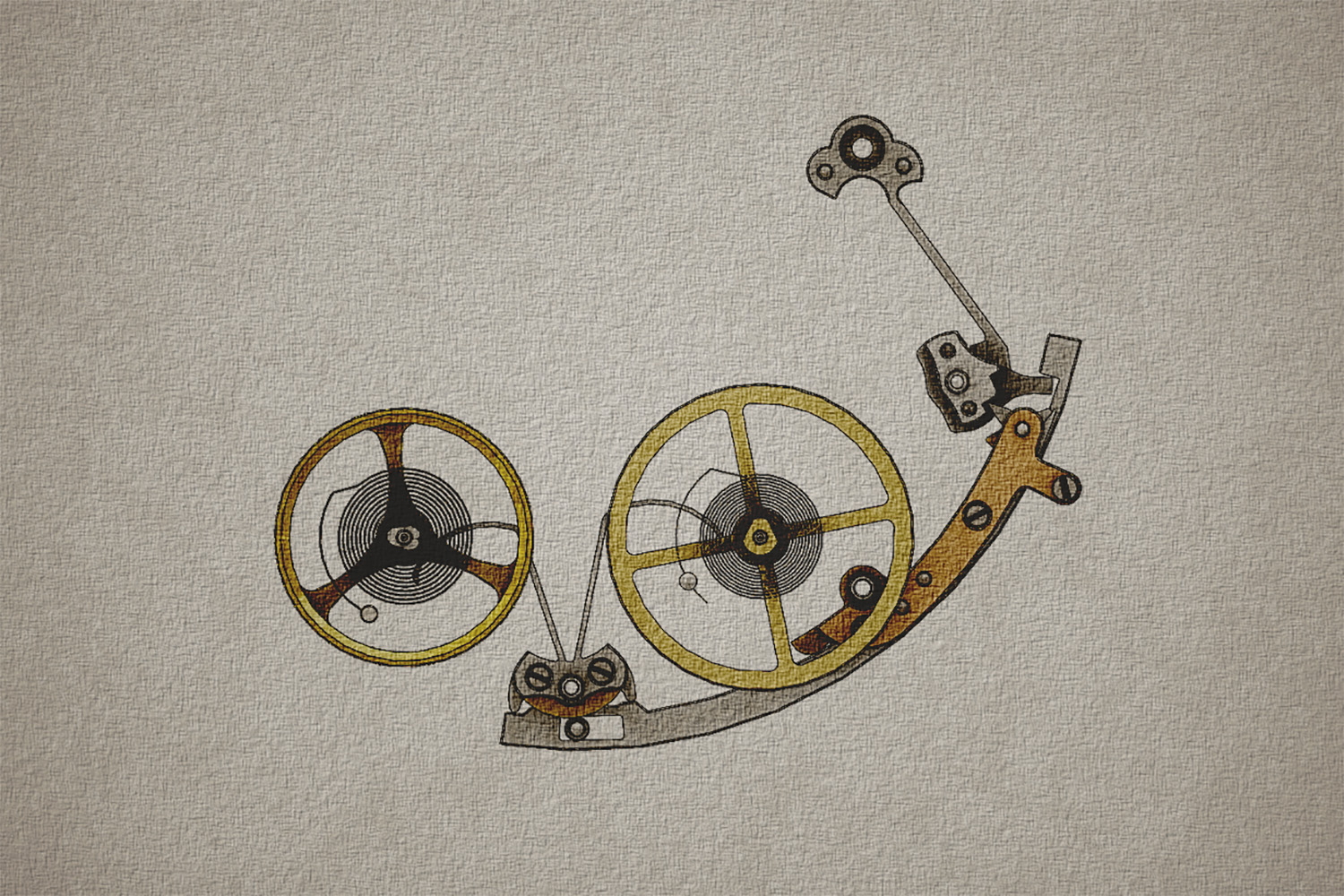
What is still missing is the mechanism that prevents the rate accuracy from deteriorating at the end of the power reserve. This is located in the power reserve and uses the seconds stop to halt the balance: the power reserve mechanism with differential controls a rack that follows a curved path and carries the power reserve hand. A pin is mounted on this rack. If the power reserve falls below a defined value, this pin strikes a lug located at the end of a spring-loaded arm.
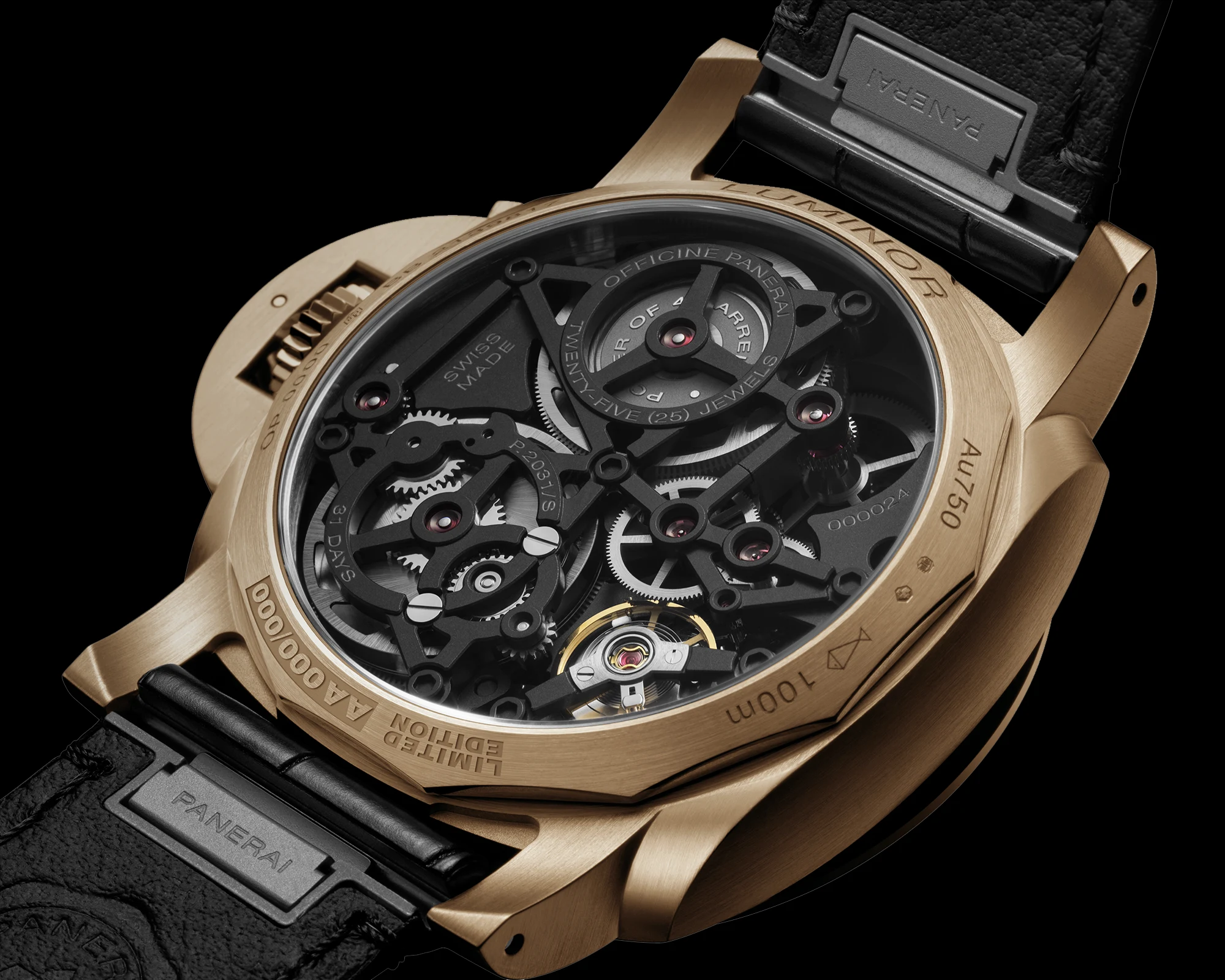
This arm forms part of a two-armed spring fork mounted on a rocker. The actual brake block is attached to the other arm of the fork: a pin with a domed head that protrudes from below through a slot in the circuit board and can press against the balance wheel. So, in principle, it acts as a second-stop mechanism.
The mechanism is interesting. The tab has a sloping flank followed by a flat end face. As the pin moves up the slope, it bends the arm away and, at the same time, tensions a second spring via a stop, which applies force to the rocker. At this point, the tab is still holding the rocker back. As soon as the pin crosses the transition from the sloping surface to the flat surface, the nose releases the arm, the tensioned spring snaps the rocker arm round, and the brake strikes the balance wheel abruptly.

Our Boutique Travel Guide shows you how to combine your visit to the Panerai Boutique in Stuttgart with the city’s finest attractions.
This rapid movement is necessary to prevent the brake from approaching slowly, rubbing against the balance wheel and thus affecting the accuracy of the watch before the balance wheel comes to a halt.
When winding, the movement runs backwards; the brake is retracted just as abruptly, and the watch starts running again. The mechanism can also be triggered via the winding shaft – that is, via the lever when the crown is pulled out. This also provides a classic stop-seconds function. 128 turns of the crown ensure full winding and a 31-day power reserve.
The Luminor 31 Giorni is not the first watch to boast such a long running power reserve. A. Lange & Söhne, Vacheron Constantin and Hublot have also achieved this. It is therefore worth looking beyond the obvious. What distinguishes them technically from the Panerai?
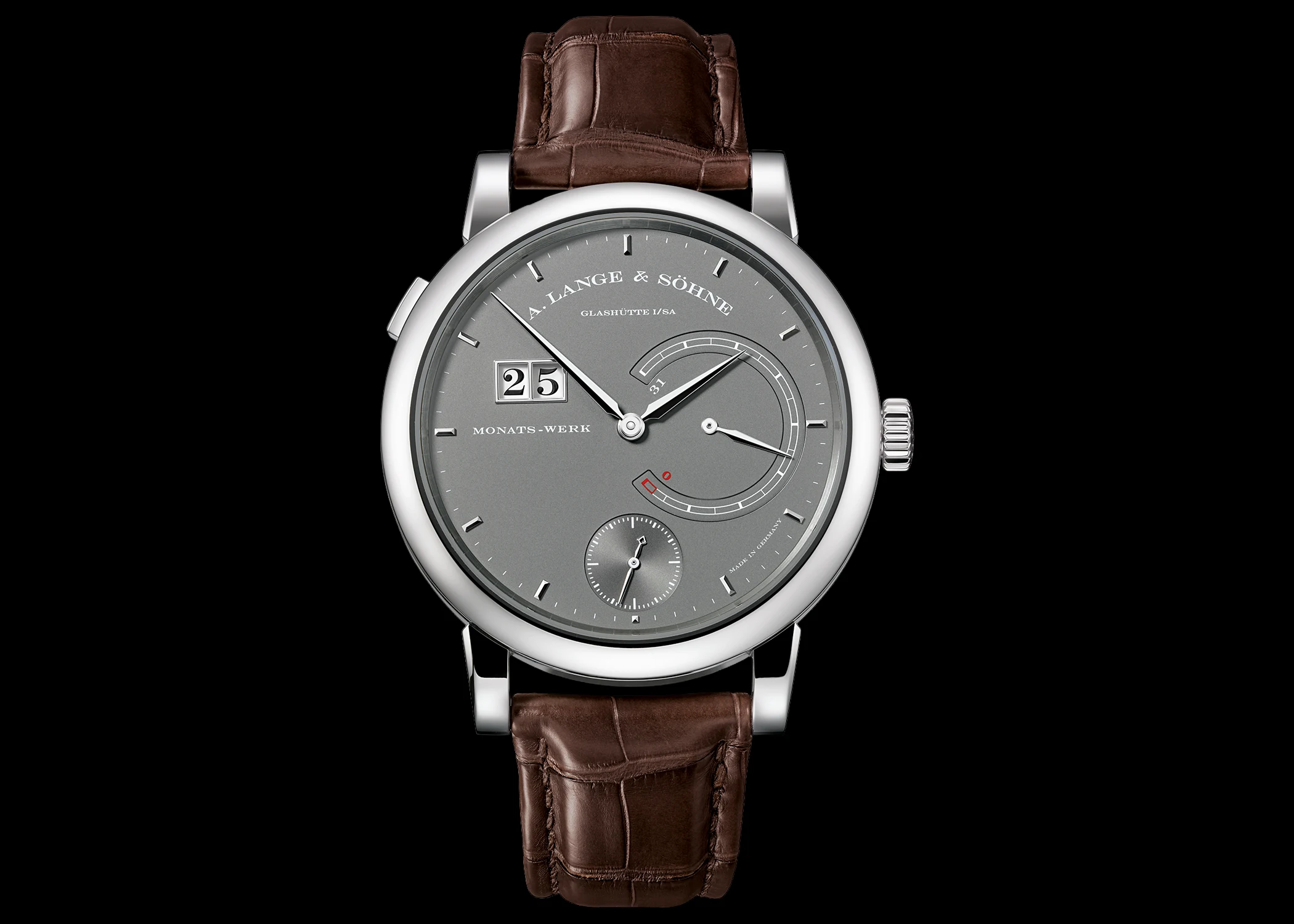
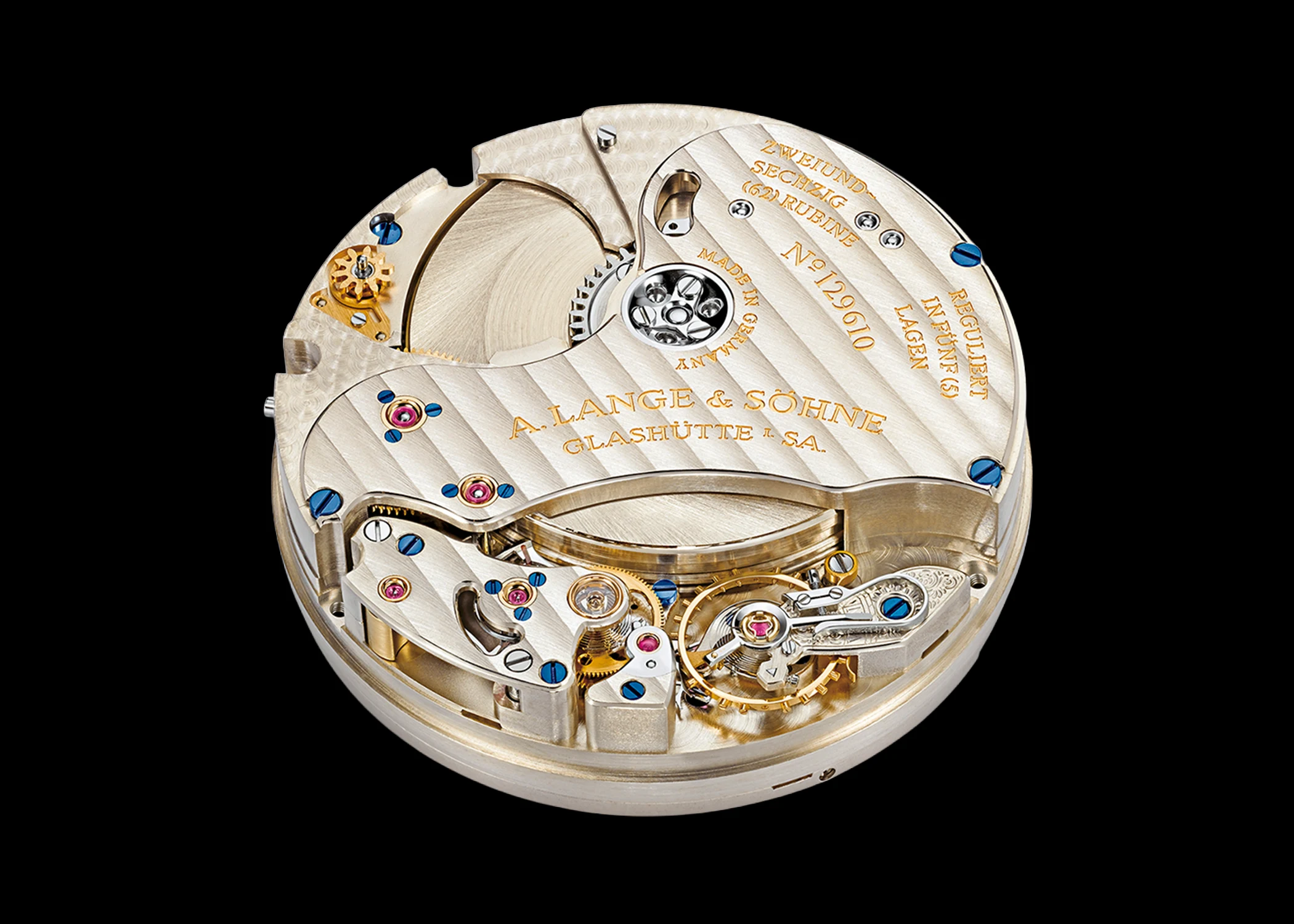
The Lange 31, launched in 2007, is slightly larger than the Luminor 31 Giorni at 45.9 millimetres. The Calibre L034.1 comprises 406 individual components, including 62 jewels – significantly more than the Luminor 31 Giorni – but is slightly thinner at 9.6 millimetres in height. The mainsprings in the two barrels are longer, with a total length of 3.7 metres. To wind the watch, a key is required for the square socket fitted to the case back.
To maintain a constant torque, Lange uses a re-tensioning mechanism. This inserts a constant buffer between the components. Think of it like this: instead of connecting the escapement directly to the large, faltering water tank – that is, the double spring barrel – there is a small measuring cup. This is always filled to exactly the same mark and empties in ten seconds. Whether the large tank is brimming or almost empty makes no difference to the cup; the portion remains the same.
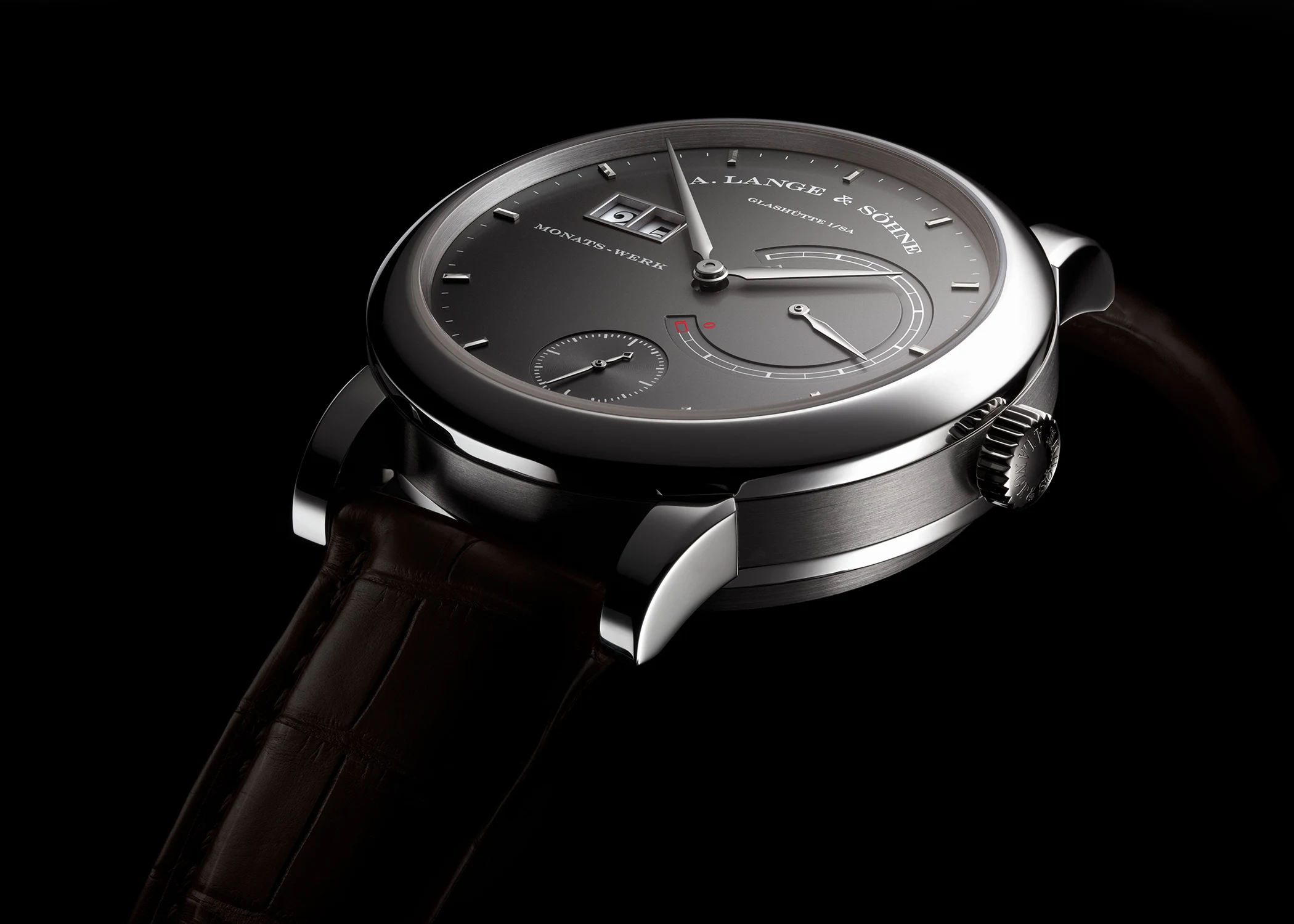
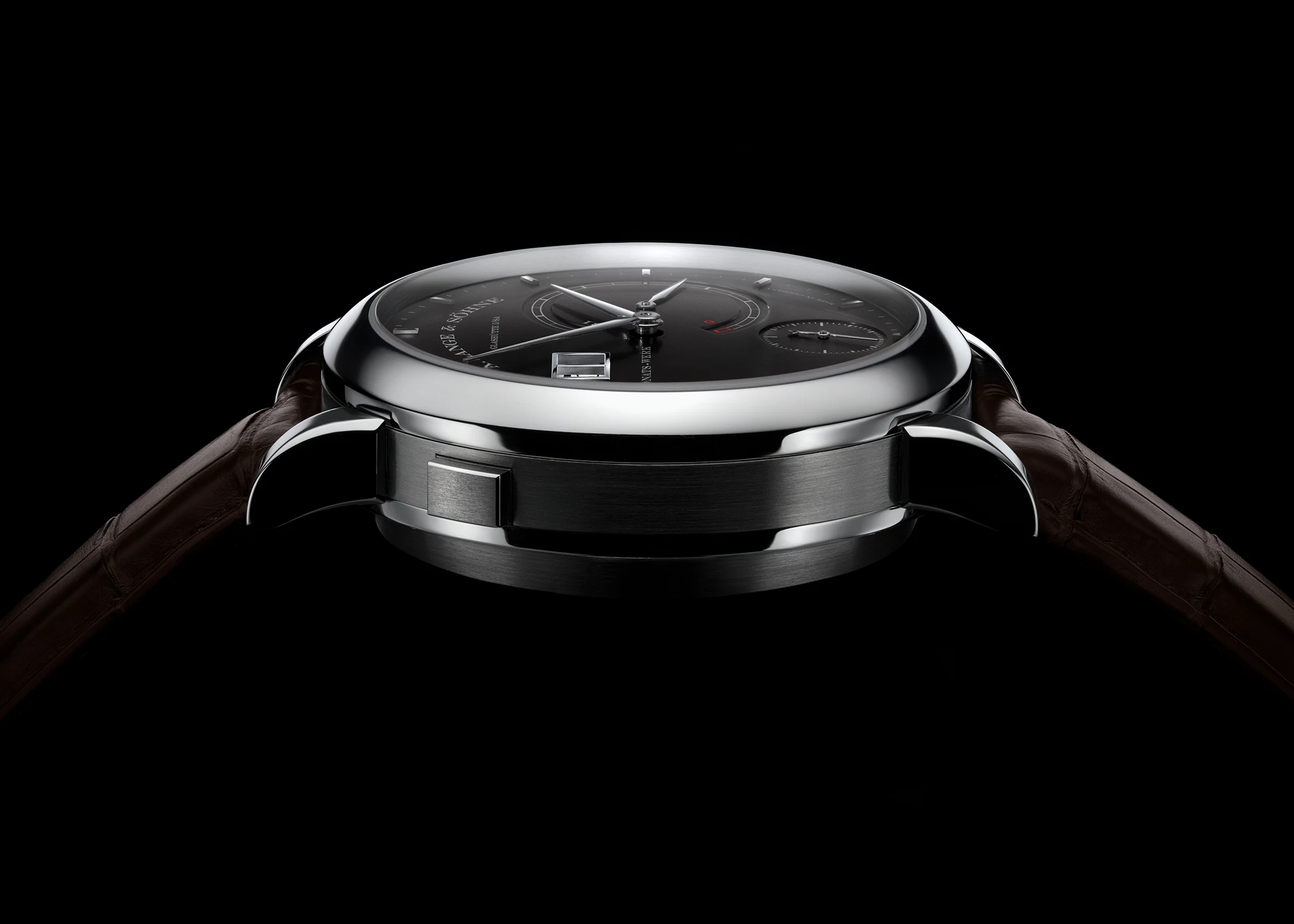
The measuring cup is a small auxiliary spiral on the seconds wheel shaft. It is this, not the mainspring, that drives the escape wheel. Over a period of ten seconds, it unwinds by just 60 degrees. Over such a tiny section of its characteristic curve, the force is practically constant. This is synchronised by the balance wheel itself: It regulates the seconds shaft, and mounted on that shaft is the Reuleaux triangle, a cam disc with curved sides. After every 60-degree rotation, it actuates the swivel lever. The lever functions like a second escapement: two pallets alternately release a wheel with just a single tooth, which is connected to the mainspring barrel. It rotates 180 degrees, winds the auxiliary spring in a flash, and is then locked again.
The result: consistent energy, consistent amplitude, consistent accuracy, for 31 days. After that, as with Panerai, a shut-off mechanism kicks in because the residual force of the mainspring would fall below the torque of the auxiliary spring: it would then no longer be able to wind it reliably.
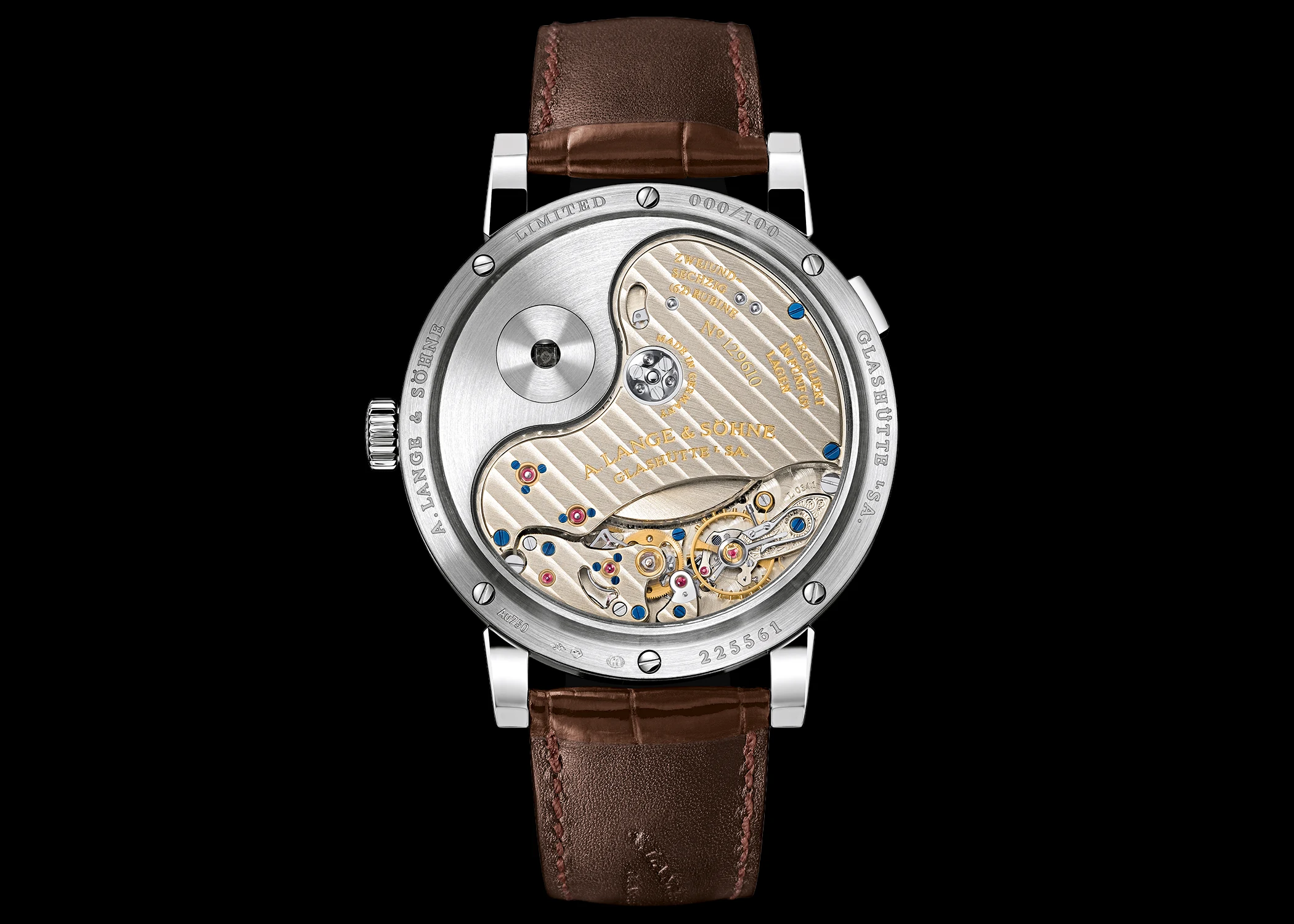
Through the sapphire crystal caseback, you can watch the interplay between the triangle and the swivel lever in action: a visible jerk every ten seconds.
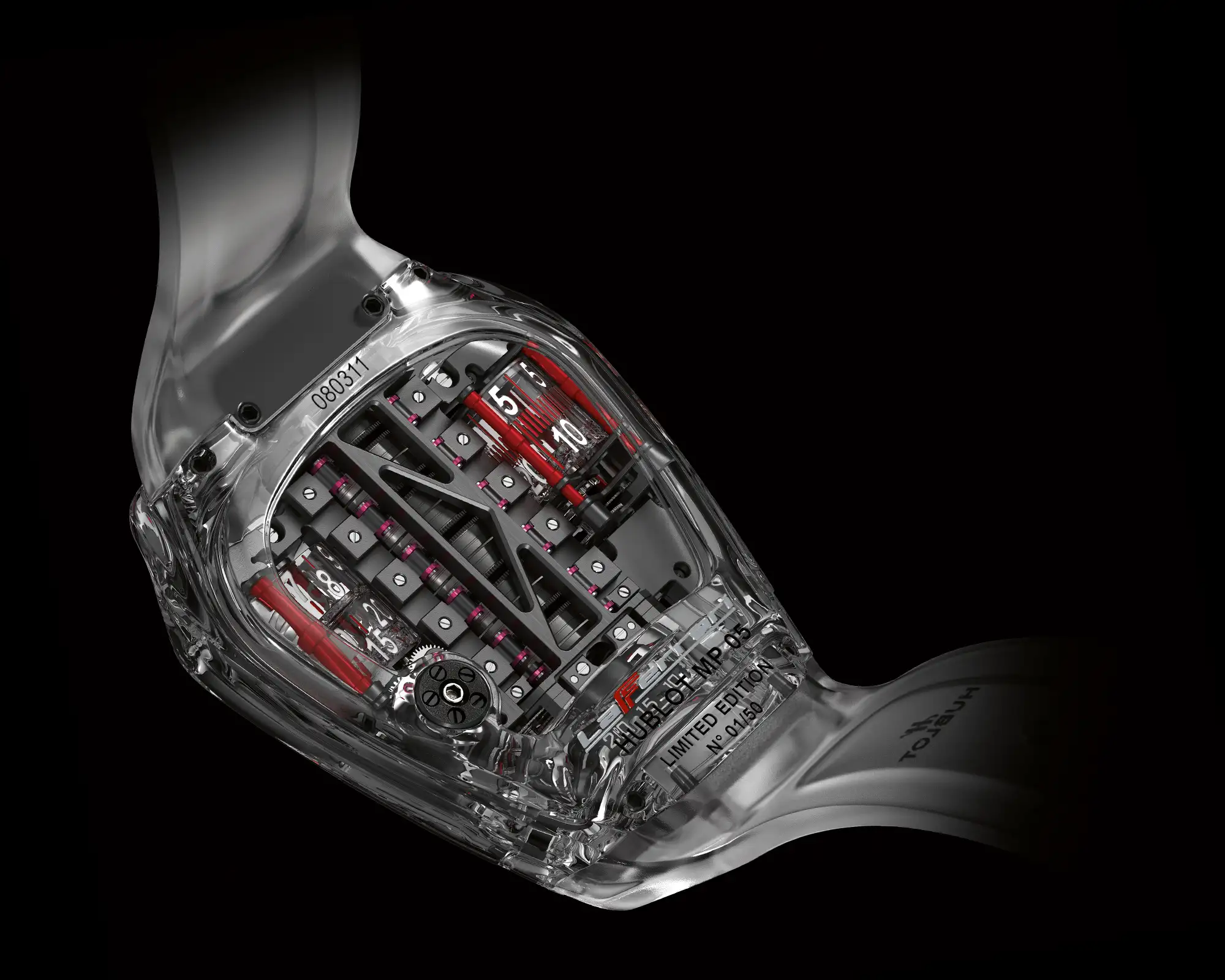
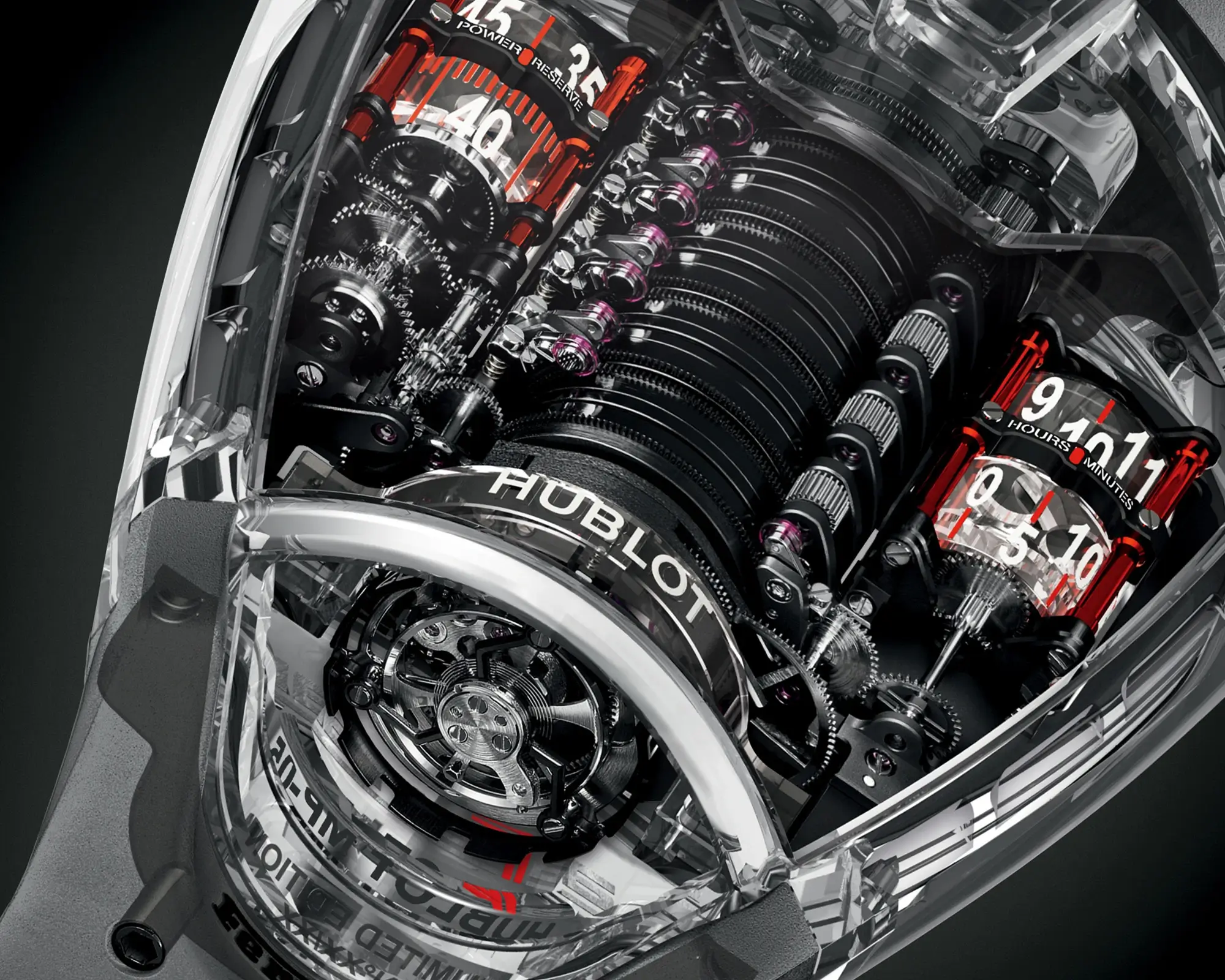
In 2013, Hublot raised the bar even higher: the MP-05 LaFerrari lasts for 50 days. Designed by Ferrari’s chief designer Flavio Manzoni to resemble a supercar, the watch features eleven barrels, a tourbillon and a striking movement layout rotated by 90 degrees, with cylinders for displaying the time and power reserve. The movement consists of 637 components. The watch is wound using an Allen key and a cordless screwdriver.
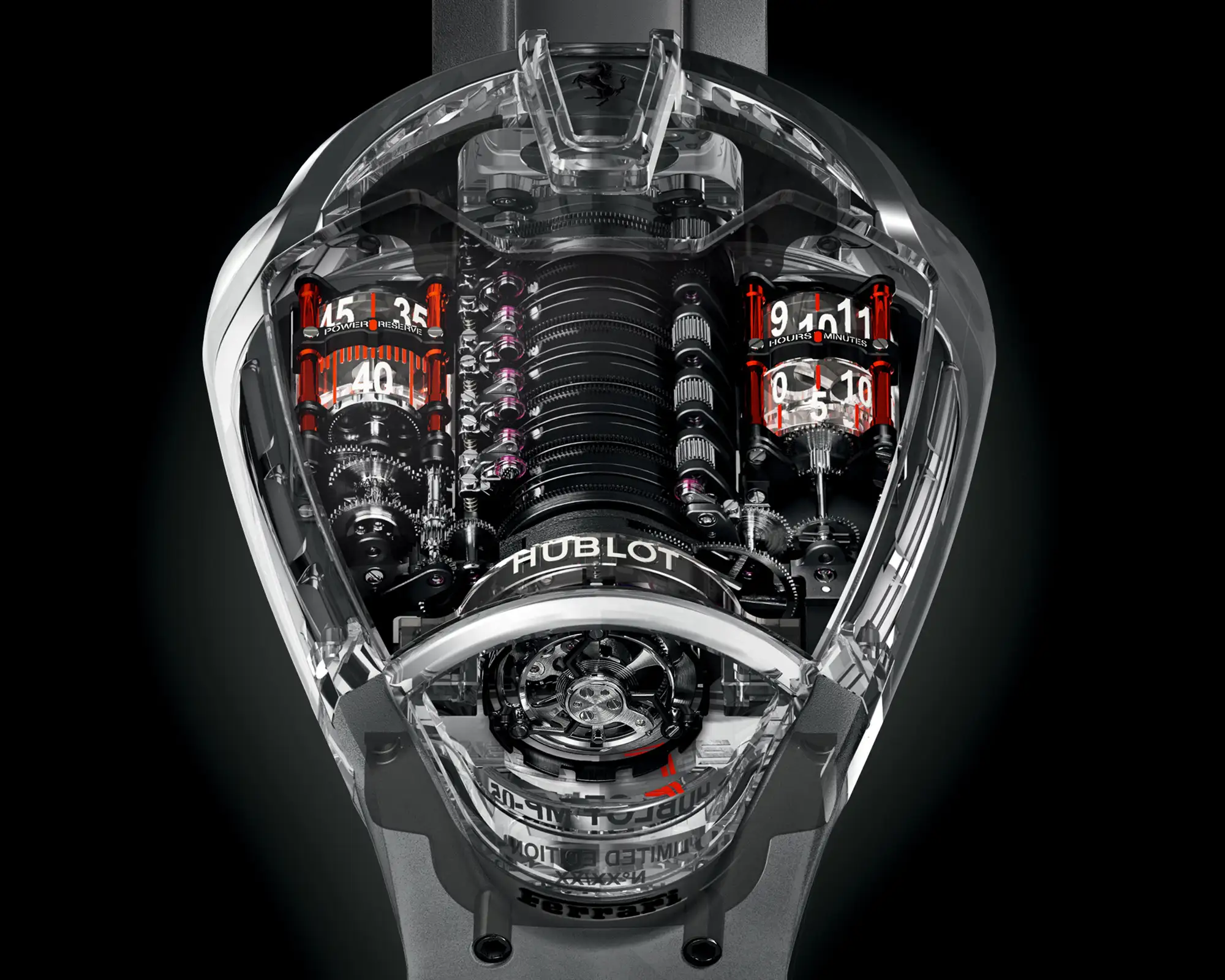
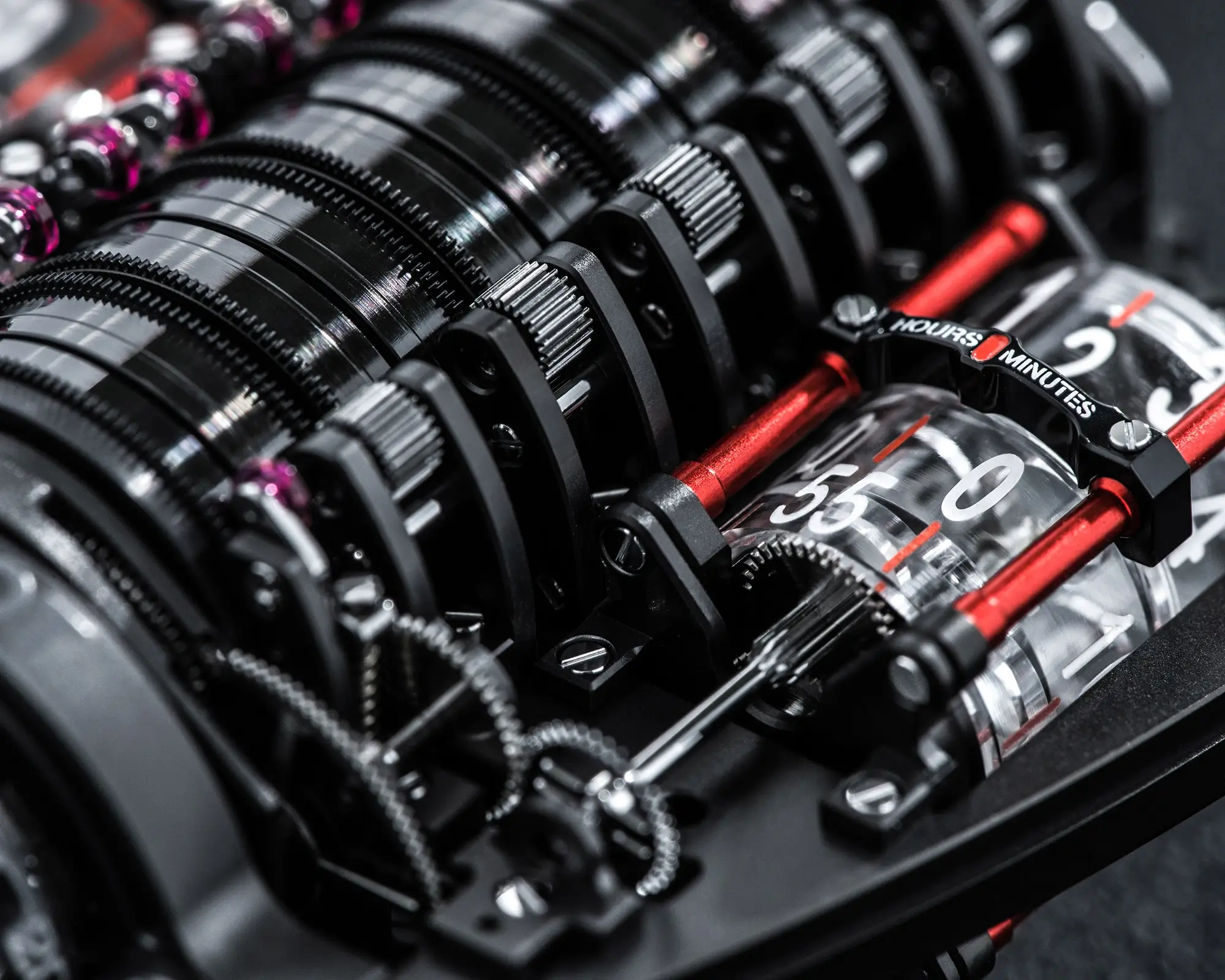
How does Hublot solve the torque problem? Although the eleven mainsprings are connected in series, meaning their lengths add up, the maximum torque remains just as high as with a single mainspring. The vertical design therefore not only looks spectacular, but is also necessary to accommodate the many mainsprings that help to limit the force.
In 2019, Vacheron Constantin went one step further: the Traditionnelle Twin Beat Perpetual Calendar runs for 65 days – and, following an improvement in 2026, for as long as 70 days – without winding. However, this is on one condition: it must not be worn during this period. The aim of this Perpetual Calendar is to prevent the watch from stopping, which would then require the time-consuming task of resetting all the calendar functions correctly.
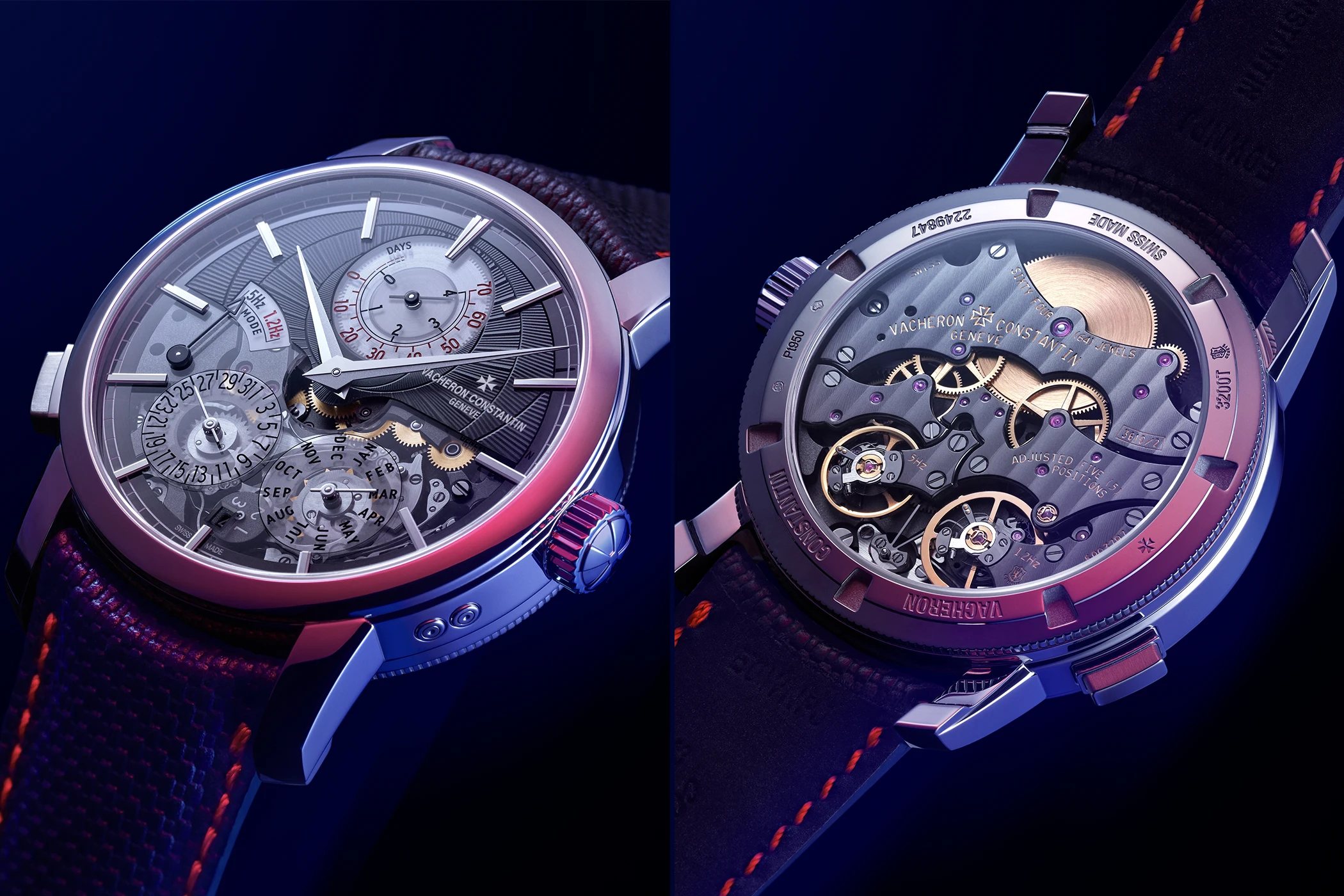
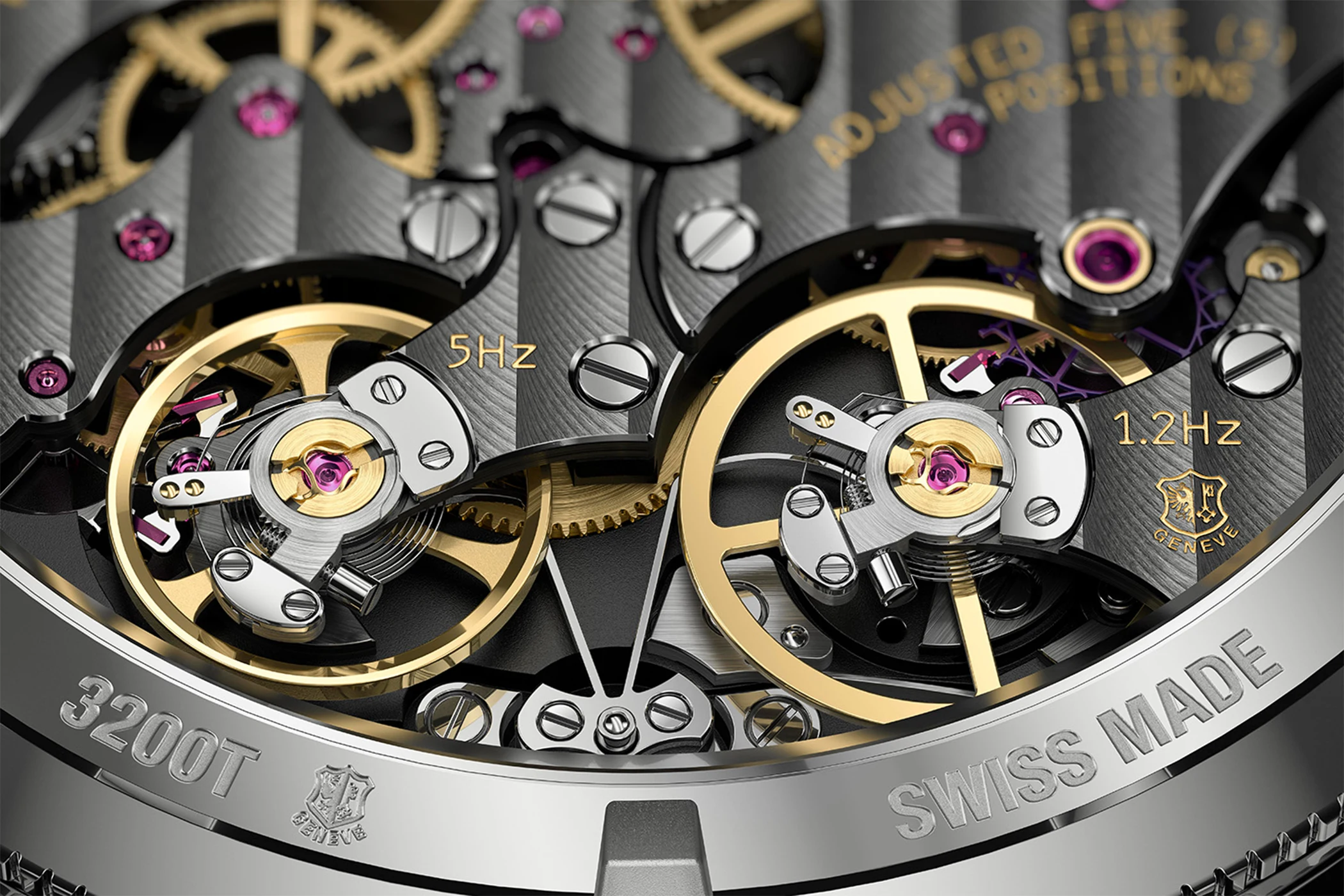
As the name suggests, the watch has two balance wheels between which one can switch: 5 hertz, or 36,000 half-vibrations per hour, for wear on the wrist; and 1.2 hertz, corresponding to 8,640 half-vibrations per hour, for long-term operation whilst the watch is not being worn. When you consider that 18,000 half-vibrations per hour was the standard for pocket watches, it isn’t actually that slow.
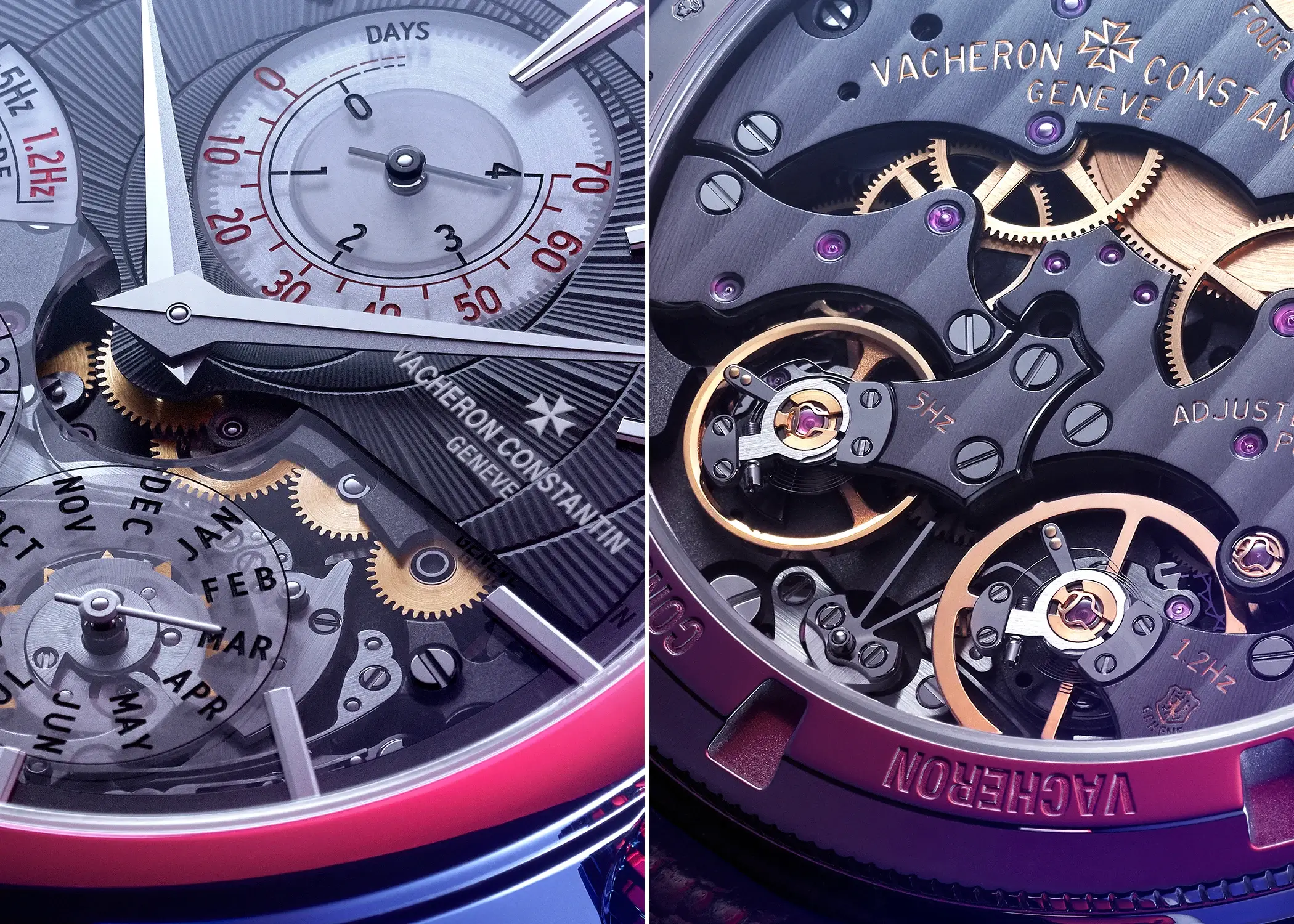
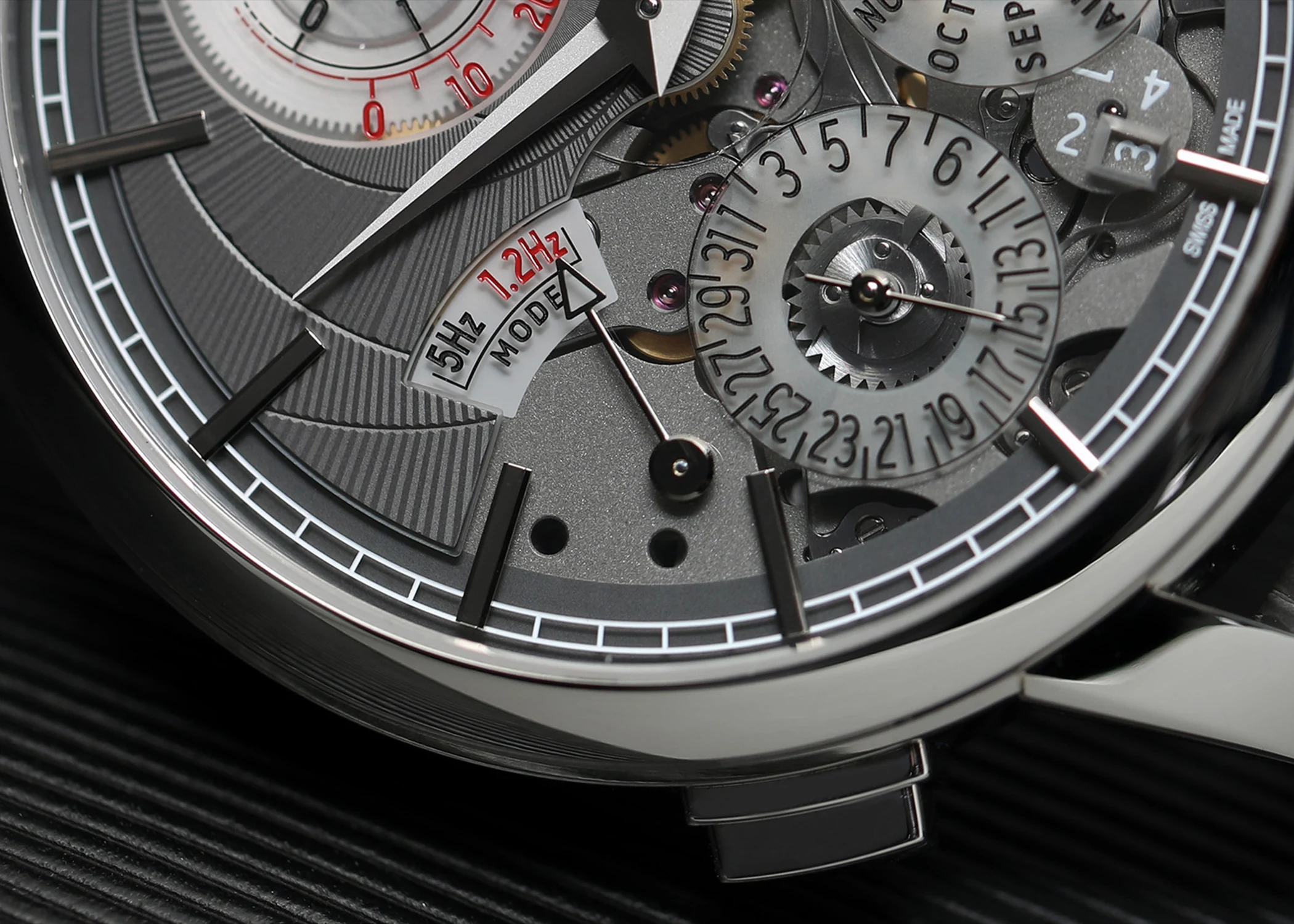
The push-piece at the eight o’clock position is used to switch between the frequencies. It controls a rocker arm that holds one balance wheel in place whilst releasing the other. Each balance wheel has its own gear train, and a differential ensures that both gear trains can drive the hands. A second differential controls the distribution of power from the mainspring barrel.
A great deal of meticulous work has gone into the energy-intensive switching mechanism for the calendar functions: using worm gears, they store energy over a prolonged period, releasing it all at once when the switch occurs. Without this ingenious solution, the lightweight 1.2-hertz balance wheel would come to a standstill during the switching process.
What happens if you wear the watch on your wrist in slow mode? Movements affect the slow balance wheel much more significantly, and it would therefore run very inaccurately. In fast mode, the watch still achieves a power reserve of four days. The Vacheron Calibre 3610 QP, comprising 480 components, is just six millimetres thick and features a double barrel.
In addition to its long power reserve, the Luminor 31 Giorni boasts a number of other special features. For instance, the lettering on the date ring is only visible within the date window. Elsewhere, the ring is completely transparent and therefore does not obstruct the view of the movement. The date disc, meanwhile, is made of transparent borosilicate glass. The numerals are applied using a laser, which specifically alters the optical properties of the glass, rendering them virtually invisible. Only a polarised crystal above the date window reveals the current number there – and there alone. The rest of the disc rotates invisibly behind the skeletonised dial.
This patent-pending solution maintains an unobstructed view of the movement whilst still ensuring the date is clearly legible. Panerai first employed this principle back in 2018 in the L’Astronomo.
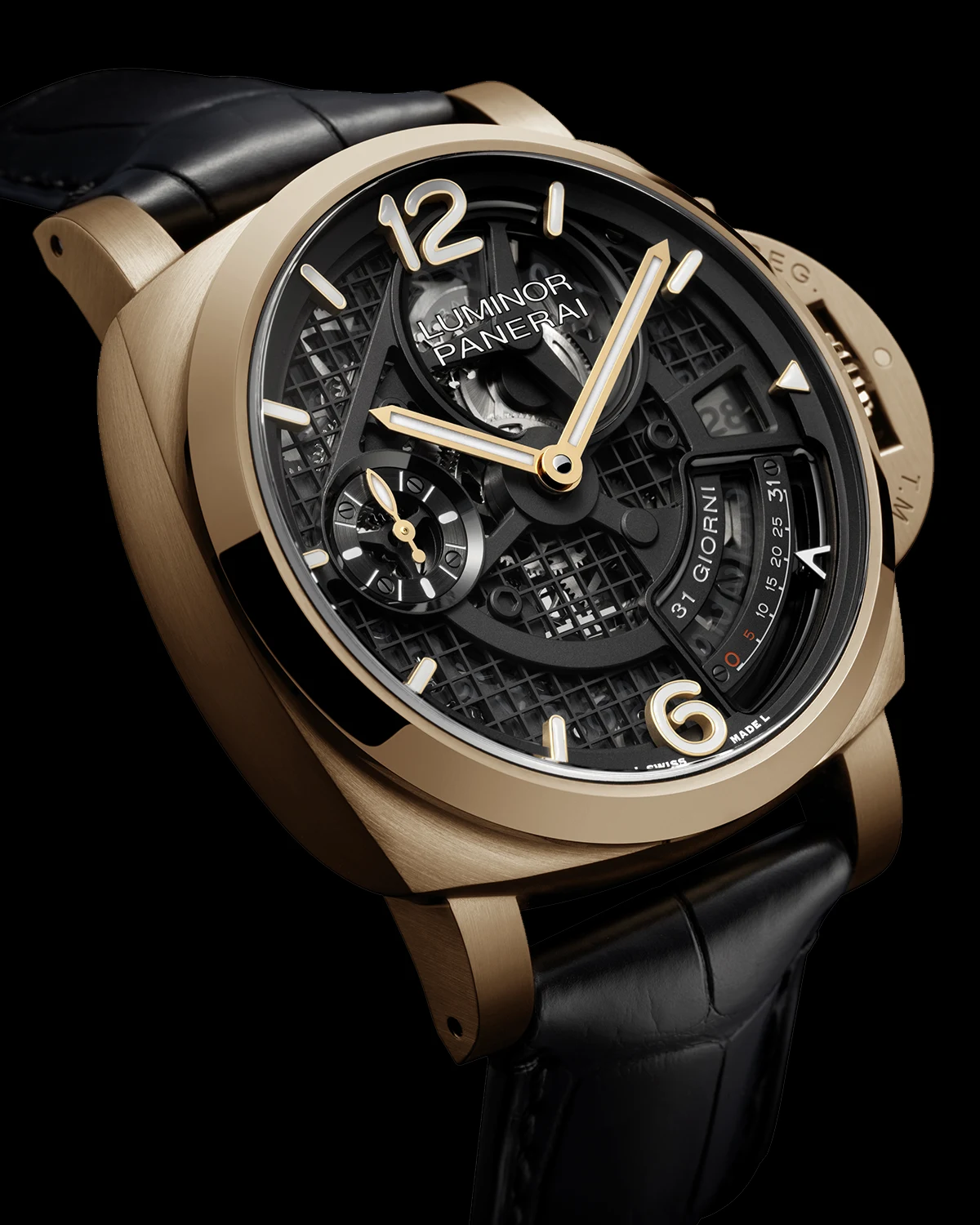
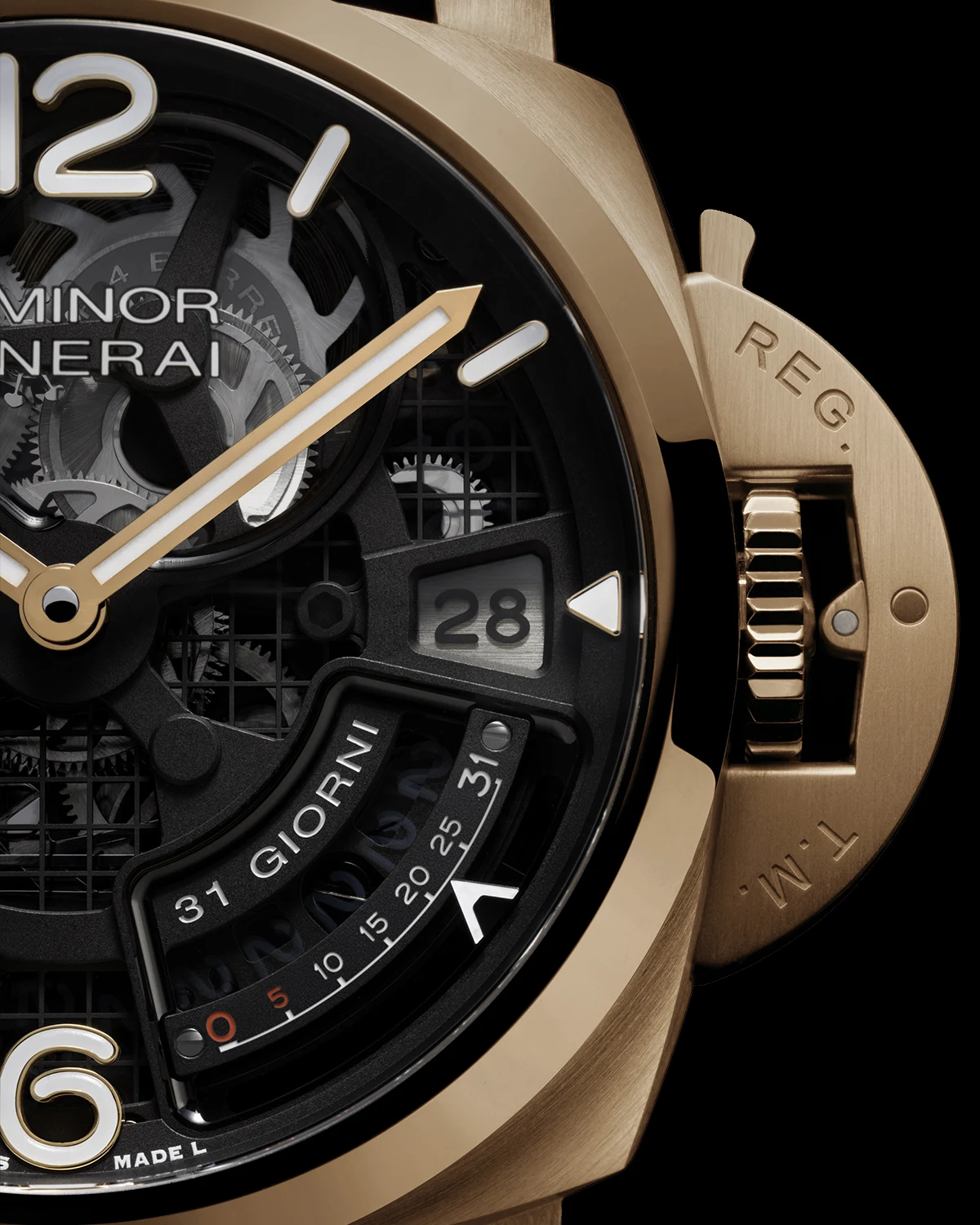
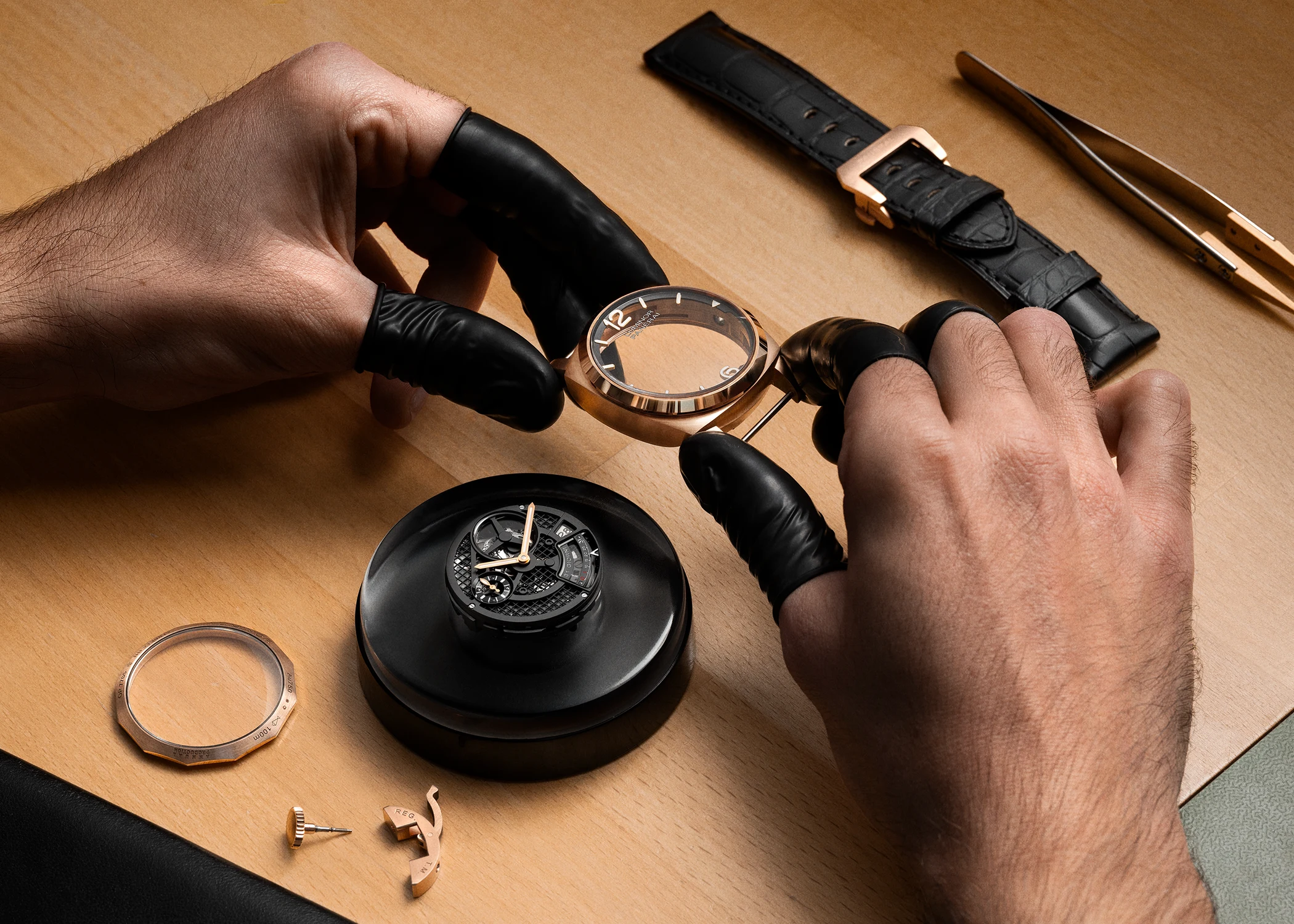
Of all the long-running models, the Luminor remains the only one that is water-resistant to 100 metres. The 44-millimetre case is made from the exclusive ‘Goldtech’ alloy. This consists of 18-carat gold mixed with copper, platinum and silver. This gives the material a warm reddish-gold hue. It is also said to be harder than other gold alloys and therefore less prone to scratches.
Functionality therefore remains the focus, even if it is unlikely that any combat swimmer will go into action wearing the Luminor 31 Giorni, which costs 95,000 euros.