The Quality Of The A. Lange & Söhne Datograph Perpetual Shines Through In A New Platinum and Diamond-Set Limited Edition
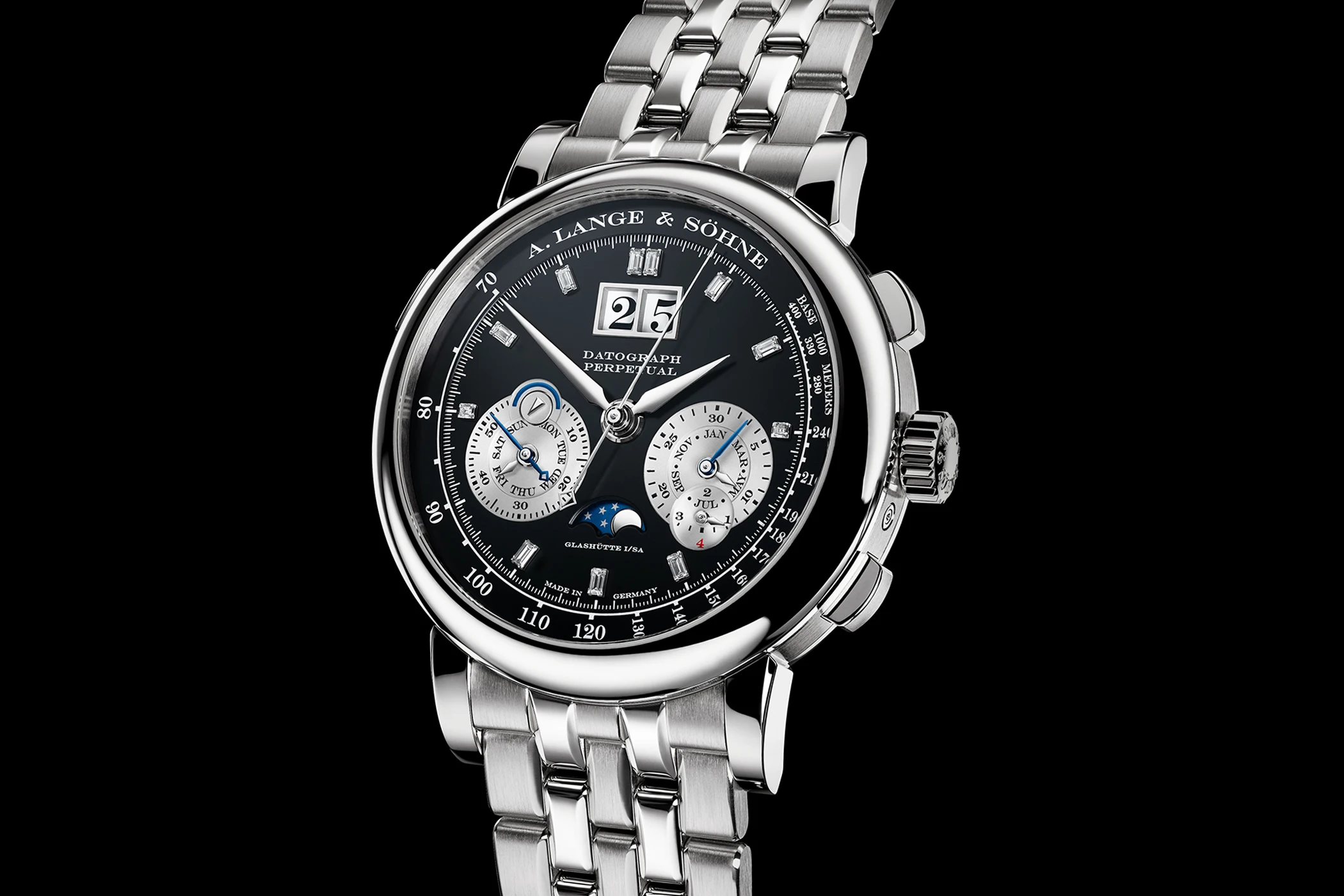
Twenty years after it first combined its flagship chronograph with a perpetual calendar, A. Lange & Sohne has released a new Datograph Perpetual in platinum with a diamond-set dial and platinum bracelet.
Announced on the 32nd anniversary of the unveiling of its comeback collection in 1994, the reference 410.136E is a limited edition run of 50 pieces that jumps straight to the top of the Datograph hierarchy in terms of rarity, complexity and desirability.
The Backstory
The Datograph launched in 1999. Over the last 27 years it has become one of the most beloved, significant and collectible haute horlogerie chronographs in the industry, and has given rise to a rich library of descendants.
Advertising
As the first chronograph developed by the brand since its emergence onto the modern watchmaking scene in 1994 – the year A. Lange & Söhne’s first collections were presented – the Datograph is the spiritual father of all Lange chronographs, from the groundbreaking Triple Split to the Odysseus Chronograph, but even restricting ourselves to the Datograph and Datograph Perpetual is a legacy of excellence.
But first, it is worth reiterating the impact that the Datograph had on its arrival. Chronograph watches are common enough across the entire watch industry that it can be easy to underestimate how challenging an entirely new movement architecture is to develop; there is a reason so many mainstream chronographs rely on the underpinnings of tried-and-tested calibres like the Valjoux 7750. Developing new calibres is a multi-million Swiss franc endeavour – even the maisons with the resources and pedigree to do so often prefer to evolve their existing movements.
A high-end chronograph is another thing entirely. You are looking for a fully integrated construction, with the chronograph mechanism built into and around the gear train of the movement, rather than a modular construction that sits atop it, adding bulk. And at the time of the Datograph’s launch, none of A. Lange & Söhne’s rivals at watchmaking’s top table had invested in creating their own fully in-house chronograph. Brands like Vacheron Constantin, Breguet, Audemars Piguet and Patek Philippe all relied on ebauches like the Lemania CH 27-70 / 2310 or Piguet 1185. Indeed, just the year before, Patek Philippe had released the 5070 with its Lemania-based movement.
Diplomacy prevents any public awareness of the exact reaction to the gauntlet thrown down by A. Lange & Söhne, but it was more than a decade until Patek Philippe could offer a like-for-like rival with 2010’s 5170, and Vacheron Constantin and Audemars Piguet did not introduce similar movements until 2015 and 2019 respectively.
The new A. Lange & Söhne Datograph Perpetual Platinum
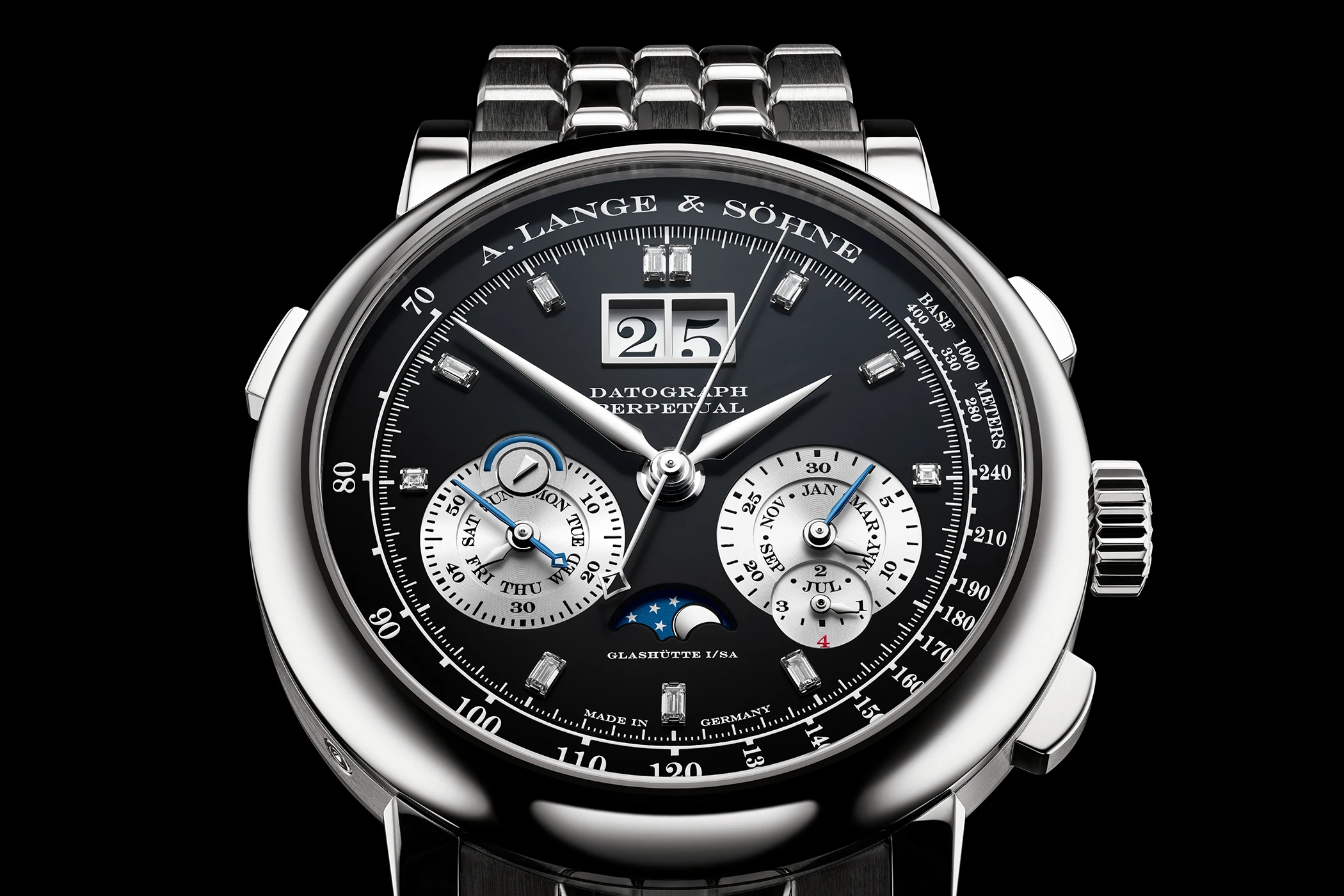
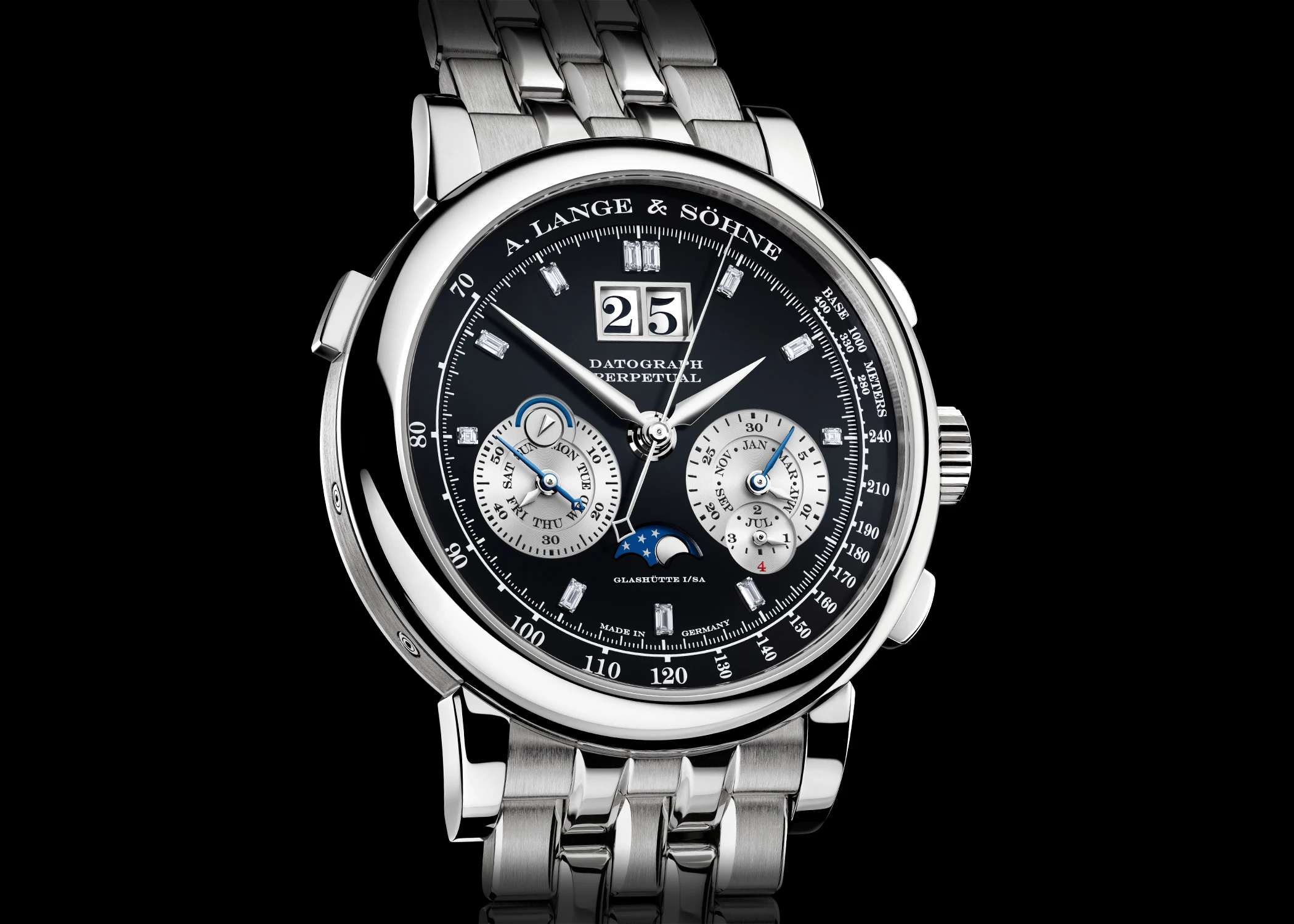
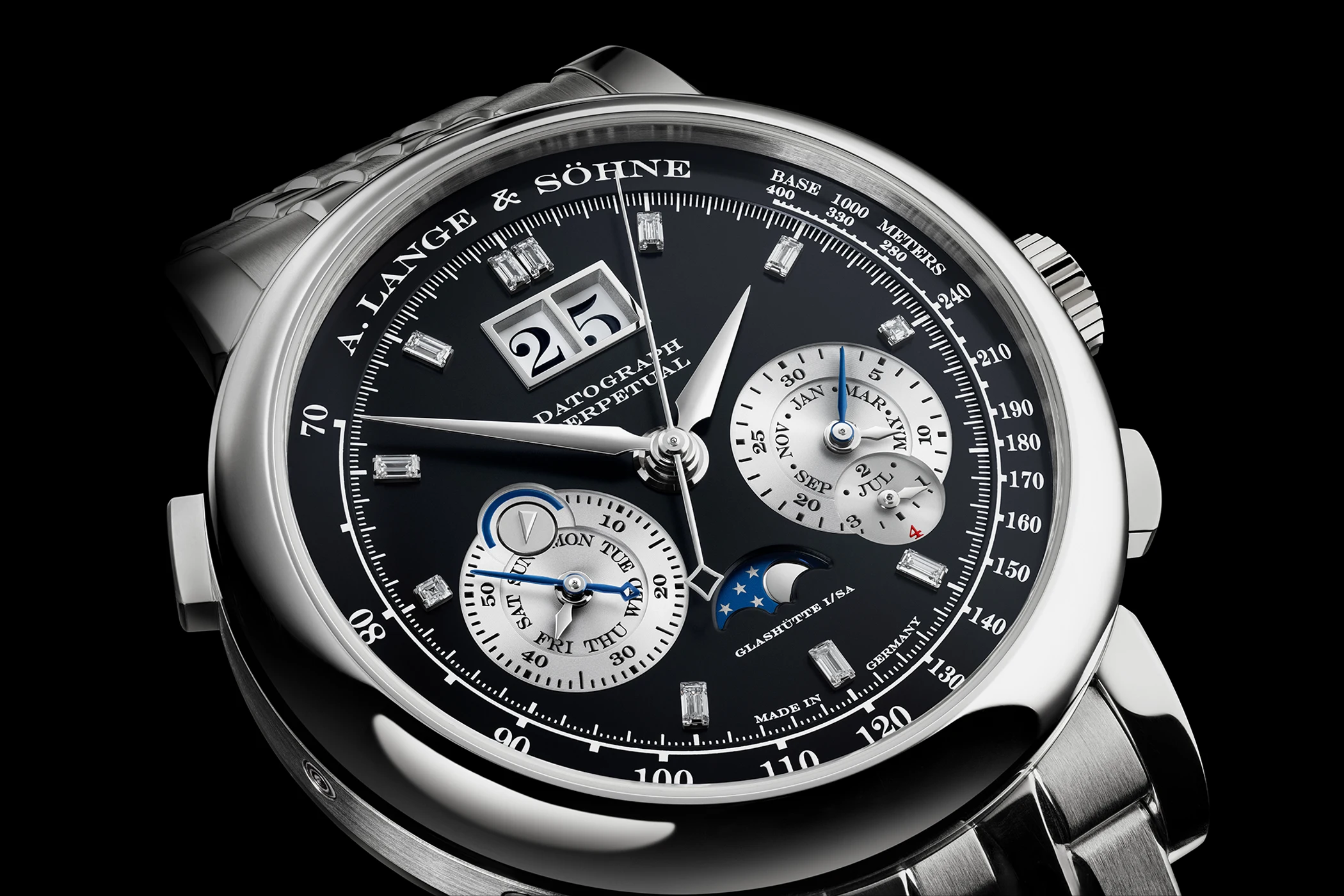
The black-plated silver dial is accentuated with eleven baguette-cut diamonds (omitting the markers at 4 and 8, with two at 12 o’clock) that provide a subtle decorative counterbalance to the meticulously organised layout of information. The four o’clock subdial combines the chronograph minutes with an indicator for the month, with an overlapping dial showing the leap-year cycle at its base, the leap year itself marked in red.
On the opposite side of the dial, the running seconds subdial houses the weekday indicator, with a minimalist day/night subdial overlaid at its top. Between the two rhodium-plated subdials sits a moonphase indicator, accurate to one day’s deviation in 122.6 years (a standard of accuracy first introduced by IWC with Kurt Klaus’ Da Vinci Perpetual Calendar). The blue sky of the moonphase echoes the blued steel of the chronograph minutes and running seconds hands, as well as the blue arc of the night-time indicator, providing a touch of colour amid the otherwise monochrome appearance.
The date, as with all Datograph watches since the model’s introduction in 1999, is shown in the outsized window at 12 o’clock. A familiar sight across A. Lange & Söhne’s watches, it takes its shape, style and typography from the clock in the Dresden Semperoper opera house, in the heart of Saxony and a short distance from the brand’s Glashütte manufacture. Around the periphery of the dial runs a tachymeter scale, annotated to show measurements of speed over a distance of one kilometre – although the scale will also work over any other known distance.
All perpetual calendar functions can be advanced with the quick-adjustment pusher at 10 o’clock, in increments of one day at a time. Alternatively, if individual elements of the calendar display need adjusting, the watch has multiple recessed push-buttons for their adjustment. The control at 10 o’clock features a built-in safety block to prevent its use at times that would interfere with the correct running of the perpetual calendar, specifically in the period of the day when the date has already begun to change over, between 10pm and 2am; it can also only be operated when the crown is pulled out, to prevent accidental inputs.
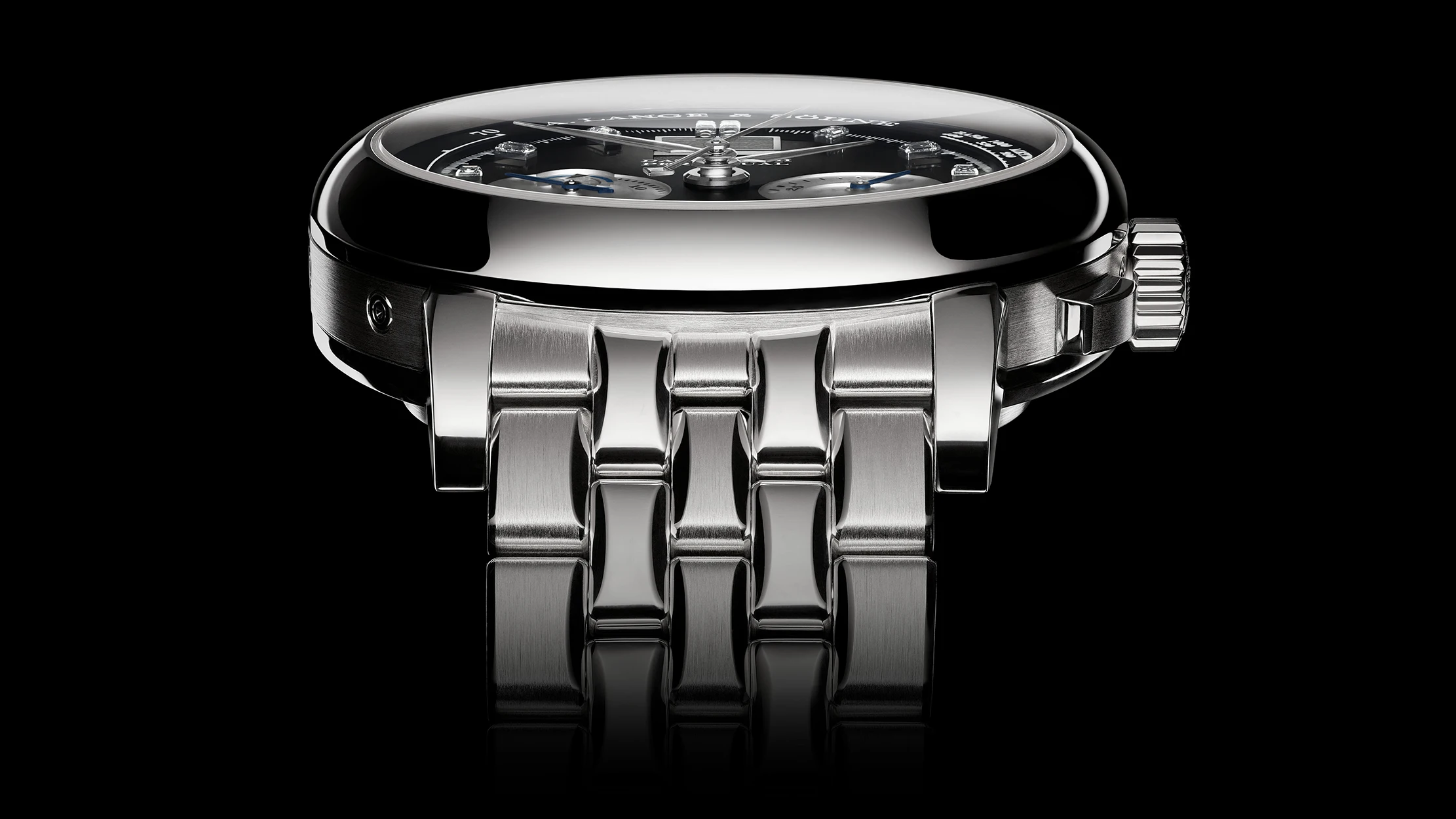
The watch measures 41mm across, in keeping with the existing and most recent Datograph and Datograph Perpetual models, and is 13.5mm thick. The five-link platinum bracelet is fastened with a deployant folding clasp. Each row of the bracelet’s construction alternates between brushed and polished surface finishing, with polished edges to each link that combine for a sophisticated, light-catching effect. Including the bracelet, the watch weighs a substantial 309.9 grams. The bracelet is reminiscent of the ‘Wellendorff’ bracelets prized by A. Lange & Sohne collectors and is sure to be a very popular development among devotees of the brand today. A small number of first-generation Datographs in platinum and in rose gold were sold with seven-link, beads-of-rice style bracelets by the German jeweller; these command a significant premium at auction today.
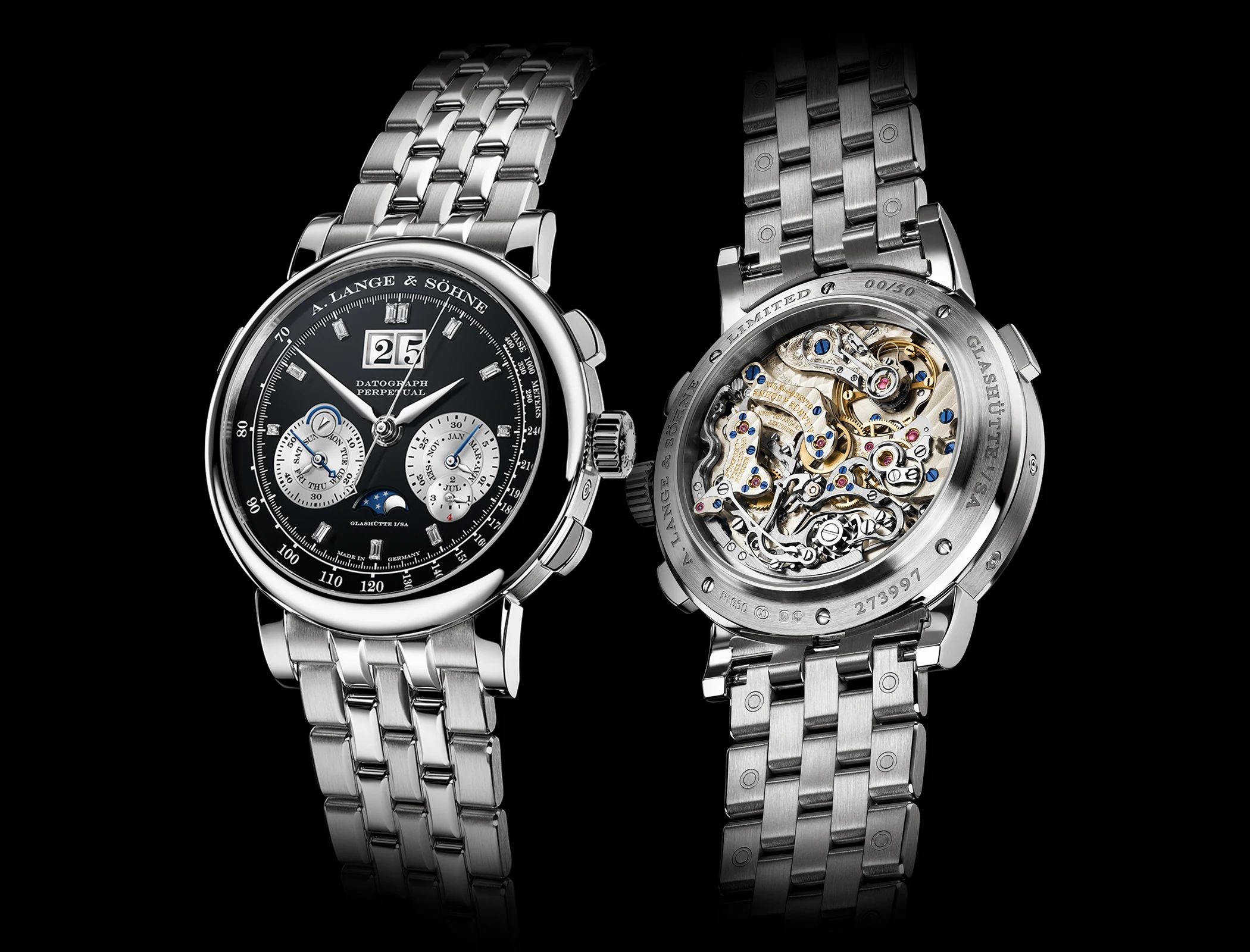
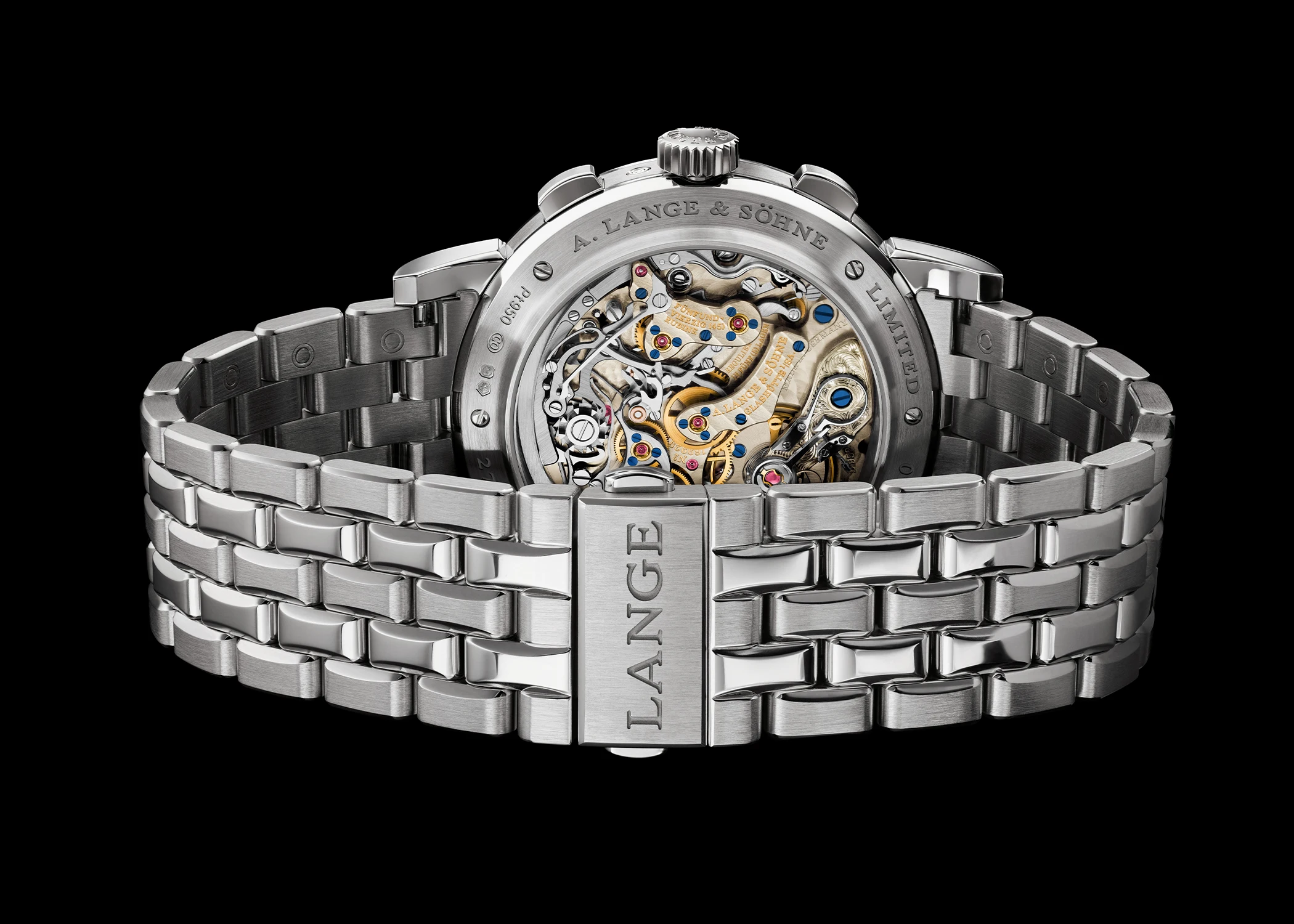
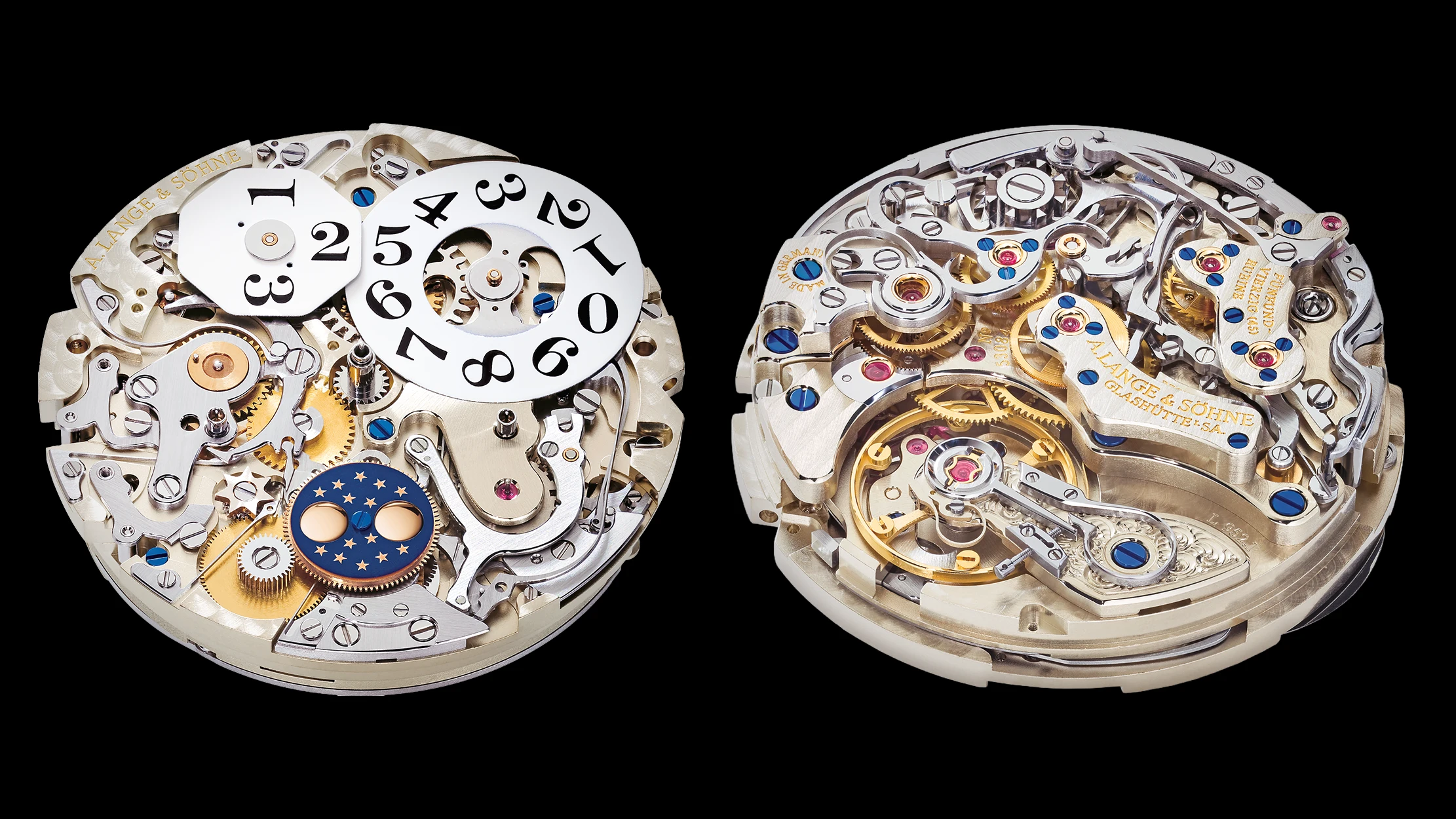
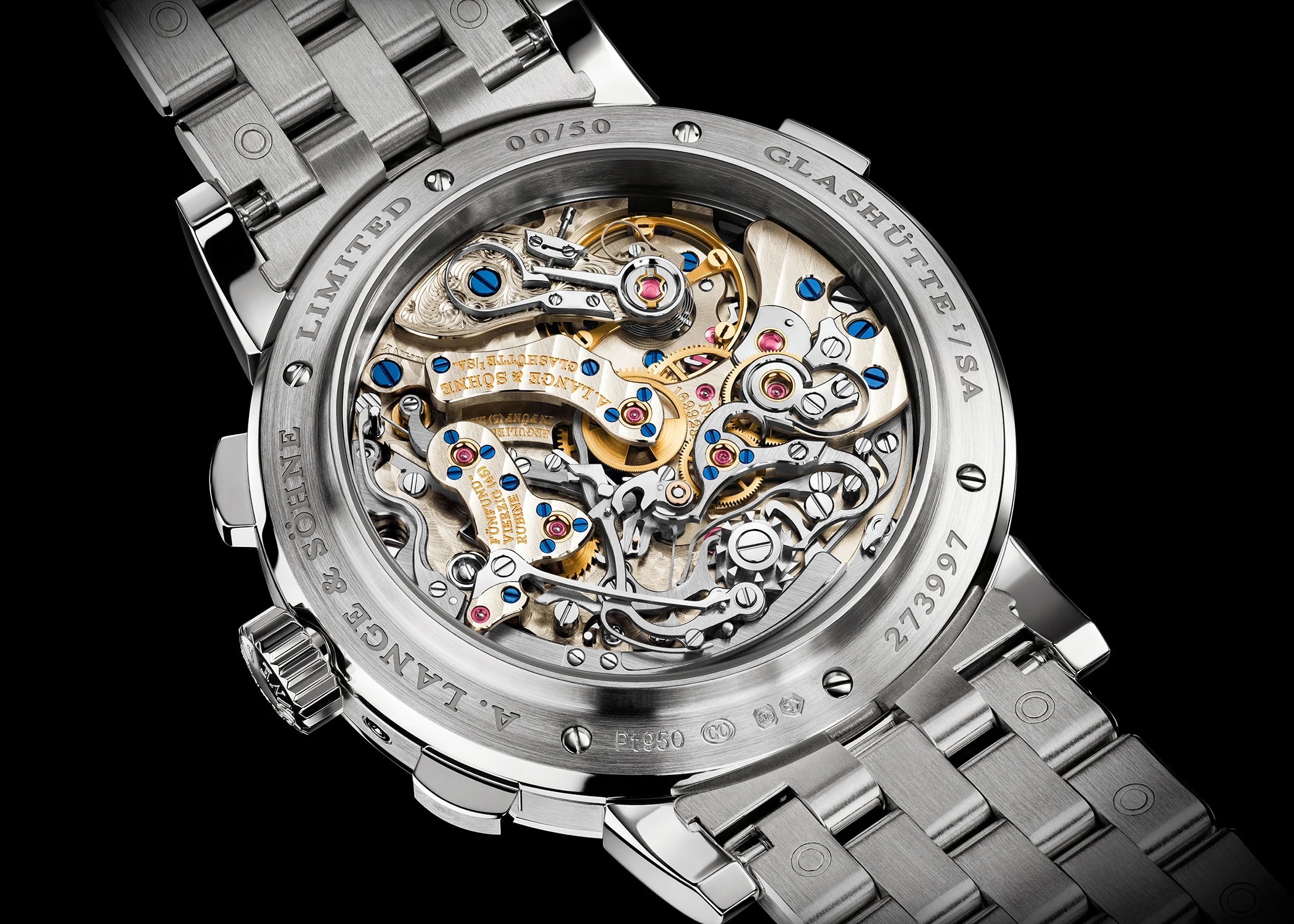
The movement inside is A. Lange & Söhne’s in-house hand-wound calibre L952.1, first introduced in 2006. Comprising 556 components (223 of which make up the perpetual calendar mechanism), it beats at 2.5Hz and has a 36 hour power reserve. This last detail is one that collectors will note; despite the 60 hour power reserve of the Datograph Up/Down, the perpetual calendar reference sticks with the relatively short reserve it has always had.
Among the features that mark the Datograph out as a superior chronograph is the instantaneous jumping minute counter, something found in very few wristwatches (Patek Philippe is one brand to feature it; Petermann Bedat another). The feature, present since the Datograph’s introduction, ensures that the chronograph minutes indicator only advances at the exact moment that a minute has elapsed, rather than dragging gradually as most do. The system used by A. Lange & Sohne uses a jewel-tipped lever attached to a snail cam that only releases once sixty seconds have passed. A delicately synchronised addition, it has been further improved by introducing a switching lever that allows the brand’s watchmakers to fine-tune it without disassembling the movement.
More fundamental to the appeal of the watch, to most customers at least, are the signature finishing touches that are expected from an A. Lange & Söhne movement: the nickel silver bridges and plates are striped and bevelled with perlage on the baseplate, and contrast nicely with the mesmerising nest of levers, springs and cams that make up the flyback chronograph mechanism. Countersunk polished chatons are surrounded by the three blued-steel screws, and the balance cock is hand-engraved (each one slightly different, to the extent that individual engravers’ work can be identified from one watch to the next).
A Generation Of Datographs
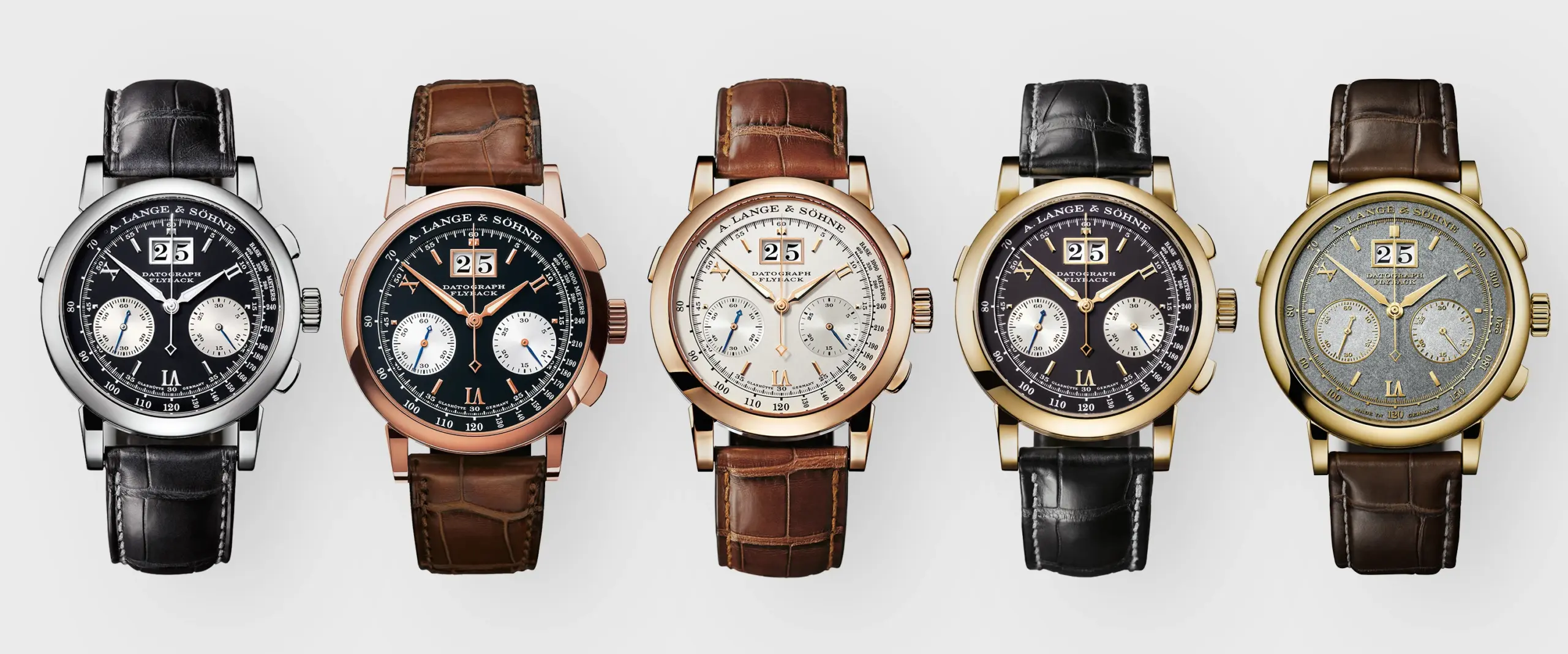
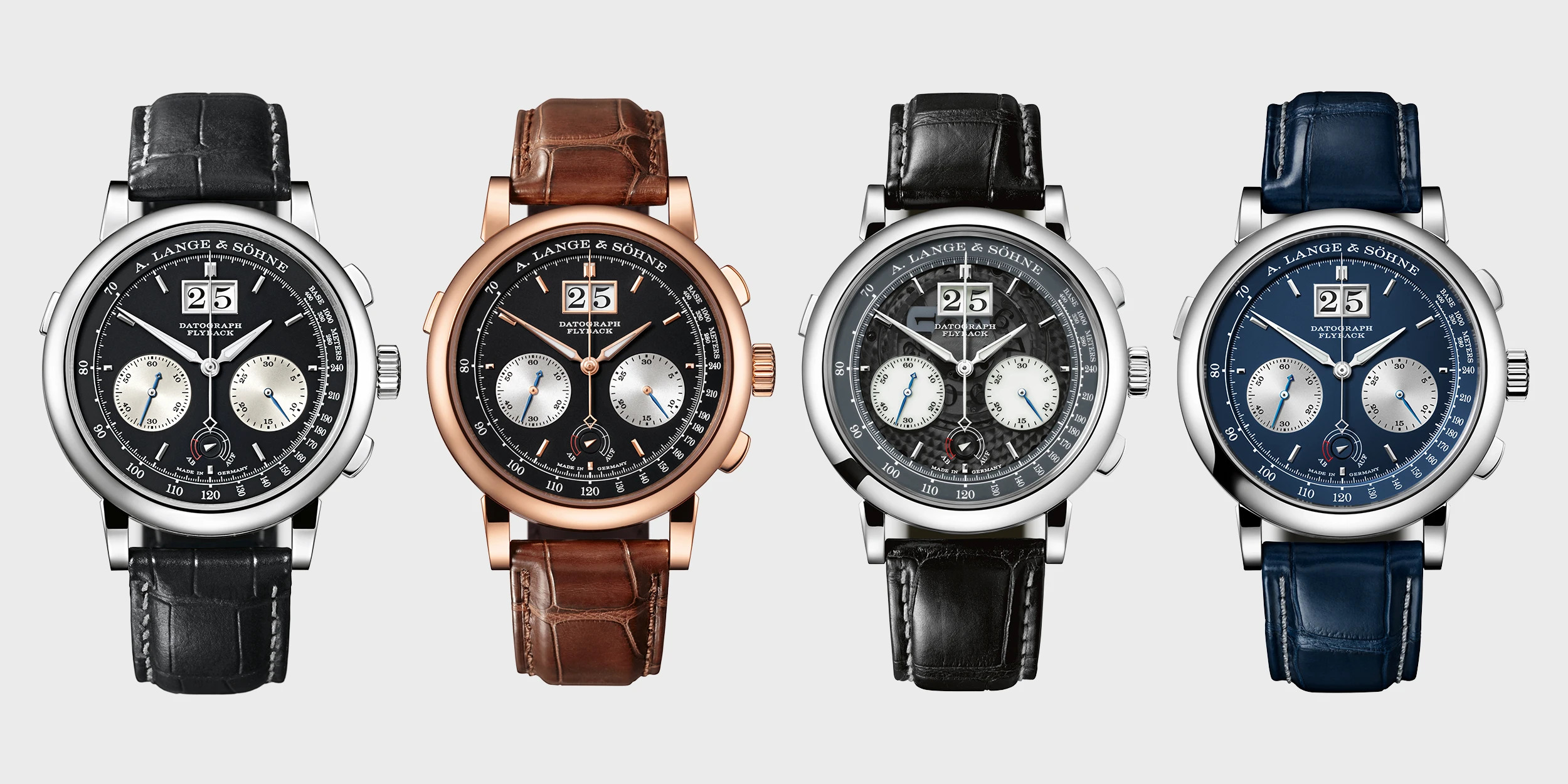
The first generation Datograph was in production from 1999 until 2012, when it was replaced by the Datograph Up/Down. It was launched in platinum with a black dial, and other variants soon followed, mostly in pink gold, with some rare references in yellow gold and in platinum with a silver dial.
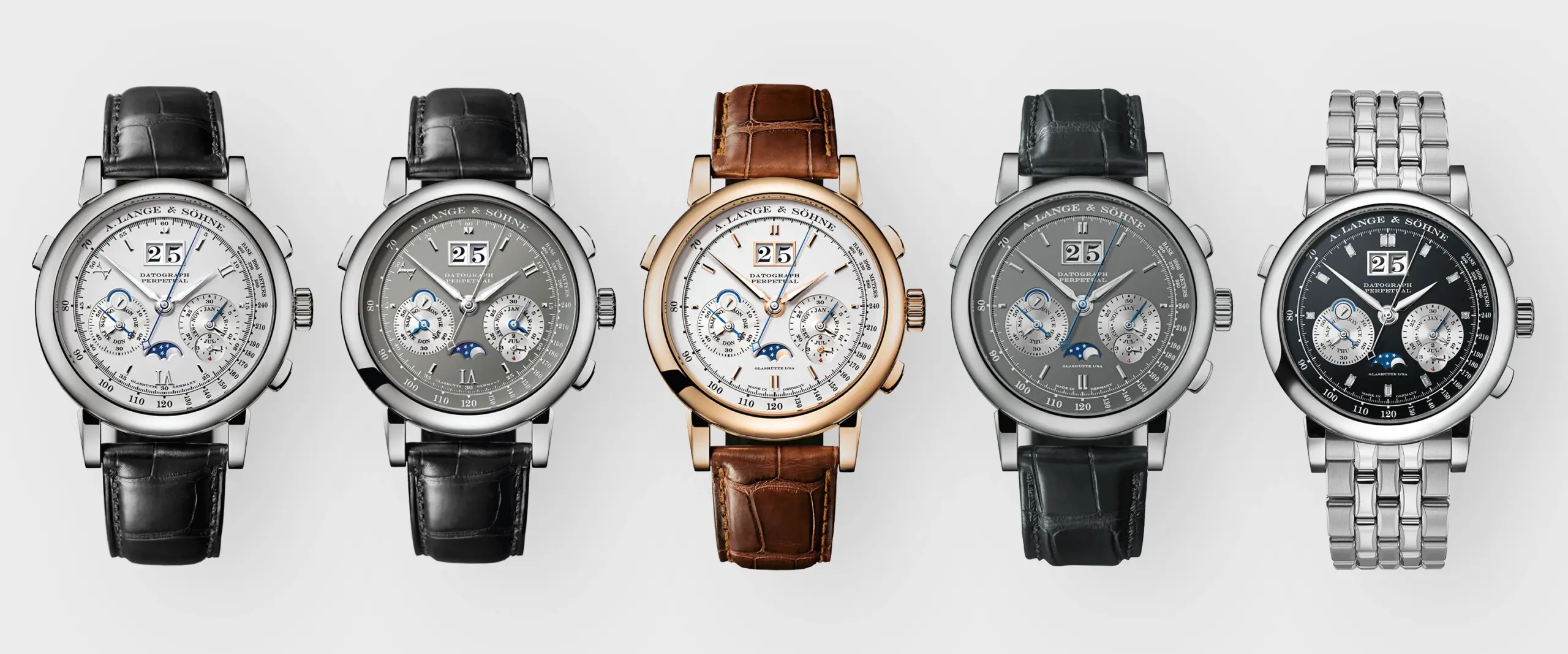
The first Datograph Perpetual joined the collection seven years after the launch of the Datograph itself which, in the context of complex movement development, is on the quick side. It could be argued that its arrival was another shot across the bow of Patek Philippe, whose perpetual calendar chronographs, especially the 1518 and 2499, rank among its most collectible references of all time.
The first Datograph Perpetual was also cased in platinum, and was followed by a white gold variant in 2009. It established the dimensions that remain in today’s version, increasing both the case diameter and thickness from the standard Datograph to accommodate the perpetual calendar module. Both references were discontinued in 2011.
Meanwhile, a redesigned Datograph Perpetual arrived in 2010, in pink gold. This dropped the Roman numerals of the first generation and slimmed down the typography for a more modern appearance. A new white gold reference followed in 2015. In the eleven years since, there has been no further change to the Datograph Perpetual collection.
The regular Datograph underwent a similar modernisation in 2012, when the Up/Down was launched; this also saw the Roman numerals replaced by baton markers and the subdials made slightly neater and brighter. The movement was upgraded from L951.1 to L951.6, which increased the power reserve and added an in-house free-sprung balance with overcoil. A. Lange & Söhne says that the changes to the escapement significantly improve timekeeping, especially when the chronograph is running.
Aside from retailer-specific limited editions and special orders – which introduce enticing touches such as colourful dials or gem-set bezels – there are two more main versions of the Datograph to know about: the Datograph Perpetual Calendar Tourbillon, and the Datograph “Lumen”.
The first represents the technical pinnacle of the Datograph’s journey so far, and was originally launched in 2016 (again, as is customary, in platinum with a black dial). It was updated in 2019 with the addition of a white gold model with a salmon-pink dial, and again in 2024 with a honeygold “Lumen” edition. This was the second “Lumen” model in the Datograph family, after the Datograph Up/Down “Lumen” which was released in 2018. Followers of the brand will be familiar with the approach, which modifies existing designs by introducing semi-transparent “smoked” sapphire dials with luminous components underneath for a ghostly green appearance. Limited to 200 pieces, is arguably the most distinctive Datograph of all, with its glowing green subdials. Whatever the Datograph family has in store for us next, it has a lot to live up to.
The price of the new Datograph Perpetual in platinum is 280,000 Euros.
In July 2025, Hermès Horloger announced plans to expand its Le Noirmont site to 11,000 square metres by 2028. In 2026, the Hermès H08 will be fitted with its first in-house calibre. Does the H08 have the potential to become Hermès’s answer to the Nautilus?
Jeweller KUTTER 1825 and Patek Philippe are marking their double anniversary with the launch of the Calatrava Weekly Calendar Ref. 5212A-012, limited to 20 pieces.