We look back on 30 years of the Vacheron Constantin Overseas and how diverse the collection has become.

Not every relationship lasts forever. Nevertheless, even temporary relationships leave their mark. At their best, they also provide lasting experiences and values to help us face whatever the future may hold.
This is roughly how the alliance between Montblanc and Minerva should be understood. Without Richemont’s acquisition of Minerva – aimed at integrating and strengthening the group’s subsidiary Montblanc – the watch manufacturer, founded in 1858, would scarcely possess its current strength today. Richemont has invested heavily in Minerva’s workshops, and in return, Minerva’s movements, designs and, of course, its name have lent prestige to the most sophisticated models in the Montblanc watch collection. Now, however, the two houses are – at least outwardly – going their separate ways once more. Minerva is now an independent entity within Montblanc and is set to prove itself as a brand in its own right. That is likely to be considerably easier in 2026 than it was in 2006, the year of the takeover.
Small, discerning manufacturers with modest annual production volumes are currently in high demand. Over the past two decades, this niche has established itself as an alternative to the giants of haute horlogerie. In this context, the merging of a ‘high-street’ brand such as Montblanc with a name known primarily to enthusiasts does more harm than good. One has a strong interest in high production volumes, whilst the other focuses on creating timepieces that are as valuable and intricately crafted as possible – a focus that naturally imposes certain limitations. Each, on its own, has a much clearer message and a stronger market position, and you don’t have to be a Minerva fanboy to realise that the first independent models demonstrate the strength of a solo venture over a collaboration of recent years.
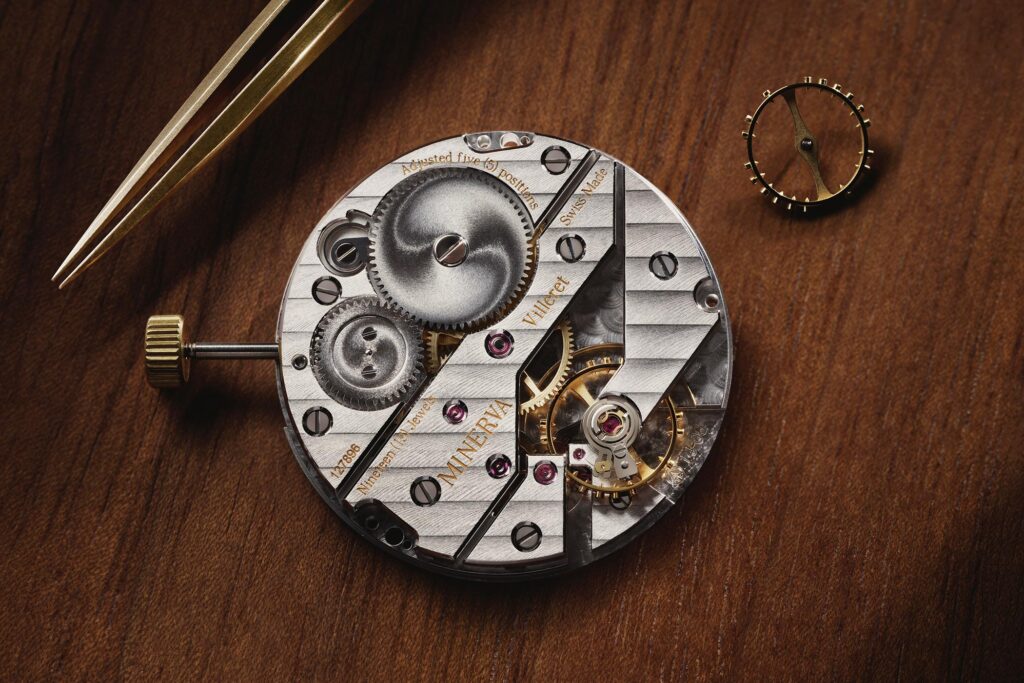
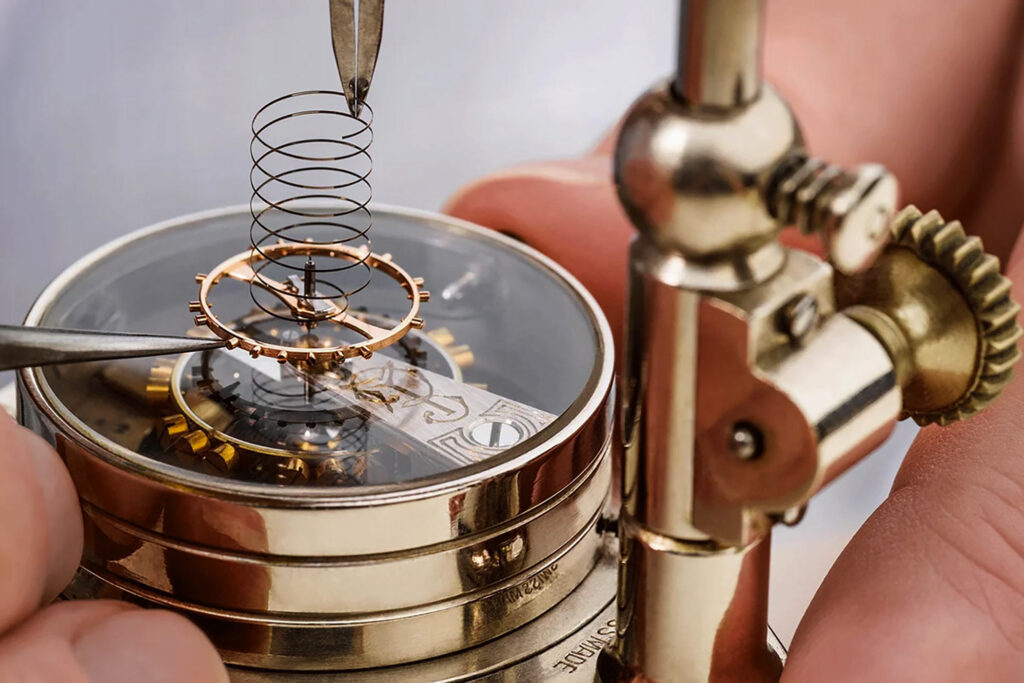
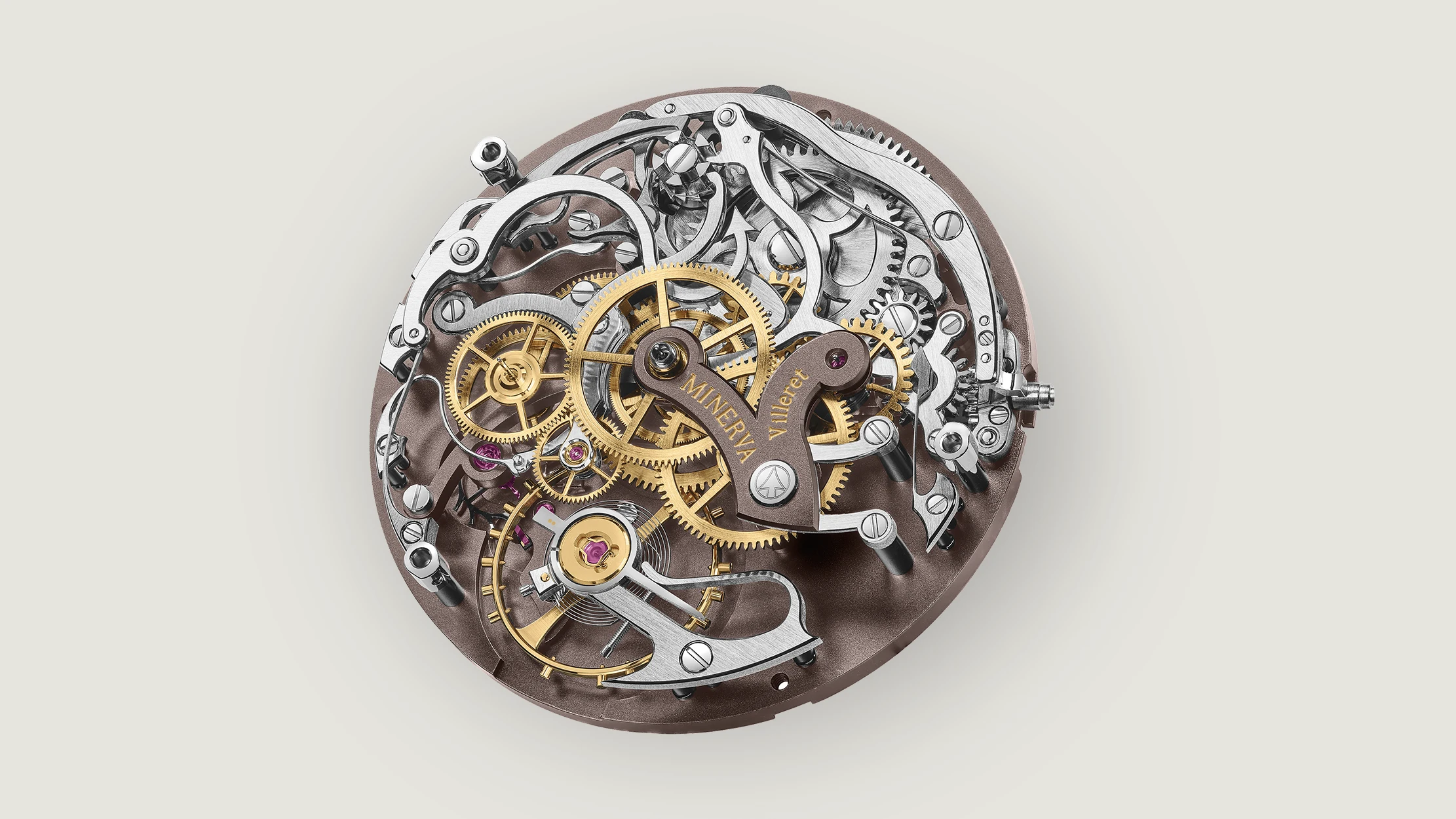
The history of Minerva began in 1858 with the brothers Charles-Yvan and Hyppolite Robert, who crafted watches in a workshop in the Jura village of Villeret and quickly made a name for themselves there. It was not until 1887 that the brothers’ company became Minerva, complete with its arrow logo. The name is derived from Roman mythology and the goddess of wisdom, craftsmanship and the arts. The company began developing its own movements at an early stage, and the descendants of the Robert brothers launched the first monopusher chronograph in 1923. Key milestones included the Calibre 19.09, introduced in 1909, with its patented, distinctive V-shaped bridge, as well as the development of pioneering stopwatches – including early high-frequency movements capable of measuring hundredths of a second as early as 1916. In the 1920s and 1930s, the company also set new standards with calibres such as the 13.20 and 17.29, the first ultra-thin single-push-piece chronographs (monopusher) designed specifically for the wrist. Incidentally, unlike the majority of the industry, Minerva still produces the balance springs for its timepieces in-house and by hand to this day.
It is the innovations from the brand’s early decades that ensure it still captivates collectors around the world today. The new models of the 21st century more than live up to this great tradition. However, now that the company has regained its independence, one hopes that it will soon be able to showcase itself more prominently with its own virtual brand presence – so far, the new-old brand, with its small collection, can only be found tucked away on the Montblanc homepage. This seems somewhat neglectful when it comes to such an important external presentation. It is rather like if, for the relaunch of Universal Genève, Georges Kern had simply tucked the expansion of his brand portfolio away somewhere on the Breitling website.
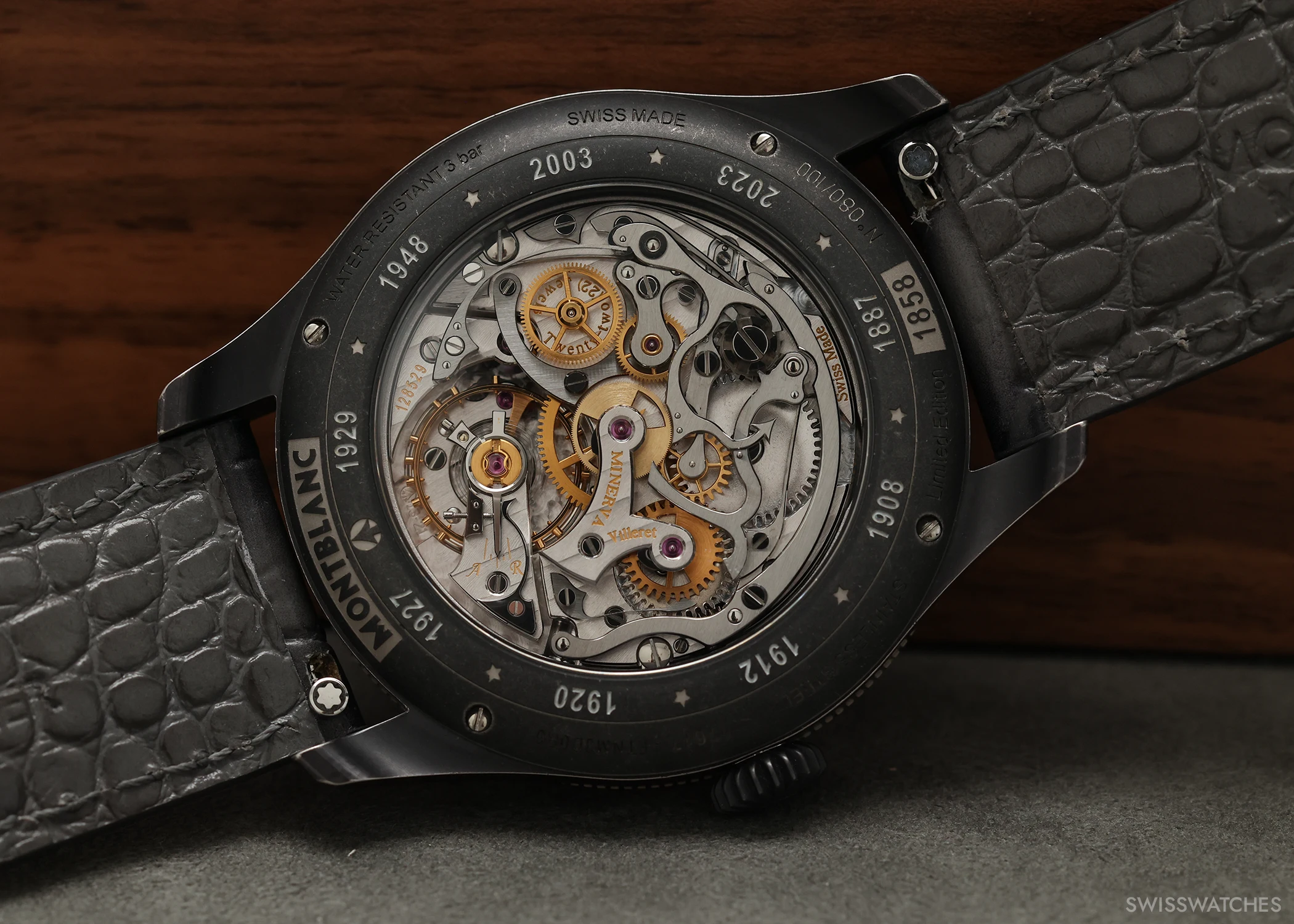
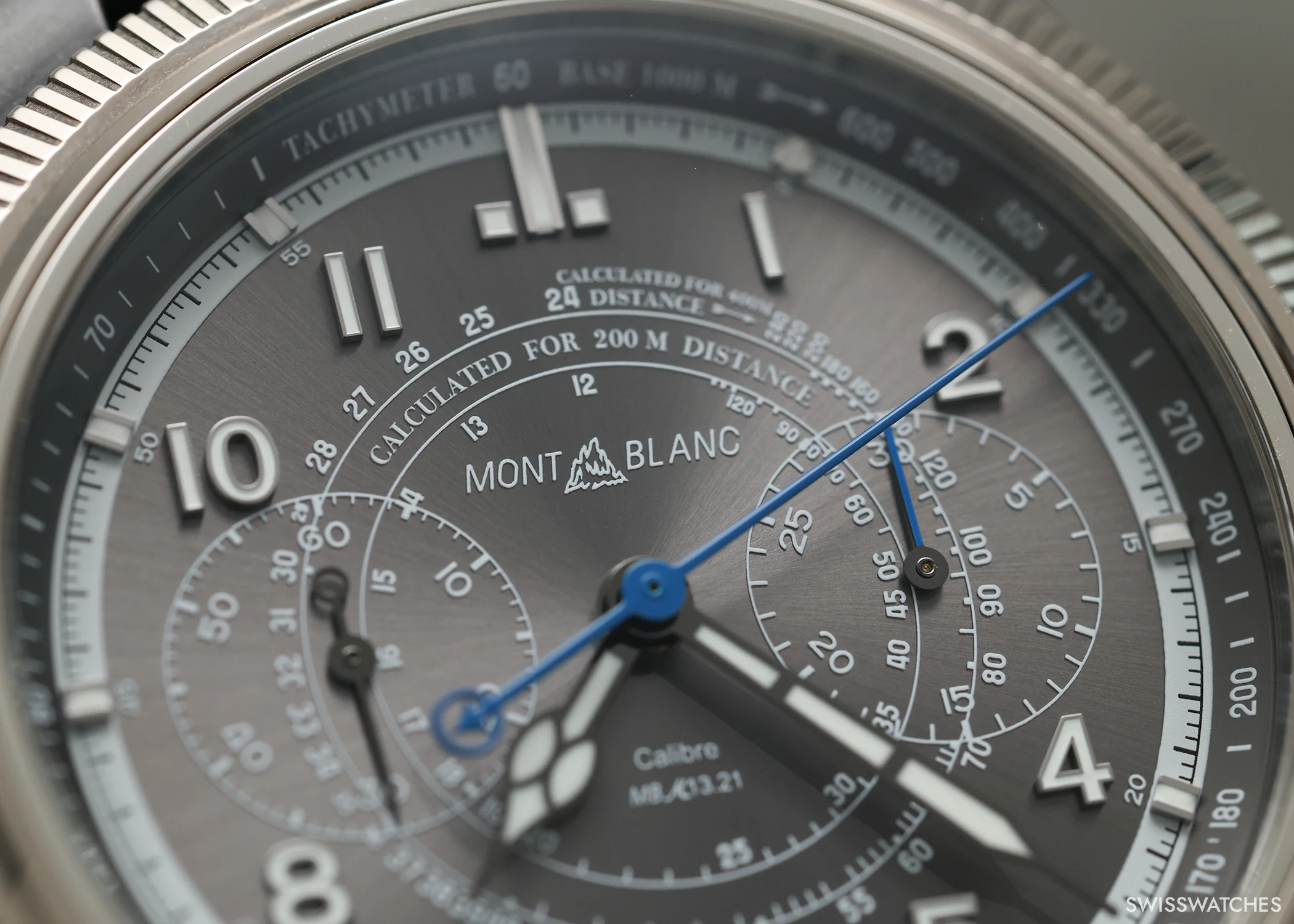
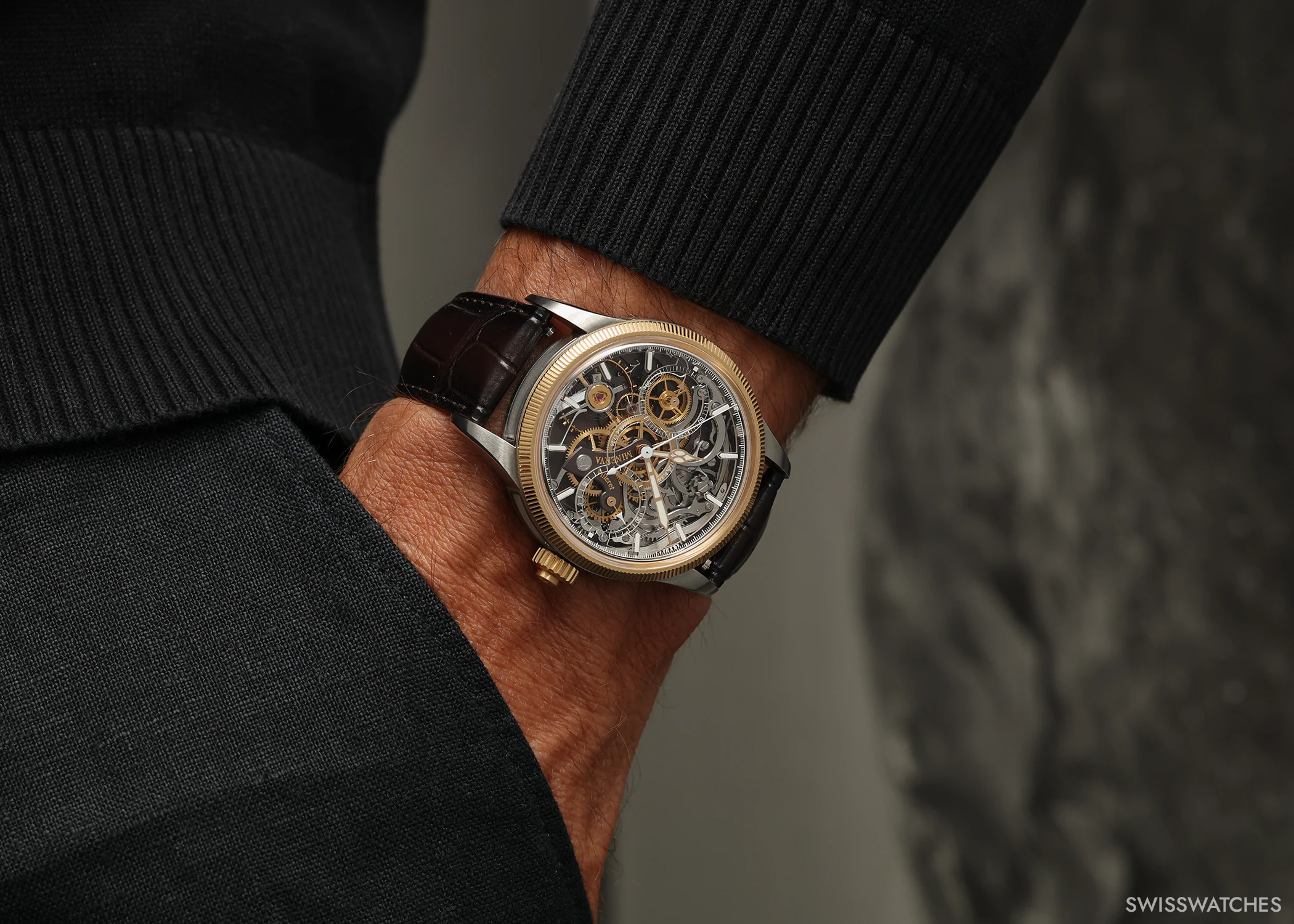
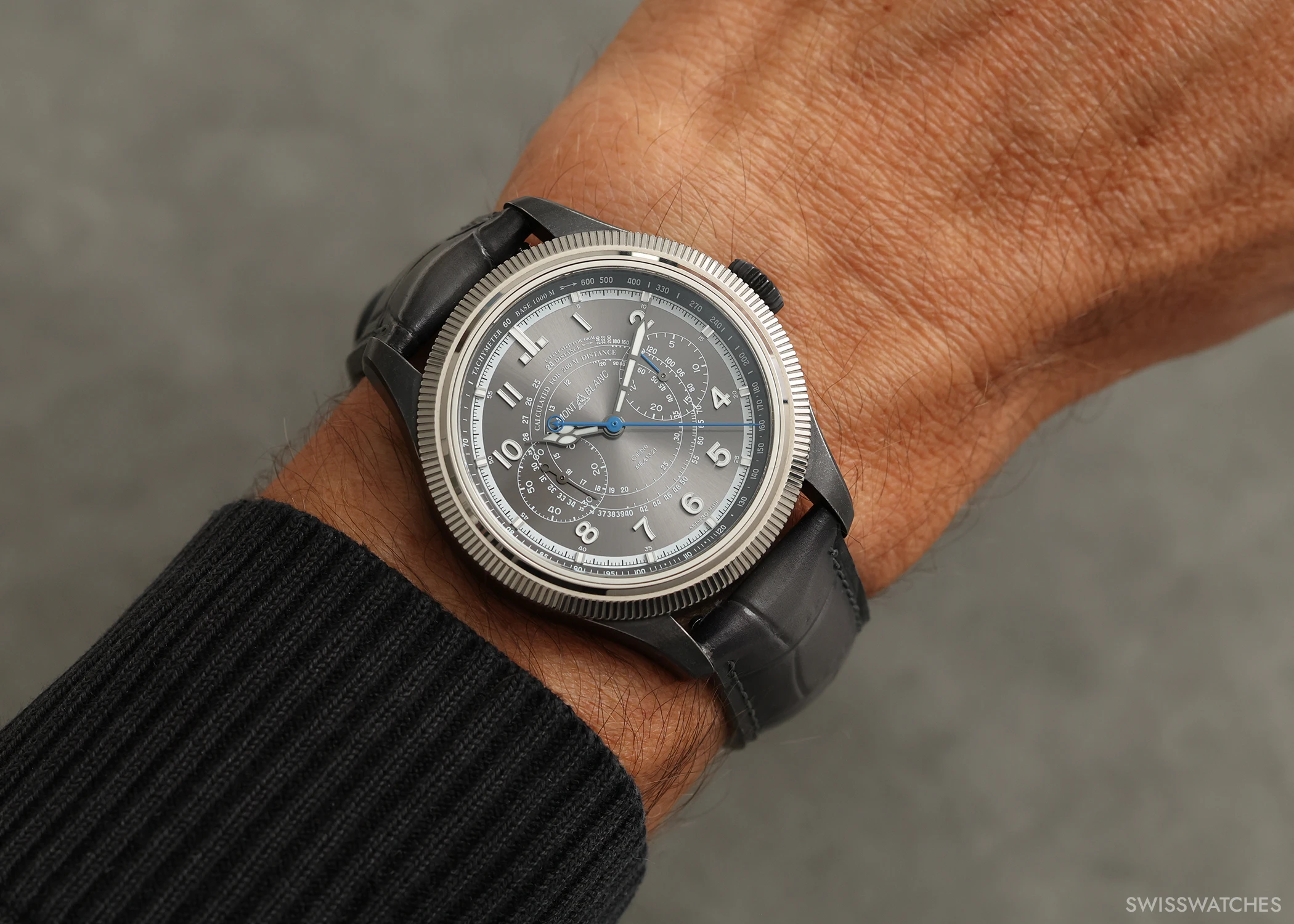
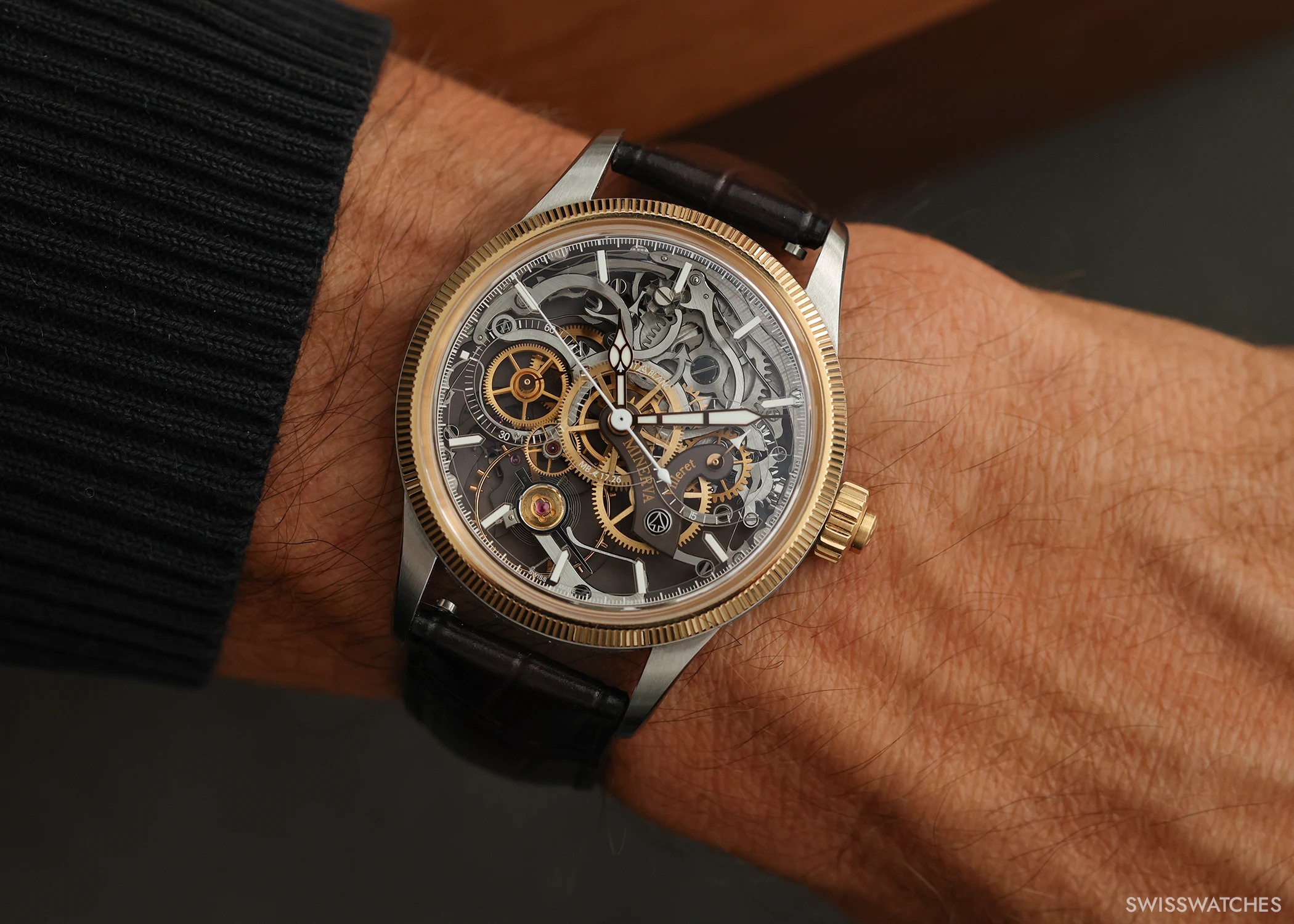
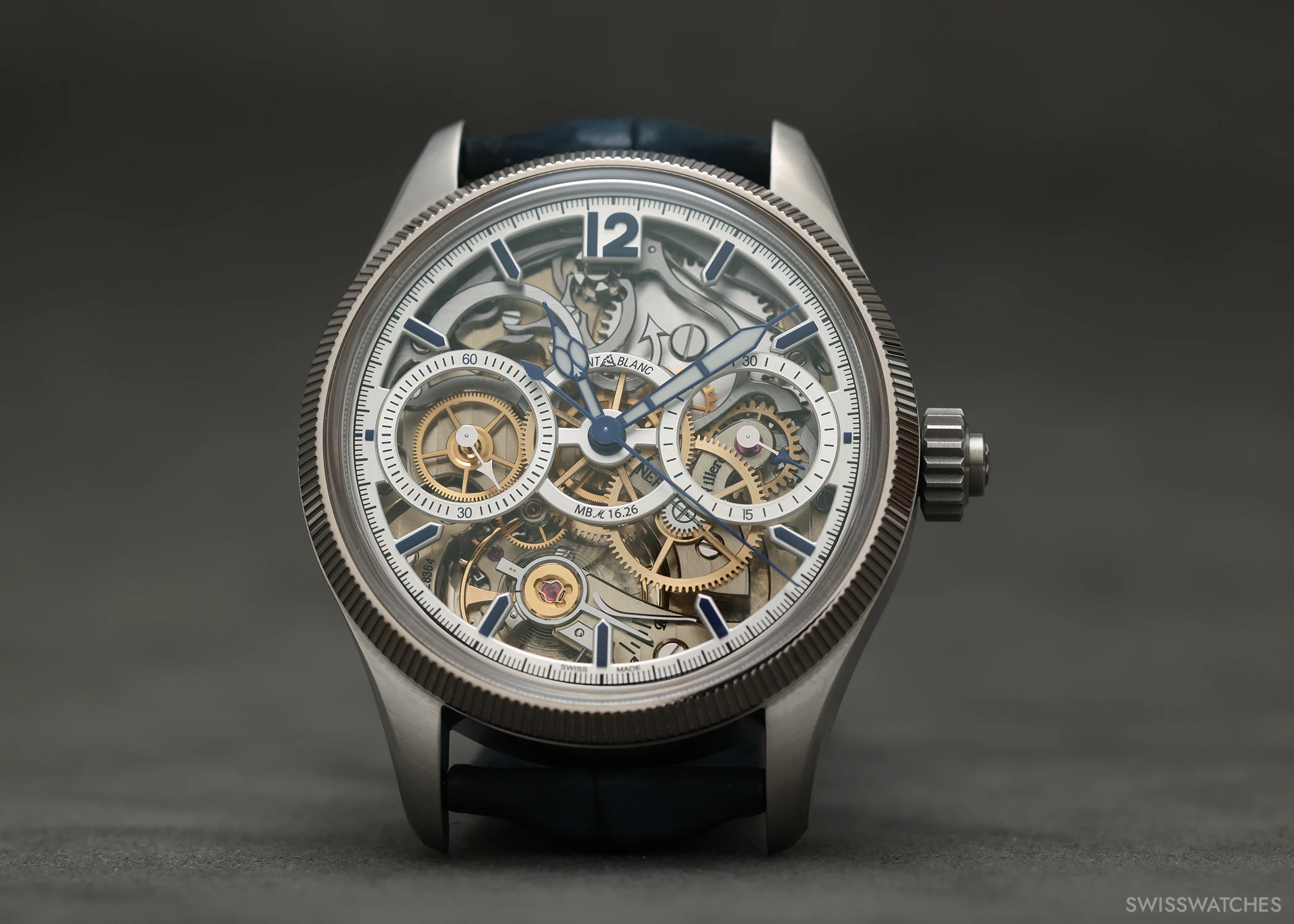
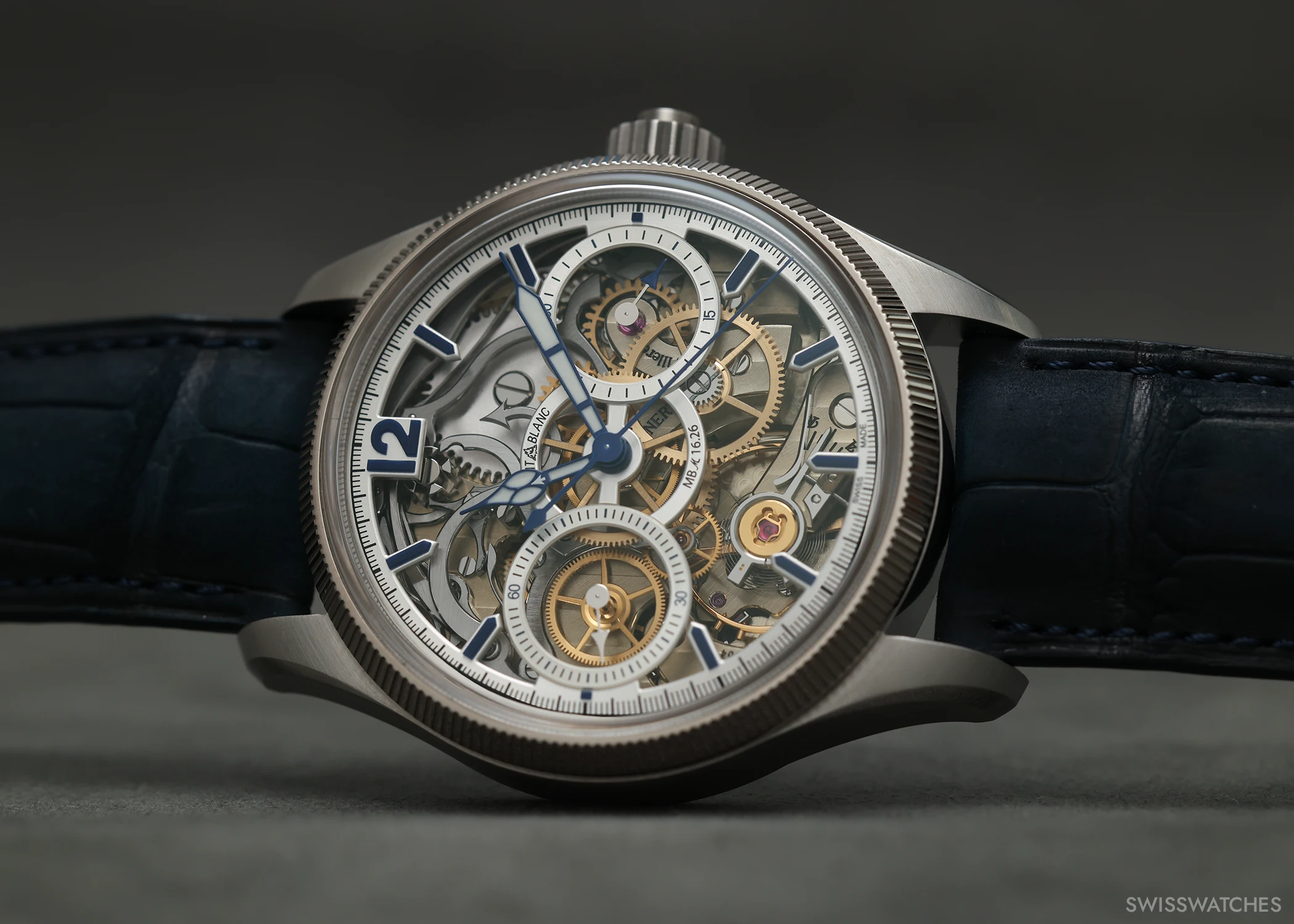
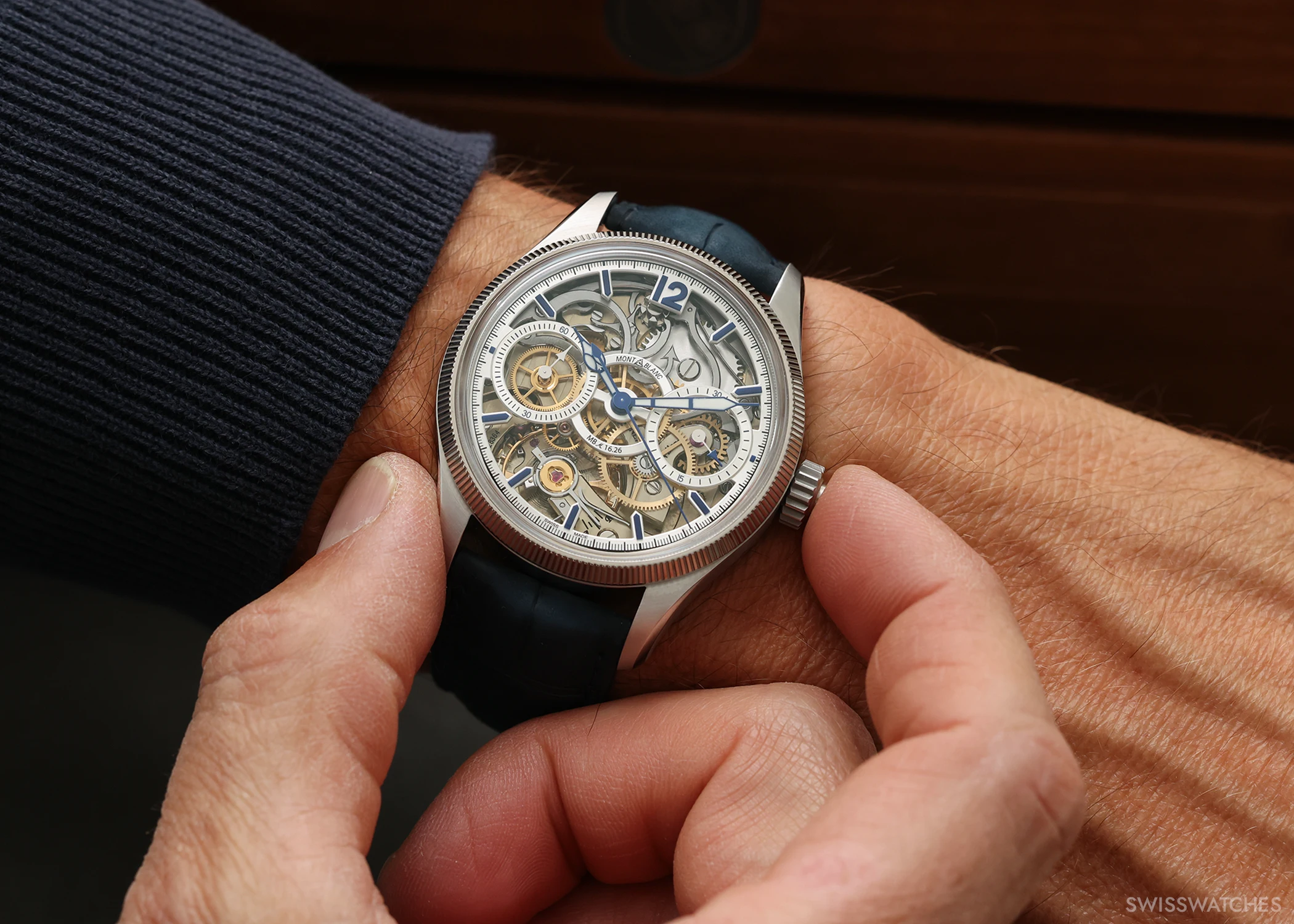
Presumably, however, Minerva’s CEO, Laurent Lecamp, currently has one priority above all others: to impress with products that command attention in their own right. Three years ago, the brand had already attracted a great deal of attention with the ‘1858 The Unveiled Minerva Chronograph’ mentioned at the outset. The steel monopusher chronograph stood out thanks to a skeletonised dial with astonishing depth. To provide particularly impressive views, the movement was turned so that the mechanics were more clearly aligned with the dial side.
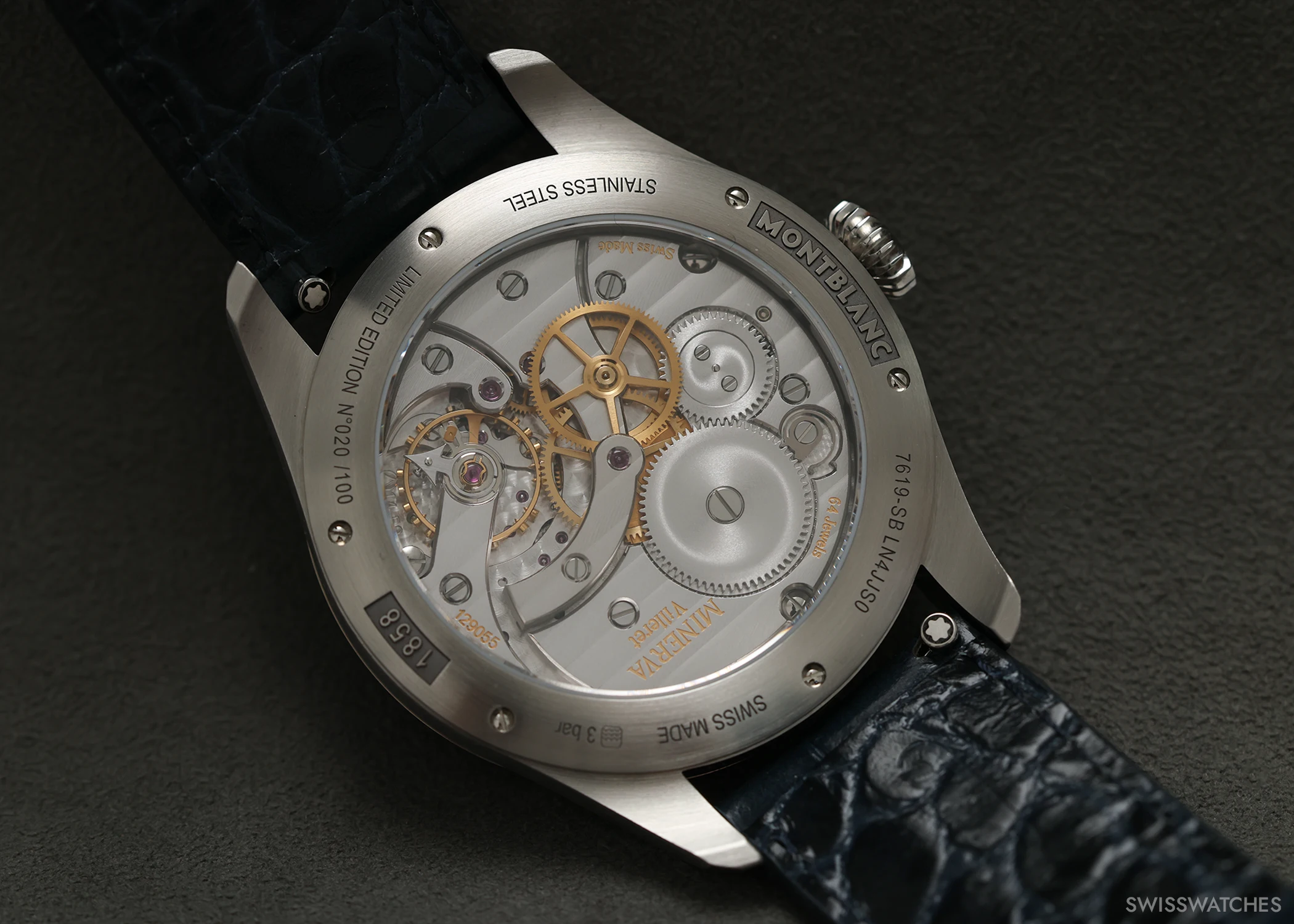
Simply turning the calibre round was, of course, not enough; instead, the design had to be adapted, as the hands were to run clockwise on these models as well. The 43-millimetre steel version was followed last year by a limited edition of 100 pieces in Minerva’s signature two-tone look, featuring a steel case and a yellow gold bezel. This version also features the Montblanc name on the dial, albeit in a much more understated manner than on the 2023 model.
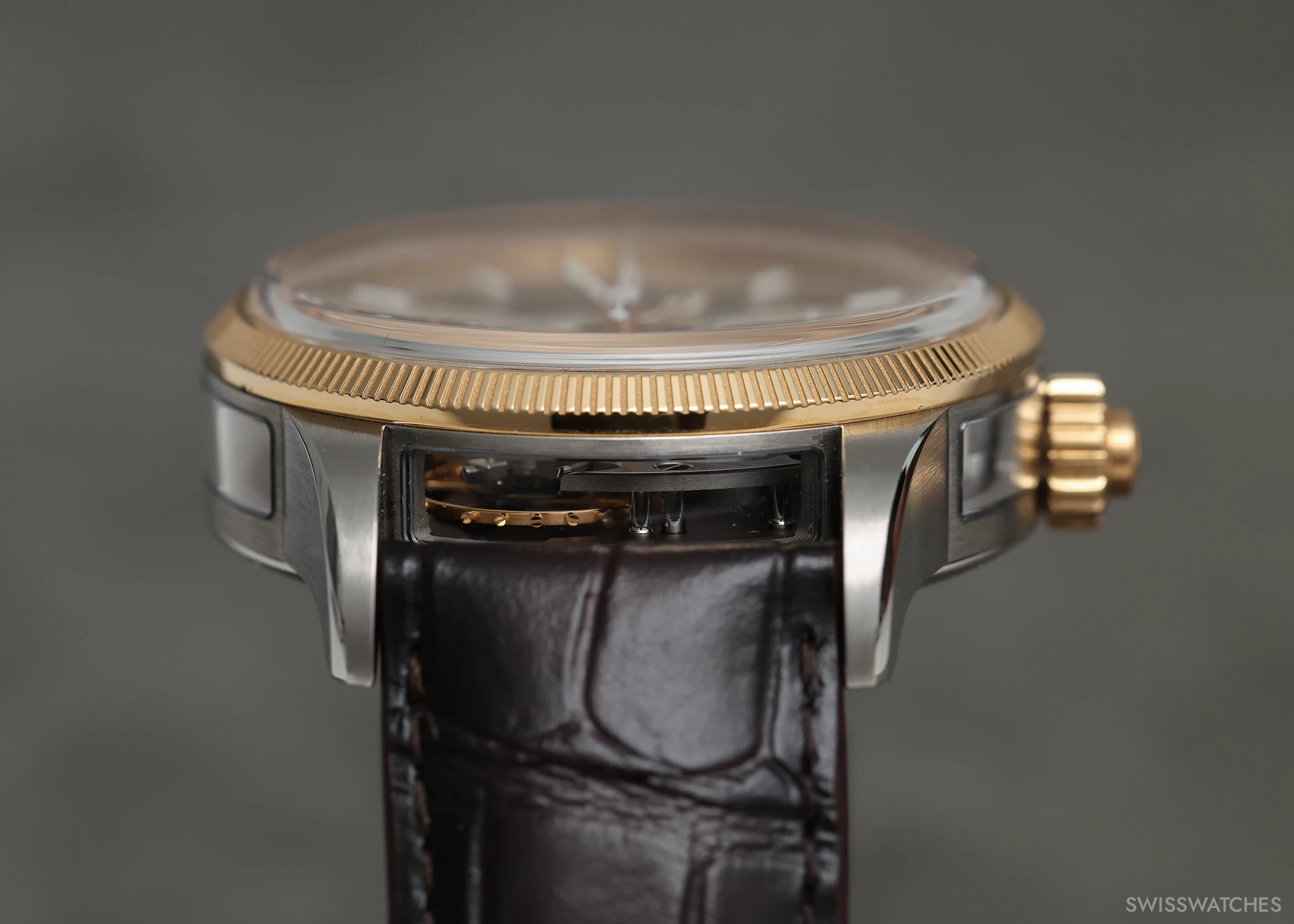
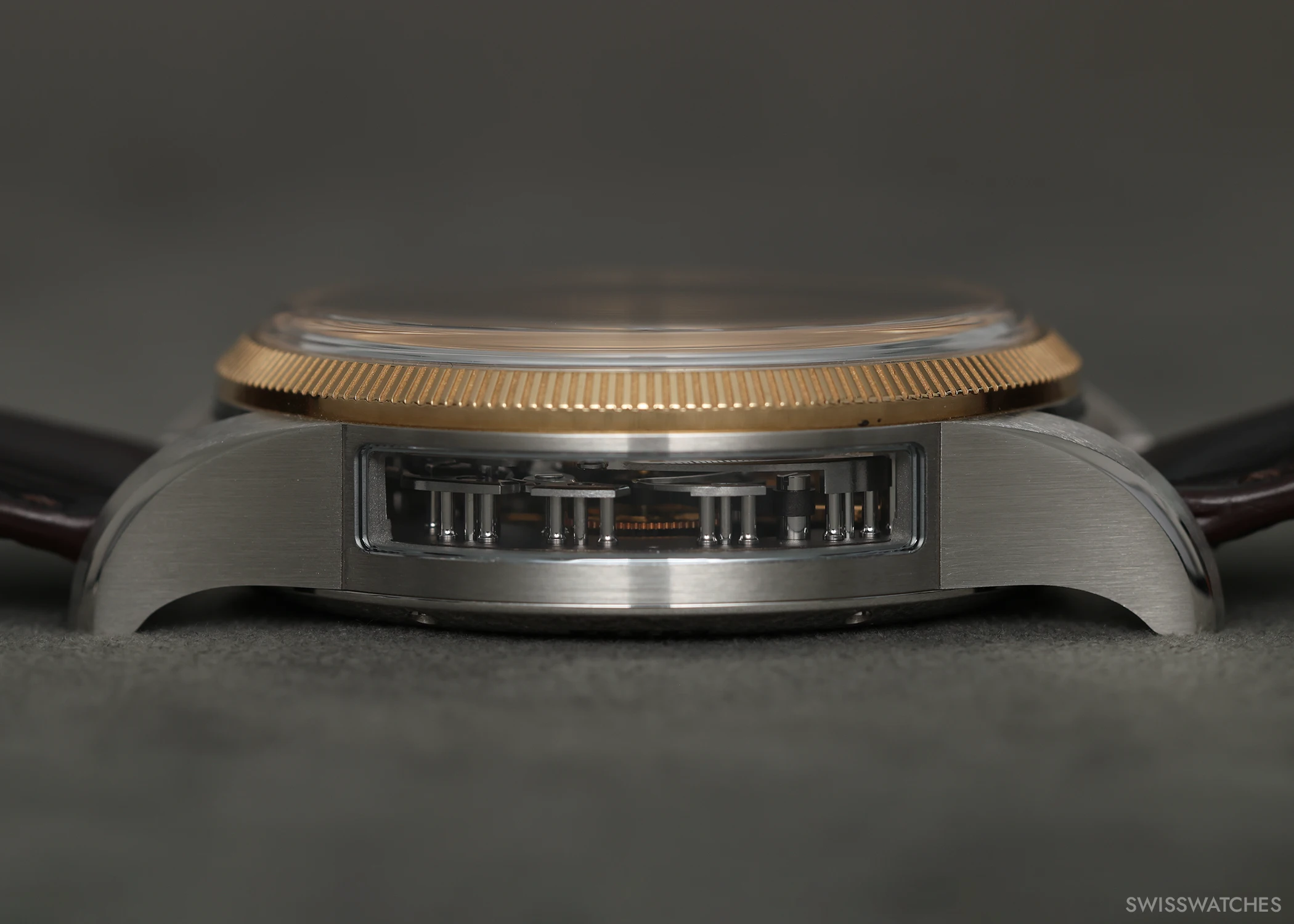
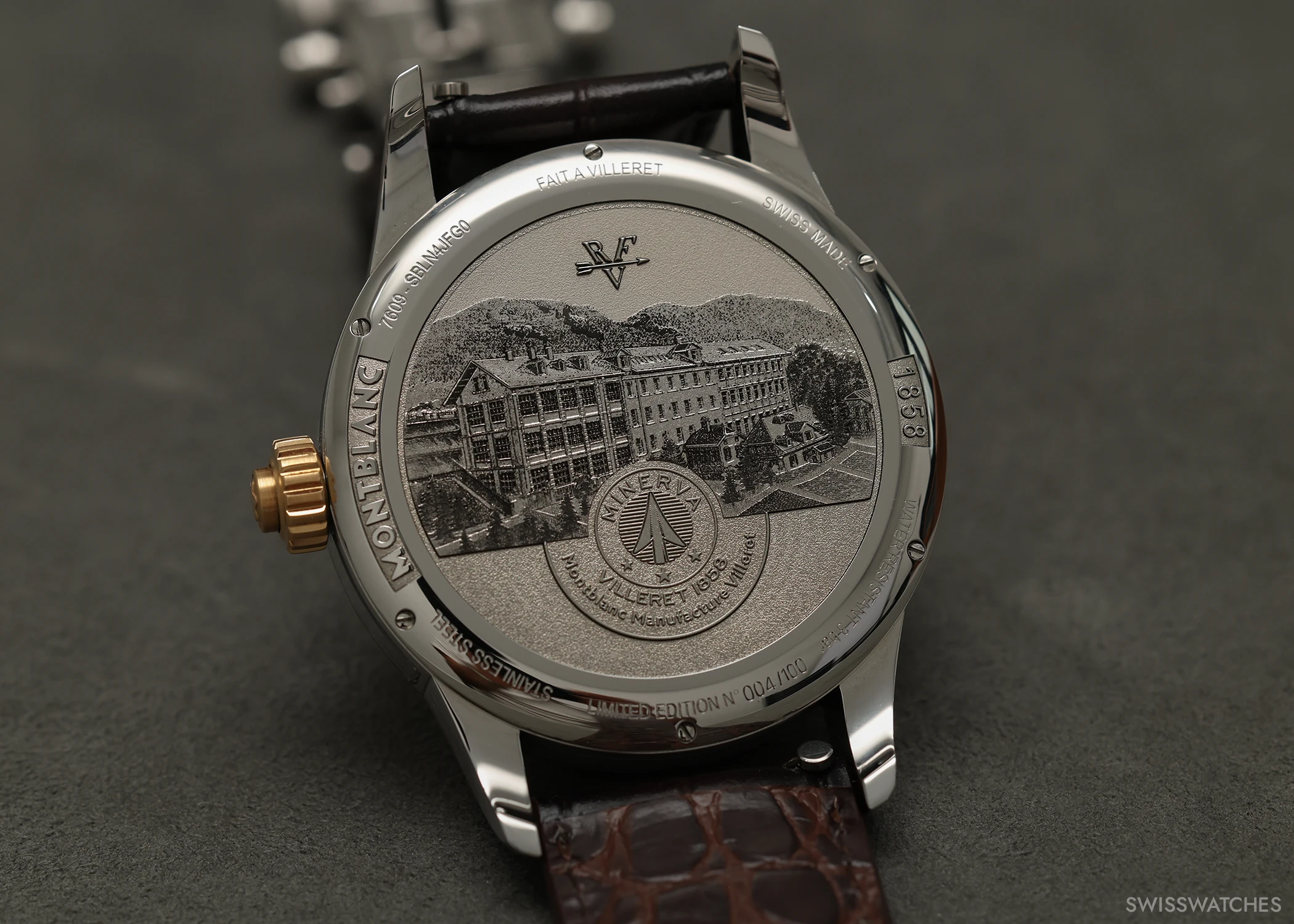
Back in 2023, a much-acclaimed Montblanc Minerva chronograph had been unveiled under the name ‘Unveiled Timekeeper’, featuring a stopwatch function controlled via the bezel: to start and stop a timing sequence, and to reset the hands to their starting position, the wearer turns the bezel slightly clockwise. This method of operation is typical of Minerva, where the technology was first used in military watches as early as 1927. Even whilst wearing gloves, fighter pilots were to be able to measure the individual stages of a flight plan with ease. “The Unveiled Crownless” now goes one step further: this three-hand watch with a small seconds dial does away with the crown entirely.
The result is a watch that serves both as a conversation starter amongst the general public and as a topic for technical discussion amongst collectors. A crown has become such an integral part of a watch’s overall appearance that its absence initially seems like a glitch in the matrix. Can this be, and should it be? But of course it can. After all, the Belgian-Swiss watch brand Ressence has built an entire collection without a crown, and IWC, for example, has also positioned itself in this segment this year with the Pilot’s Venturer Vertical Drive. In this context, the Minerva appears to be the most classic choice. Whilst its lack of a crown catches the eye instantly, any sense of unease is countered by a design that is harmonious and true to Minerva’s design tradition. And once the eye has got used to what appears to be a photo-editing error, it becomes clear: it is only without a crown that a timepiece can, ultimately, present itself as truly symmetrical.
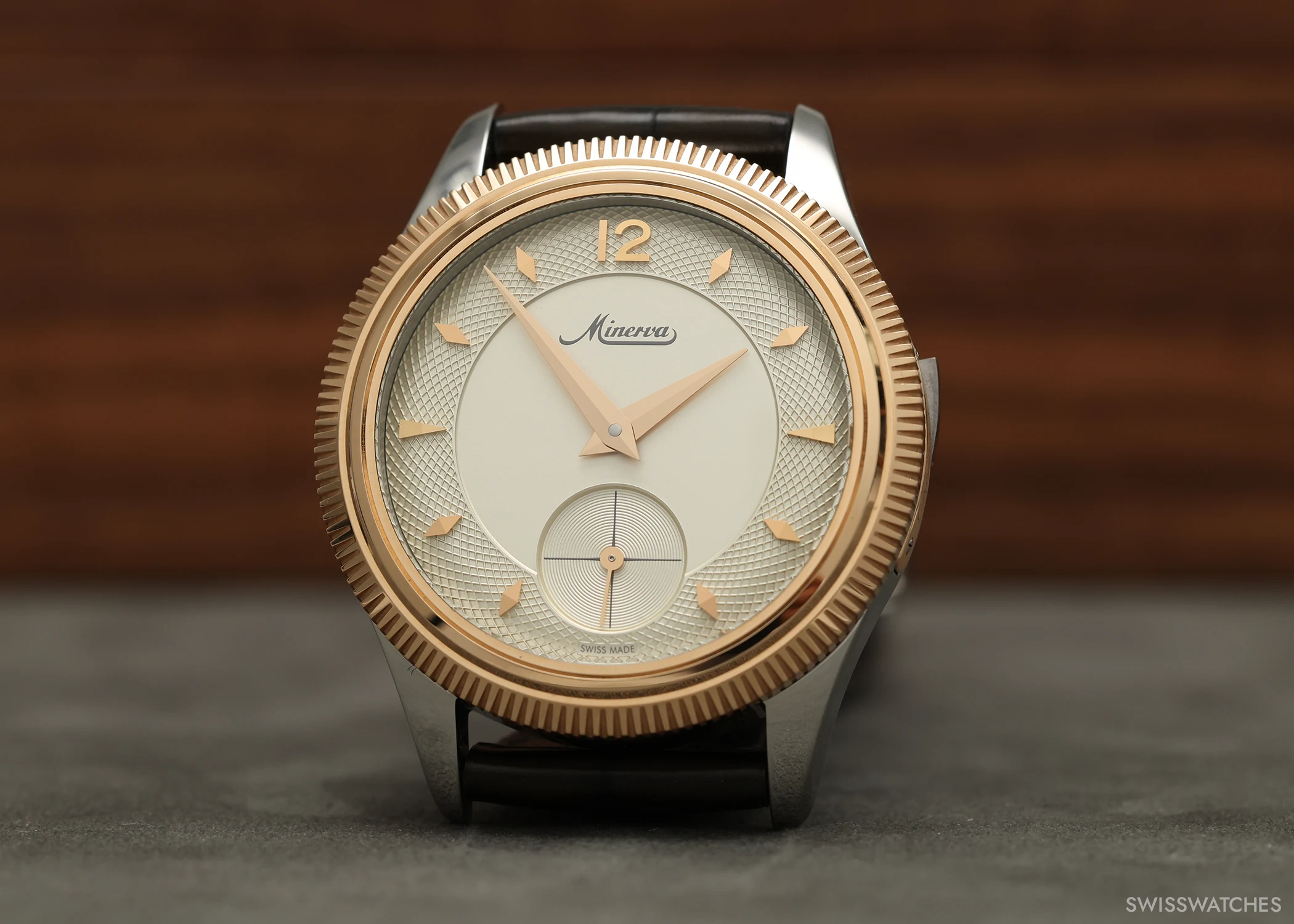
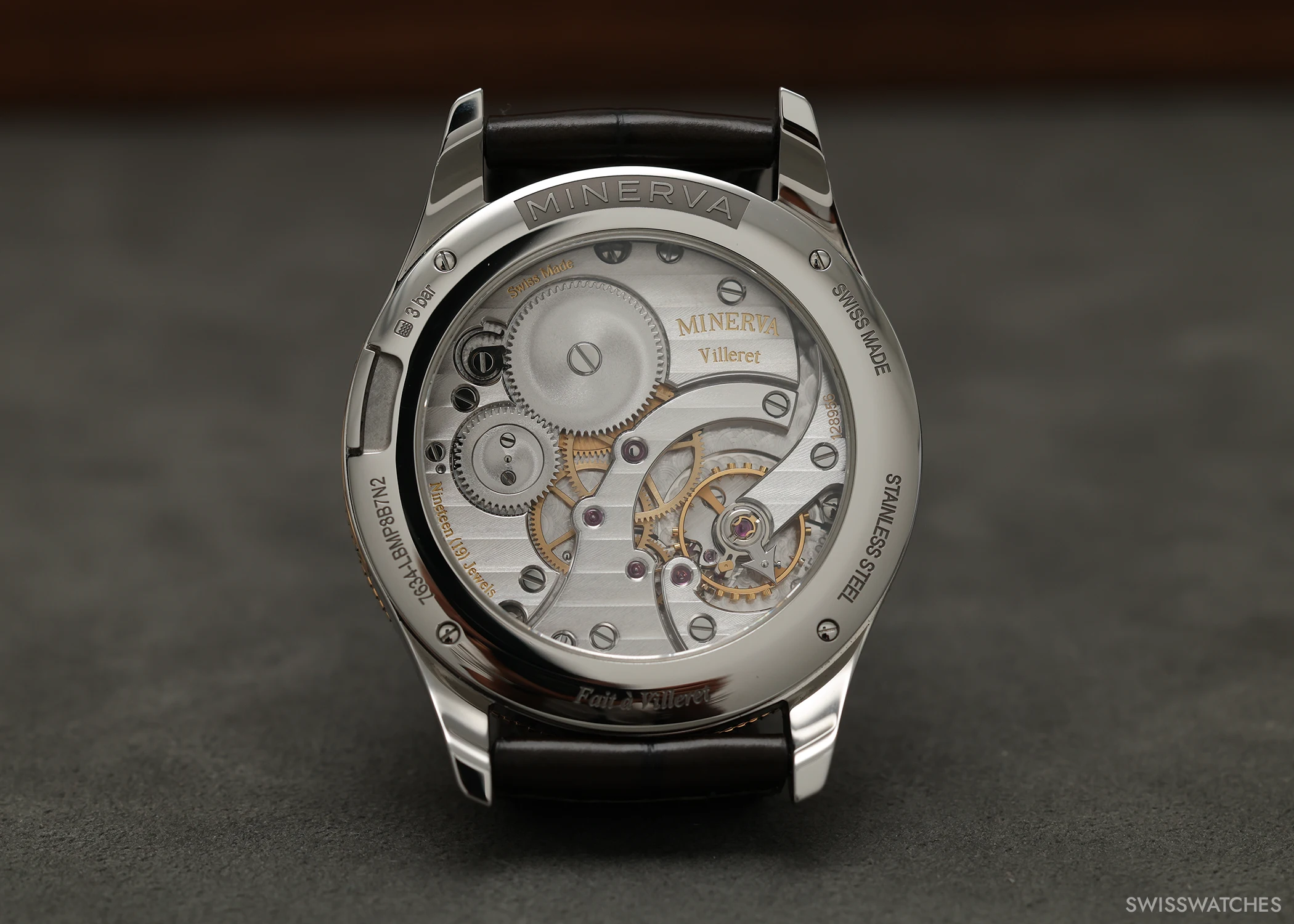
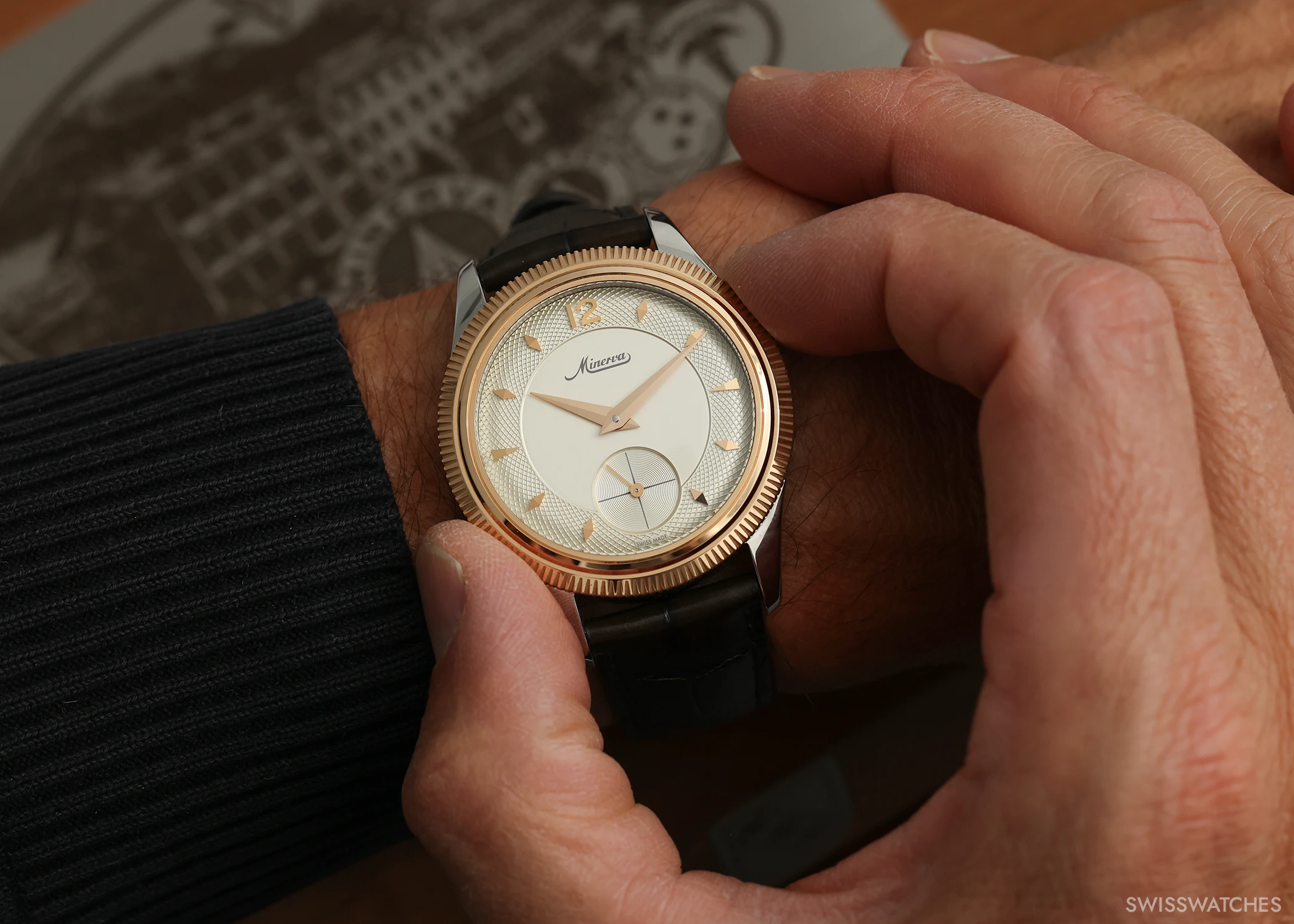
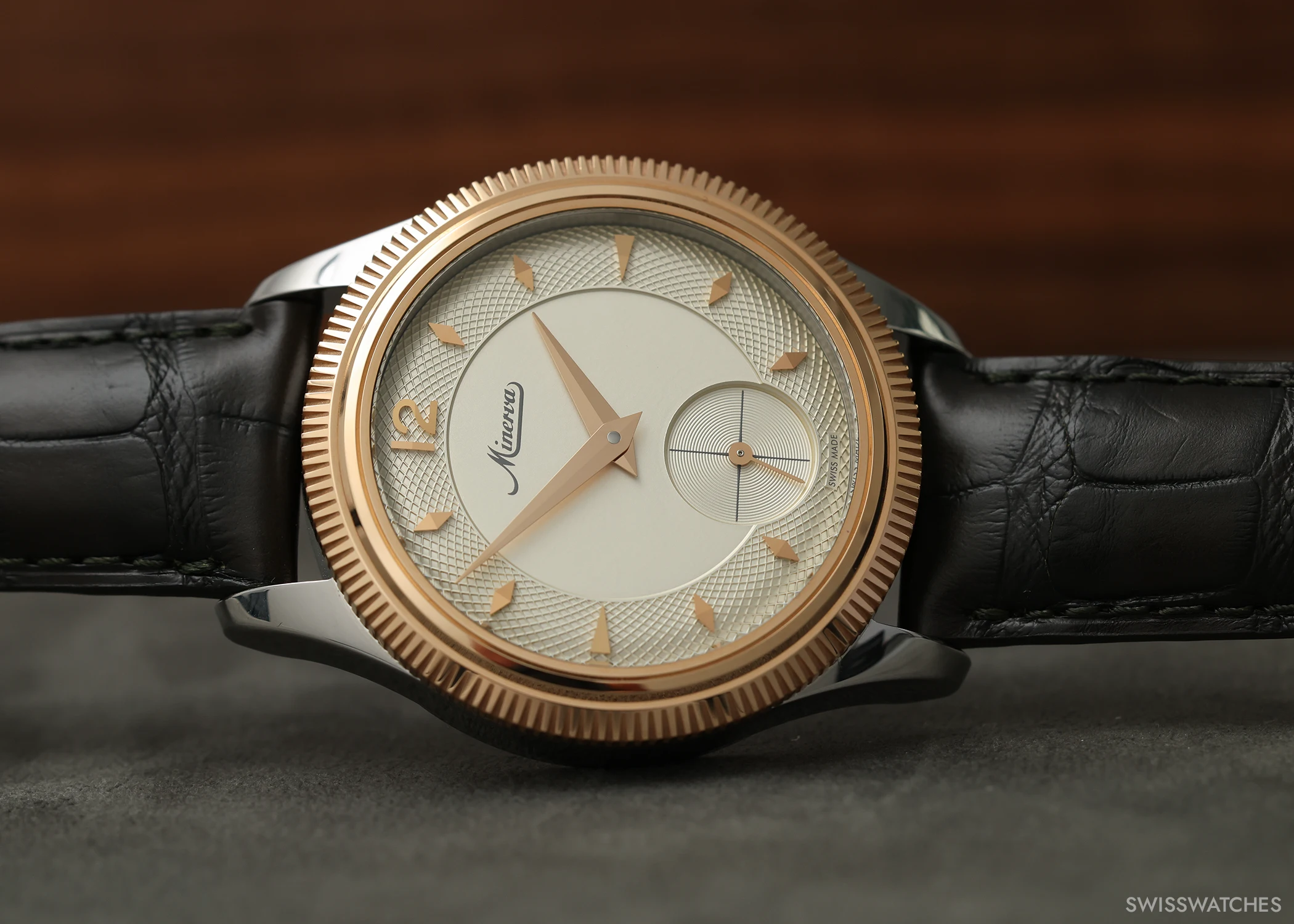
To achieve this truly special ‘wow’ effect, the new hand-wound M15.08 calibre with small seconds was developed in Villeret. A lever on the 3 o’clock side of the case back frame allows the movement to be wound via the bezel when the lever is pressed, or the time to be set when the lever is pulled out. As this lever is located on the underside, the harmonious upper surface of the watch remains flawless.
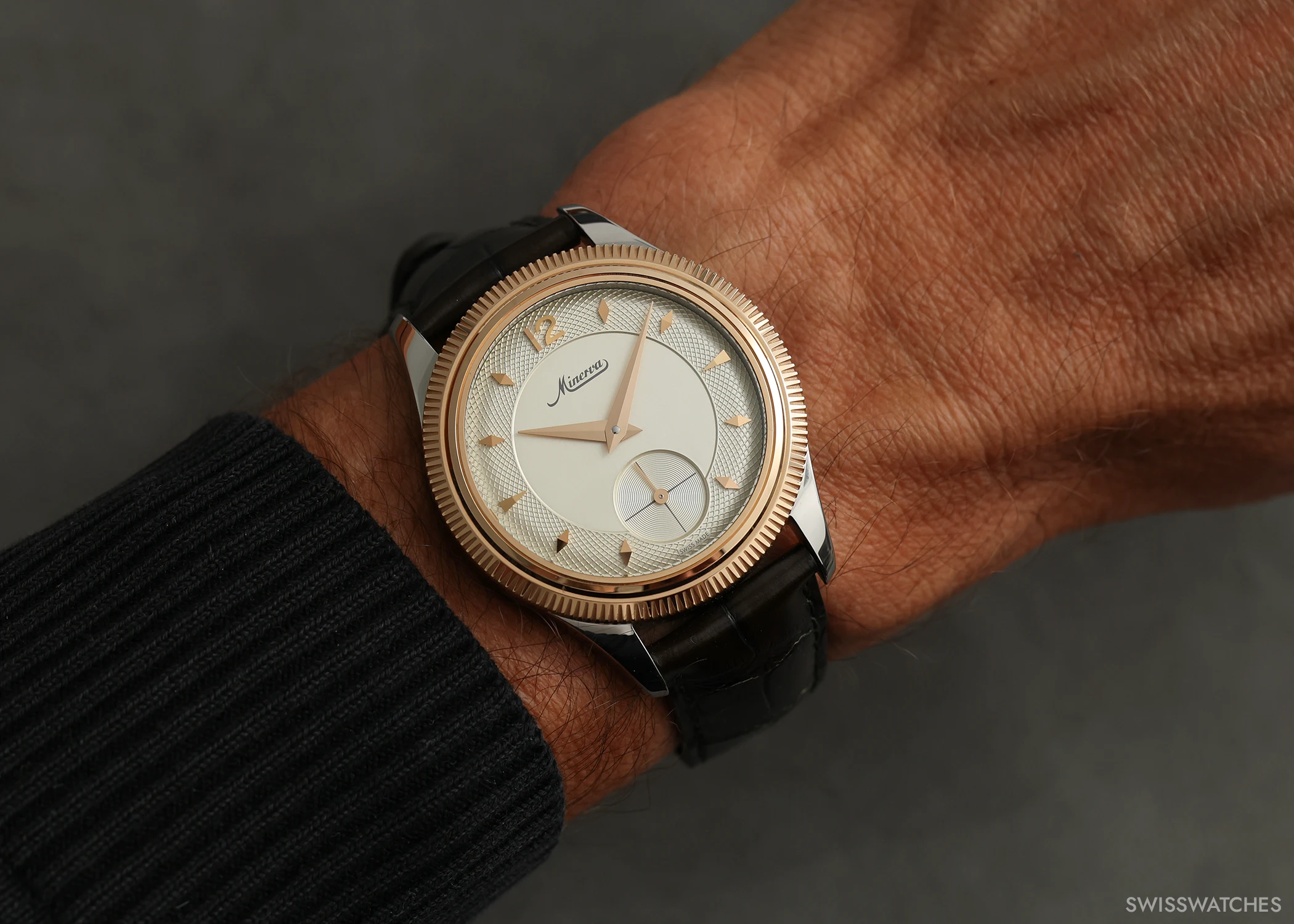
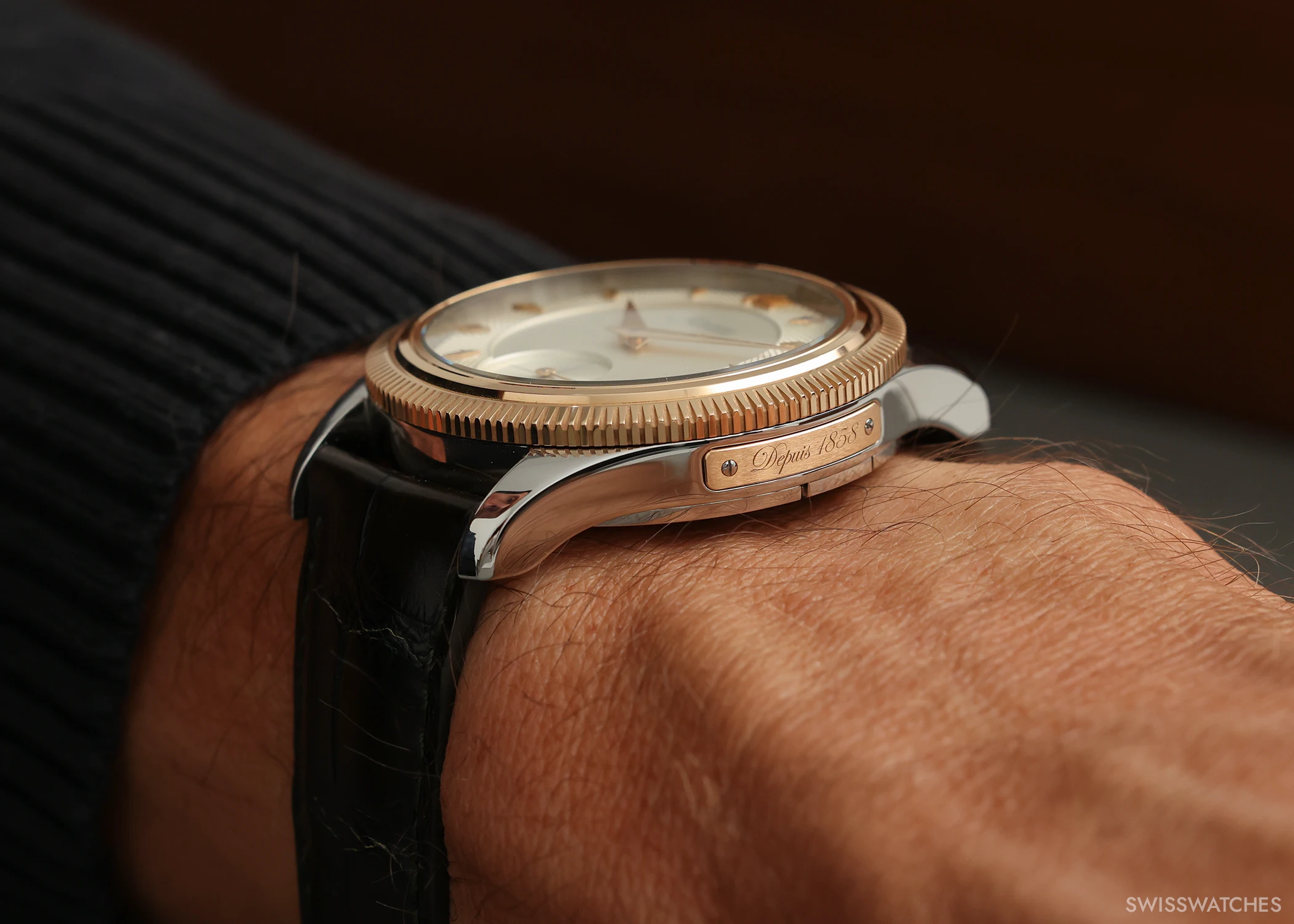
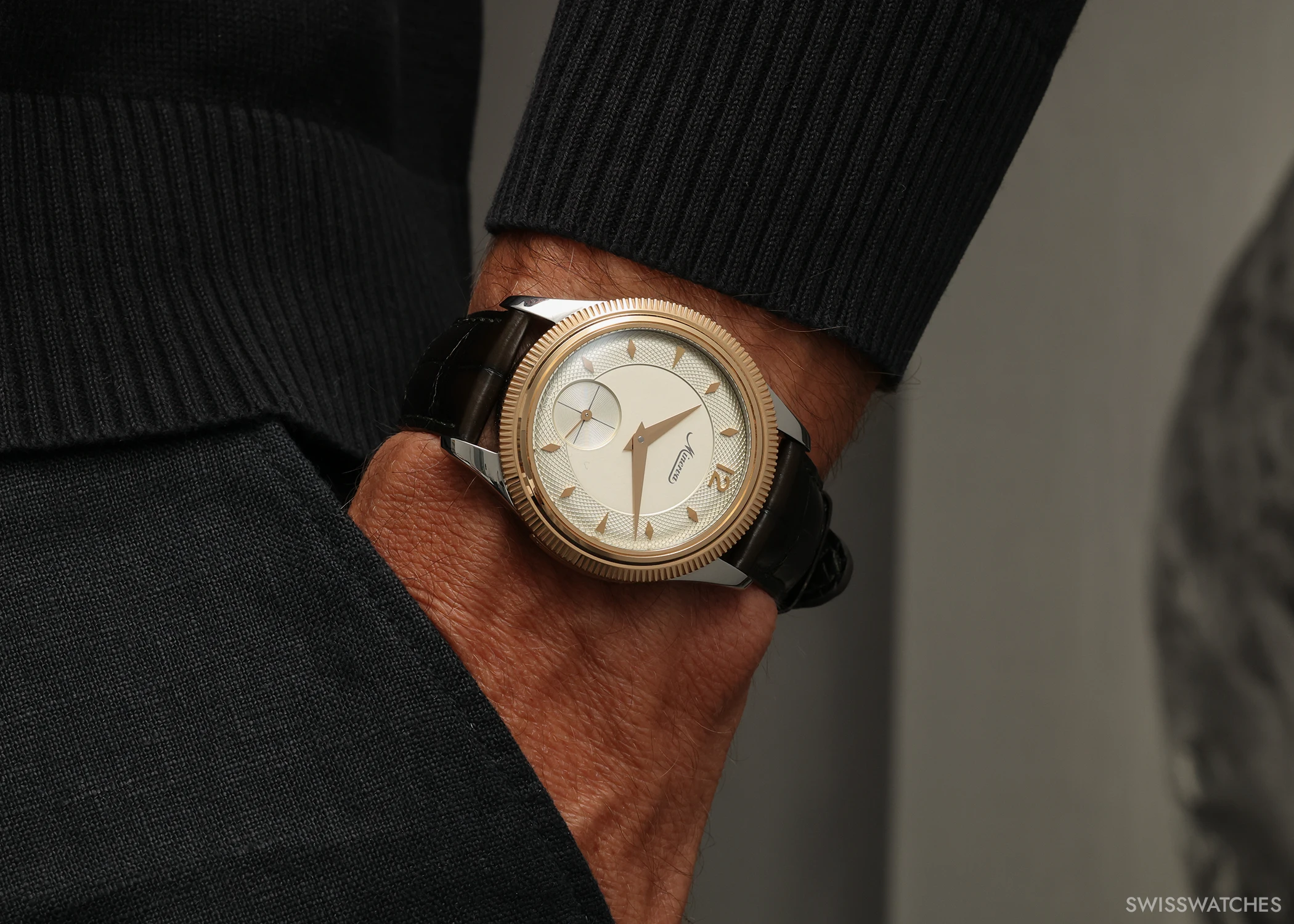
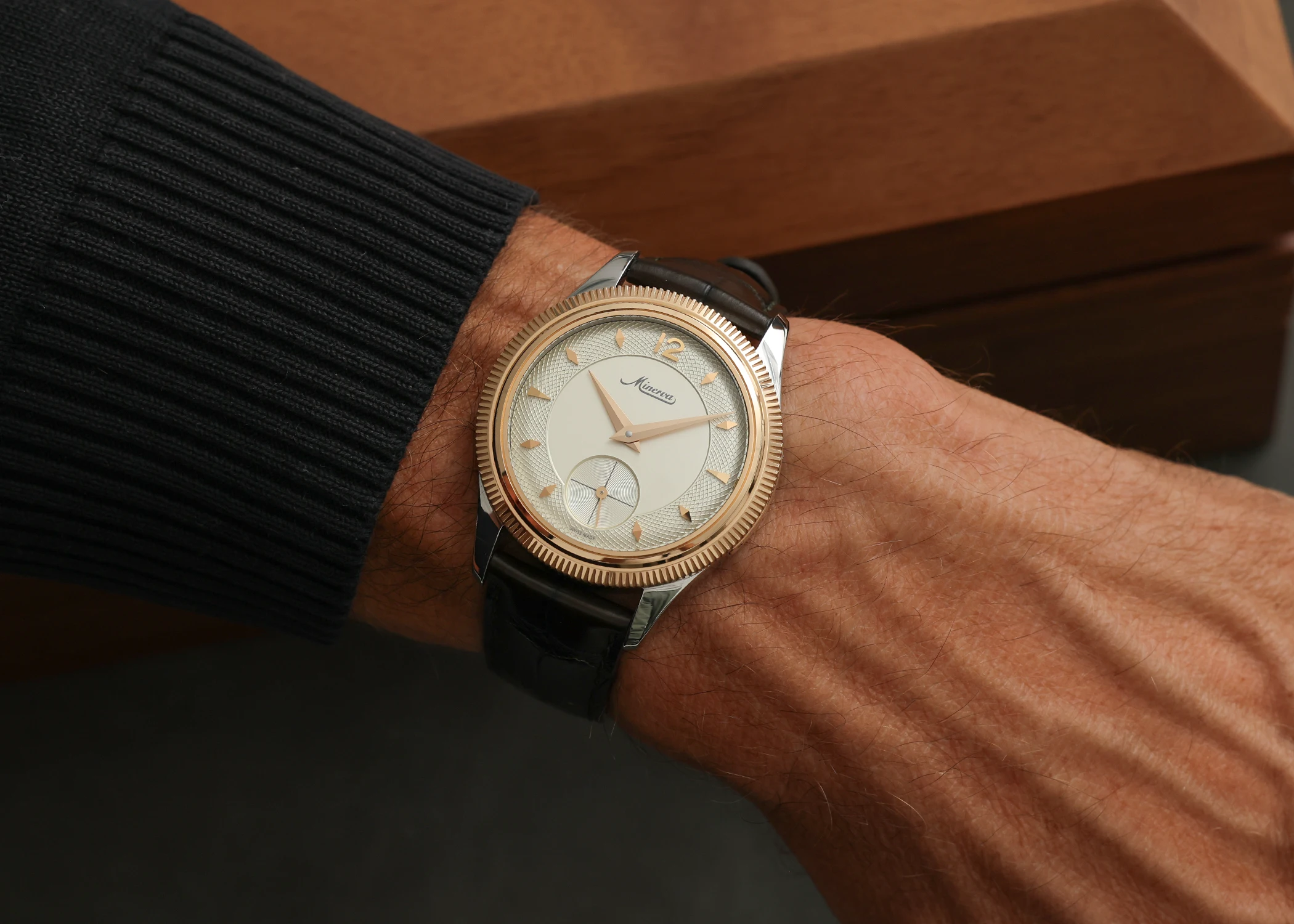
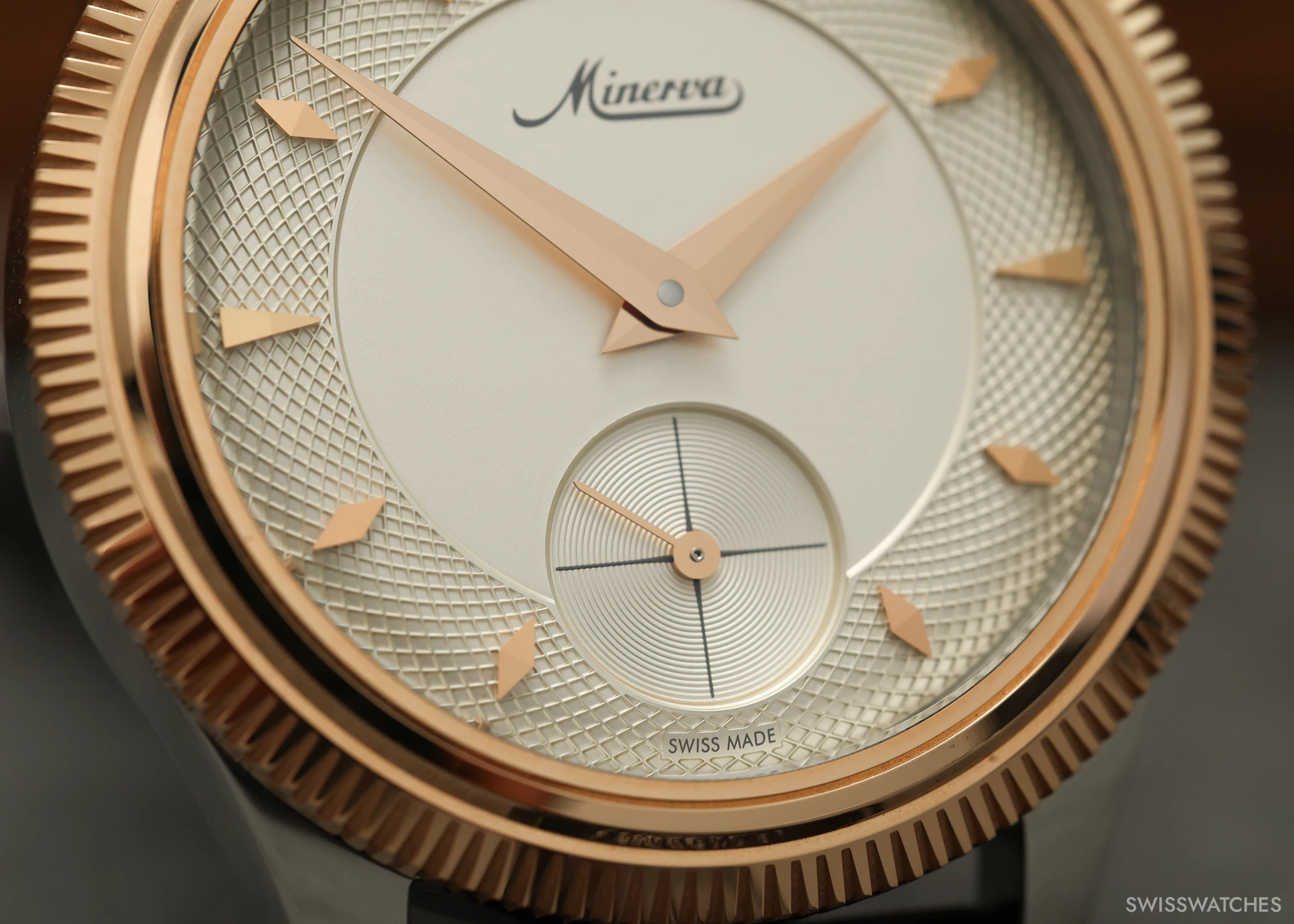
The 41.5-millimetre case is crafted from stainless steel and rose gold and is 12 millimetres in height. For the opaline guilloché dial, Minerva drew inspiration from a model from the 1950s; gold-plated hour markers harmoniously complement the two-tone colour scheme. In Villeret, this model is regarded as a watch for ‘stylish occasions’, though it doesn’t take much imagination to picture it on the wrist of a friend with a more relaxed sense of style. Ultimately, this €39,000 watch does not dictate a particular look; instead, it simply evokes a world of emotion with the charm of days gone by, which will inspire enthusiasm among a wide variety of owners.
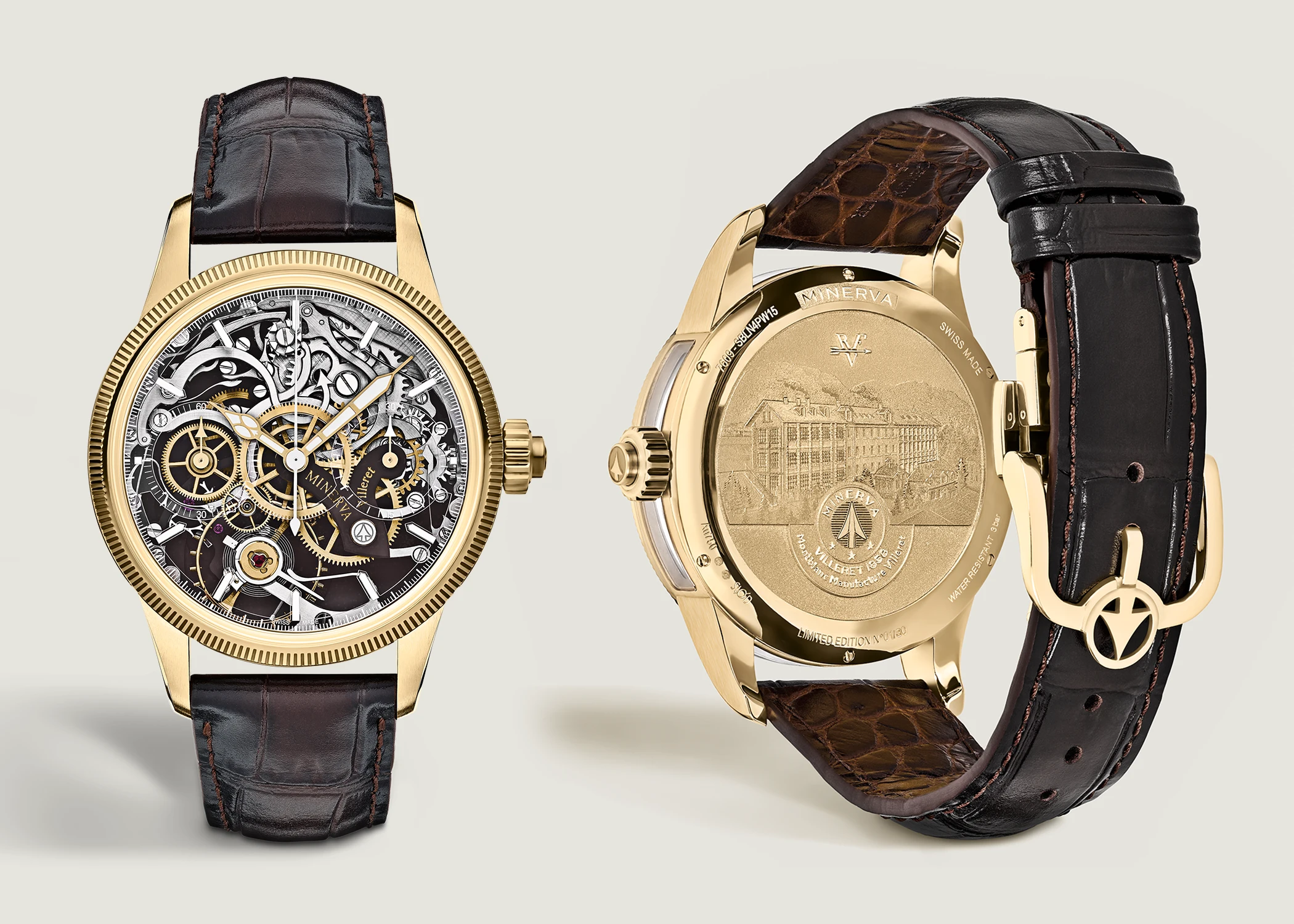
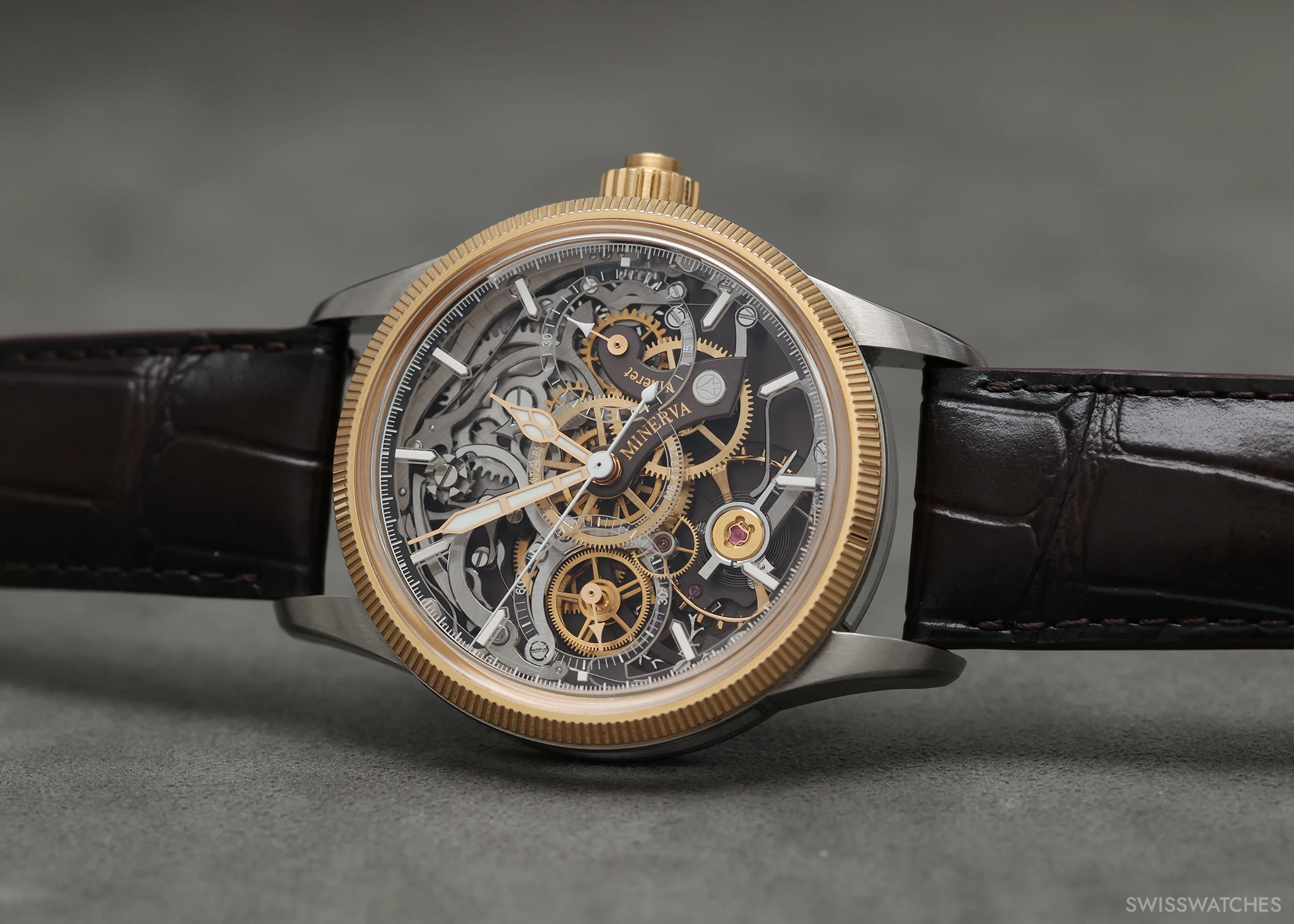
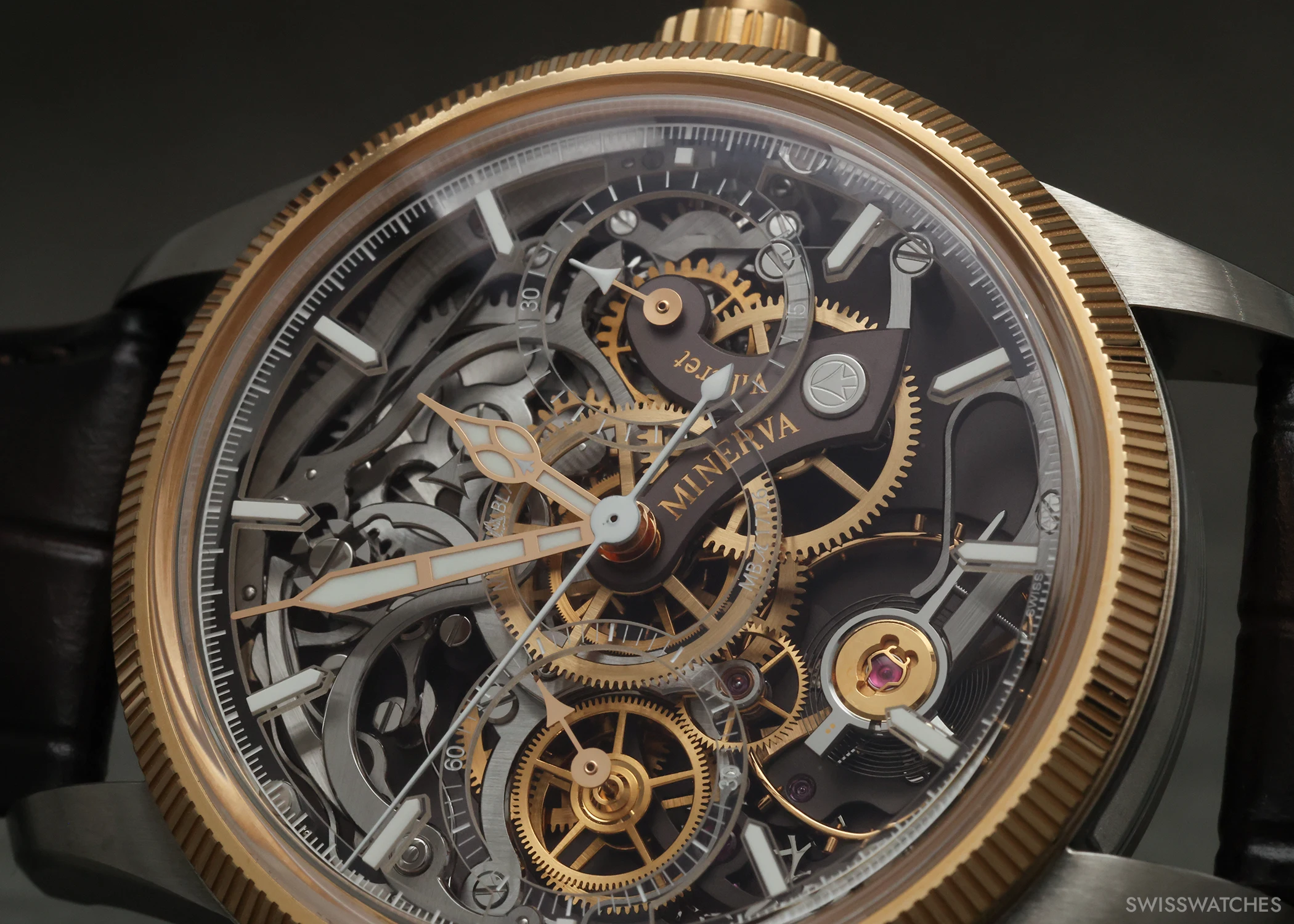
This year, a version of this truly impressive calibre, limited to 30 pieces and housed in a yellow gold case, was presented as the ‘Pure Minerva’. 43 millimetres in diameter, 14.78 millimetres in height, crafted entirely from gold and, above all, maximally skeletonised. The watch makes a statement. Striking on the wrist, exuding quality, and infinitely delicate upon closer inspection. Whilst elegant restraint characterises Minerva’s aesthetic, the brand is embarking on a new path with this model with great self-assurance.
Lecamp can rely on an exclusive group of collectors: the M58 Club. Since its foundation in 2022, this club has comprised exactly 58 collectors of countless nationalities who maintain close contact with the manufacture, and for whom limited editions featuring entirely new calibres are produced. Strictly speaking, entry into this exclusive club is only possible upon the purchase of such a Club Minerva. However, a new enthusiast can only join once another member vacates their place in the club.
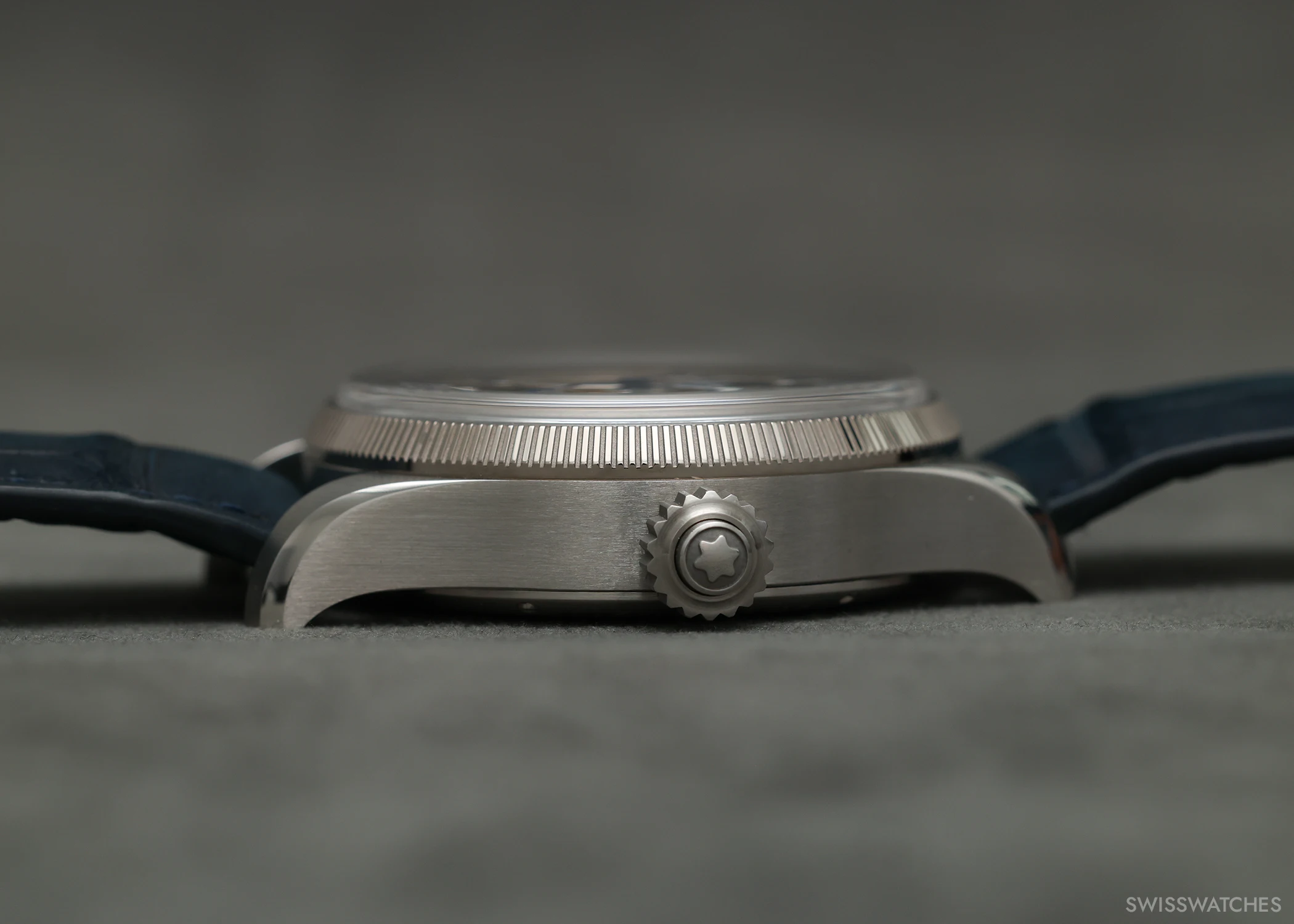
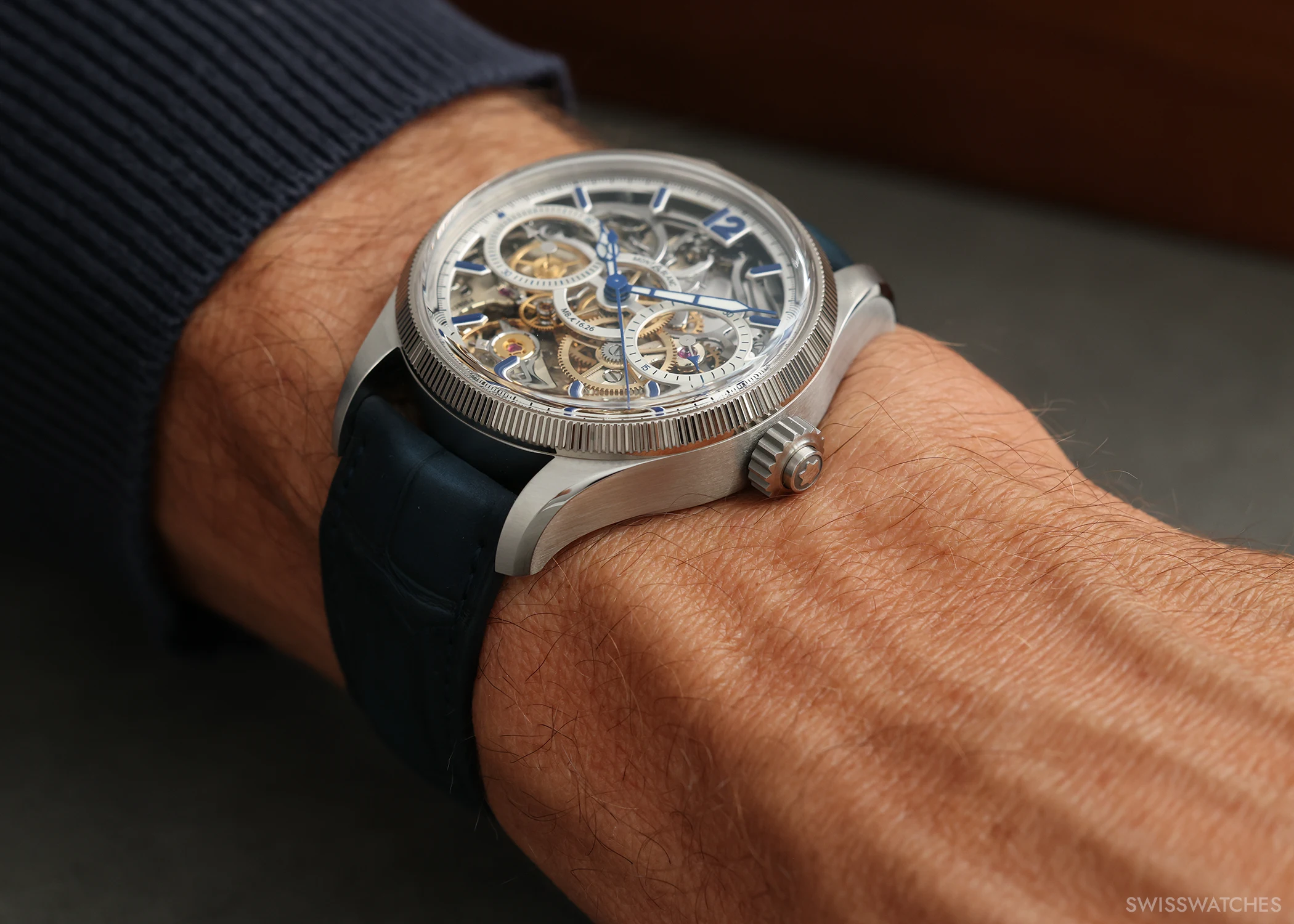
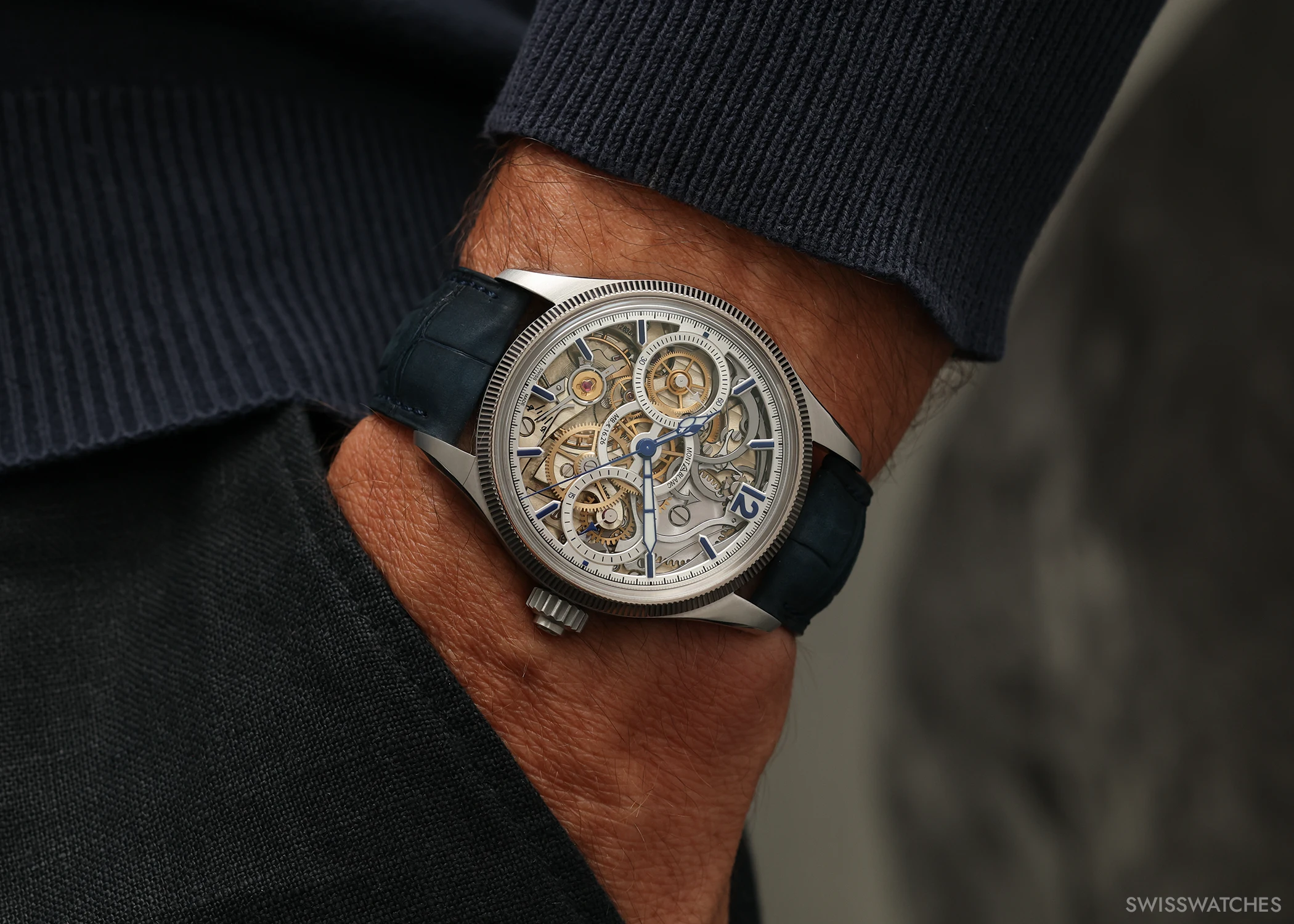
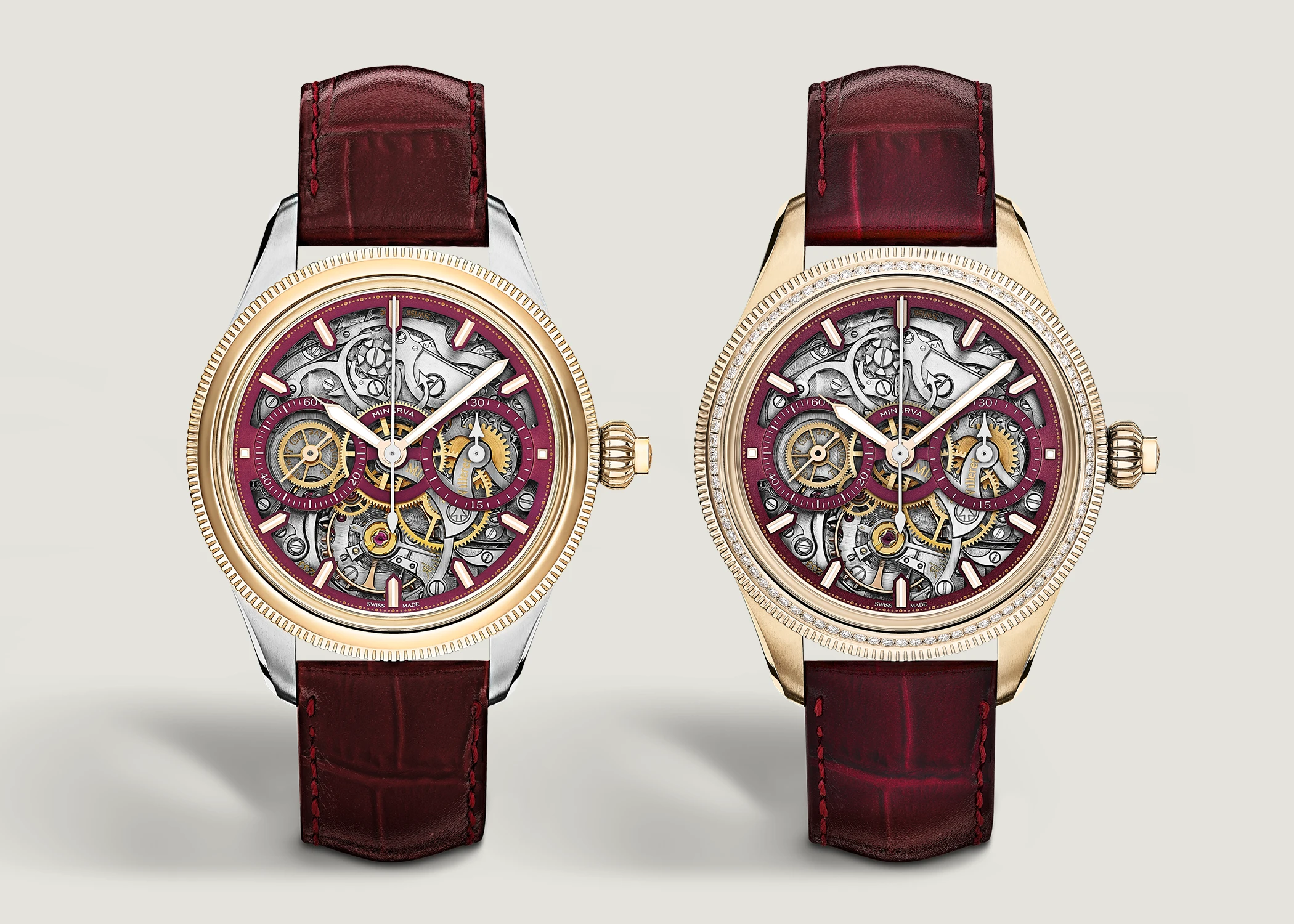
The number 58, inspired by the year the company was founded, is a correspondingly significant figure for Lecamp. This is also reflected in ‘The Unveiled Secret Limited Edition 58’, which has been accompanied by an even rarer variant than ‘The Unveiled Secret Limited Edition 18’. Both are monopusher chronographs, the size of which has been reduced from 43 to a more discreet 39 millimetres. In the 58 variant, the case is made of stainless steel and the bezel of rose gold, giving it a very classic look. In the version limited to 18 pieces, the case is crafted from rose gold, and the rose gold fluted bezel is set with 84 brilliant-cut diamonds.
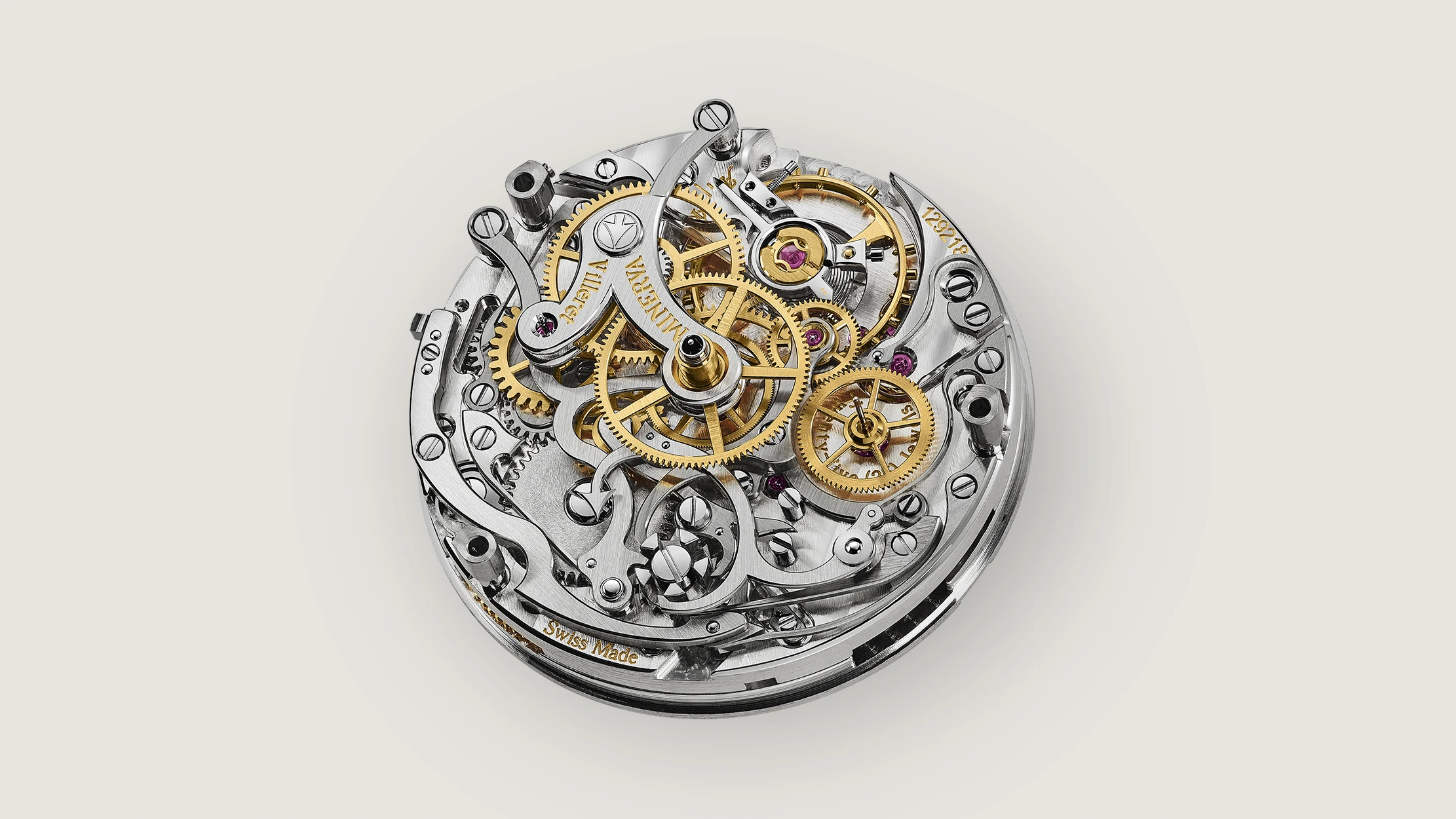
However, even the presence of gemstones will not distract viewers from the fact that the undisputed centrepiece of these models is the skeletonised monopusher chronograph calibre with a column wheel and horizontal clutch in an inverted configuration. It is watches such as these, with their finishing and unique construction, that demonstrate, on the one hand, how Minerva nurtures its collector community, whilst at the same time highlighting how the regular collection can be further expanded.
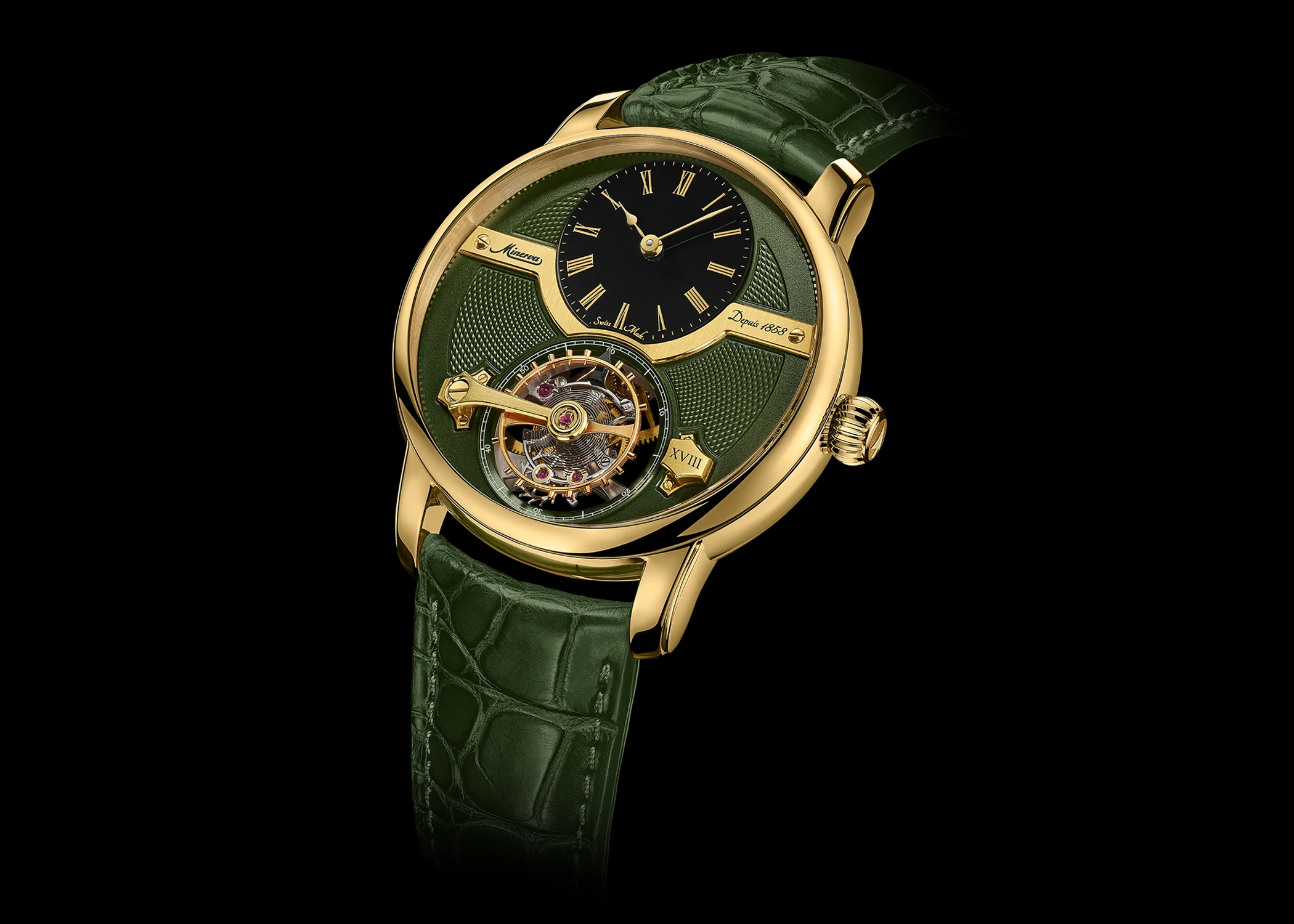
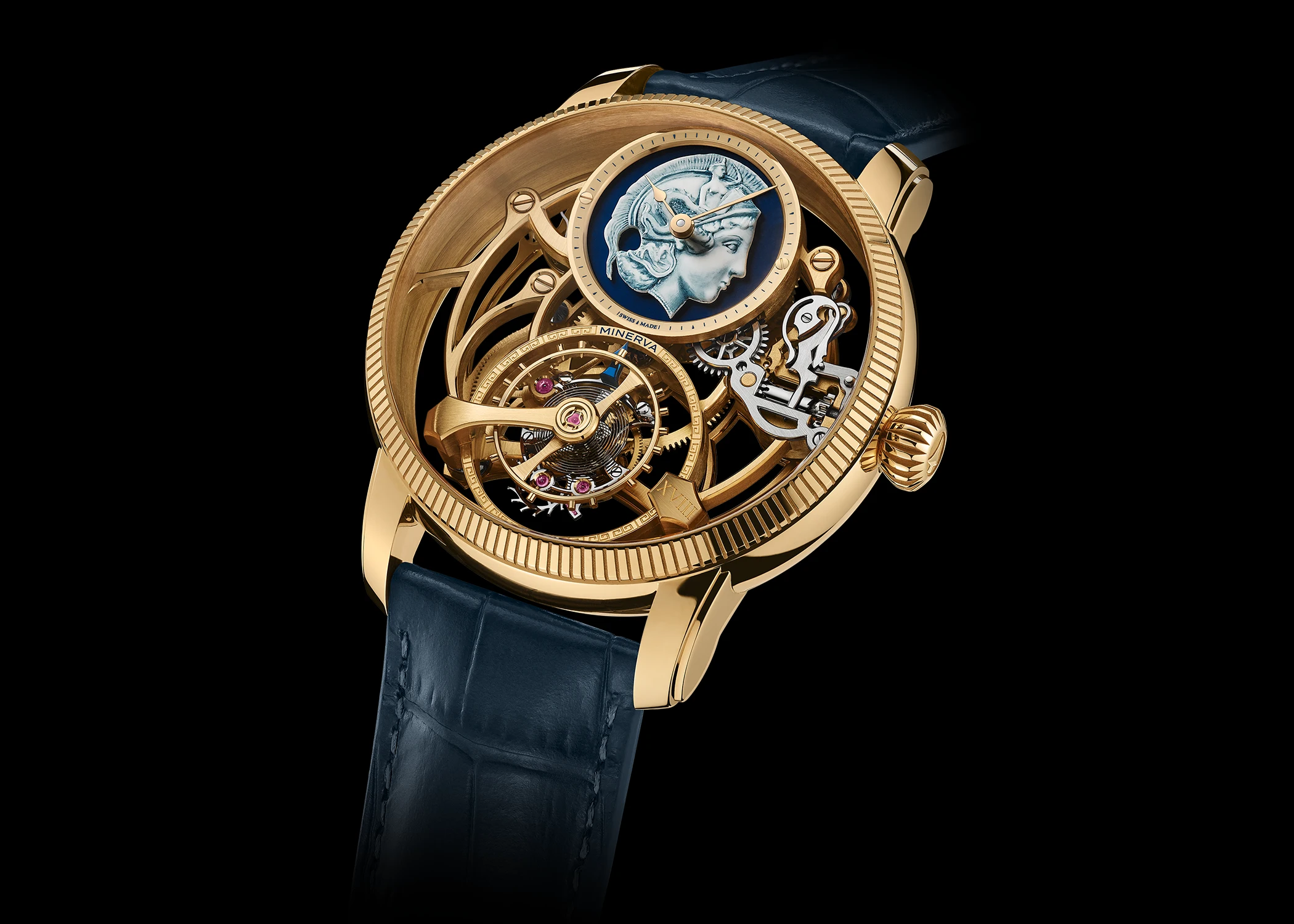
That said, it is unlikely that Villeret is planning a flurry of new releases in the coming years. The further development of existing models, the interplay of metals, and selected highlights such as the Exo Tourbillon – limited to 18 pieces, with a yellow gold case and an olive-green dial featuring a black onyx sub-dial for the time display – or the skeletonised version of this 44.8-millimetre timepiece – give a sense of how the brand intends to continue forging its own path as an independent brand within the Richemont Group.
The fact that the Roman Minerva was revered not only as the patron goddess of craftsmen but also as the goddess of war seems fitting in this context. Virtually everything that is currently happening in Villeret appears to be strategically well thought out. The small team there aims to make its mark in a market that is as popular as it is crowded, and the new releases in its first year as an independent brand are likely not only to attract growing interest amongst collectors, but it will also certainly catch the competitors’ attention.
Enter your email address and we'll send you a link to reset your password.
We have sent a confirmation link to . Open it to activate your account.