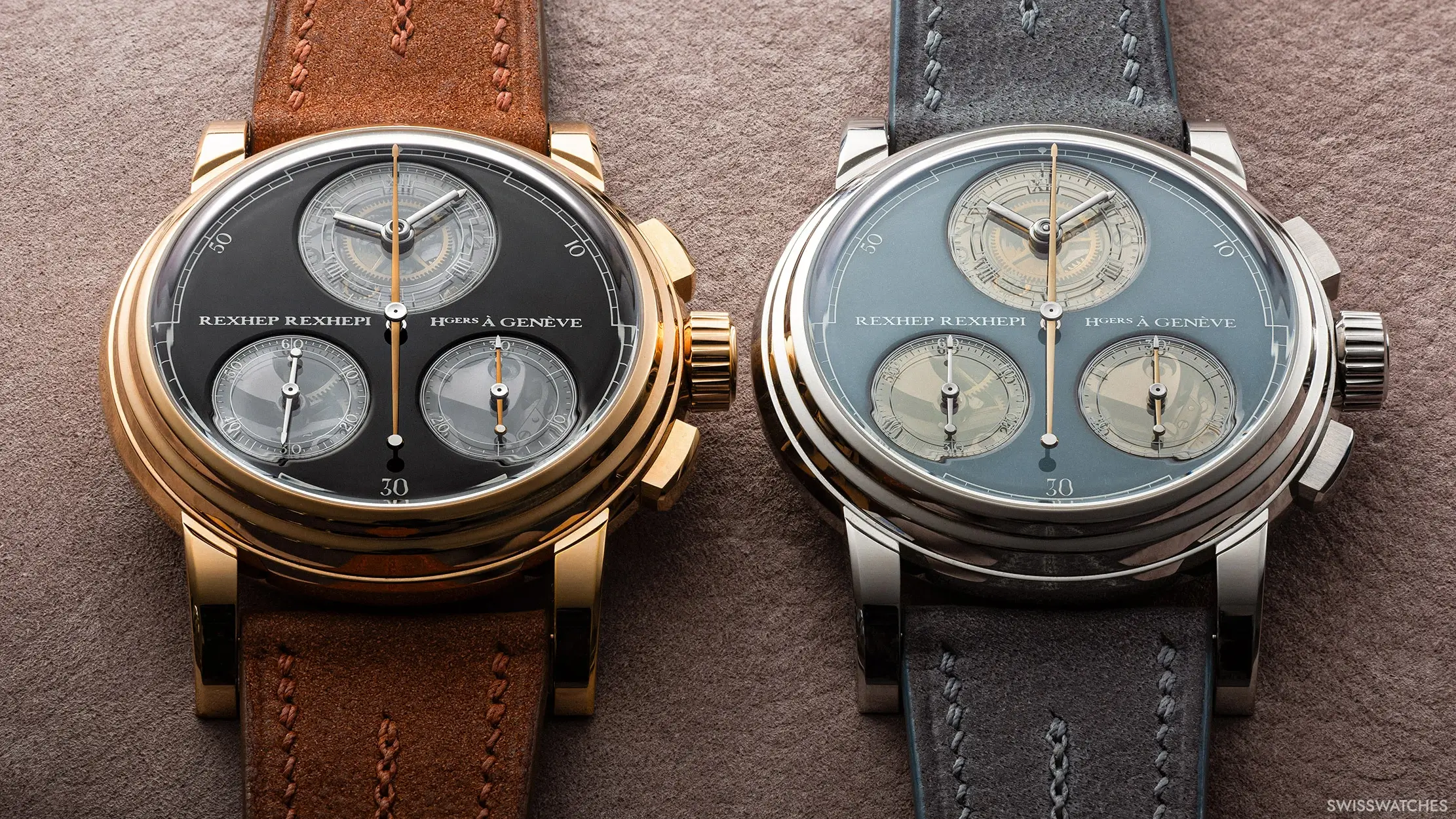
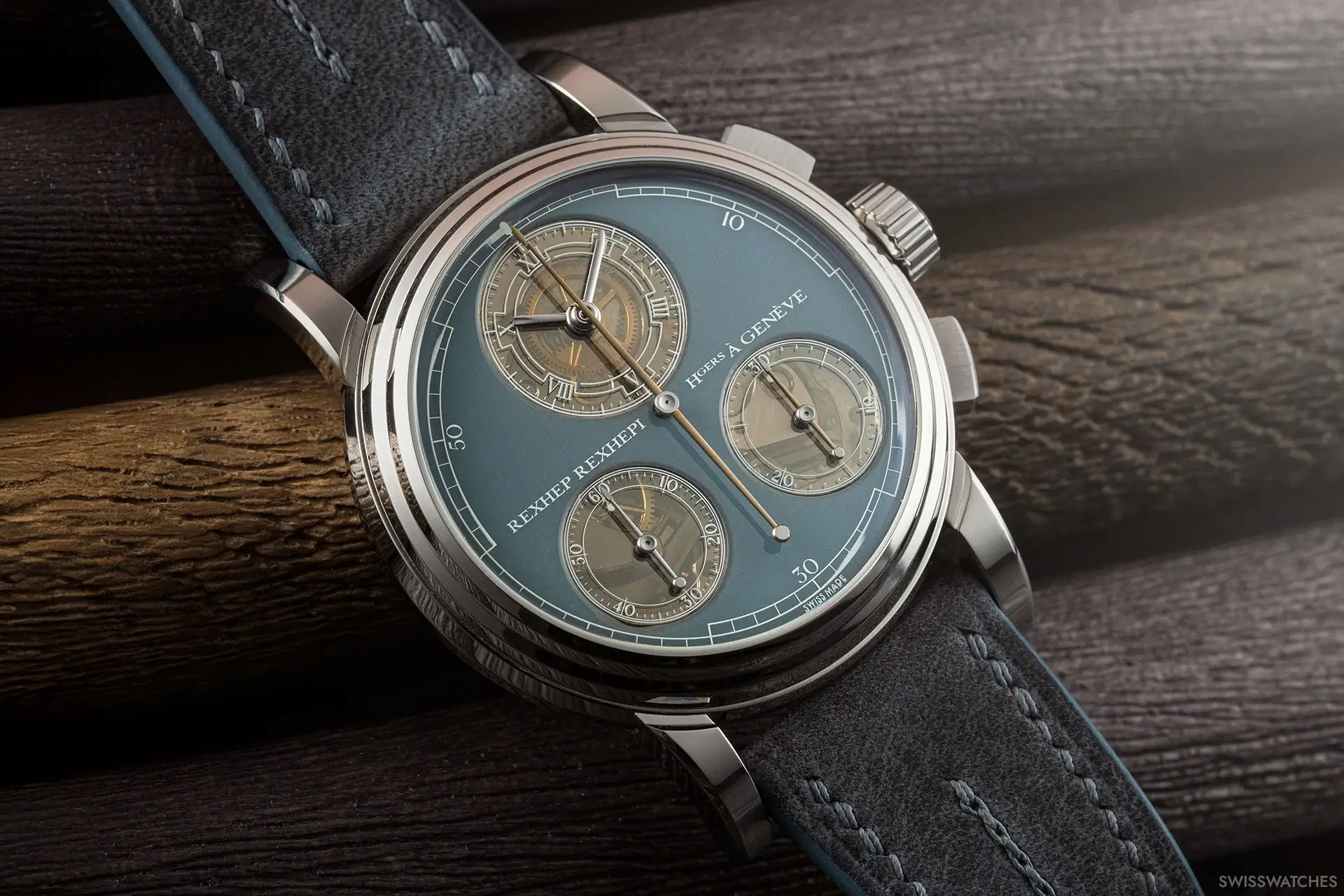
Rexhep Rexhepi RRCHF Flyback Chronograph: a new integrated flyback chronograph with Grand Feu enamel dial, refined proportions and movement built from the outside in.
With the RRCHF, the movement did not come first — the watch did. Only once the dial, case and proportions had been defined did Rexhep Rexhepi develop a new flyback chronograph movement with an instantaneous minute counter, exclusively for this one model.
Rexhep Rexhepi’s new RRCHF chronograph marks an important moment in his development. It is his first new serially produced watch since the Chronomètre Contemporain II in 2022, yet it also seems to carry forward something of the more experimental energy that had already surfaced in the Antimagnétique Unique Piece for Only Watch 2023.
The result is a watch that feels less like a break than a concentration: classical in spirit, yet markedly more ambitious in technical terms; disciplined in its proportions, yet bolder in its architecture. Rexhep Rexhepi himself describes it as an expression of “performance”. In fact, the watch brings together a flyback chronograph with an instantaneous jumping minute counter, a Grand Feu enamel dial, generous hand-finishing, and a remarkably integrated conception that shows just how much of the work now takes place within his own Atelier.
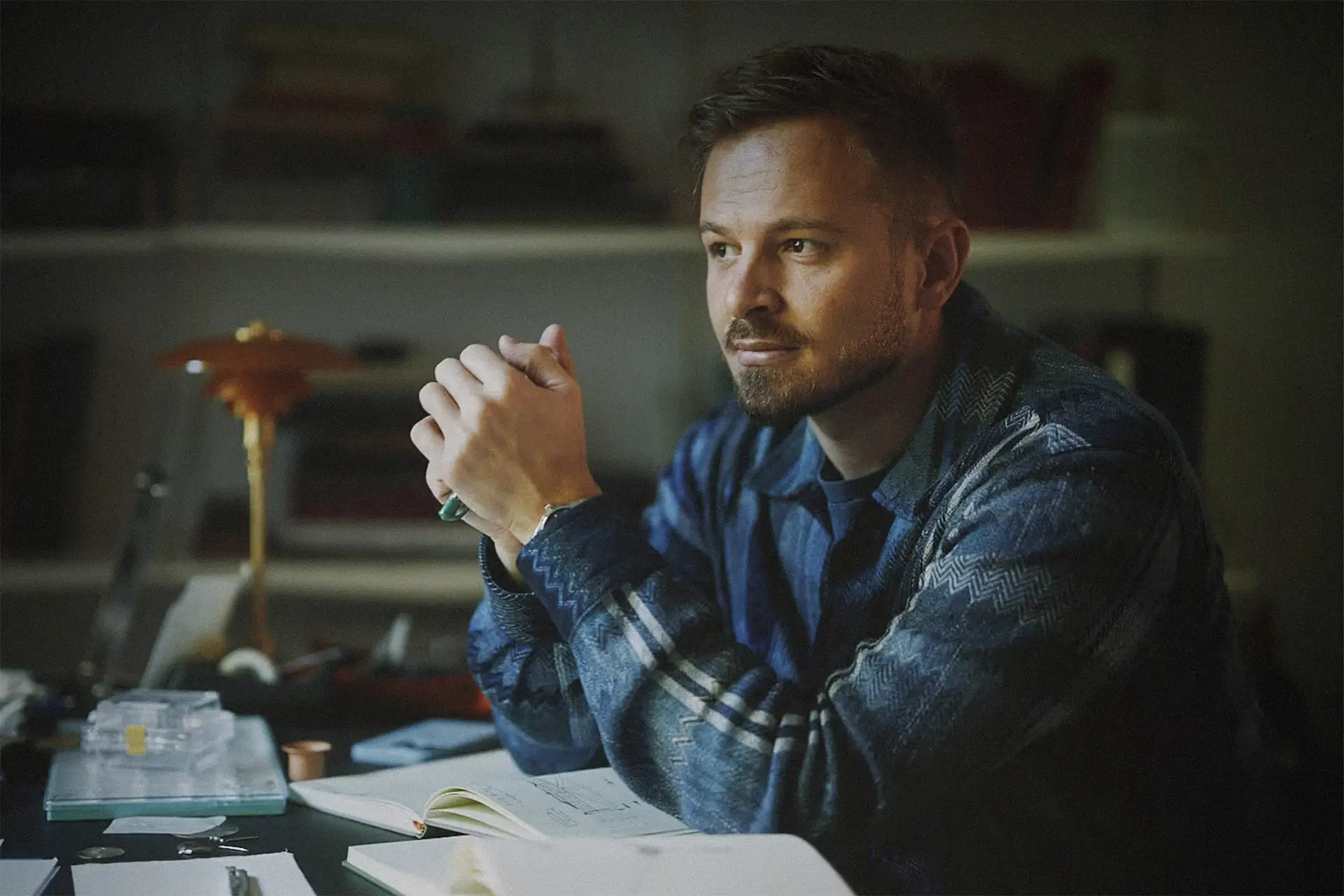
We met Rexhep Rexhepi in Geneva for a conversation about his newest timepiece, the RRCHF Flyback-Chronograph.
For me, it means everything. A watch is not only something beautiful; it also has to work well. The aesthetic side has to be right, the technical side has to be right, and there is also a human side to it. You spend hours thinking, drawing, correcting, starting again. In the end, the watch becomes part of your life. If I had made this watch two years earlier, or two years later, it would not be the same watch. It reflects a moment in my life, my state of mind, and the experience I had at that time. That is why I call it a performance.
Because I felt ready for it now. I wanted to do something more complex, something that could show another side of our work. I also wanted to show that we could make a complication like this in our own way, with our own identity. The Chronomètre Contemporain established my name in one direction. This chronograph had to show that we could go further, technically and aesthetically, while still keeping a strong identity.
Because this one starts from scratch. Yes, we have worked on chronographs before. But in the case of the AK-01, the movement was still based on an ébauche from the BNB Concept orbit, which was then extensively reworked. This movement, by contrast, is entirely new and entirely our own. It was not about taking an existing base and developing it further. We wanted to create a completely new project under my own name — with a new architecture and a new sense of balance. That is the decisive difference.
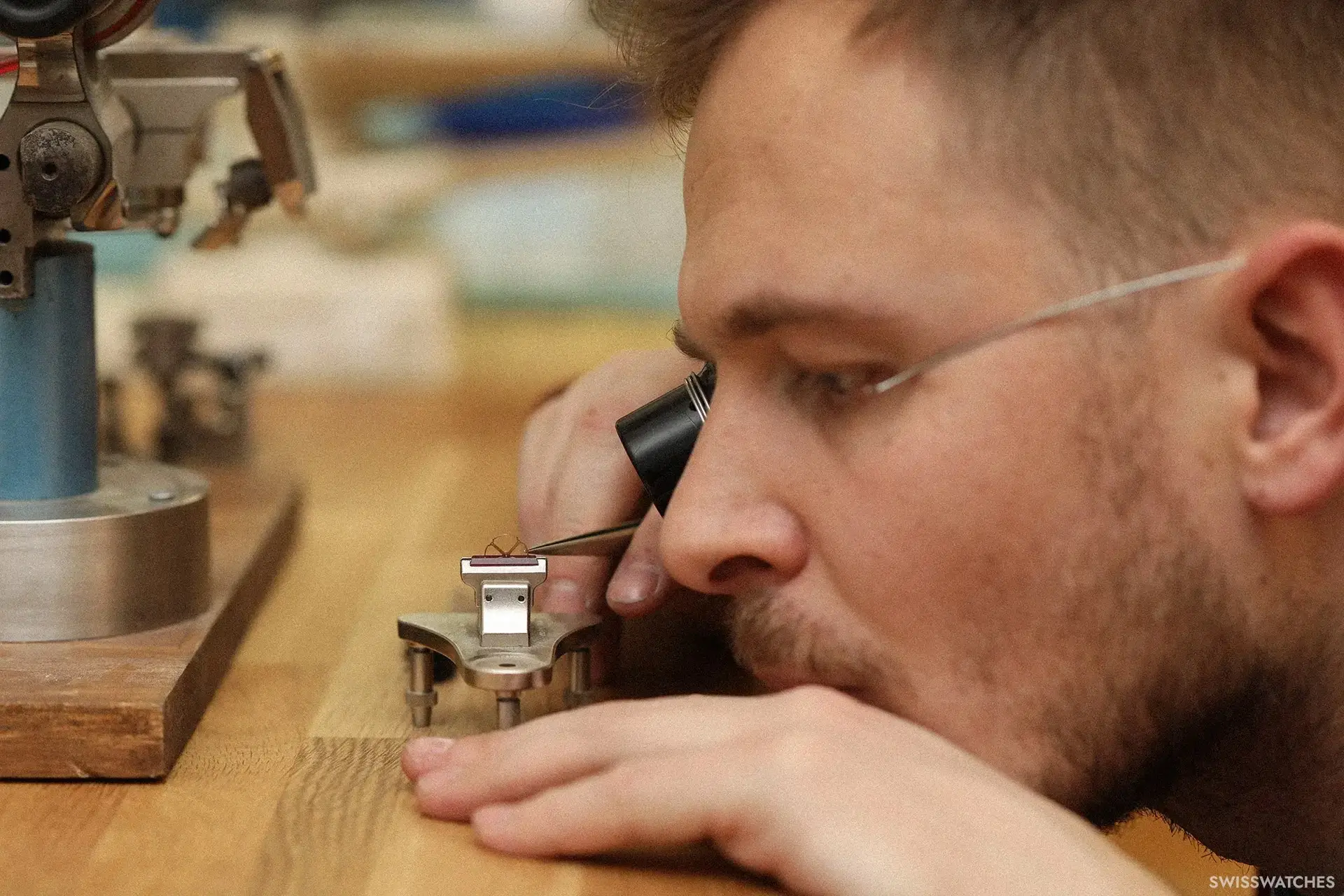
Two things. First, that we are able to handle this level of complexity. And second, that we can do something different aesthetically while still keeping our identity. I wanted the watch to be recognisable as ours — not only in the movement, but in the layout, the proportions, the whole composition.
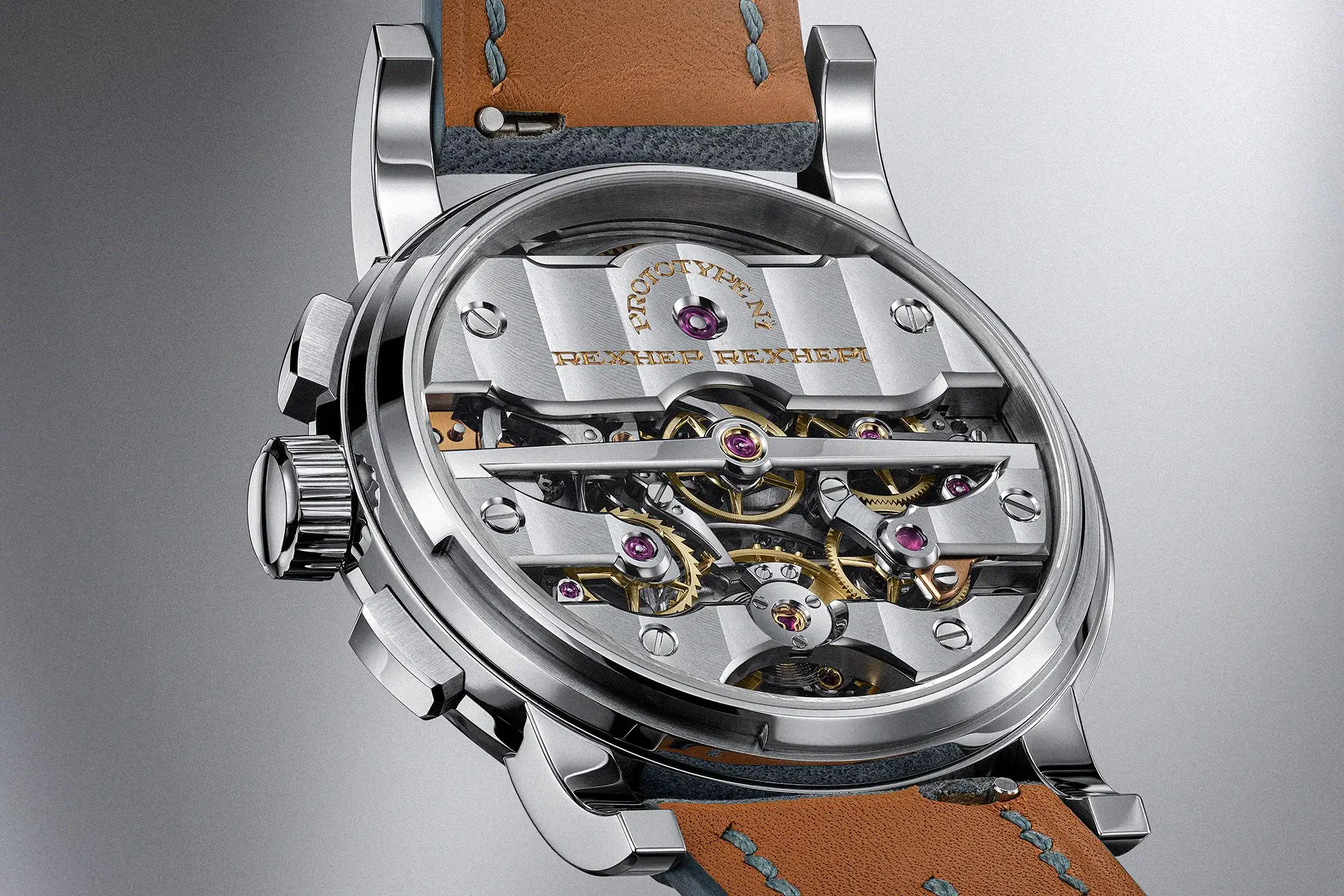
Mechanically speaking, the RRCHF is a column-wheel chronograph with a horizontal clutch. More important, however, is this: the movement was developed exclusively for this watch. I did not want a calibre that could later be adapted for something else. This movement, this chronograph — they belong to this watch alone.
If you want to create a good watch — not just a good movement — everything has to be conceived as a whole from the very beginning. Too often, one starts with the movement and then tries to arrange everything else around it. In the end, the pushers, the crown, the counters or the proportions do not feel quite right. Here, the movement was developed around the watch. The motion works sit beneath the dial, while the chronograph mechanism is on the reverse side. We used every bit of available space to create something symmetrical, integrated and coherent.
The centre. I wanted to emphasise the central chronograph seconds with that large steel bridge. For me, that is the heart of the watch. You can see the clutch, you can see how it engages, you can really understand the mechanism there. That central bridge is probably the strongest expression of the whole idea.
Because material is not only about appearance. Friction behaves differently with steel than with German silver. In some places, we use steel deliberately because there are wheels, pivots and mechanical interactions where friction becomes important. It is a structural choice, but also a functional one.
Very difficult. We started this movement around three to three and a half years ago. We made one version, then rebuilt it because I wanted to gain more space. We worked on the front and on the back, always trying to keep the movement integrated but visually simple. I did not want something that showed off too much. I wanted depth, but I also wanted clarity. So we reworked it many times.
Because it is more complex, and because I wanted to push further. We could have made a simpler chronograph, but I wanted to explore more. If I make a chronograph now under my own name, I want it to offer more than the obvious solution.
It makes reading elapsed time much clearer. The minute jumps exactly, all at once, so it feels more precise and more exact. Technically, it is much more difficult, but it gives the watch something more refined.
The jumping (instantaneous) minute counter. You have to store the energy progressively and then release it at exactly the right moment, with exactly the right force. It must jump cleanly, but it must not take too much energy from the movement. So it becomes a question of fine balance: spring tension, flexibility, braking, friction, return. Everything has to be calibrated very carefully.
Because the first thing people see is the watch, not the movement alone. And the first thing they touch is the case. I used to think more traditionally: start with the movement, then build around it. Today, I prefer to begin with the watch I want to see — the size, the case, the dial, the proportions — and then force myself to find the technical solution within those constraints. It is much harder, but I think it gives a better watch.
A good watch needs both. It has to bring something new; otherwise it is too easy. But at the same time, it should not shock people. It still has to feel right. It still has to be well proportioned. The easy solution would have been to take the Chronomètre Contemporain and add two counters. That would have been safe. Instead, I wanted a new disposition, new hands, a new case — but still something coherent.
Probably the way everything was made to work together. People will notice that the watch is well proportioned, or that the movement looks strong, or that it has this large central bridge. But many of the real decisions are less obvious: the hands, the placement of the pushers and crown, the way the movement was built around the watch, the use of different materials and how they are finished together. That is where a lot of the work is.
From function first, and then identity. The stepped shape is there for a reason. It allows the hands to sit closer to the dial, which improves legibility and reduces the visual thickness of the watch. They also catch the light differently depending on the angle, which makes them easier to read. So yes, they bring identity, but they are not decorative for the sake of it. They have a purpose.
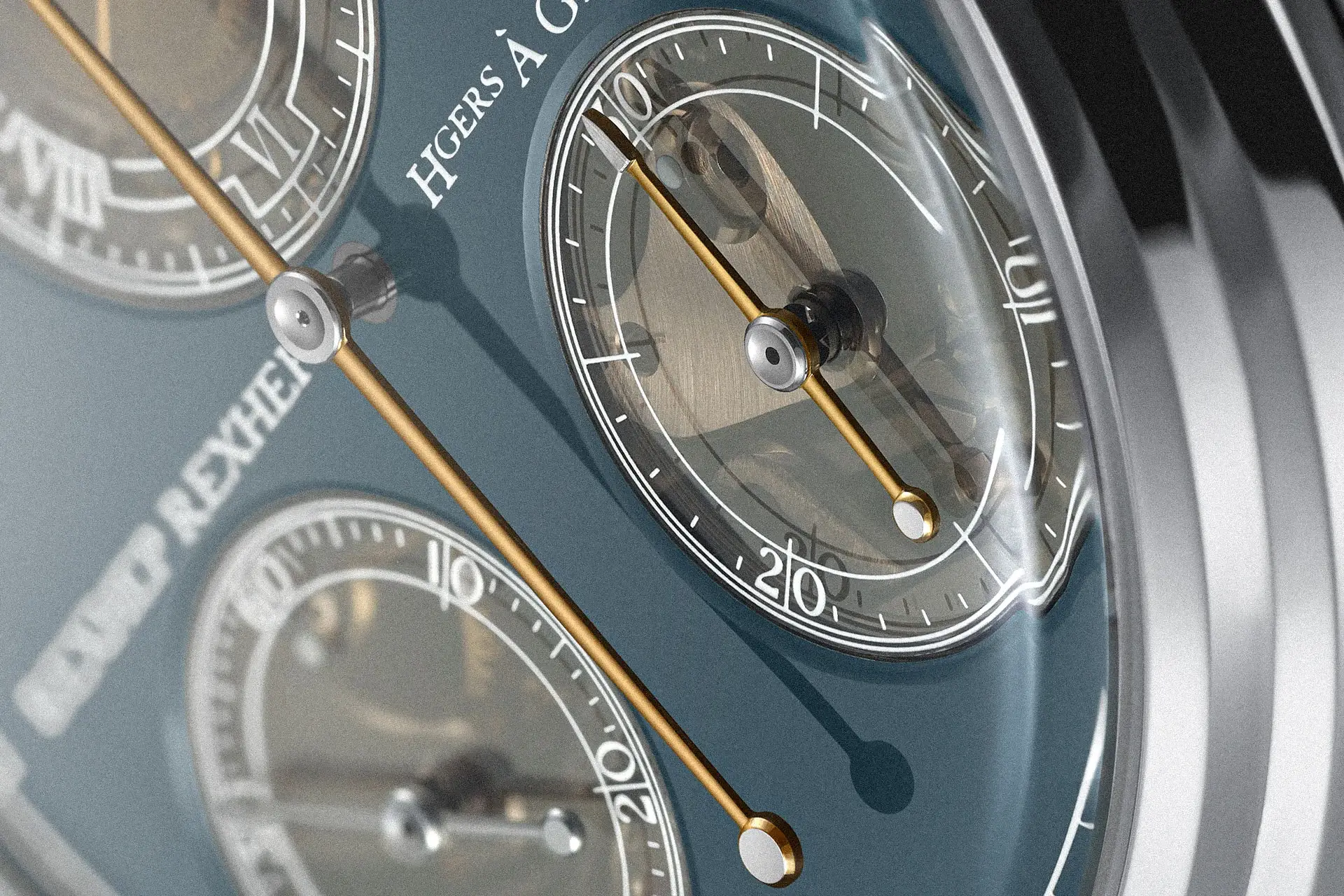
I have loved this grey-blue tone for a long time. Years ago, I already tried to achieve it in enamel, and I never really managed to get there. In the end, the inspiration was something very simple: I have a ceramic table at home in a colour I love, and I always had that tone in mind. Finally, our enameller came very close to what I wanted. So it is not a complicated story. It is simply a colour I had wanted for a long time.
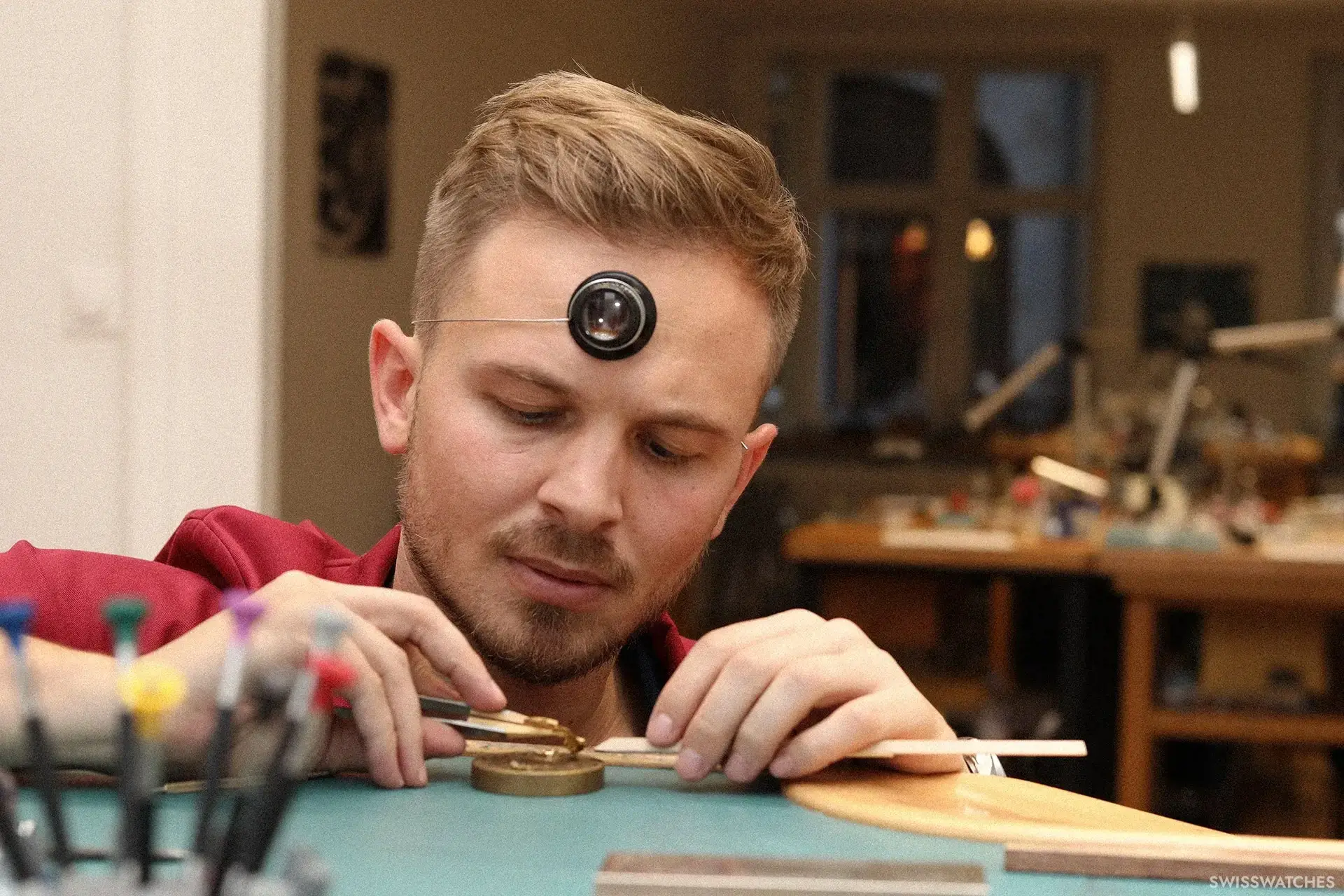
Essential. This watch could not have existed like this a few years ago. Today, more is done inside the workshop, which gives us more control, more freedom and more consistency. Some of that also came from difficult experiences with suppliers. Sometimes you depend on people who do not share your standards, or who stop taking you seriously because your quantities are too small. At some point, I did not want to depend on that anymore.
Yes. We had quality problems with one supplier, and I was not happy with the chronometry. If I am not happy, I cannot simply say, “That is their quality.” No — it becomes my problem. So we had to find another solution and make more ourselves. For me, that is part of the performance as well: not accepting something that does not meet your standard.
A great deal, but not in a direct way. He did not design this watch for us. It is not like that. But he gave us tools, confidence and a way of thinking. He taught us how to think about proportion, what makes a good case, what traditional case-making really means. Without him, I do not think we would be where we are today in this area.
The conflict is everywhere. But for me, a watch should still show the human side. If everything becomes too cold, too perfect, too clinical, then I do not like it. At the same time, you cannot use handwork as an excuse for poor work. You have to push as far as you can, and then know when to stop. That line is difficult, but it is also what makes the work interesting.
There are many: black polishing, inward angles, satin finishing, perlage, Côtes de Genève, engraving, circular graining, anglage, polished steel parts, diamantage, and poli-bercé. This kind of information matters, because it shows the level of competence behind the watch. It should be part of the story.
Because I want to be able to look people in the eye. It is as simple as that. I wanted to set a price that I still consider fair, despite all the development costs. One should not forget: this movement was developed exclusively for this watch. It is not a modular system, nor a base that we can simply reuse later across many other products. That is, of course, where many large brands operate differently — partly because they have to calculate and develop on a very different scale. Our starting point was different: we built this movement only for this reference, with everything that implies in terms of time, energy and investment.
I know very well that I could price these watches much higher. People tell me that all the time. But I do not want to play that game. I do not want greed to define the relationship. For me, the challenge lies in offering the best possible watch at a price that I can still honestly and fairly stand behind, despite all that development — not in pushing everything to the absolute limit simply because the market has gone mad.
Someone who values the work and thinks long-term. Of course, I know I cannot control everything. But I do not like seeing a watch go to someone who sells it a few months later while other people have been waiting for years. That is unfair to the people who are waiting, and it also reflects badly on me, because it makes it seem as though I chose badly. I still want a human connection. I still want people who understand what they are getting.
That I have not yet achieved everything I want to achieve. I still want to bring something important to watchmaking. I still want to invent something real. I would not call this watch an invention in that sense. It is a new creation, yes — a new movement, a new architecture, a new design, new proportions — but I still want to go further. That frustration is always there. It may not be comfortable, but it pushes me.
Maturity, perhaps — or a stage of maturity. But not the end. More a step. I want people to see that we are growing, that we are becoming stronger, and that we are building something serious. For me, the dream is not only to make watches, but to leave something behind: a way of thinking, a workshop culture, people who learn here and perhaps go on to do their own things later. If one day people say we brought something meaningful, that would matter to me.