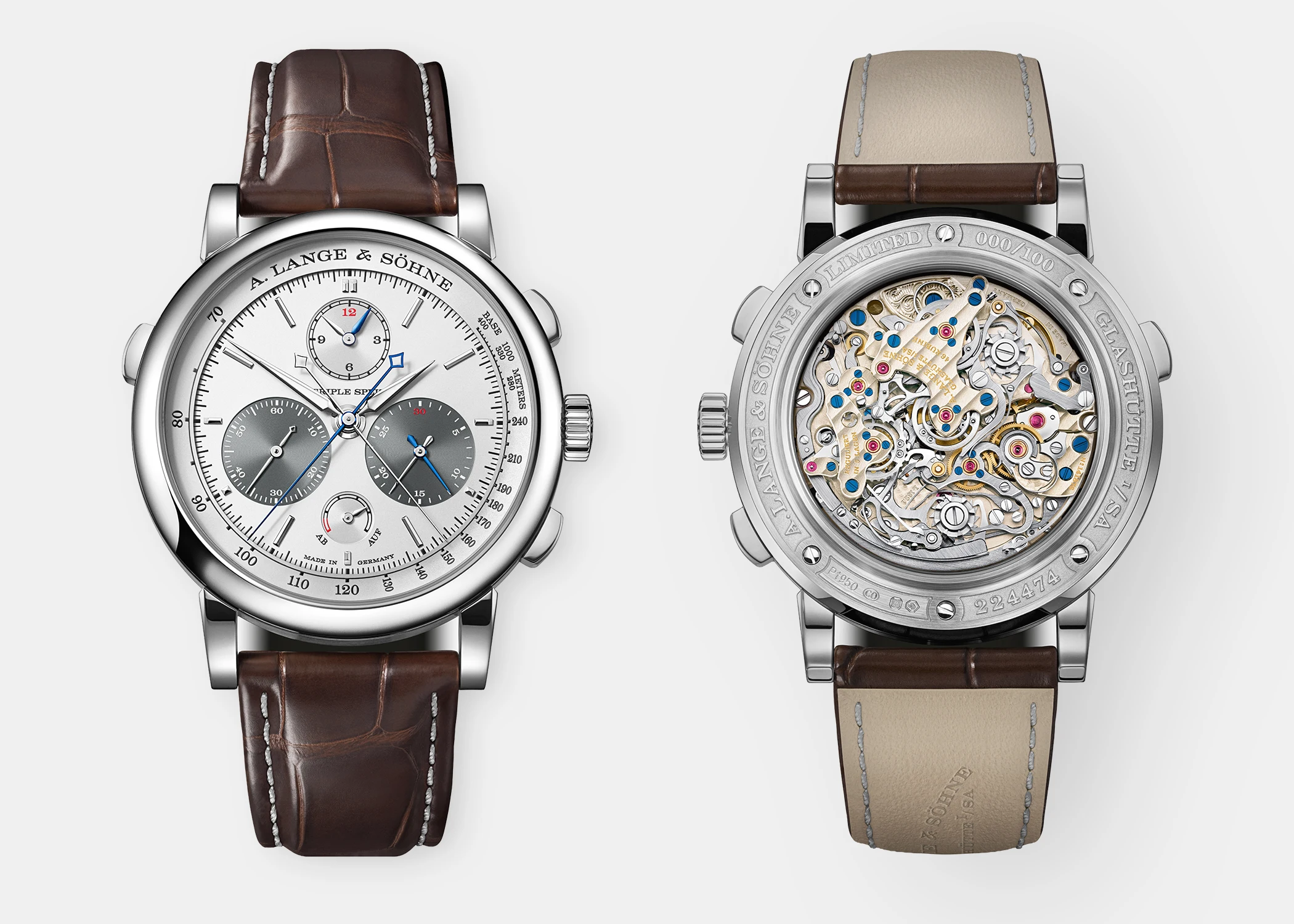
Chopard L.U.C 1963 Heritage Regulator: Weißgold, 40 mm & neun Tage Gangreserve. Entdecken Sie die auf 25 Exemplare limitierte Neuauflage.
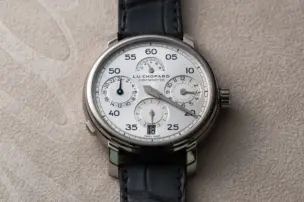
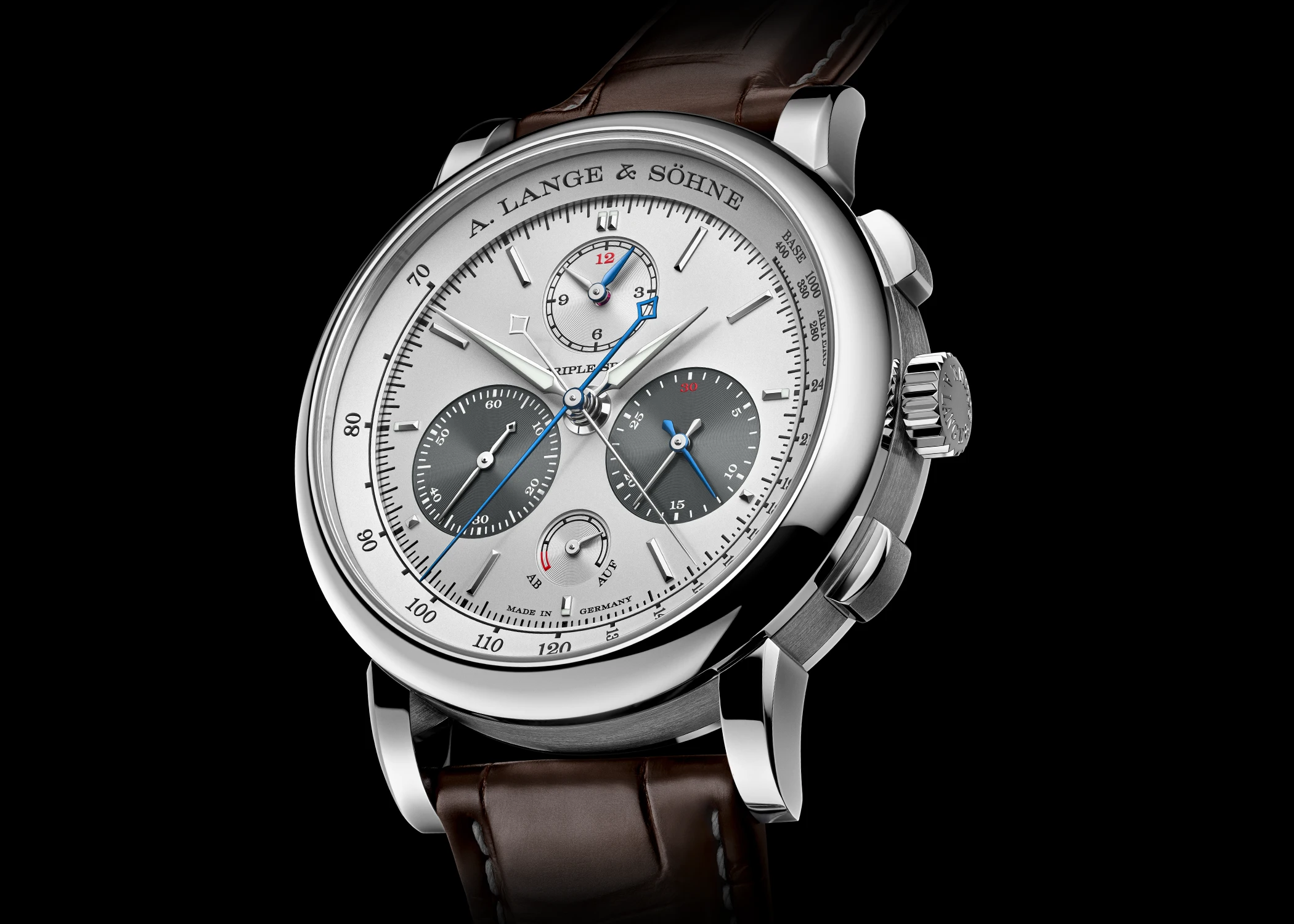
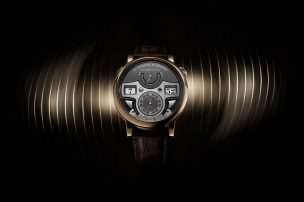
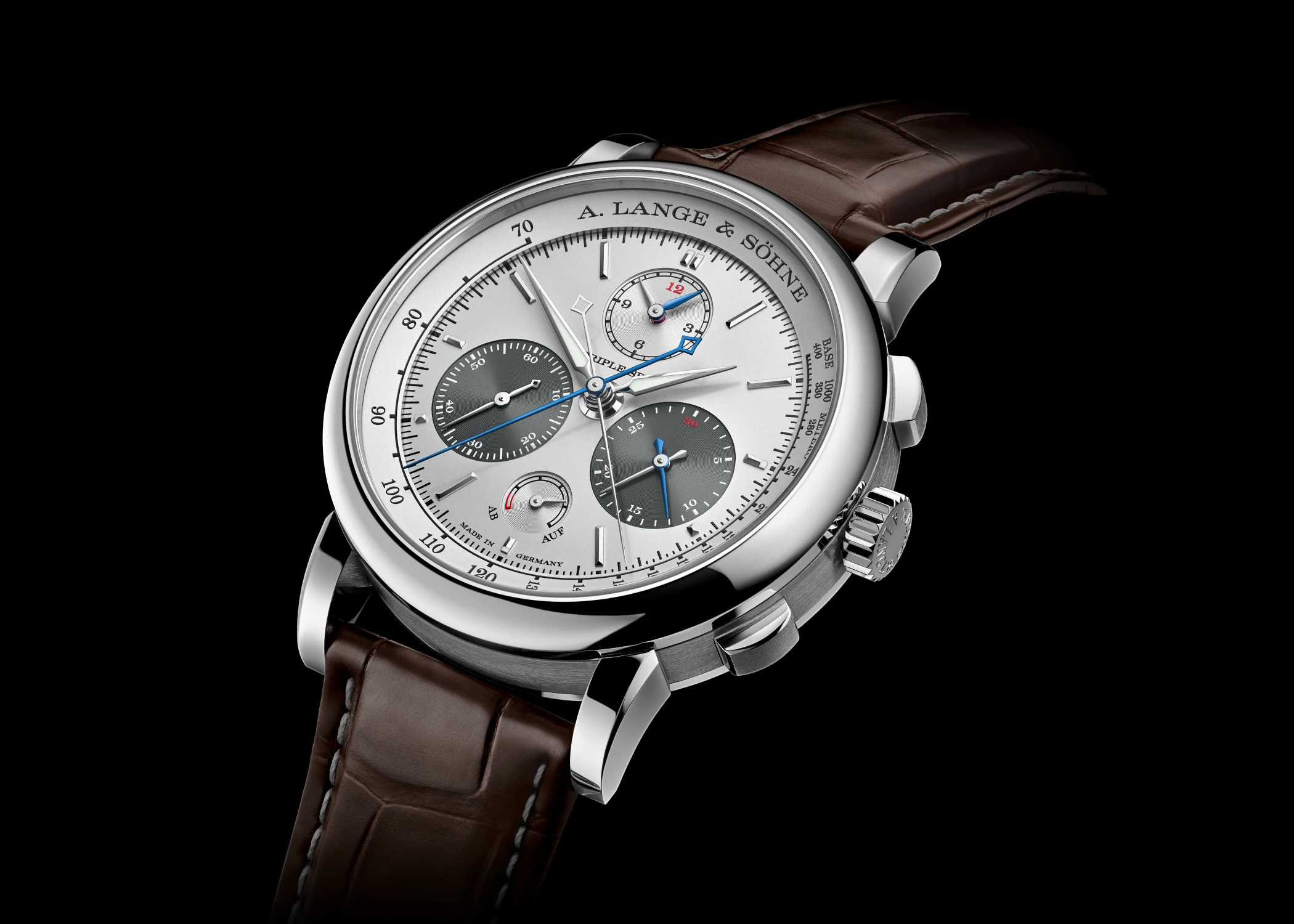
The A. Lange & Söhne Triple Split is far more than a split-seconds chronograph with an additional counter. Since its introduction in 2018, the Triple Split Chronograph has possessed a technical distinction that sets it apart from other mechanical chronographs: it is the world’s only split-seconds chronograph capable of measuring intermediate, comparative and final times over a period of up to twelve hours. A. Lange & Söhne is now presenting a new edition limited to 100 pieces, combining a 950 platinum case with a rhodium-coloured dial and darker grey subsidiary dials for the first time.
In this article, we take a closer look at the new A. Lange & Söhne Triple Split and the distinctive mechanics behind its operation.
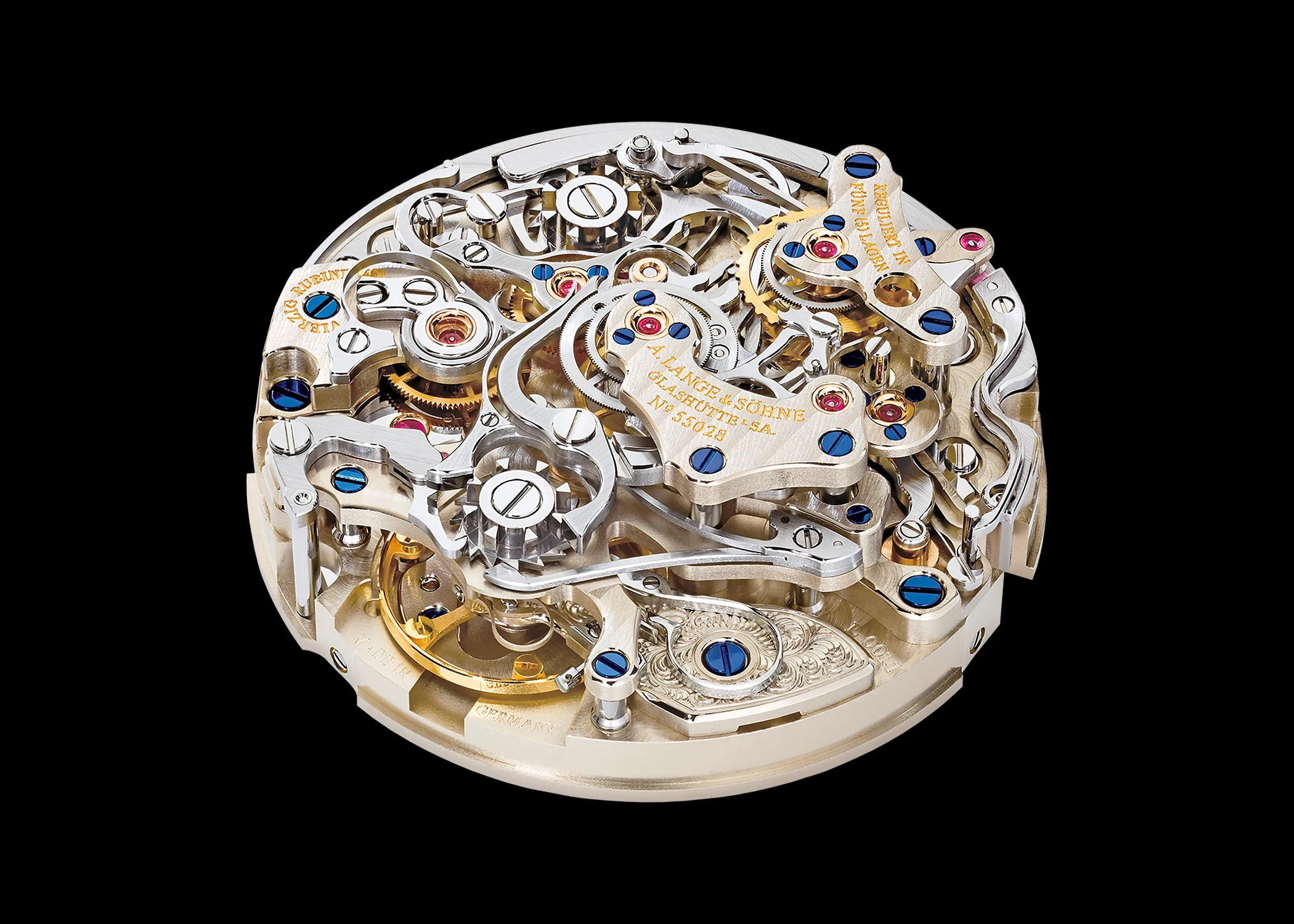
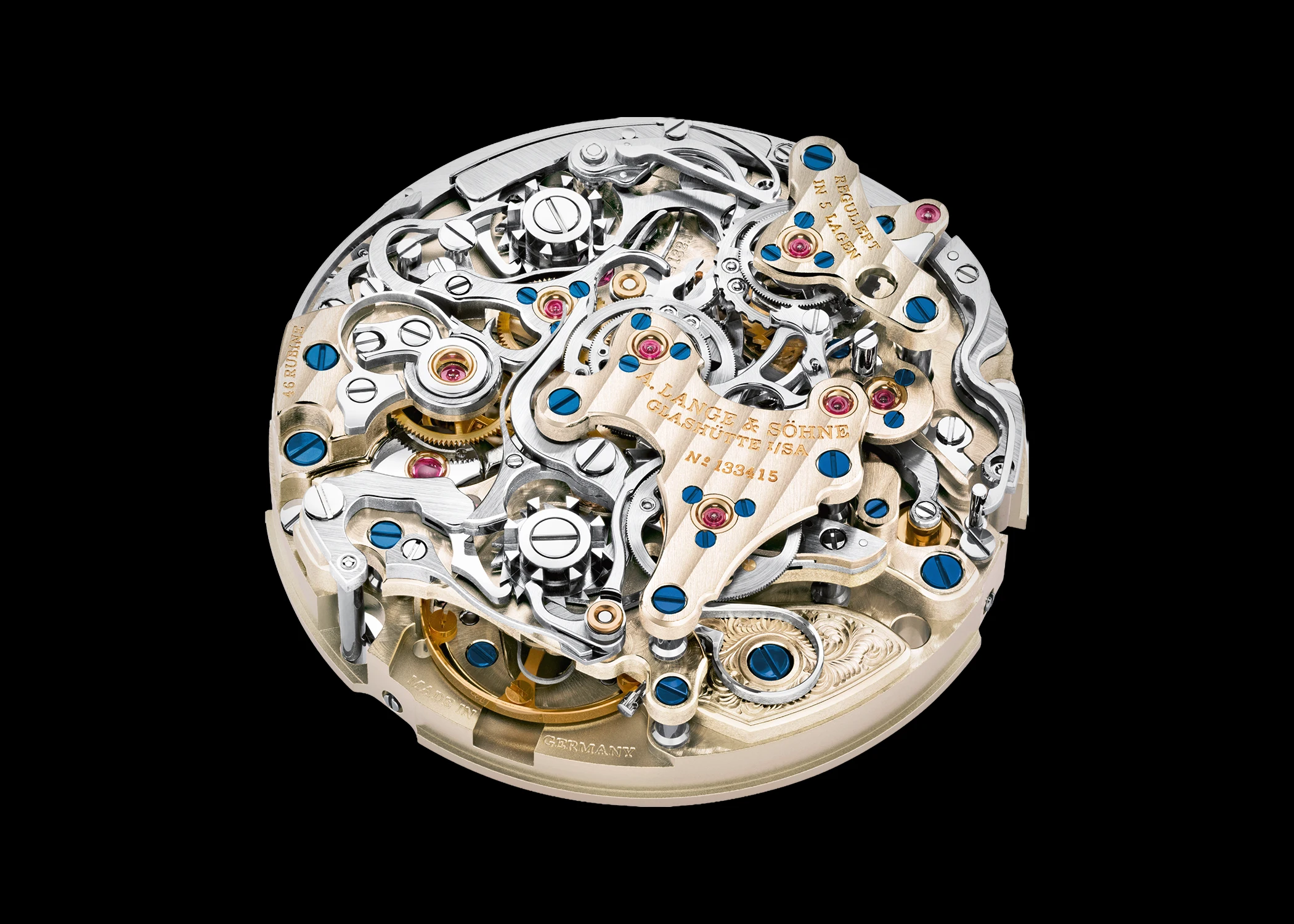
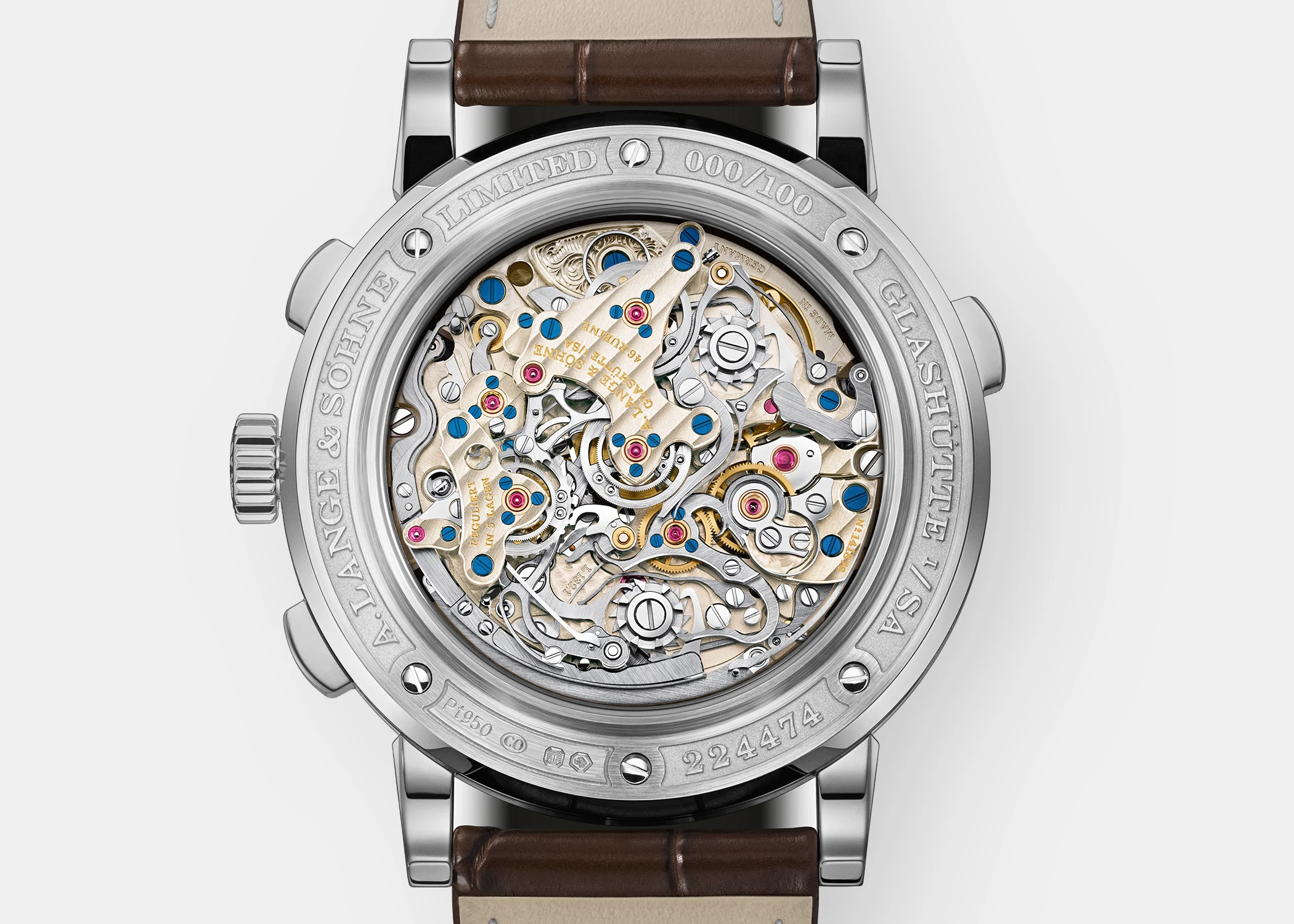
The defining feature of the A. Lange & Söhne Triple Split lies in the mechanism at its core: the manually wound manufacture calibre L132.1, comprising 567 individual components, which was developed from the existing L001.1 calibre used in the Double Split of 2004.
The technical distinction of the manufacture calibre L132.1 lay in taking the classic rattrapante principle and applying it threefold. While a conventional rattrapante chronograph can separate two events that start simultaneously only over a period of up to 60 seconds, the Lange Double Split of 2004 already made it possible to measure seconds and up to 30 minutes separately. With the Triple Split, A. Lange & Söhne took the concept a step further in 2018: for the first time, not only seconds and minutes, but also hours could be measured separately – allowing two simultaneously started events to be compared over a period of up to twelve hours.
The basic principle of a rattrapante chronograph relies on two superimposed hands – the actual chronograph hand and the rattrapante, or ‘split-seconds’, hand positioned above it, which is rendered in blue on the Triple Split – mounted on concentric arbors. In the Double Split, this arrangement is already employed twice: with two central seconds hands and a further pair of hands for the minute counter, which can measure up to 30 minutes. With the Triple Split, A. Lange & Söhne extended this principle once again by adding a third pair of hands on the 12-hour counter at 12 o’clock, complementing the seconds and minutes displays. This allows two events that start simultaneously to be compared directly over a period of up to twelve hours.
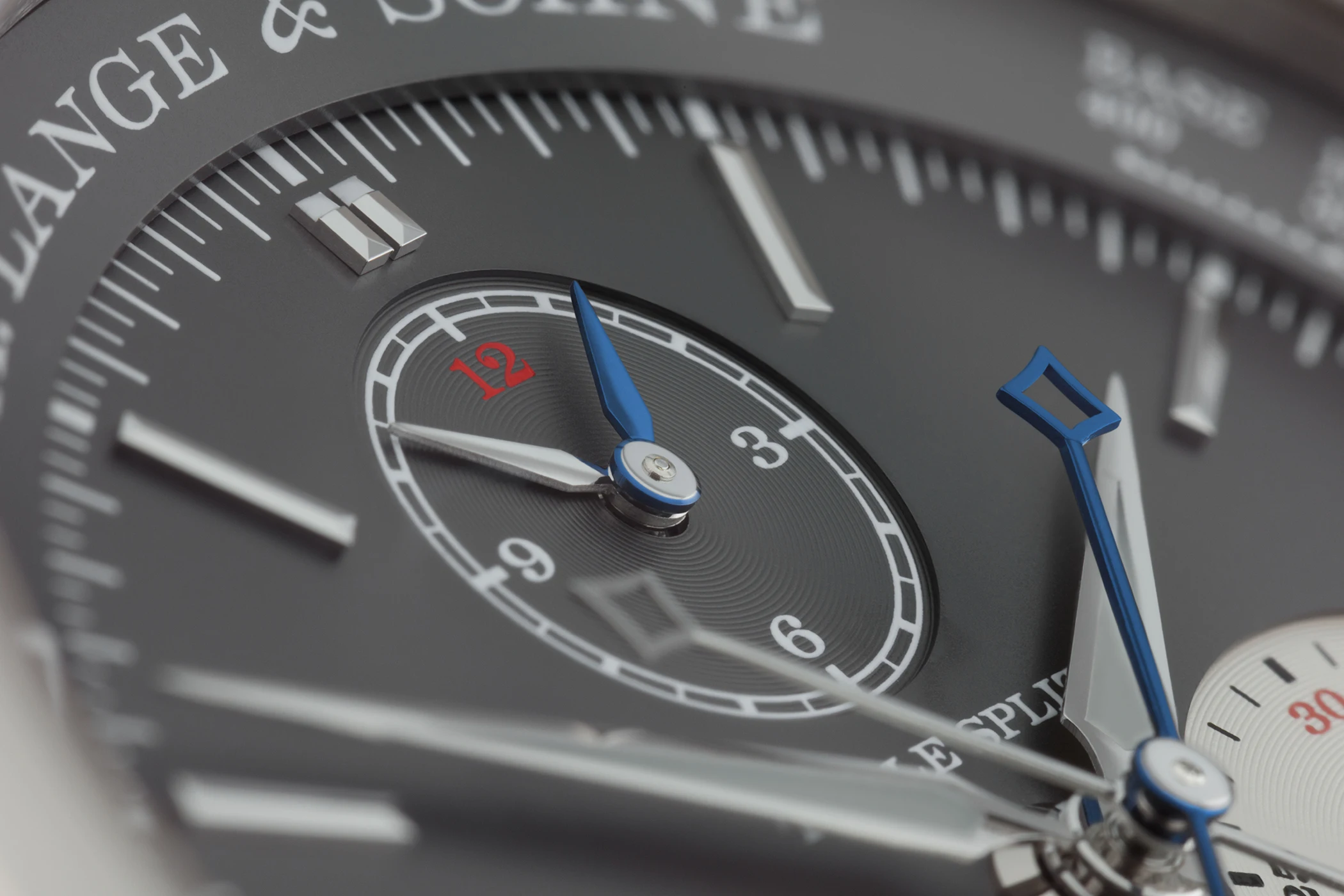
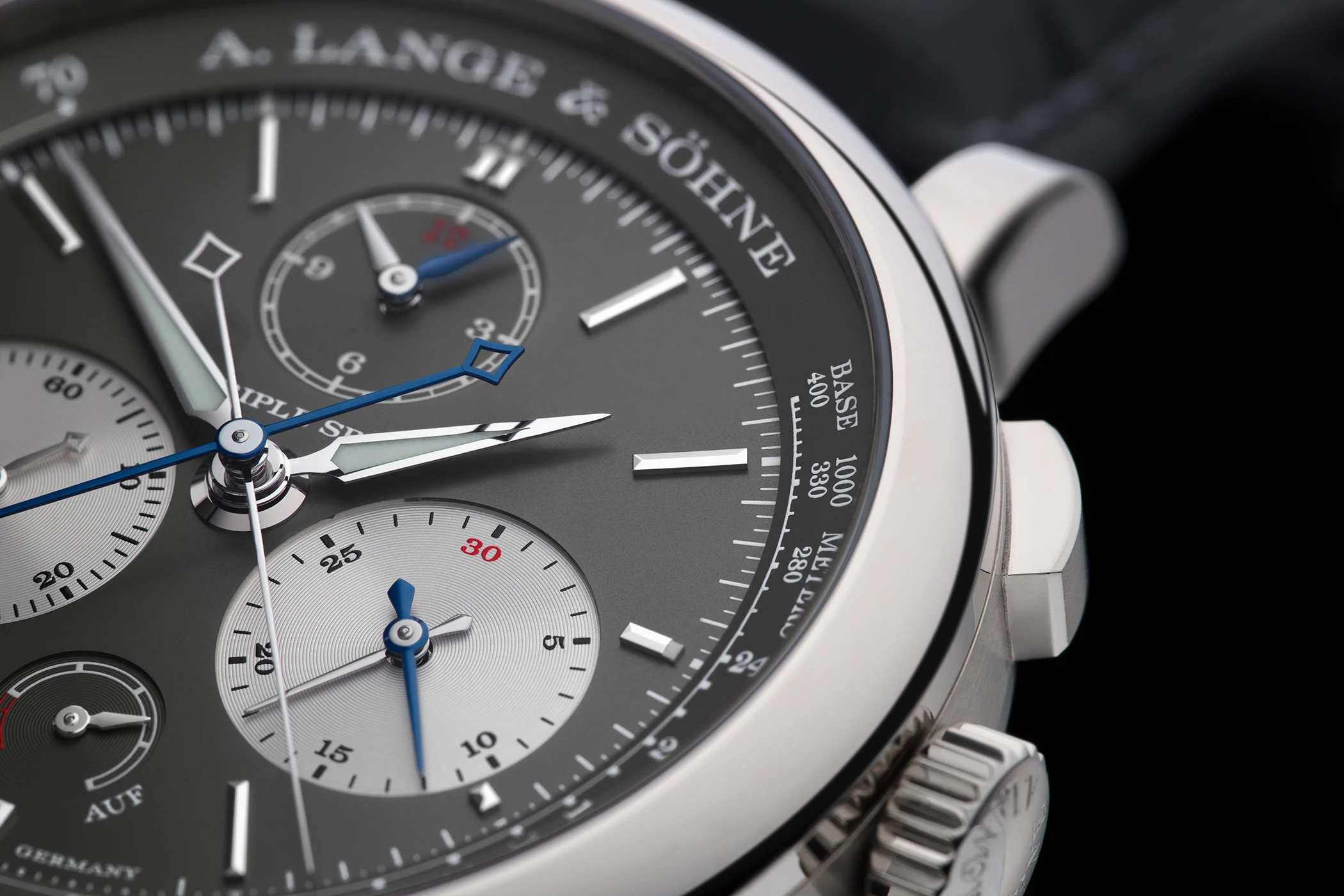
The real constructional challenge therefore lies less in the sheer number of displays than in their precise coordination. The movement must ensure that all six chronograph and rattrapante hands perform their respective functions exactly – from starting together and stopping separately to subsequently resynchronising.
But what practical purpose does this serve? The A. Lange & Söhne Triple Split makes it possible to compare two events that start simultaneously over the course of several hours. In a motor race, for example, the time of one car could be recorded with the rattrapante hands as it crosses the finish line, while the chronograph hands continue running until a second car arrives. In this way, the time difference between the two can be read directly – even if the race lasts for several hours.
The operation of the A. Lange & Söhne Triple Split is best understood through its three pushers. The pusher at 2 o’clock starts and stops the chronograph. When started, all three pairs of chronograph and rattrapante hands for seconds, minutes and hours begin moving together. The pusher at 4 o’clock controls the flyback, or reset, function: it allows the chronograph hands to be returned to zero and a new timing operation to begin immediately, without first having to stop the chronograph.
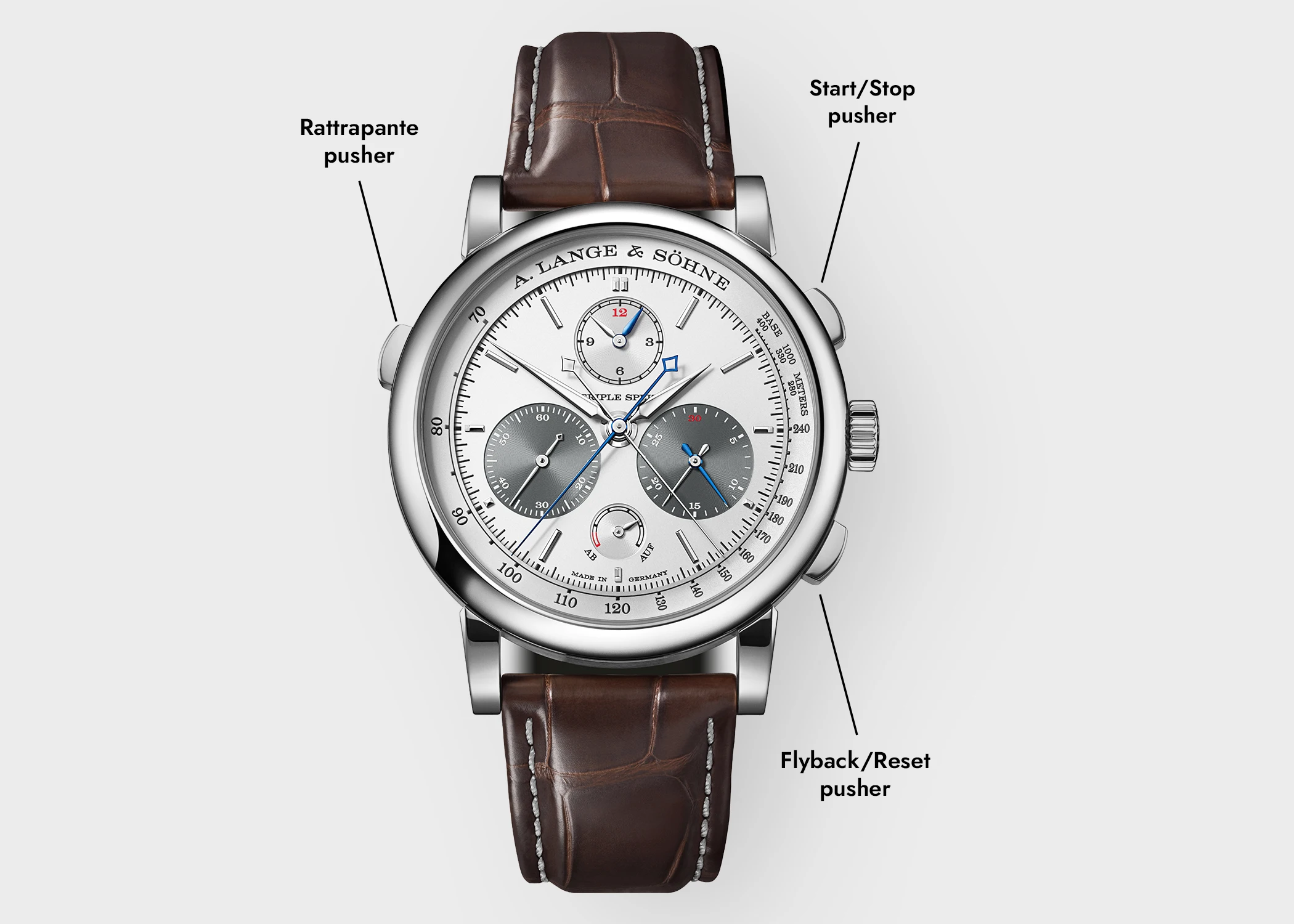
The actual rattrapante function is controlled by the pusher at 10 o’clock. When pressed during an ongoing measurement, the three blue rattrapante hands for chronograph seconds, minutes and hours stop, thereby recording an intermediate time, while the chronograph hands beneath them continue to run. Pressing the rattrapante pusher again releases the stopped rattrapante hands: they instantly catch up with the continuously running chronograph hands and then continue to run in synchronisation with them.
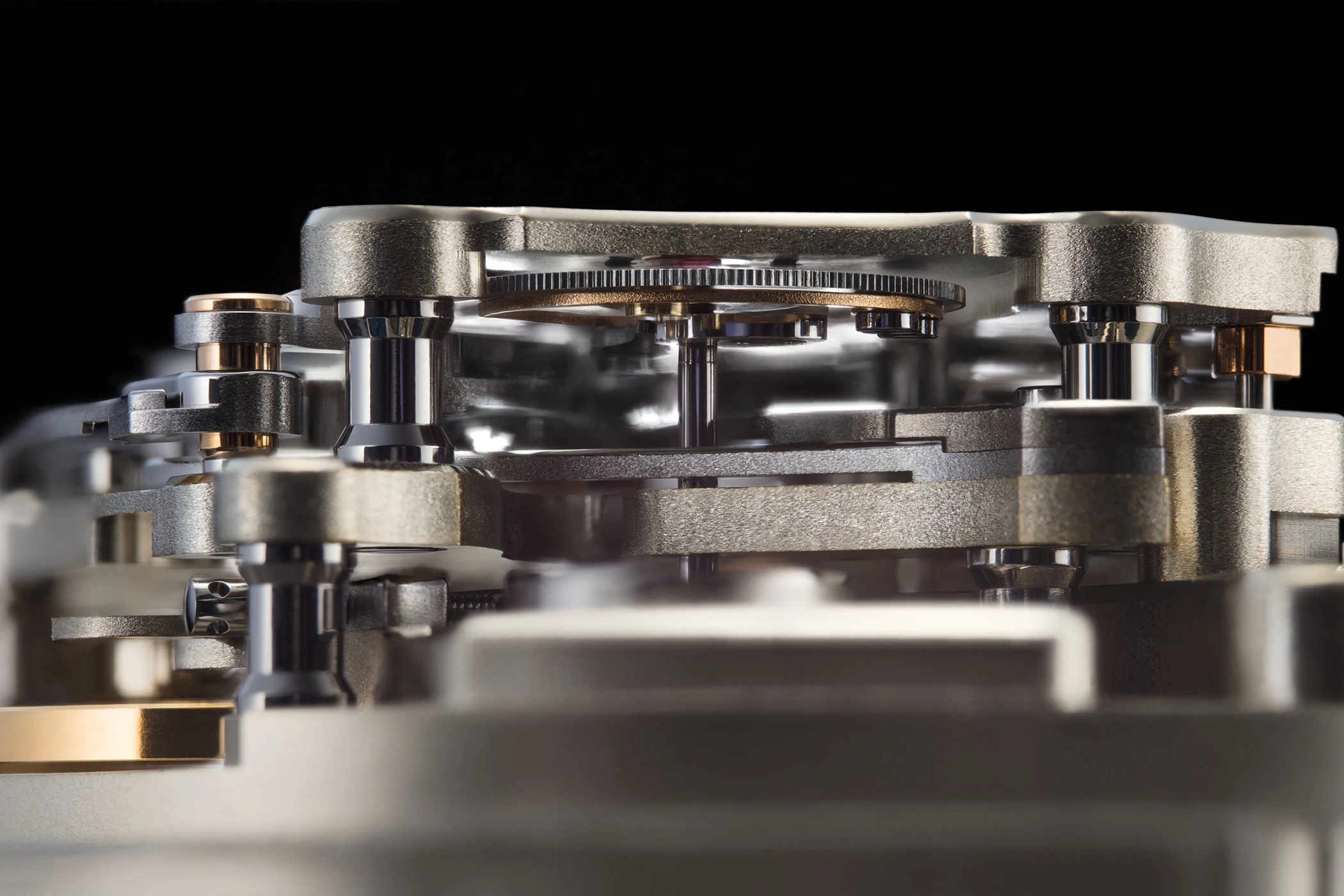
To ensure that the closely sequenced operations of starting, stopping, catching up and resetting are carried out precisely, numerous column wheels, levers, springs, clutches and detents interact within the movement. Although the Triple Split adds a 12-hour counter with its own gear train compared with the Double Split, while also increasing the power reserve by 17 hours – from 38 to 55 hours – calibre L132.1 is only 0.3 millimetres taller than its predecessor, the L001.1. This illustrates how compactly A. Lange & Söhne was able to integrate the additional mechanism into the movement.
The main constructional challenge in developing the movement was to combine the three rattrapante systems for seconds, minutes and hours within a single calibre. In a conventional rattrapante chronograph, two hands are mounted on concentric arbors that can move independently of one another for a limited period. In the Triple Split, this principle is implemented three times: in addition to the two central seconds hands, the minute and hour counters each have their own pair of concentric arbors carrying a chronograph hand and a rattrapante hand.
But how does this principle work mechanically? To make the complex switching sequences easier to follow, the basic principle of the rattrapante mechanism is best explained using the central chronograph-seconds axis. The following description applies, in principle, to the minute and hour-counter axes as well.
The crucial point is that the chronograph and rattrapante hands must be able to move independently of one another for a limited period: while the rattrapante hand remains stationary to record an intermediate time, the actual chronograph hand continues to run. The two hands must then be coupled and synchronised again.
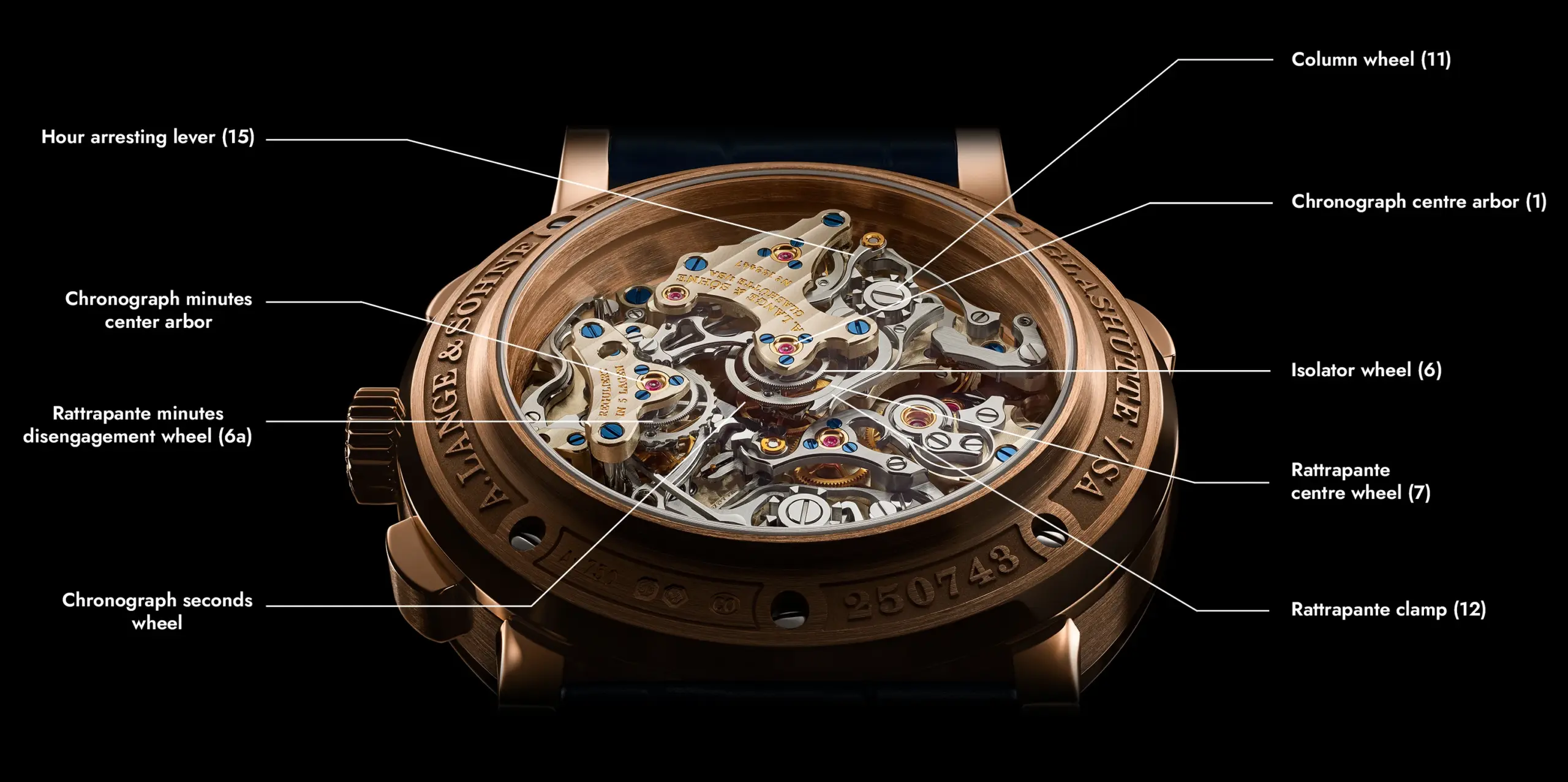
The regular central chronograph-seconds hand is mounted on an outer, tubular chronograph centre arbor (1). This is driven by the movement via the chronograph centre wheel (2). Fixed to the arbor are a heart cam for resetting the chronograph centre wheel (3) and a second heart cam for the rattrapante function (4). This heart cam allows a hand to return to zero as quickly as possible via the shortest route – regardless of whether this occurs clockwise or anticlockwise.
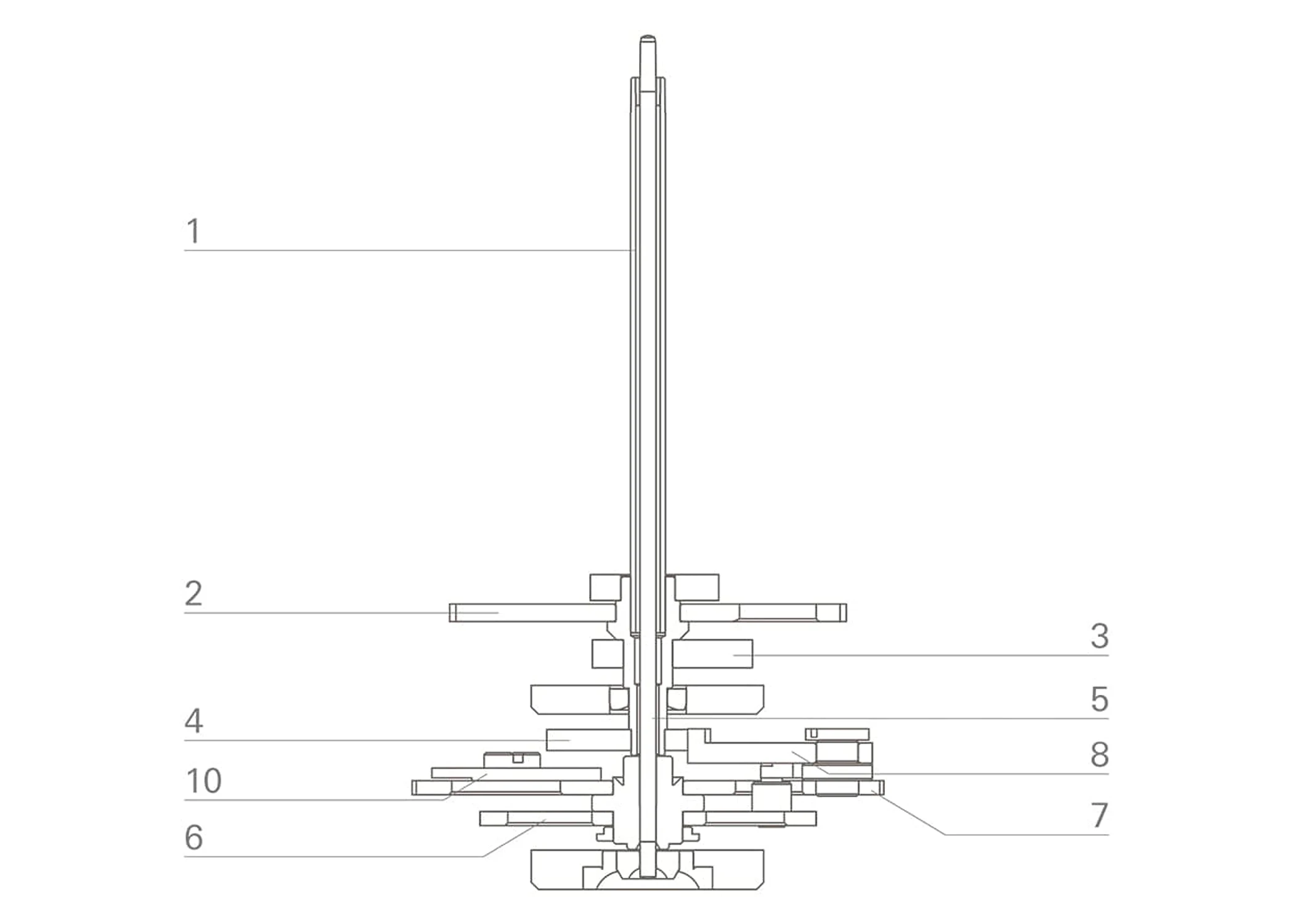
After an intermediate time has been stopped, the rattrapante hand must be resynchronised with the running chronograph-seconds hand. The rattrapante hand, positioned above the chronograph-seconds hand, is mounted on the inner rattrapante centre arbor (5), which runs through the hollow outer arbor. At the lower end of the inner rattrapante centre arbor are the isolator wheel (6) and the rattrapante centre wheel (7), to which the freely pivoting rattrapante heart lever (8) is attached.
The key challenge is now to couple the independently moving centre arbors of the chronograph (1) and the rattrapante mechanism (5). In the initial position, a spring presses the rattrapante heart lever (8) against the flat side of the rattrapante heart cam (4). This ensures that the rattrapante centre wheel (7) is driven when the rattrapante mechanism is engaged and that the two centre arbors carrying the chronograph hand (1) and the rattrapante hand (5) are coupled together. As soon as the chronograph is started, all three pairs of chronograph and rattrapante hands therefore begin to run together.
The remaining key functions of the rattrapante mechanism are the stopping and subsequent catching up of the Triple Split’s three rattrapante hands. When the rattrapante pusher is pressed, the rattrapante switching lever (10) advances the column wheel (11) by one position. The rattrapante clamp (12) then closes and holds the rattrapante centre wheel (7) in place, bringing the rattrapante seconds hand to a stop. At the same moment, the minute arresting spring (13) and the hour arresting lever (15) stop the rattrapante hands of the minute and hour counters. Meanwhile, the three chronograph hands continue to run uninterrupted.
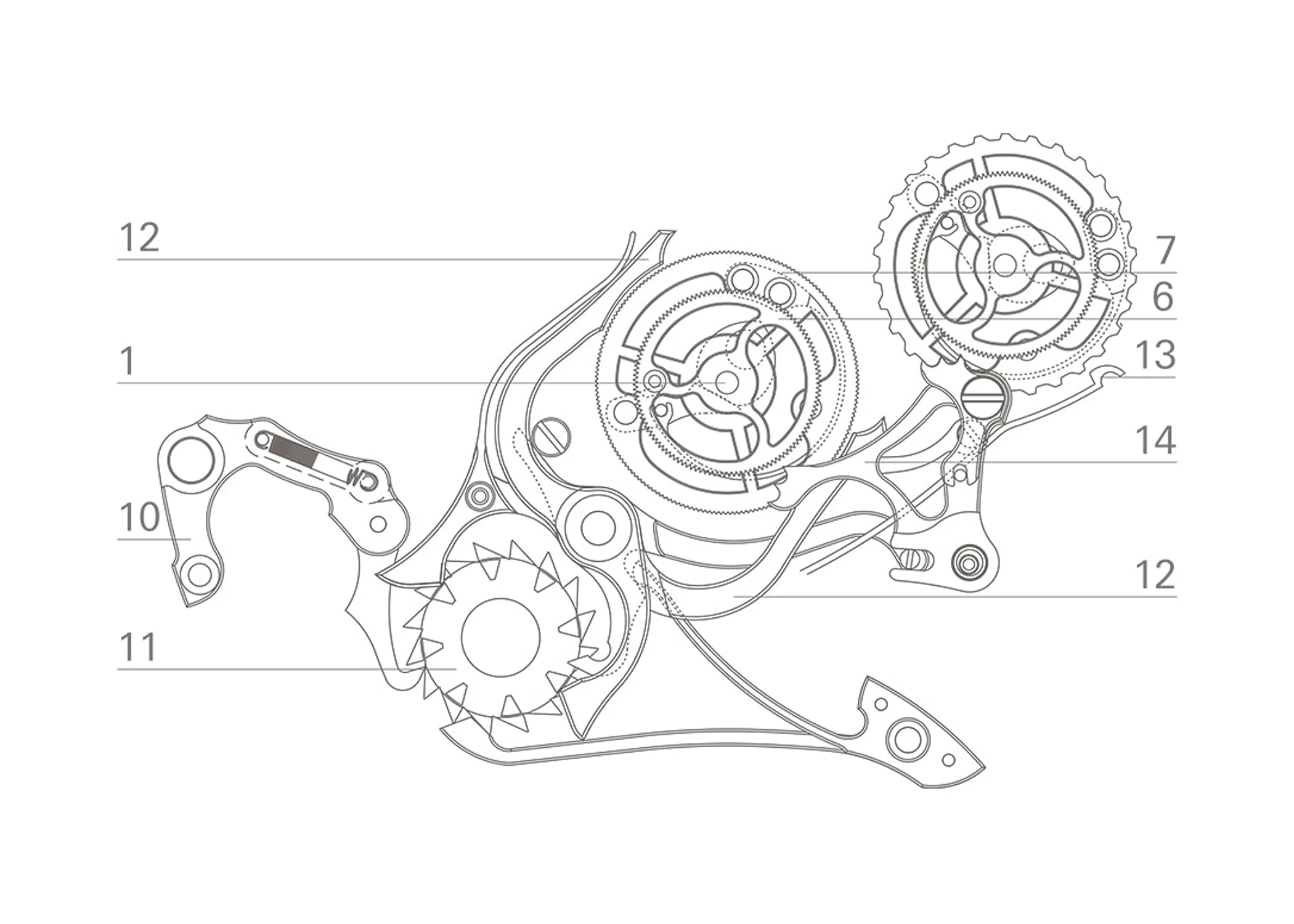
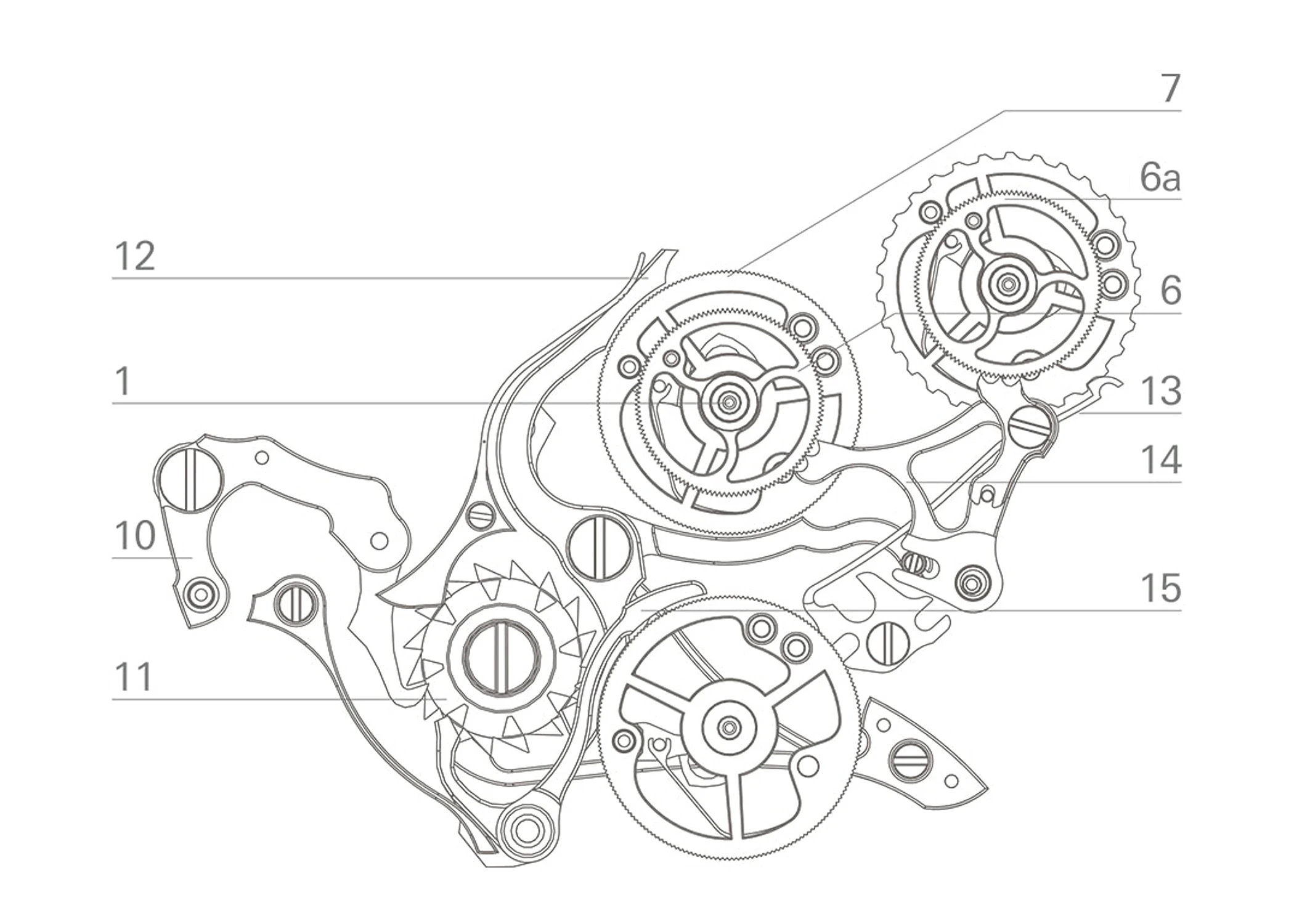
When the rattrapante pusher (10) is pressed a second time, the rattrapante clamp (12) opens; at the same time, the minute arresting spring (13) and the hour arresting lever (15) are pushed out of engagement. The three rattrapante hands then instantly catch up with the running chronograph hands.
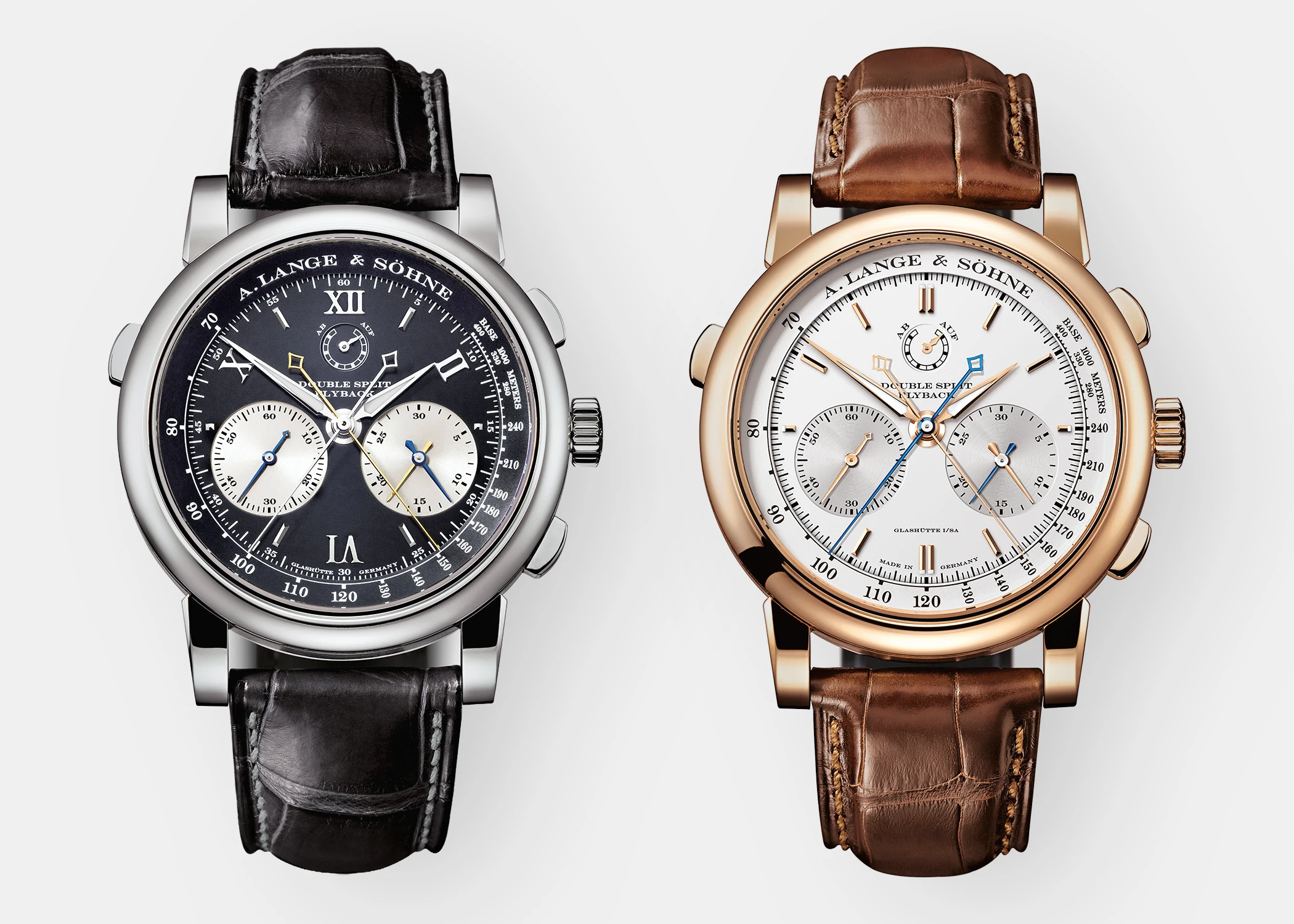
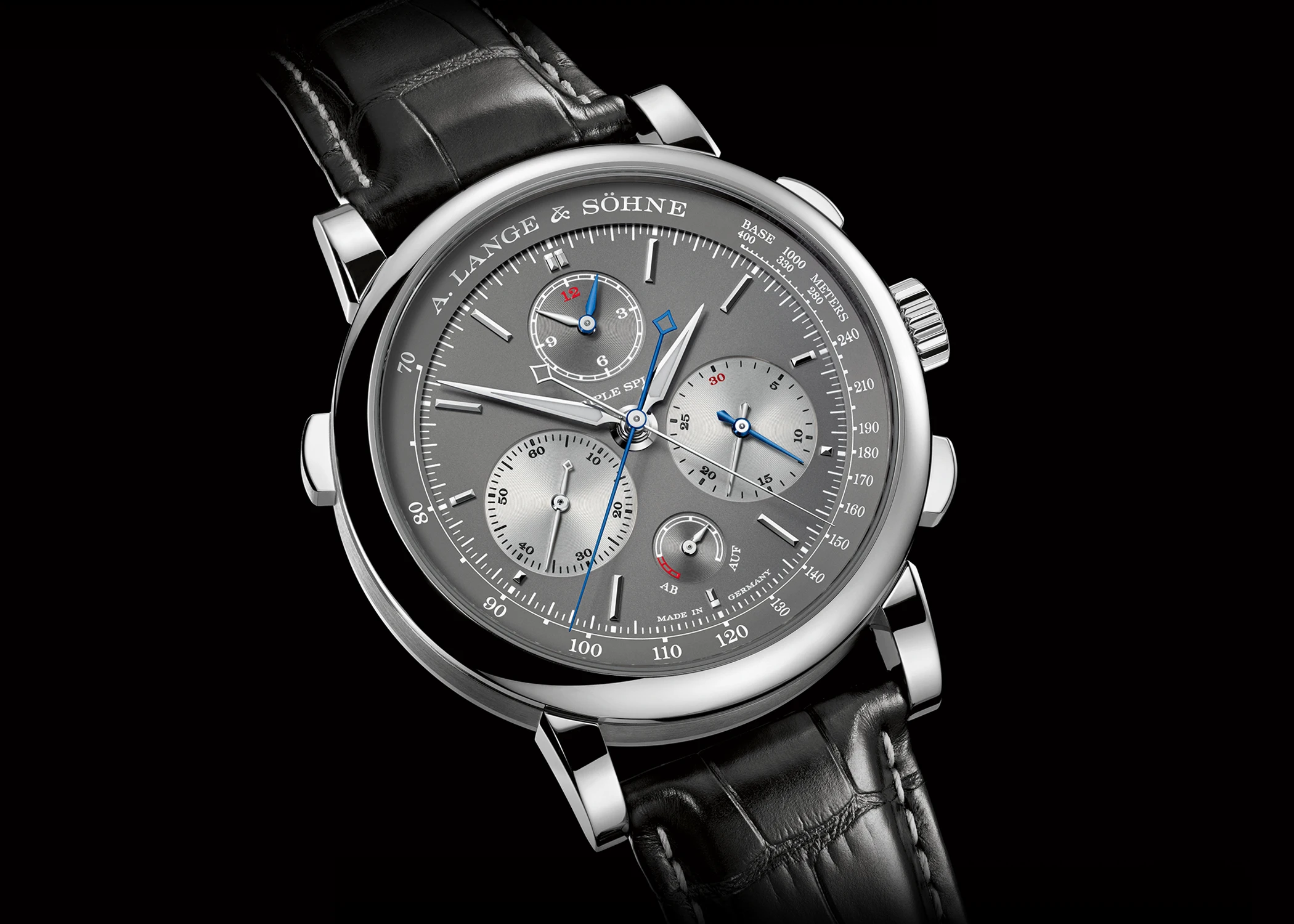
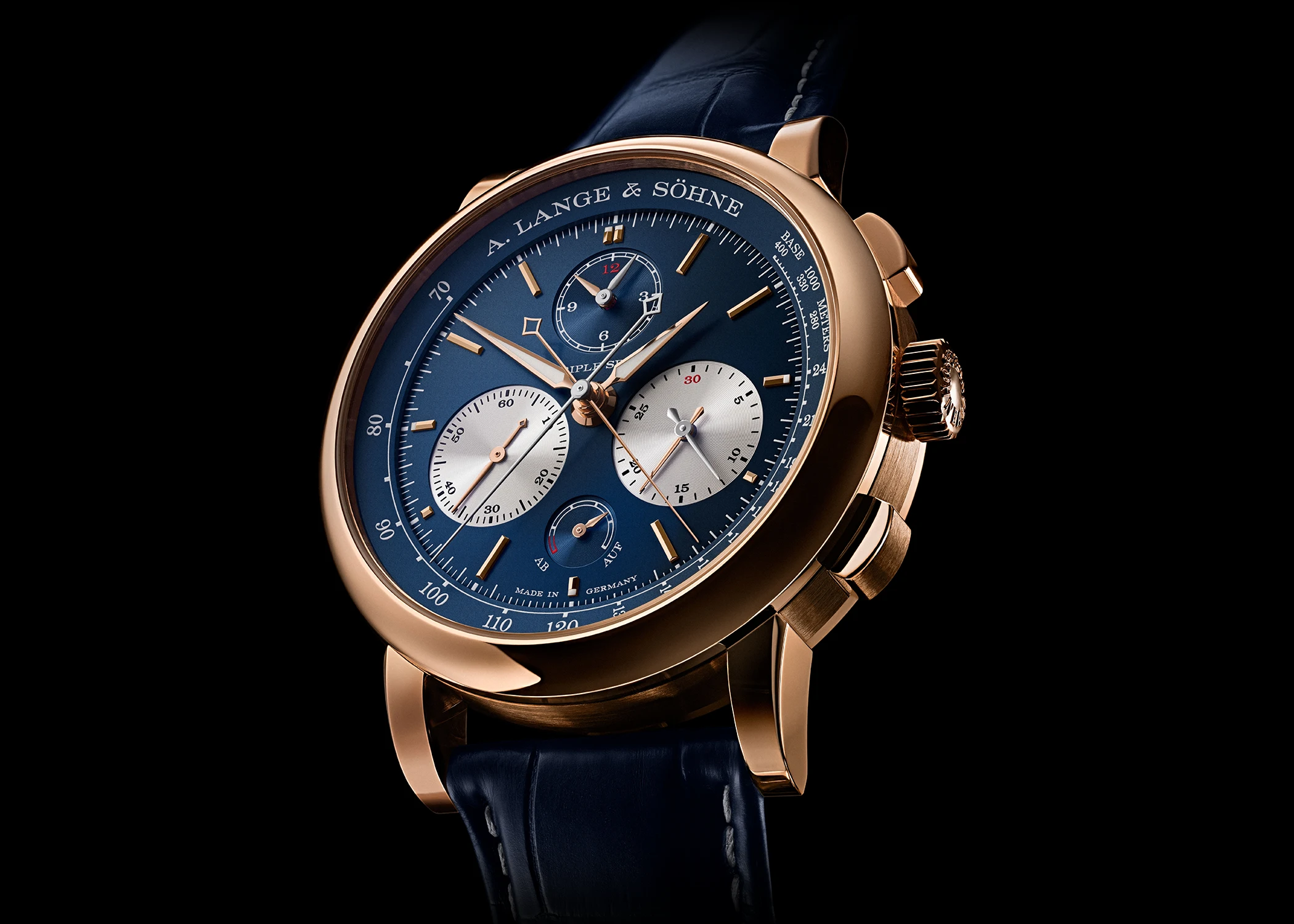
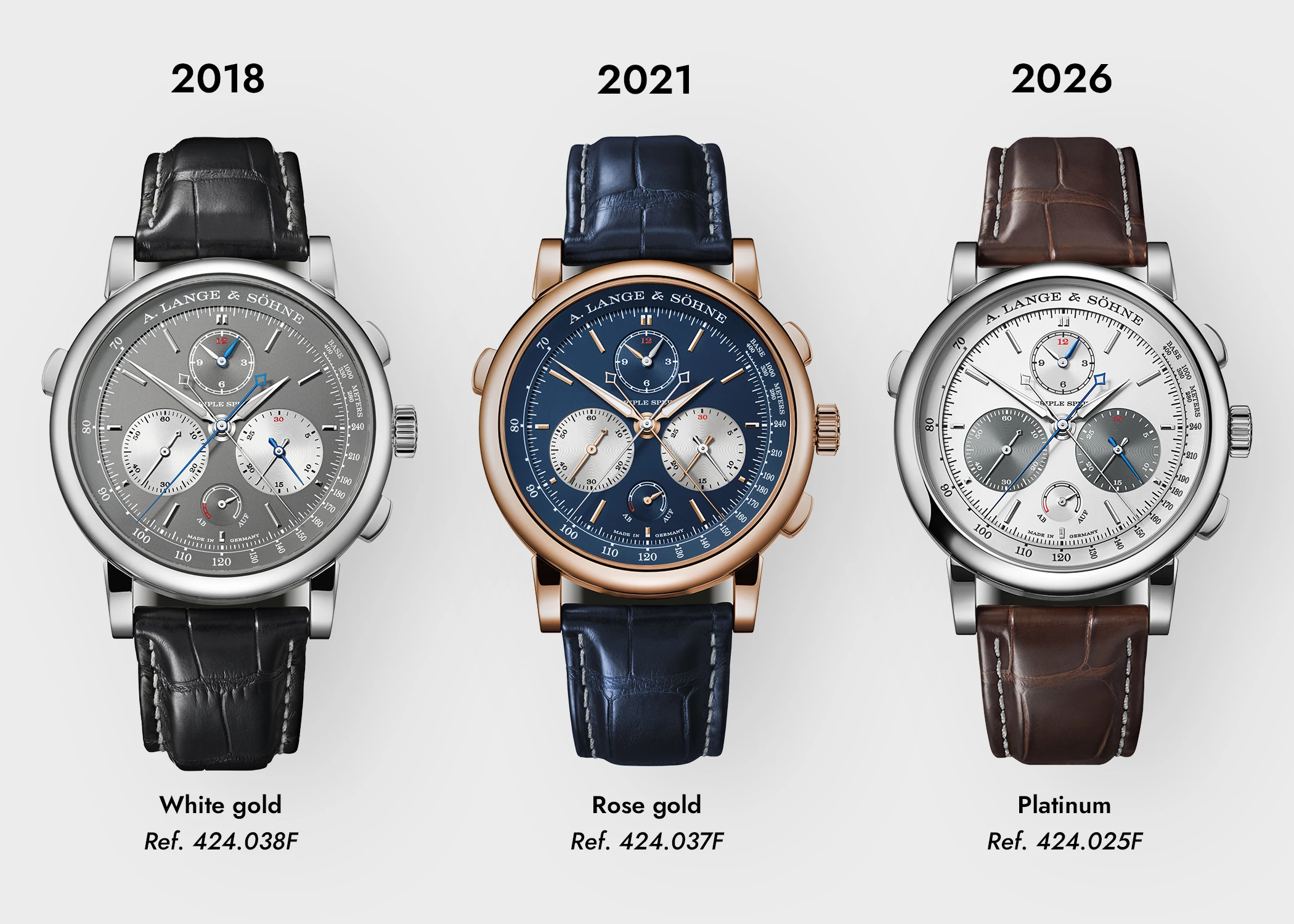
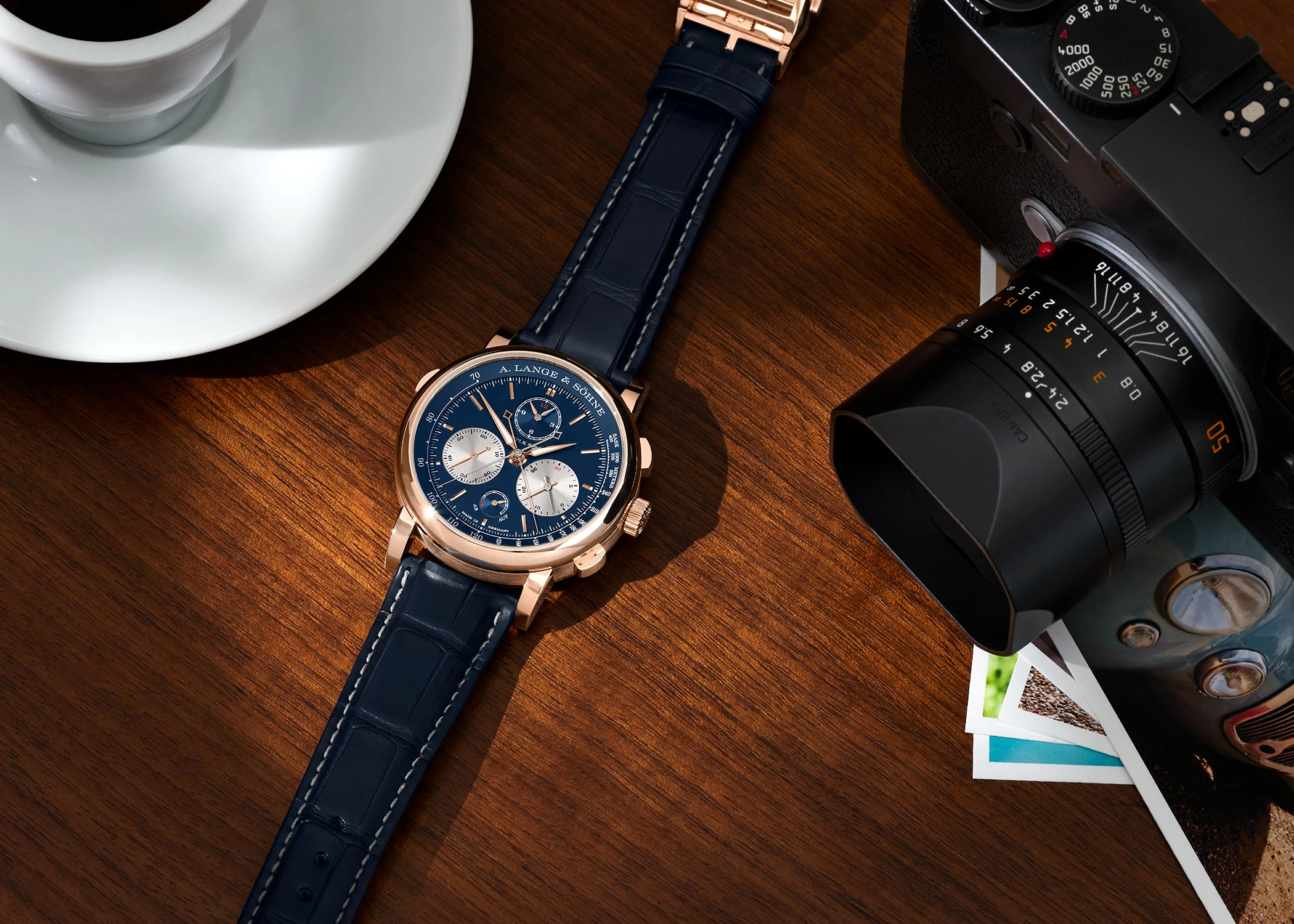
Following the first version of the A. Lange & Söhne Triple Split from 2018 in 750 white gold with a grey dial, and the 2021 version in 750 pink gold with a blue dial, a third edition now follows, likewise limited to 100 pieces. For the first time, the new version presents the Triple Split in a platinum case with a rhodium-coloured dial, set off by contrasting grey subsidiary dials.
The case measures 43.2 mm in diameter and 15.6 mm in height, is water-resistant to 3 bar (30 metres) and is made of platinum. These dimensions are substantial for a traditional manually wound chronograph and are a consequence of the complex rattrapante mechanism. The case surrounds a rhodium-coloured dial in 925 silver, on which the grey subsidiary dials for the small seconds and 30-minute counter provide a contrasting accent.
The dial of the A. Lange & Söhne Triple Split features a total of ten hands, creating a wealth of information at a glance. The two central chronograph seconds hands are given the largest display area on the main dial. At 4 o’clock sits the jumping 30-minute counter, which advances by one increment at the end of each minute. Slightly smaller, at 12 o’clock, is the continuously moving 12-hour counter, while opposite it at 6 o’clock sits Lange’s characteristic ‘AUF/AB’ power-reserve indicator. This shows how much of the maximum 55-hour power reserve remains available. The subsidiary dial for the small seconds at 8 o’clock completes the layout.
For the new new A. Lange & Söhne Triple Split, Lange uses different materials for the main chronograph and rattrapante hands in order to distinguish their respective functions visually. Both the small-seconds hand and the chronograph minute-counter hand are made of rhodiumed 750 gold; the power-reserve hand, chronograph seconds hand and chronograph hour-counter hand are made of rhodiumed steel, while the rattrapante seconds, minute-counter and hour-counter hands are made of blued steel for clear visual differentiation.
Finally, the watch’s appliqués, including the hour markers at 3, 6, 9 and 12 o’clock, are made of rhodiumed 750 gold. Both the hour markers and the central hour and minute hands are also coated with luminous material, allowing them to glow in low-light conditions. The inner dial is framed by a tachymeter scale, which can be used during chronograph measurements to calculate average speeds over a distance of 1,000 metres.
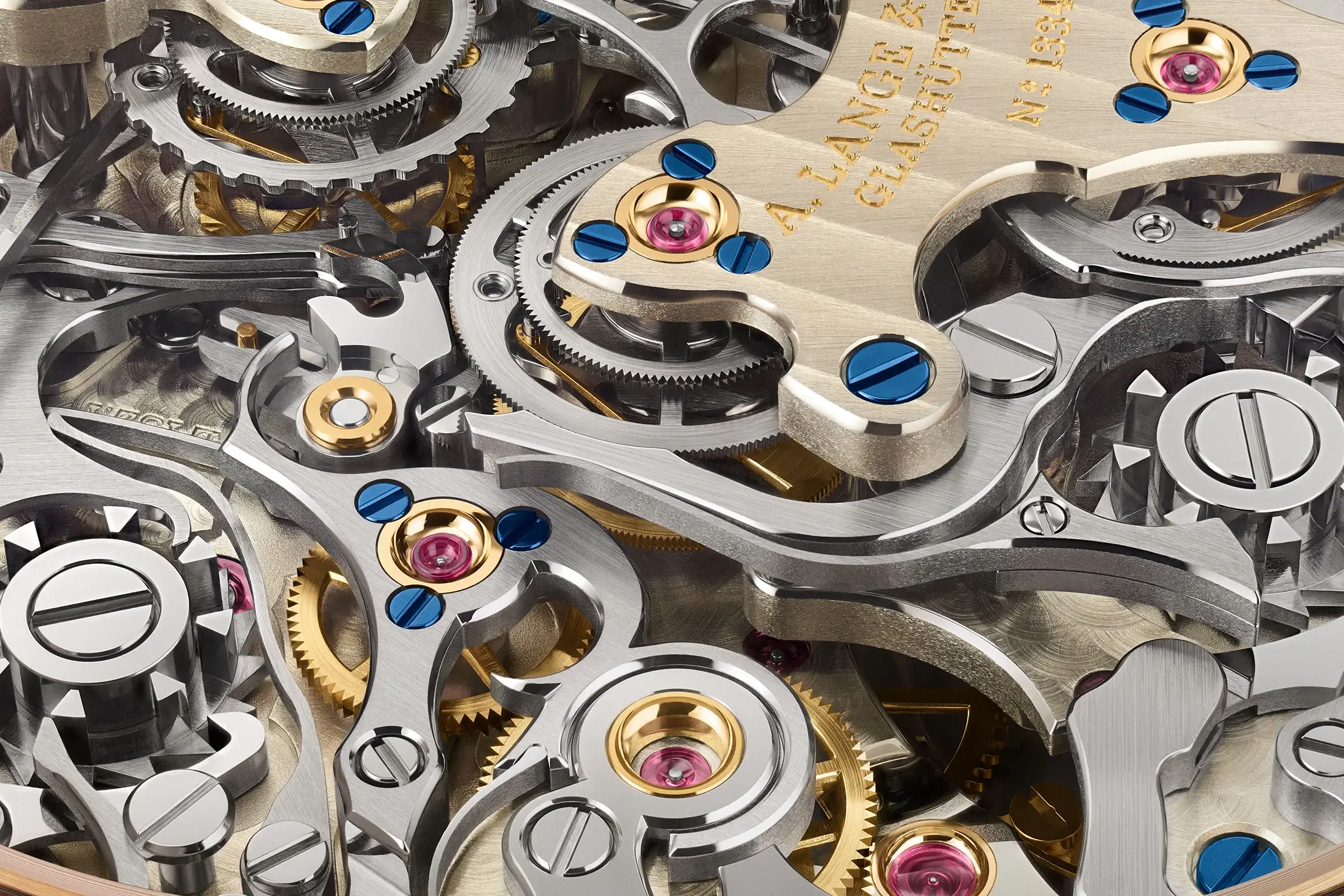
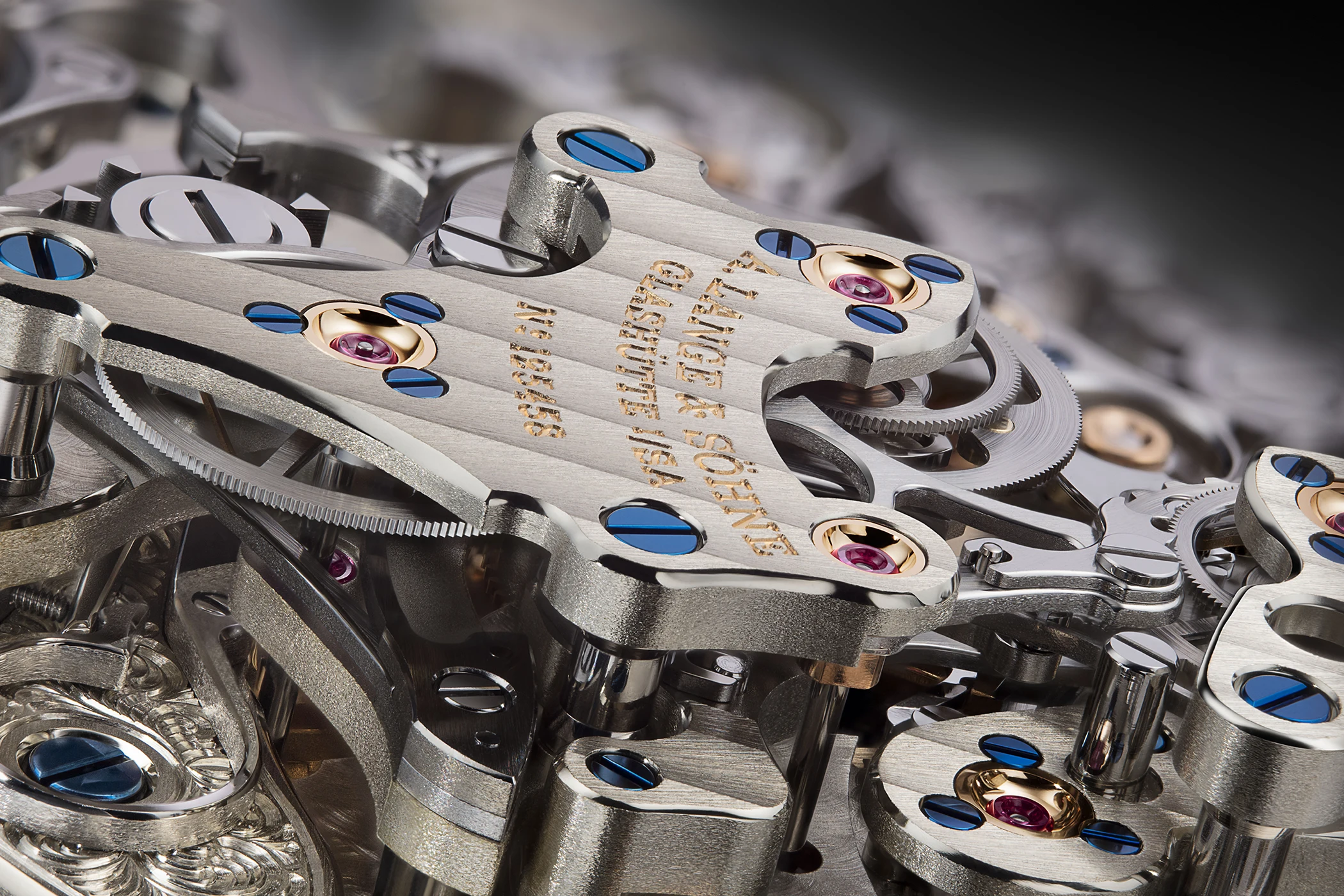
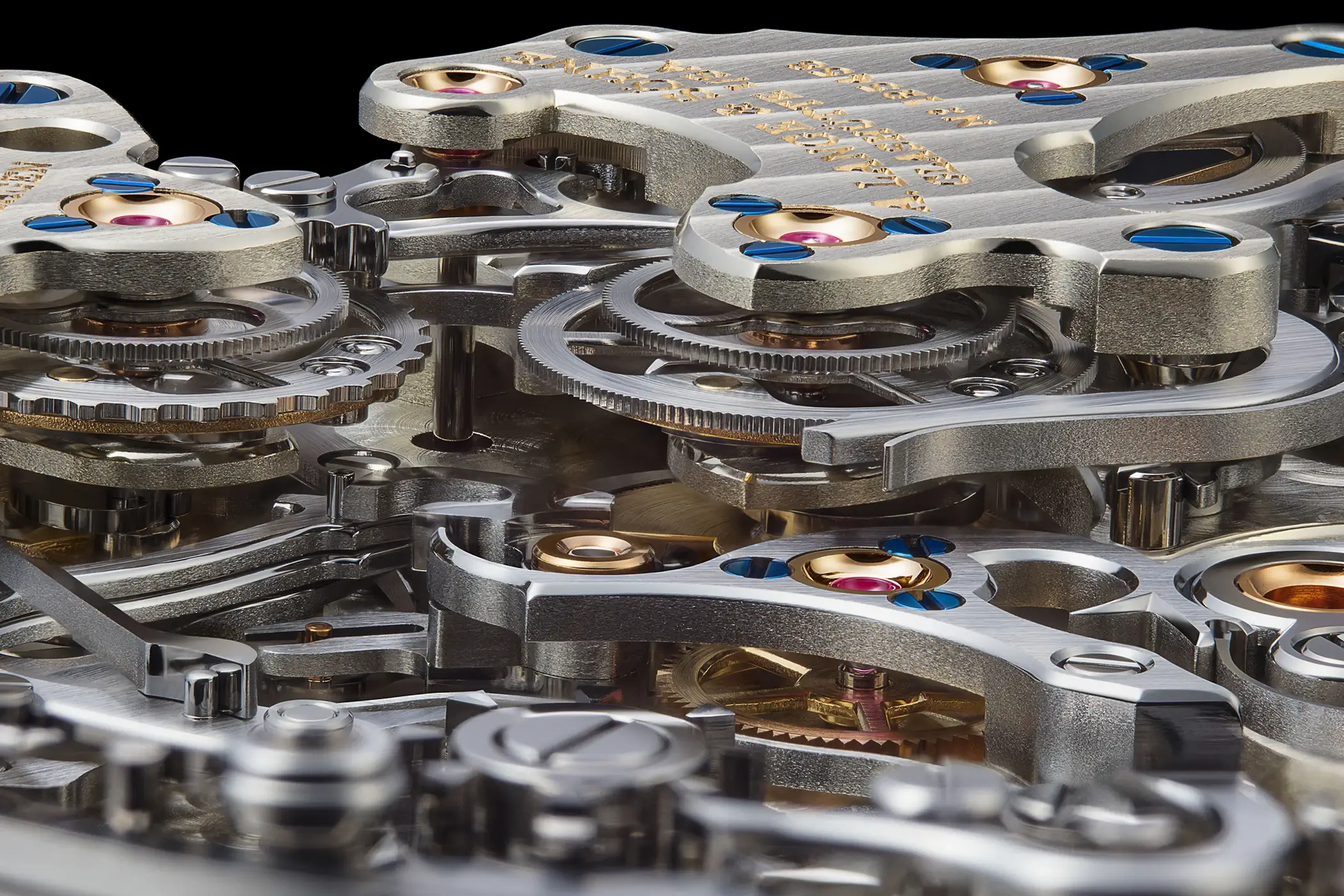
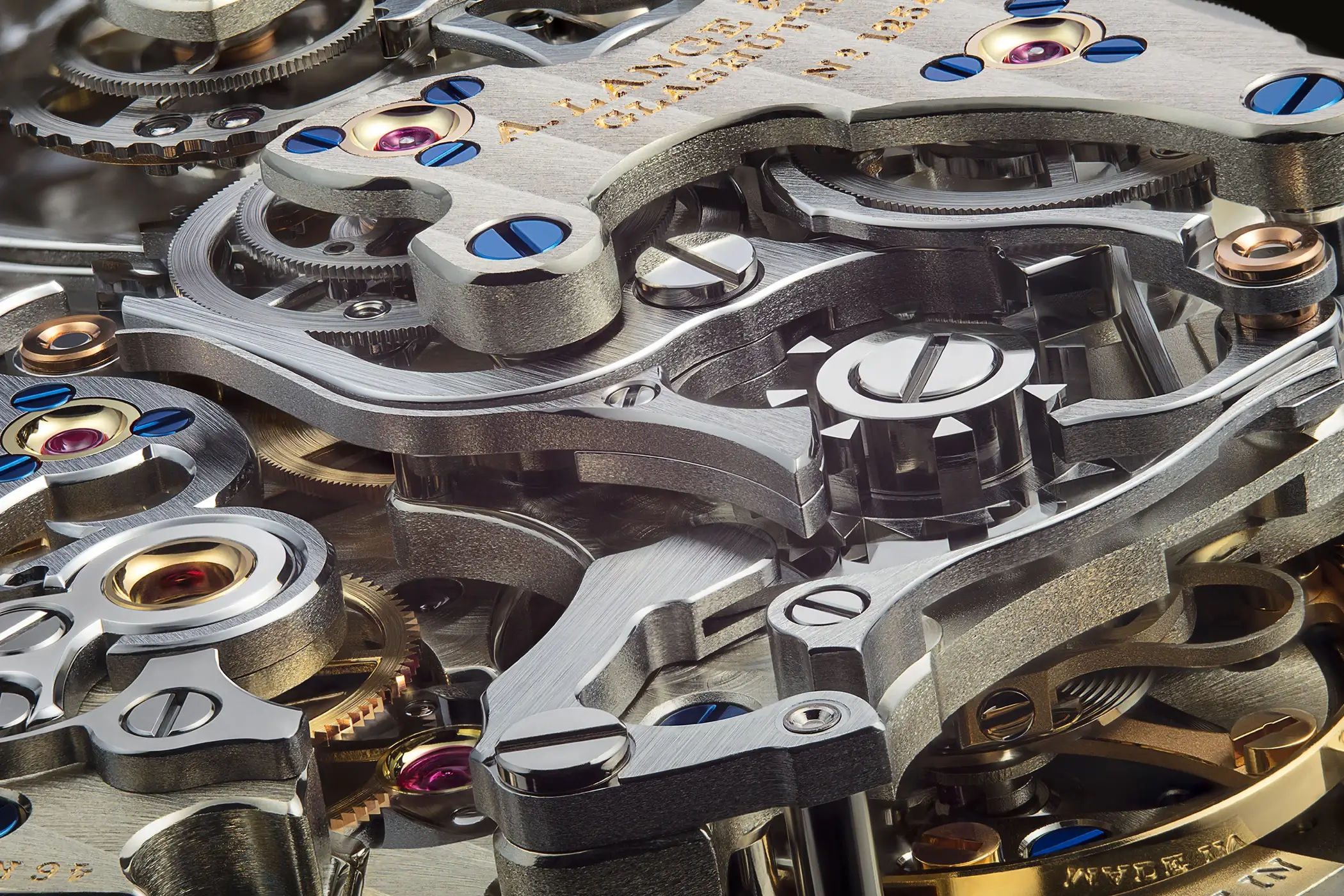
Turning the new A. Lange & Söhne Triple Split over, the sapphire-crystal caseback offers a view of the manually wound manufacture calibre L132.1. In keeping with A. Lange & Söhne’s characteristic depth of manufacture, the movement is decorated and assembled by hand and precision-adjusted in five positions. Particularly noteworthy are the upper surfaces of the levers, springs and jumpers, all of which are decorated with straight graining, while their surrounding edges are bevelled. One of the most demanding aspects of the movement finishing is the polishing of the bevels in the acute internal angles. Five screwed gold chatons set into bridges decorated with Glashütte ribbing and made of untreated German silver, together with the hand-engraved balance cock, complete the overall appearance.
The new A. Lange & Söhne Triple Split is paired with a brown, hand-stitched alligator leather strap with grey stitching, fitted with a folding clasp with quick-release mechanism in 950 platinum.
The new A. Lange & Söhne Triple Split edition is limited to 100 pieces, each bearing a corresponding limitation engraving, and will be presented at this year’s Concours of Elegance at Hampton Court Palace over the first weekend of September. The Triple Split is expected to be priced at around €210,000.