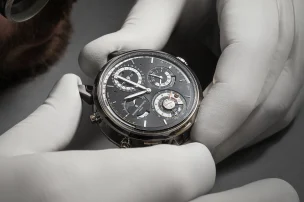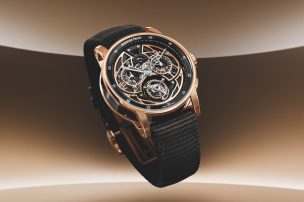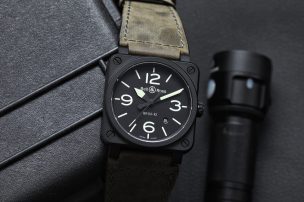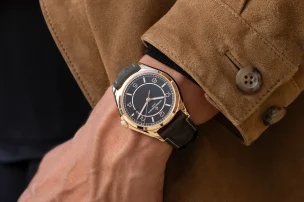
To mark the ‘Watch Art Grand Exhibition Milan 2026’, Patek Philippe has combined its patented hand-wound chronograph calibre CH 29-535 with an instantaneous perpetual calendar in the new reference 5978P-010.
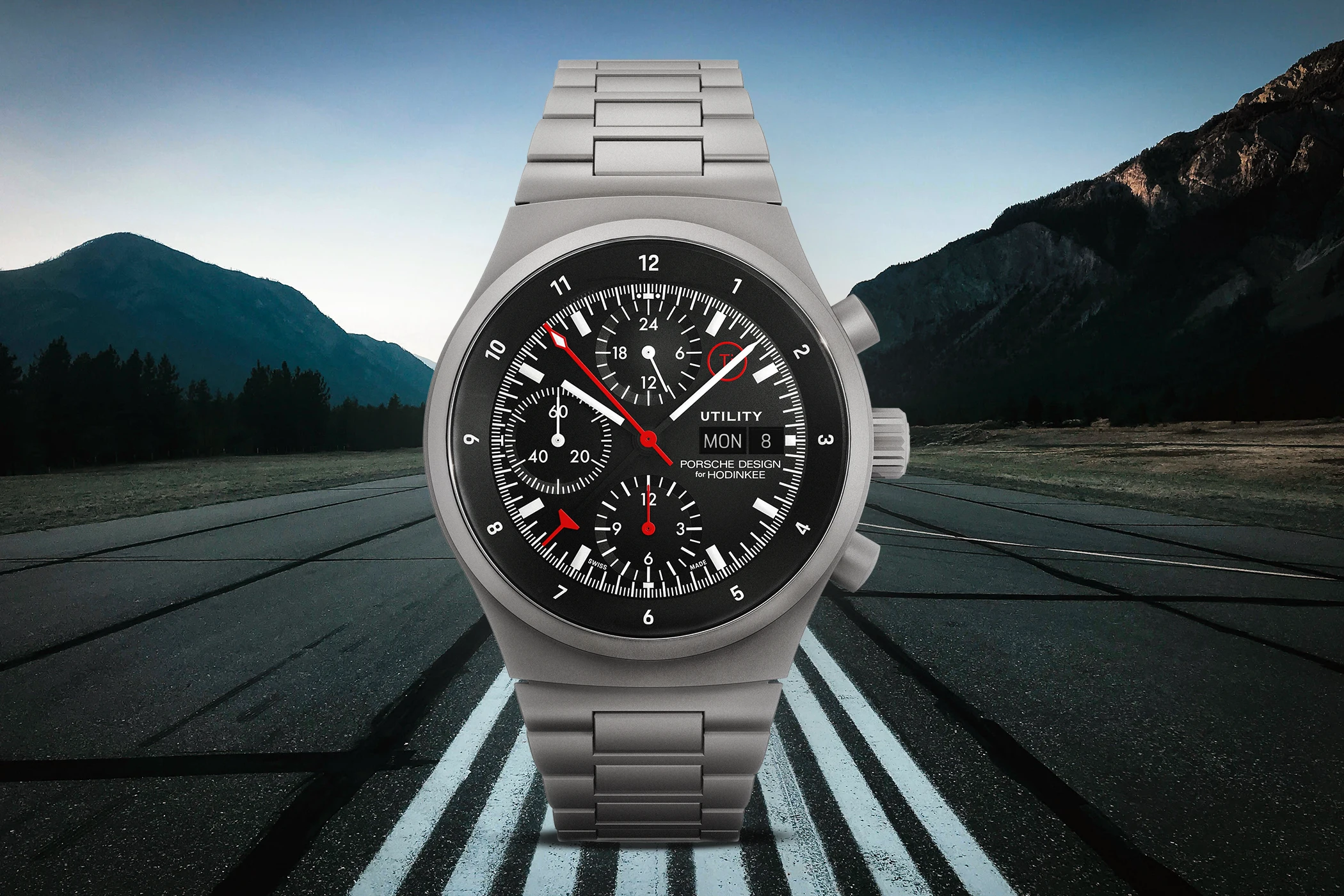
Porsche is generally regarded as the only car manufacturer to also operate its own Swiss watch manufacture. Yet this seemingly unusual connection dates back as far as 1972, when the Chronograph 1 was introduced – a model that remains Porsche Design’s most important watch to this day. Originally designed by Ferdinand Alexander Porsche, the creator of the Porsche 911, the Chronograph 1 now returns in a new iteration: the Porsche Design Chronograph 1 Utility – Limited Edition for Hodinkee.
The new Porsche Design Chronograph 1 Utility – Limited Edition for Hodinkee draws on several milestones in Porsche Design’s watchmaking history. It references both the first entirely black chronograph and the first series-produced chronograph made entirely of titanium. Its inner workings, however, are equally significant: with the new WERK 01.340, the characteristic functional architecture of the legendary Lemania 5100 returns in modern form – most notably its centrally mounted 60-minute chronograph hand.
In this article, we trace the history of the Porsche Design Chronograph 1 and take a closer look at the new model.
The Porsche Design Chronograph 1 forms part of the creative legacy of Ferdinand Alexander Porsche, who secured his place in automotive history as Porsche’s chief designer, overseeing the development of some of the marque’s most important models: the Porsche 911, created in 1963; the first 911 Targa with a removable hardtop, designed in 1965; and the Porsche 904 racing car with its fibreglass body. Yet his creative work would soon extend beyond the automotive world – and one of the fields he turned to was watchmaking.
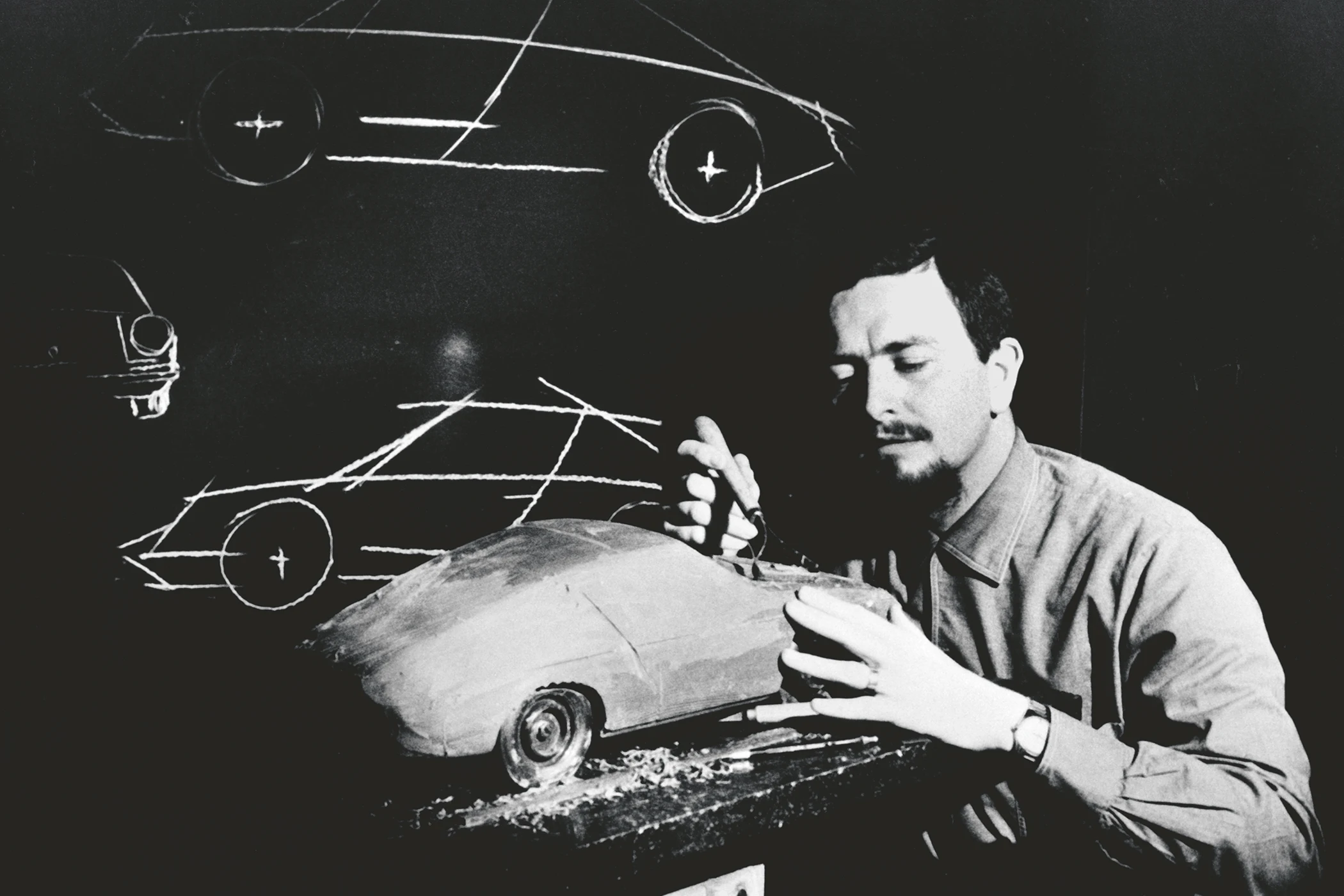
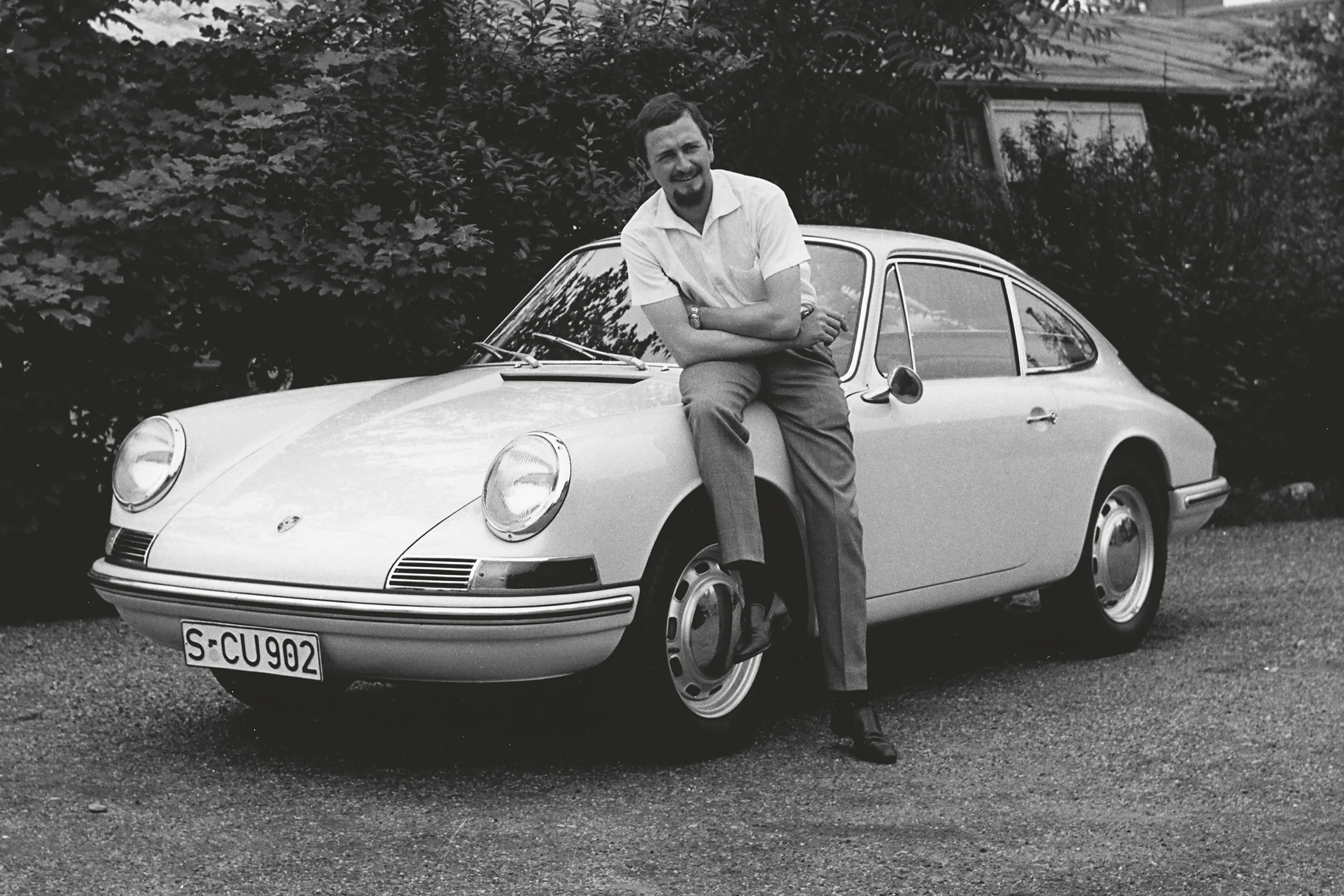
When the members of the Porsche family withdrew from the operational management of their company in 1972, as required by the change in its legal form from Porsche KG to a public limited company, Ferdinand Alexander Porsche founded his own design studio in Stuttgart together with his brother Hans-Peter. Two years later, he returned with the studio to Austria, where he had spent his childhood. Yet two years before Ferdinand Alexander was able to establish his own design studio in Zell am See, the newly incorporated Porsche AG commissioned its former chief designer to create neither a car nor a piece of furniture. Instead, he was asked to design a wristwatch that could be presented to long-serving Porsche employees.
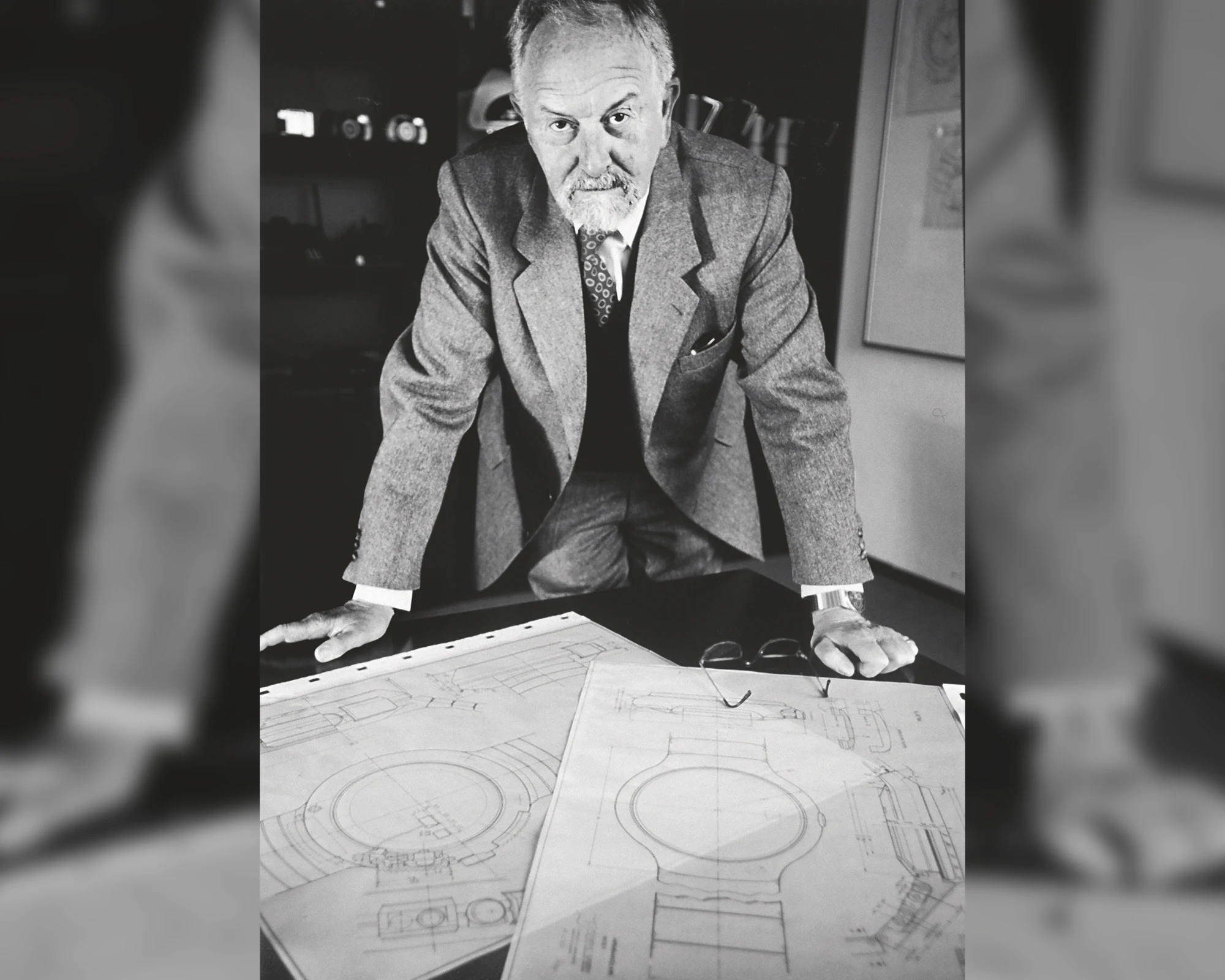
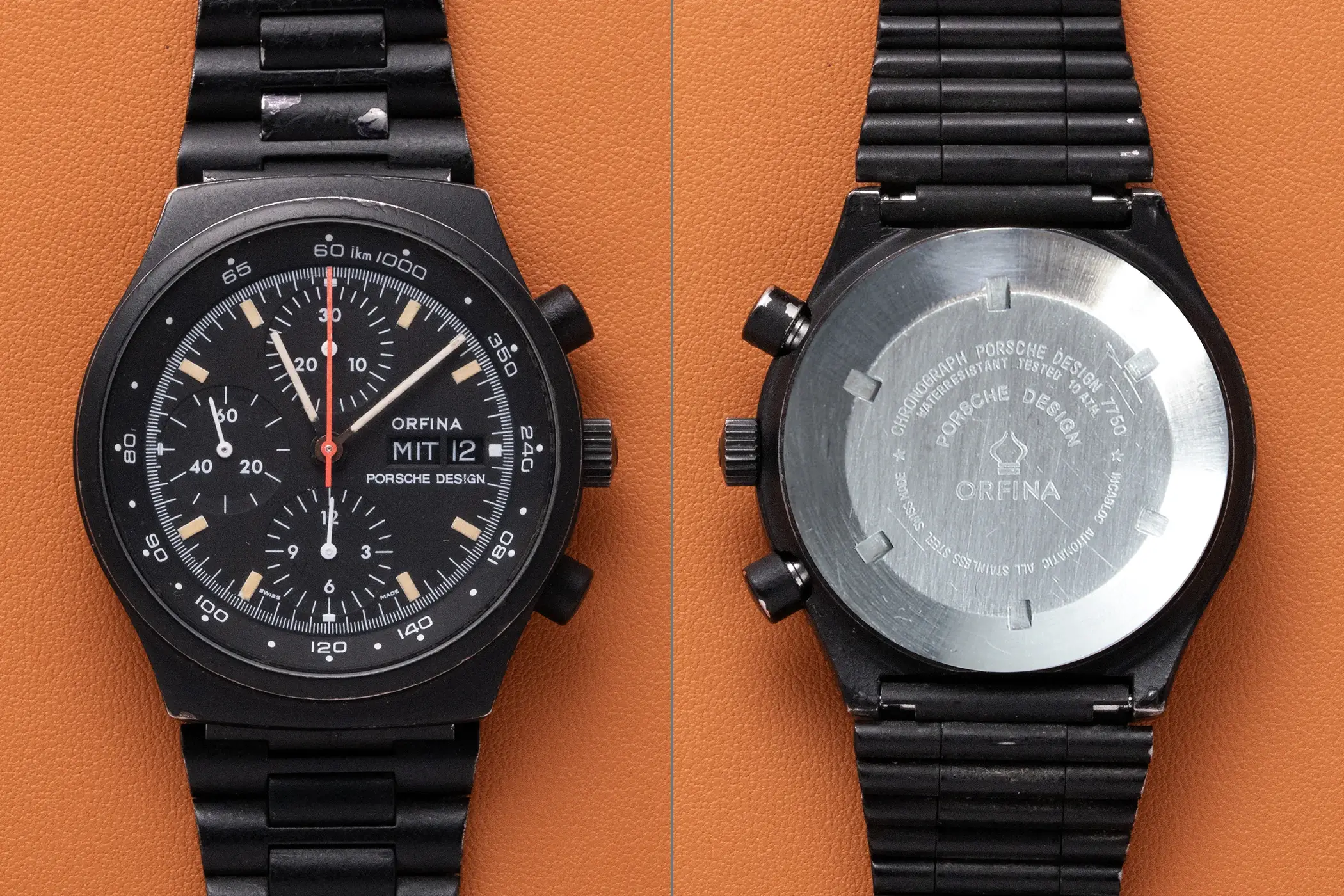
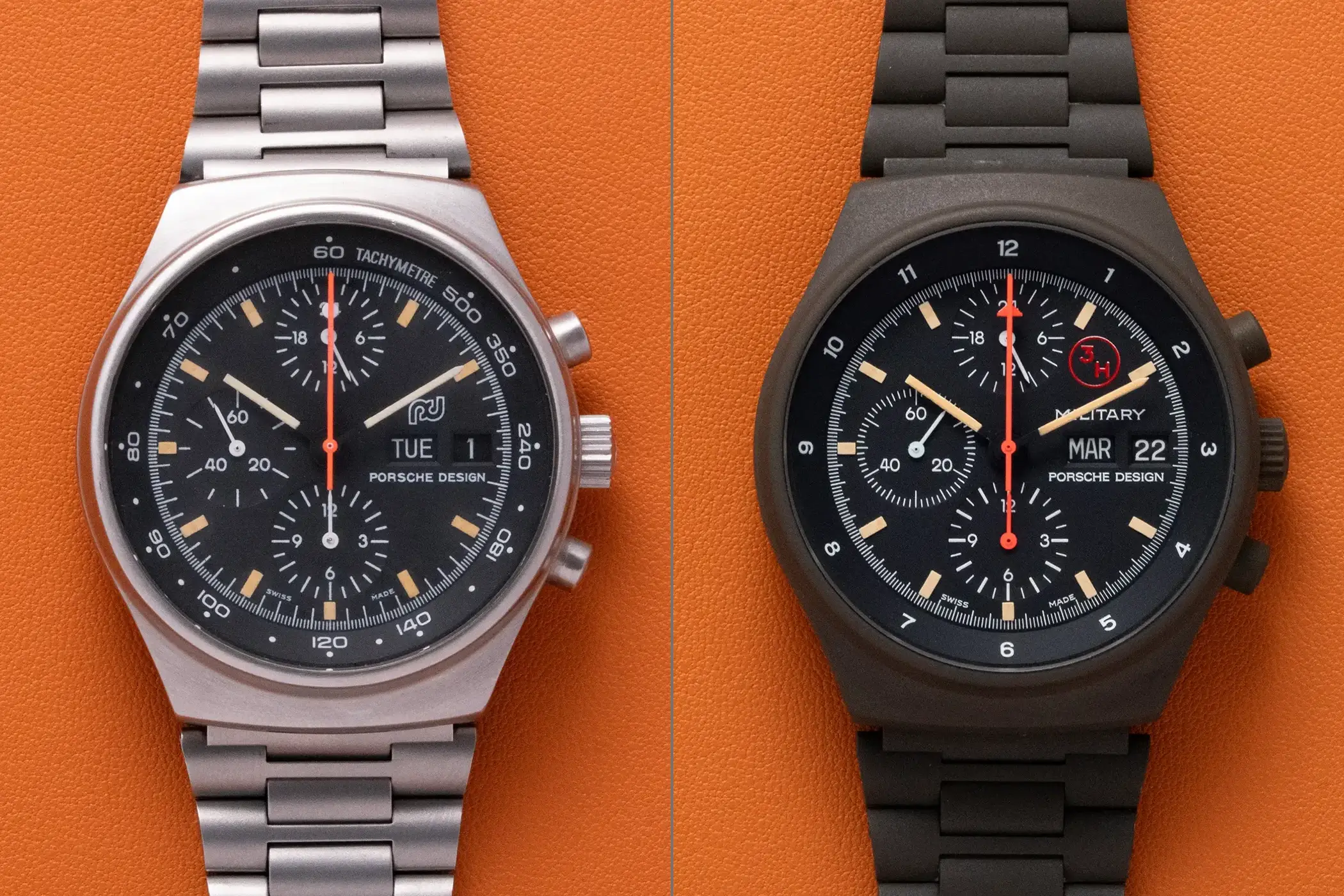
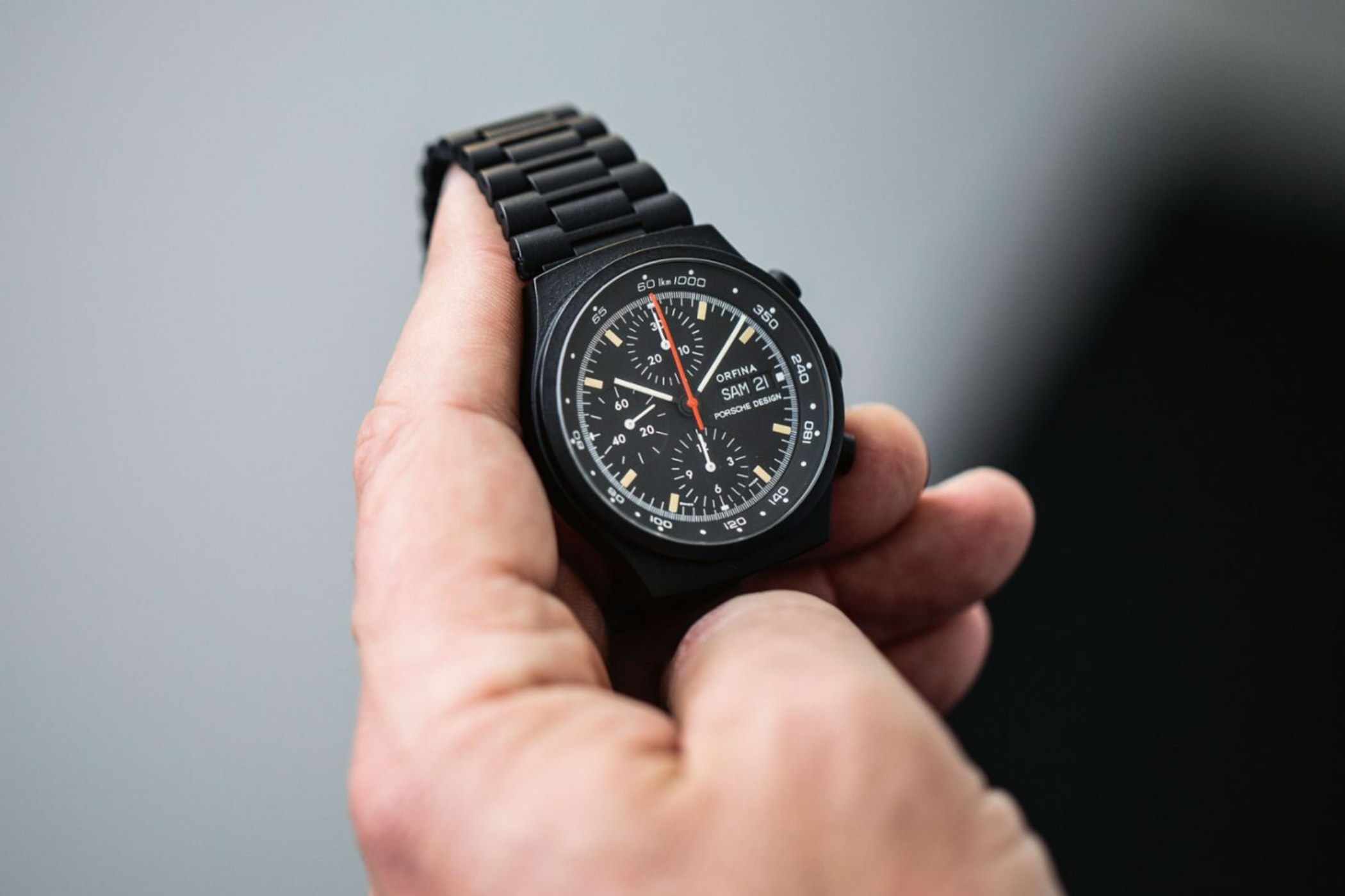
To achieve this, he created a watch whose form and construction were dictated by function, transferring the design principles of the 911 sports car to the Chronograph 1 – and thus to the wrist. Its design was inspired above all by the black dashboard of the 911. The clearest and most distinctive expression of this influence is the dial, with its red central chronograph seconds hand, 30-minute counter at 12 o’clock, 12-hour counter at six o’clock, tachymeter scale on the rehaut, and white numerals and indices standing out in sharp contrast against the black dial.
Beyond the dial and rehaut, the case, bezel and bracelet – all likewise finished in black – also formed part of this same functional design approach.
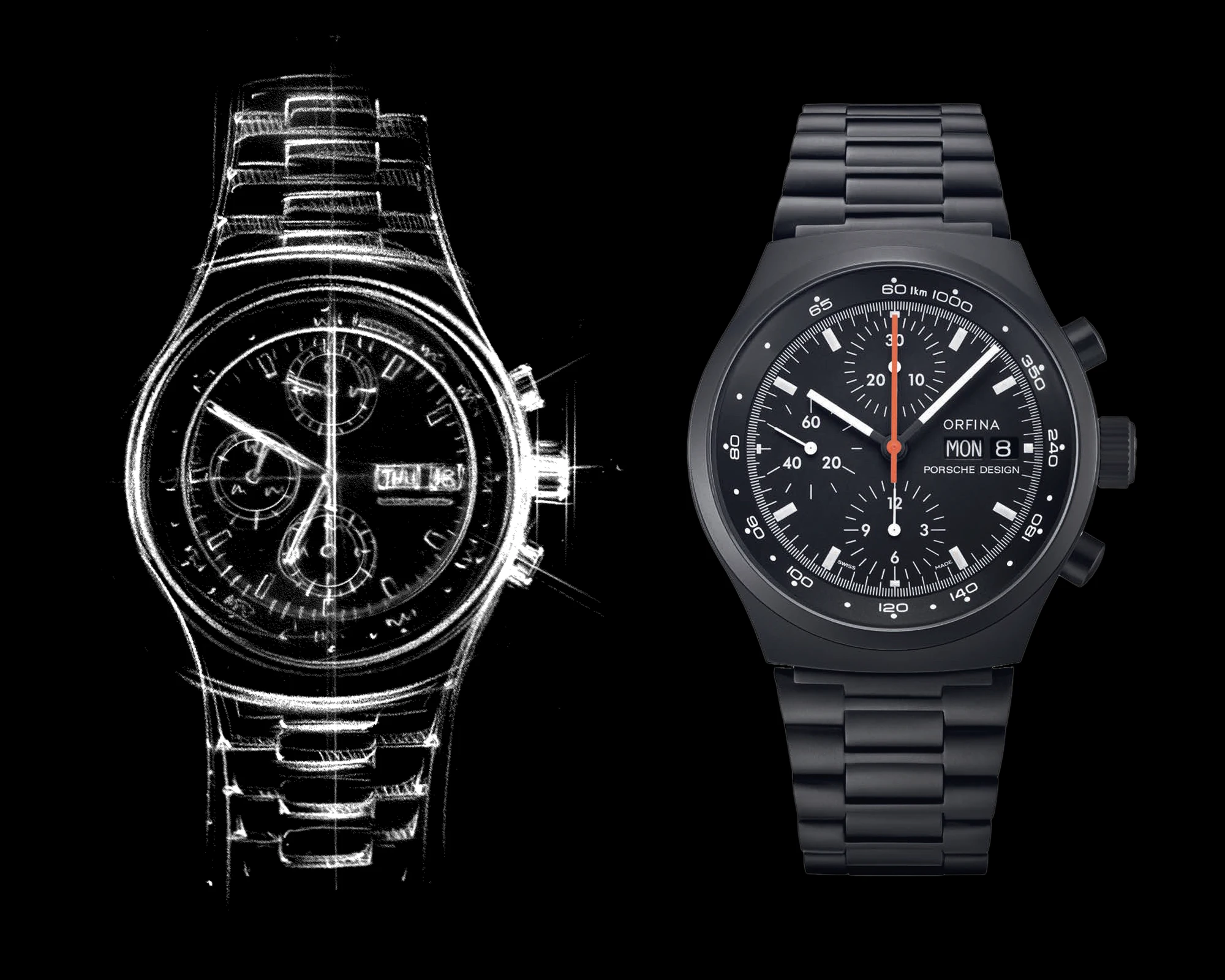
This was particularly unusual because, while black had already been used for dials and bezels in the watch industry, it had not previously been applied to cases and bracelets. Taken together, the matt-black elements of the dial, case, bezel and bracelet evoked the non-reflective dashboard of a Porsche 911, while their uniformly black appearance helped to eliminate reflections. With these characteristics, the Chronograph 1 became the first all-black wristwatch ever made.
Yet while Ferdinand Alexander Porsche provided the vision and design, he still needed a manufacturer capable of bringing his idea to life. According to the Orfinaporschedesign archive, the solution came in the form of Umberto Maglioli, an Italian Formula One racing driver who had competed for Ferrari, Maserati and Porsche during the 1950s. After retiring from motor racing, Maglioli took over the Swiss watch manufacturer Orfina in 1970. Founded by Roland Rüefli in the 1920s, the company had previously undergone several name changes – from Jorin SA around 1927 to Finora Watch Co. around 1929, before eventually becoming Montres Orfina around 1947.
The combination of Ferdinand Alexander Porsche’s design and Orfina’s manufacturing capabilities ultimately gave rise to the Porsche Design Chronograph I. According to Porsche Design, around 51,000 examples were produced during the partnership between Porsche Design and Orfina, which began in 1973 and ended in 1991.
The first version of the Orfina-produced Porsche Design Chronograph 1, reference 7750, was powered – as its reference number suggests – by the recently introduced Valjoux 7750, now widely regarded as one of the most successful automatic chronograph movements ever made. Reference 7750 featured a flat crystal, a broad tachymeter bezel, a 30-minute counter at 12 o’clock and a 12-hour counter at six o’clock. These were complemented by a small-seconds display at nine o’clock and a quick-set function for the day and date indications – a novelty for a sports chronograph at the time.
Credit © Orfinaporschedesign
Although the Chronograph I was designed and presented by F. A. Porsche in 1972, the first production models did not reach customers until 1973. This made them some of the earliest watches in the world to use the Valjoux 7750. However, the quartz crisis soon dealt a severe blow to the mechanical watch industry, with consequences that are well known. Production of the Valjoux 7750 was affected too, and was temporarily discontinued just two years after the movement’s introduction.
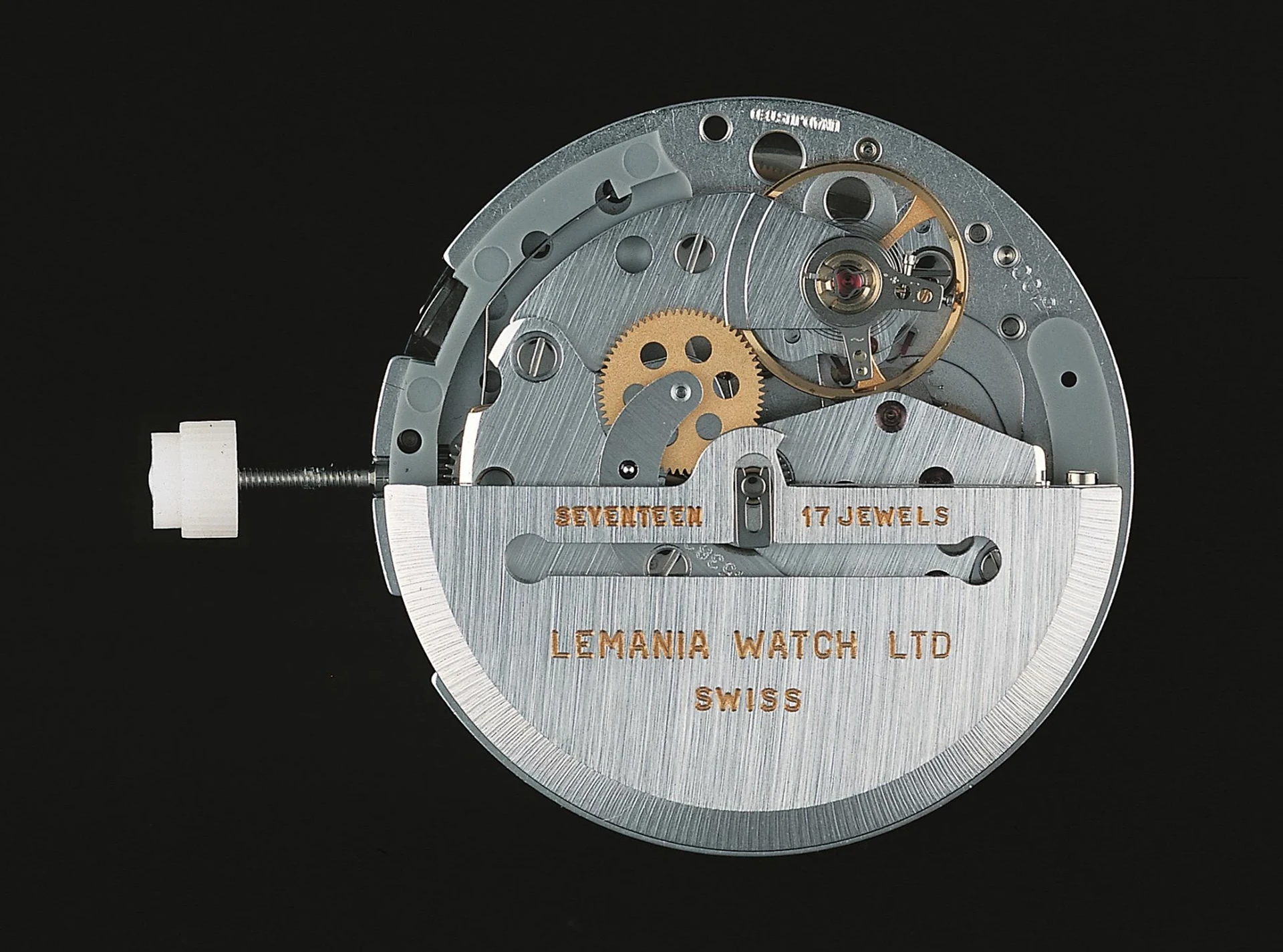
This prompted Porsche Design to turn to a new movement: the Lemania 5100, introduced in 1974 and notable for several reasons. The calibre was engineered for robustness, reliability and economical production, reflected in its extensive use of stamped components and practical materials such as Delrin plastic, as well as a cam-controlled chronograph mechanism instead of the more elaborate and delicate column-wheel construction. Thanks to the chronograph mechanism’s direct-drive architecture, the movement could withstand severe shocks without causing the central chronograph hand to stop. It was also capable of tolerating vertical accelerations of up to 7 g without any significant loss of rate accuracy.
The feature most responsible for the legendary status of the Lemania 5100, however, is one that was – and remains – a rarity among relatively affordable chronographs: a centrally mounted chronograph minute counter. Whereas the Valjoux 7750 placed only the chronograph seconds hand at the centre, with the minute counter housed in a separate subdial at 12 o’clock, the Lemania 5100 features two central chronograph hands for displaying elapsed seconds and minutes.
This gives the Lemania 5100 a total of four centrally mounted hands on a single axis, allowing elapsed times to be read more intuitively and with greater precision. This significant change also altered the layout of the subdials: a 12-hour counter was positioned at six o’clock, the small seconds at nine o’clock and a 24-hour display at 12 o’clock, while the day and date display at three o’clock was retained.
This new movement generation of the Orfina-produced Porsche Design Chronograph 1 gave rise to two key reference families: the civilian models of the 7176 family – including, most notably, the first use of the so-called ‘Military dial’ – and the 7177 family, which was closely associated with the military variants. The Porsche Design Chronograph 1’s connection with the armed forces of various countries can be traced back to its combination of centrally mounted chronograph seconds and minute hands, which made elapsed times quicker and more intuitive to read, particularly in aviation or motorsport, and thereby also made the chronograph attractive to military users.
Credit © Orfinaporschedesign
Versions fitted with the Military dial are distinguished by a central chronograph minute hand that often features a prominent, aircraft-shaped tip. This allows elapsed time to be read just as quickly as the regular time – a characteristic that could prove useful in cockpit and other operational applications. Another military feature was the red ‘3H’ marking on the dial. Rather than referring to ‘three hours’, it denotes hydrogen-3, or tritium, a mildly radioactive luminous material applied to the hands and dial markers to improve legibility in the dark.
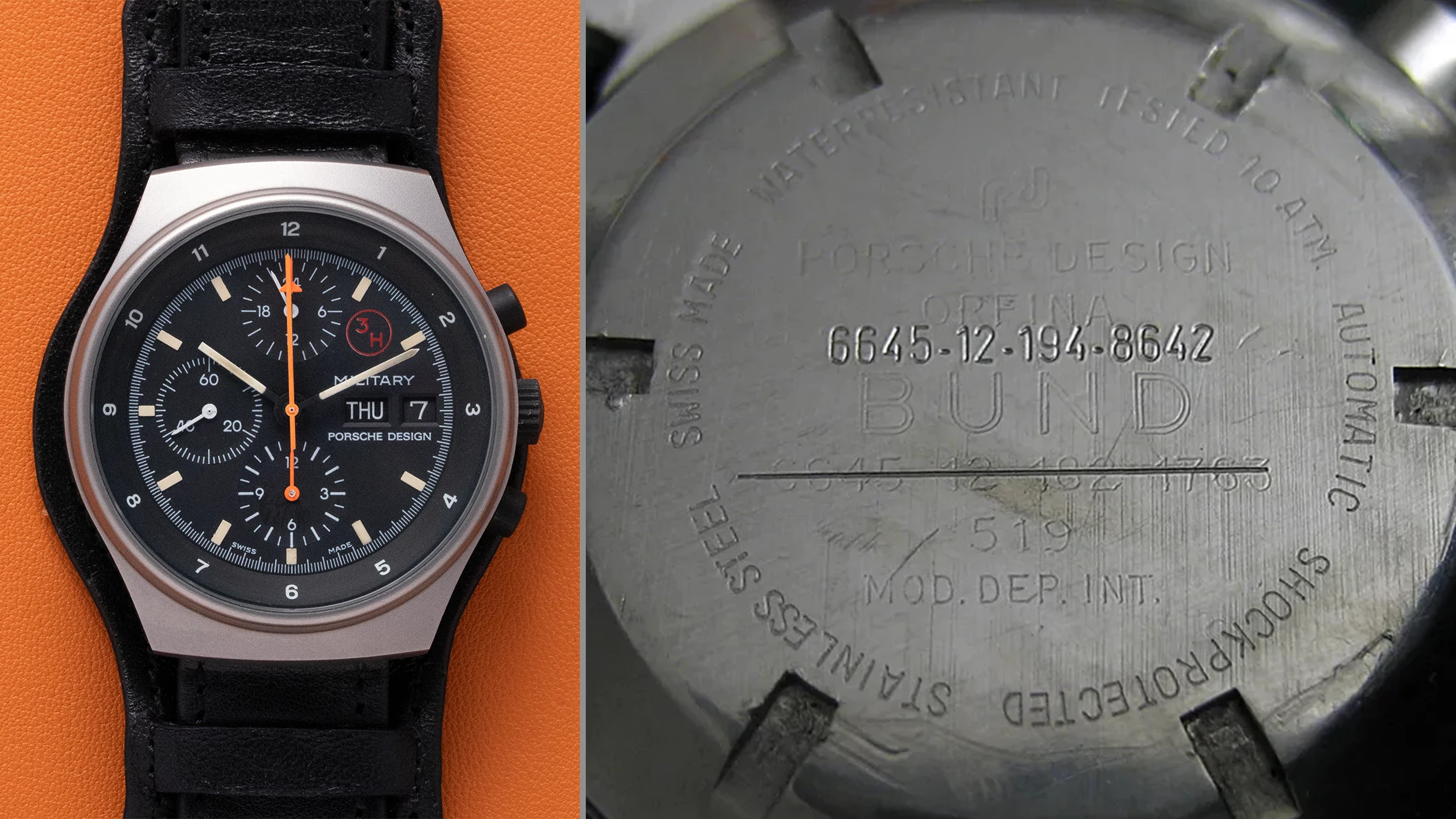
The use of reference 7177 Chronograph 1 watches by the German Bundeswehr is particularly well documented. From around 1979 onwards, the Orfina-produced chronograph powered by the Lemania 5100 was issued as a pilot’s chronograph. These service watches can be identified by the ‘BUND’ marking on the caseback, together with a military supply number; known examples include 6645-12-182-1763 and, later, 6645-12-194-8642.
Credit © Orfinaporschedesign
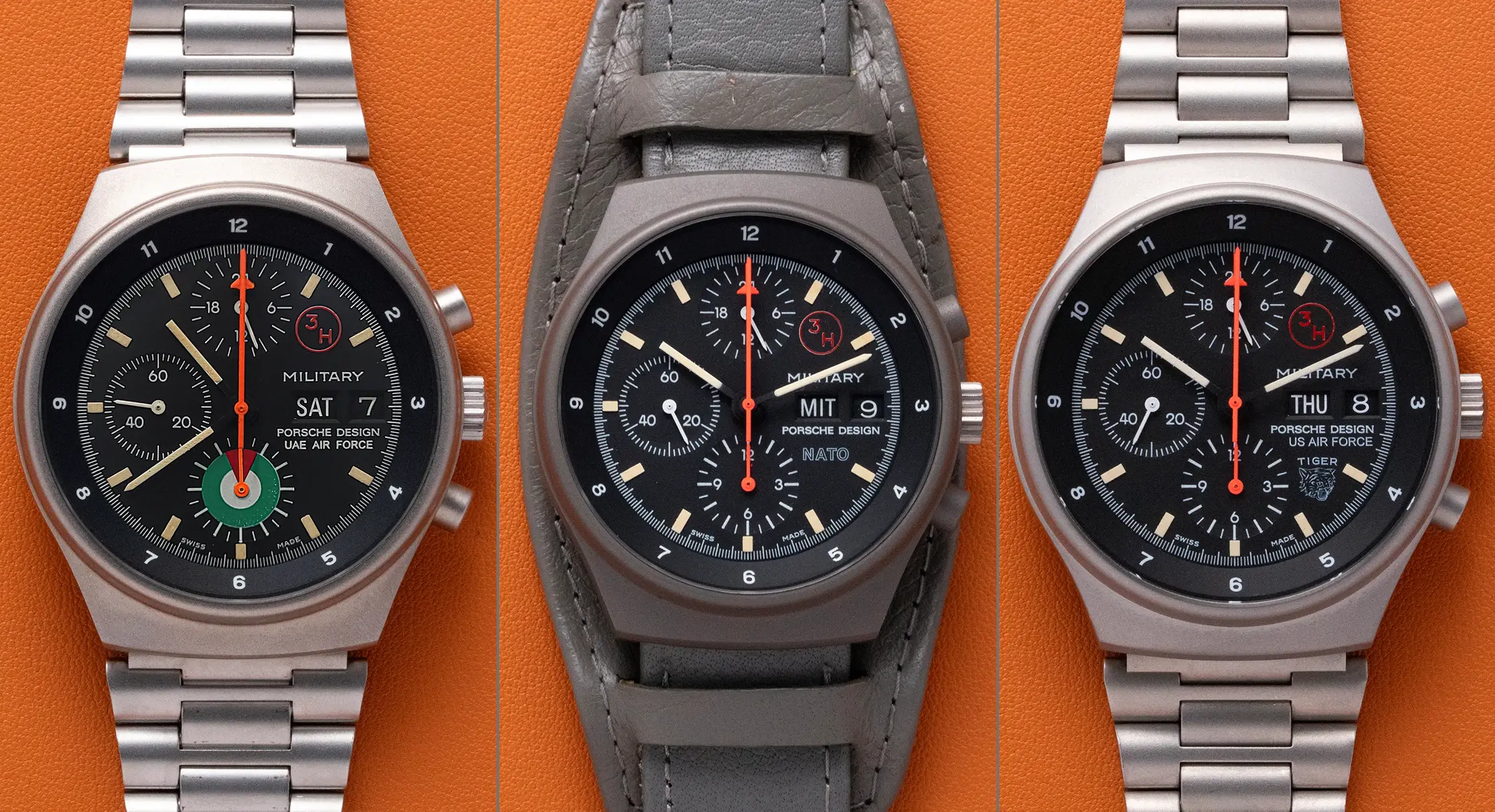
Variants of reference 7177 were also produced with links to NATO, the British Royal Navy, the Swiss Armed Forces, the United Arab Emirates, Venezuela and the U.S. Air Force, each distinguished by a corresponding symbol or inscription on the dial.
Credit © Orfinaporschedesign
One of the best-known versions is the so-called ‘Flying Tiger’, distinguished by the characteristic tiger’s head on the dial. It is associated with the U.S. Air Force’s 23rd Tactical Fighter Wing and, decades later, served as inspiration for the Porsche Design Chronograph 1 Utility. Introduced in 2023 as a reinterpretation of the Military chronograph, the Utility replaced the tiger’s head with a graphic of a screaming marmot – known colloquially as a ‘Mankei’ in the Pinzgau region of Austria.
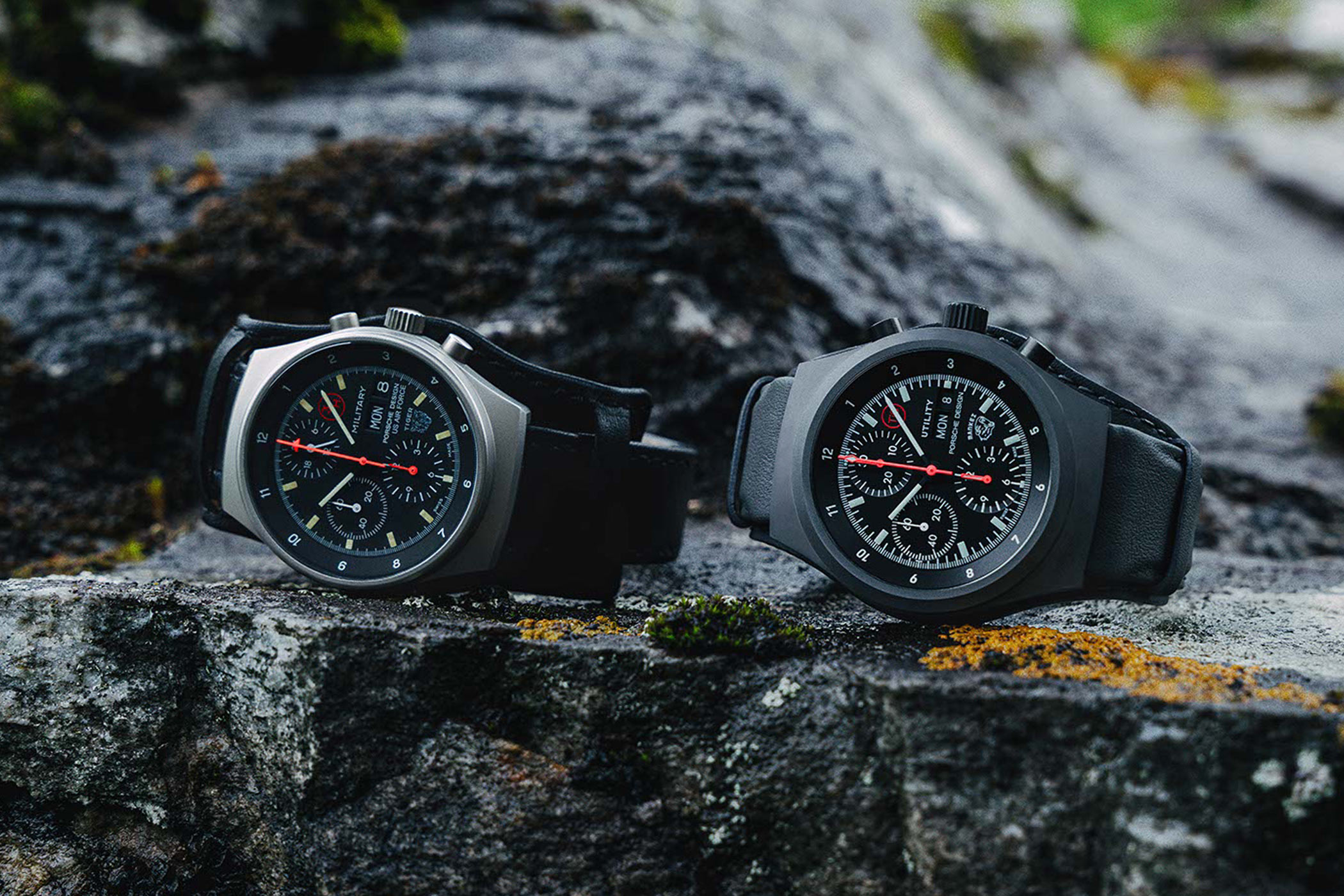
For the Utility, Porsche Design revisited the defining design elements of the ‘Military dial’, but replaced the ‘3H’ marking with ‘TiC’, referring to titanium carbide, while the historical luminous material gave way to Super-LumiNova. Production of the Porsche Design Chronograph 1 by Orfina continued until 1991, the same year in which the partnership between Porsche Design and Orfina officially came to an end.
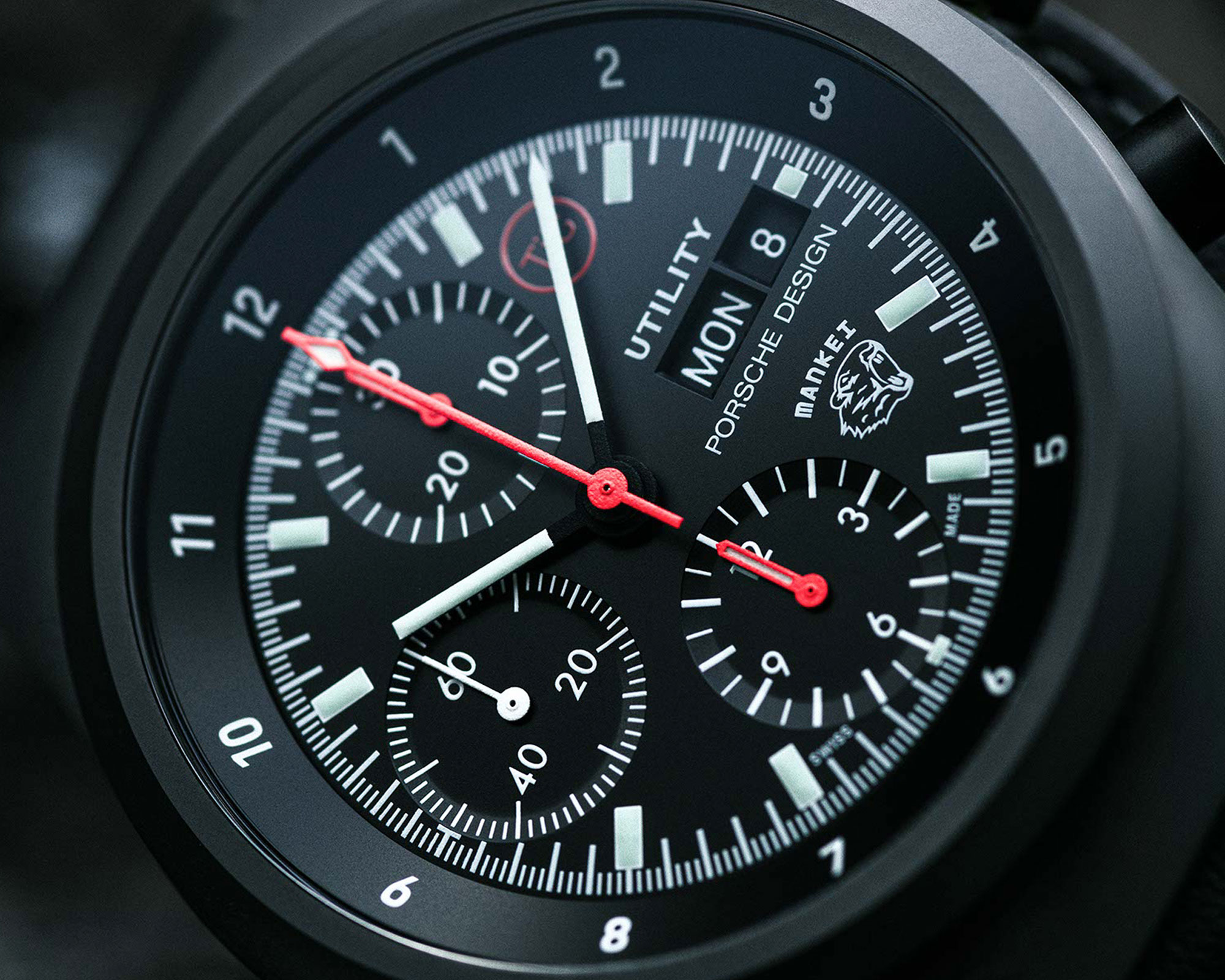
Porsche Design has now joined forces with Hodinkee to present the Porsche Design Chronograph 1 Utility – Limited Edition for Hodinkee, marking the second chapter of a three-part collaboration that began in 2024 with the Chronograph 1 – Hodinkee 2024 Edition. Limited to 350 pieces, the new model not only draws on the historic Military chronographs in terms of design: with the new WERK 01.340, the characteristic functional architecture of the Lemania 5100 also returns to a modern Chronograph 1 for the first time.
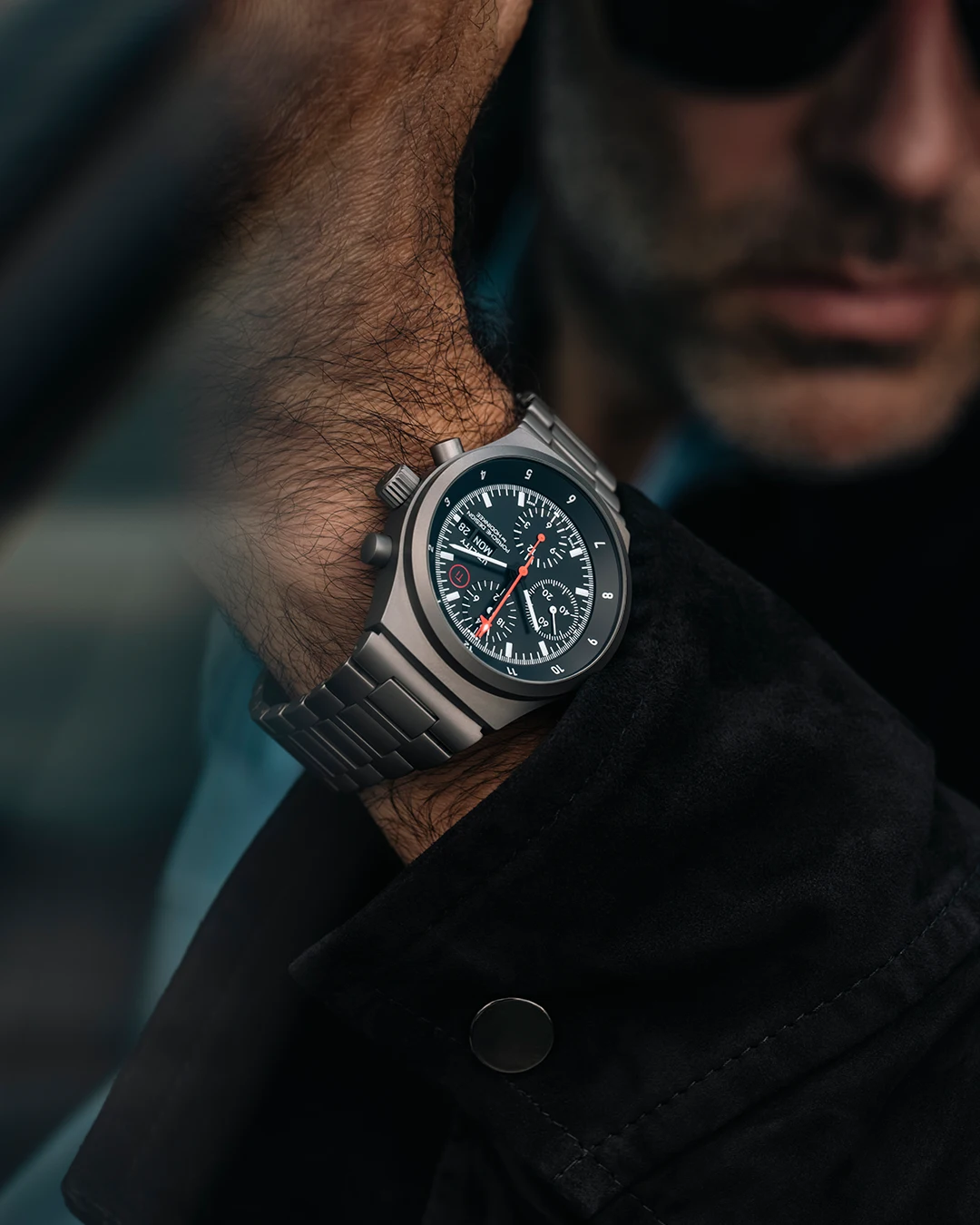
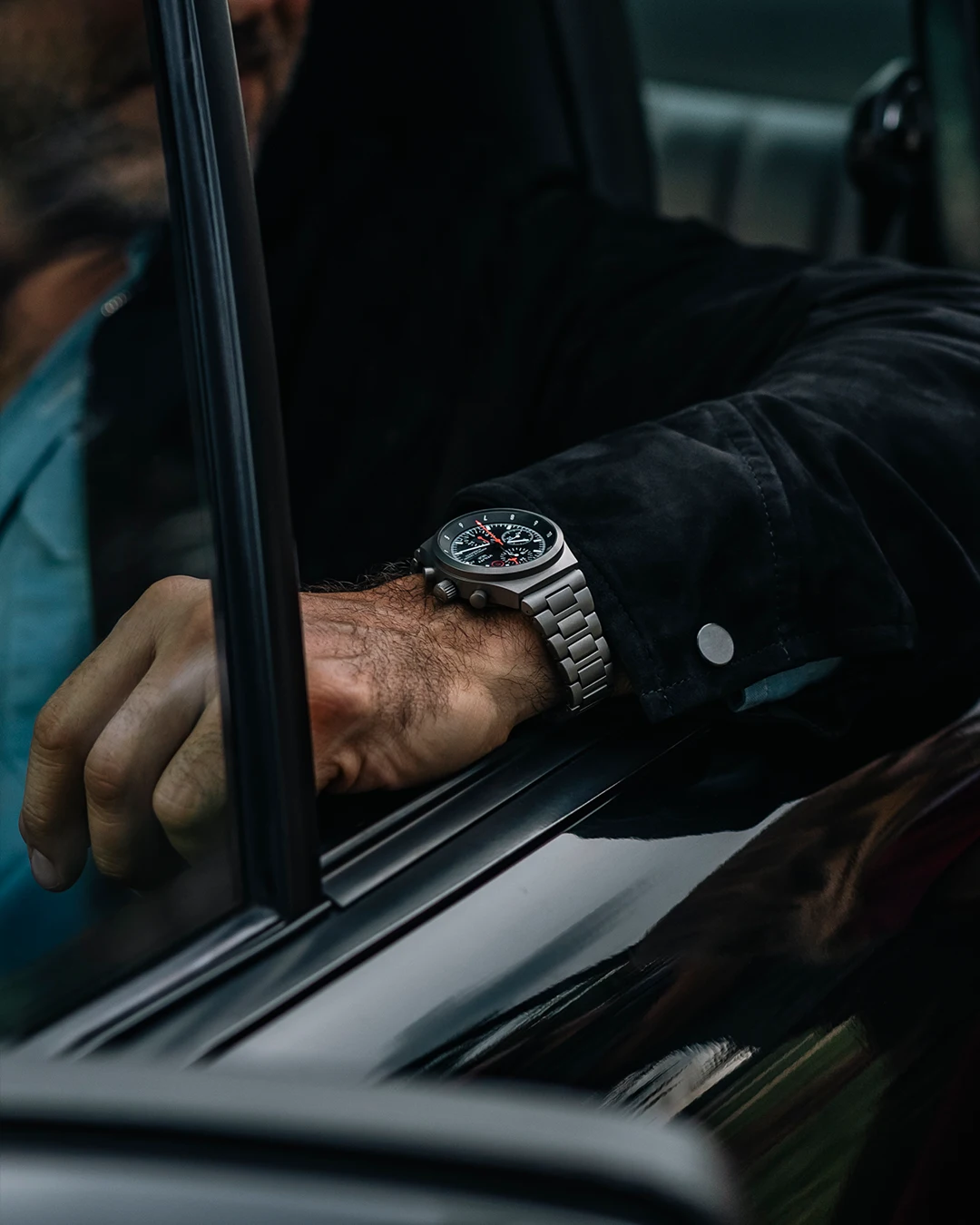

One of the new Porsche Design Chronograph 1 Utility – Limited Edition for Hodinkee model’s most important features lies inside the watch. Although the Lemania 5100 had proven itself over several decades, particularly in robust service and pilot’s chronographs, the calibre gradually lost relevance. Its construction, conceived for economical and rugged production using stamped parts and plastic components, became increasingly at odds with a watch industry in which elaborately decorated movements and exhibition casebacks were gaining importance. Production was eventually discontinued in the early 2000s.
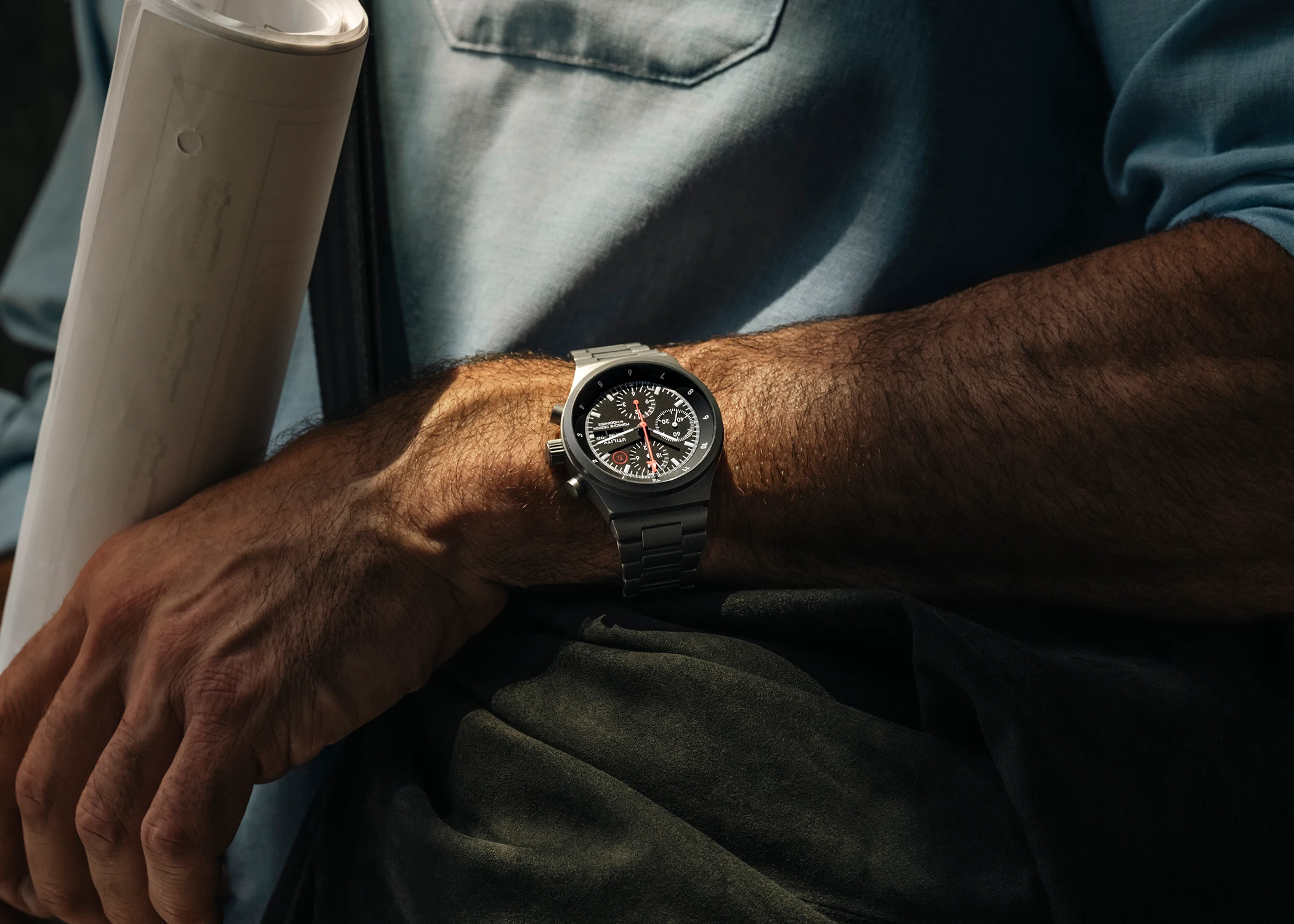
Unlike the Valjoux 7750, the unusually constructed Lemania 5100 was not followed by a comparable successor. Even after its patent protection expired, very few direct reproductions appeared, meaning that the calibre’s distinctive display architecture largely disappeared from the market along with the movement itself.
This is precisely where Porsche Design now picks up the thread. The WERK 01.340 is not a reproduction of the Lemania 5100, but rather a newly developed complication based on Porsche Design’s automatic chronograph platform. What does return, however, are its defining functions: the central 60-minute chronograph hand, the 24-hour display at 12 o’clock, the 12-hour counter at six o’clock, the small seconds at nine o’clock, and the quick-set day and date functions.
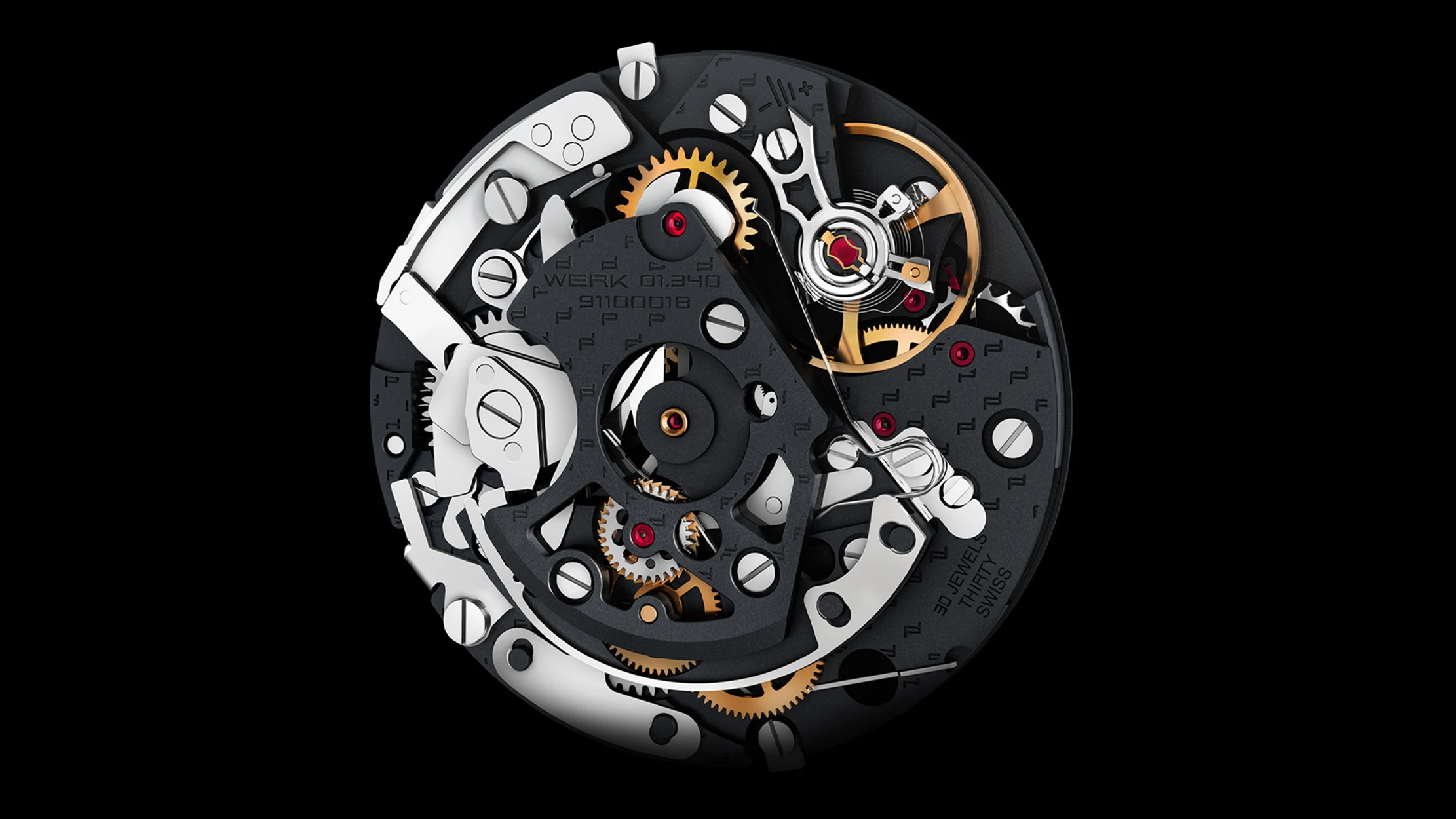
The COSC-certified WERK 01.340 operates at 4 Hz, features 30 jewels and offers a power reserve of 60 hours. Rather than reviving the Lemania 5100 itself, Porsche Design has brought its characteristic functional and display architecture into the present day.
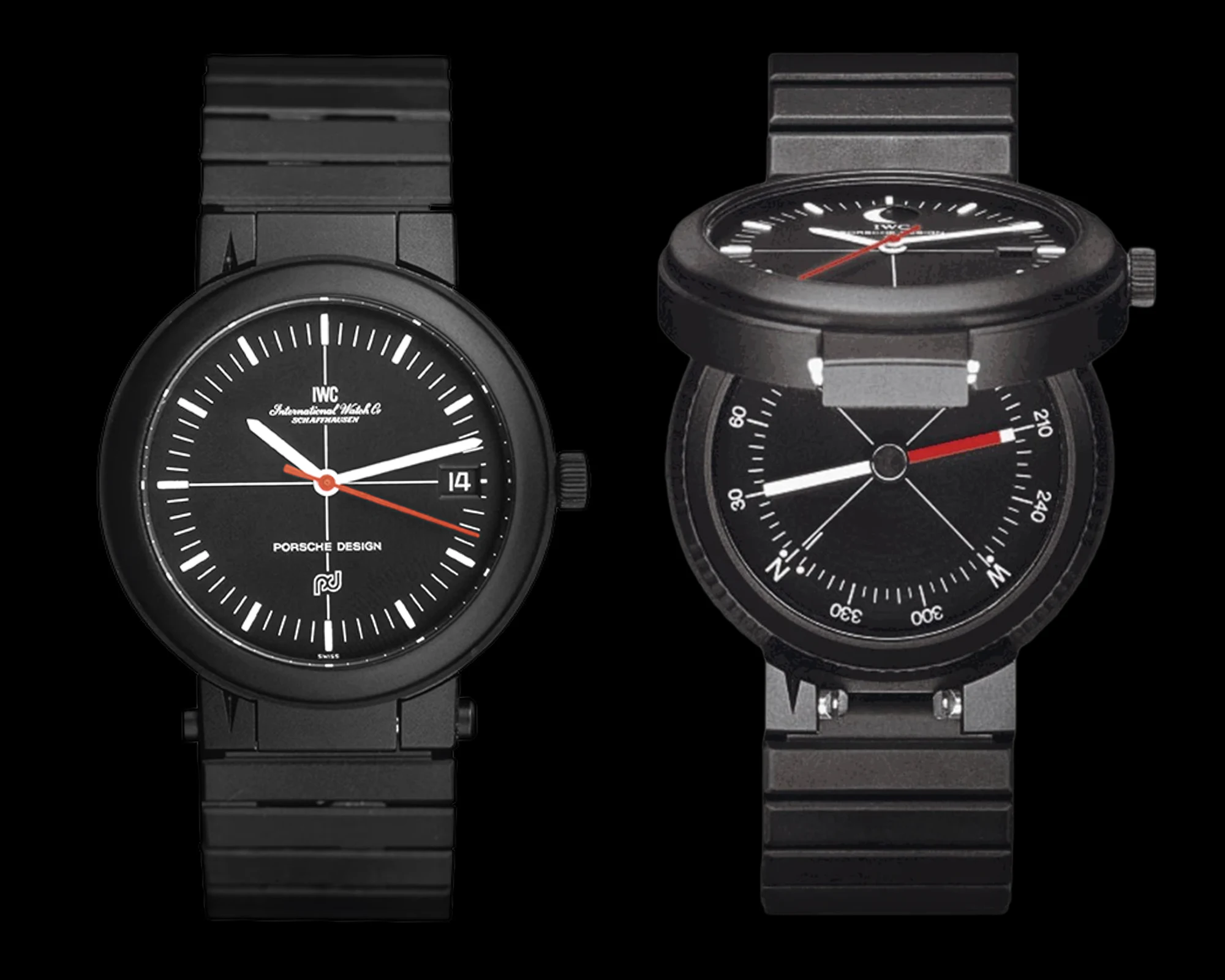
The titanium case of the new Porsche Design Chronograph 1 Utility – Limited Edition for Hodinkee model brings us to the second milestone in Porsche Design’s watchmaking history mentioned at the outset. This development began in 1978 with the collaboration between Porsche Design and IWC. For the jointly developed Compass Watch, the two companies experimented with titanium for the first time – a material whose low weight, high corrosion resistance and excellent skin compatibility made it particularly well suited to use on the wrist.
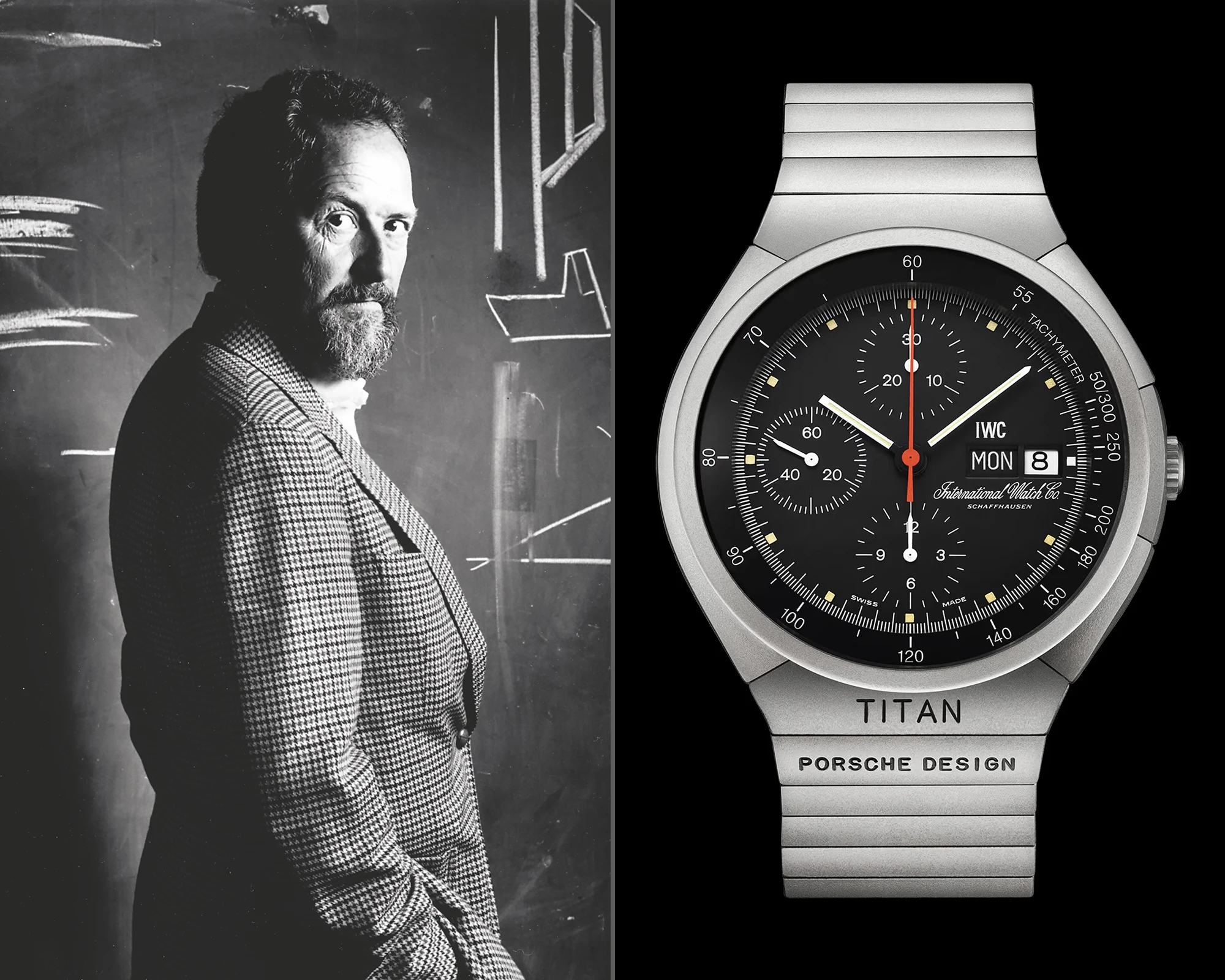
Building on this experience, Porsche Design and IWC presented the Porsche Design Titan Chronograph at the Basel watch fair in 1981, further developing the concept Ferdinand Alexander Porsche had established with the Chronograph I. The watch represented a milestone in two respects: it was the first series-produced chronograph made entirely of titanium and the first series-produced wristwatch with chronograph pushers fully integrated into the case. Their large surface areas also made the chronograph easier to start, stop and reset. Inside the comparatively large 42 mm case was once again the automatic Valjoux 7750, which had already proven itself in the Chronograph I. From this point onwards, titanium would become a defining material for Porsche Design.
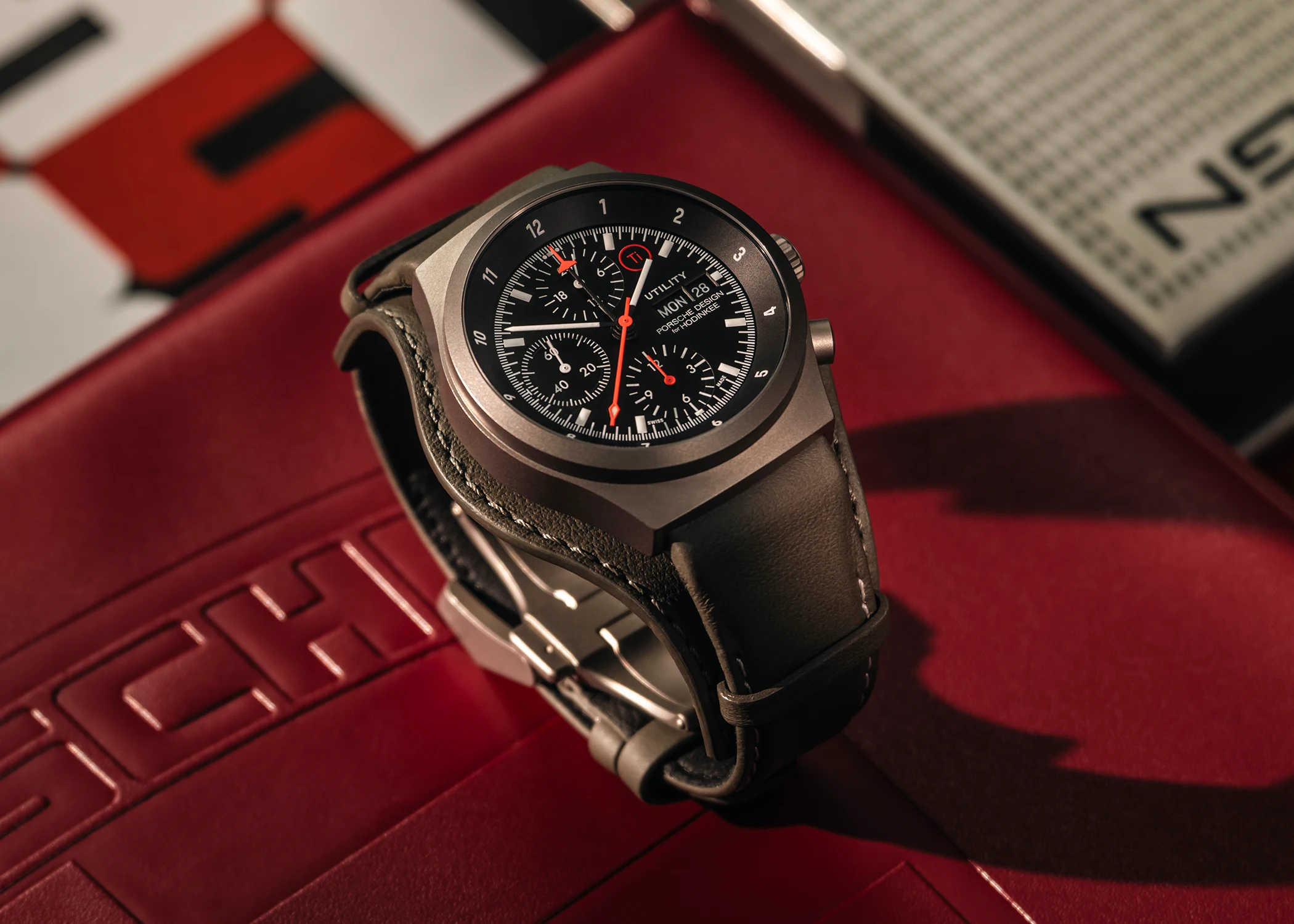
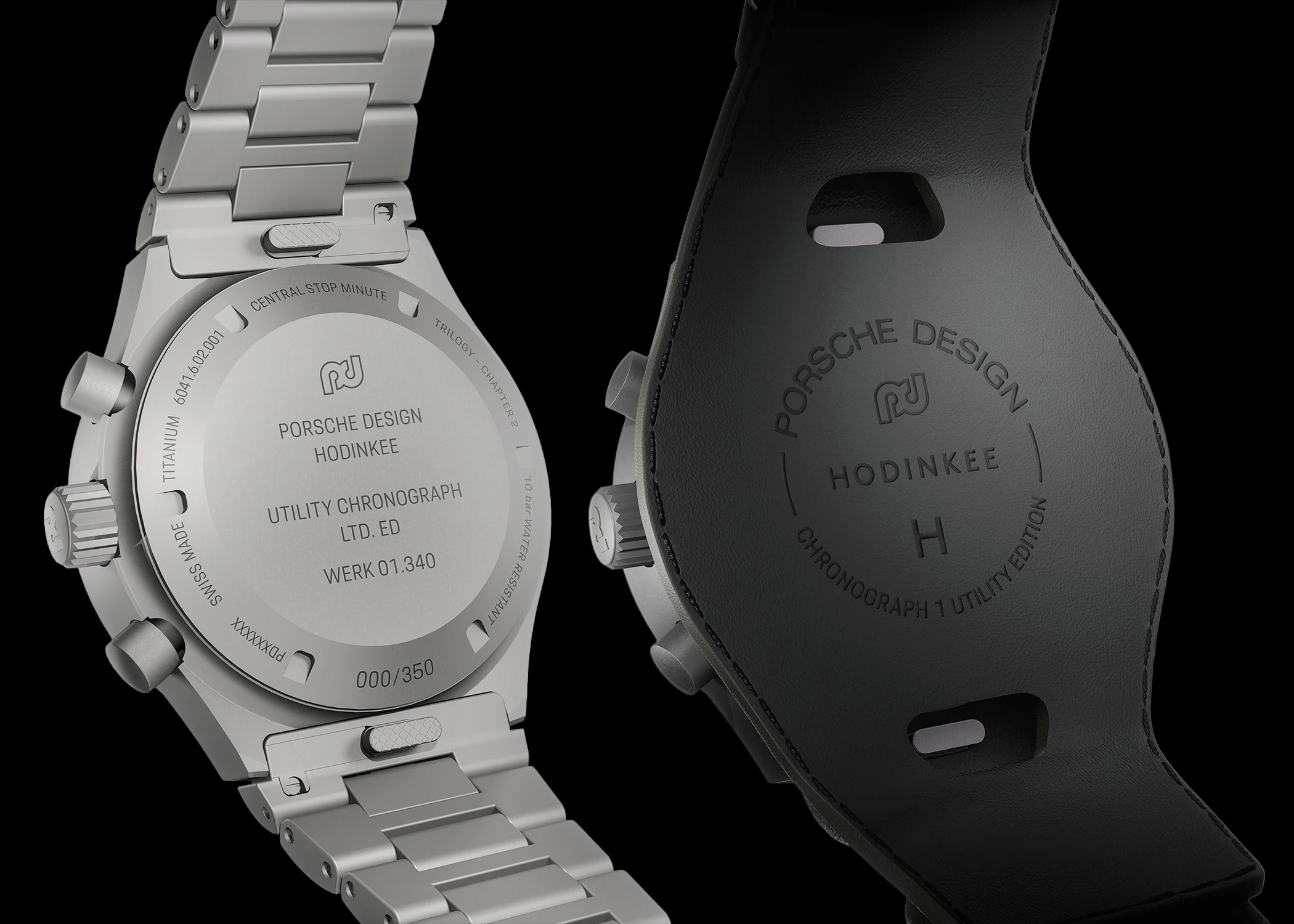
The new Porsche Design Chronograph 1 Utility – Limited Edition for Hodinkee model continues this tradition with an uncoated, glass-bead-blasted titanium case. It measures 40.8 mm in diameter and 15.41 mm in height, is water-resistant to 10 bar and is fitted with sapphire crystal featuring sevenfold anti-reflective coating on both sides. In addition to the titanium bracelet, the watch is supplied with an agave-green Bund leather strap with decorative stitching in GT Silver.
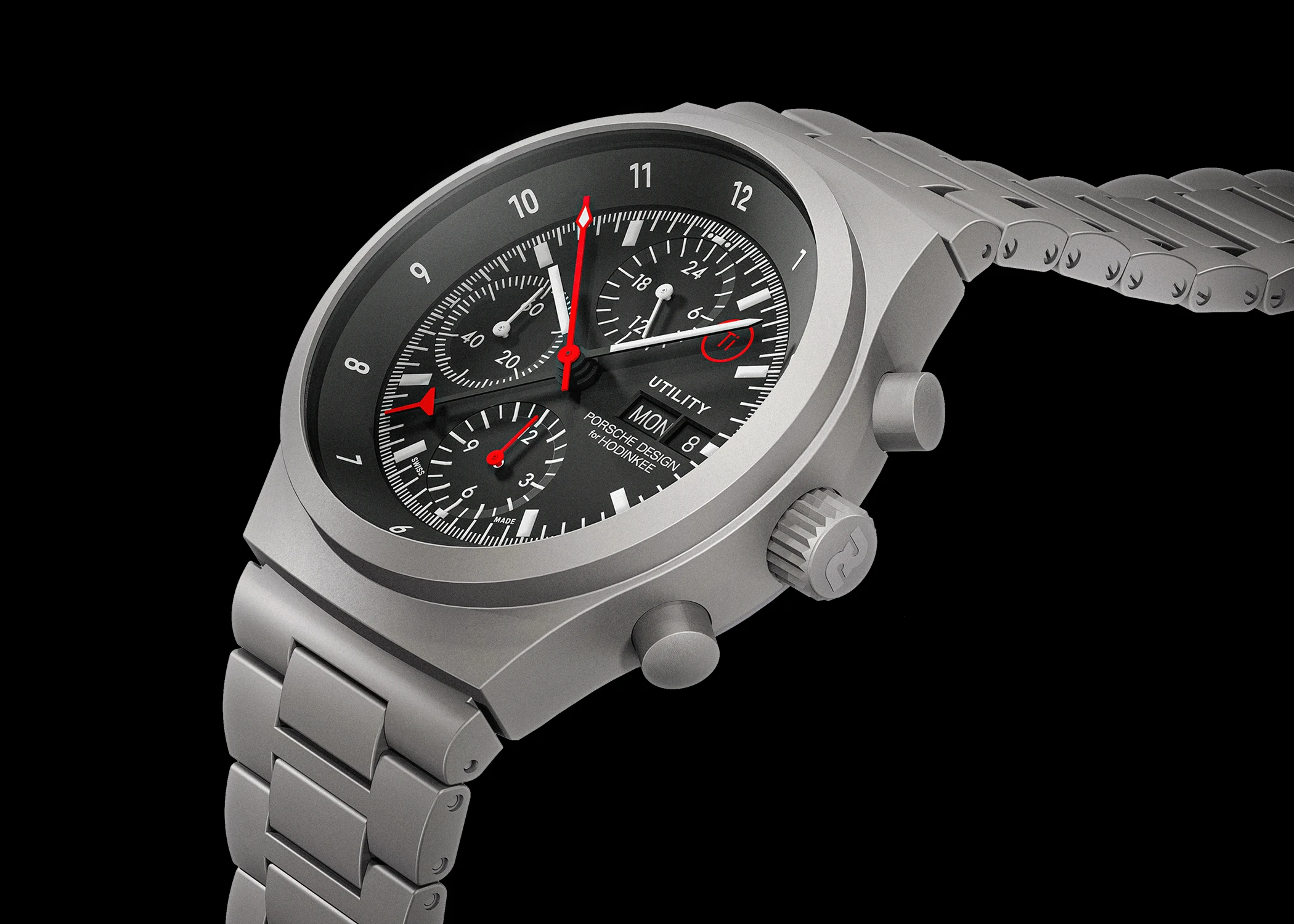
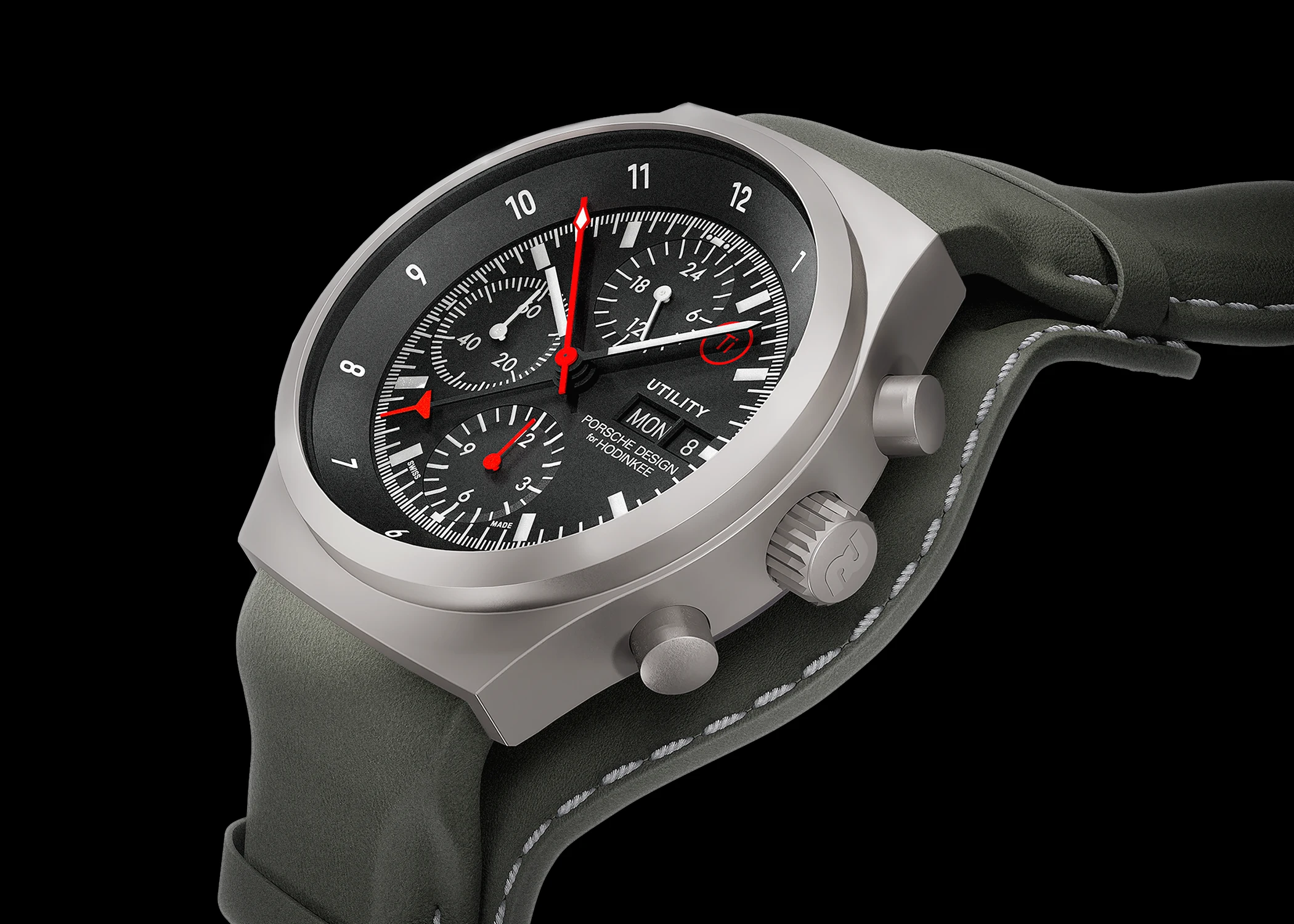
The references to the historic Military models are even more pronounced on the dial of the Porsche Design Chronograph 1 Utility – Limited Edition for Hodinkee. The central chronograph minute hand returns, once again featuring a distinctive red tip whose shape recalls the silhouette of a fighter jet. The 24-hour display is positioned at 12 o’clock, the red 12-hour counter at six o’clock and the small seconds at nine o’clock. The day and date indications remain at three o’clock.
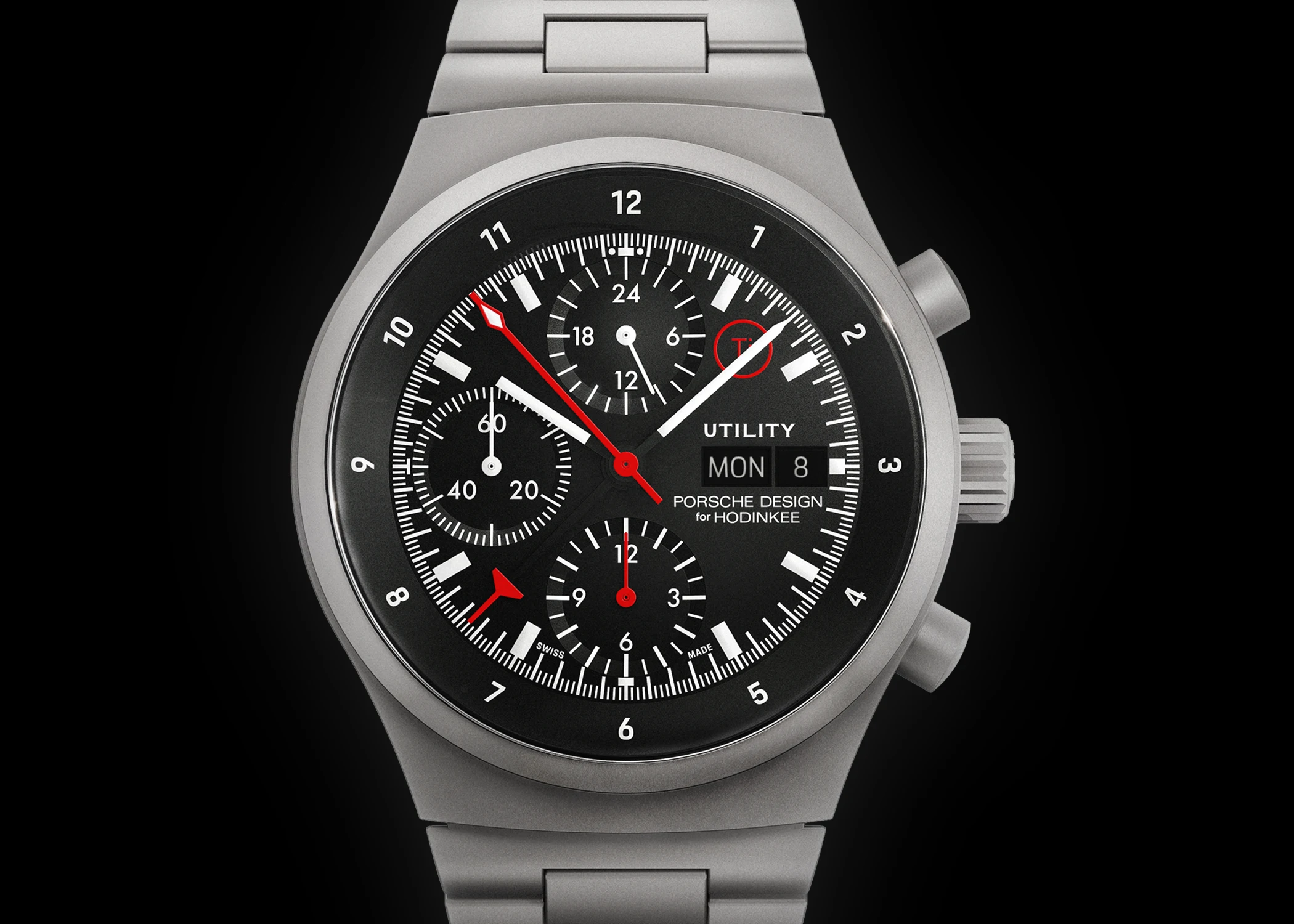
Several historic details have also been reinterpreted. The former ‘3H’ or ‘T’ marking for tritium has been replaced by ‘Ti’ as a reference to the titanium case. The historic ‘by Orfina’ inscription finds its modern counterpart in ‘Porsche Design for Hodinkee’. The tachymeter scale has also been replaced by a 12-hour scale on the rehaut.
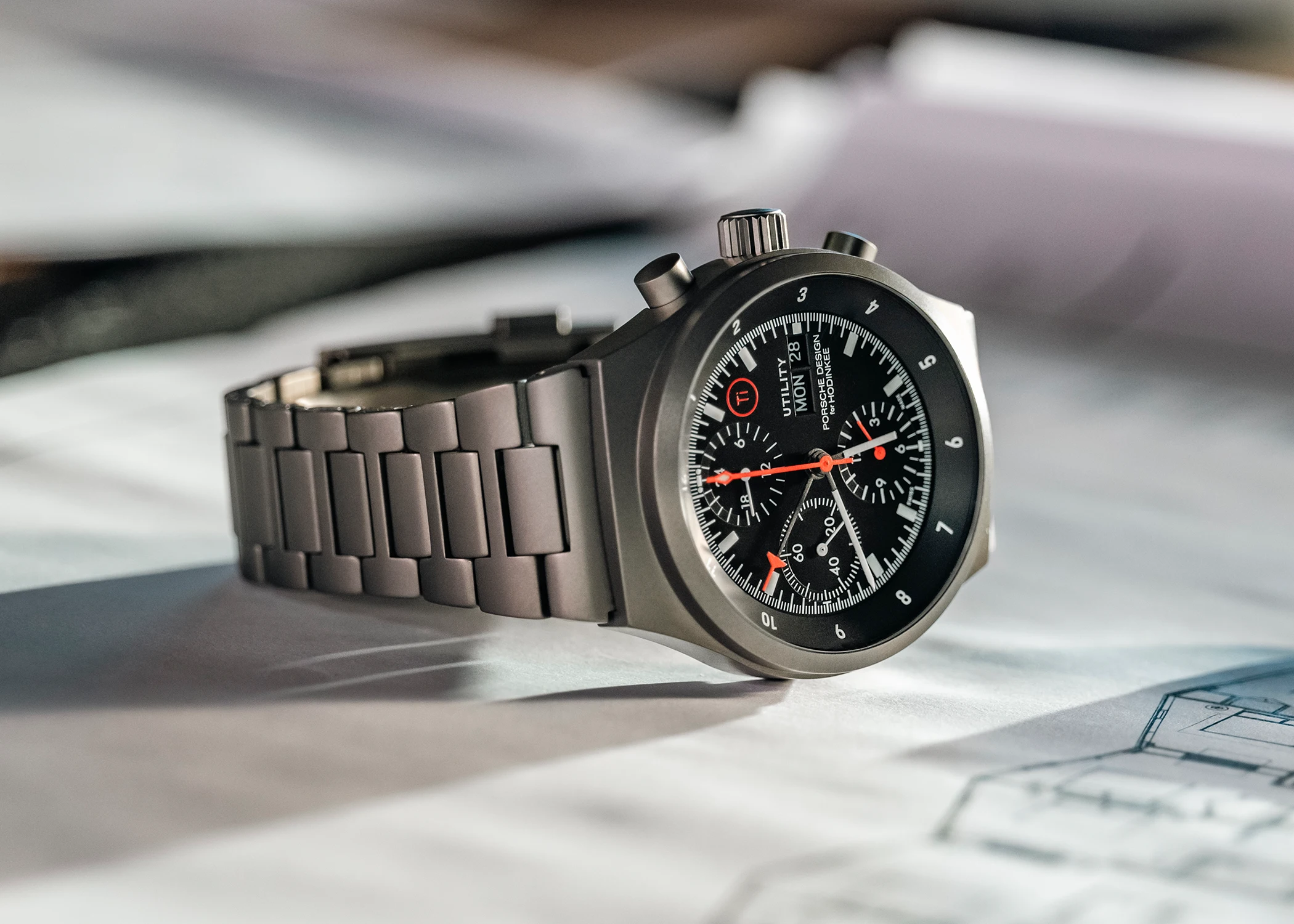
The Porsche Design Chronograph 1 Utility – Limited Edition for Hodinkee is limited to 350 pieces and is priced at €8,950.