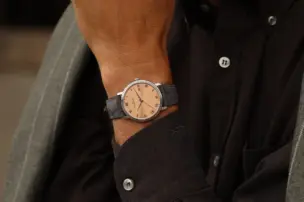
Armin Strom’s Minute Repeater Resonance 12:59 strikes either the current time or, at any time, the longest possible Westminster chime sequence.
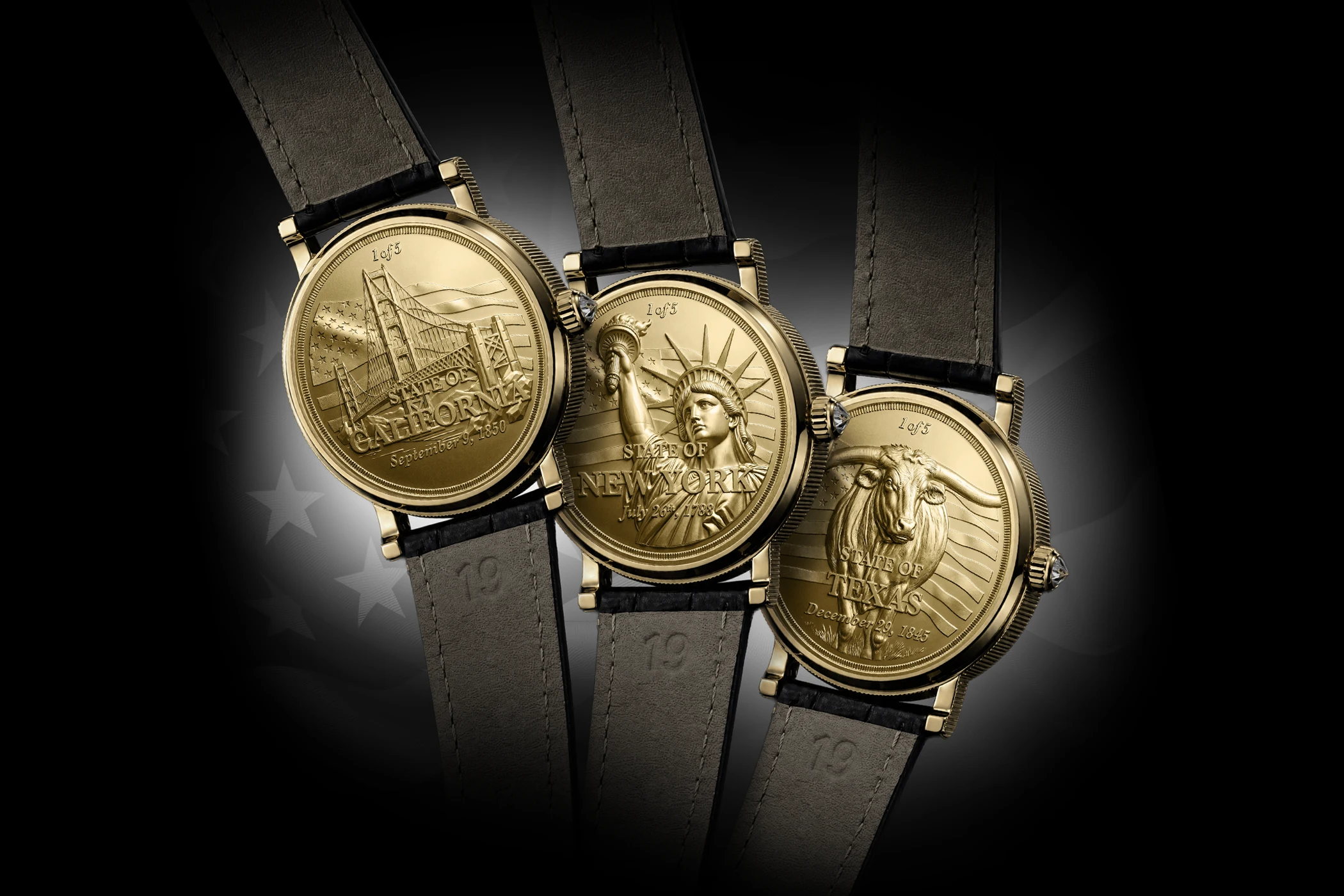
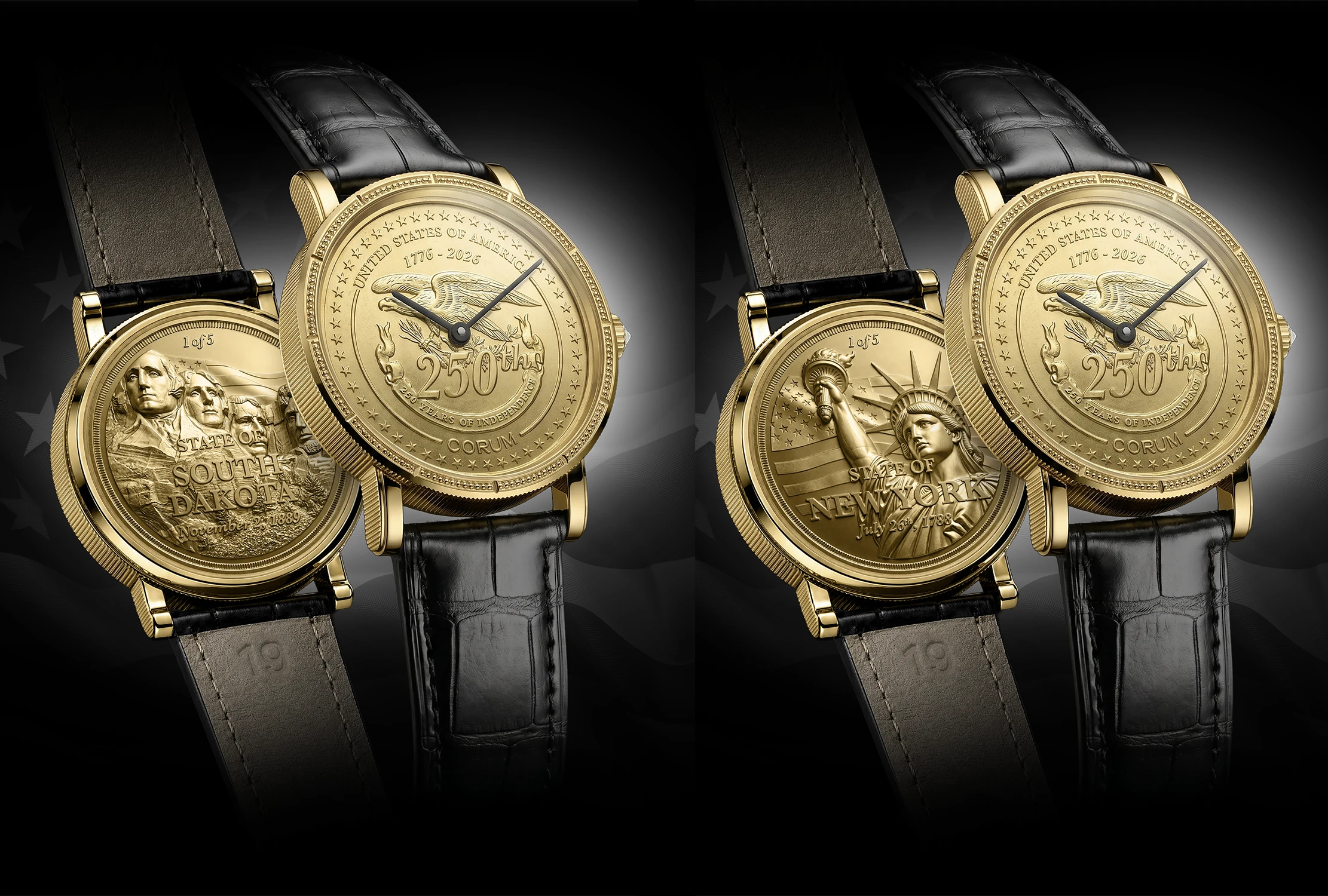
With its Heritage Coin collection, Corum dedicates an individual coin watch to each of the 50 US states, continuing a form of watch construction whose history dates back to the 19th century. The brand took a decisive step in its development in 1964, when it first used the coin not merely as a decorative casing, but simultaneously as the dial and caseback of a wristwatch whose time could be read directly. To mark the 250th anniversary of the United States, Corum is now continuing this principle through 50 distinct creations. In this article, we trace the evolution of the coin watch and take a closer look at Corum’s new Heritage Coin collection.
In the world of watchmaking, there is often a tendency to regard those constructions that openly display their dials as the most distinguished – but what of watches concealed within coins, medals or even gold bars? Known as coin watches, these timepieces belong to the category of secret watches: watches that reveal their display only when a hinged cover is opened or part of the case is moved aside. Even within this unusual genre, coin watches occupy a distinctive position.
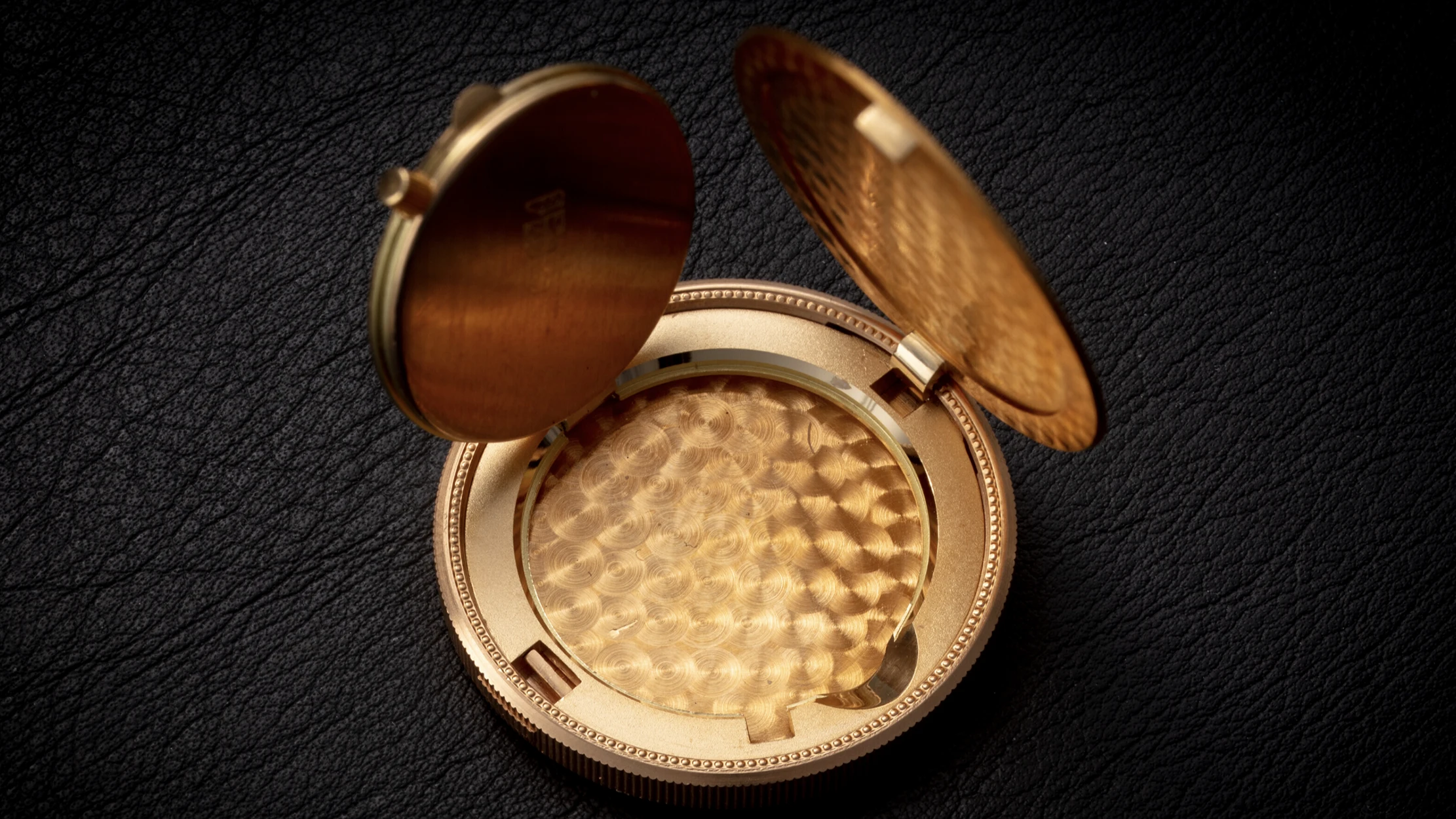
Historical coin watches gave the principle of the concealed timepiece an ingenious and technically demanding interpretation. Their construction required at least two mint-condition coins. The first was hollowed out while retaining its full height, forming the lower section of the case. The second was milled down until only one face of the coin remained, which then served as the cover.
Credit © Christies
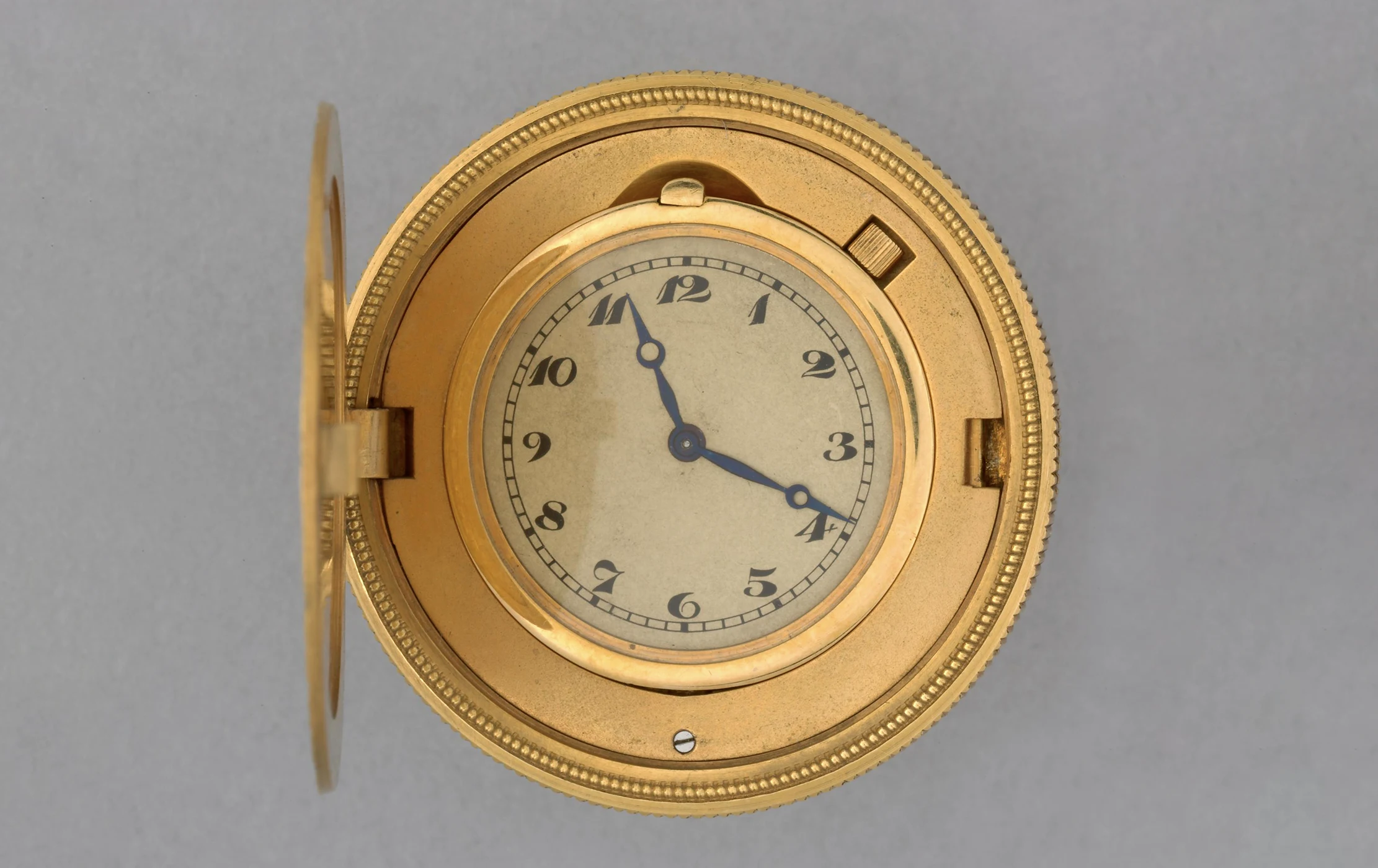
The cavity created within the coin accommodated a complete watch with a separate inner case, an extremely thin movement and its own dial and crystal. The case and cover were then joined by a hinge. The upper face of the coin served as a spring-loaded lid, which could be opened by means of a discreet push-piece concealed within the coin’s knurled edge, revealing the dial beneath.
Credit © Christies
The distinctive character of the coin watch lies in its architecture: the constraints imposed by a coin’s small diameter and limited height left virtually no scope for construction. Consequently, only the thinnest movements of their time could be used, restricting the circle of suitable manufacturers to the most prestigious Swiss watchmaking houses with the necessary technical capabilities.
Credit © Christies
The result was a series of watches that, when closed, appeared simply as coins and offered no indication of the mechanism concealed within them. These included substantial dollar, peso and pound coins in yellow or white gold, as well as examples featuring Arabic- or Chinese-inspired designs.
The principal historical centres of coin-watch production were Switzerland and – as the countries of origin of the most influential coin types – Great Britain and the United States. Swiss watch manufacturers constructed the cases and produced the ultra-thin movements, while Great Britain and the United States supplied the familiar denominations on which most historical examples were based, including the British £5 coin and the US $20 Double Eagle.
Credit © Sothebys
Although the precise origin of the idea behind the coin watch remains uncertain, the British Museum identifies the Swiss watchmaker Philippe-Samuel Meylan as one of the first to put it into practice. One example made by F. A. Meylan, now held by the Musée d’Art et d’Histoire de Neuchâtel, is based on a 20-franc gold coin dating from 1826.
The construction of coin watches depended on the development of particularly thin movements, which began to gather pace in Switzerland during the 1830s. Two technical milestones proved instrumental in this development. The first was the cylinder escapement introduced by George Graham in 1725, which permitted a slimmer construction than comparable watches fitted with a verge escapement.
The decisive breakthrough, however, came with the Lépine calibre, which enabled the overall height of the movement to be reduced considerably. This was achieved primarily through a revised arrangement of the bridges supporting the wheel train, the use of a suspended barrel and the partial recessing of the balance wheel into the mainplate.
Coin watches took the principle of the ultra-thin movement a step further by integrating the calibre into a gold coin. In a particularly early example held by the British Museum, two five-pound gold coins dating from 1911 are believed to enclose a movement with a Swiss lever escapement. The first coin was hollowed out from within to create the space required for the movement, while the outer face of the second served as a hinged cover. A minute push-piece concealed within the coin’s knurled edge releases the lid.
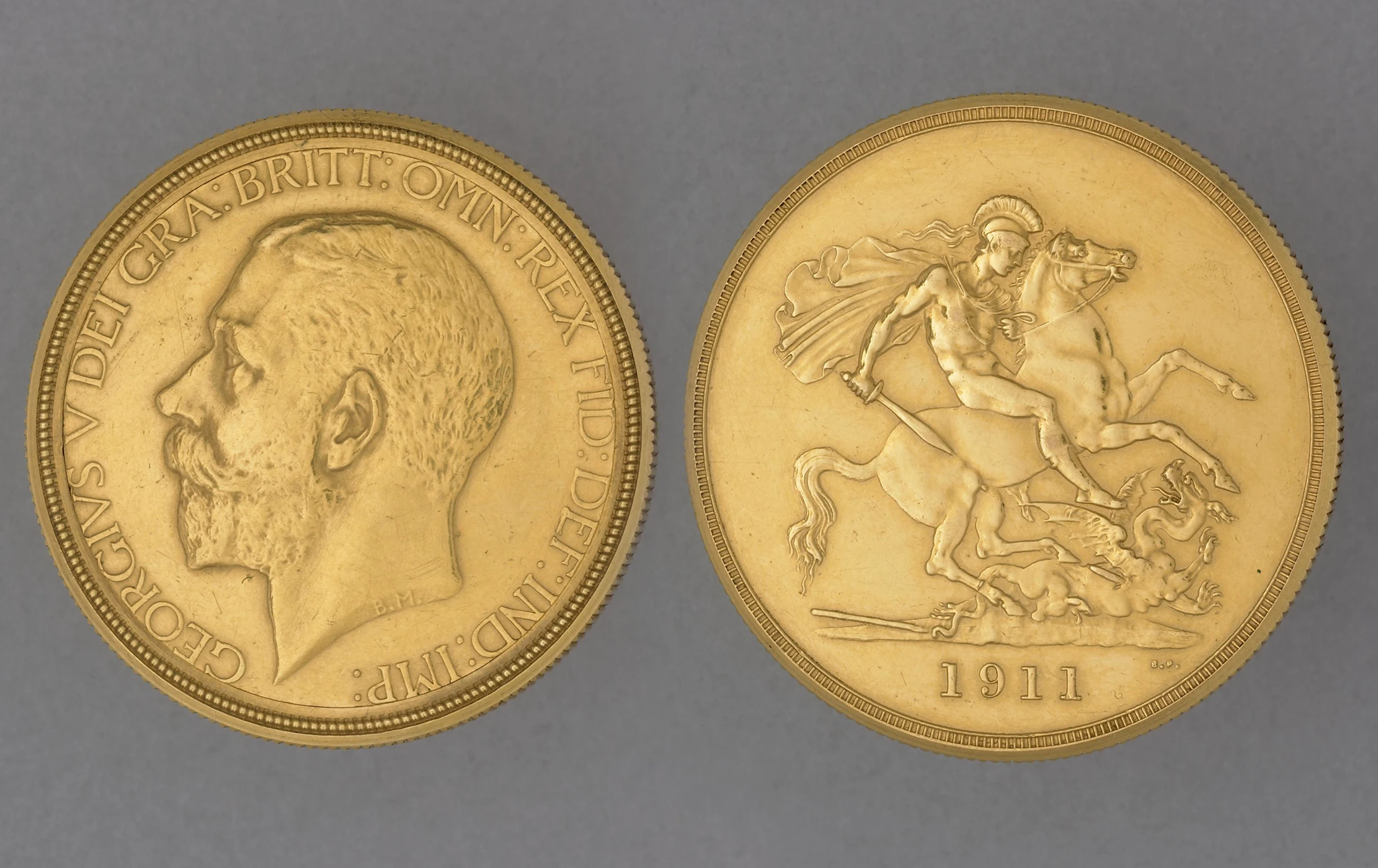
Credit © The Trustees of the British Museum. Shared under a Creative Commons Attribution-NonCommercial-ShareAlike 4.0 International (CC BY-NC-SA 4.0) licence.
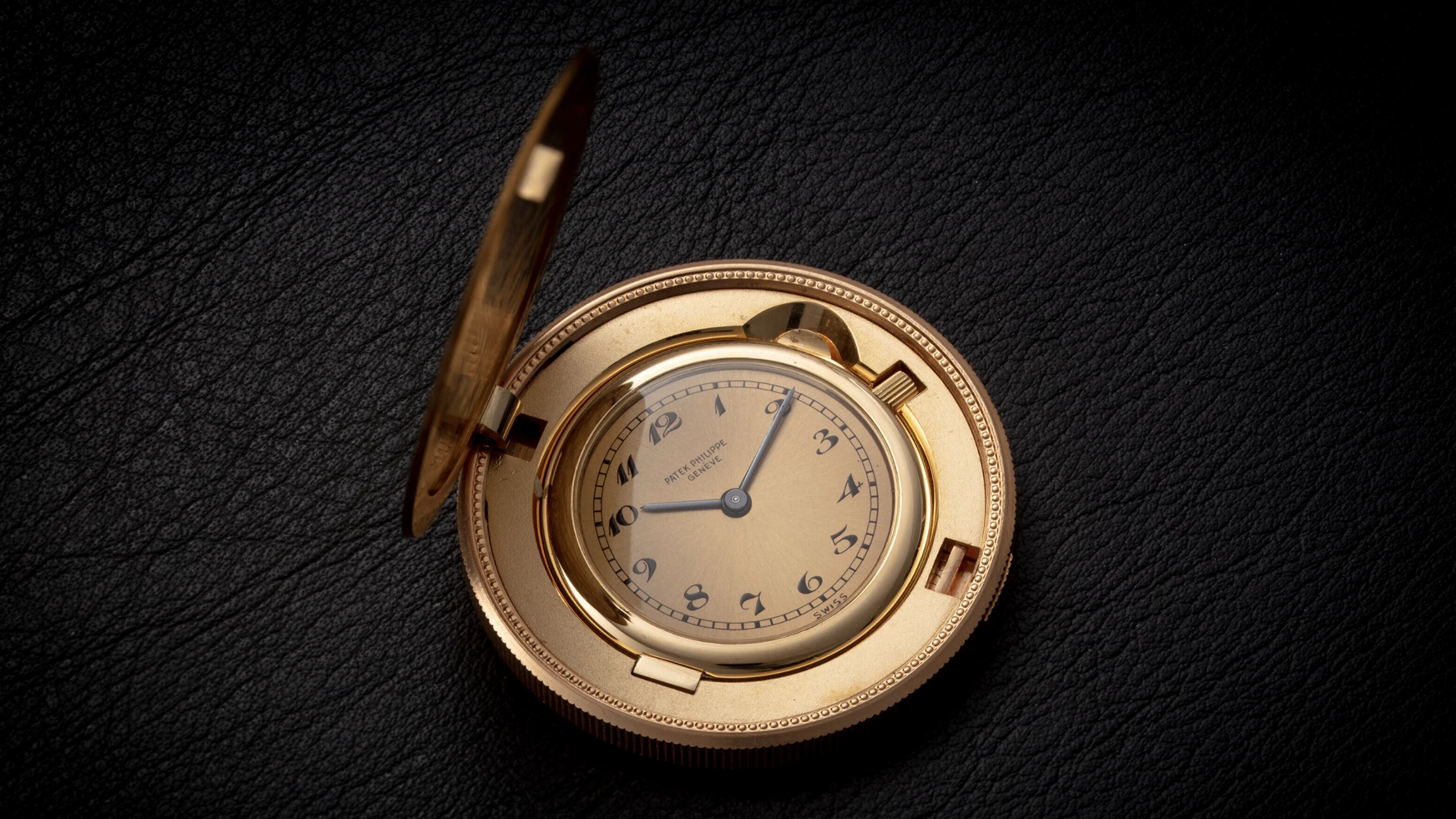
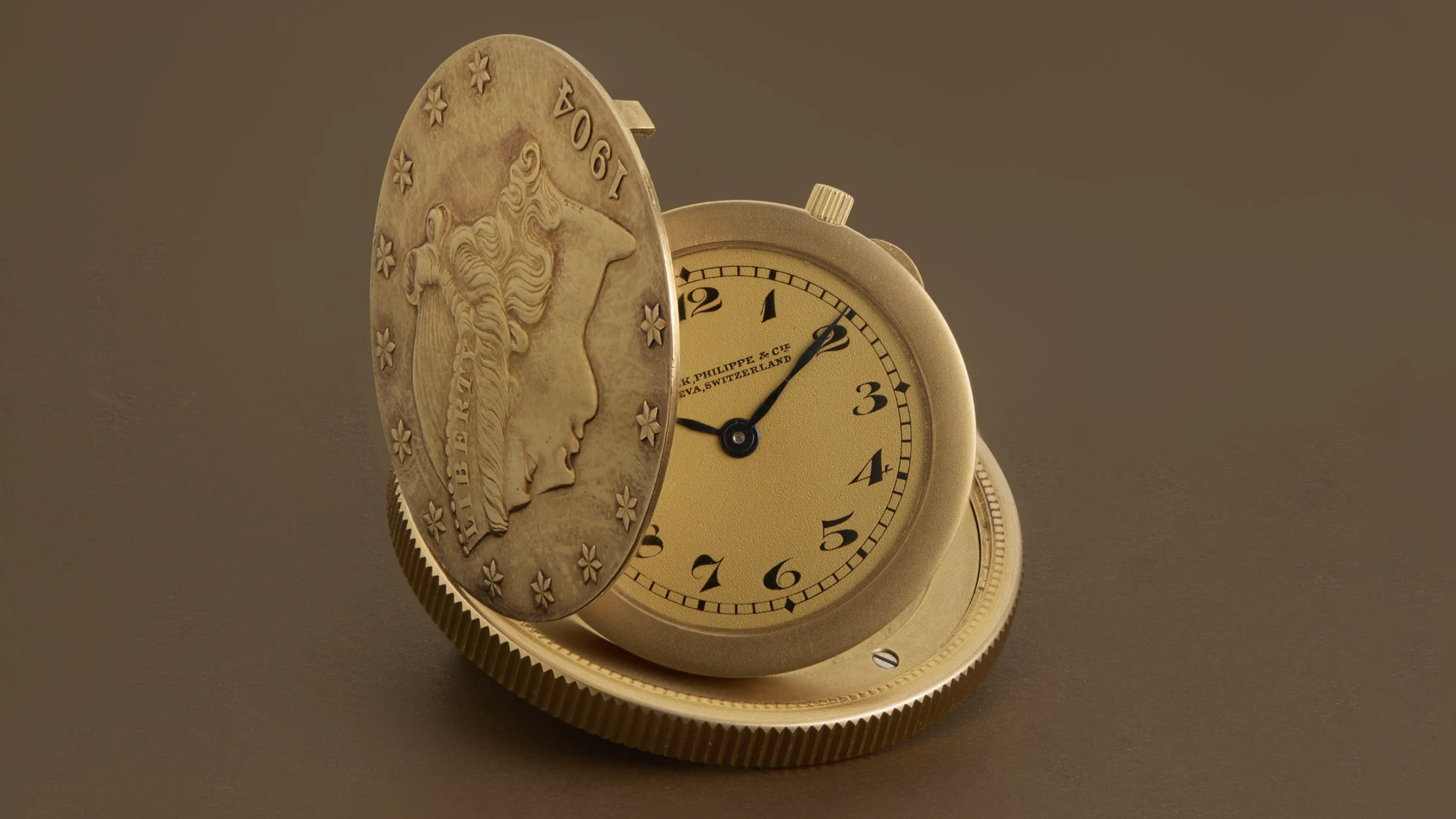
It was therefore a natural progression for the concept of the coin watch as a secret timepiece to be adopted by renowned watch brands during the late 19th and 20th centuries. Patek Philippe, known not only for its complicated movements but also for rare and unusual timepieces, likewise produced coin watches. One of the earliest examples known to have appeared on the market, attributed to Reference 802, was made in 1925, sold to Henry Graves Jr. on 29 June 1928 and remained in his possession for several decades. According to the auction house Sotheby’s, Patek Philippe produced around 100 coin watches bearing Reference 802 over the decades that followed.
Credit © Sothebys
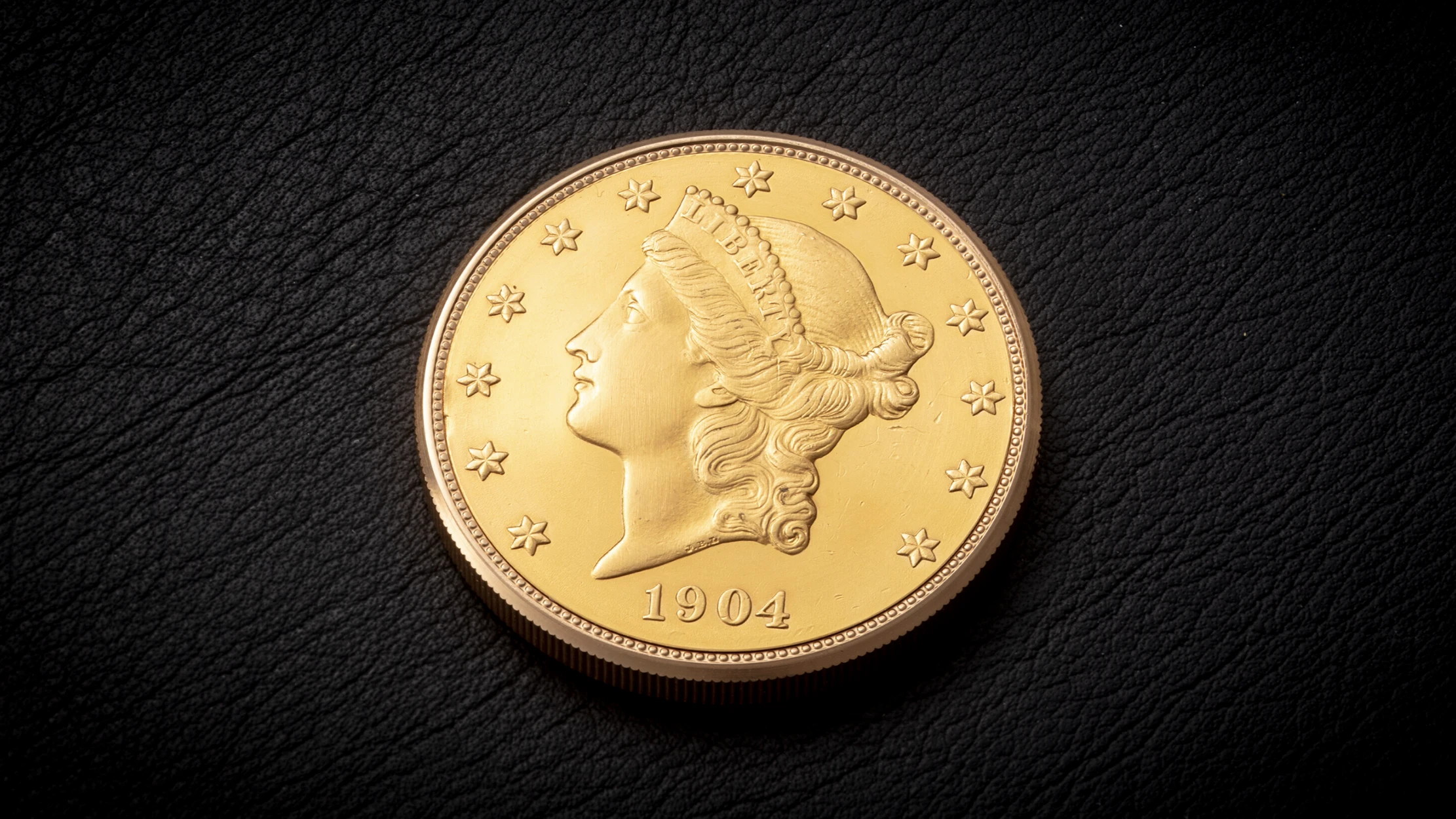
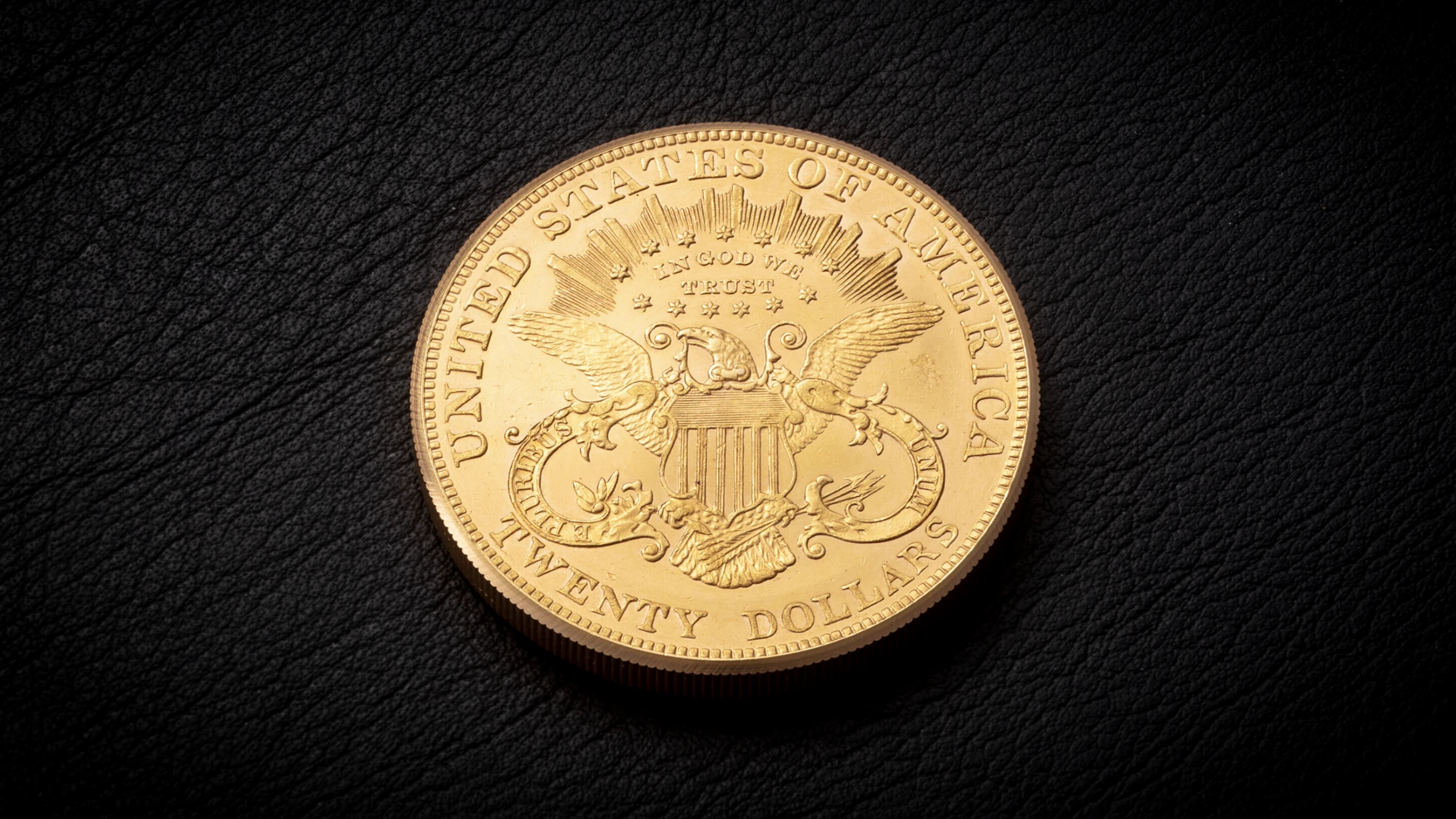
Reference 802 can be identified by its use of an American 20-dollar gold coin featuring the Liberty Head motif, also known as the ‘Double Eagle Liberty Head’ and regarded as the coin most commonly used for coin watches. Minted between 1850 and 1907, the coin depicts Liberty on its obverse, while the reverse is engraved with an eagle and the Great Seal of the United States, surrounded by a ring of 13 stars representing the country’s founding colonies and the inscription ‘In God We Trust’.
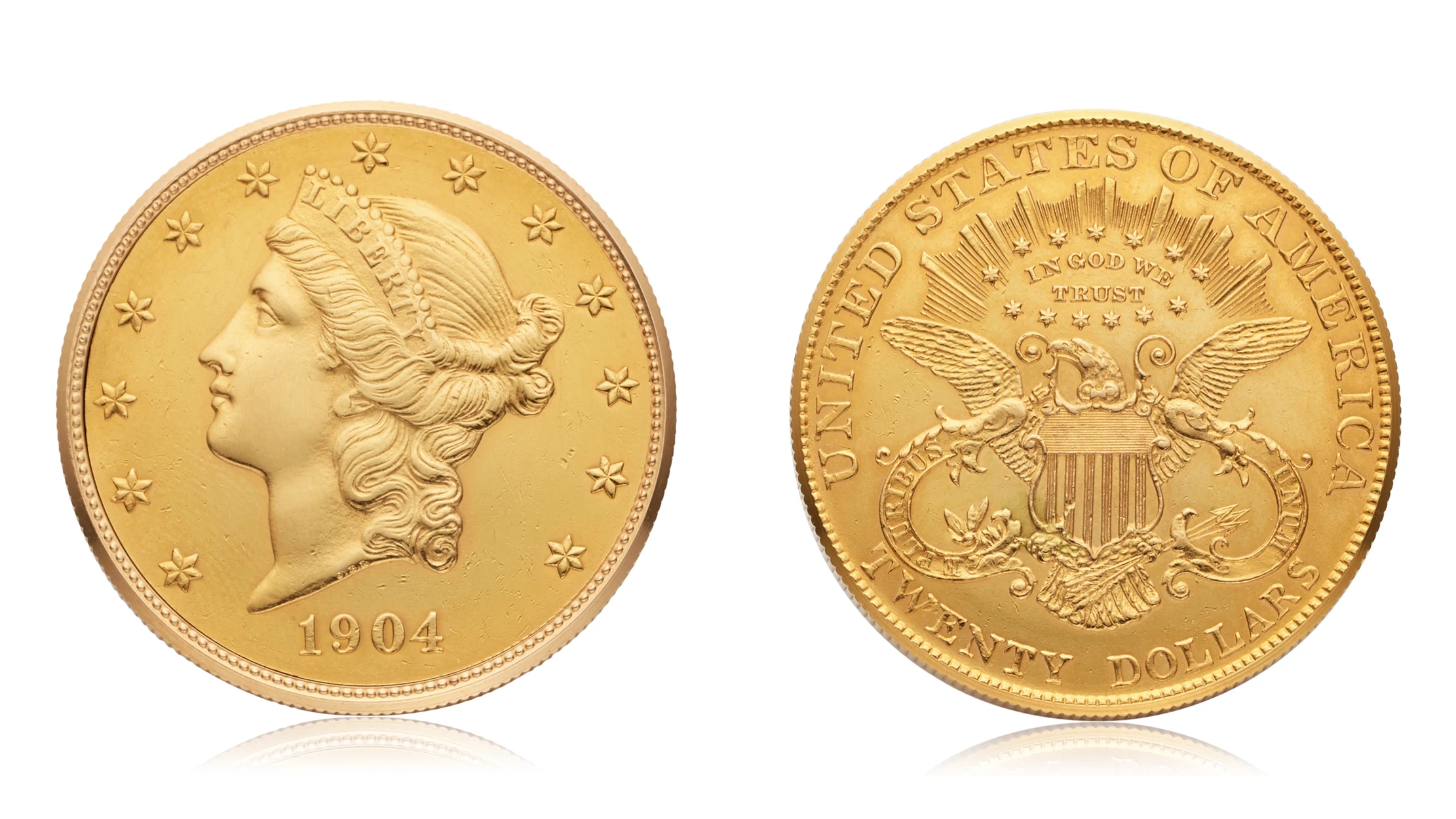
Credit © Christies
The name ‘Double Eagle’ does not refer to the number of eagles depicted on the coin, but rather serves to distinguish it from the 10-dollar coin known simply as the ‘Eagle’. The coin was particularly well suited to the construction of a coin watch because its diameter of 34.5 mm made it fundamentally suitable for use as a watch case.
Between 1925 and the 1980s, Patek Philippe produced a range of coin watches under reference numbers 800 to 809, with the majority made in the period following the Second World War. According to the auction house Christie’s, a variety of coins were used: a US five-dollar coin for Reference 800, a US ten-dollar coin for Reference 801, US twenty-dollar coins for References 802 and 803, a Swiss 100-franc coin for Reference 804 and a Mexican 50-peso coin for Reference 805. From the 1950s onwards, coin watches formed part of Patek Philippe’s regular collection.
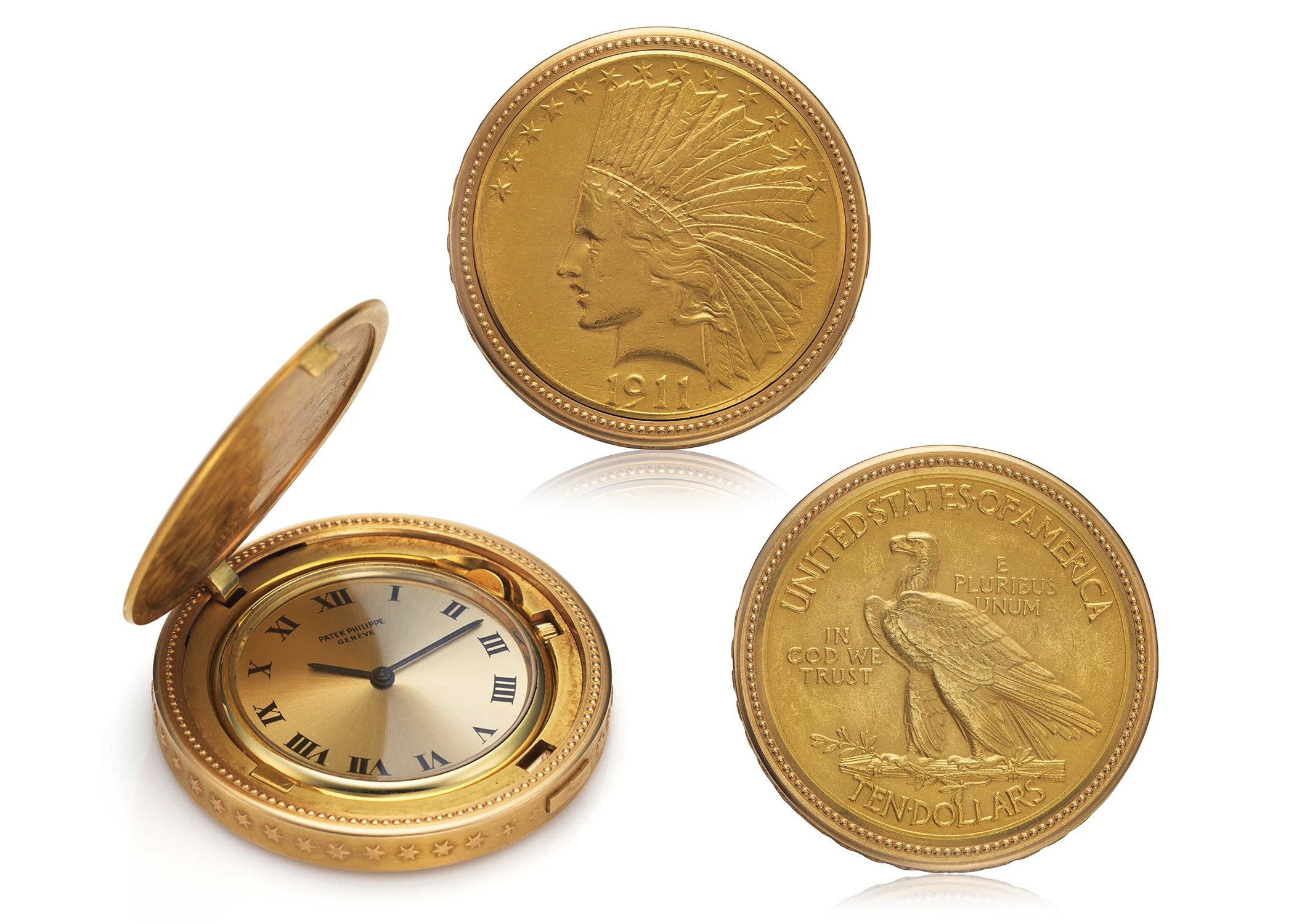
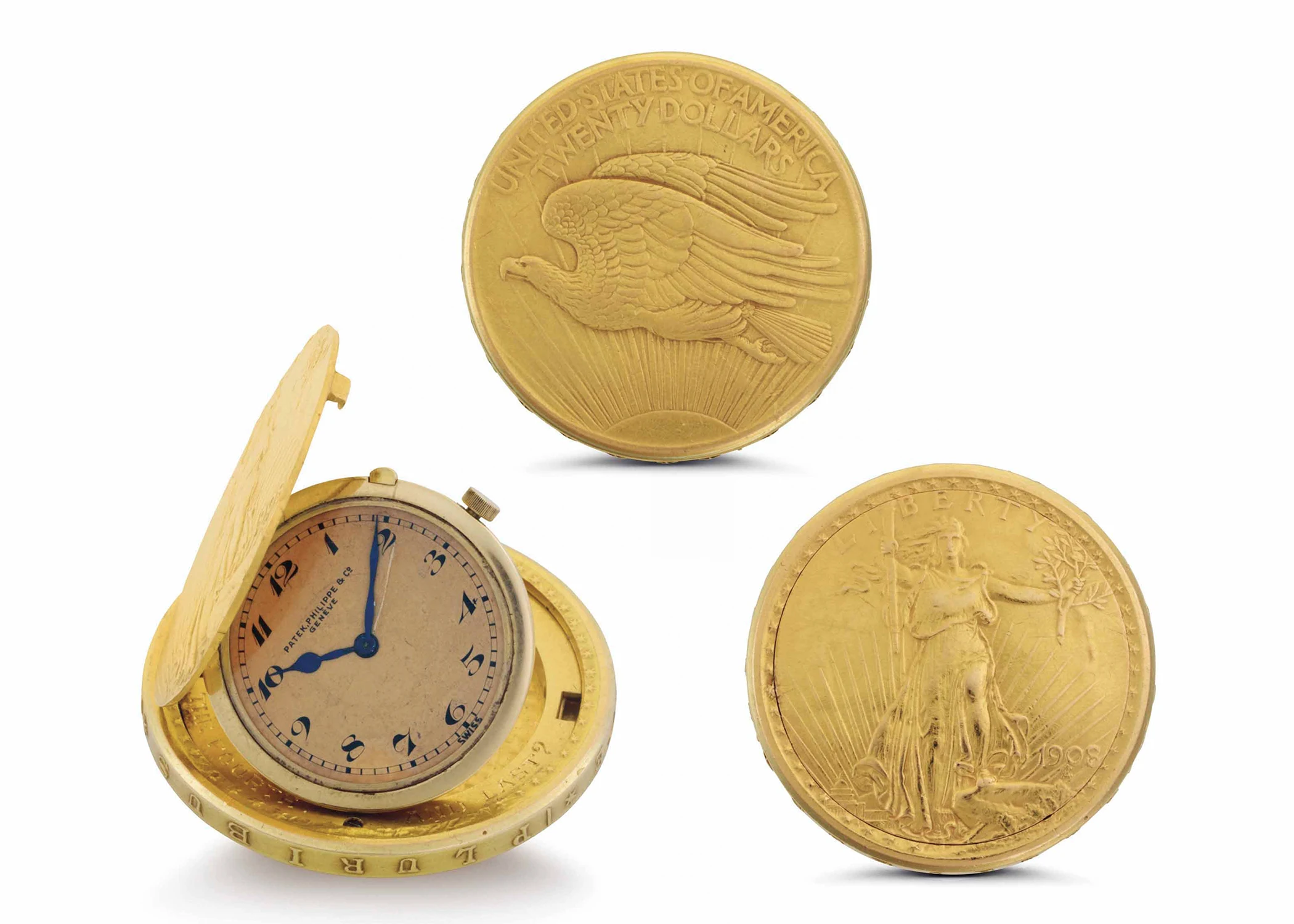
Credit © Collectability | Credit © Christies
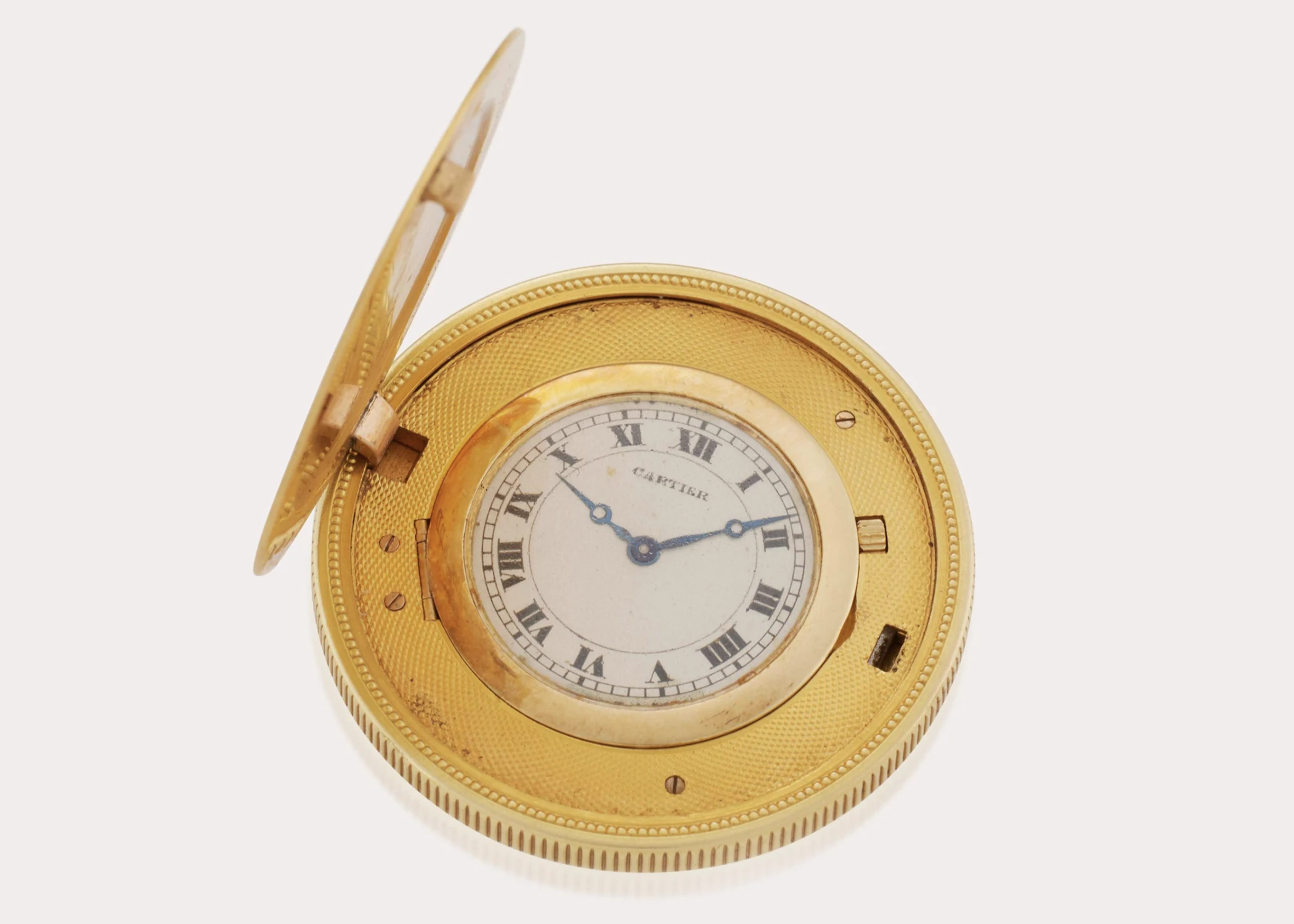
Alongside Patek Philippe, Cartier also produced coin watches. One notable example dates from 1927 and is based on an 1898 Double Eagle gold coin. The watch is fitted with a movement made by the European Watch and Clock Co., a joint venture between Edmond Jaeger and Cartier that secured Cartier exclusive access to all movements produced by Jaeger for a period of 15 years.
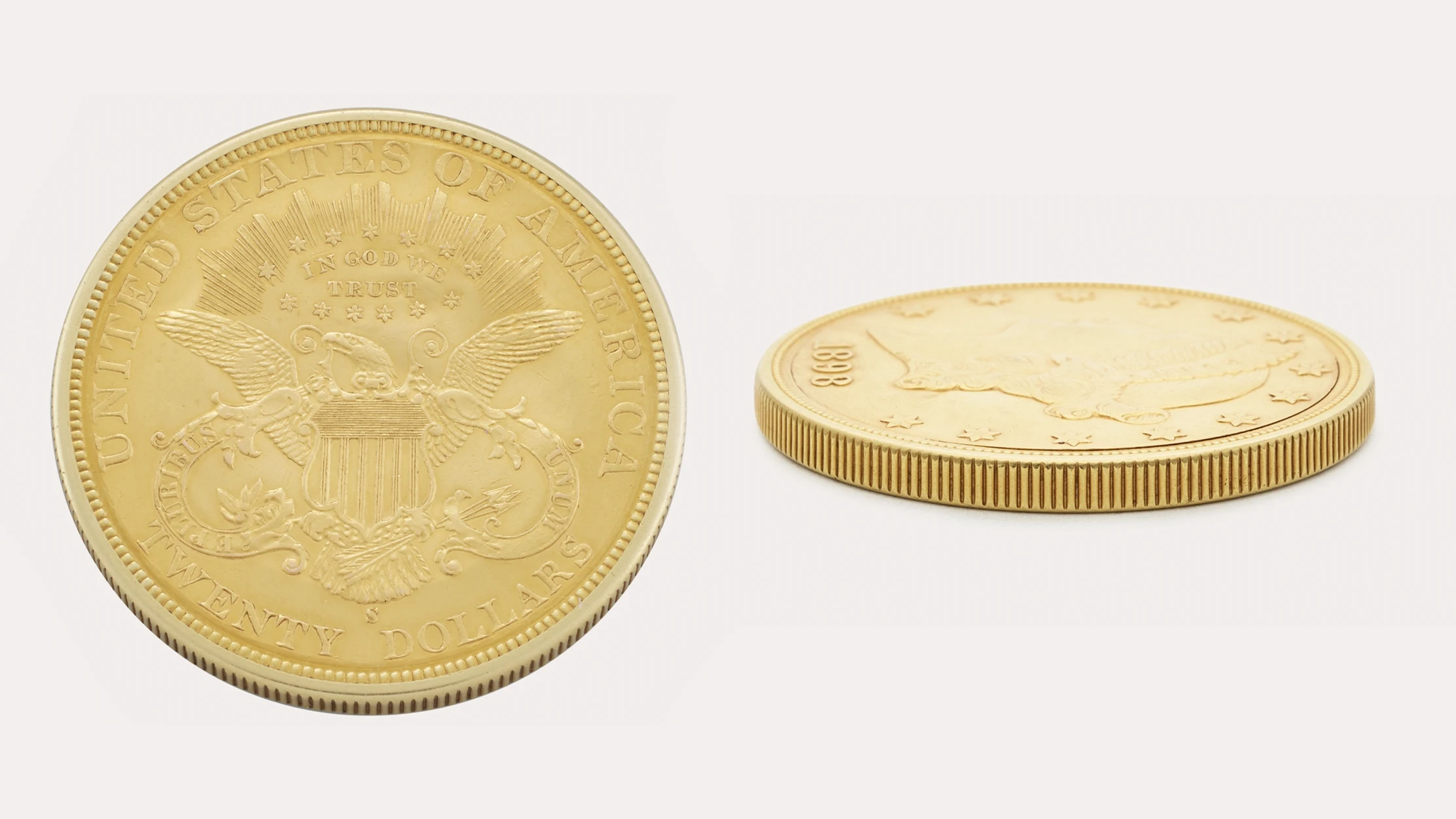
Credit © Sothebys
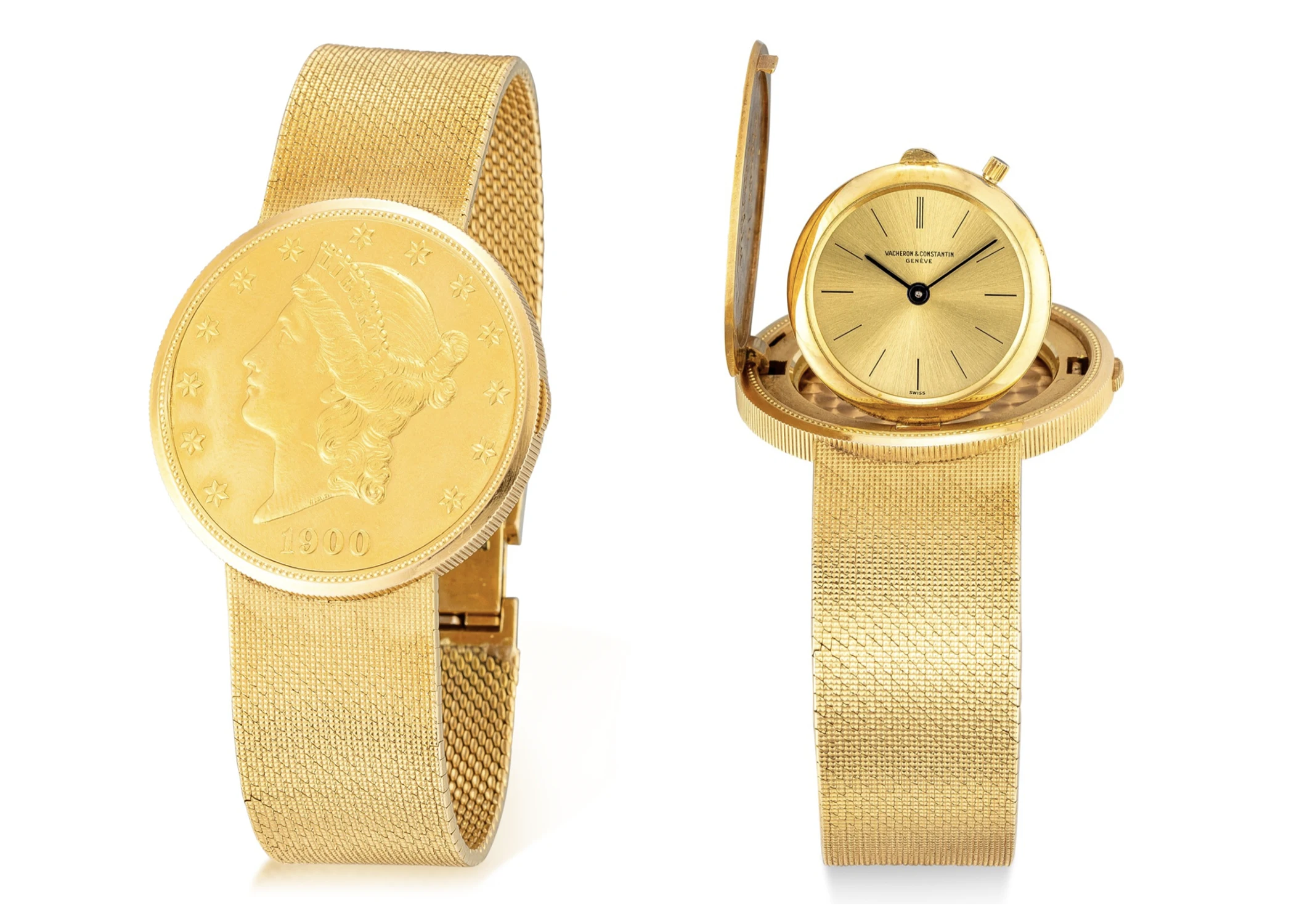
Following the Second World War, the coin-watch format once again gained prominence among several major Swiss watchmakers, including Vacheron Constantin, Piaget, Rolex and Audemars Piguet. This development was made possible above all by the availability of ultra-thin movements capable of meeting the spatial constraints imposed by the coin watch. Vacheron Constantin introduced the Calibre 1003 in 1955, measuring just 1.64 mm in height; Piaget followed in 1957 with the 2.0 mm Calibre 9P; and Rolex launched the 1.8 mm Calibre 650 in 1958. Audemars Piguet likewise later employed ultra-thin hand-wound movements like the calibre 2003 in its coin watches. A defining feature of many examples from this period was that they could now be worn on the wrist in the manner of a conventional wristwatch.
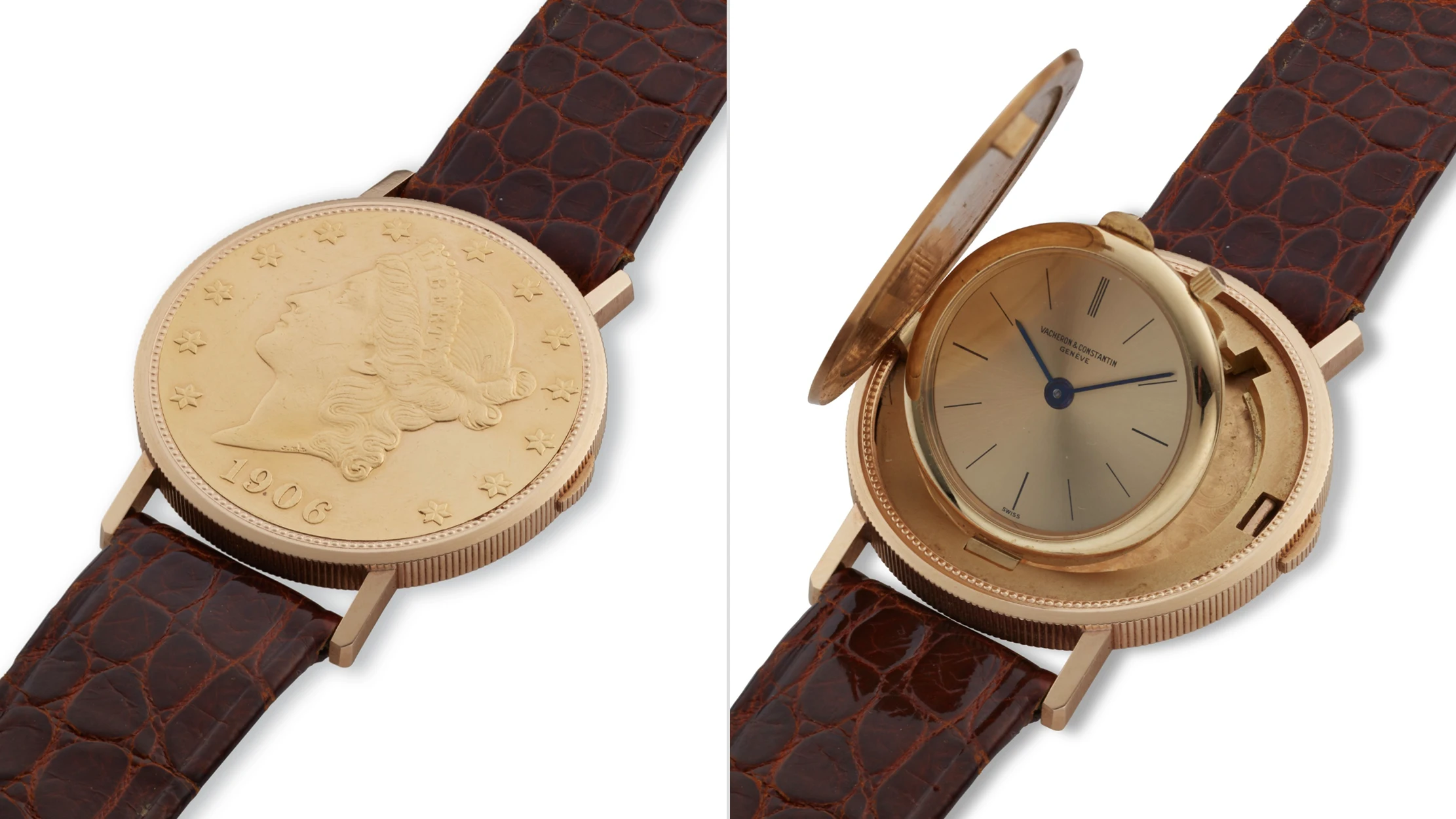
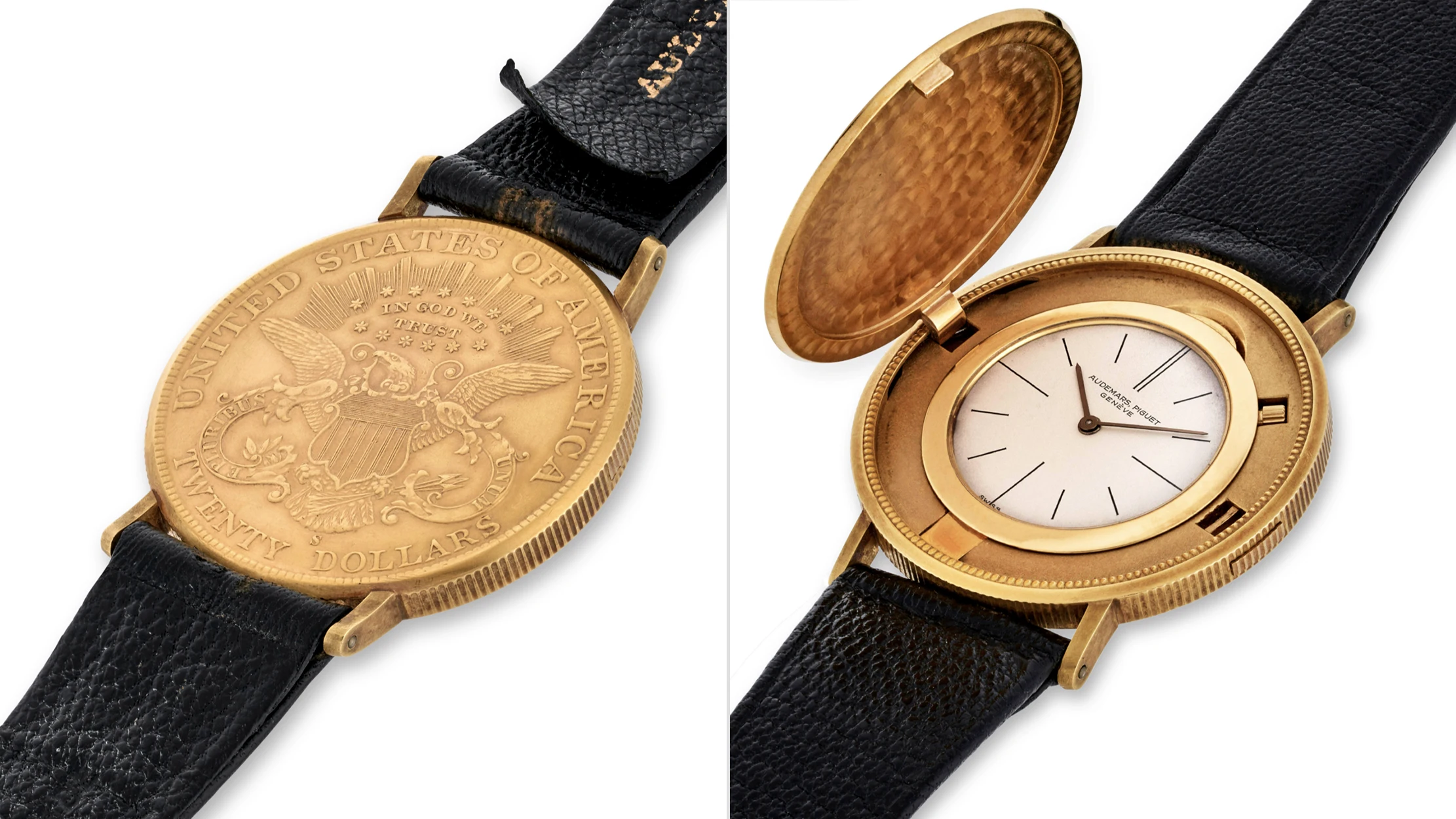
Credit © Christies | Credit © Christies
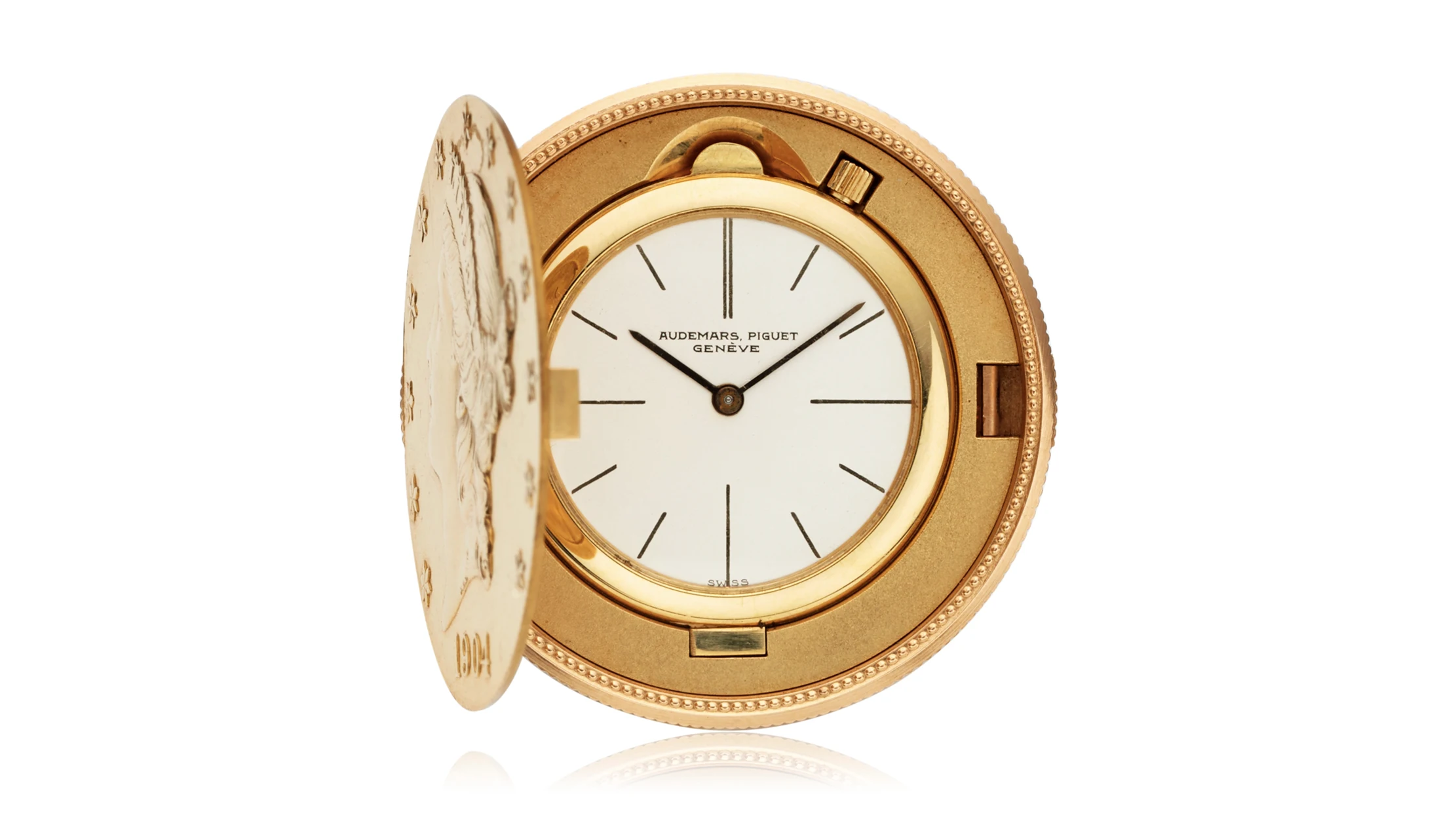
Credit © Christies
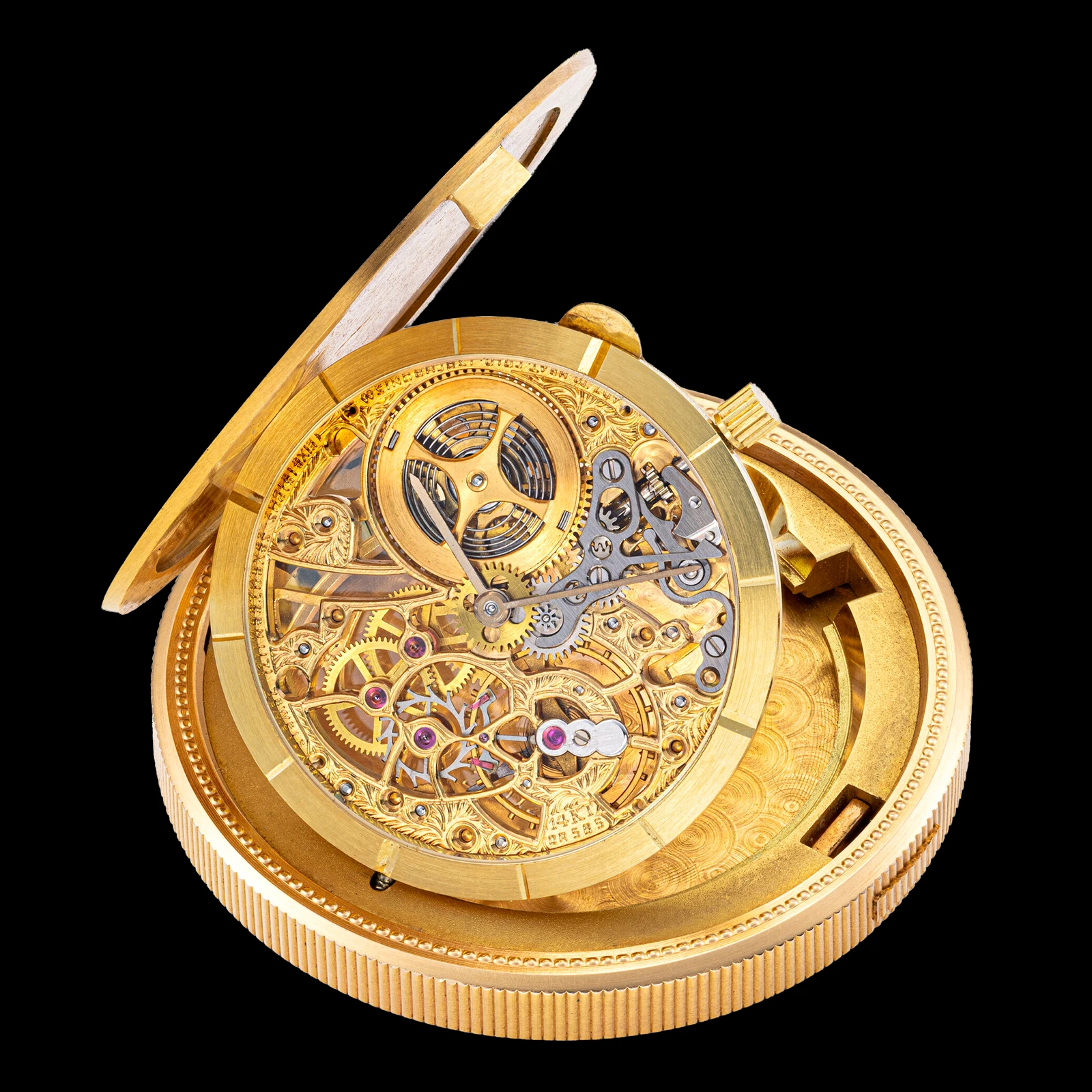
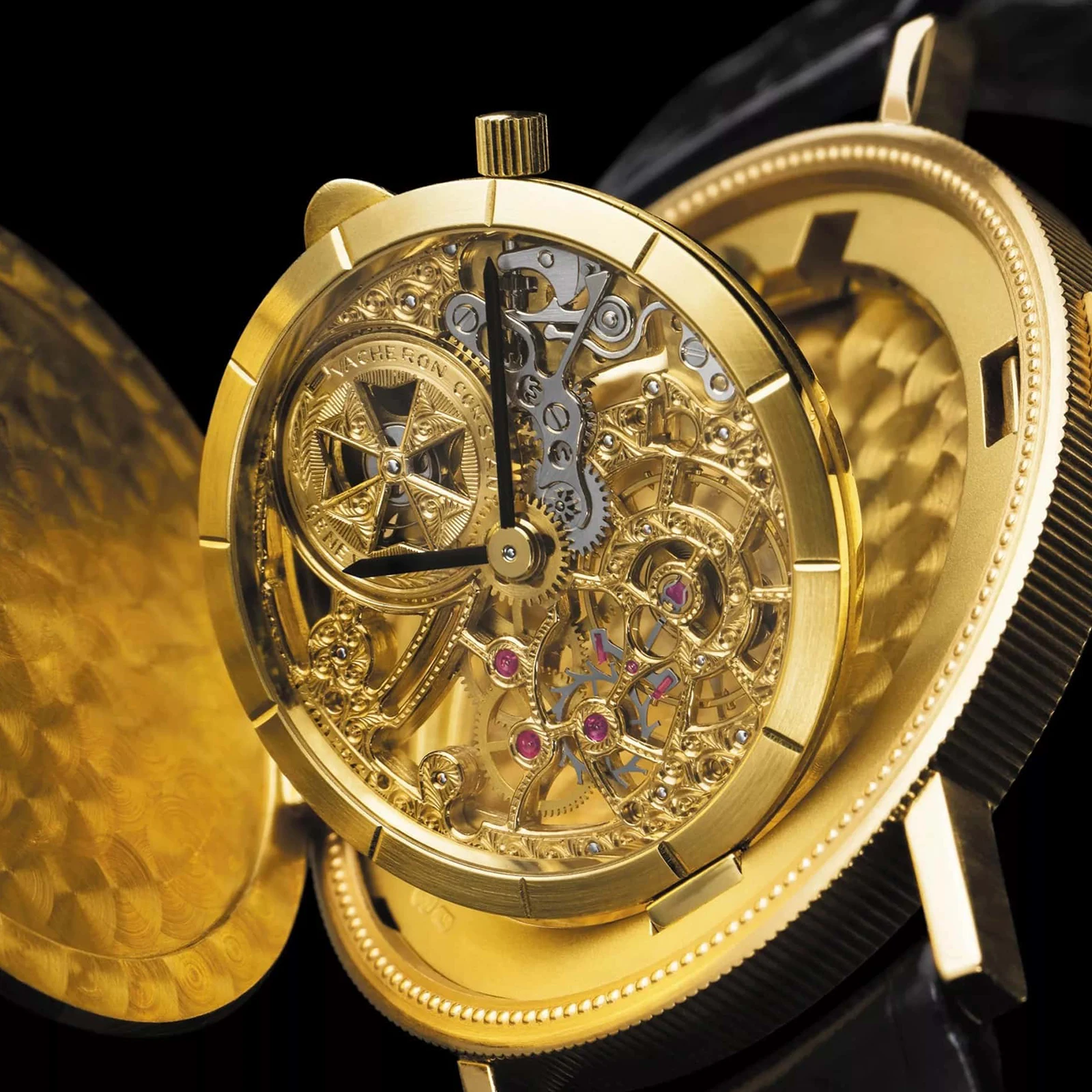
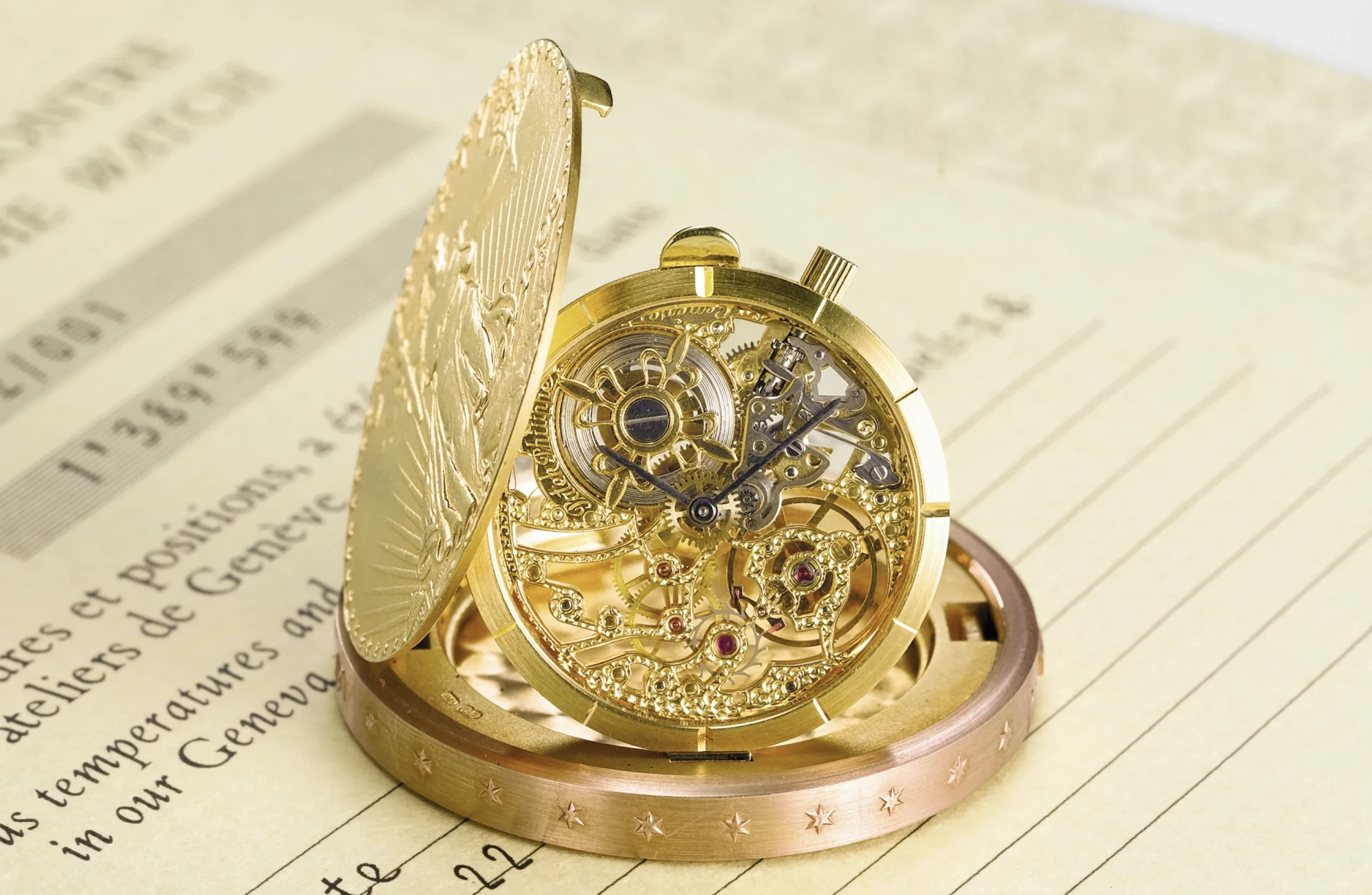
Within the already rare category of coin watches, certain examples stand out for their exclusivity and unusual construction. With Reference 5677, Audemars Piguet applied the art of skeletonisation – the removal of non-essential sections of the movement’s mainplates and bridges in order to reveal the mechanism – to a coin watch. Dating from around 1977, the watch is based on a ‘Double Eagle Liberty Head’ coin and consequently measures 35 mm in diameter. Alongside Audemars Piguet, Vacheron Constantin and Patek Philippe also produced skeletonised coin watches.
Credit © Christies | Credit © Vacheron Constantin
Credit © Sothebys
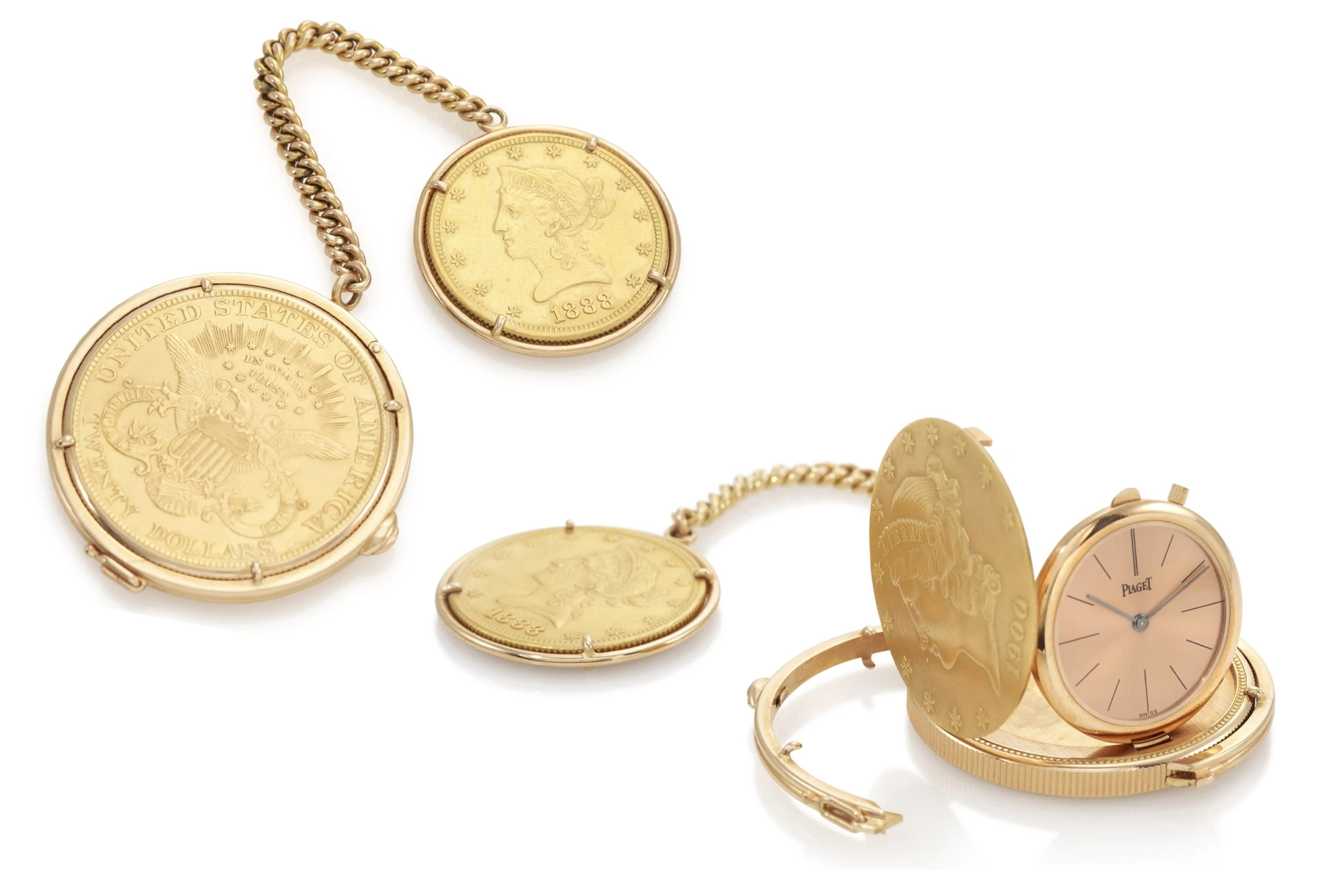
For the Twenty Dollar Coin Watch Reference 900, Piaget combined two American gold coins to create an unusual ensemble. The watch itself is integrated into a 20-dollar coin dated 1900 and powered by the ultra-thin, manually wound Calibre 9P. It is set within a detachable outer frame and suspended from a chain, which also incorporates an American 10-dollar gold coin dated 1888 as a pendant.
Credit © Sothebys
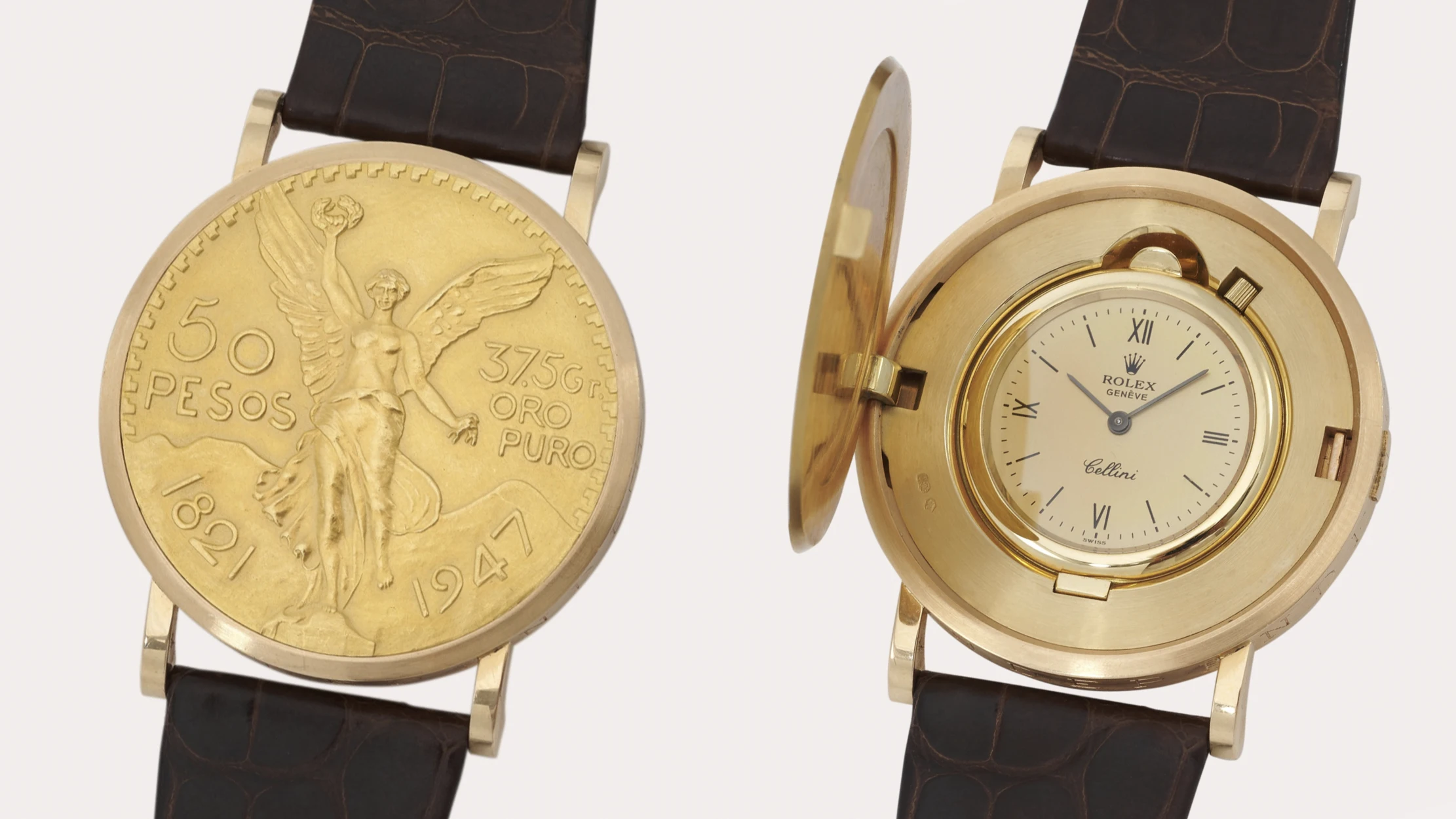
Although Rolex produced several limited series over the course of its history, this edition, restricted to only a handful of examples, is likely to be unfamiliar even to many collectors: Reference 3612 from 1971, produced in a series of just ten pieces. It commemorated two anniversaries: the 50th anniversary of the Mexican Centenario gold coin, also known as the ‘Centenario de Oro’, and the 150th anniversary of the Treaty of Córdoba, which sealed Mexico’s separation from Spain following the Mexican War of Independence. The 39 mm case is therefore made from a Mexican 50-peso gold coin bearing the dates ‘1821–1947’. The watch is powered by the Rolex Calibre 651.
Credit © Sothebys
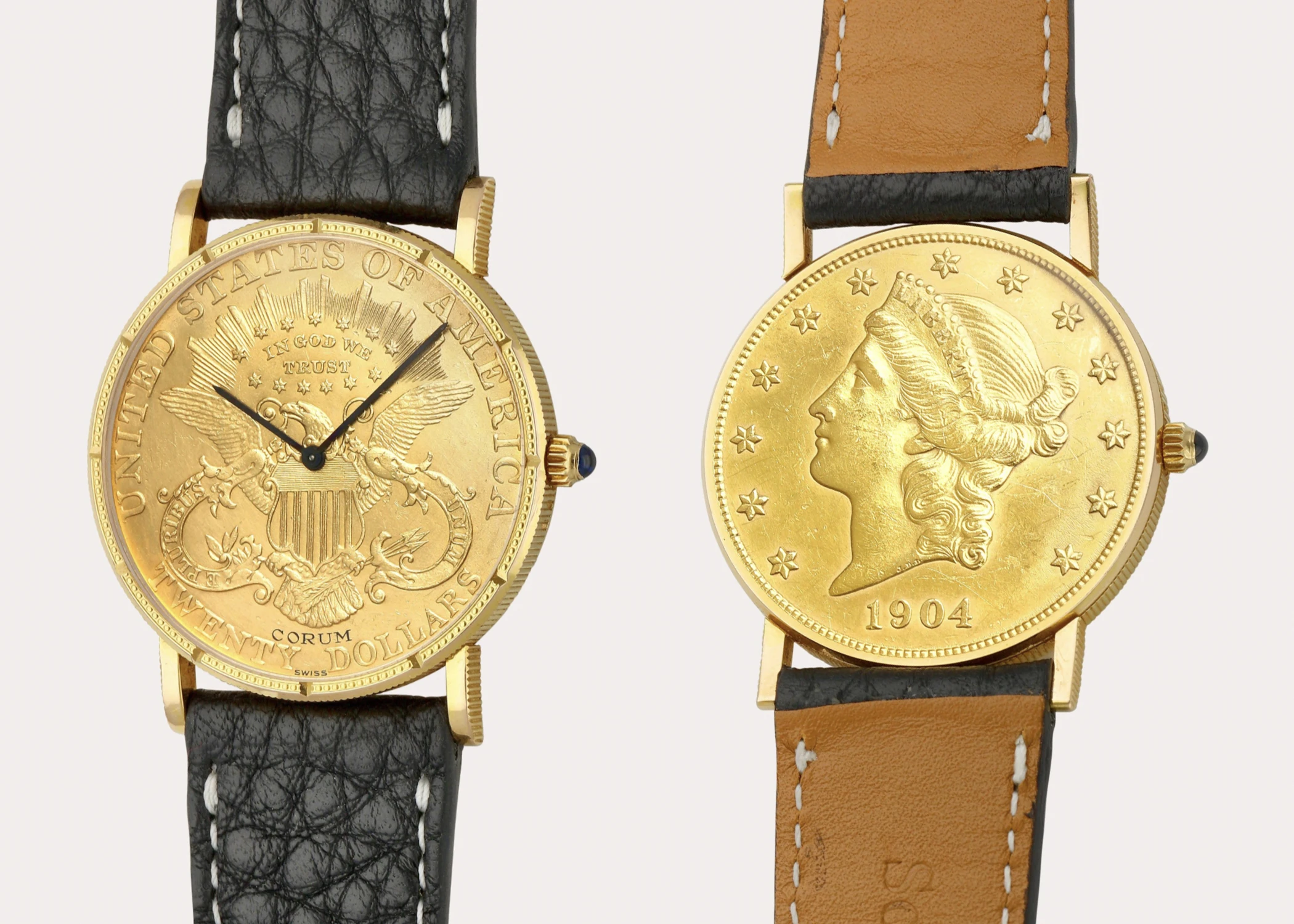
Corum took the coin watch a decisive step further in 1964, inspired by the emergence of sapphire crystal at the beginning of the 1960s. A coin was split into two halves along its edge and transformed into a wearable wristwatch from which the time could be read directly. One half of the coin serves as the dial, above which the hands revolve beneath a protective sapphire crystal, while the other forms the caseback. An extremely thin movement is housed between the two. A solid ring of 18-carat gold serves as the case middle, with the coin’s original reeded edge faithfully reproduced around its circumference.
Credit © Sothebys
Corum’s solution therefore differed fundamentally from anything previously known on the market. Rather than serving as a fully preserved outer shell, the coin was divided into two halves and used as both the dial and the caseback. Unlike the traditional construction, in which the coin and the watch formed two separate units, Corum combined the two into a single object. The principal basis for Corum’s coin watch was the twenty-dollar ‘Double Eagle Liberty Head’ coin.
Over the decades, the Corum Coin Watch also found its way into the highest echelons of American politics. Richard Nixon, the 37th President of the United States, received one of these models as a gift. In 1981, Ronald Reagan, the 40th US President, appeared on the cover of TIME Magazine wearing a Coin Watch on his wrist. Former US Secretary of State Henry Kissinger was likewise among its most prominent wearers.
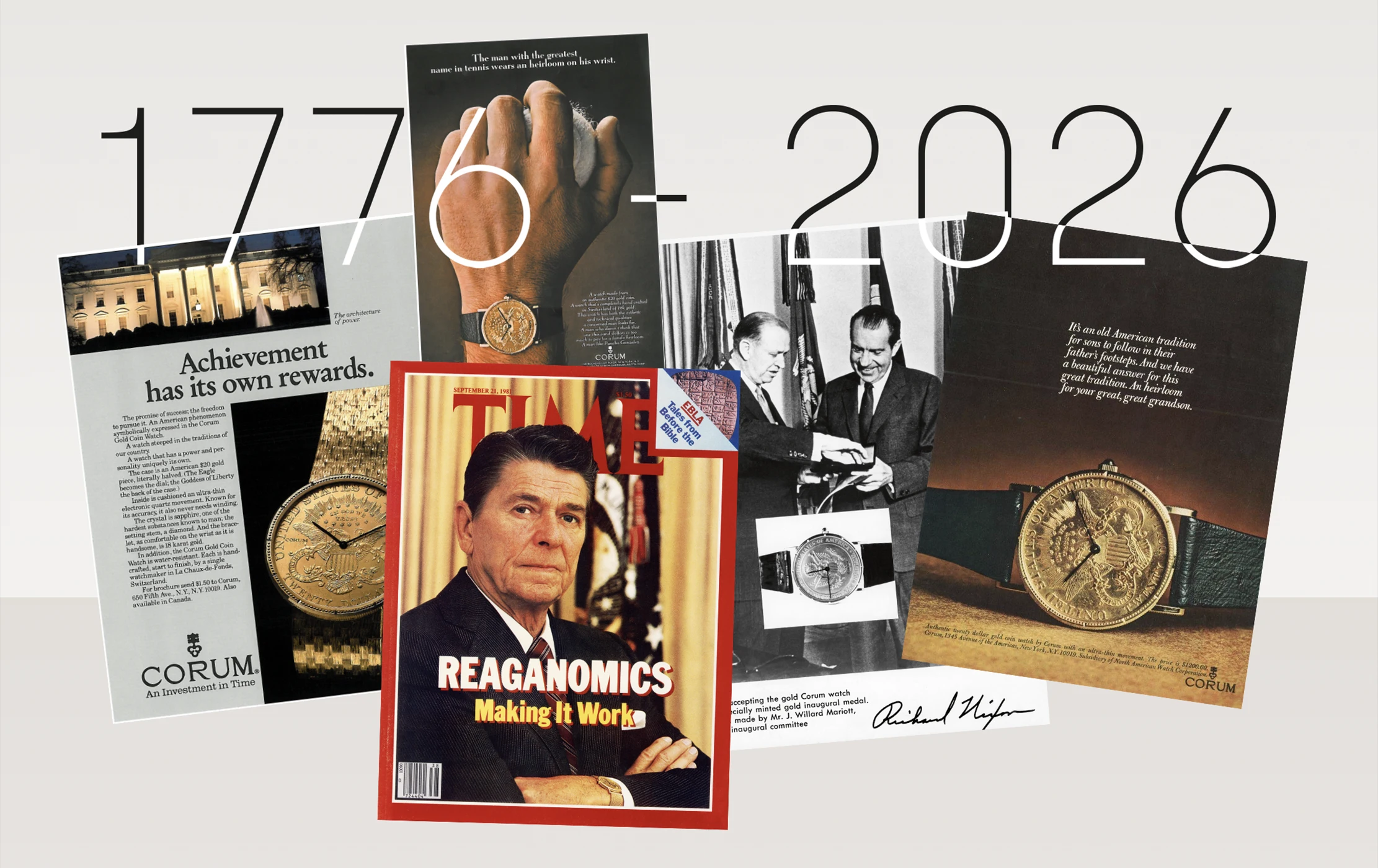
On 2 July 1776, the Second Continental Congress – the assembly of delegates from the 13 colonies of British North America, including George Washington, Thomas Jefferson and Benjamin Franklin – voted in favour of independence from Great Britain. Two days later, on 4 July, the Declaration of Independence was adopted in Philadelphia, and the date remains one of the most important public holidays in the United States. This year in particular, as 4 July marked the 250th anniversary of the Declaration’s adoption, the occasion held particular significance for the country’s political identity as an expression of the inalienable rights to liberty, equality and popular sovereignty.
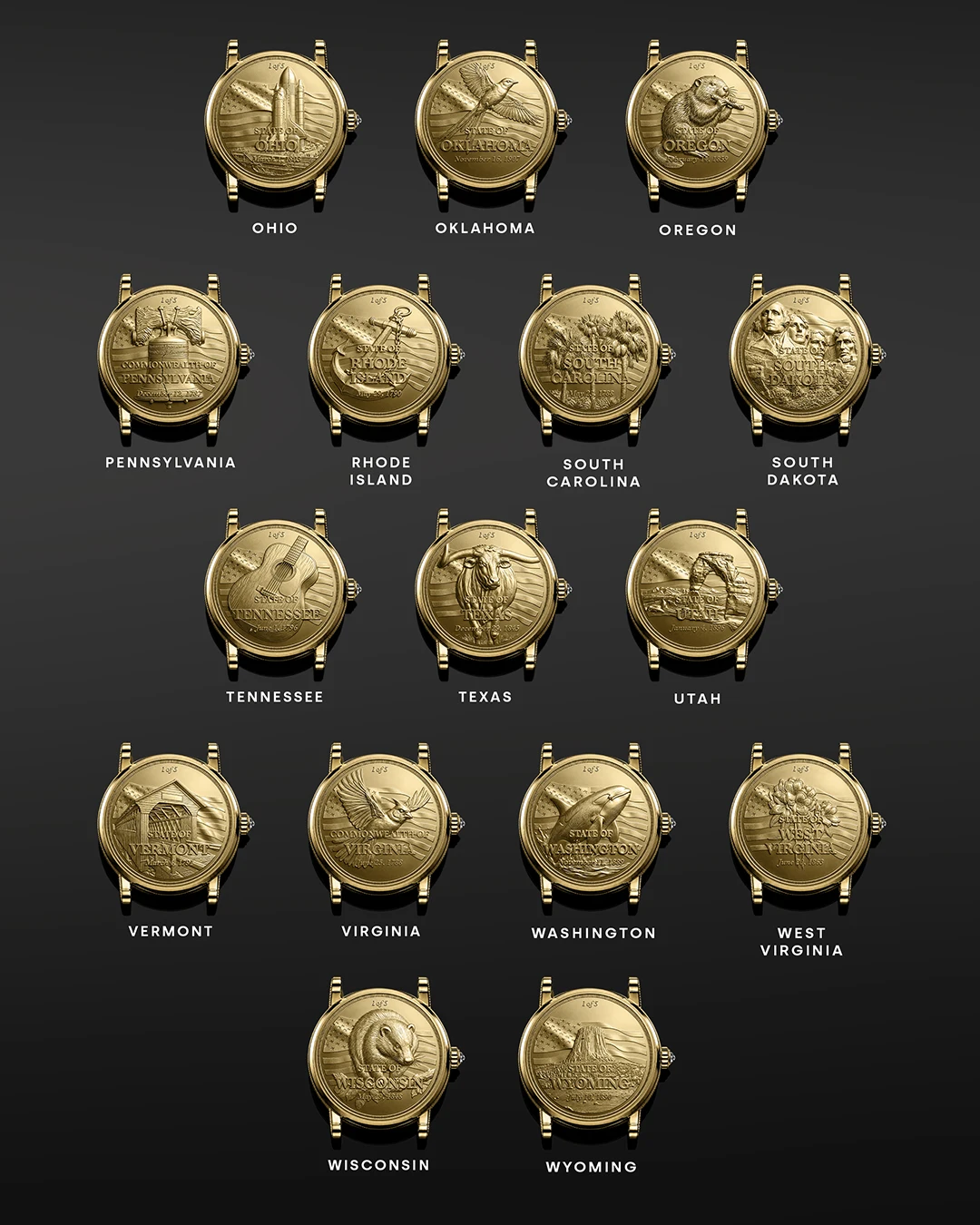
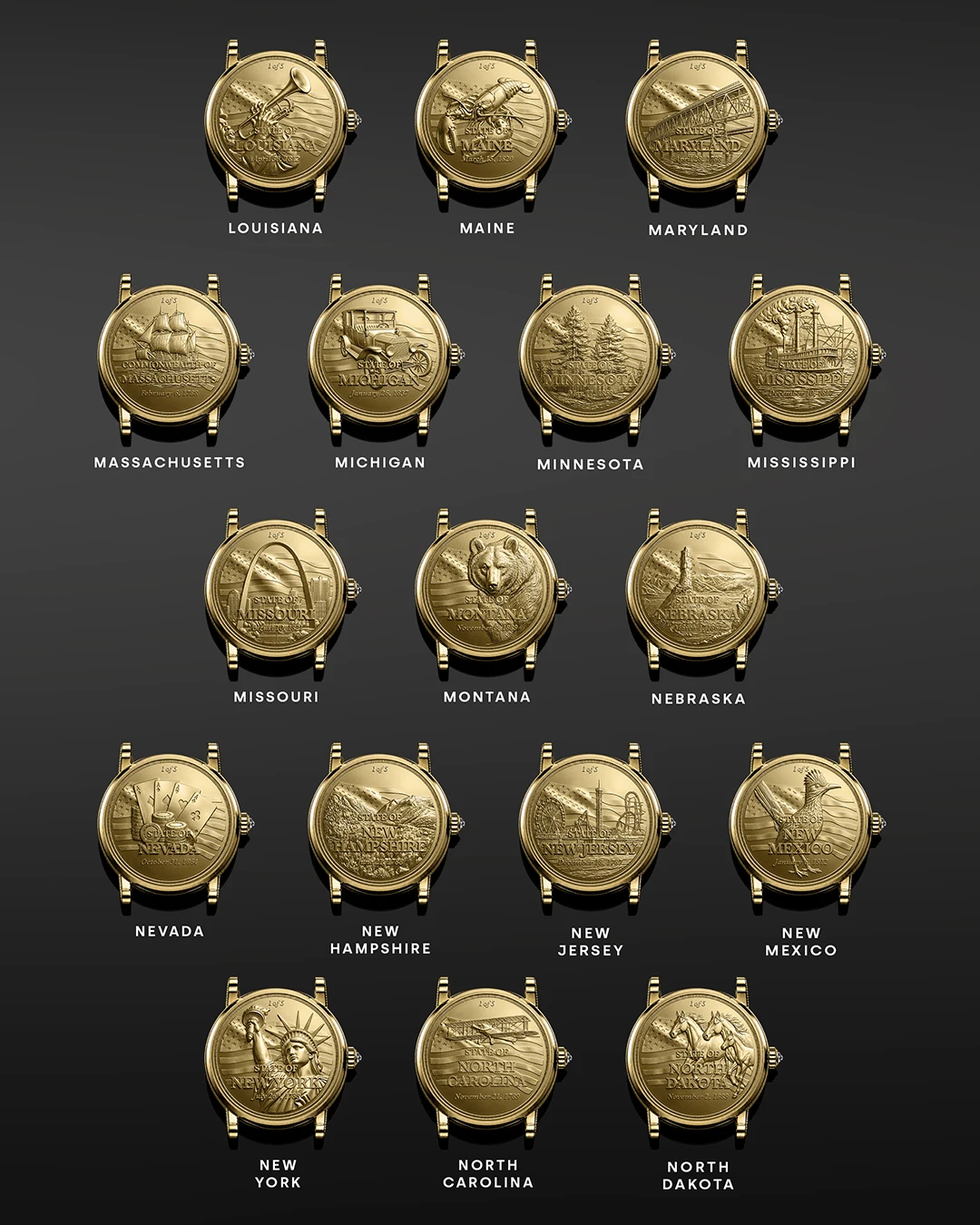
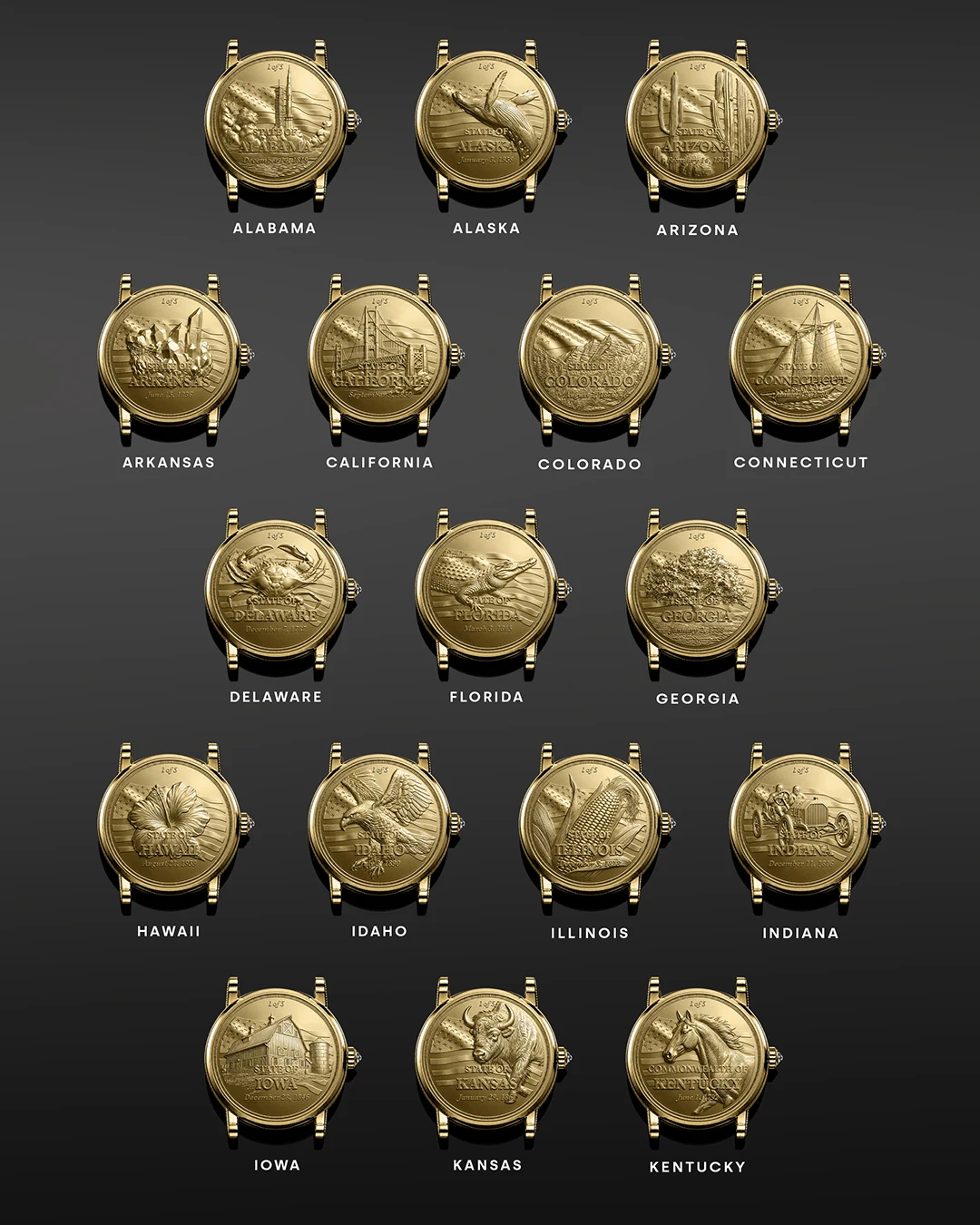
To mark the 250th anniversary of the United States, Corum is presenting a collection of 50 distinct creations, each dedicated to one of the country’s states. On the dial side, every watch features the American eagle, accompanied by the inscriptions ‘250 Years of Independence’ and ‘1776–2026’. Each version bears a different design on the caseback: depending on the state, it depicts a characteristic landscape, a regional landmark or a defining historical moment, together with the state’s name and the date on which it joined the United States. Only five individually numbered examples of each version will be produced.
Each watch features a yellow-gold case measuring 39 mm in diameter and 7.60 mm in height. It houses the automatic Corum Calibre CO 082, which offers a power reserve of 42 hours and operates at a frequency of 4 Hz (28,800 vibrations per hour). The dial, embossed with an eagle motif, can be seen as a reference to the coinage of the US Mint and features two baton hands indicating the hours and minutes. The watches are presented on a vulcanised rubber strap with a textured leather finish. Each watch is priced at CHF 46,000 or USD 58,000 and is available exclusively online.