Zenith presents the new Defy Skyline Tourbillon Skeleton flagship in rose gold, powered by a skeletonized El Primero movement with tourbillon.

Girard-Perregaux has developed an innovative silicon escapement that maintains precise timekeeping even as the mainspring’s power wanes. In 2023, the manufacture revised the constant-force escapement and is now unveiling new models.
In 2008 Girard-Perregaux unveiled the first concept watch featuring a unique silicon spring. In 2013, the watchmaker unveiled its first small-series watch, the Constant Escapement L.M. In 2023, Girard-Perregaux revised the escapement with the Neo Constant Escapement. The basic functioning remained the same. However, the geometry of the escapement wheels was modified, enabling greater efficiency to be achieved.
Girard-Perregaux’s two new “Neo Constant Escapement” models in rose gold and carbon-silicon composite complement the existing titanium version. But before we take a closer look at the watches, let’s first examine the innovative escapement and its advantages in detail.
The decisive flash of inspiration came to the developer, Nicolas Déhon, during a train journey in the late 1990s. The designer, who was then employed by Rolex, was playing with a ticket in his hand. He pressed the card together and it curved into an arc. With his other hand, he pressed against the arc until the card sprang back in the opposite direction. Whether he moved the ticket slowly and carefully or gave it a forceful push, at a certain point it always seemed to snap back with the same force. Couldn’t such a bistable blade be used to develop an escapement with constant force?
An initial patent was filed at Rolex, but it was not possible to build a reliable escapement using the existing metallic materials. The idea was not pursued further. But what exactly was the problem that had the designer so preoccupied?
There are several challenges when it comes to a watch’s accuracy: even if the deviation is virtually zero at any given moment, changing conditions such as fluctuating temperatures, different positions, shocks or magnetic fields can quickly cause the precision to deteriorate.
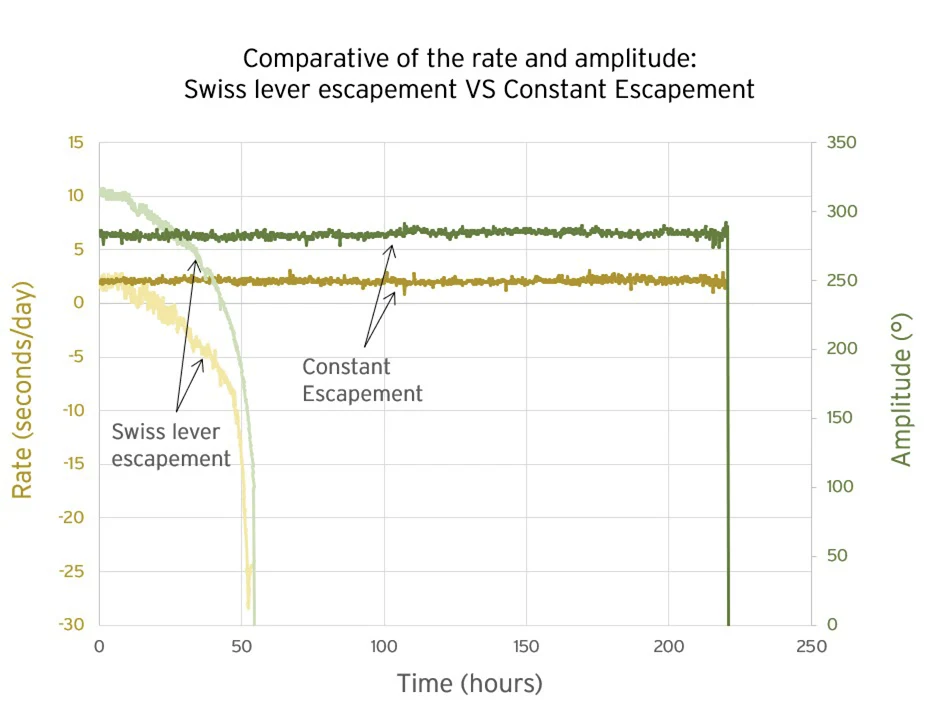
Another such negative factor is the torque of the mainspring. The force of the mainspring is particularly high when fully wound; the more the spring relaxes over time, the weaker it becomes. The result: less force reaches the balance wheel at the other end of the movement. The impulse diminishes, the amplitude of the balance wheel’s oscillation decreases, and the watch’s accuracy is compromised.
Although certain techniques, such as specific end curves in the balance spring, can improve isochronism – that is, the independence of accuracy from the amplitude of oscillation – the fundamental principle remains: the rate changes with the amplitude of the balance wheel. The rate accuracy therefore decreases as the mainspring loses its tension.
Throughout the history of watchmaking, various approaches have been taken to supply the balance wheel with a constant force: winding via a chain and worm gear, a self-winding mechanism, or a Maltese cross. However, these systems – known among watchmakers as ‘constant force’ mechanisms – also have significant drawbacks: above all, they are costly to manufacture, complex and therefore prone to faults, or they reduce the power reserve. To this day, they are therefore only used in watches in exceptional cases.
Throughout its history, Girard-Perregaux has been committed to precision from an early stage and to this day. This includes Constant Girard’s three-bridge tourbillon from 1867. In 1966, the brand won the Neuchâtel Observatory’s Century Prize for its high-frequency movement with 36,000 vibrations per hour. In 1970, the brand built the first industrially manufactured quartz watch. And with an oscillation frequency of 32,768 Hz, it set the standard for quartz movements that remains to this day.
The tourbillon resolved the issue of positional error, the impact of shocks was reduced by high-frequency movements, and new materials such as silicon eliminated the problems caused by temperature fluctuations and magnetic fields. However, there was no effective technical solution for the negative effect of diminishing mainspring tension on timekeeping accuracy.
Years later, when Nicolas Déhon was working at Girard-Perregaux and the first silicon movement components and balance springs were being incorporated into watches, the developer therefore resumed his work and pursued his original idea. However, he had to carry out truly pioneering work and design the complex Constant Escapement mechanism from scratch. There was no historical precedent or prior experience to draw upon for the shape of the silicon escapement spring.
In 2008, the time had come, and Girard-Perregaux unveiled the first concept watch featuring the unique silicon spring. The idea could indeed be realised, and an escapement with constant force was achieved. However, there were still a number of technical challenges to overcome to ensure that the design would function perfectly in everyday use under all conditions.
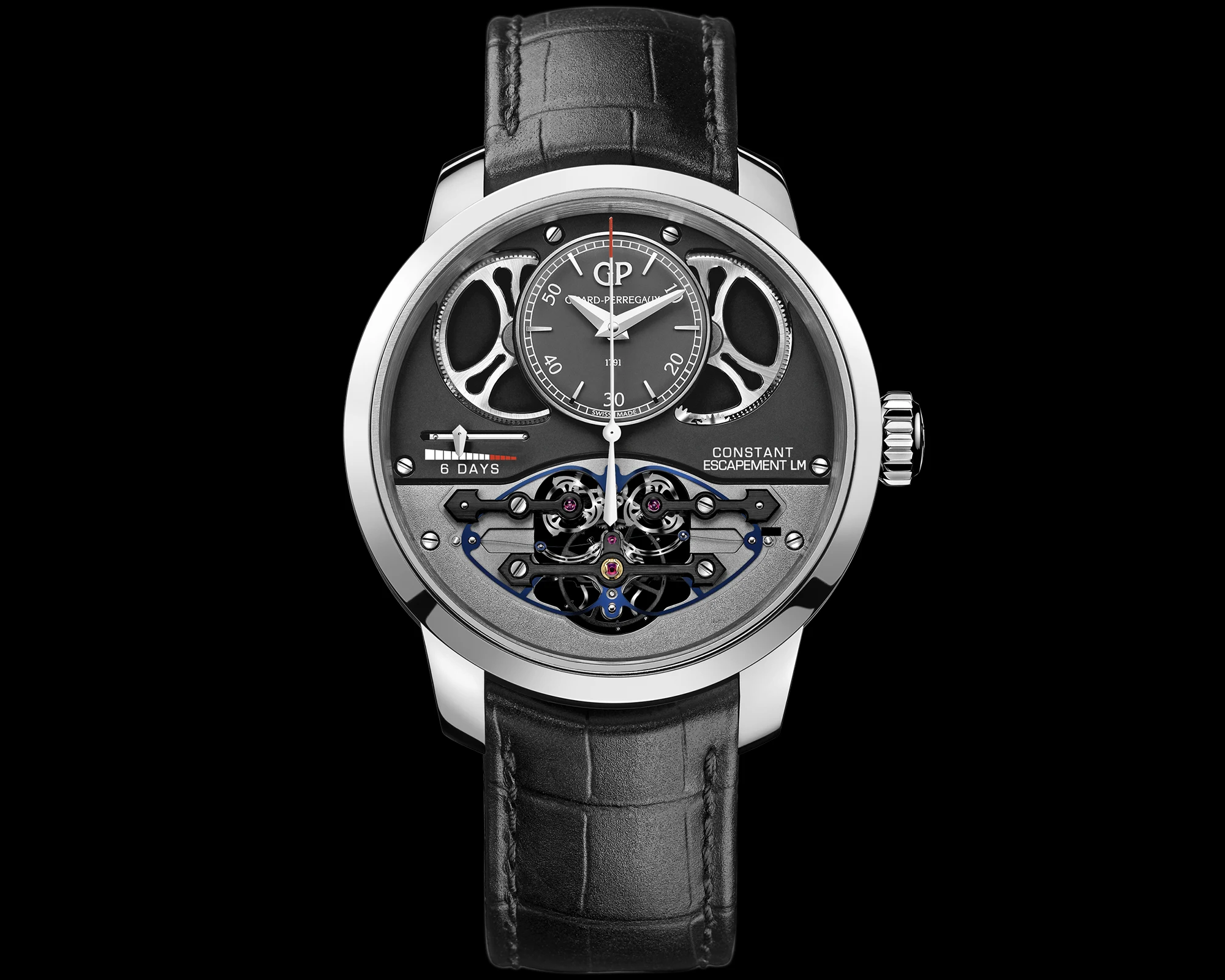
In 2013, Girard-Perregaux unveiled its first small-series watch, the Constant Escapement L.M. The initials stood for the company’s CEO, Luigi Macaluso, who had recently passed away and had always supported the project. The lower half of the dial was occupied by the silicon escapement spring, whose shape resembled a butterfly. In the upper half, an off-centre dial displayed the hours and minutes, whilst the seconds hand was positioned in the centre. A linear power reserve indicator showed how much of the maximum six-day power reserve remained. The bridges for the balance wheel and escape wheels were designed in the style of Girard-Perregaux’s famous Three-Bridge Tourbillon. The model featured a 48-millimetre white gold case.
The innovative watch was acclaimed by experts and won the Aiguille d’Or, the highest honour, at the prestigious Grand Prix d’Horlogerie de Genève. In 2023, Girard-Perregaux revised the escapement with the Neo Constant Escapement. The basic functioning remained the same. However, the geometry of the escapement wheels was modified, enabling greater efficiency to be achieved. Furthermore, with a diameter of 45 millimetres, the new model was significantly more suitable for everyday wear than its 48-millimetre predecessor.
The balance wheel and hairspring in this movement are of a relatively conventional design. The escapement, however, is significantly more complex than the standard Swiss lever escapement. Essentially, it performs the same functions: it slows down the gear train and releases it at regular intervals. It also transmits an impulse to the balance wheel, causing it to continue oscillating.
The key difference lies in the method of impulse transmission. In a conventional lever escapement, the current spring force acts directly on the escape wheel and from there, via the lever, on the balance wheel. When the mainspring is fully wound, a strong impulse is transmitted; when it is nearly run down, a weak one.
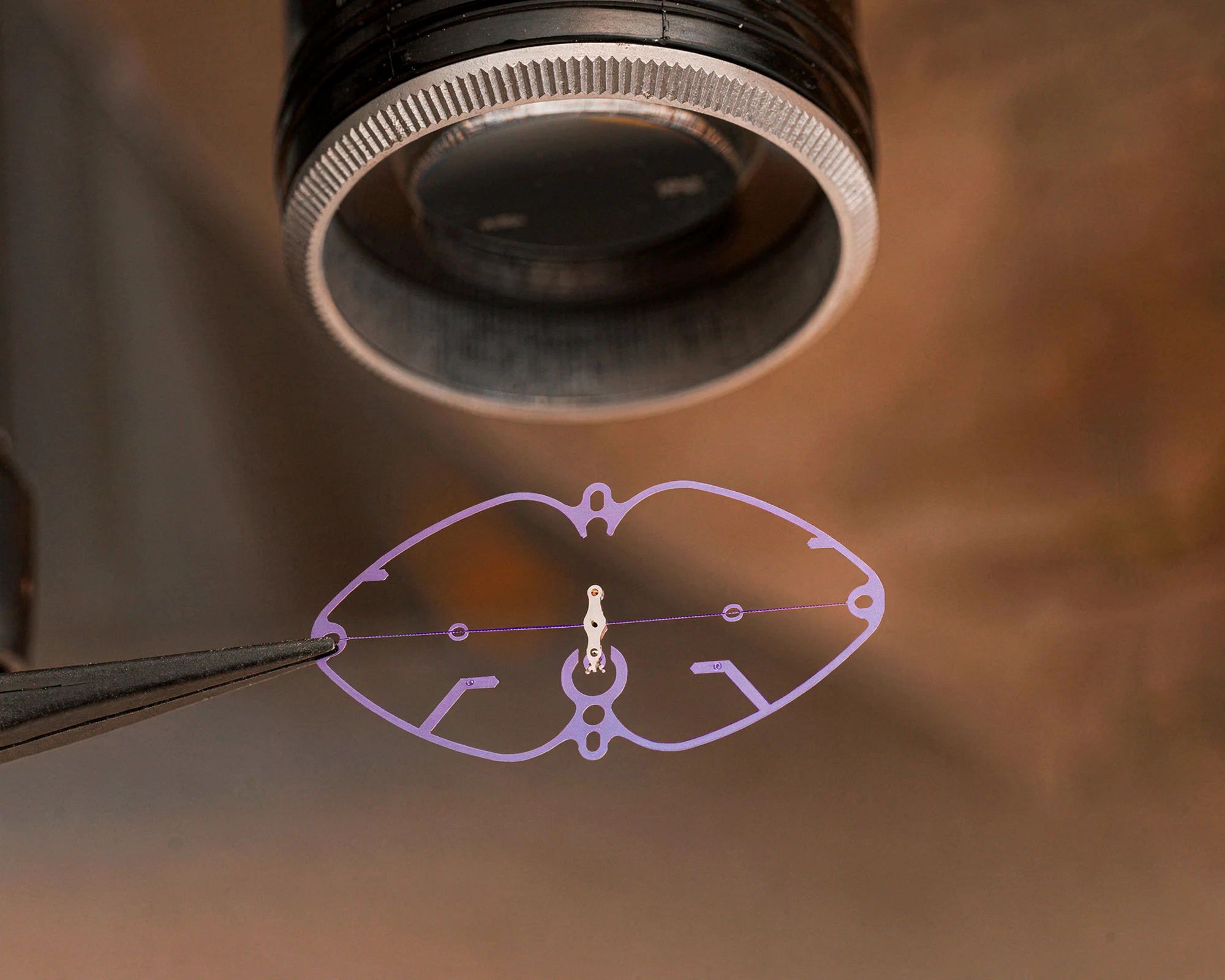
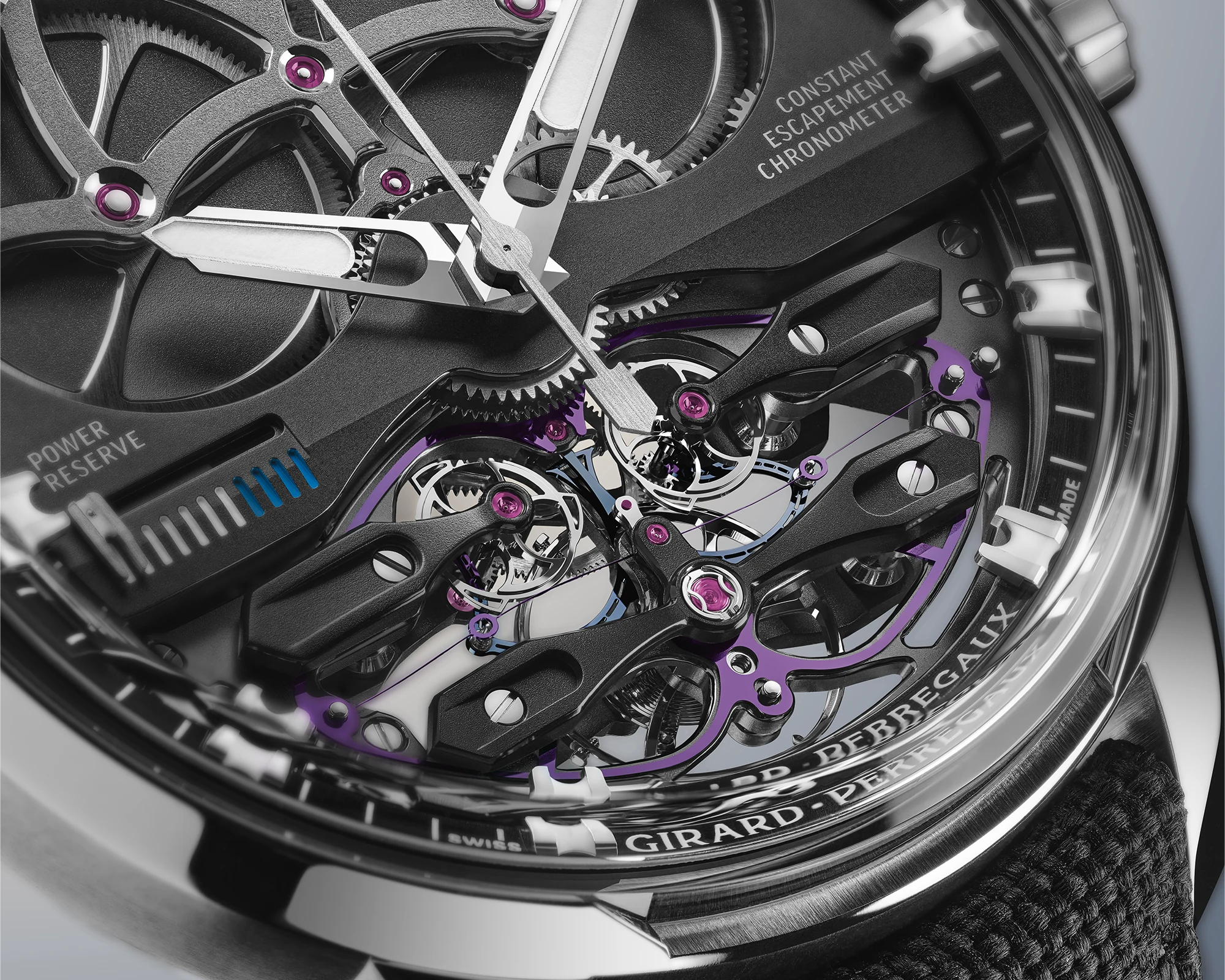
In the Constant Escapement, an intermediate buffer is incorporated: the silicon balance spring. One of the two escape wheels slowly compresses the spring plate via the escape lever. It makes no difference whether the mainspring delivers a lot or a little force. As soon as a certain point is reached, the spring plate snaps abruptly in the opposite direction, just like Déhon’s ‘ticket’. This snap movement always occurs with the same force.
The impulse is transmitted to the balance wheel via the escape lever. As the balance wheel swings back, it releases the escape lever via a small pallet. The escape wheels rotate a further third of a turn and now compress the other side of the leaf spring until it snaps back again, delivering an impulse in the opposite direction. The principle is essentially simple: a leaf spring that snaps back with the same force no matter how hard it is pressed. However, its technical implementation in a movement required decades of development and innovative materials such as silicon.
The result: the amplitude of the balance wheel remains constant throughout the entire power reserve. The rate no longer varies with the state of the mainspring. This escapement is a historic achievement, as the system is the best solution to date for constant force. All this was only made possible by innovative materials such as silicon and extremely precise manufacturing processes.
The silicon balance spring, the heart of the new escapement, is manufactured under laboratory conditions in a cleanroom at Sigatec, the largest manufacturer of silicon components for the watch industry in Sion.
The process begins with a large silicon crystal being sawn into wafer-thin slices. These so-called wafers form the basis for the subsequent process. Geometric shapes are then transferred onto the wafers using photolithography. The silicon wafer is bonded to a silicon substrate via an oxide layer. This layer later serves as a reference to determine the exact depth limit during etching. In the next step, a liquid polymer is applied to the surface whilst the wafer rotates at high speed. The resulting centrifugal force displaces excess liquid, leaving a smooth, thin and uniform layer of photoresist.
A mask is now used that matches the shape of the balance spring and is positioned on the wafer like a stencil. Intense UV light triggers a chemical reaction, before a special solution removes all traces of the photoresist. After this cleaning process, the outlines of several balance springs become visible on the surface of the wafer. These are etched out of the wafer using reactive ion deep etching (DRIE). The process works like a reverse 3D print: silicon is removed layer by layer until the oxide layer is reached.
The silicon substrate and the oxide layer are then removed via a process known as ‘stripping’. A thermal treatment then creates a new oxide layer on the silicon components. This increases the mechanical strength of the component and gives it a characteristic colour ranging from blue to violet. Finally, each individual balance spring is carefully detached from the wafer by hand, starting from the central spring plate.
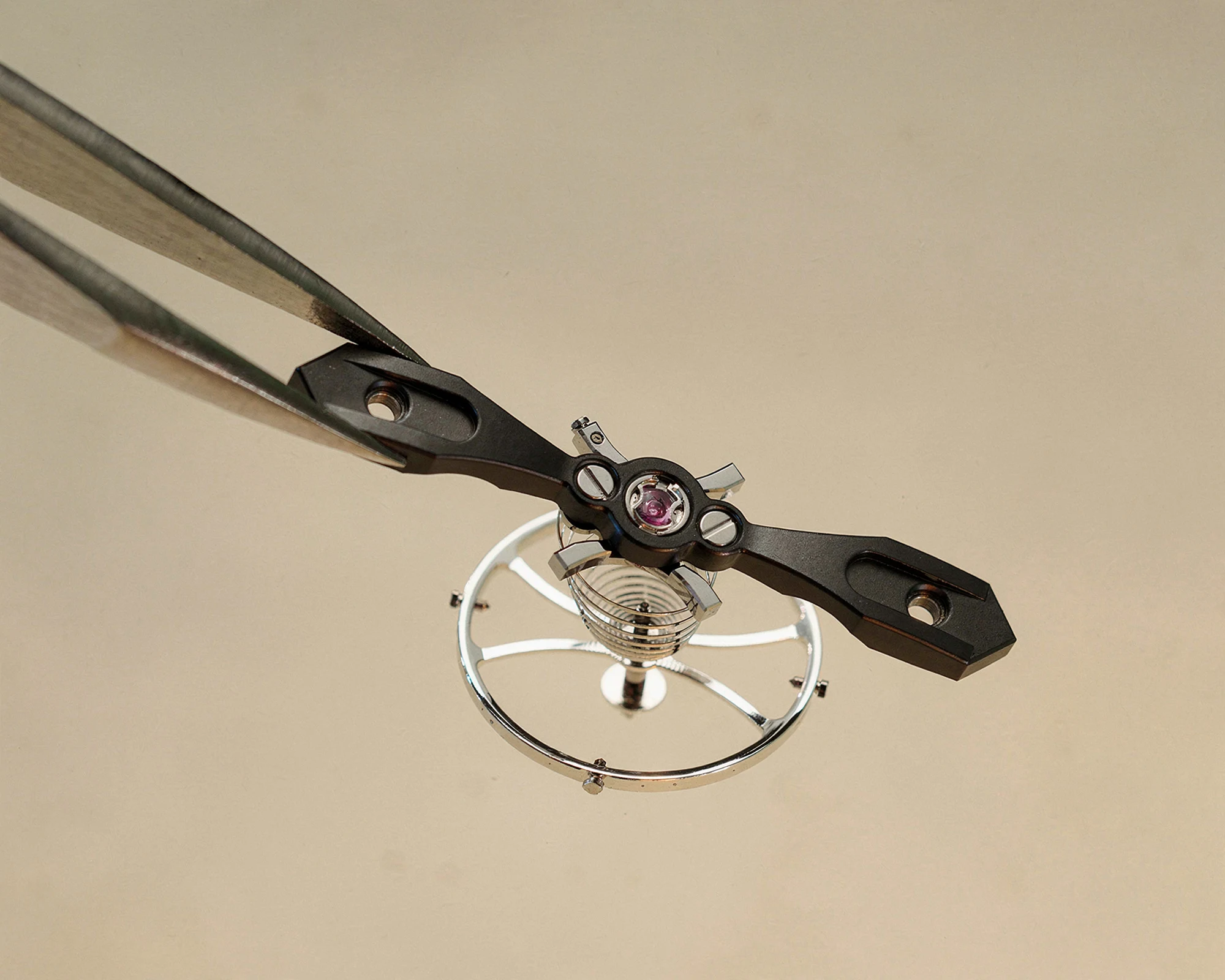
The cost of this process is considerable: whilst conventional spiral springs can accommodate 500 pieces on a single wafer, the Constant Escapement process can only produce 30 escapement springs per wafer. This is reflected in the production costs. The finished component is 120 micrometres thick and the escapement spring measures just 14 micrometres in width. By way of comparison: a human hair, at 50 to 90 micrometres, is up to six times thicker.
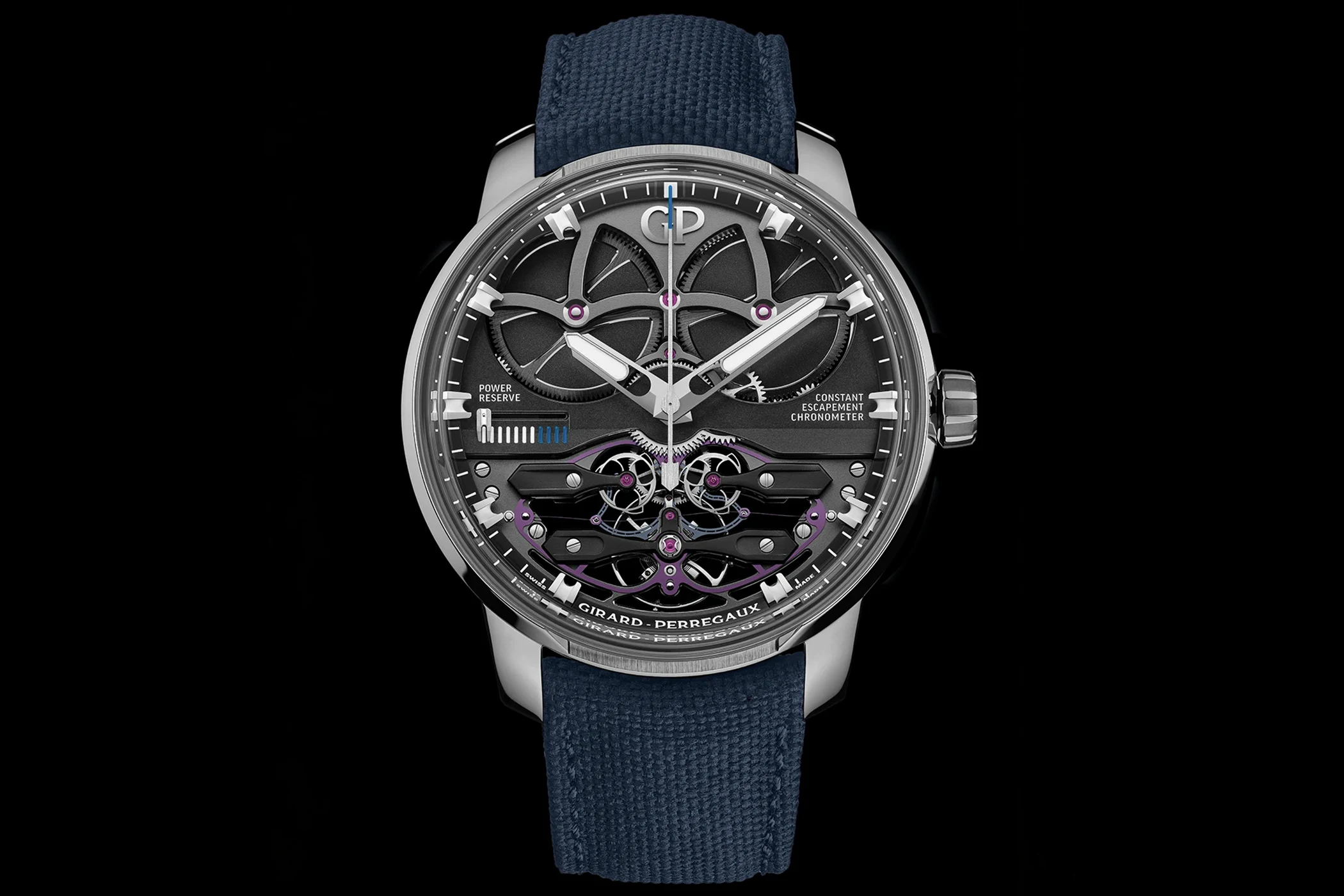
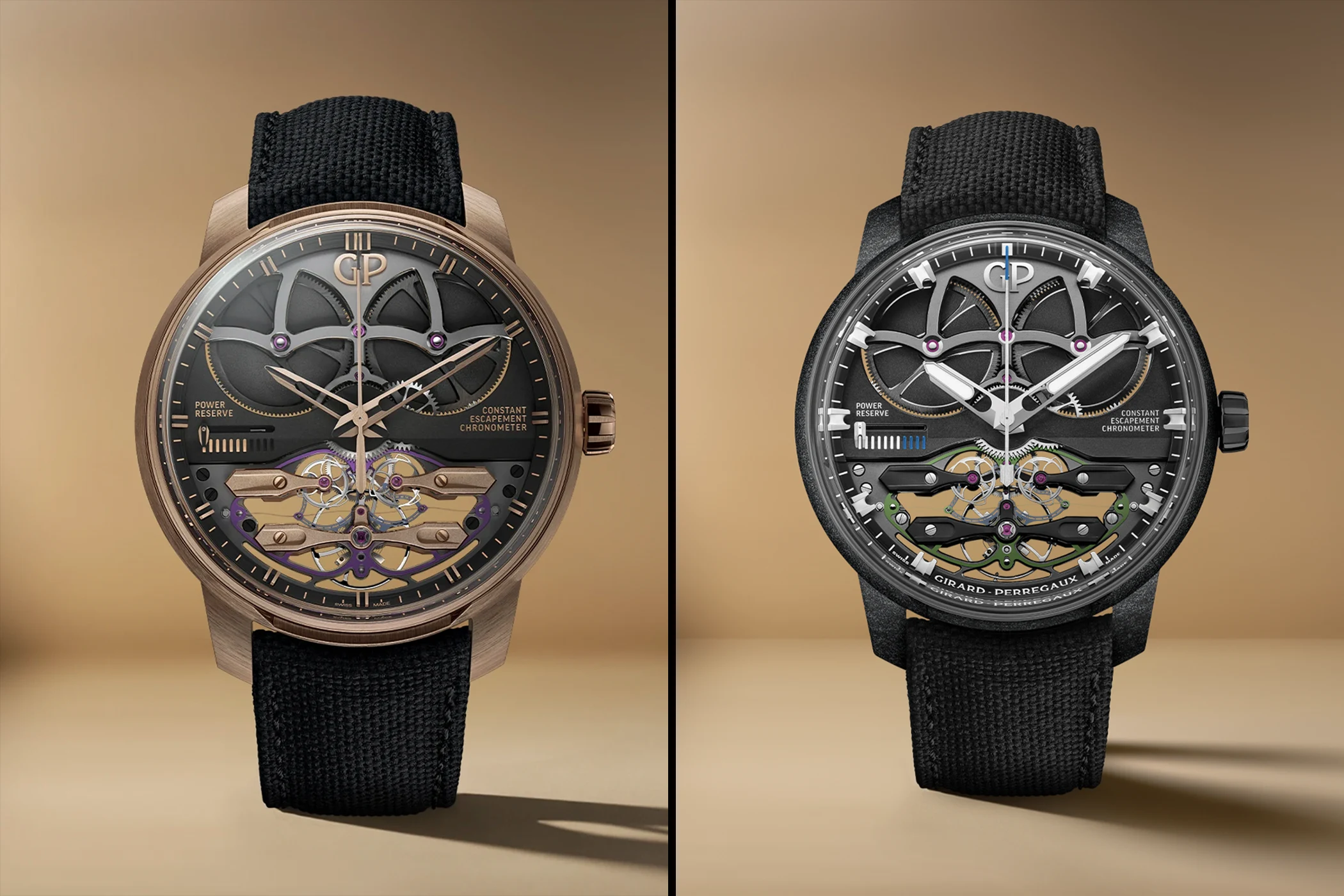
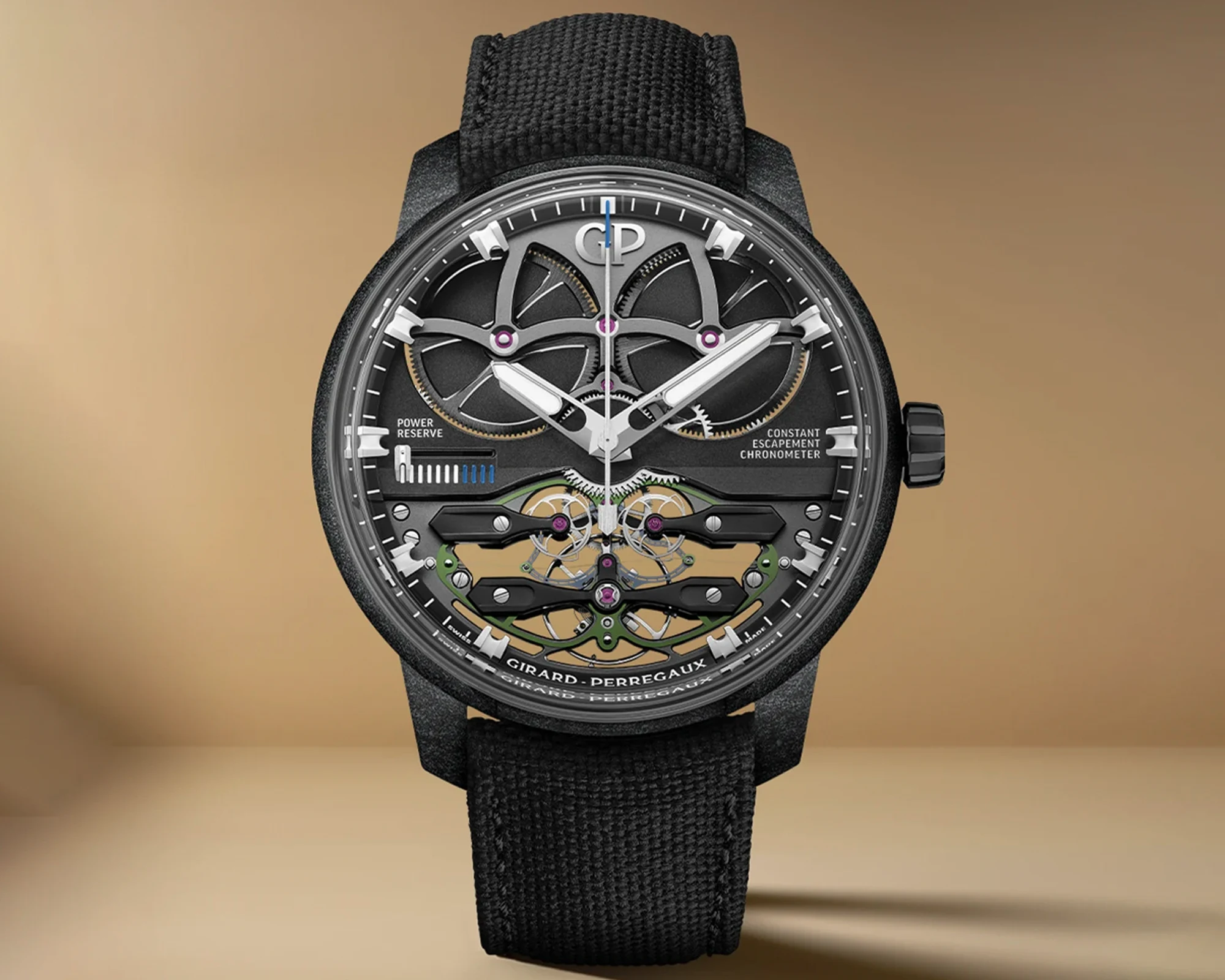
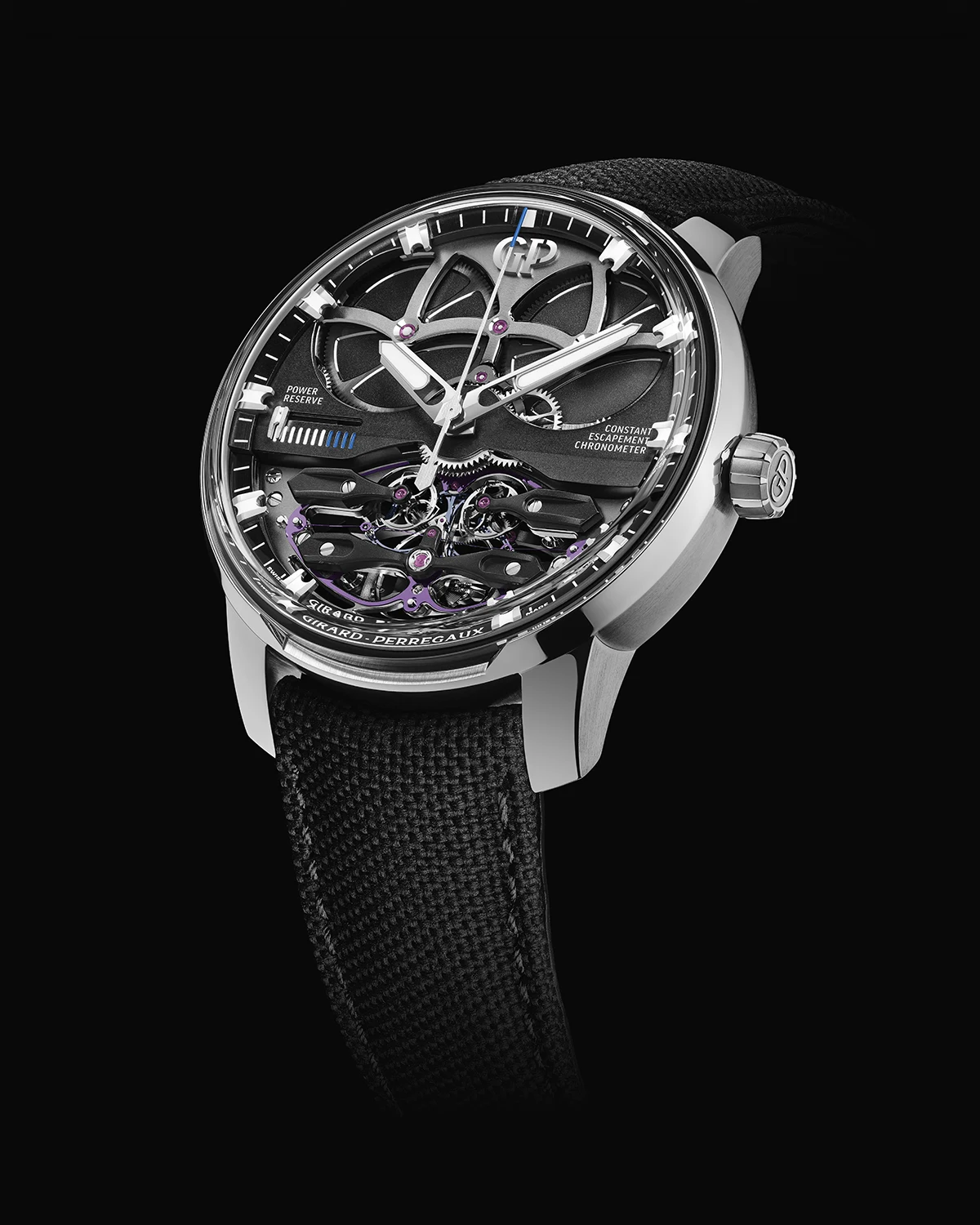
The Swiss manufacturer is presenting a rose gold version as well as a limited edition of just two pieces featuring a case made of carbon and silicon. The new models are based on the Neo Constant Escapement, unveiled in 2023, which features a revised escapement.
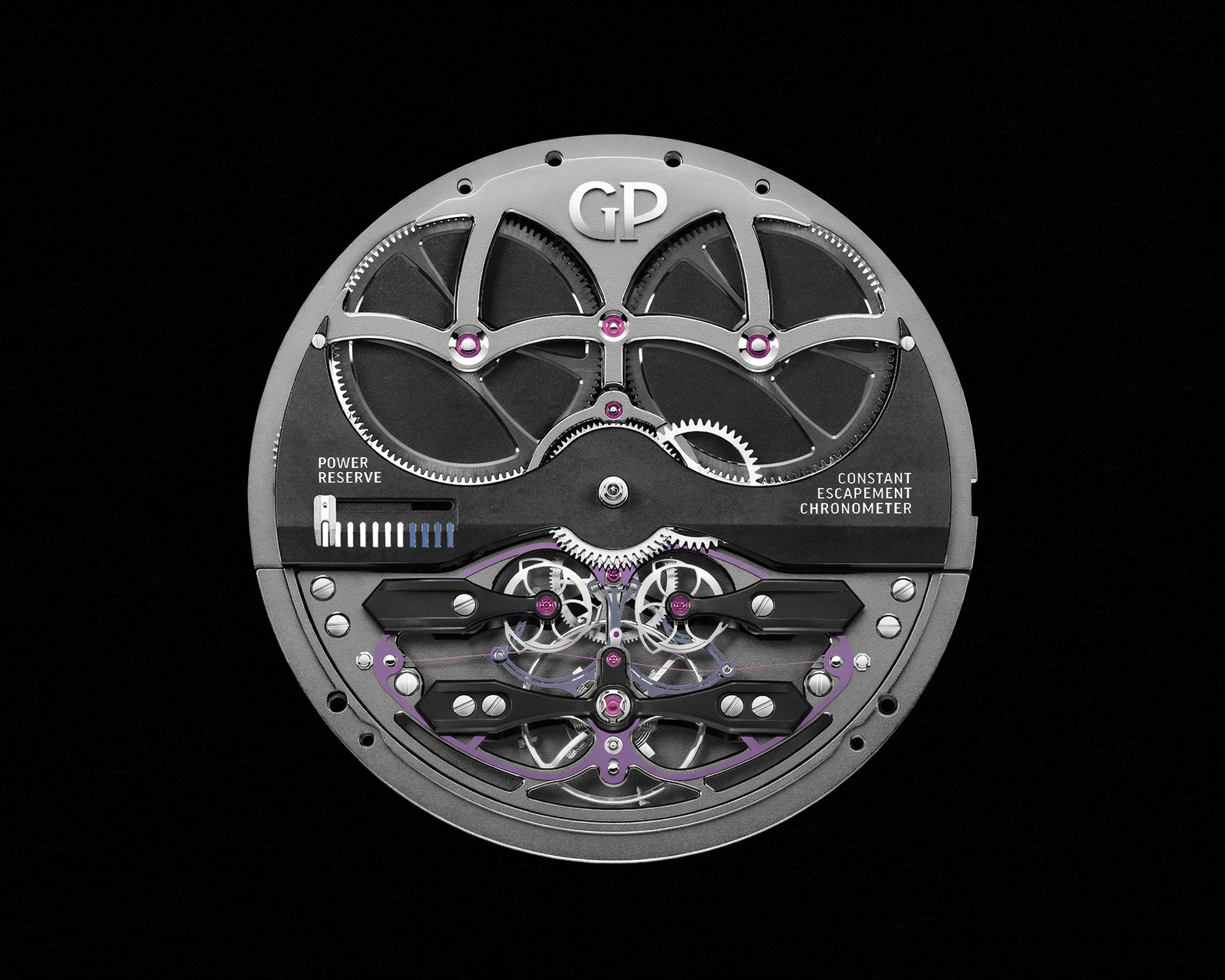
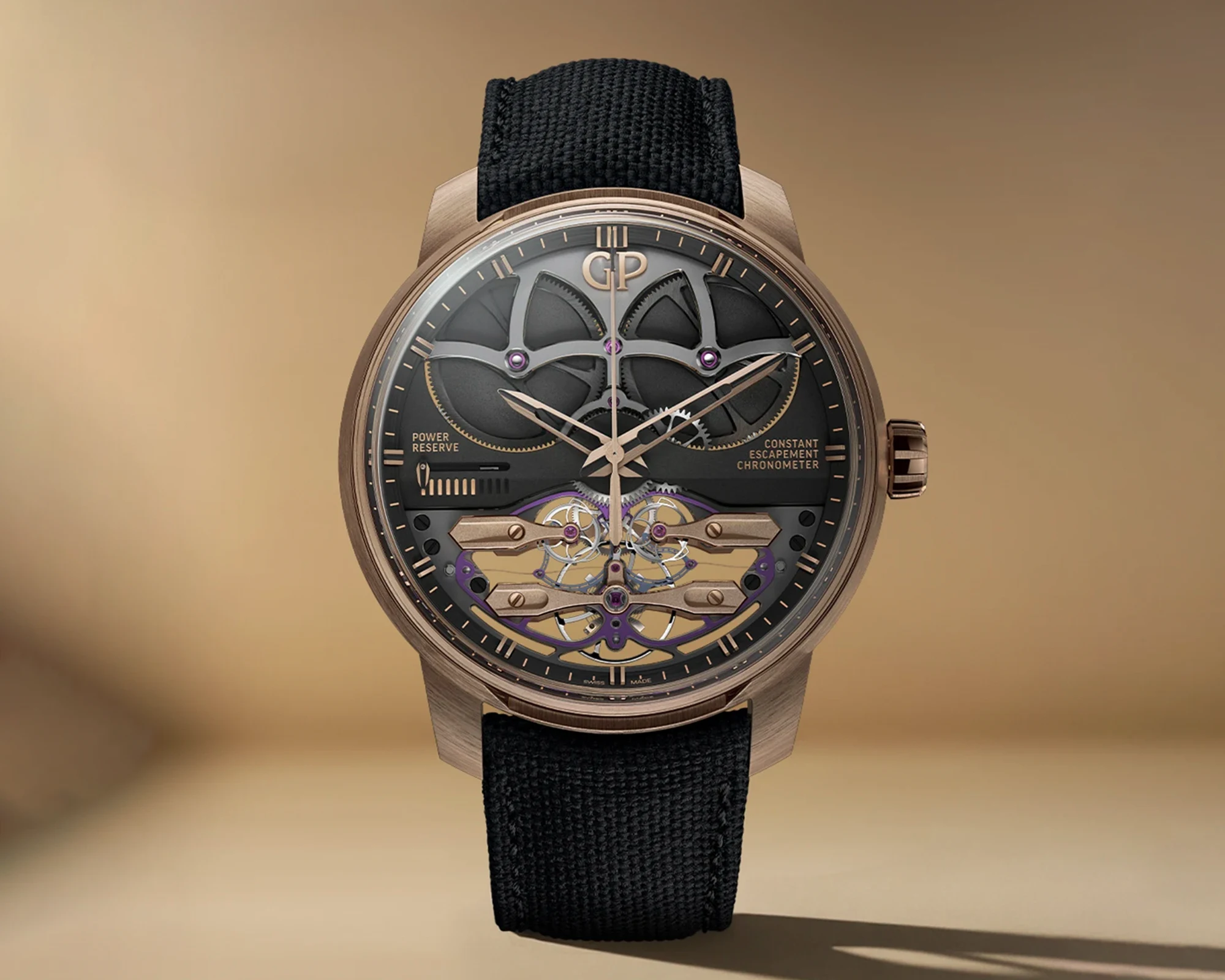
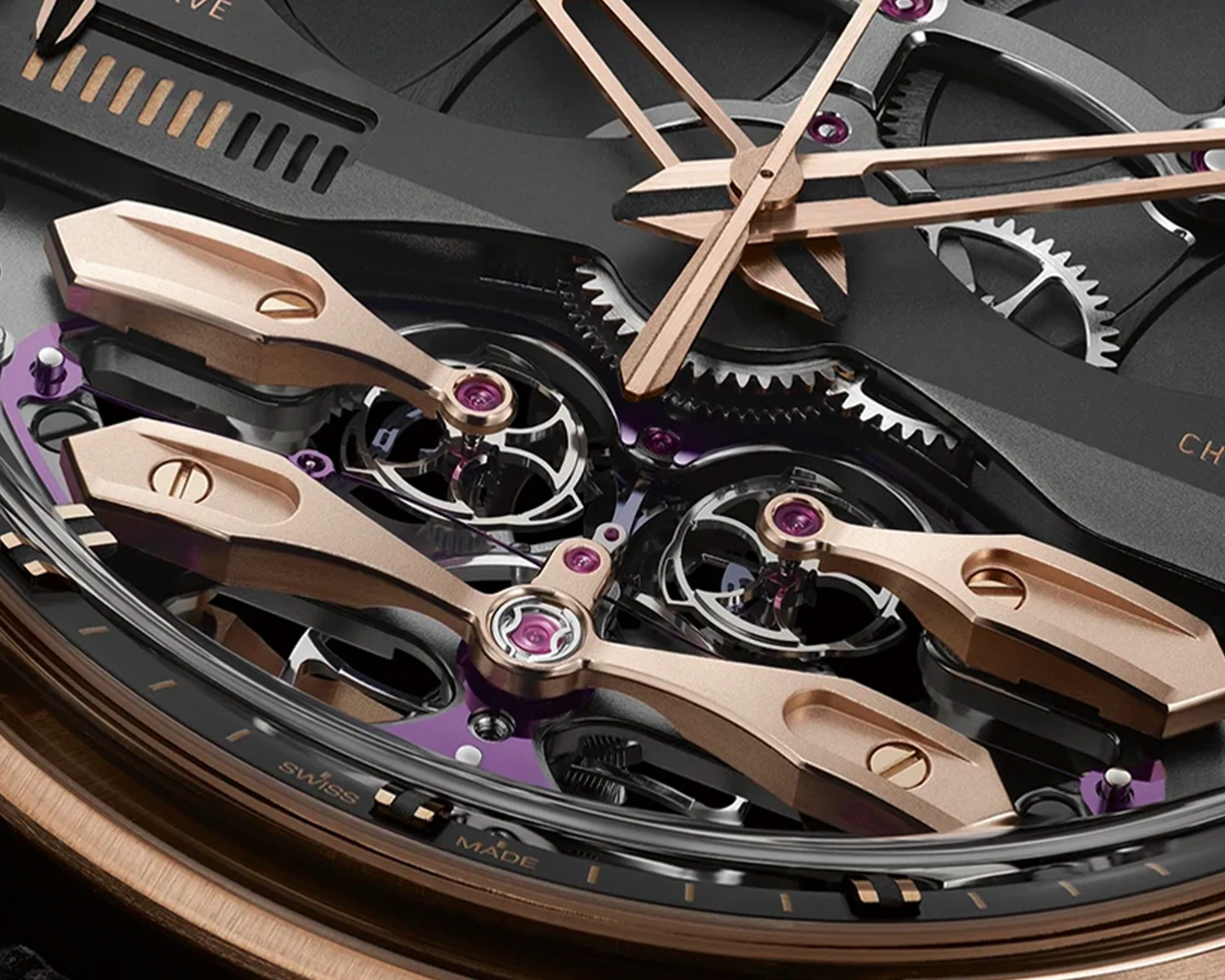
The 18-carat rose gold version will form part of the regular collection. The 45-millimetre case reveals the oscillating balance wheel and the purple silicon balance spring beneath the rose gold Neo bridges. The skeletonised hour and minute hands feature a luminescent coating for improved readability in the dark. The rubber strap with a textile effect fastens with a triple folding clasp in rose gold. The second variant is limited to two numbered pieces. The case is made from a composite material consisting of carbon, silicon carbide and silicon. This material is extremely hard, yet only half as heavy as titanium. As it is difficult to work with, it is rarely used in the watch industry.
For this version, the case diameter has been slightly increased to 45.35 millimetres. The surface features subtle shades of black and grey with fine speckles that catch the light. A notable detail: the silicon balance spring shimmers green here rather than purple, a serendipitous result of the manufacturing process. The crown, made of black DLC-coated titanium, and an engraving with the serial number on the reverse further distinguish this model.
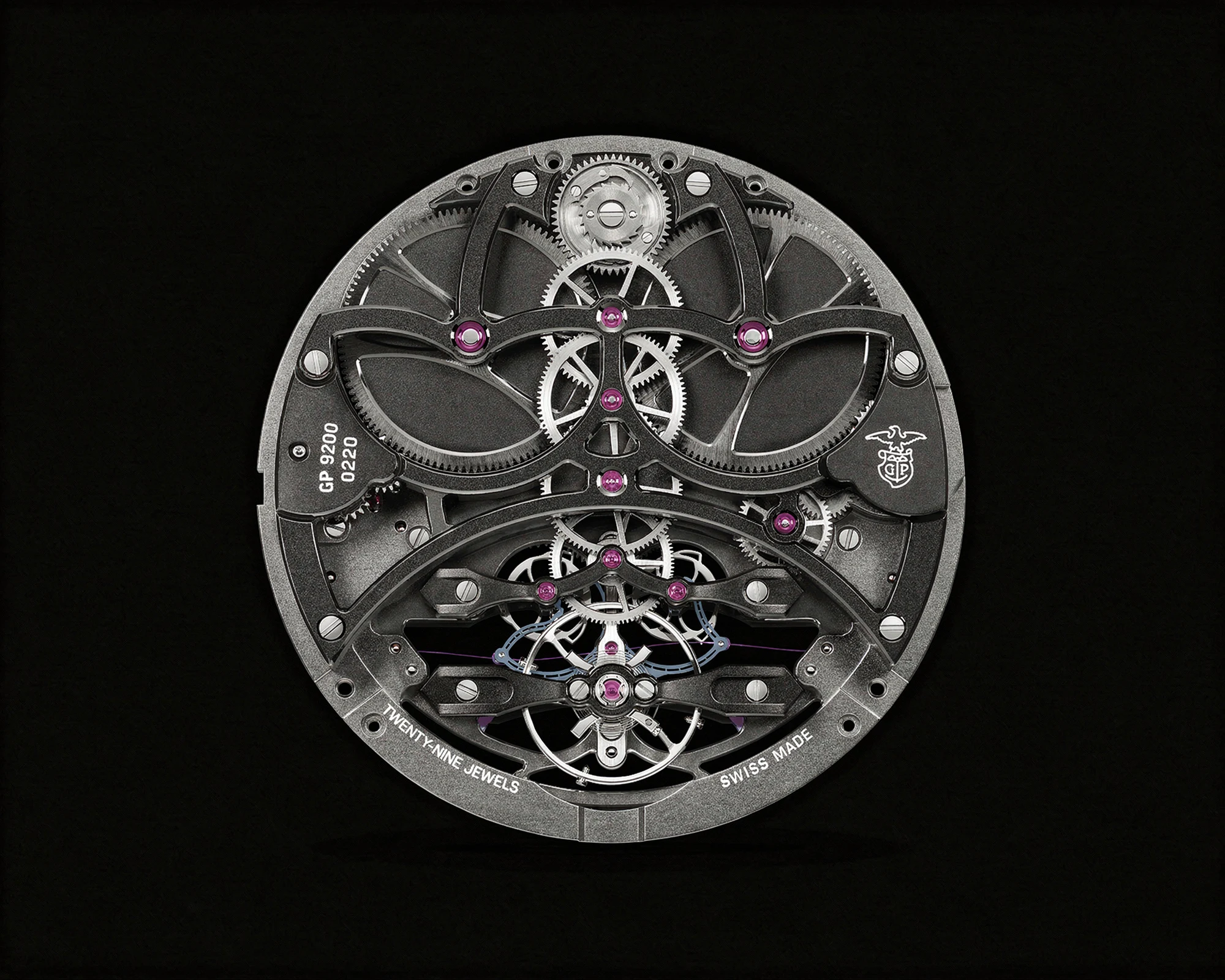
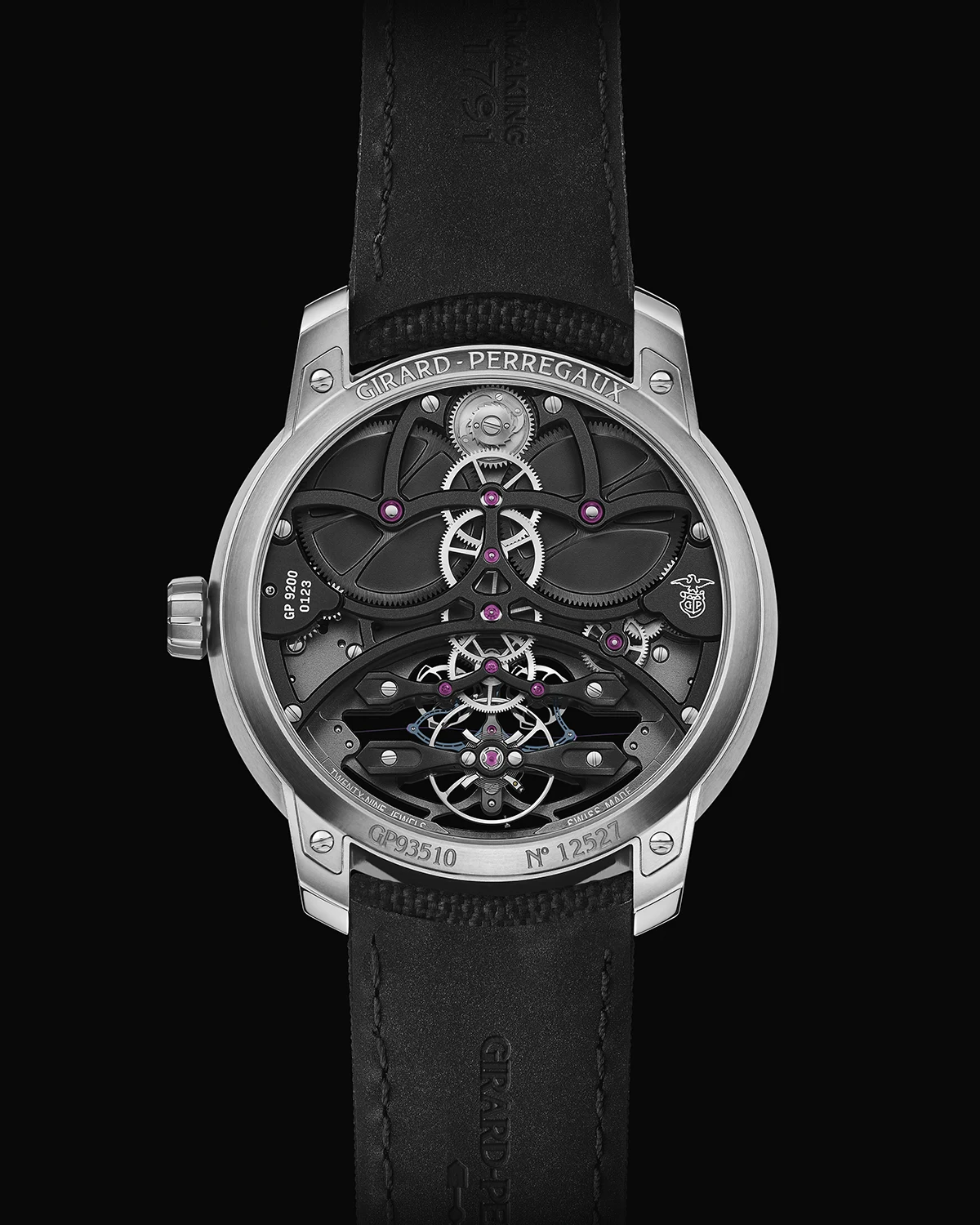
Both models feature the COSC-certified hand-wound GP09200 calibre. The movement comprises 266 components and 29 jewels. Compared to the first Constant Escapement L.M. from 2013, the number of components has been reduced by 16. Girard-Perregaux has filed 15 patents for the calibre’s innovations. The movement operates at 21,600 vibrations per hour and, thanks to a double barrel, provides a power reserve of at least seven days. A linear indicator shows the remaining power reserve.
The sapphire crystal case back allows a view of the movement’s symmetrical rear. The characteristic Neo-bridges are finished in a warm gold tone for the rose gold version and in dark anthracite for the carbon-silicon variant.
The rose gold version of this revolutionary watch costs €140,000.00. However, Girard-Perregaux will only disclose the price of the carbon-silicon variant, limited to two pieces, upon request.