The Sinn EZM 19 was developed for command-staff operations, combining time management, robust engineering and clear orientation in the field.
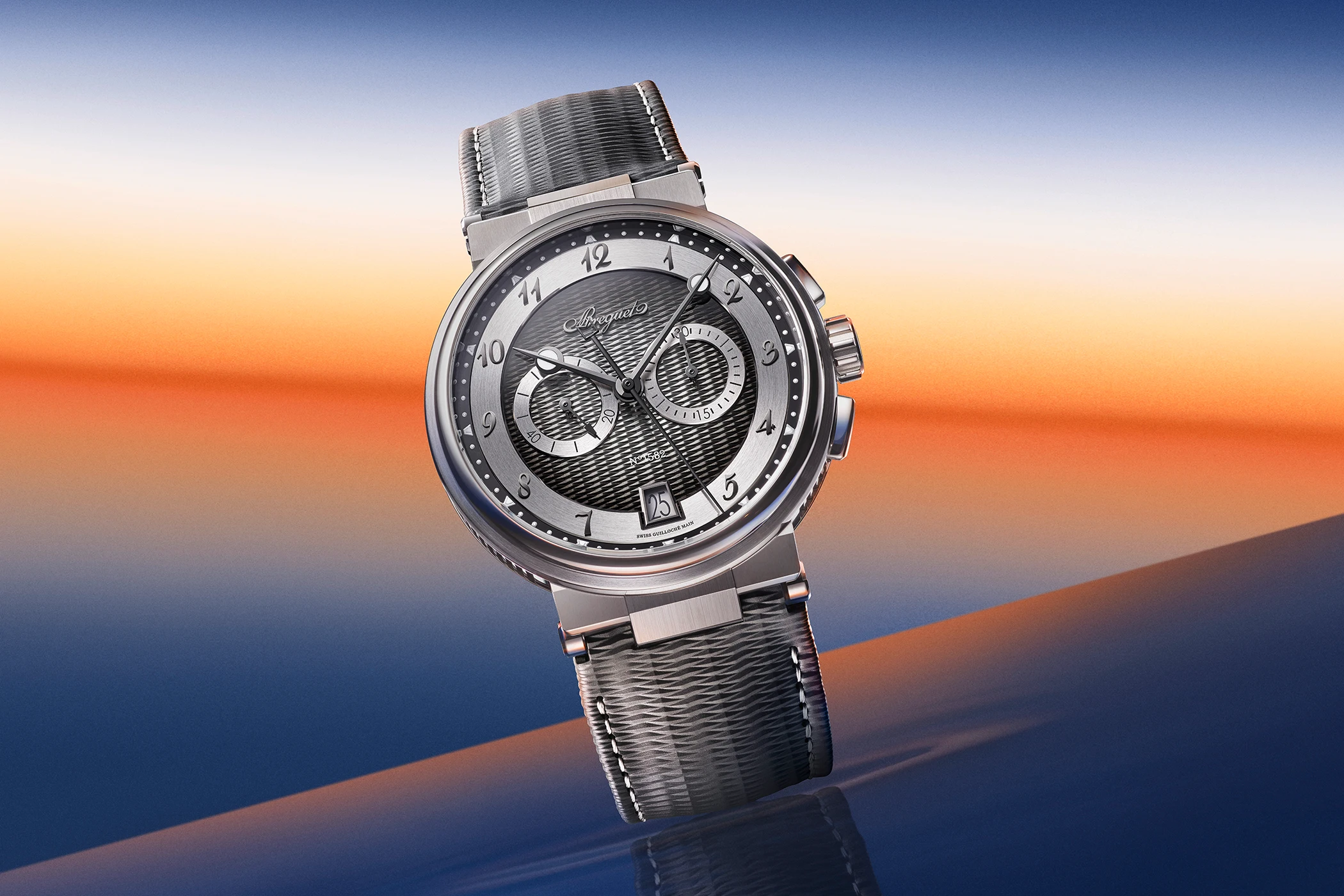
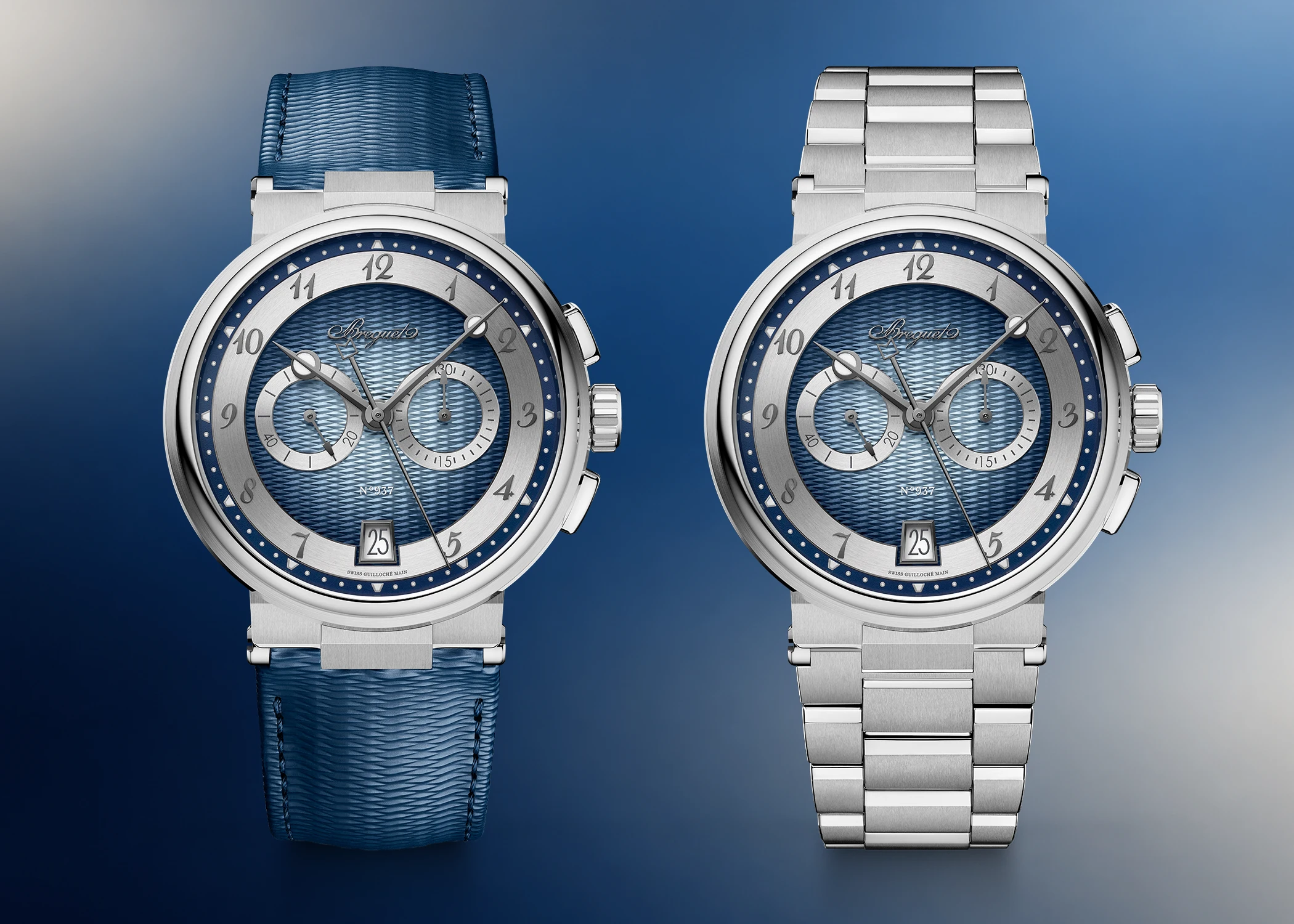
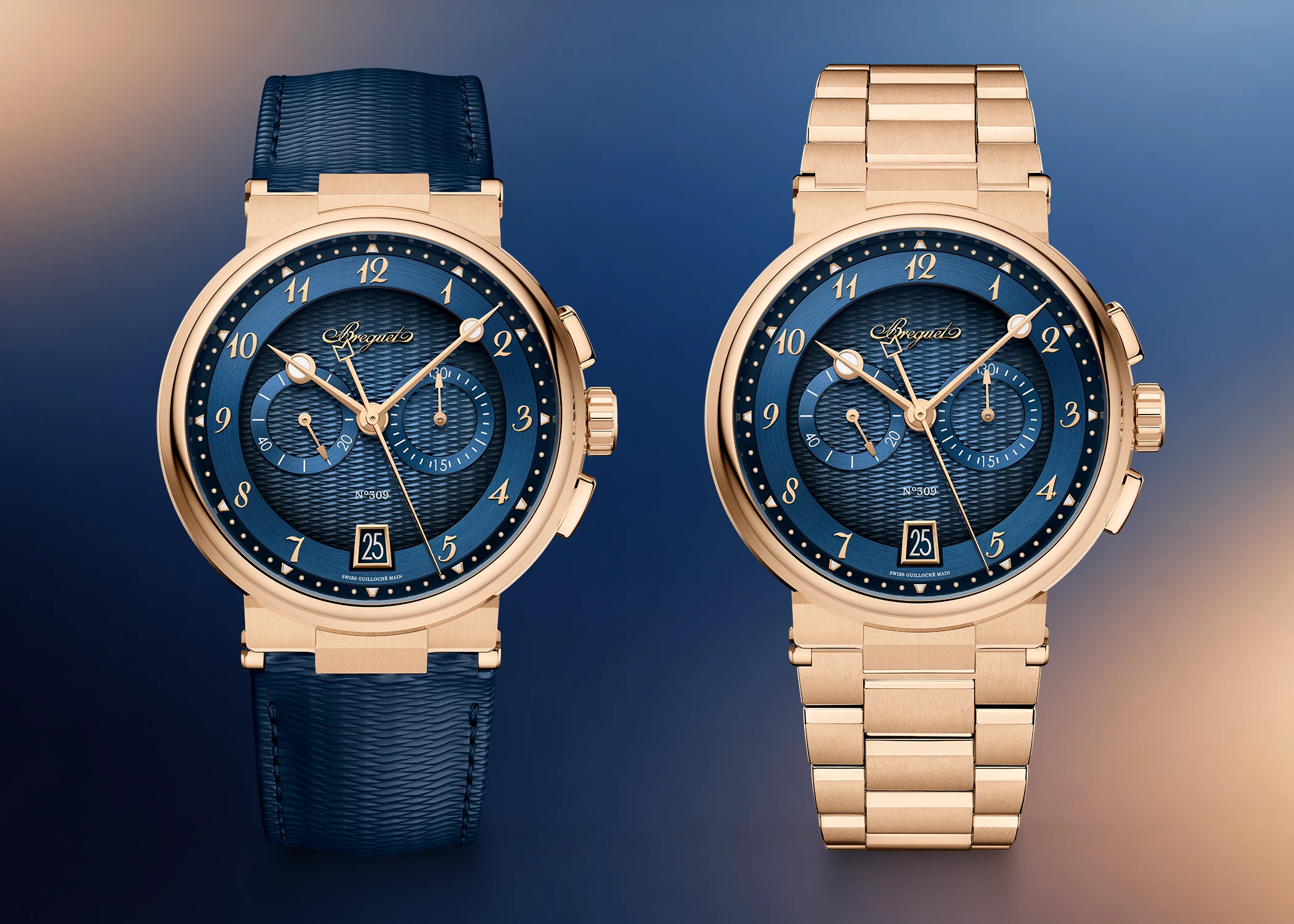
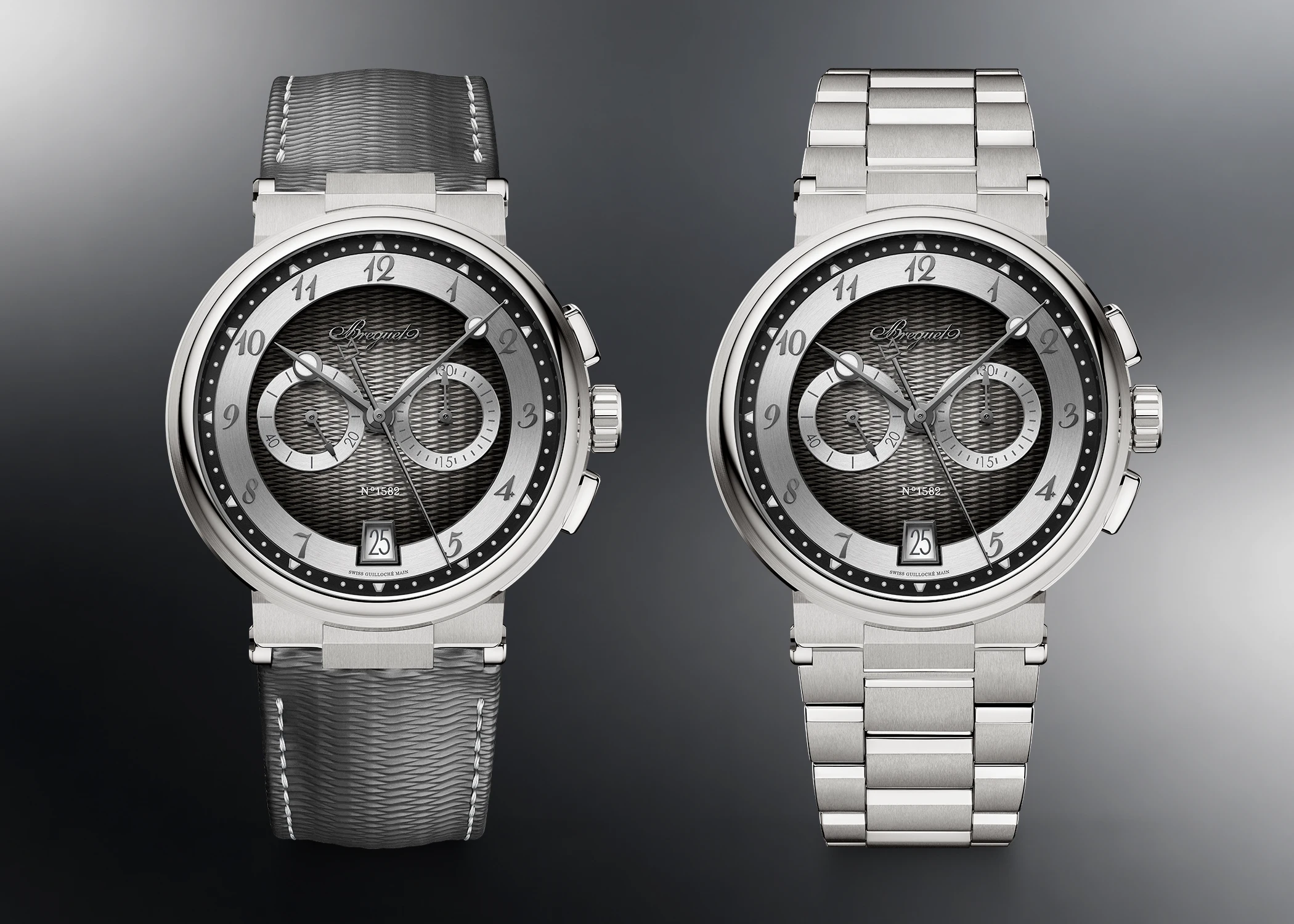
With new versions of the Marine 5517 and Marine Chronographe 5527, Breguet is continuing the latest evolution of its sports watch collection, first introduced in 1990. Three variants each in white gold, rose gold and titanium combine the familiar architecture of the two models with new dial colours and the ‘Quai de l’Horloge’ guilloché pattern.
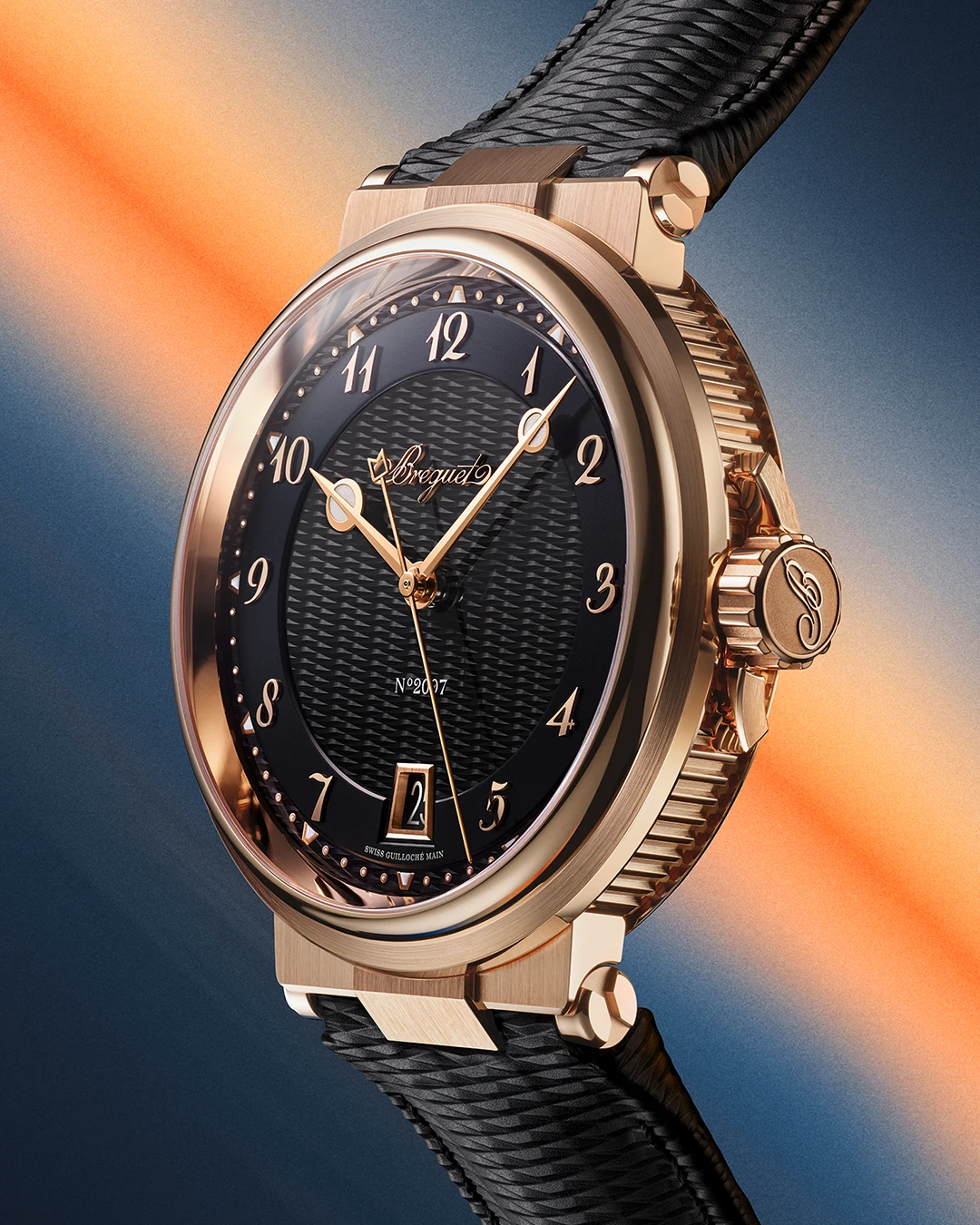
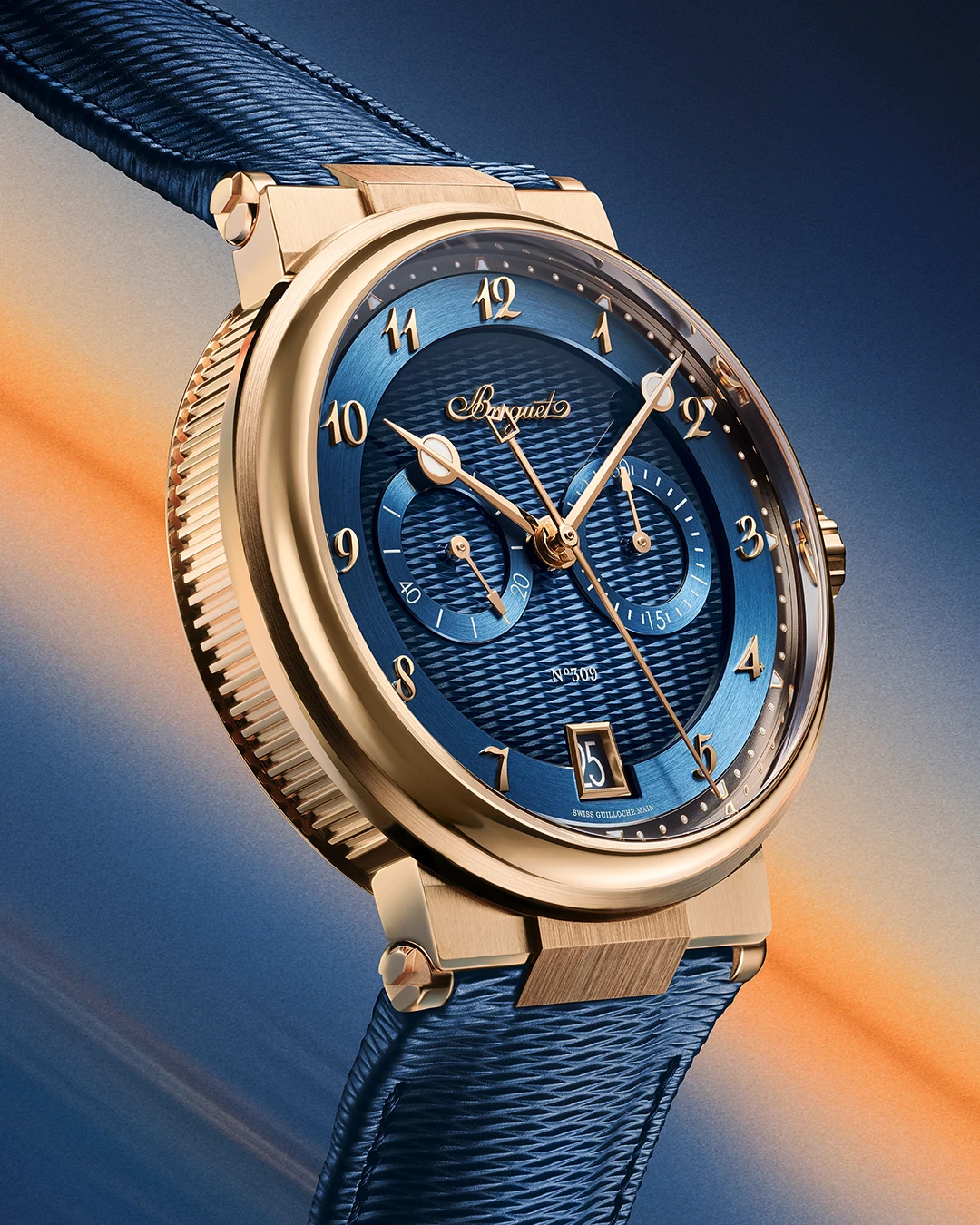
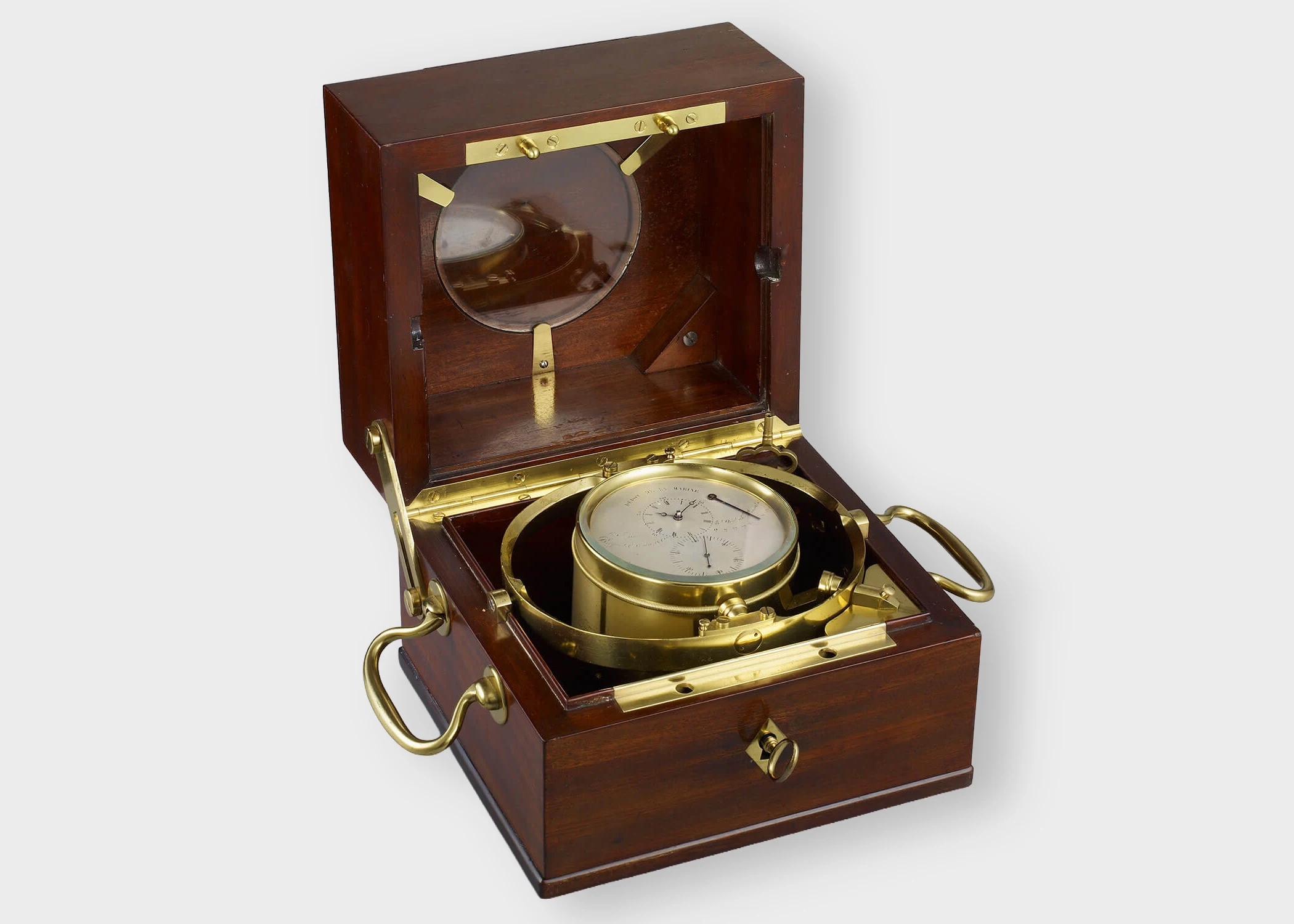
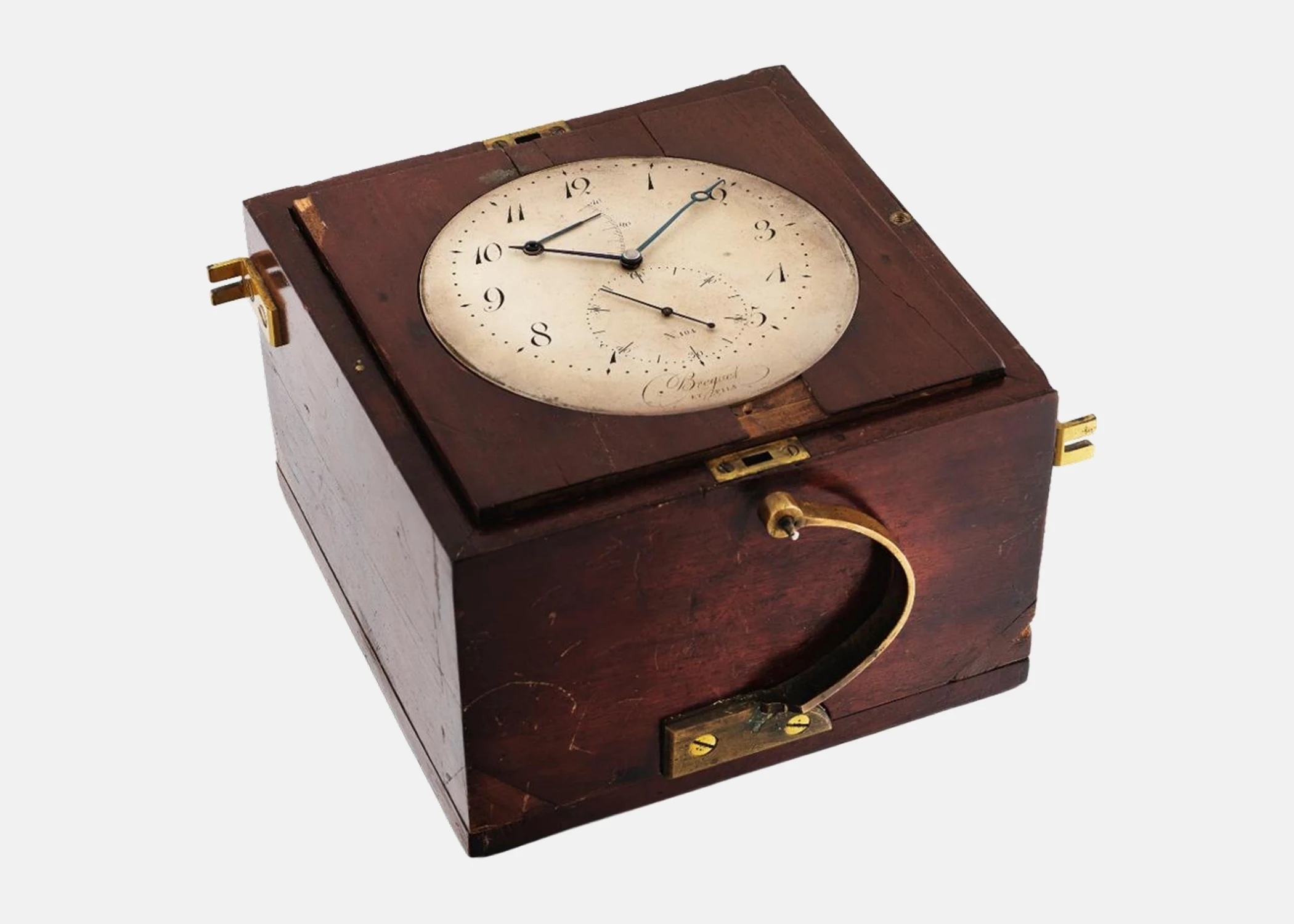
The Breguet Marine collection has its roots in a chapter of the company’s history that began no later than the end of the 18th century. During this period, Abraham-Louis Breguet conceived his watches as scientific instruments whose high standards of quality met the demands of the time, particularly in terms of precision, reliability and legibility.
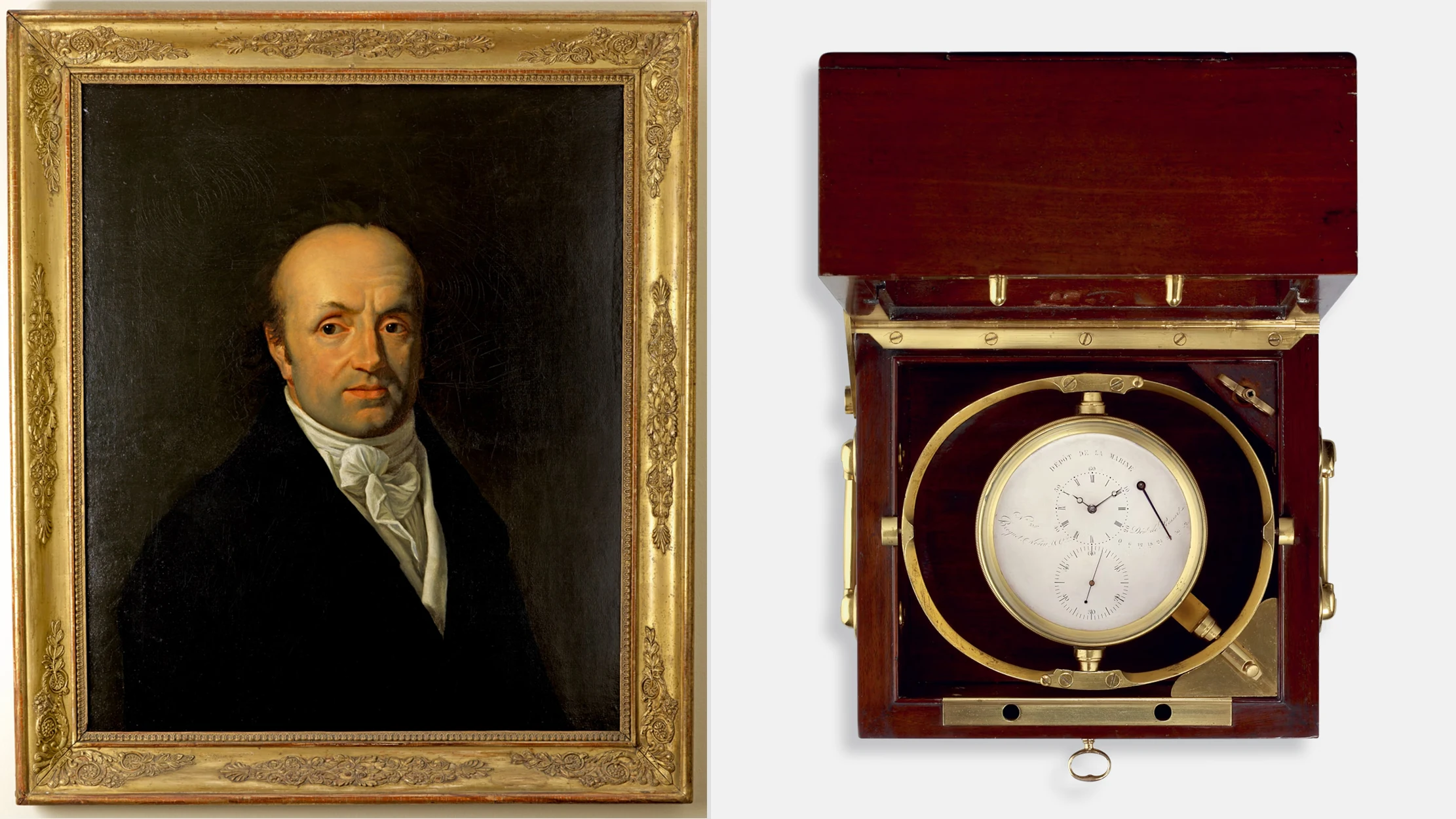
This soon attracted the attention of the royal court. As a result, Louis XVIII, who ascended the throne following the fall of Napoleon I, appointed Breguet Watchmaker to the French Royal Navy on 27 October 1815. The appointment came after Breguet had already been made a member of the French Bureau des Longitudes, founded in 1795, by royal decree in 1814.
Credit © Breguet
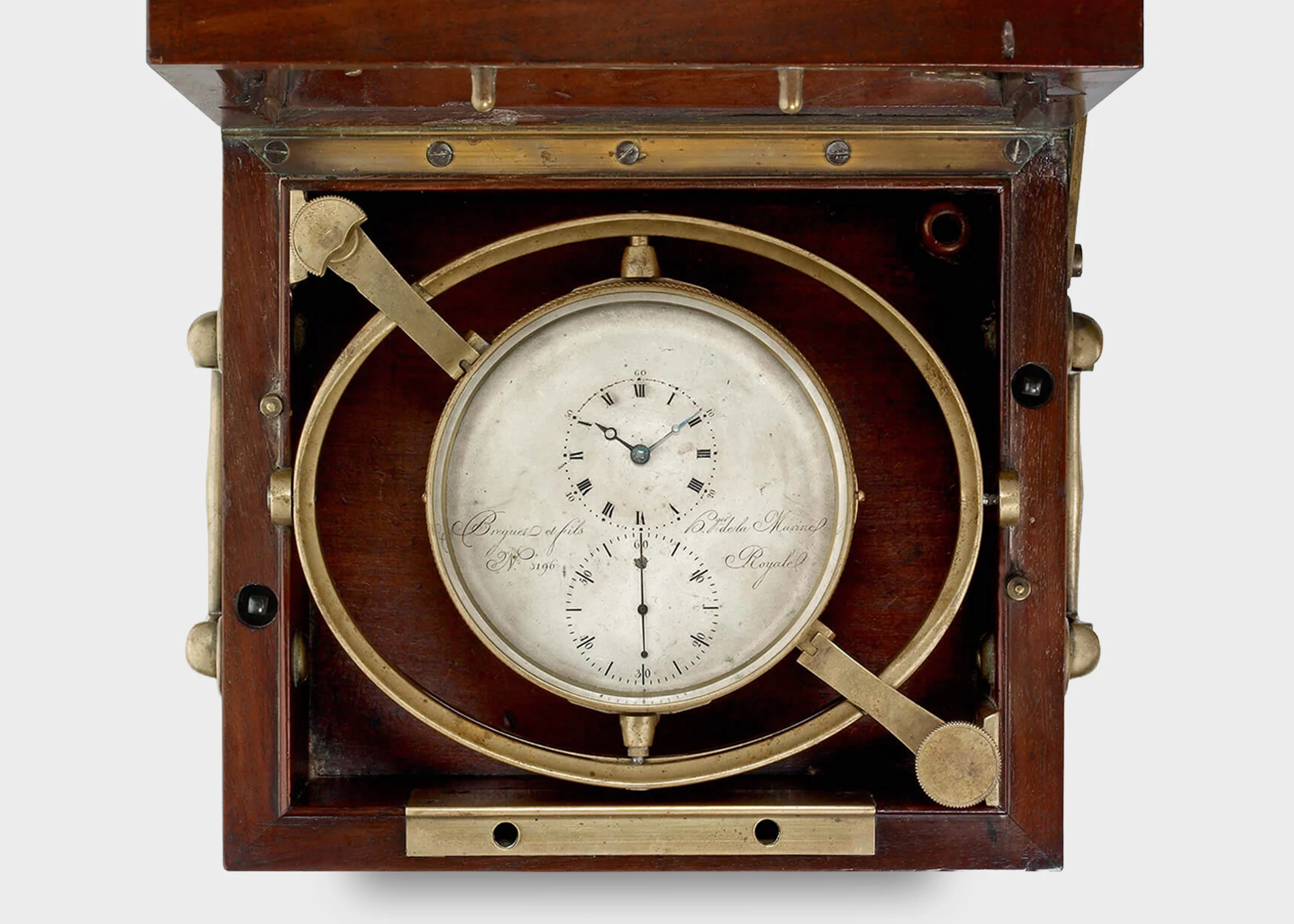
The title of Watchmaker to the Royal Navy (Horloger de la Marine Royale) was significant in several respects. It was awarded for life and was tied to the individual holder – in this case Abraham-Louis Breguet himself – rather than to his manufacture. Only upon the holder’s retirement or death was the title passed on. Breguet succeeded the Neuchâtel-born watchmaker Louis Berthoud, who died in 1813 and had himself succeeded his uncle Ferdinand Berthoud in 1802, after the latter retired due to his age. The Horloger-mécanicien de la Marine – the precise title, meaning Watchmaker-Mechanician to the Navy – became a principal, though not exclusive, supplier to the Navy.
Credit © quillandpad
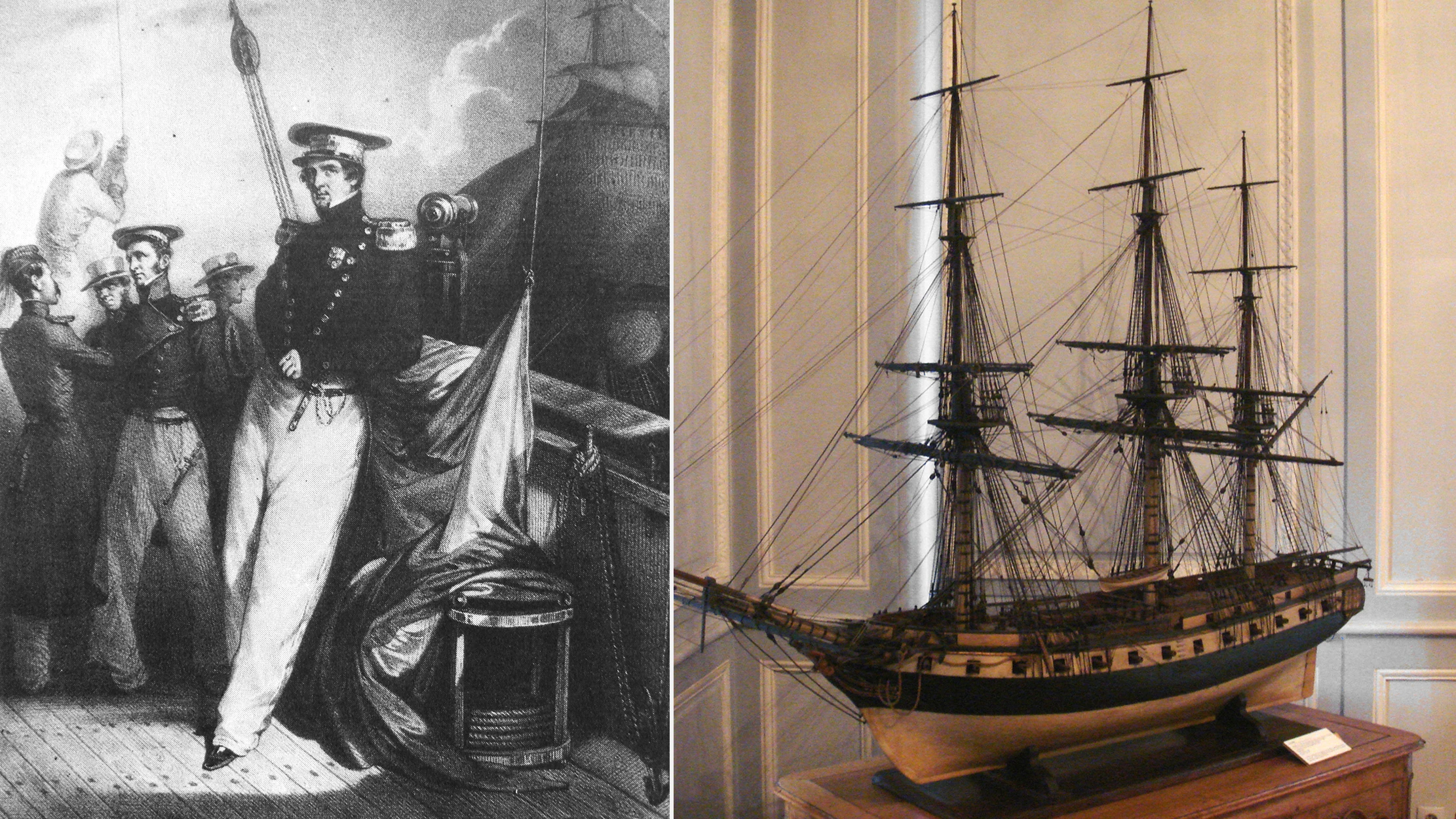
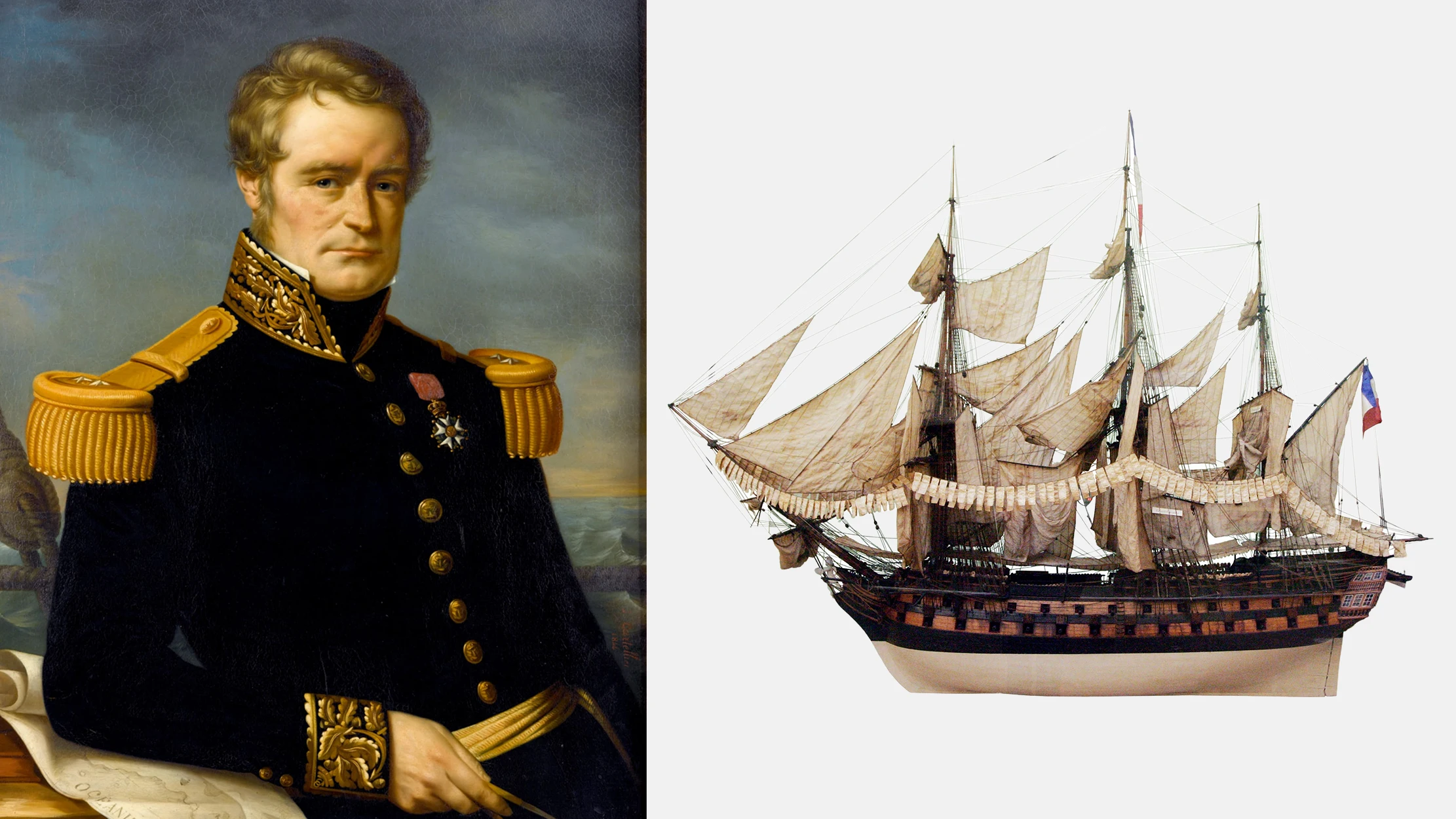
Following Breguet’s appointment as official watchmaker to the French Royal Navy, his chronometers soon accompanied navigators and explorers on a number of important expeditions. Watch No. 3502, for example, travelled with the French naval officer Louis Le Goarant de Tromelin during his explorations of the Pacific, on which he is believed to have discovered several islands, including Rawaki in the Phoenix Islands and Fais in the Caroline Islands. Marine chronometer No. 3588 accompanied the naval officer Hyacinthe de Bougainville (1781–1846) aboard his frigate Thétis on his expedition around the world from March 1824 to June 1826.
1/33rd-scale model of the 74-gun Achille” © Rama / Wikimedia Commons, licensed under CC BY-SA 3.0 FR
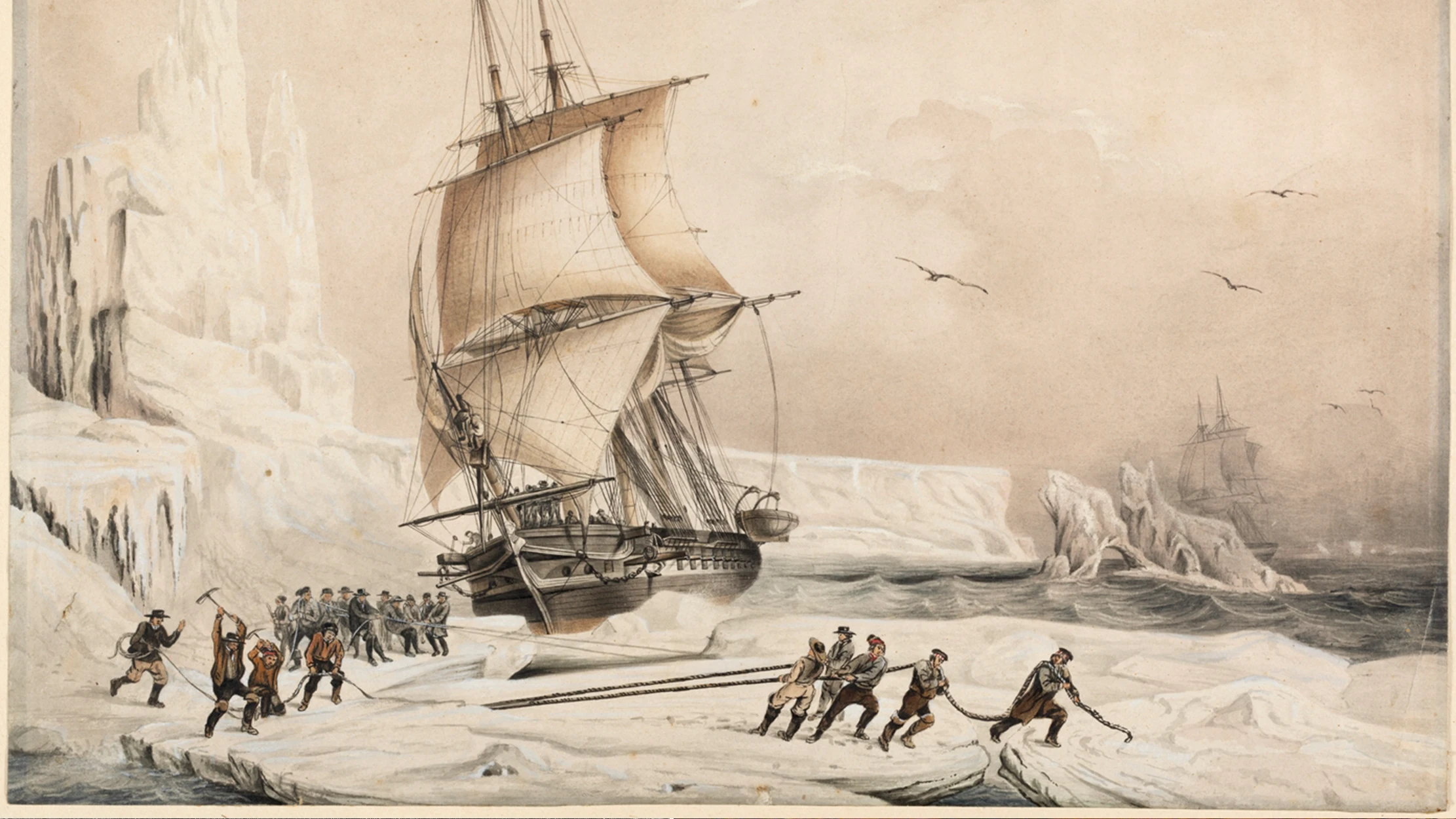
Breguet marine chronometer No. 2868 was made for Louis de Freycinet (1779–1842), accompanying him on his circumnavigation of the globe from 1817 to 1820. Not least, Breguet watch No. 4367, described as a regulator, was sold to the Ministry of the Navy on 21 May 1838 ‘for an expedition to the Pole, with two mahogany cases, two walnut cases and one firwood case for packing’. It was intended for the final expedition of Jules Dumont d’Urville (1790–1842) and became the very first timekeeping instrument to reach Antarctica, in January 1840.
According to Breguet, the company’s records show that between 1815 and 1823 – the year of Abraham-Louis Breguet’s death – the manufacture delivered a total of 78 timepieces described as marine chronometers or marine clocks. Of these, only 22 were destined for the Royal Navy. A further 29 examples were sold through agents selected by Breguet in the most important port cities.
Credit © Breguet
The Marine collection as we know it today, launched in 1990, draws on this historic connection with seafaring and translates it into contemporary wristwatches centred on robustness, technical performance and design.
The first model in the Marine collection was designed by East German designer Jörg Hysek, best known in particular for his work on the Vacheron Constantin 222. To create the brand’s first sports watch with the Marine, he borrowed historicising elements from the Classique line, including a gold dial with guilloché decoration at the centre, a separate chapter ring with Roman numerals, Breguet hands with their openworked pomme tips, and the finely fluted caseband of the round case. At the same time, he complemented these features with a larger case, a prominent crown framed by crown guards, and a more pronounced bezel.
With the first Marine of 1990, Hysek therefore did not create an entirely new design language. Rather, at its core, the watch was a reinterpretation of established Breguet design codes in the form of a more robust, sportier wristwatch.
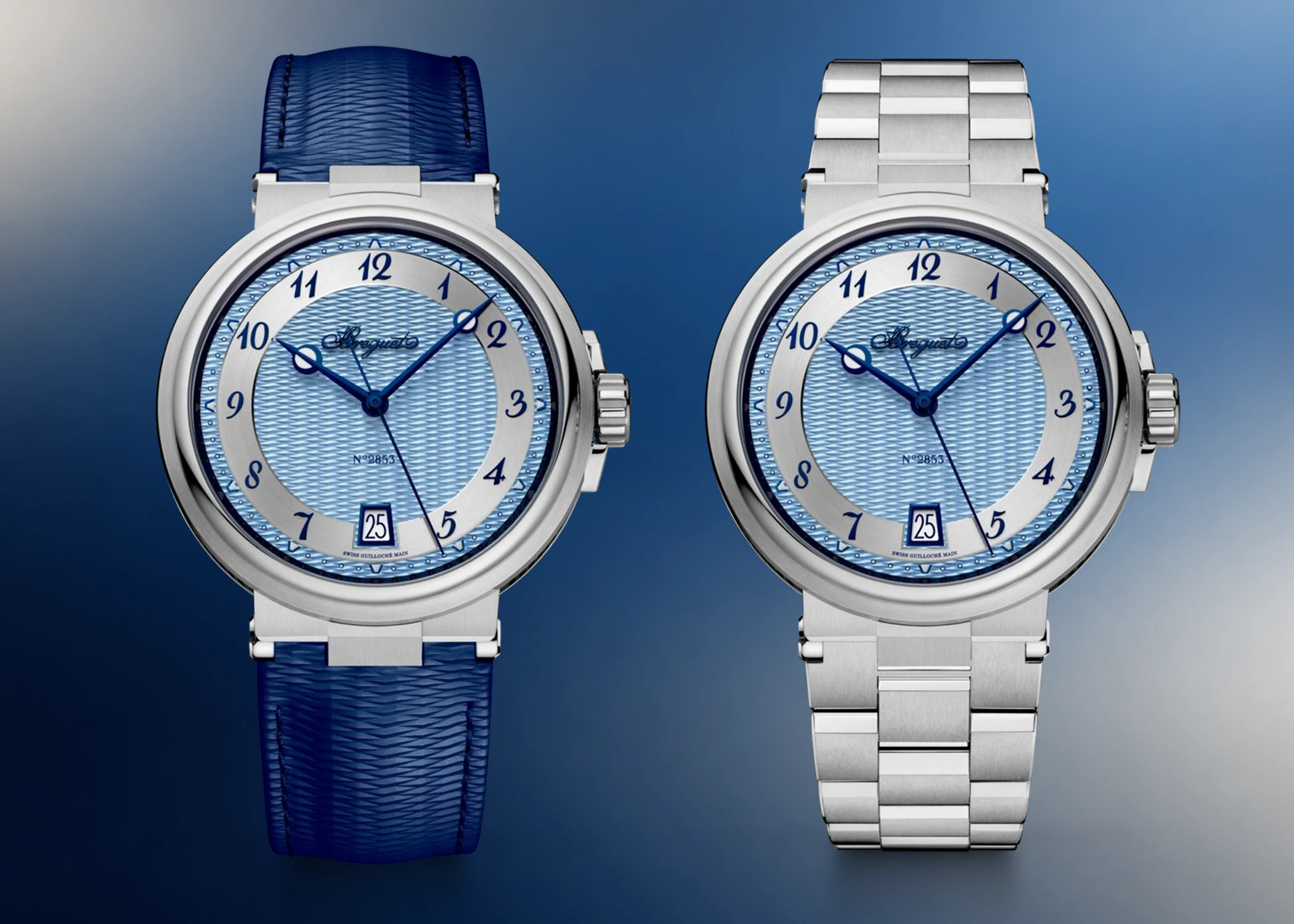
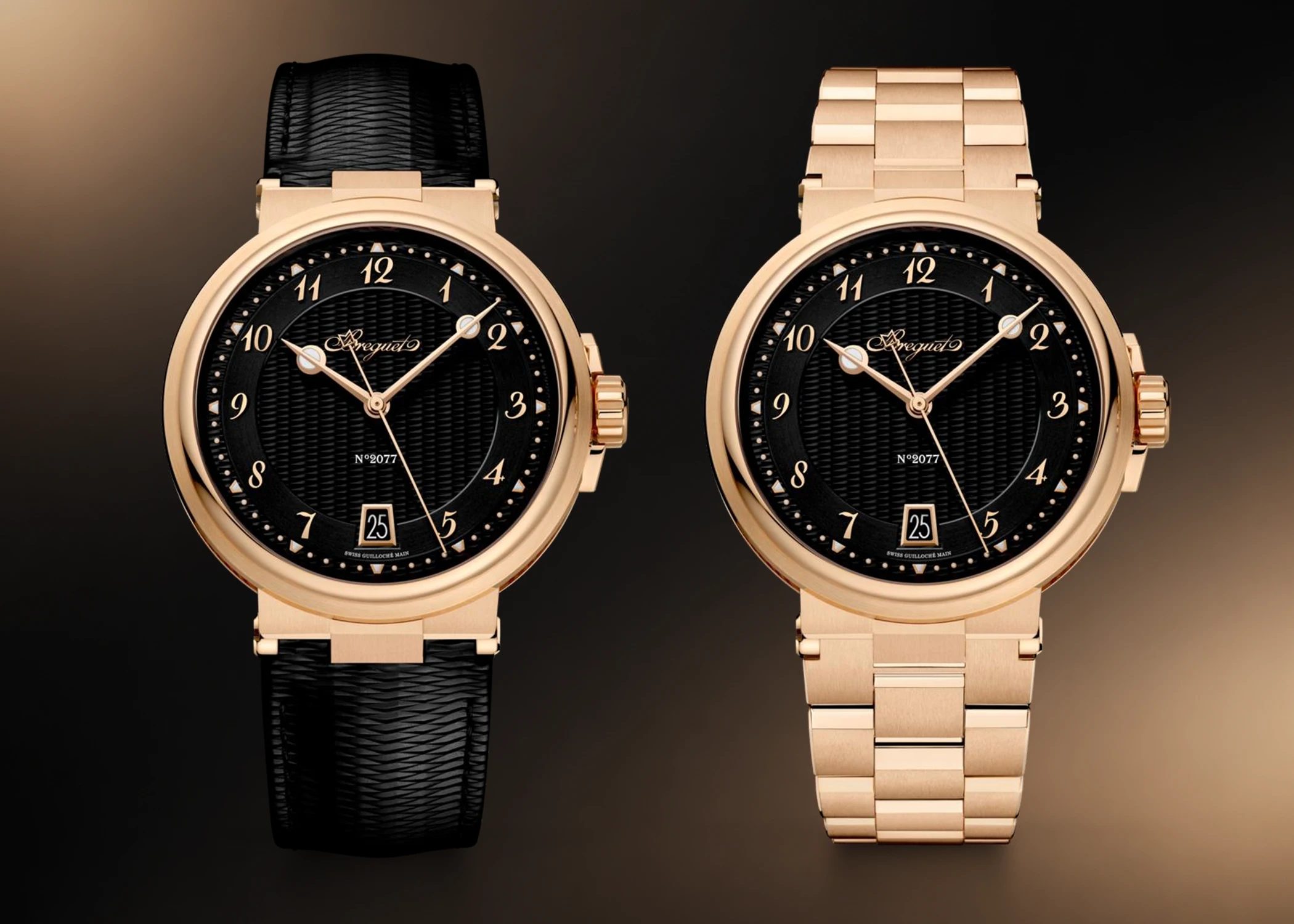
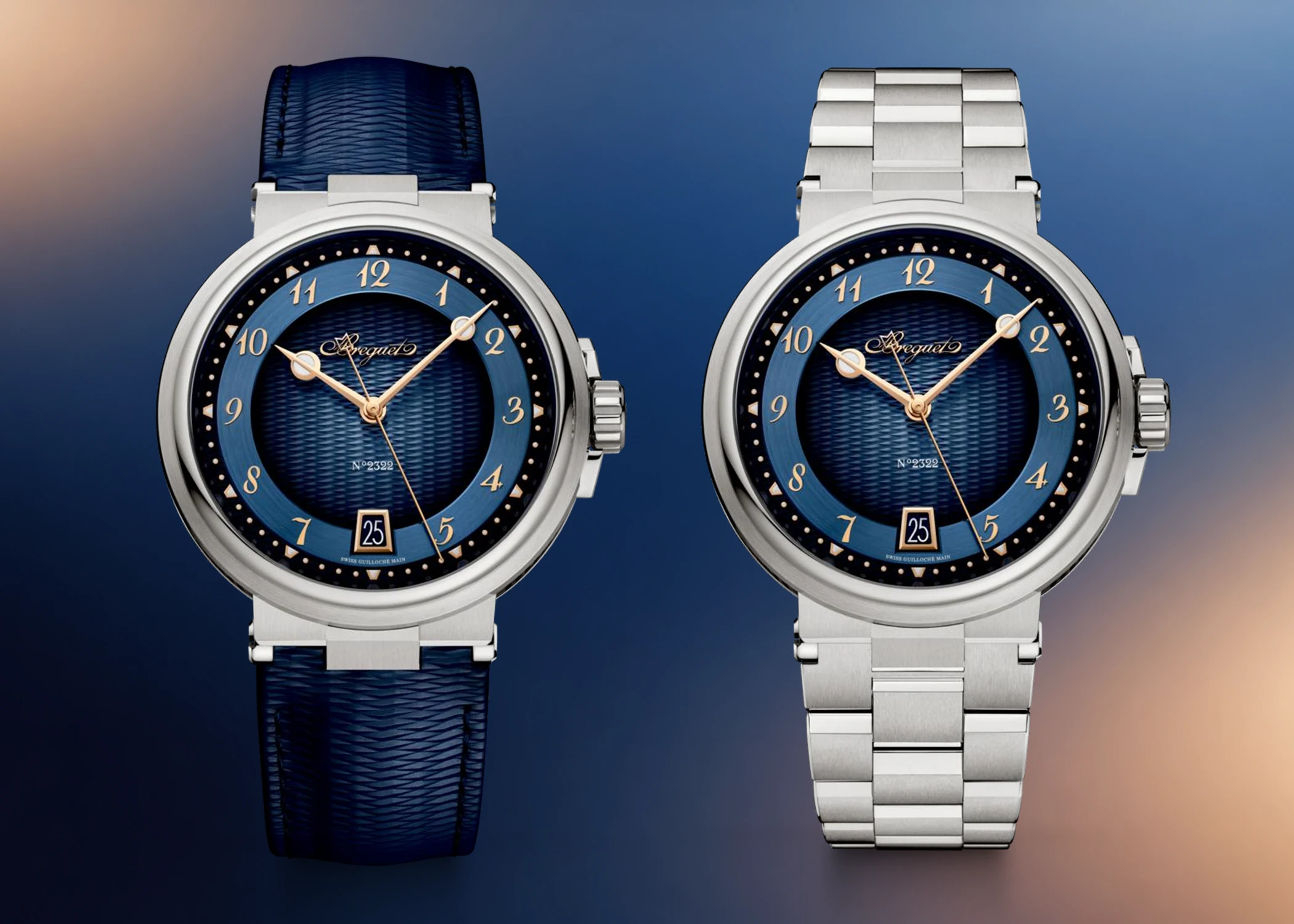
In terms of construction, all three new versions of the Breguet Marine 5517 follow the same basic concept. They share the same movement, case dimensions and fundamental arrangement of the displays on the dial. Accordingly, all three are powered by calibre 777A, comprising 235 components and offering a power reserve of 55 hours, while operating at a frequency of 4 Hz (28,800 vibrations per hour). The movement is wound by a gold oscillating weight, visible through the sapphire-crystal caseback and designed in the style of a ship’s wheel.
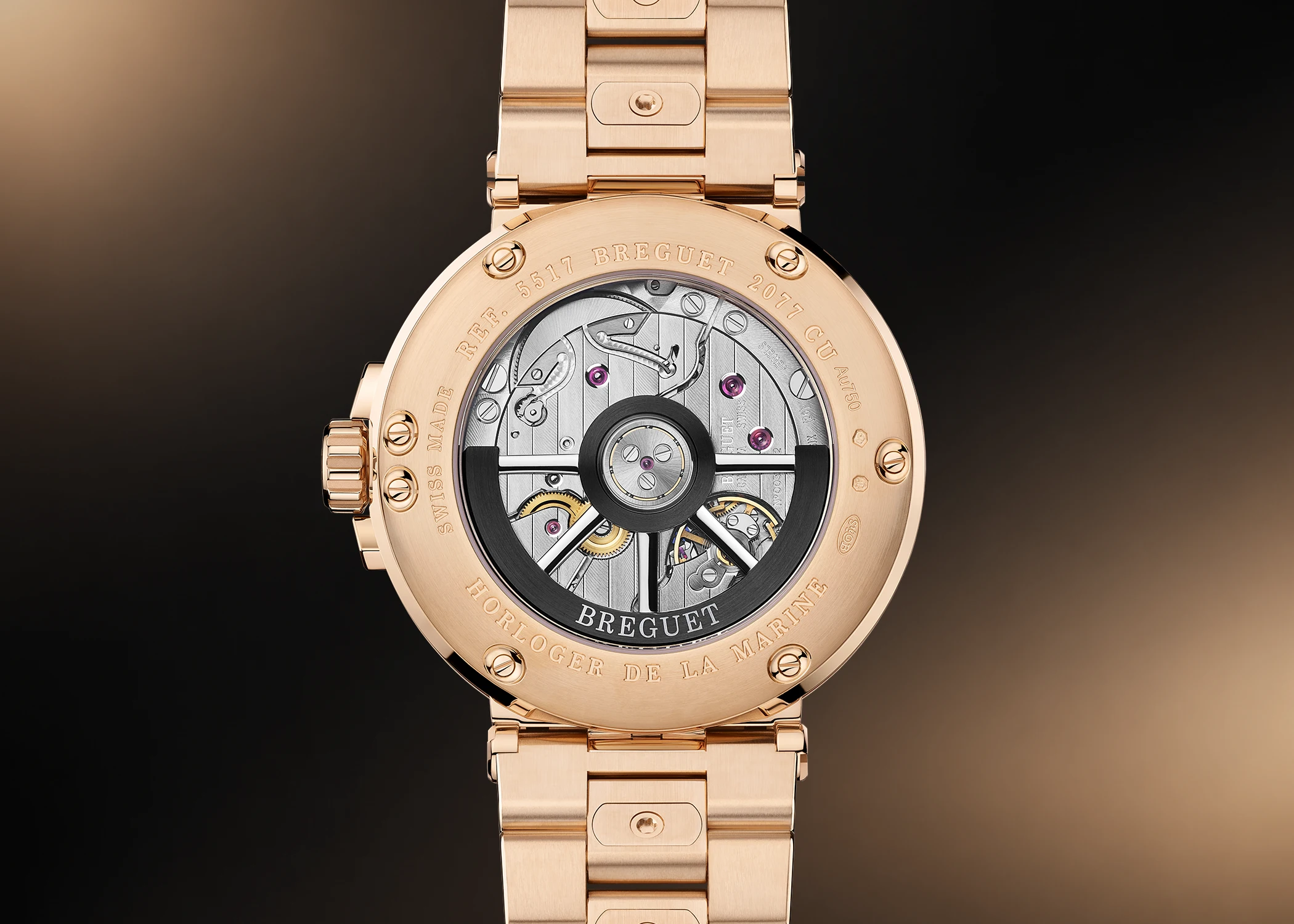
The cases of the three new Breguet Marine 5517 versions feature the traditional fluting along the caseband, measure 40 mm in diameter and 11.50 mm in height, and are water-resistant to 10 bar (100 metres). The screw-down crown is also framed by a crown guard whose form evokes the movement of waves.
The dials of the new Breguet Marine 5517 models are based on 18-carat gold and decorated with the hand-guilloché ‘Quai de l’Horloge’ pattern, which Breguet introduced to mark the manufacture’s 250th anniversary. It takes its name from the Quai de l’Horloge on the Île de la Cité in Paris, where Abraham-Louis Breguet operated his manufacture and also produced his marine chronometers. The flowing lines of the pattern echo the contours of the Île de la Cité and the neighbouring Île Saint-Louis, while simultaneously recalling the movement of waves. In this way, the guilloché motif brings together two references to the history of the Marine collection.

Depending on the version, the gold base is then treated and coloured differently before a final layer of lacquer is applied to enhance the three-dimensional effect of the pattern. All versions also share a chapter ring with Arabic Breguet numerals, a date window at 6 o’clock, and Breguet hour and minute hands filled with luminescent material.
The three versions of the Breguet Marine 5517 differ, however, in their choice of colours and materials, giving each its own distinct character. The white-gold version (Ref. 5517BB/YA/5ZU with rubber strap and Ref. 5517BB/YA/BZ0 with white-gold bracelet) features an ice-blue dial, a rhodium-plated chapter ring, and Arabic numerals, hands and a date-window frame in blued 18-carat gold.
The rose-gold version (Ref. 5517BR/99/5ZU with rubber strap and Ref. 5517BR/99/RZ0 with rose-gold bracelet) features a black dial and black chapter ring, complemented by Arabic numerals, hands and a date-window frame in 18-carat rose gold.
Finally, the titanium version (Ref. 5517TI/Y9/5ZU with rubber strap and Ref. 5517/Y9/TZ0 with titanium bracelet) combines a blue gradient dial with a blue chapter ring, while the Arabic numerals, hands and date-window frame are crafted from 18-carat rose gold.
In technical terms, the three new versions of the Marine Chronographe 5527 are closely related. They share the same movement, case dimensions and fundamental arrangement of the displays on the dial.
All variants of the Breguet Marine Chronographe 5527 are powered by the automatic calibre 582QA, which comprises 343 components and features a flyback chronograph function. It offers a power reserve of 48 hours and operates at a frequency of 4 Hz, or 28,800 vibrations per hour. Both the balance spring and the inverted lever escapement are made of silicon. The sapphire-crystal caseback also reveals the gold oscillating weight, whose design is inspired by a ship’s wheel.
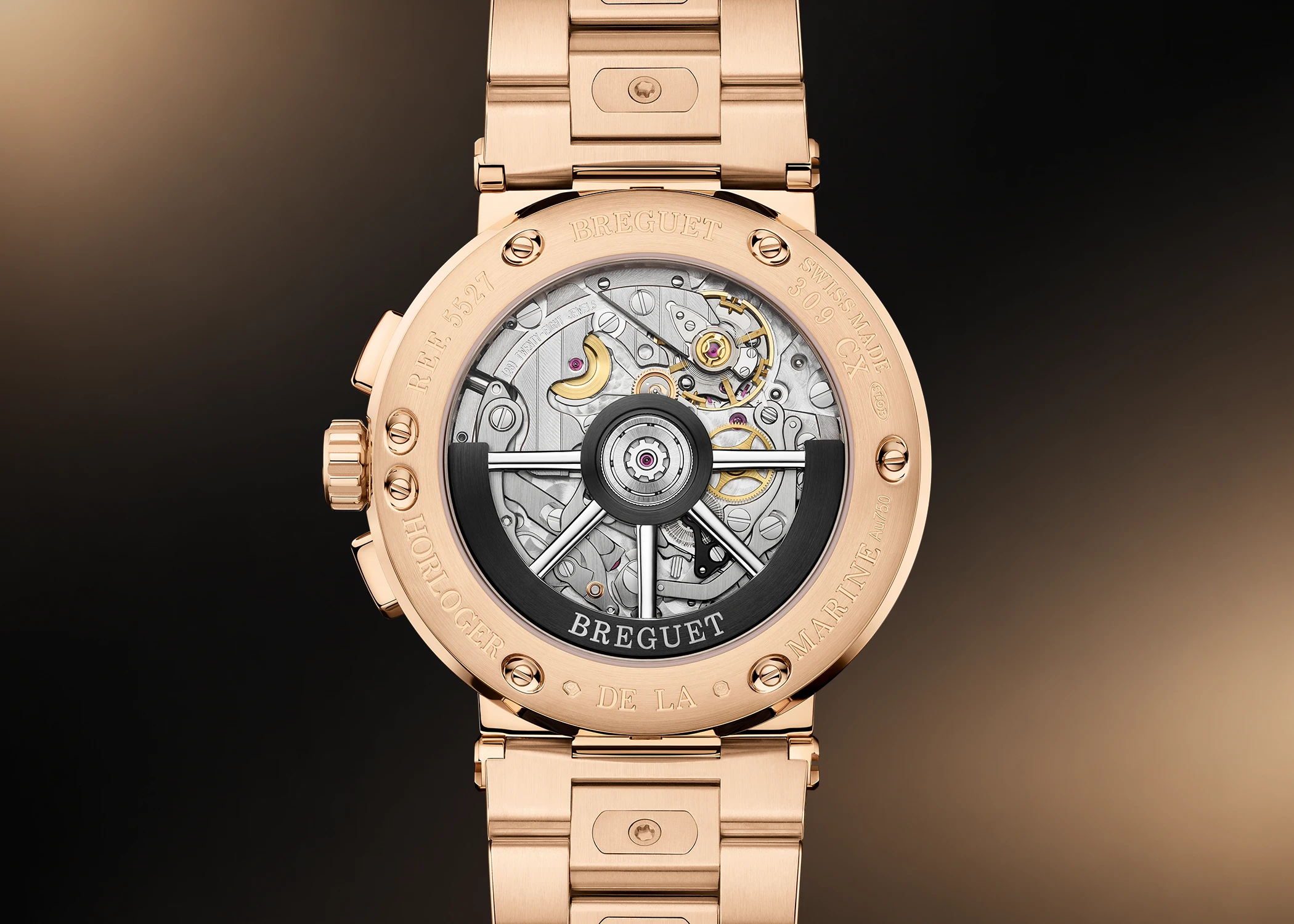
The case construction is likewise largely identical across all three versions. The case measures 42.3 mm in diameter and 50.7 mm from lug to lug. Case height is 13.9 mm for the gold versions and 13.85 mm for the titanium model. Further details include Breguet’s characteristic fluting along the caseband, a screw-down crown and water resistance to 10 bar, equivalent to 100 metres.
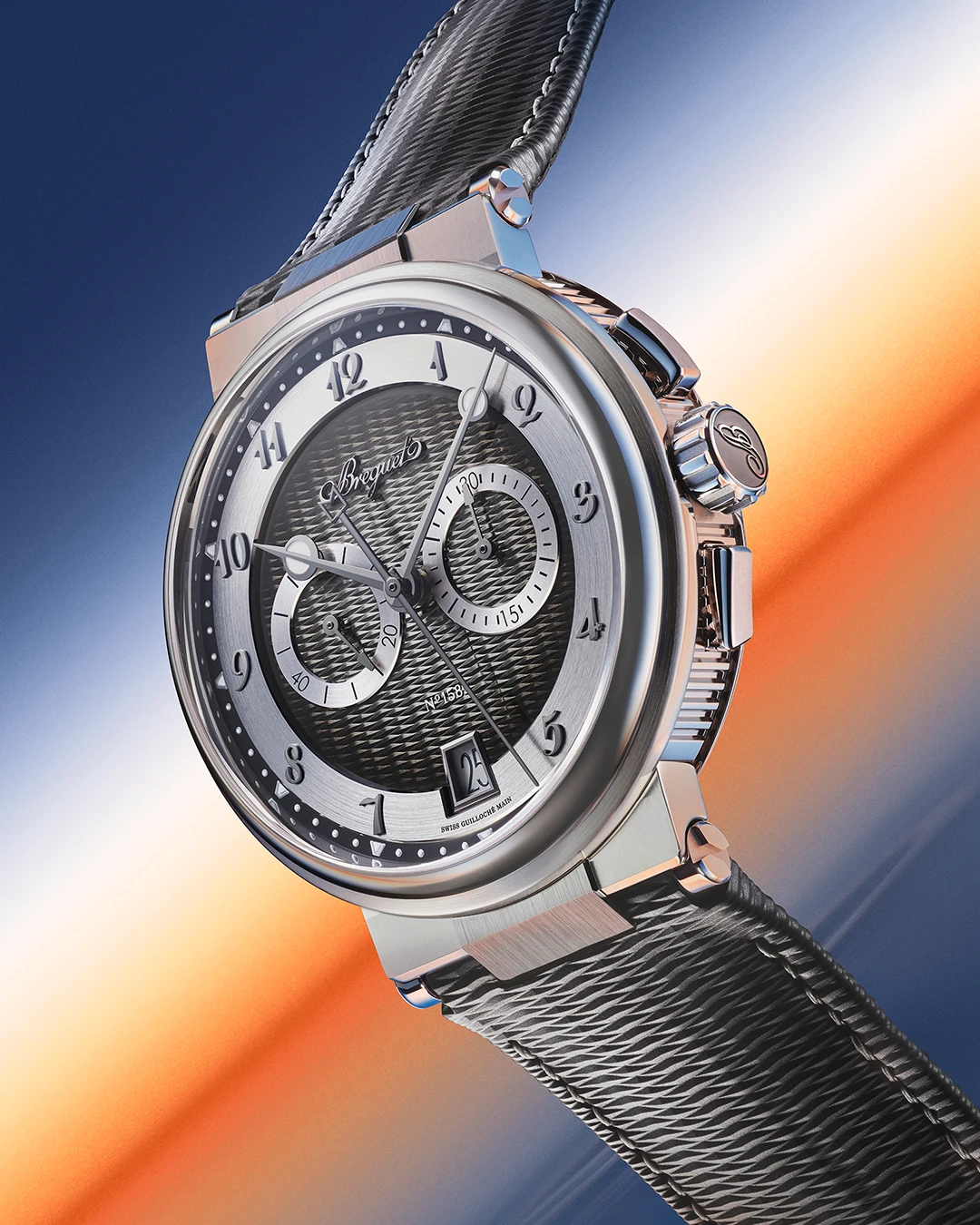
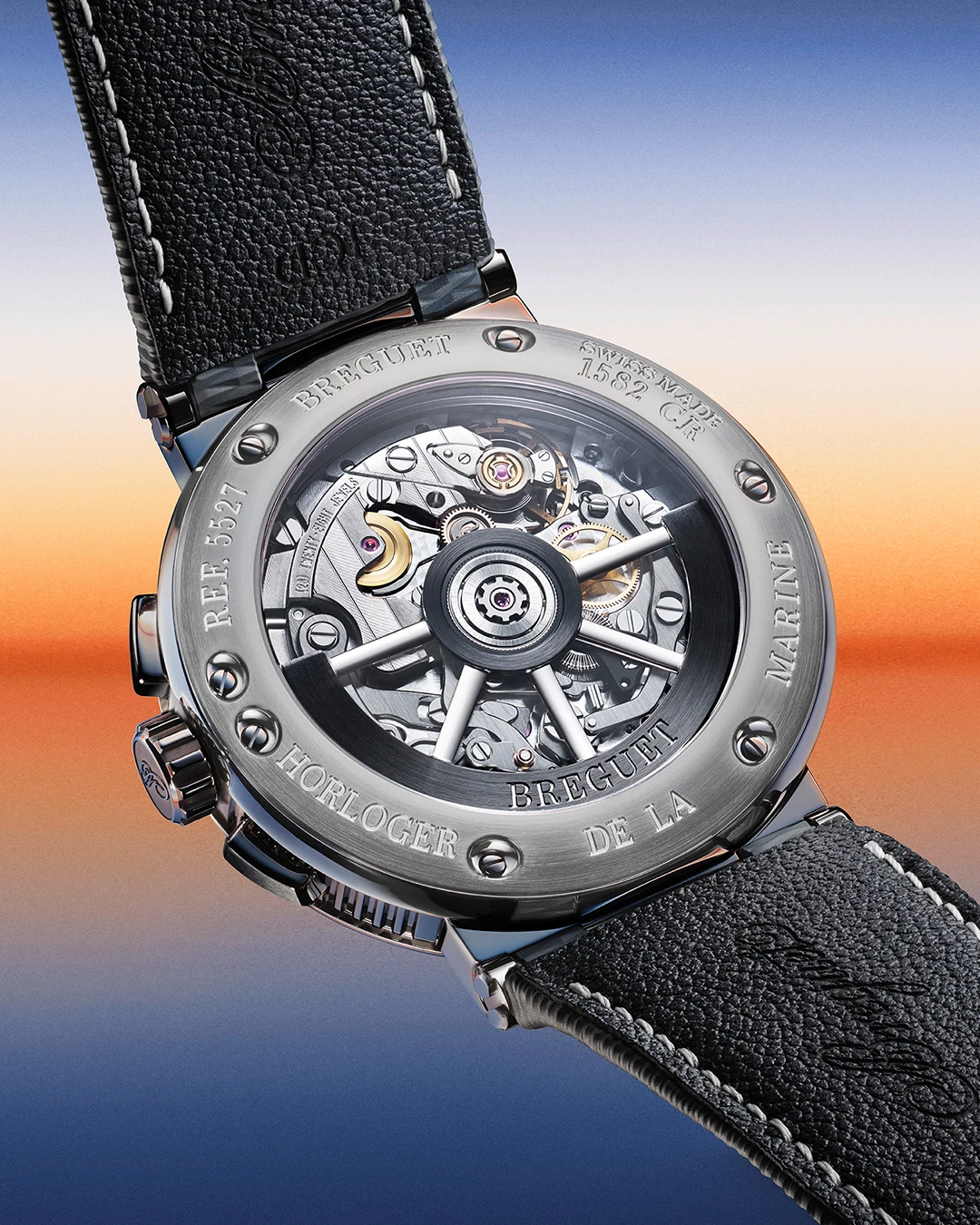
As with the Marine 5517, the dial of the chronograph is made of 18-carat gold and features the hand-guilloché ‘Quai de l’Horloge’ motif. The chronograph layout, however, differs significantly from that of the three-hand version: a 30-minute counter is positioned at 3 o’clock, the small seconds at 9 o’clock, and the date window at 6 o’clock. Chronograph seconds are indicated by the central chronograph hand. The display is completed by Arabic Breguet numerals and Breguet hour and minute hands filled with luminescent material.
The three versions diverge only in their choice of materials and colours. The white-gold version (Ref. 5527BB/YA/5WV with rubber strap and Ref. 5527BB/YA/BW0 with white-gold bracelet) combines its 18-carat white-gold case with a blue gradient dial. It is complemented by a rhodium-plated chapter ring, as well as grey-finished 18-carat gold elements for the Arabic Breguet numerals, date-window frame, Breguet appliqué and the hour and minute hands. The central chronograph hand is likewise made of tinted 18-carat gold.
In the rose-gold version (Ref. 5527BR/Y9/5WV with rubber strap and Ref. 5527BR/Y9/RW0 with rose-gold bracelet), the 18-carat rose-gold case is likewise paired with a blue gradient dial. Here, the chapter ring is finished in dark blue, while the Arabic Breguet numerals, date-window frame, Breguet appliqué and the hour and minute hands are made of 18-carat rose gold. The central chronograph seconds hand is also finished in a rose-gold tone.
The titanium version (Ref. 5527TI/GA/5WV with rubber strap and Ref. 5527TI/GA/TW0 with titanium bracelet) distinguishes itself with a grey gradient dial, combined with a rhodium-plated chapter ring. The Arabic Breguet numerals, date-window frame, Breguet signature, hour and minute hands, and chronograph hand are all made of tinted 18-carat gold.
Prices for the new Marine 5517 models start at €23,300 for the titanium version with a rubber strap, rising to €26,400 with a titanium bracelet. The white- and rose-gold versions are each priced at €43,000 with a rubber strap and €70,600 with a gold bracelet.
For the Marine Chronographe 5527, the titanium version costs €29,100 with a rubber strap and €32,300 with a titanium bracelet. The white- and rose-gold variants are each priced at €52,300 with a rubber strap and €82,600 with a gold bracelet.