
During our visit to the Girard-Perregaux manufacture, we learnt how beauty begins from within and gained some fascinating insights – including why some watchmakers here occasionally have to hold their breath.

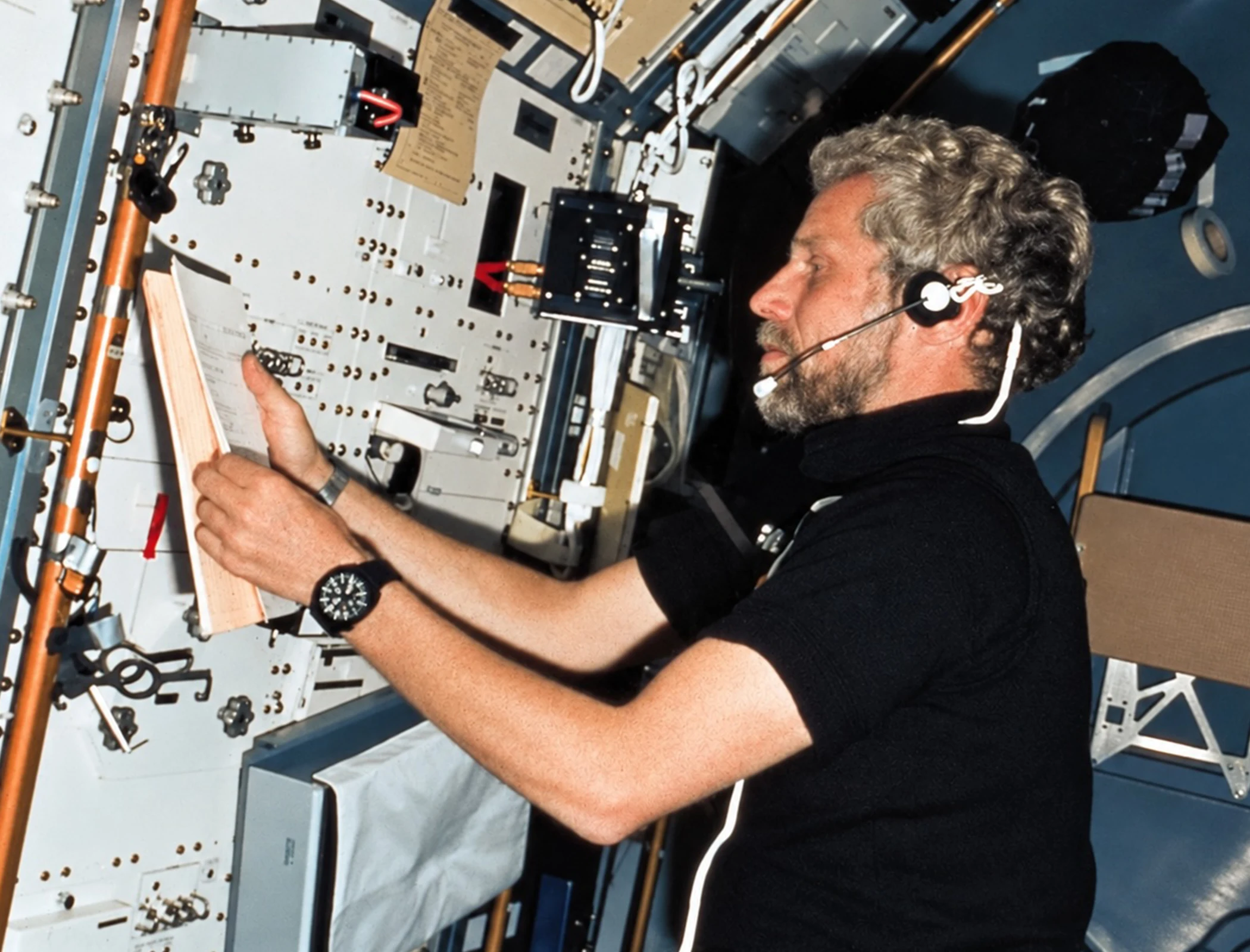
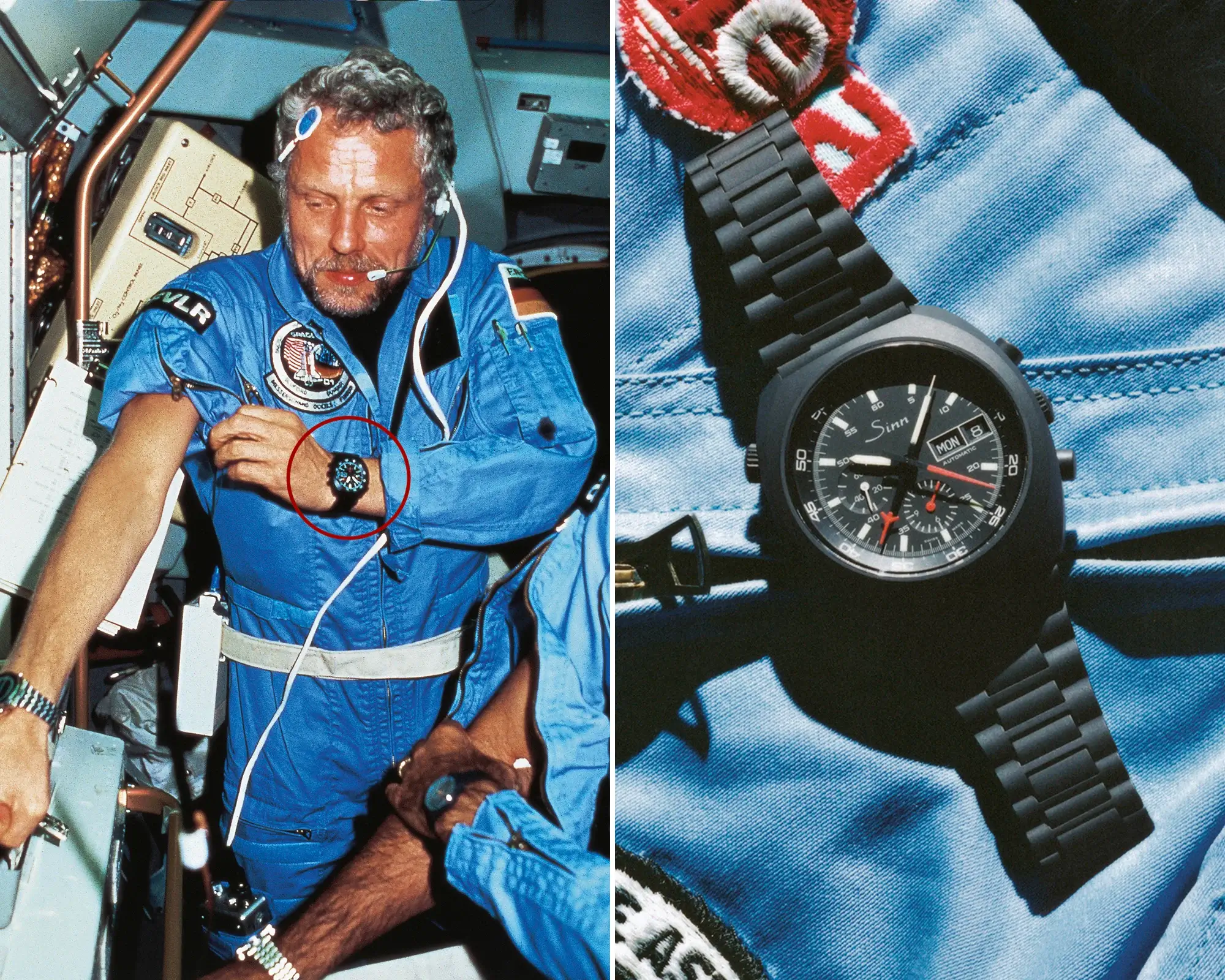
During the Spacelab Deutschland-1 mission (STS-61A) in 1985, German astronaut and scientist Reinhard Furrer wore a Sinn Chronograph 140 S on his wrist. Since then, the model has become one of the few German-made wristwatches with documented spaceflight history. With the new Sinn 140 A S Jubiläum, the brand now pays tribute to this historic mission while also celebrating the brand’s 65th anniversary. In this article, we explore how the watch made its way into space and what distinguishes the new anniversary edition.
On 30 October 1985, the first German Spacelab mission (Spacelab Deutschland-1) launched aboard the American Space Shuttle Challenger. This marked the 22nd Space Shuttle mission and the ninth and final successful flight of Challenger. During the mission, also designated STS-61A, the German Aerospace Research and Testing Establishment (Deutsche Forschungs- und Versuchsanstalt für Luft- und Raumfahrt, DFVLR) collaborated with NASA. To this day, STS-61A holds the record for the largest crew – eight people – aboard a single spacecraft for the entire duration of a mission, from launch to landing.

The Spacelab Deutschland-1 mission (D1) was the first Spacelab mission to be managed under German responsibility. The German Aerospace Research and Testing Establishment (DFVLR), a predecessor of today’s German Aerospace Center (DLR), was responsible for mission management. While the flight of the Space Shuttle Challenger was monitored and controlled from NASA’s Mission Control Center in Houston, responsibility for the scientific operations of the Spacelab payload lay with the DFVLR’s German Space Operations Center (GSOC) in Oberpfaffenhofen, near Munich. This marked the first time that a control centre outside the United States had independently operated as the Payload Operations Control Centre (POCC) for a Spacelab mission.
Of the two German crew members – Ernst Messerschmid and Reinhard Furrer – it was Furrer who wore an automatic Sinn Chronograph 140 S, powered by the Lemania 5100 movement, on his wrist during the mission. The watch was a personal purchase, and according to the brand, Furrer acquired his 140 S shortly before the Spacelab D1 mission. This makes the Sinn 140 S Chronograph one of the most significant watches to have travelled into space, as well as one of the few German-made wristwatches with documented spaceflight history.
What made this particularly remarkable was that the watch was equipped with an automatic movement, thereby demonstrating that a mechanical automatic watch could function even in weightlessness, where it had previously been assumed that the rotor would be unable to operate properly without gravity.
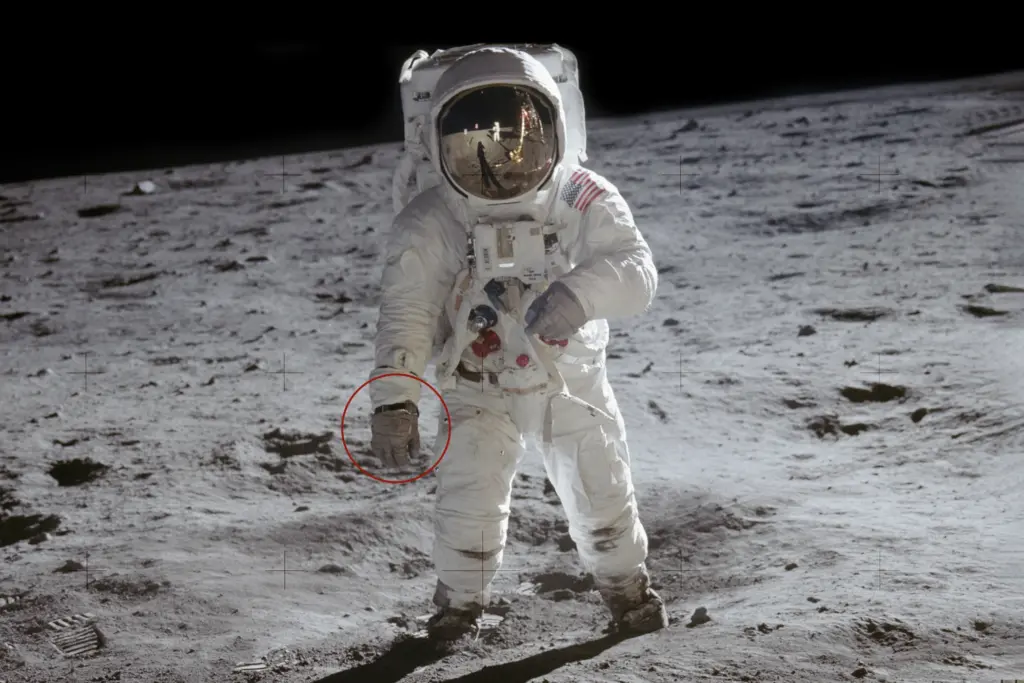
Reinhard Furrer’s Sinn 140 S is part of a broader chapter in watchmaking history: the story of mechanical watches in space.
The shuttle’s payload bay housed Spacelab, a space laboratory developed by European engineers that enabled scientists to conduct research under conditions of weightlessness over several days. During the flight, which saw the crew orbit the Earth 110 times, they carried out 75 experiments in the fields of physiology, materials science, biology and navigation.
After 168 hours in space, the three European astronauts – Ockels, Messerschmid and Furrer – returned to Earth alongside their five American colleagues. On 9 September 1995, Professor Reinhard Furrer lost his life in an aircraft crash during an air show at Berlin’s Johannisthal airfield.
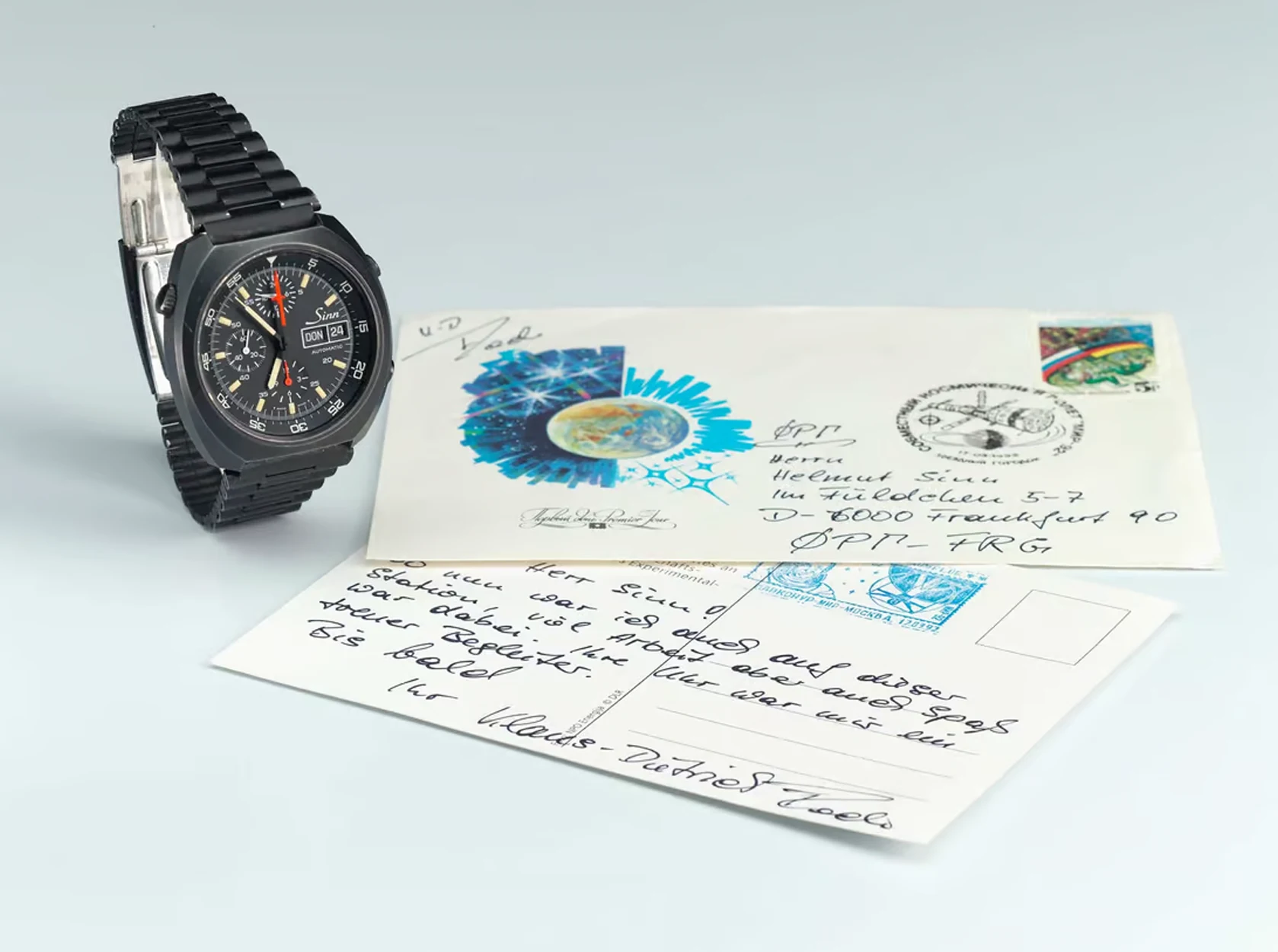
However, the successful use of the Sinn Chronograph 140 S with its Lemania 5100 movement on Reinhard Furrer’s wrist was not an isolated case. In 1992, a Sinn Chronograph 142 S accompanied German astronaut Klaus-Dietrich Flade aboard the Russian space station Mir (Russian for ‘peace’) during the Mir-92 mission. Just one year later, the model travelled into space again during the second German Spacelab mission, D2: aboard the Space Shuttle Columbia, the 142 S covered approximately 6.7 million kilometres and completed 160 orbits of the Earth during the ten-day mission.
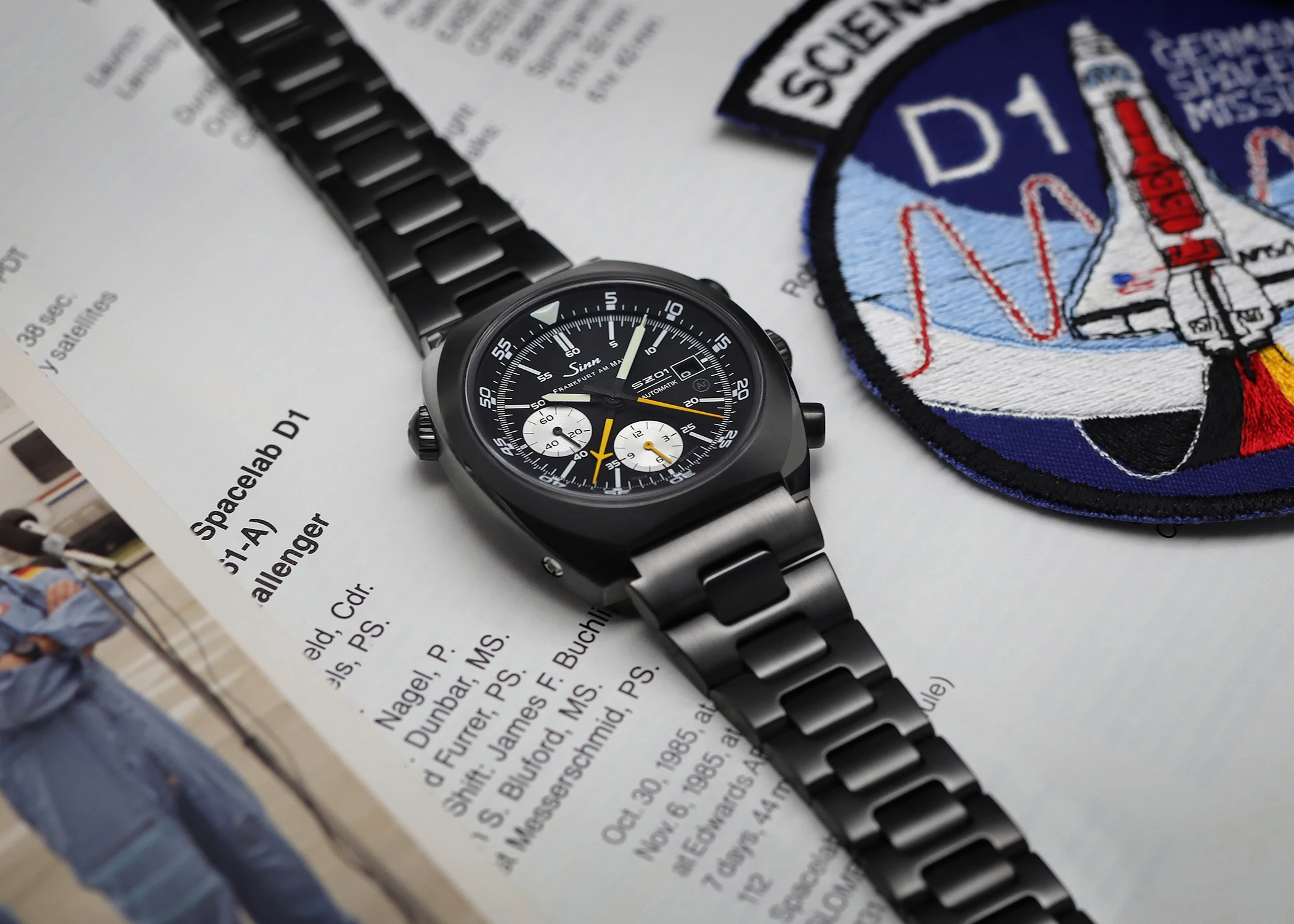
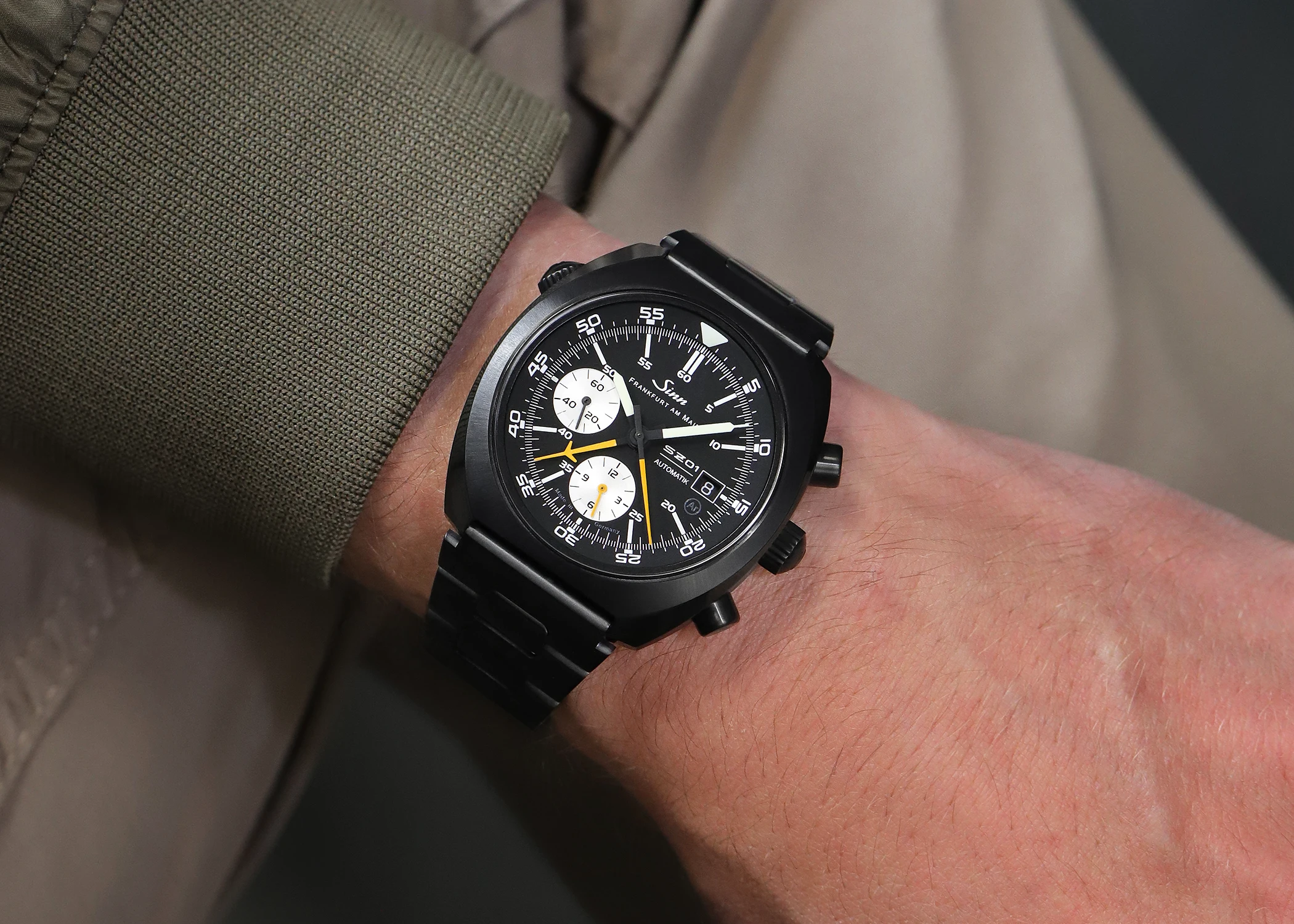
With the new 140 A S Jubiläum, Sinn now presents a chronograph limited to 300 pieces that celebrates two significant milestones: the company’s 65th anniversary and the historic occasion on which Reinhard Furrer wore the 140 S during the Spacelab Deutschland-1 mission in 1985.
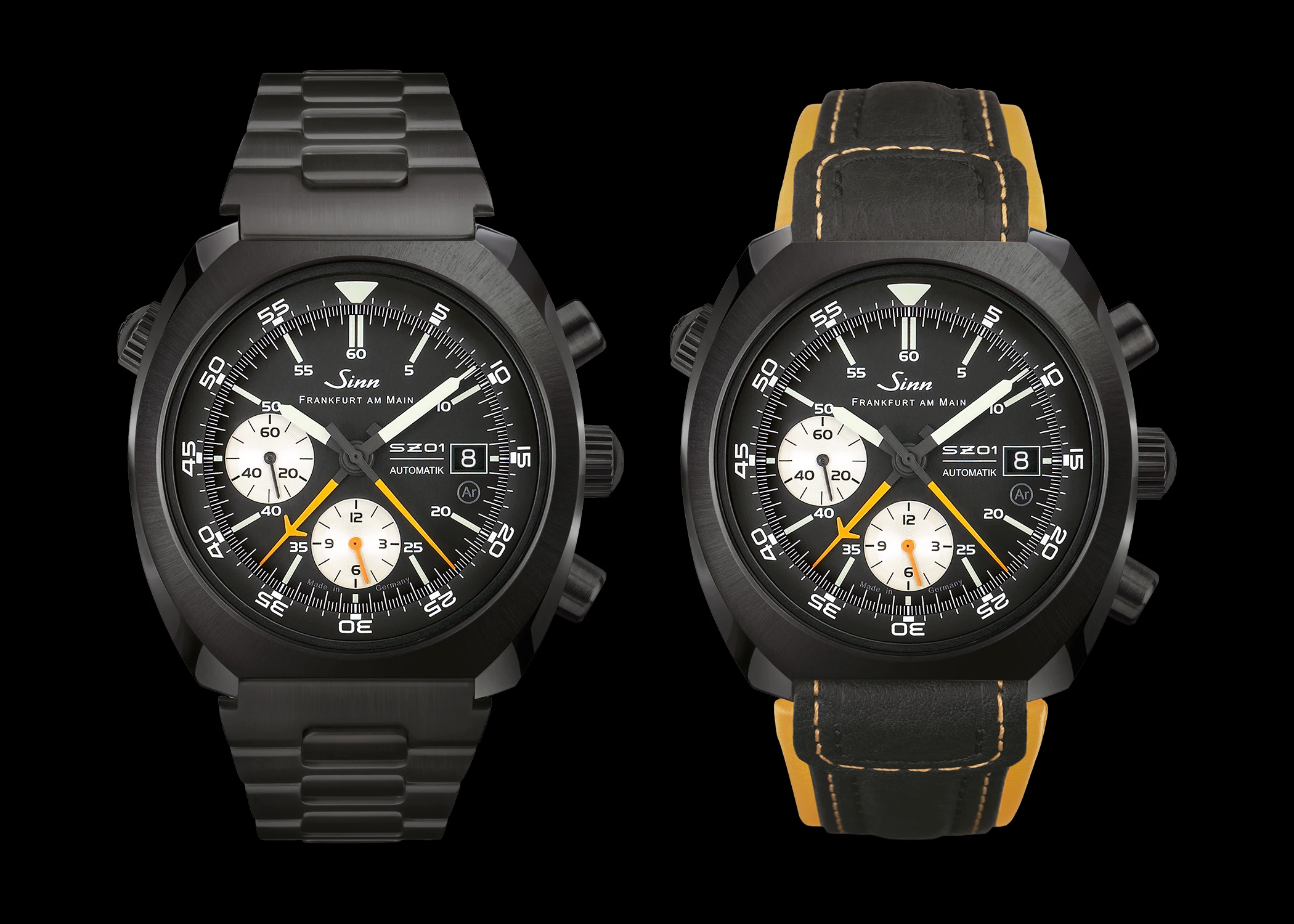
At the heart of the watch is Sinn’s self-winding SZ01 chronograph movement, which operates at a frequency of 28,800 vibrations per hour and features a stop-seconds mechanism. The movement is a further development of the Valjoux 7750. To achieve this, the Valjoux 7750 chronograph calibre was modified to incorporate a jumping central 60-minute chronograph hand alongside the conventional central chronograph seconds hand. Together with the regular hour and minute hands, the Sinn SZ01 chronograph movement thus features a total of four centrally mounted hands on a single axis, allowing for a more intuitive and precise reading of elapsed times.
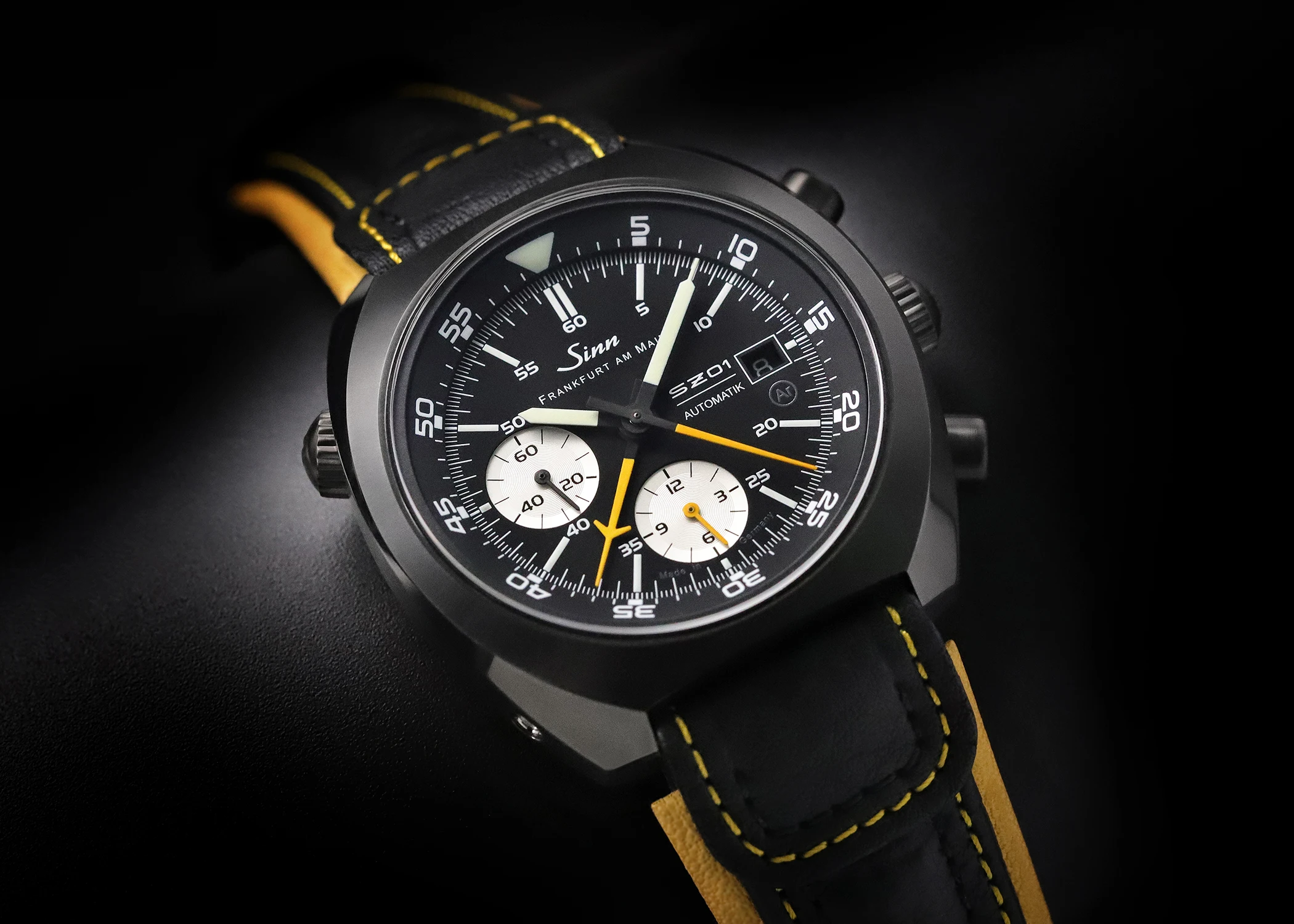
This construction improved legibility in two respects: firstly, it allowed 60 minutes to be measured per revolution of the hand instead of the usual 30, and secondly, the corresponding chronograph minute scale extended around the entire circumference of the dial. The SZ01 shares this clear legibility with the now-discontinued Lemania 5100 calibre. In addition, a date display at 3 o’clock, a 12-hour chronograph counter at 6 o’clock and small seconds at 9 o’clock complete the dial. The chronograph minute and seconds hands are coated with yellow-orange luminous paint, making them stand out clearly against the matt-black dial.
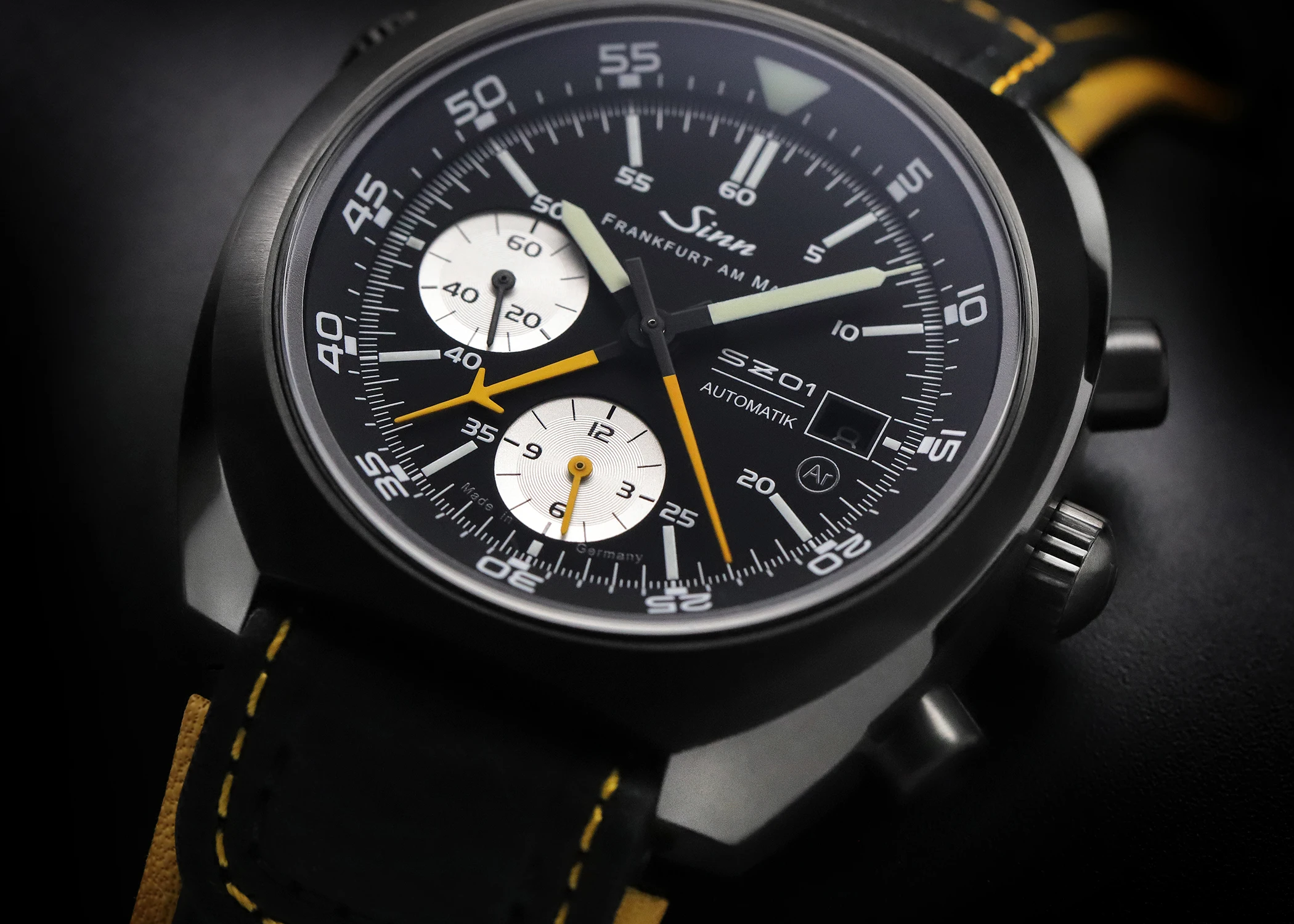
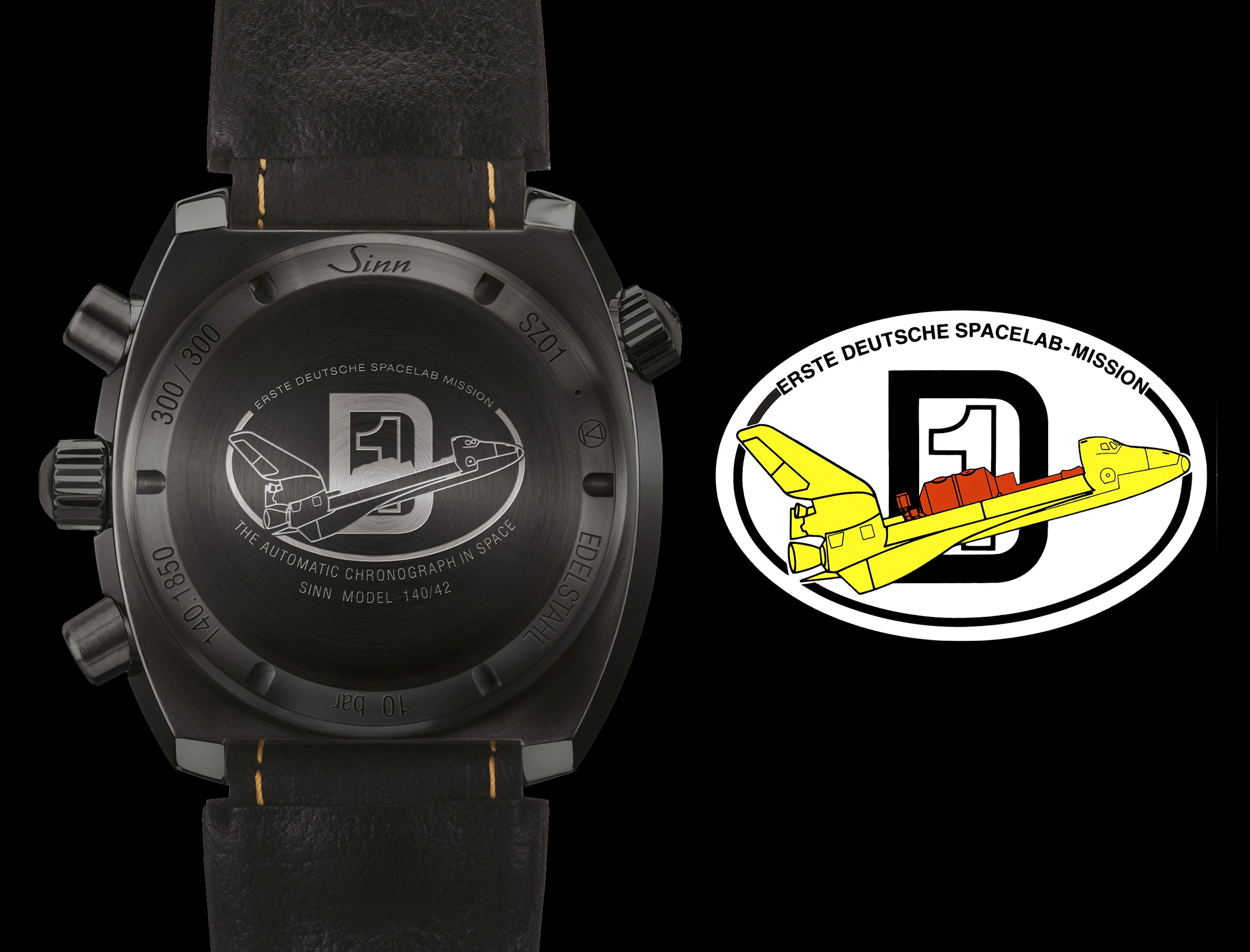
The Sinn 140 A S Jubiläum features a stainless steel case combining polished and satin-brushed surfaces, measuring 44 mm in diameter and 15.5 mm in height. The so-called Tegiment technology, which gives the case a particularly scratch-resistant surface, provides the basis for the additional black hard coating (PVD), helping to prevent the coating from flaking and to reduce wear. Turning the watch over reveals an engraving of the German mission emblem of the first German Spacelab mission, D1. The emblem consists of a large ‘D’ with a ‘1’ in the centre, in front of which a space shuttle with its external tank and solid rocket boosters is depicted.
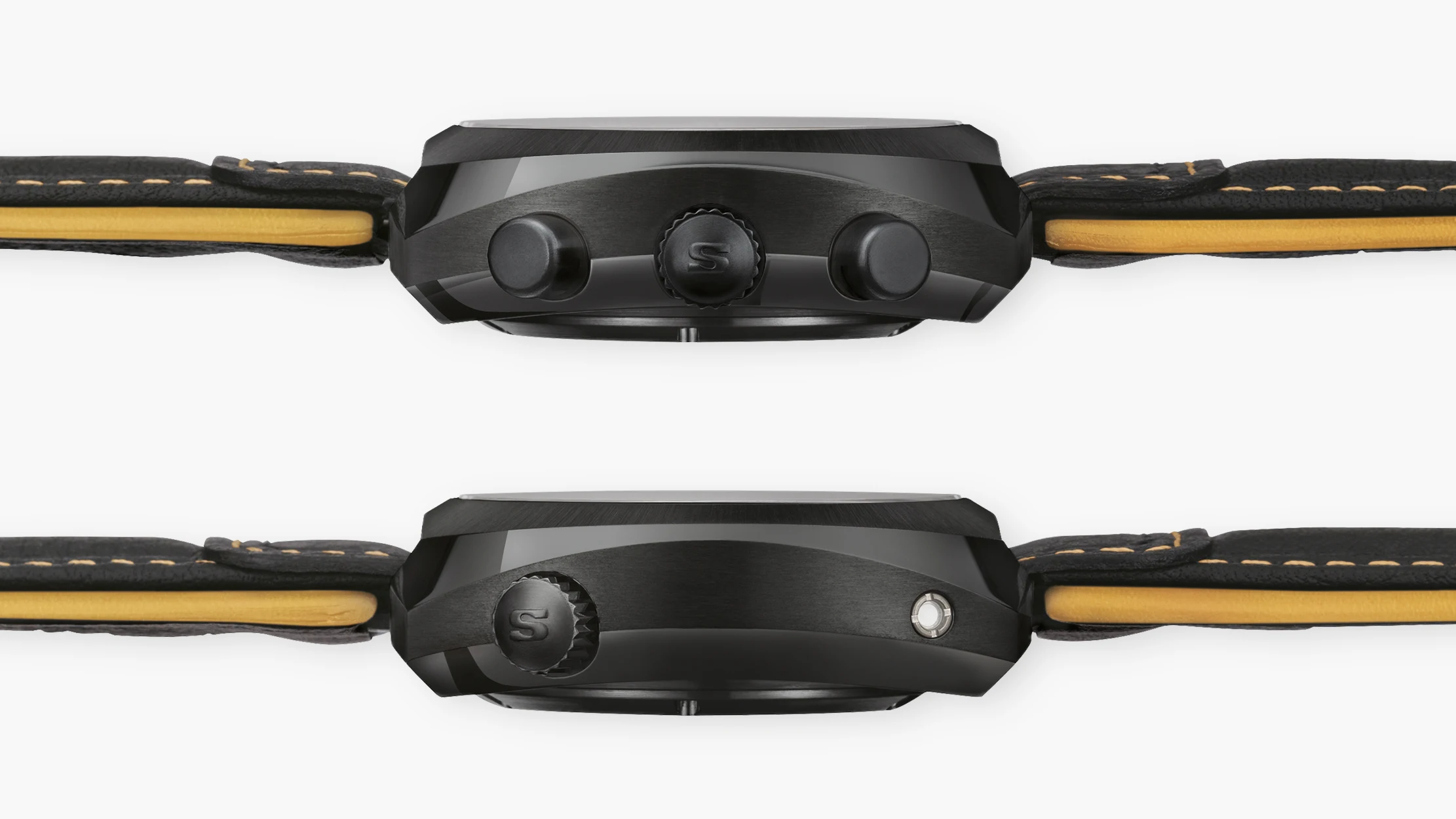
The pushers and crown are equipped with the D3 system (direct double sealing), in which the pusher pins and crown shafts are guided and sealed directly within precision-finished apertures in the case. This eliminates the need for the guide sleeve, known as the case tube, used in conventional constructions, whose additional seal presents an increased risk of gas diffusion and leakage.
The technical concept is completed by Ar-Dehumidifying Technology, a Sinn technology designed to slow down the ageing processes inside the watch. It comprises three elements: a drying capsule, a protective gas filling and EDR seals. Together, these technologies ensure water resistance and pressure resistance up to 10 bar (100 metres), as well as resistance to low pressure.
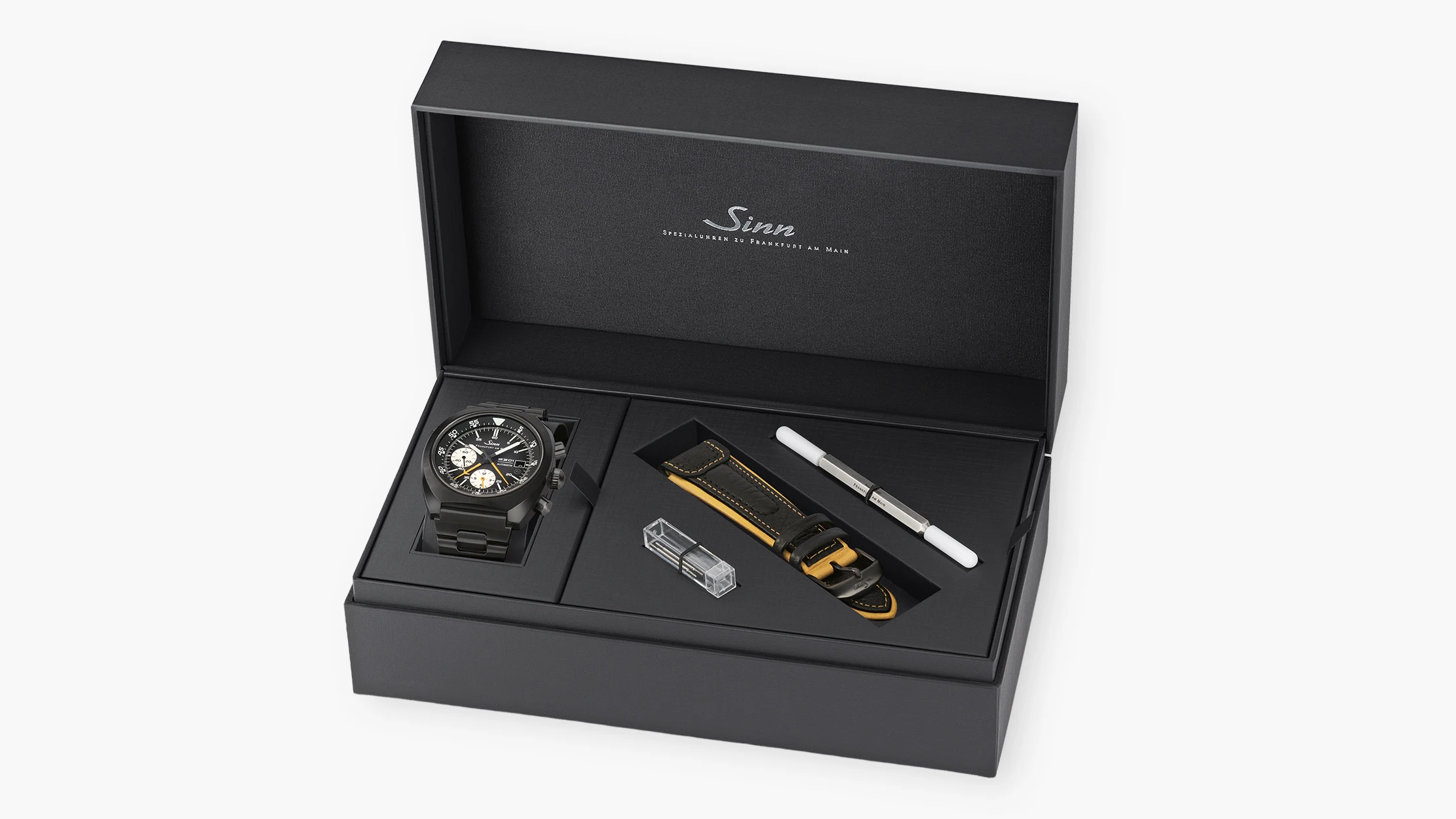
The Sinn 140 A S Jubiläum is delivered in a presentation case for two straps. The package includes a black-and-yellow leather strap, a solid stainless steel bracelet with fine adjustment of the bracelet length, as well as a strap-changing tool and spare spring bars.
The Sinn 140 A S Jubiläum is limited to 300 pieces and is available at a price of €5,490.
Sinn
140 A S Jubiläum
140.050
Stainless steel, polished and satin-finished, with a black hard coating on a TEGIMENT-hardened surface
Diameter 44 mm, height 15.5 mm, lug width 22 mm, weight without strap 118 g
Water-resistant to 10 bar (100 metres)
Matt black, indices and hour and minute hands coated with luminous material, chronograph hand coated with daylight-luminous material
Black-and-yellow leather strap, solid stainless steel bracelet
Sinn SZ01 chronograph movement based on the Valjoux 7750 architecture
Automatic
N/A
28,800 vibrations per hour (4 Hz)
Hours, minutes, small seconds, date, chronograph with centrally mounted jumping 60-minute counter, internal pilot’s rotating bezel with luminous reference marker
EUR 5,490