
The Sinn 140 A S Jubiläum commemorates Reinhard Furrer's 1985 spaceflight. Explore the SZ01 chronograph, its technical features and 300-piece limited edition.

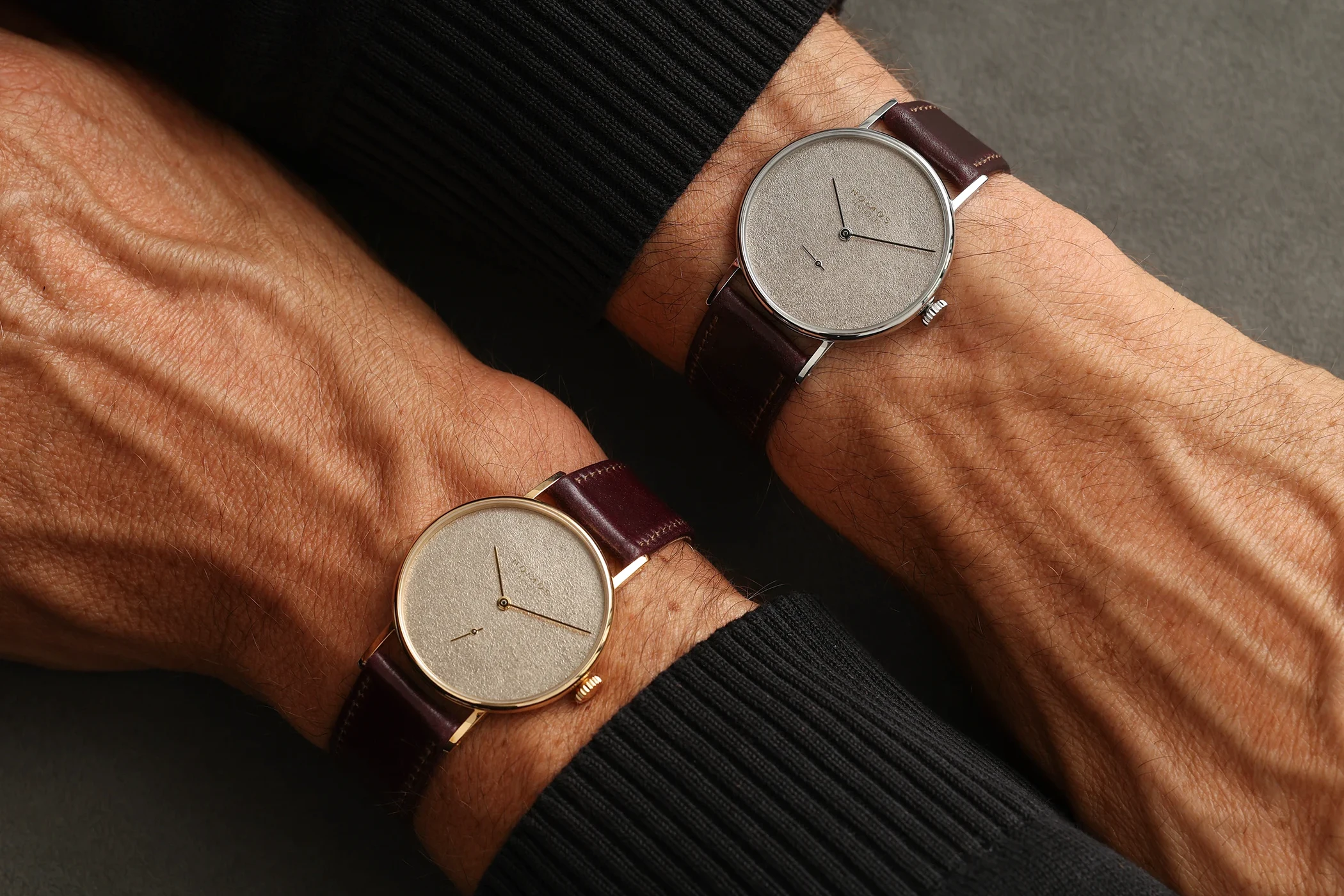
With Twice Unique, Nomos Glashütte has taken a bold step that neither customers nor the specialist press understood straight away: one-off pieces that come only in pairs – one in gold, one in steel. It was at the 7th Nomos Forum in Glashütte that the reasoning behind this became clear for the first time – a new vision of luxury from Germany’s largest watch manufacturer, one that does not seek to stand out simply for the sake of it, but stems from a dedication to materials and manufacturing techniques that, until now, have had little or nothing to do with watchmaking.
This is illustrated by a woman who uses a squirrel-hair brush to apply gold that is significantly thinner than the watch manufacturer’s tolerances. But read for yourself to find out what this extraordinary collection is all about.
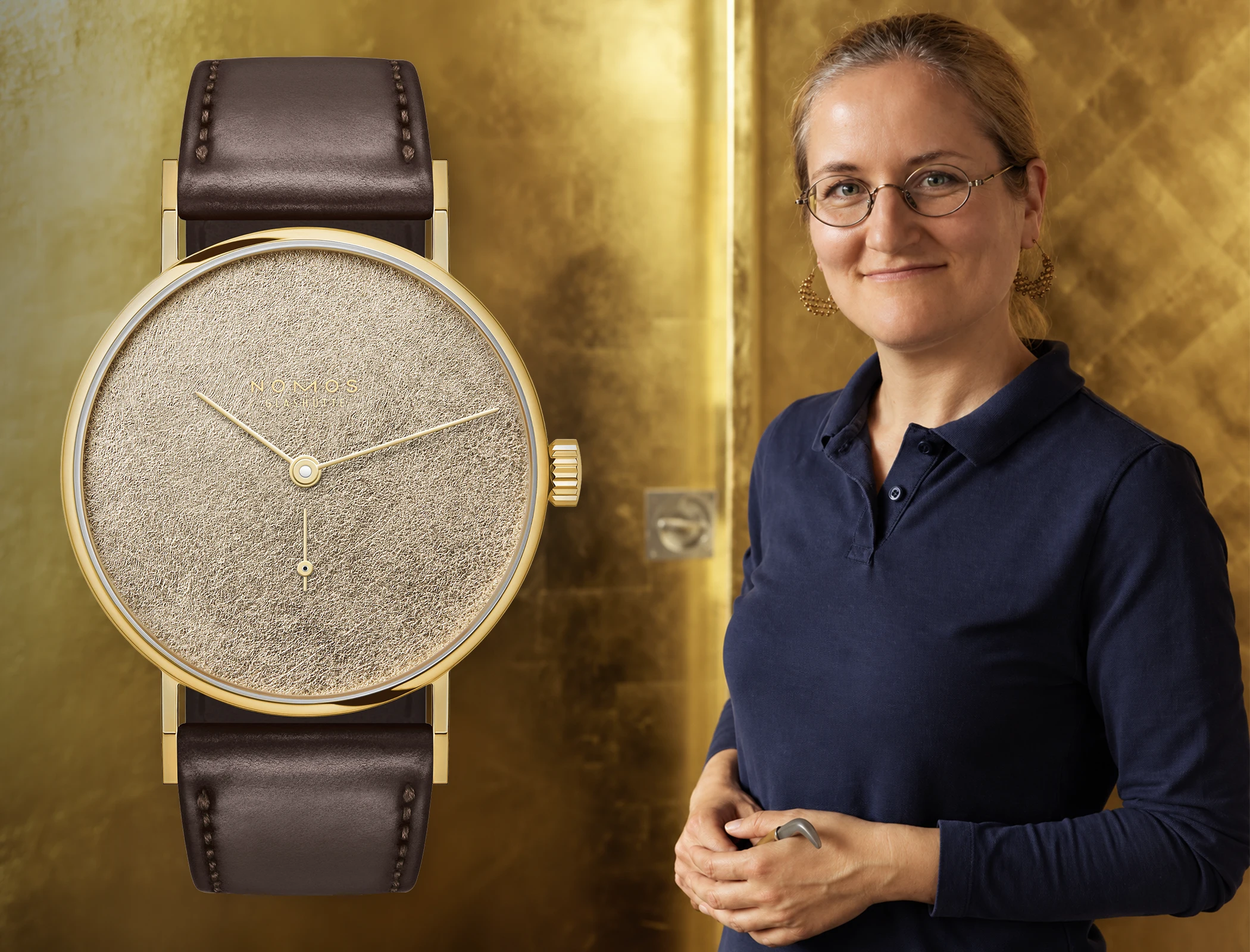
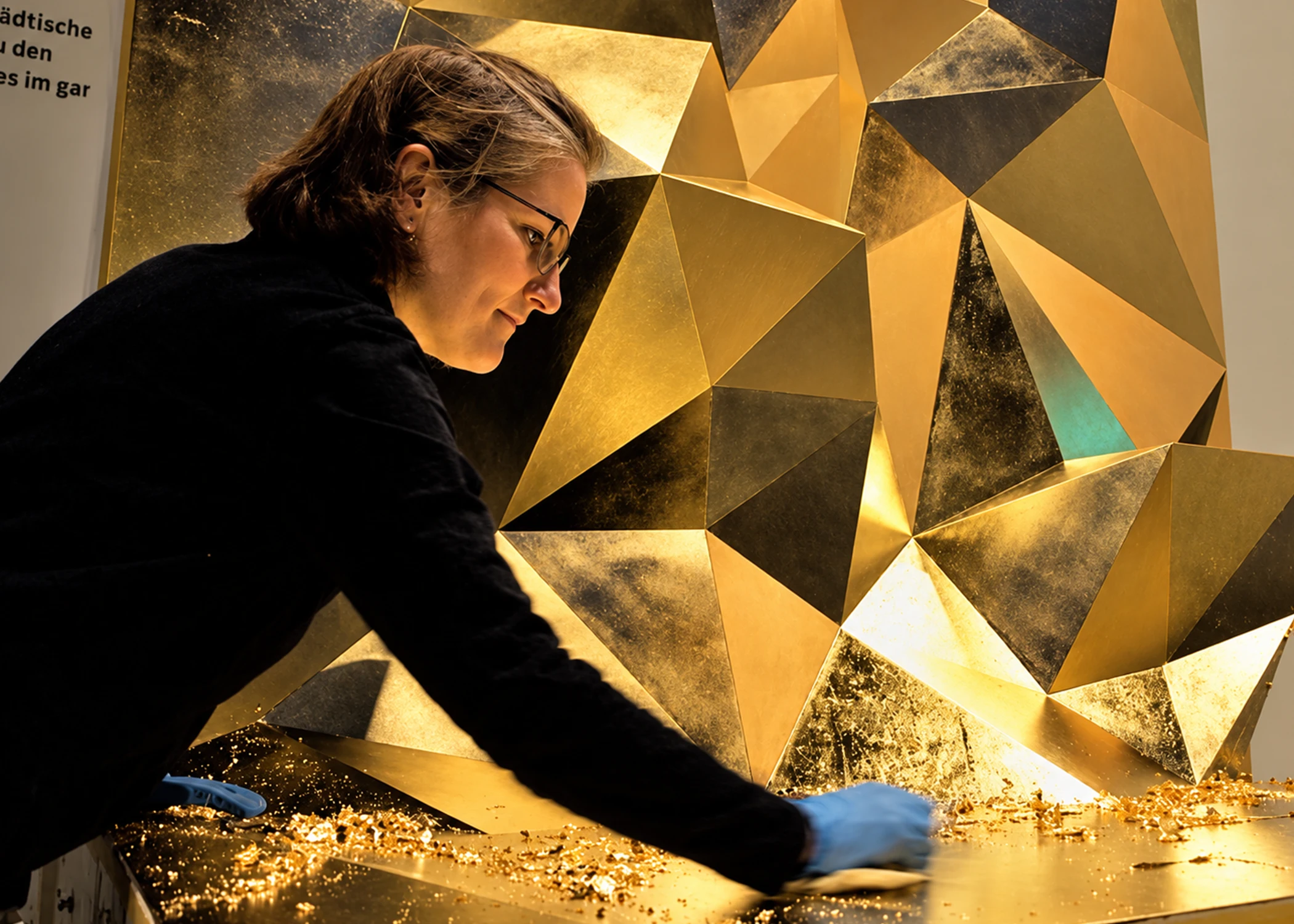
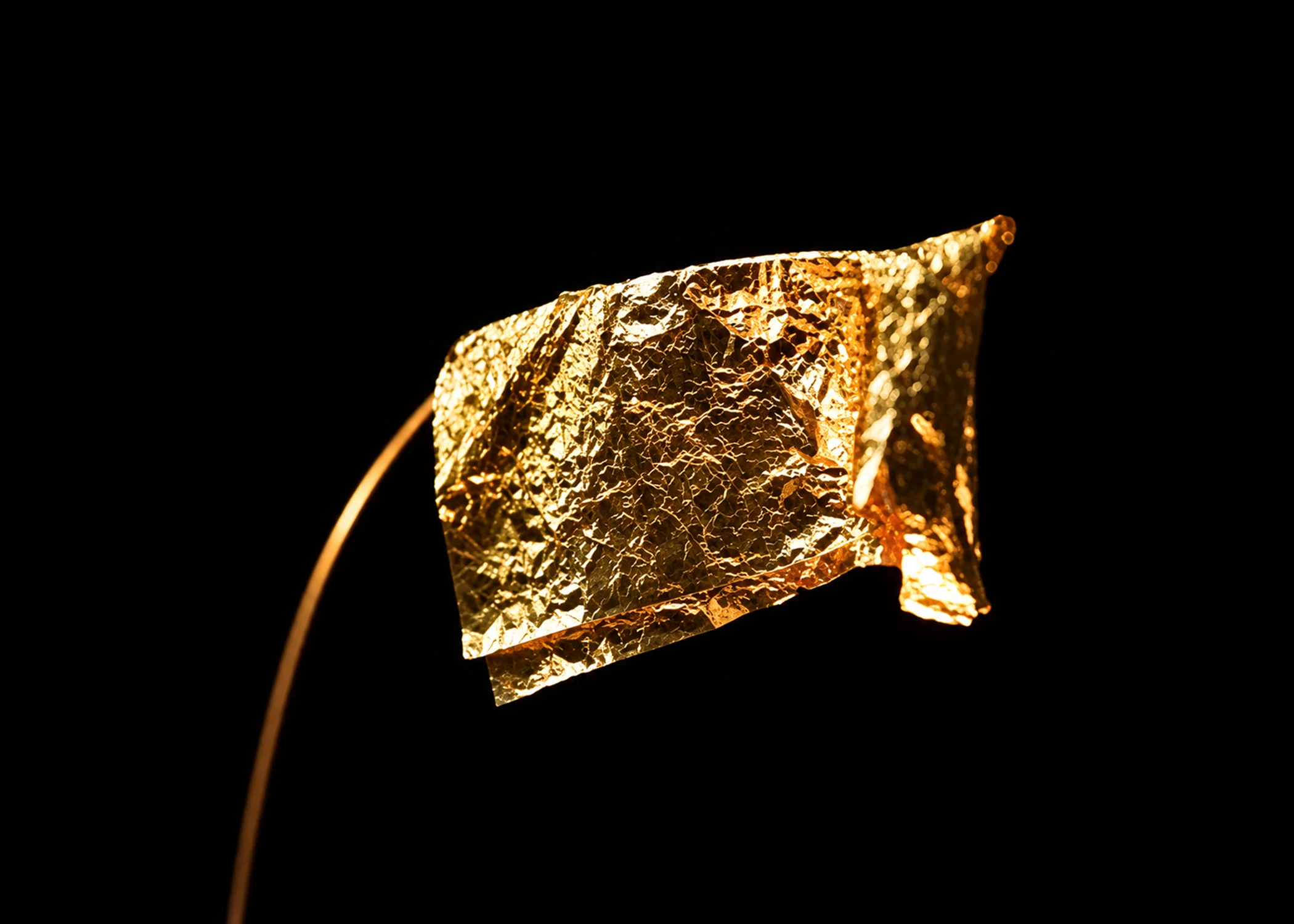
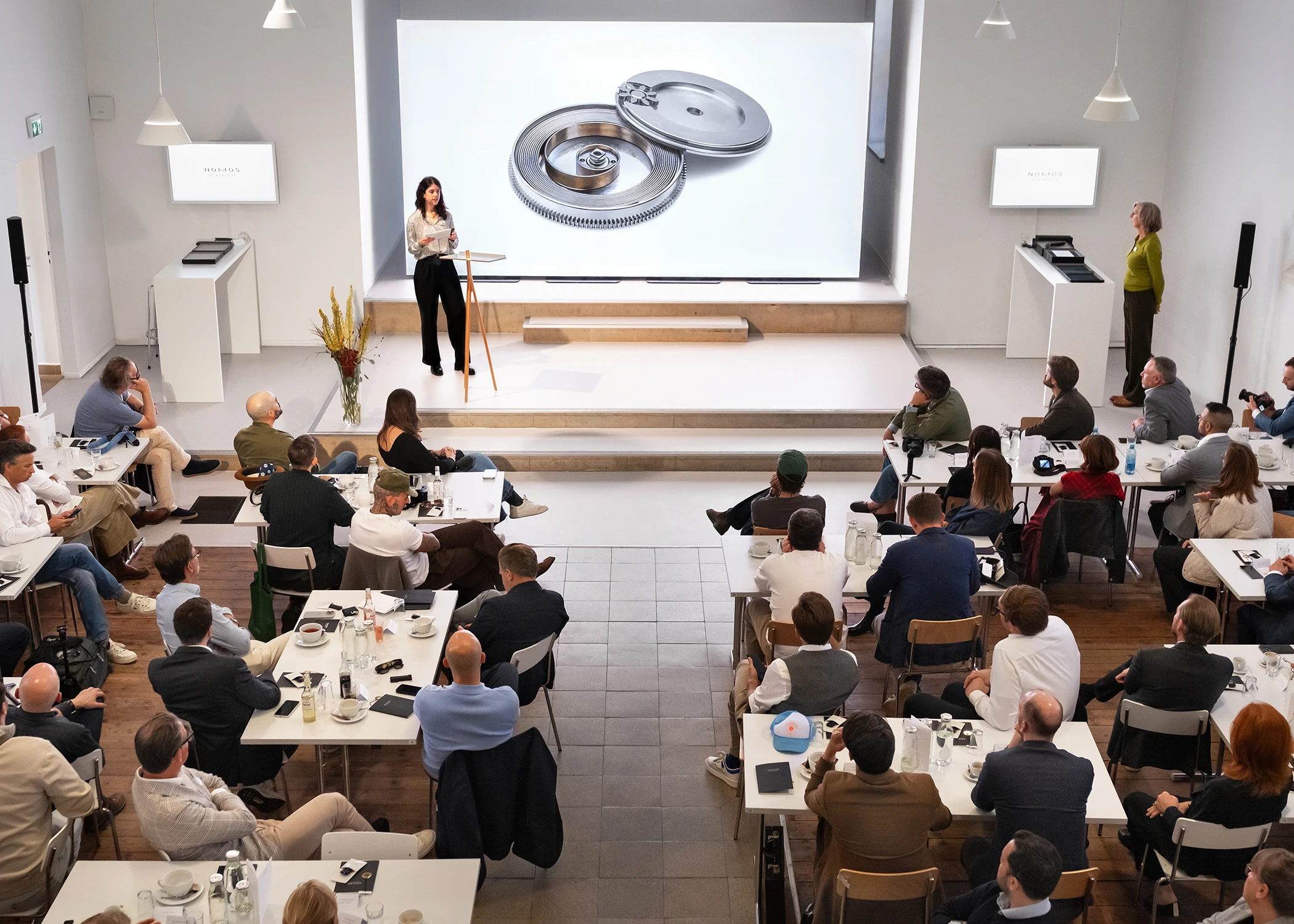
It is a special moment: dozens of retailers, journalists and watchmakers from all over the world hold their breath. At the front of the stage, Michelle Sachs opens a small booklet made of tissue paper and, using the tip of a paintbrush, lifts out a sheet of gold, measuring eight by eight centimetres. The sheet trembles, curves and seems to breathe. A murmur ripples through the hall. “You can see how draughty it is in here,” says Sachs, laughing. “The gold leaf is so thin, you’d think it had a life of its own.”
Credit © Michelle Sachs
When held up to a bright lamp, the light shimmers greenish through it. Then the Berlin master gilder does something you wouldn’t normally do with gold: she passes it round. “Don’t worry, you can touch it. You can even tear it a little. It’s even edible.” Fingertips feel for something you can barely sense. The gold sticks to the skin, crumbles into flakes, and the remains drift away. Someone shouts “Midas touch”, whilst another wonders, half-jokingly, whether they should wash the rest down with champagne later.
Credit © Michelle Sachs
It is a small scene, but it already tells us almost everything about the project that is the focus of the day at the 7th Nomos Forum in Glashütte. Gold that you want to experience, shared out of enthusiasm rather than merely put on display. A material that can only be fully appreciated up close. In this form in particular, gold is a treasure that you have to feel, because you cannot recognise it immediately from a photograph.
That is precisely the right phrase: when Nomos Glashütte unveiled the concept behind ‘Twice Unique’ on 14 April 2026 at Watches and Wonders in Geneva, the reaction was friendly but perplexed. People admired the dials and wondered what exactly they were actually looking at. The answer is complicated, and that was, at least in part, entirely intentional.
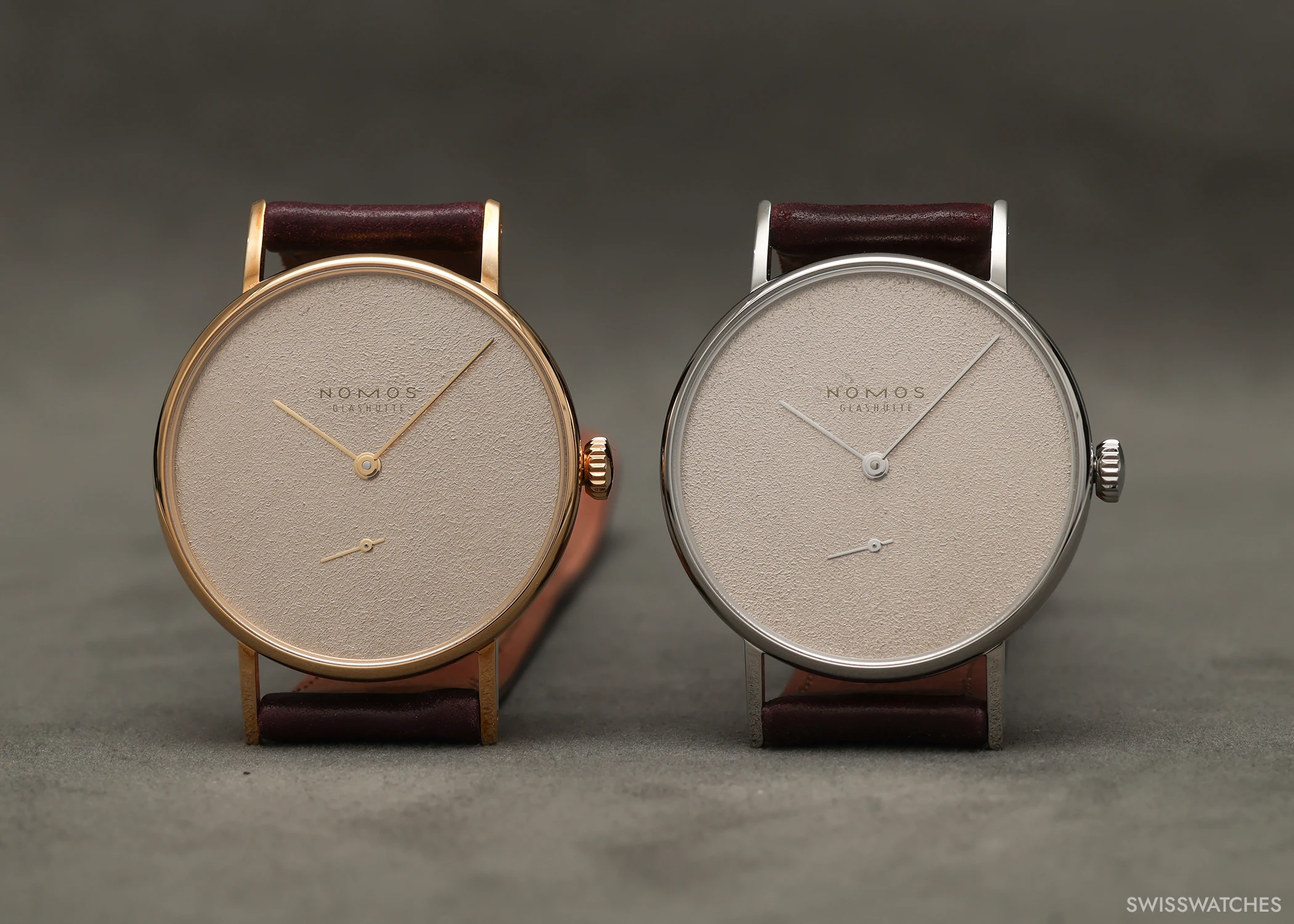
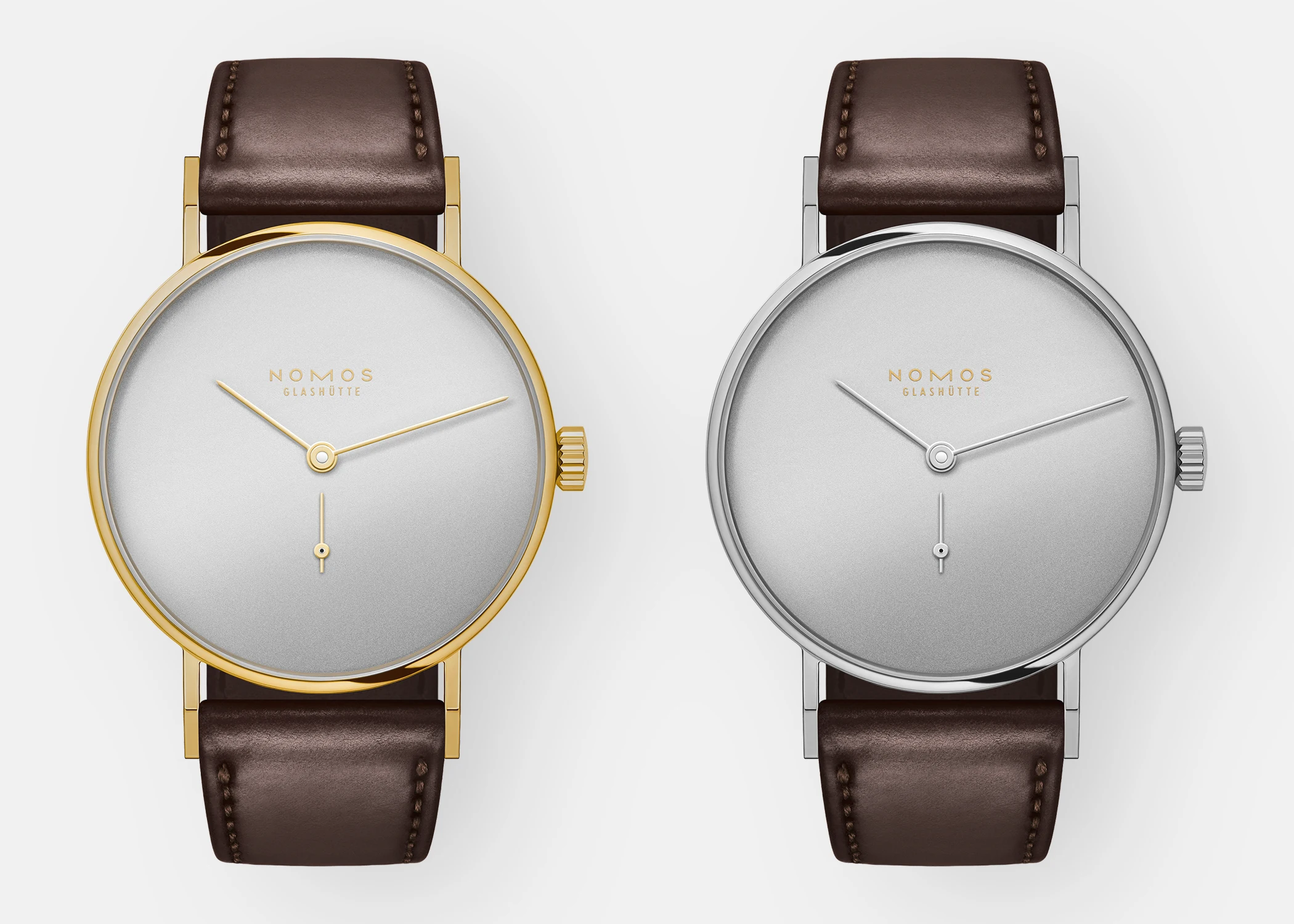
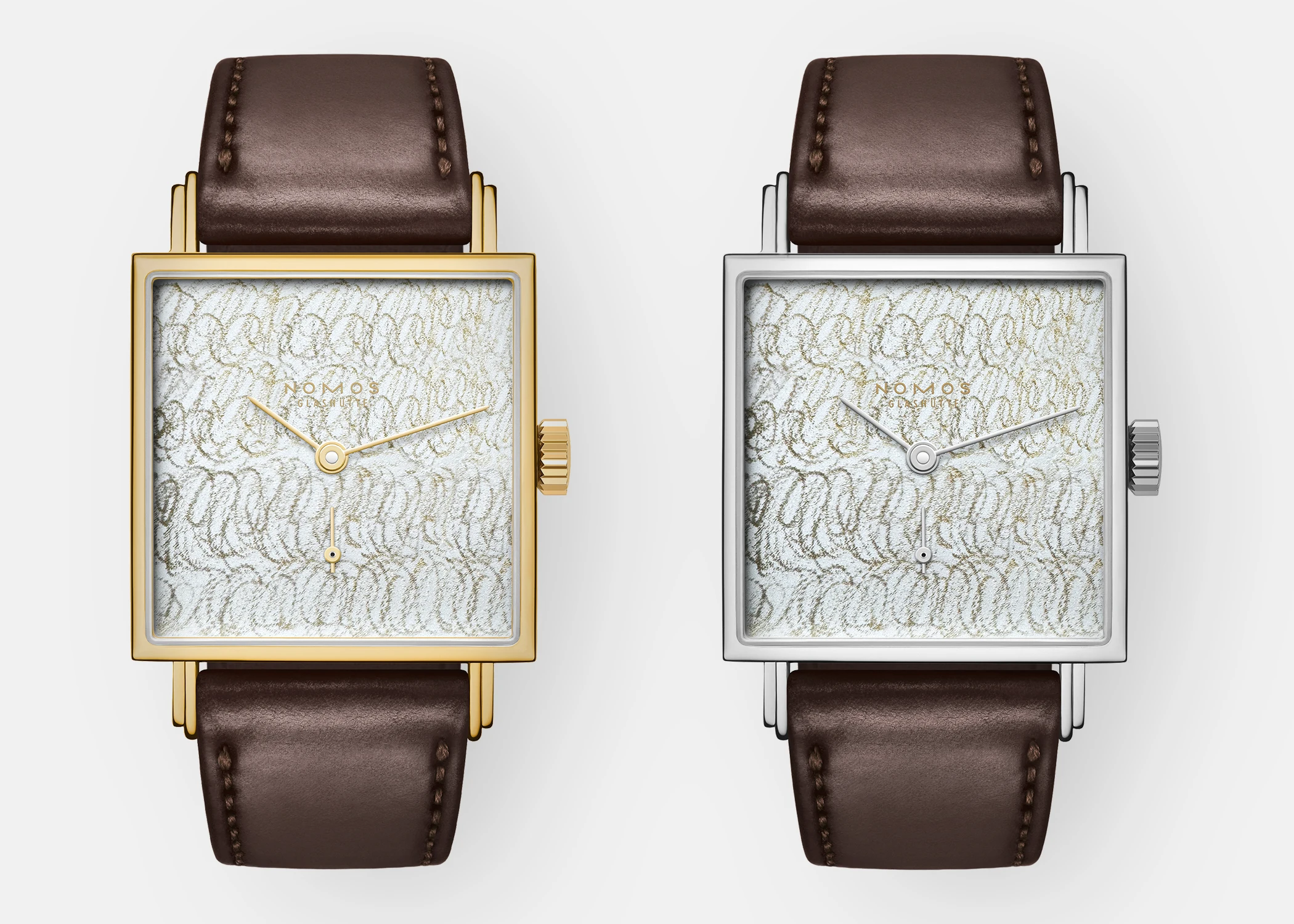
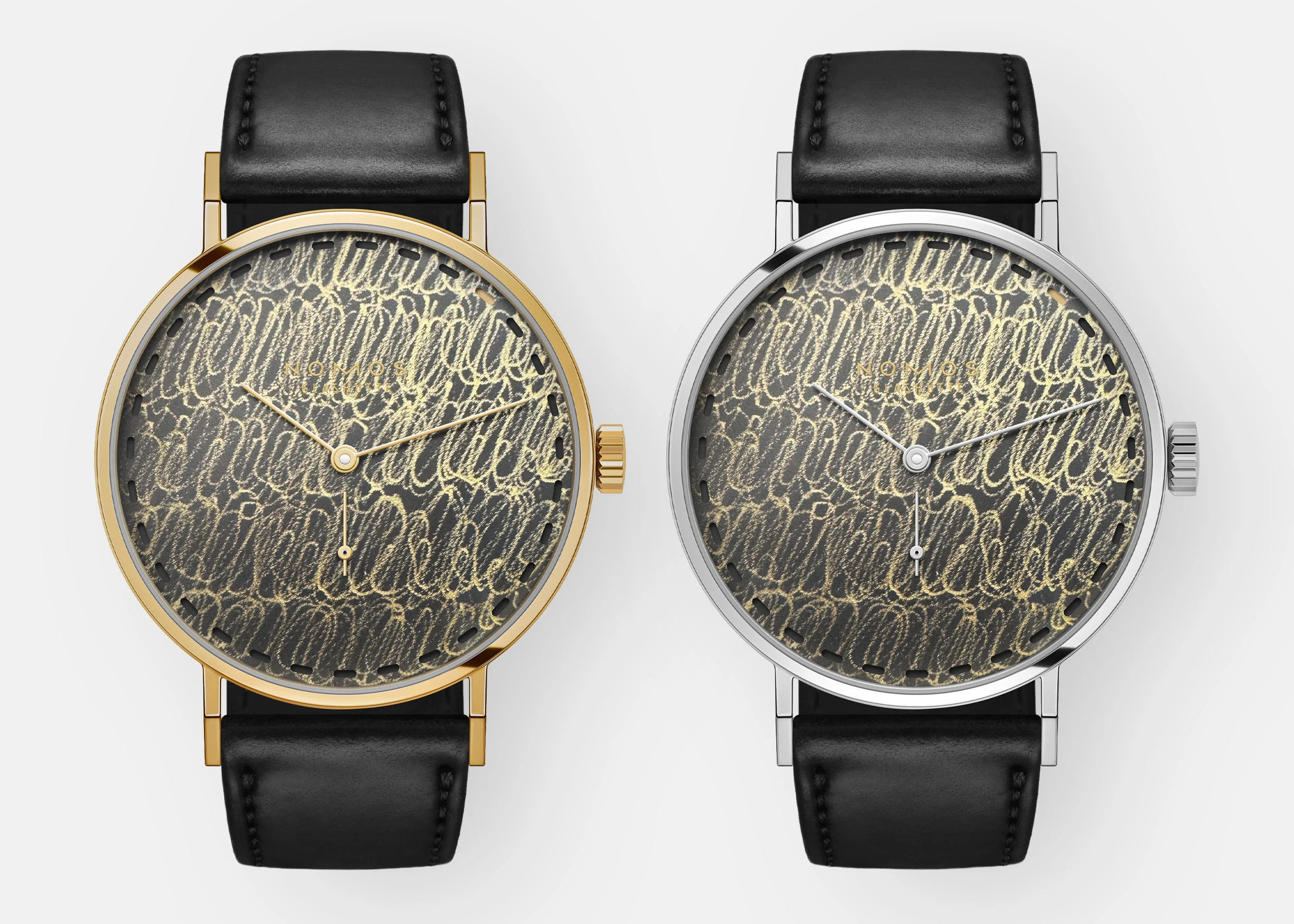
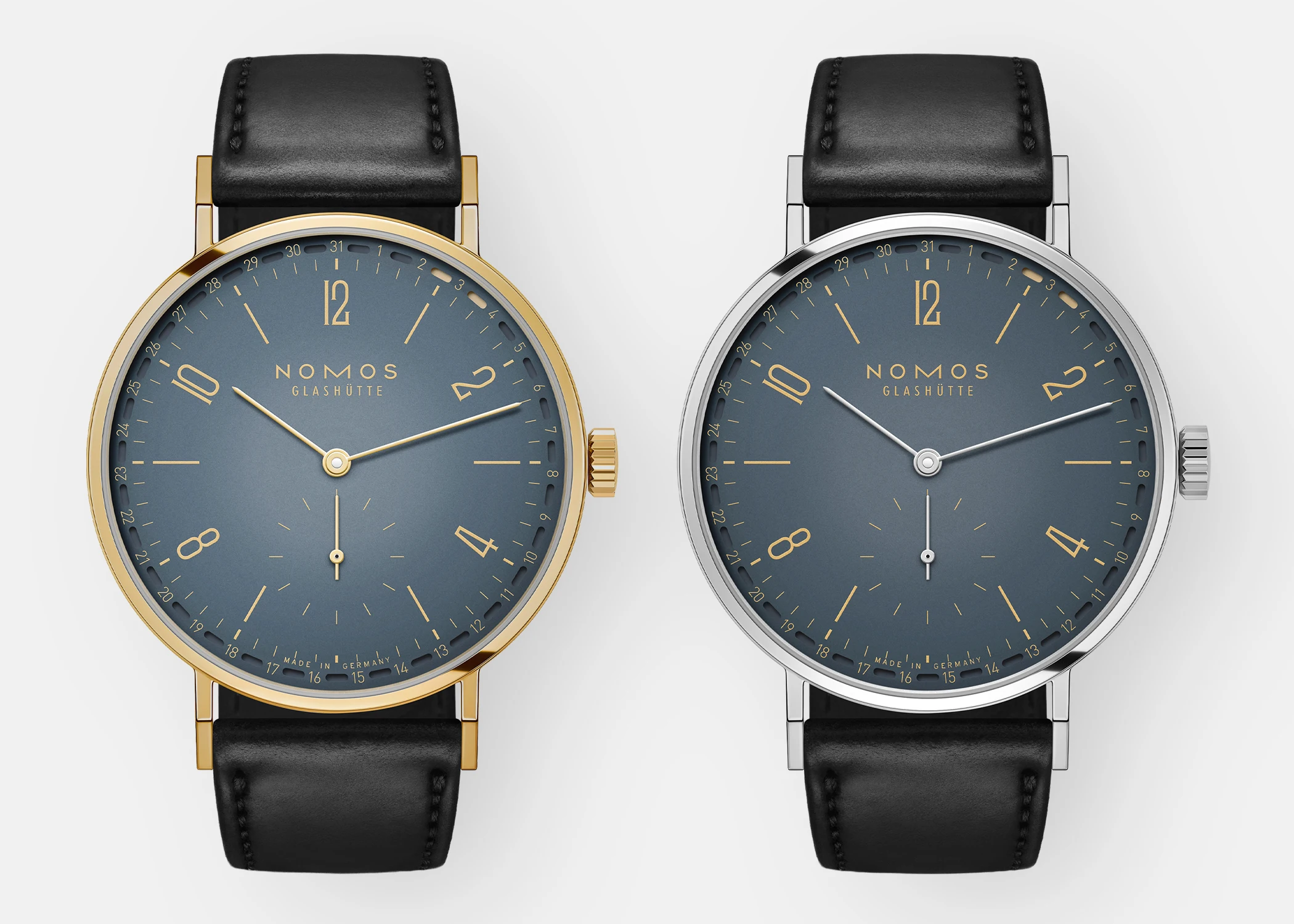
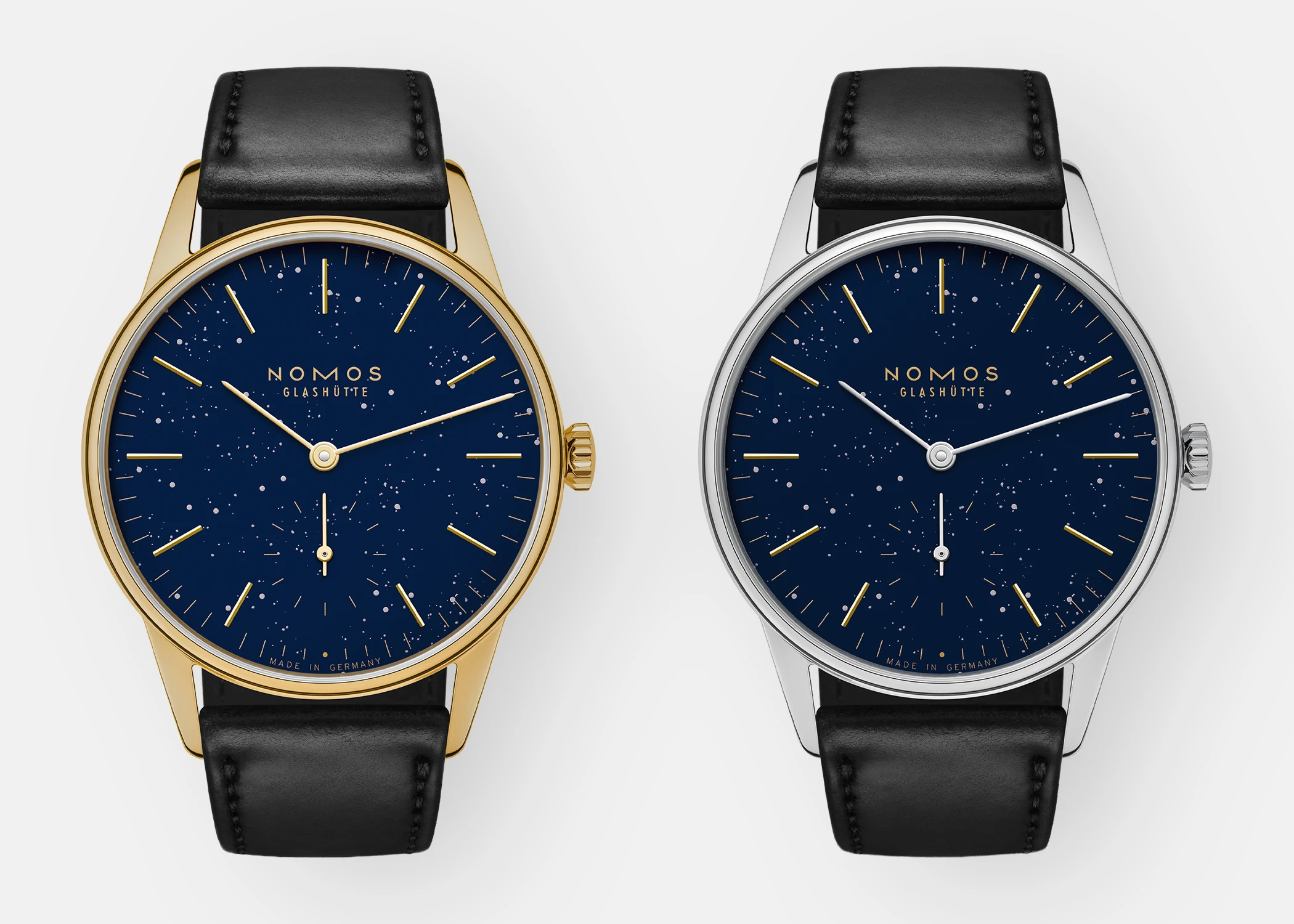
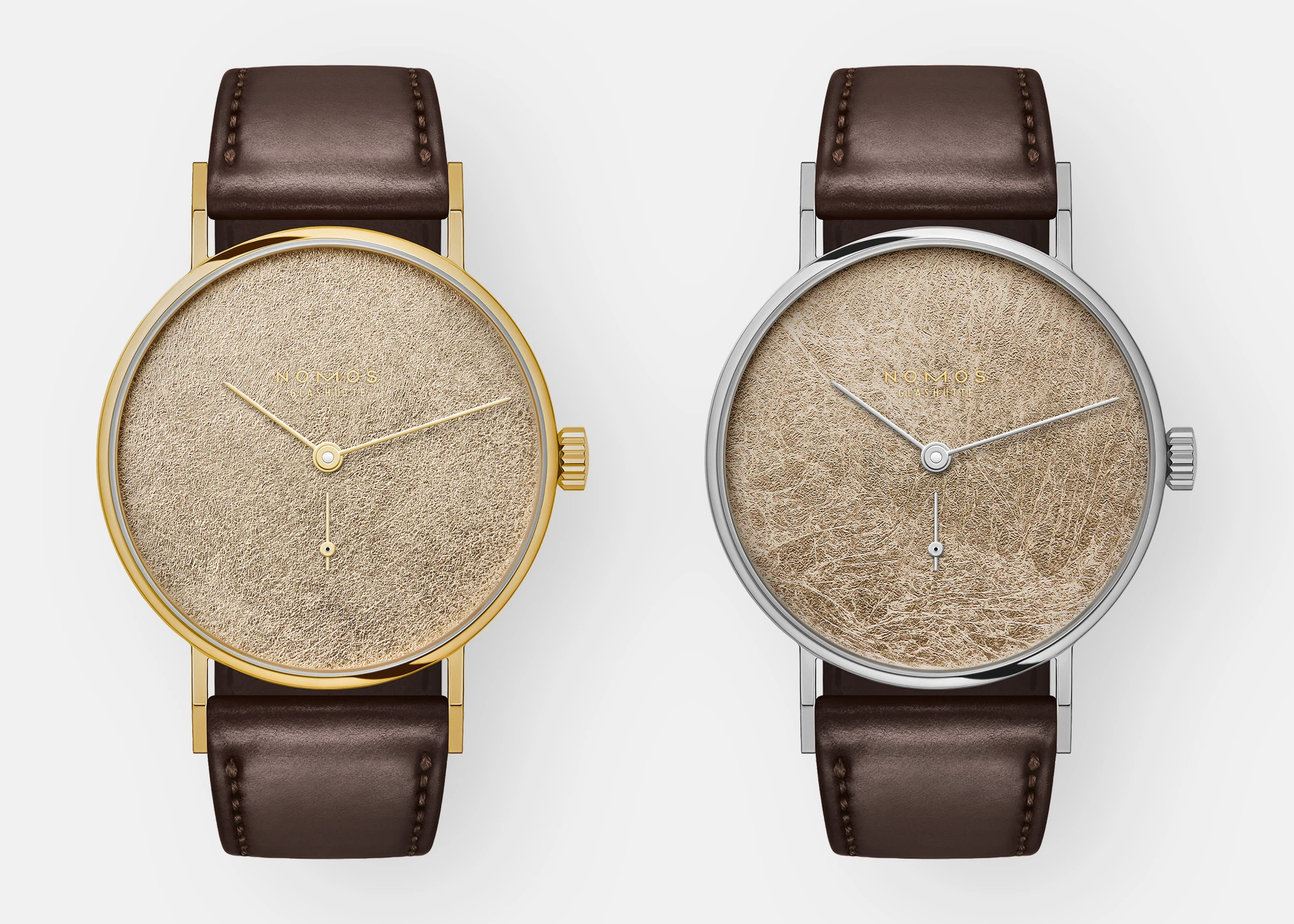
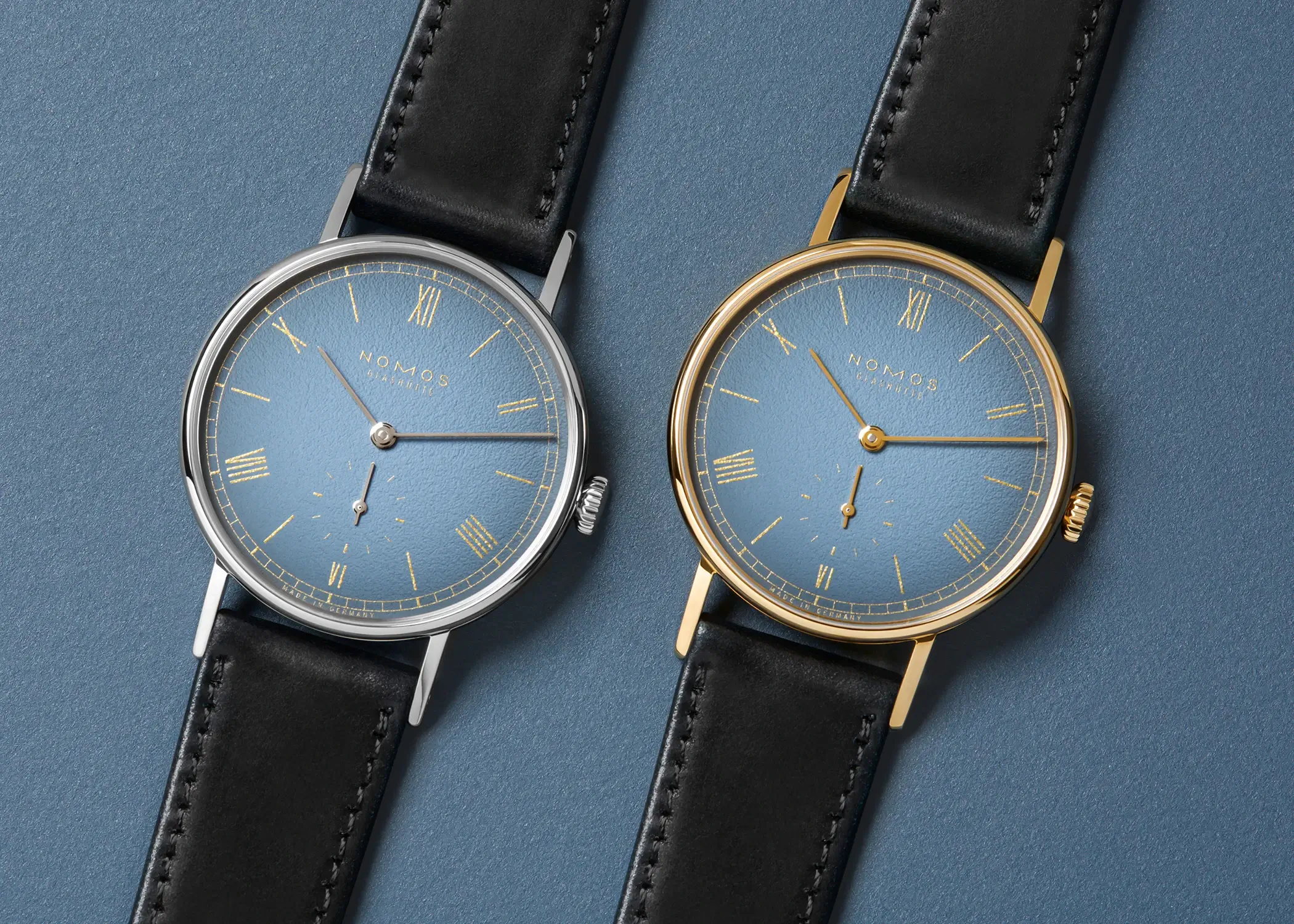
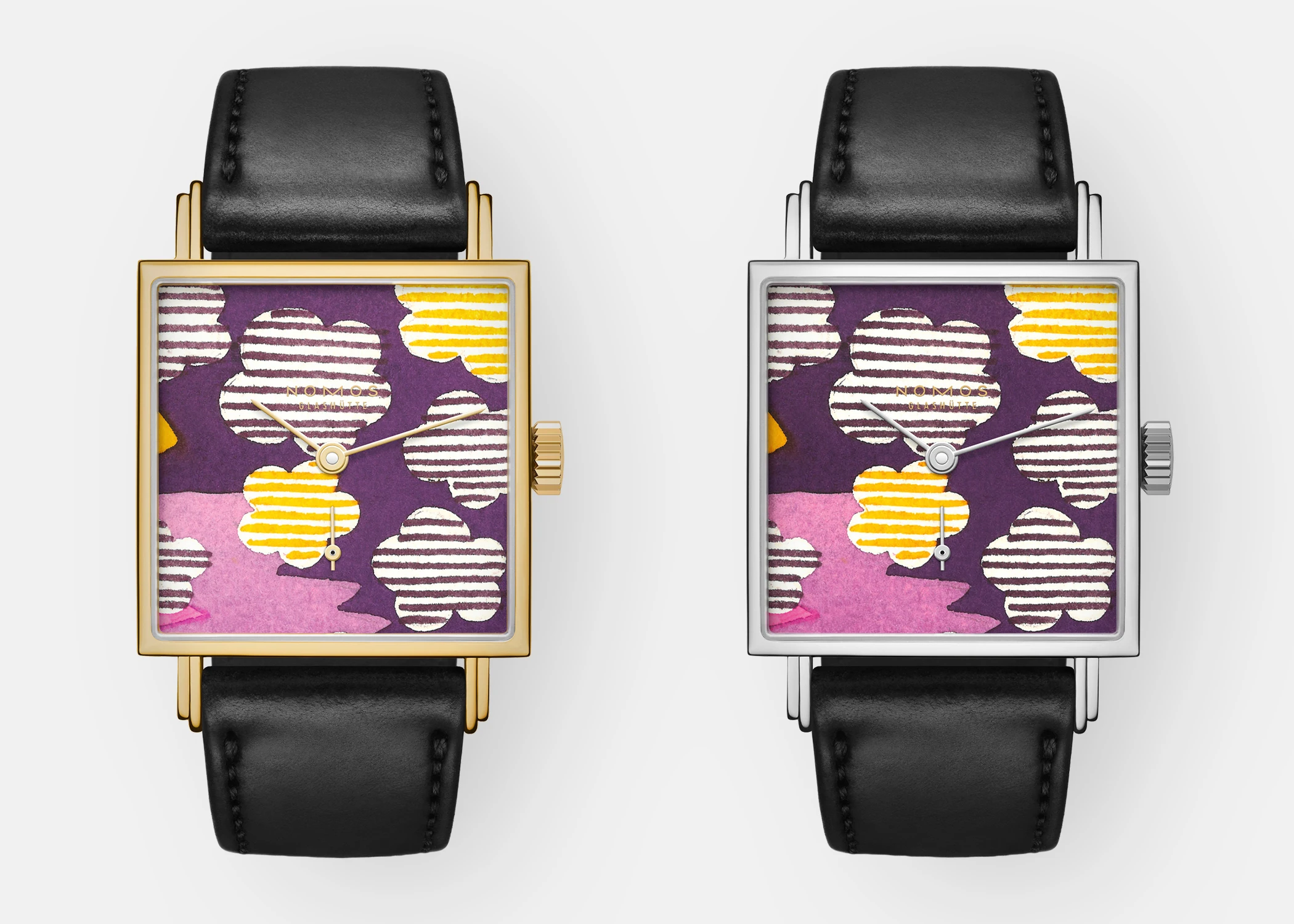
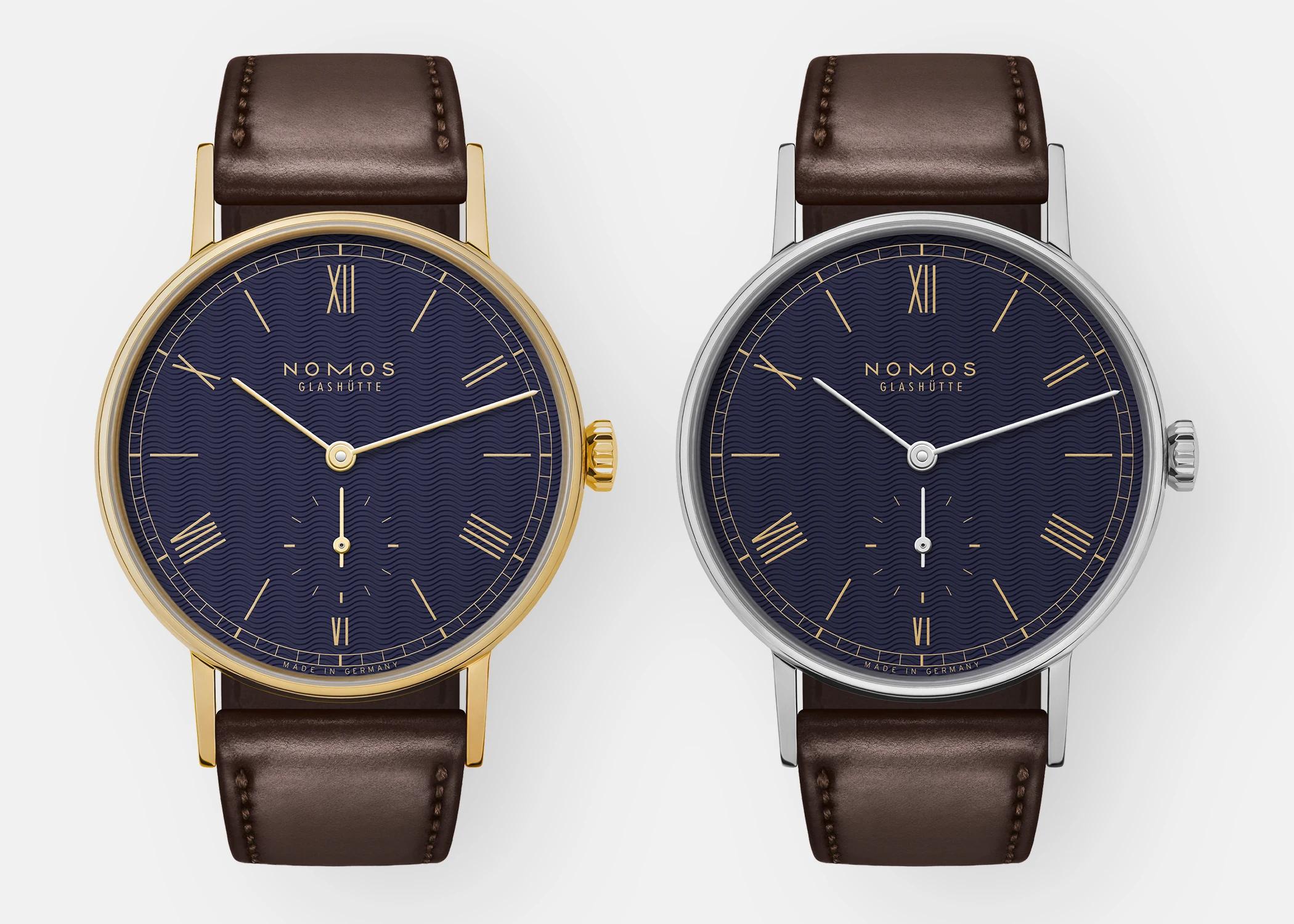
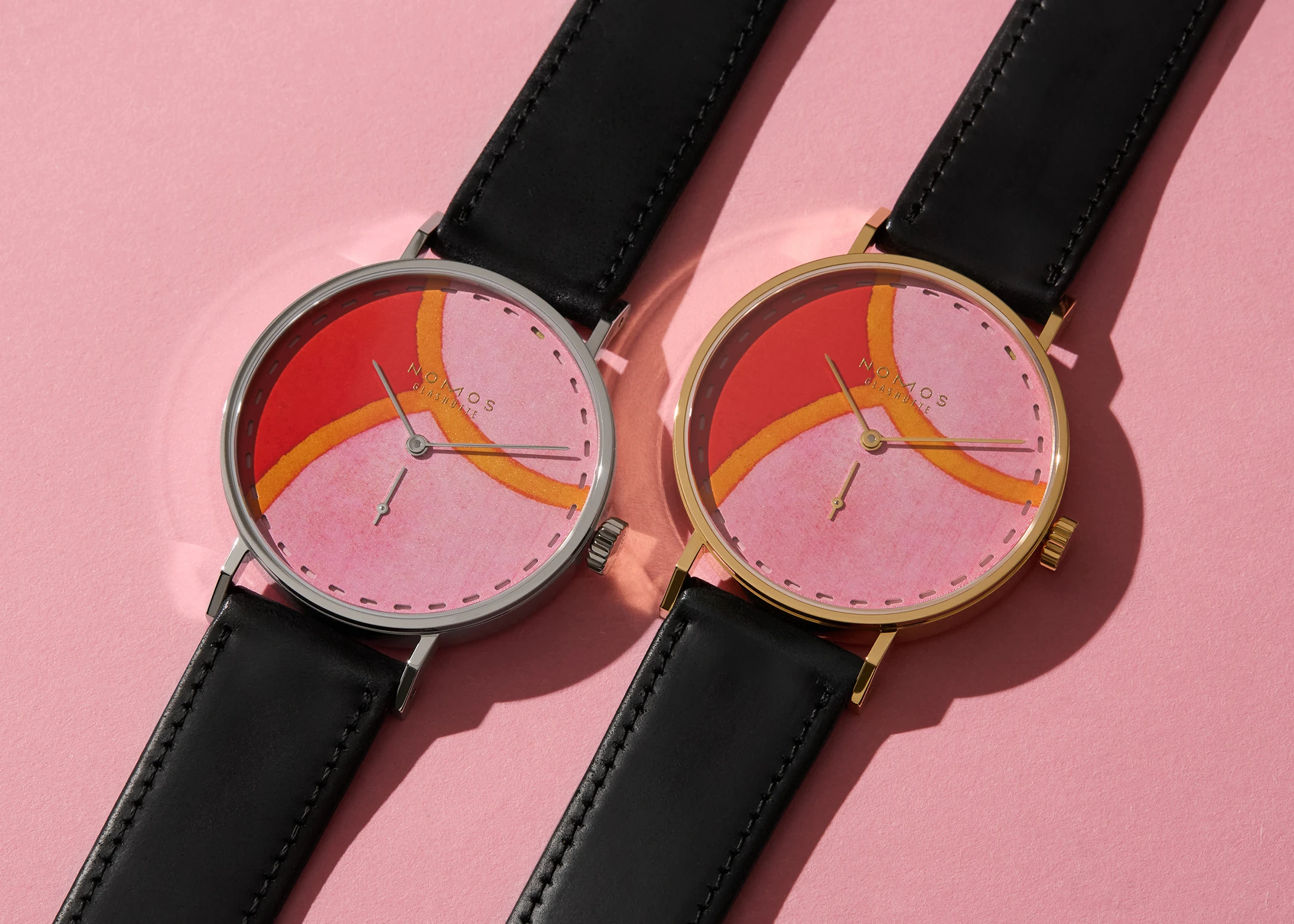
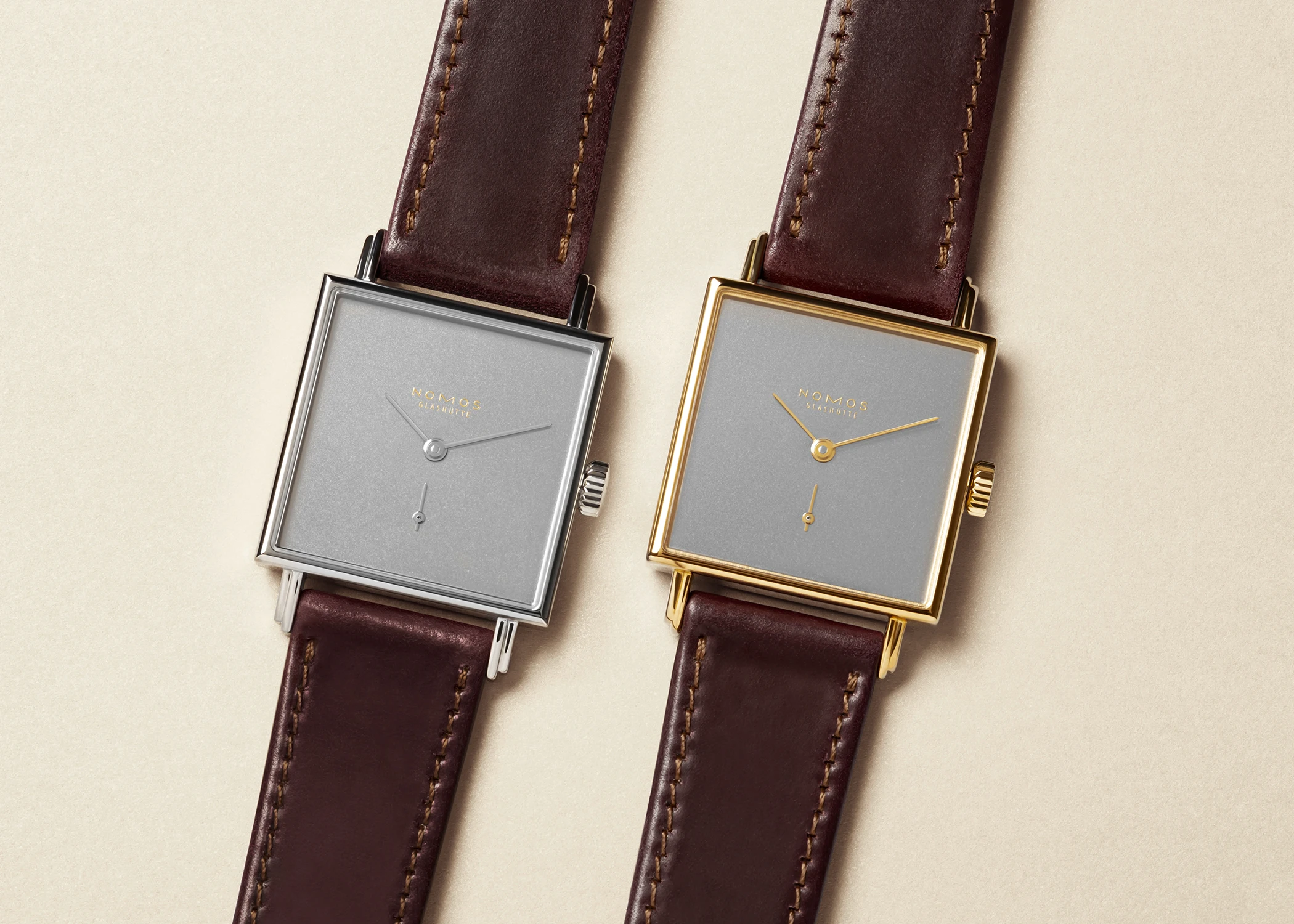
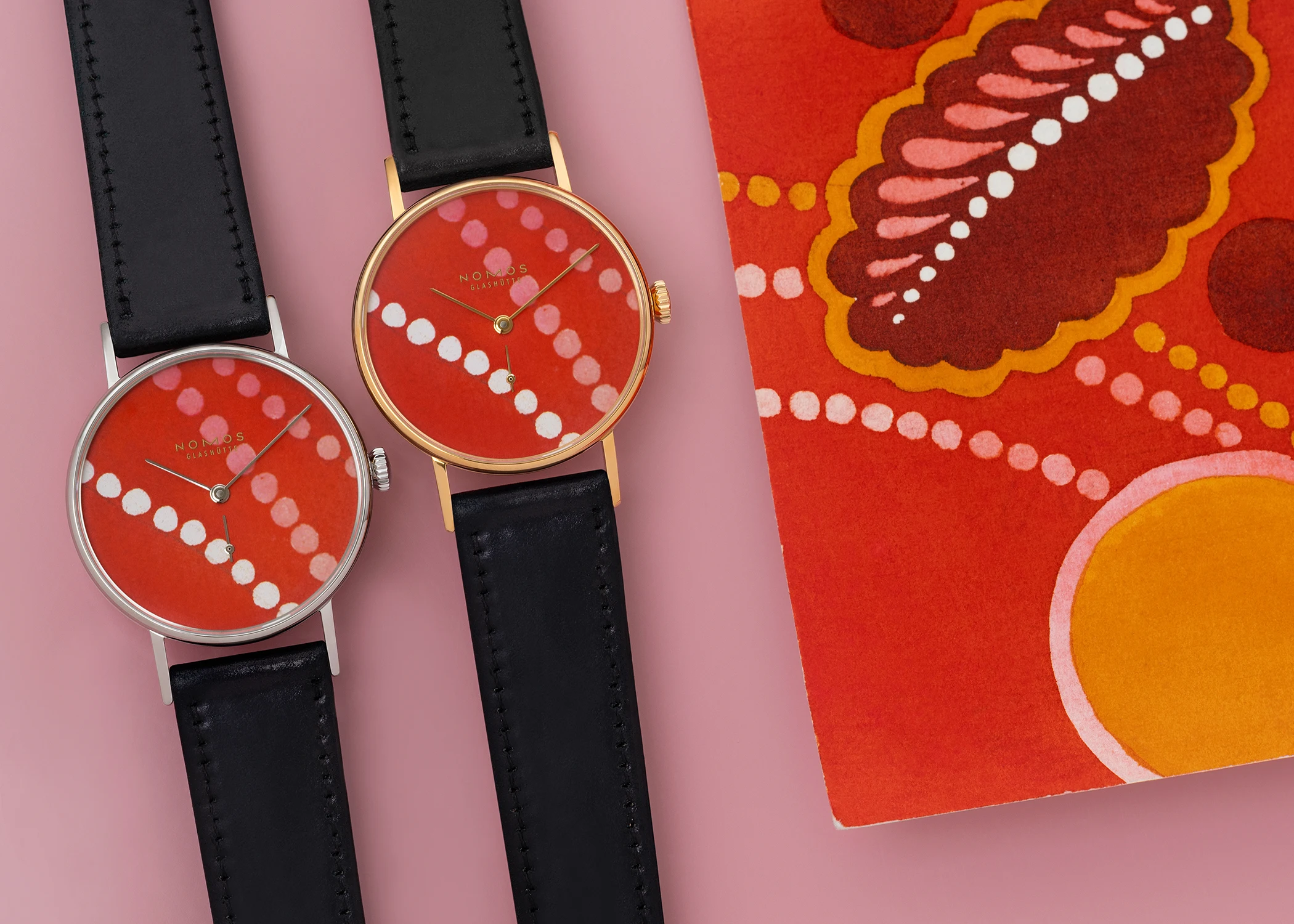
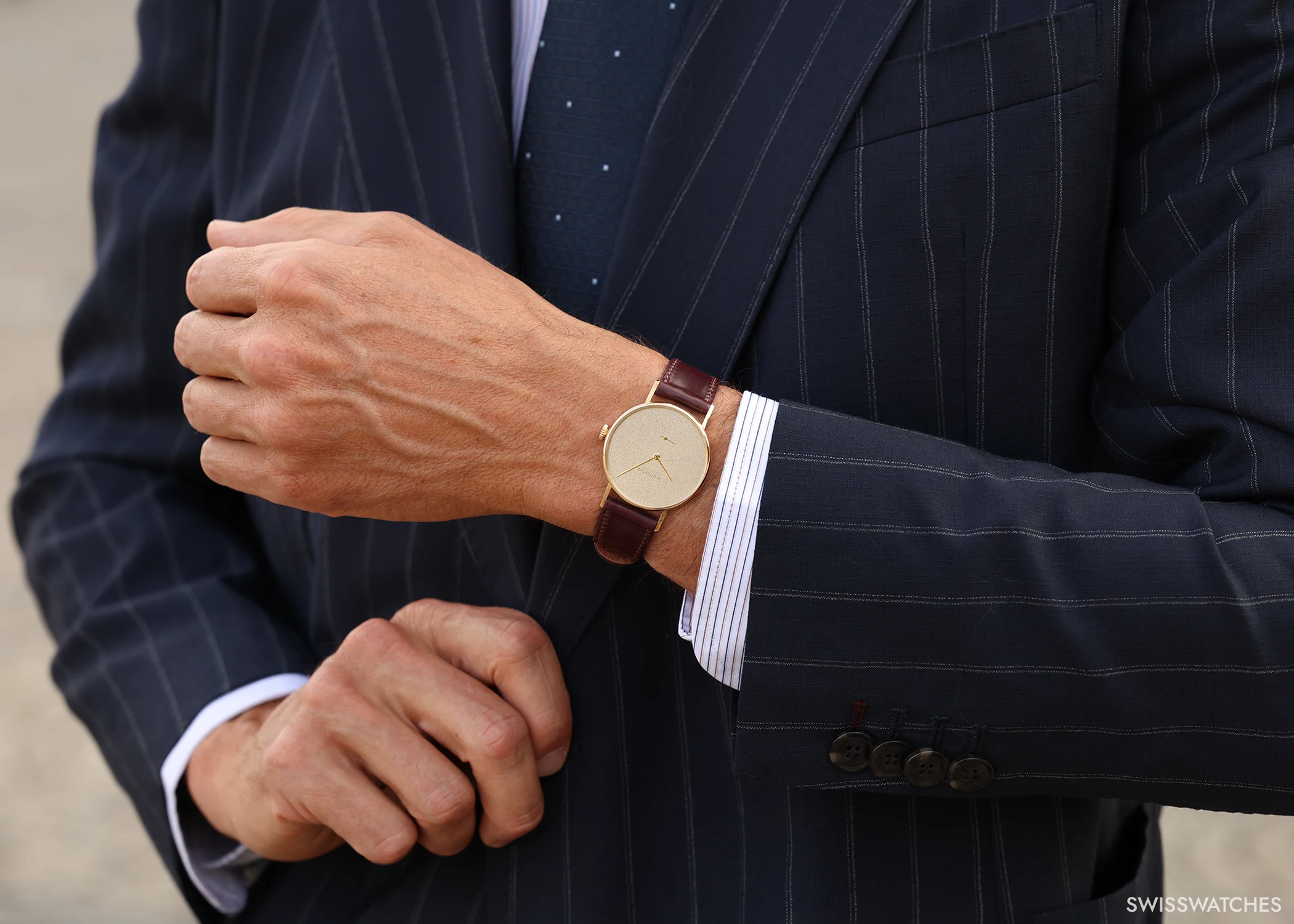
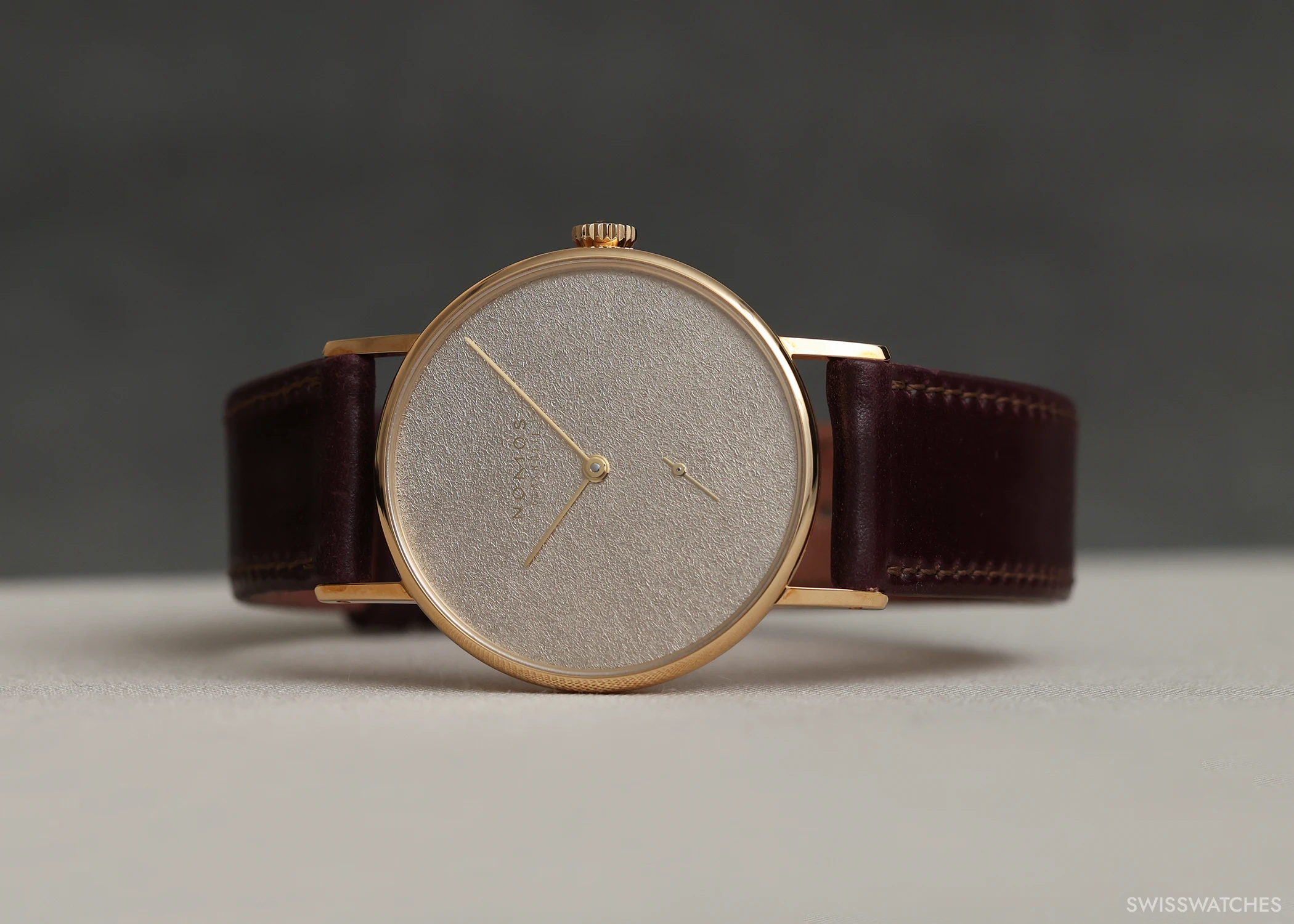
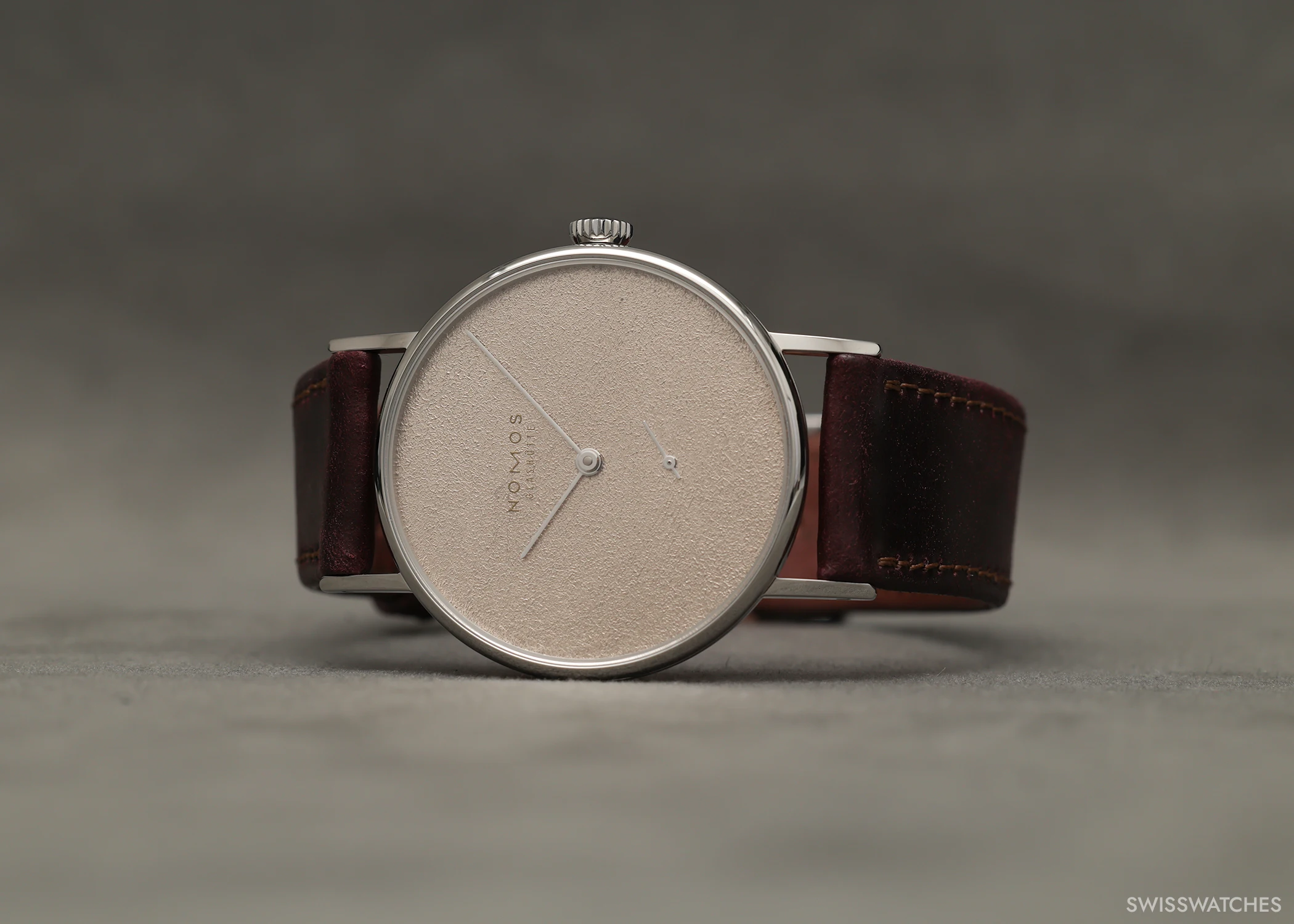
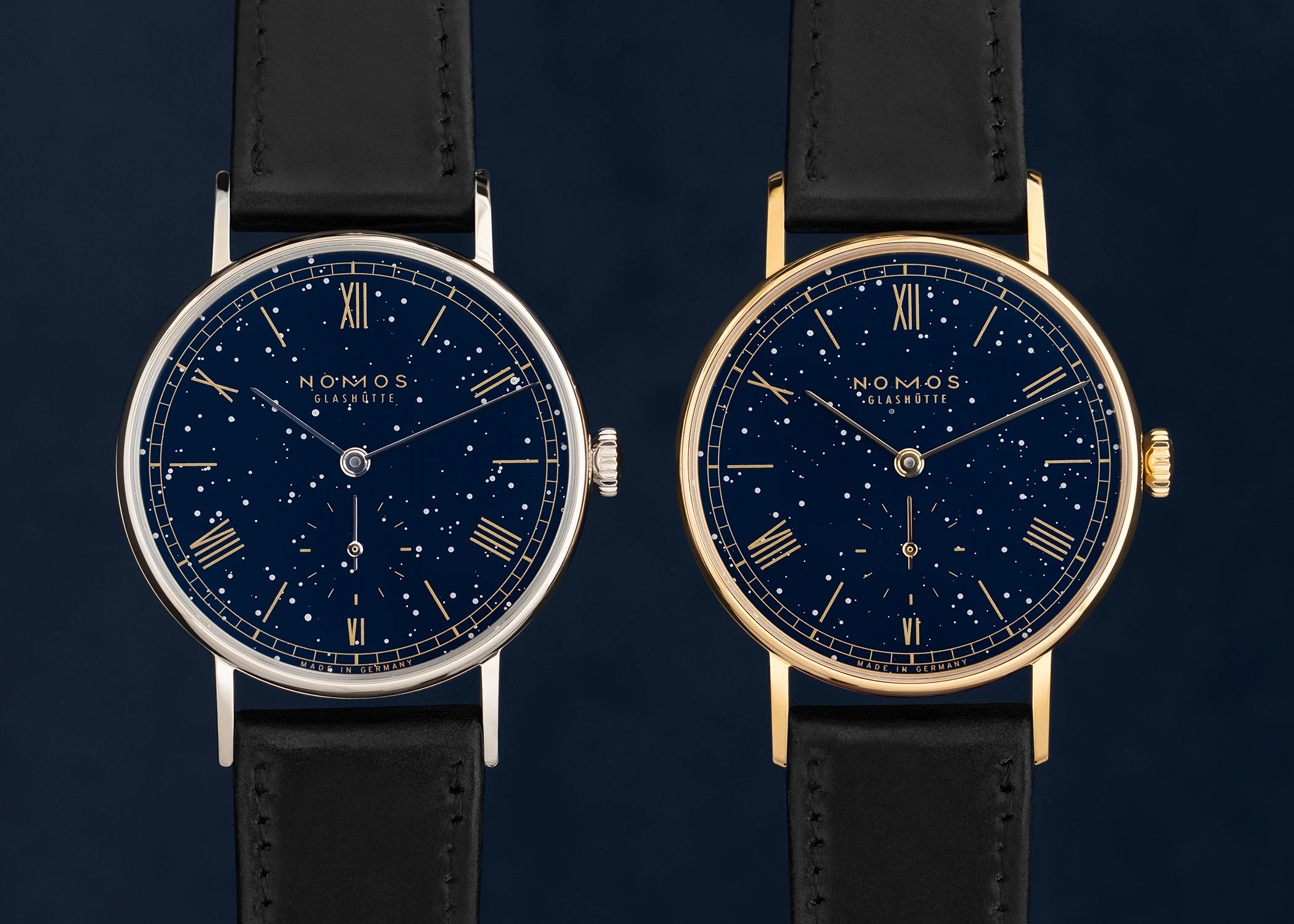
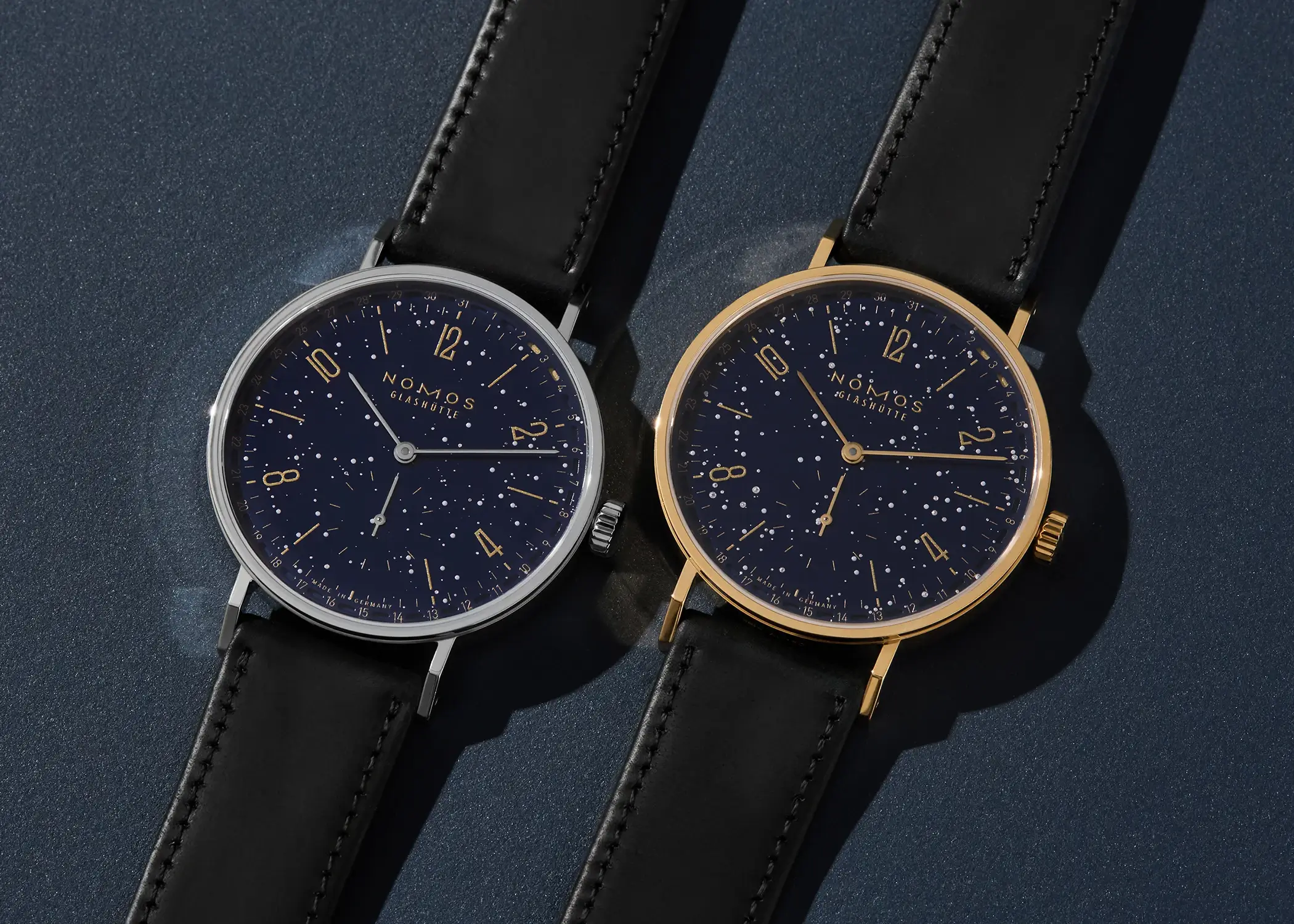
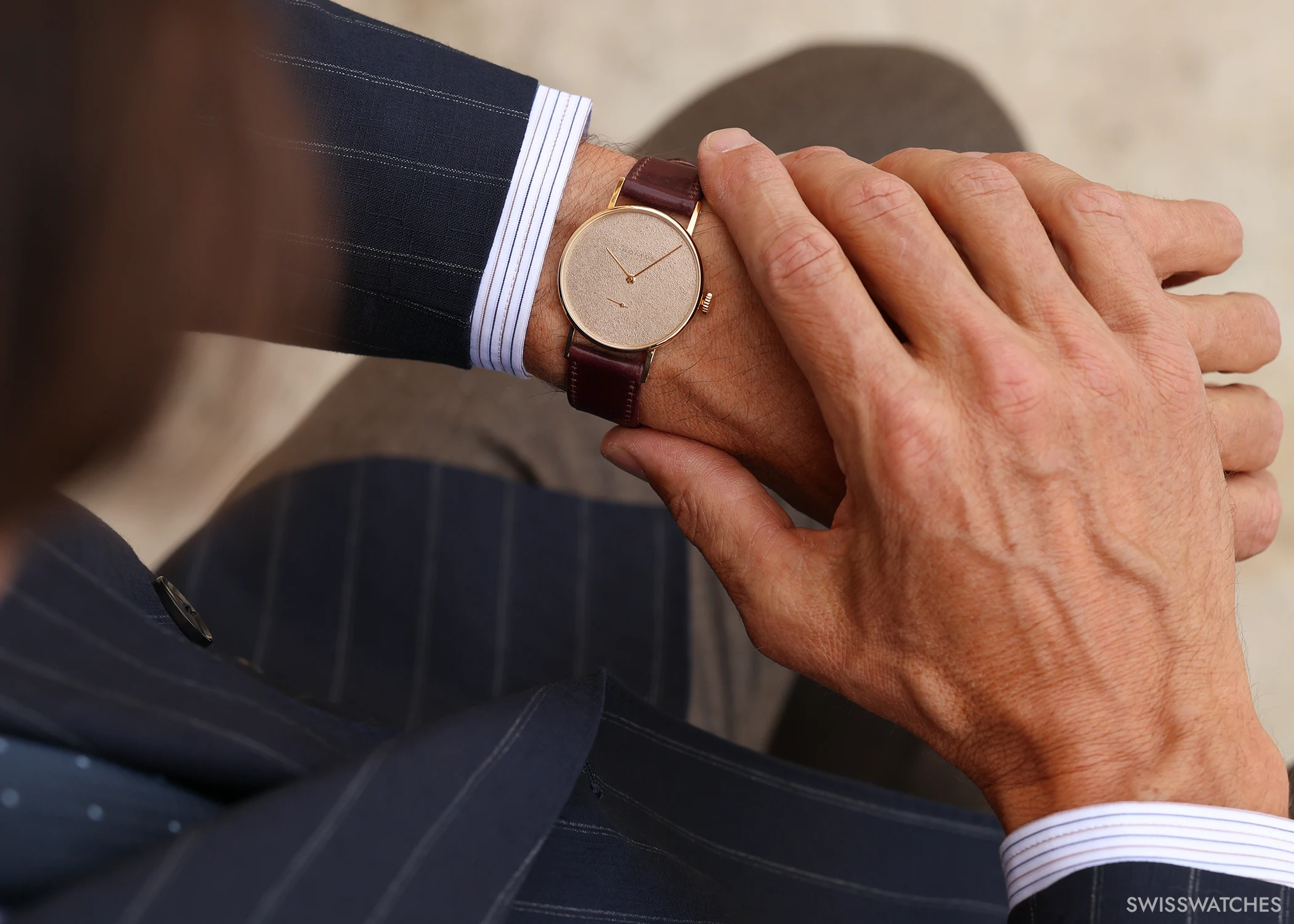
Twice Unique is sold exclusively as a pair: one watch in an 18-carat gold case, one in stainless steel; both the same size, both featuring the same calibre, and both with a hand-crafted dial that resembles the other yet is not identical. The collection is based on five Nomos classics: the Tangente 33, Tetra 27, Ludwig, Orion neomatik and Tangente neomatik 38 Update.
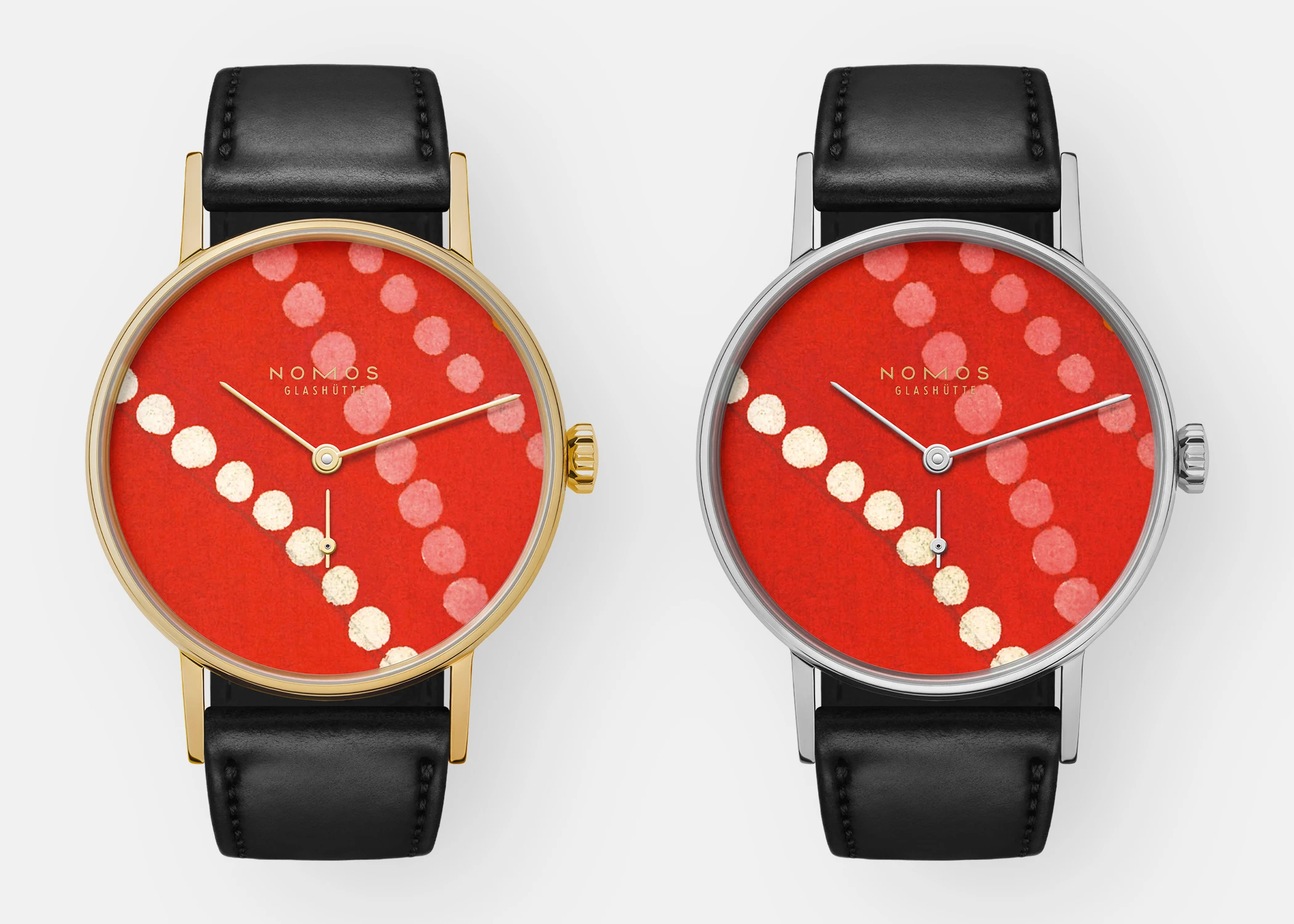
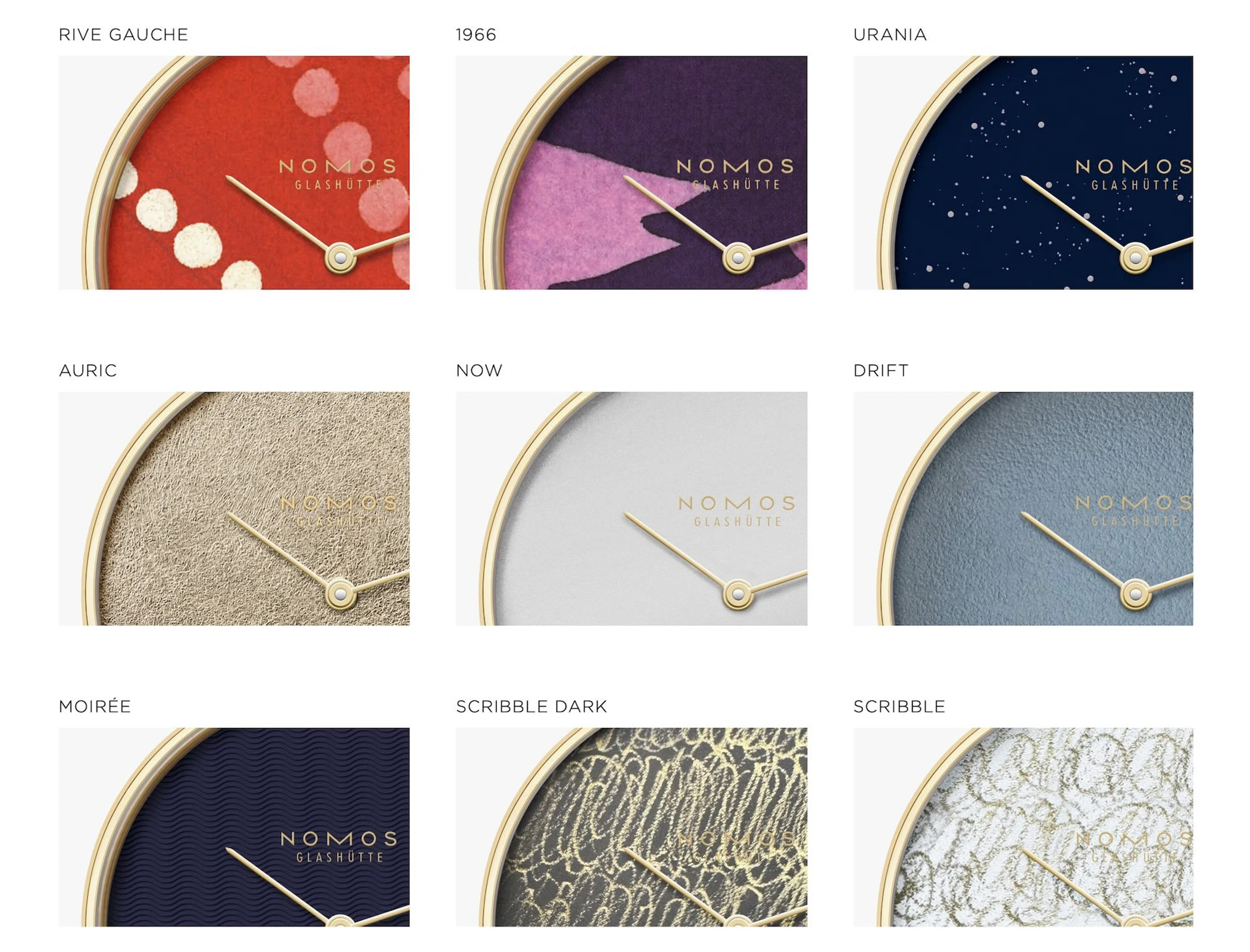
Added to this are nine completely different dial designs, which Nomos categorises by colour, technique and texture. Some were created in-house, whilst for others the manufactory enlisted the help of external craftswomen and artists. The Rive Gauche and 1966 models are based on sketches and watercolours by the textile designer Anna Diederichs, who, in 1960s Paris, created floral patterns that blended psychedelia and Op Art; the Nomos team selected sections the size of a dial and reproduced them using four-colour pad printing.
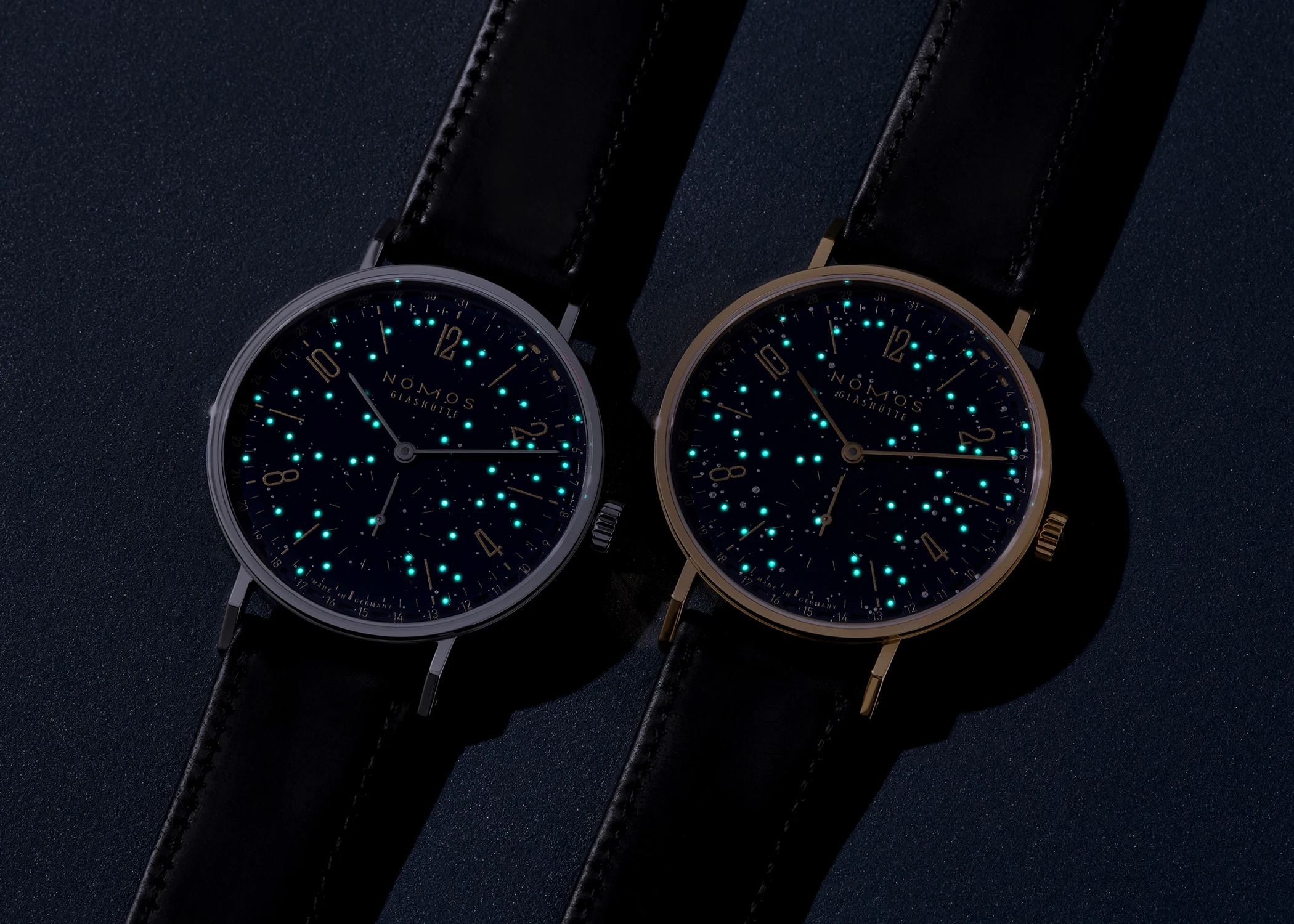
Moiré, meanwhile, is the brand’s first guilloché dial. For the ‘Now’ model, the dial is hand-polished over several hours using three different polishing compounds until it achieves a roughness of around one micrometre, and is then given a light matt lacquer finish. For the ‘Scribble’ and ‘Scribble Dark’ models, master goldsmith Saskia Licina has engraved patterns into the dial using a graver. Drift features a frosted dial with a smoky blue gradient, created using a kind of pre-industrial airbrush technique. On the Urania, silver stars have been speckled onto a dark blue background using a fine mouse-hair brush, some of them with Superluminova. And Auric is adorned with genuine gold leaf, applied by Michelle Sachs.
Five cases, nine dials: that makes 45 possible combinations, each made to order, one at a time, with its own serial number, and only until the end of 2026. Originally, there was to be just one pair per model and design; however, the response was so overwhelming that Nomos has expanded this limit. In this country, the pairs are available only on request; in specialist shops, they range in price from 15,600 euros for the Tangente 33 to 21,700 euros for the Tangente Update. Per pair, mind you.
“Twice Unique is complicated,” admits Martina Etti, Head of Business Development at Nomos and, this year, something of an ambassador for the collection. “It demands a lot from its audience.” And the question of why Germany’s largest watch manufacturer would even bother with such an elaborate concept is a valid one. Her answer has only a passing connection to the watches themselves – and certainly nothing to do with sales figures.
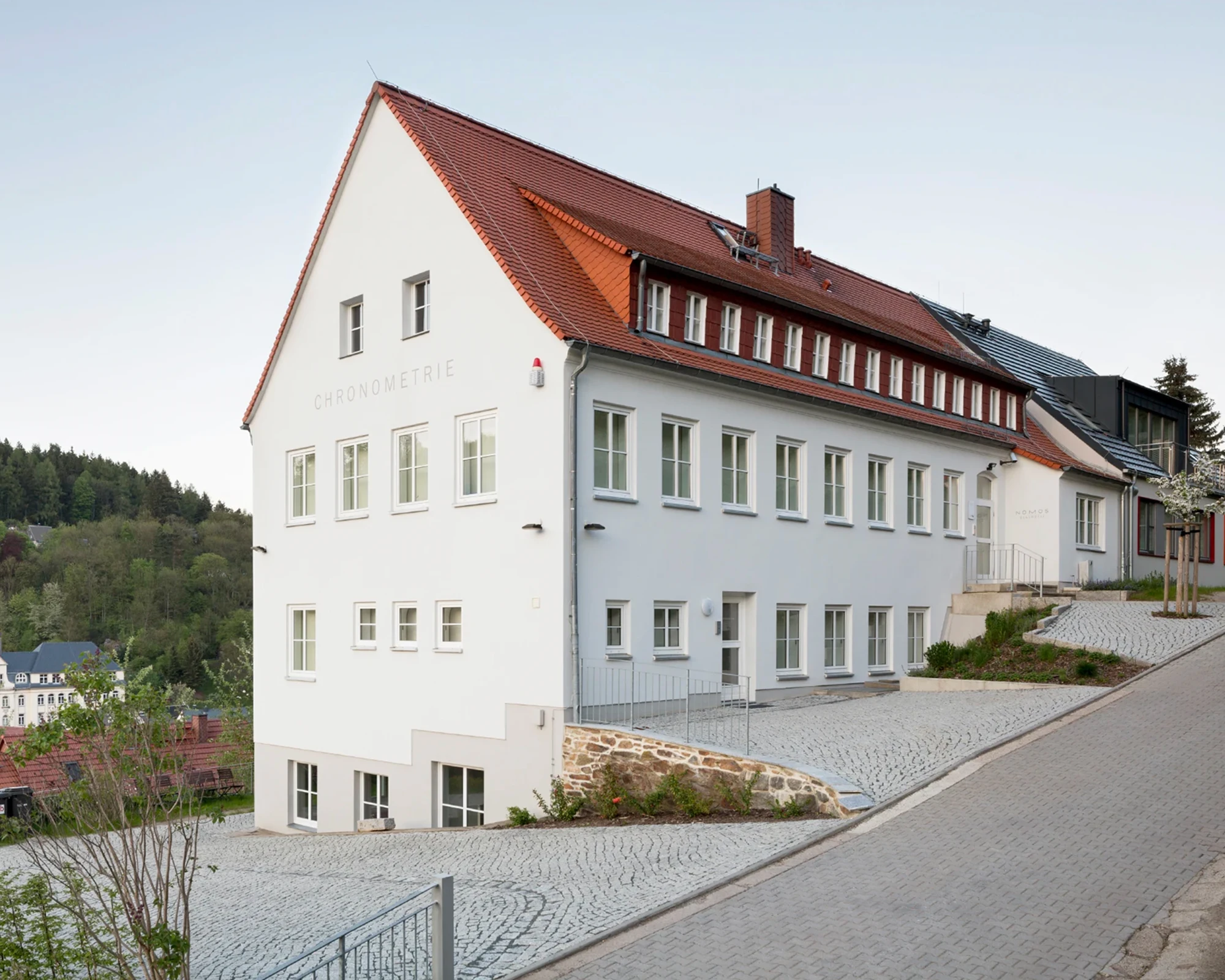
Martina Etti begins with a confession. Nomos, she says, has entered a world of luxury that it never intended to join. The brand was founded shortly after German reunification with a modest aim: to create a fine watch built to last a lifetime, crafted with integrity and based on solid watchmaking craftsmanship – one of those fine things that outlast a lifetime. Few models, but iconic ones. Watches whose design, materials and craftsmanship do justice to the legend of Glashütte.
However, the market in which Nomos operates today follows different rules. Etti describes them without polemic, but with a noticeable sense of detachment: manufacturers limit availability, making the products desirable to as many people as possible whilst ensuring they remain accessible to only a select few. Ultimately, people end up queuing for the privilege of being allowed to buy a handbag for 30,000 euros. “That’s an art,” she says, and she doesn’t mean it merely as a compliment. The principle behind it is simple: exclusivity as a process of exclusion. The more admirers are left out, the higher the status of those who are allowed in.
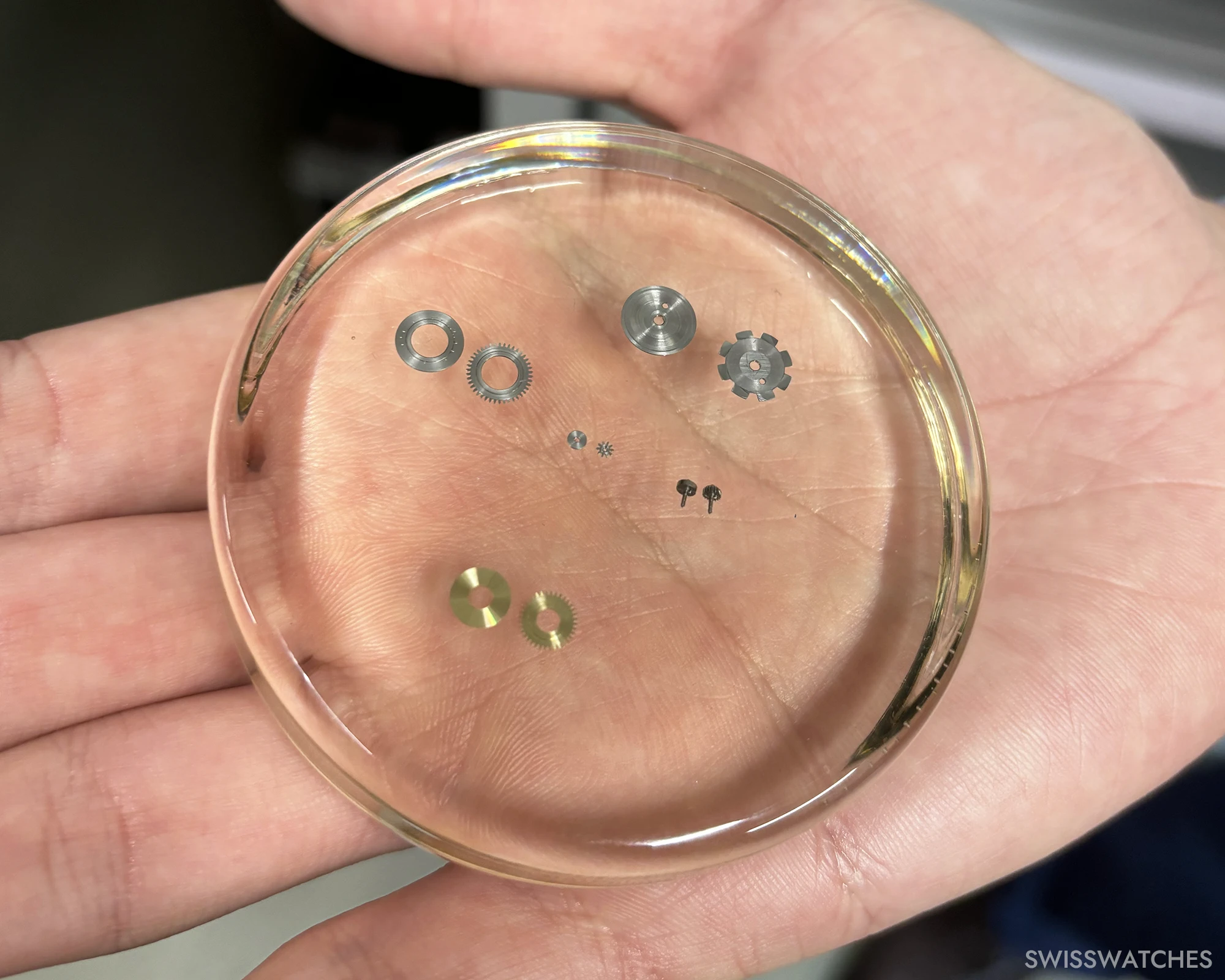
Following this line of reasoning, Nomos has been assigned a thankless role: that of an entry-level brand. A manufacture with the level of vertical integration that genuine luxury demands anyway, and at the same time the gateway to a fantasy world of ever more expensive watches. According to the unwritten rule that things can only go uphill from here: “That’s exactly what we never wanted to be,” says Etti. From the very beginning, they believed that magnificent movements and magnificent watches could be produced at a fair price, and they have impressively proven this over the last 35 years. There have long been collectors in the USA and Japan who own virtually every Nomos watch. And in Schlottwitz, Nomos has been manufacturing almost every wheel in its calibres in-house since xxx – something that very few brands and manufacturers can actually boast.

Our visit to the Nomos Glashütte manufacture reveals how tradition and modernity tick together.
Nomos knows that, in its price range, it is virtually unbeatable in terms of value for money. Meticulously finished in-house movements, award-winning design, and a much-praised value-for-money ratio. “And, ironically, it is precisely the latter that tends to be more of a handicap in the world of luxury.” However, a form of luxury based solely on price, celebrity and an expensively produced illusion is simply not what Nomos stands for. “Our luxury is built into the product itself, as quality at every level.”
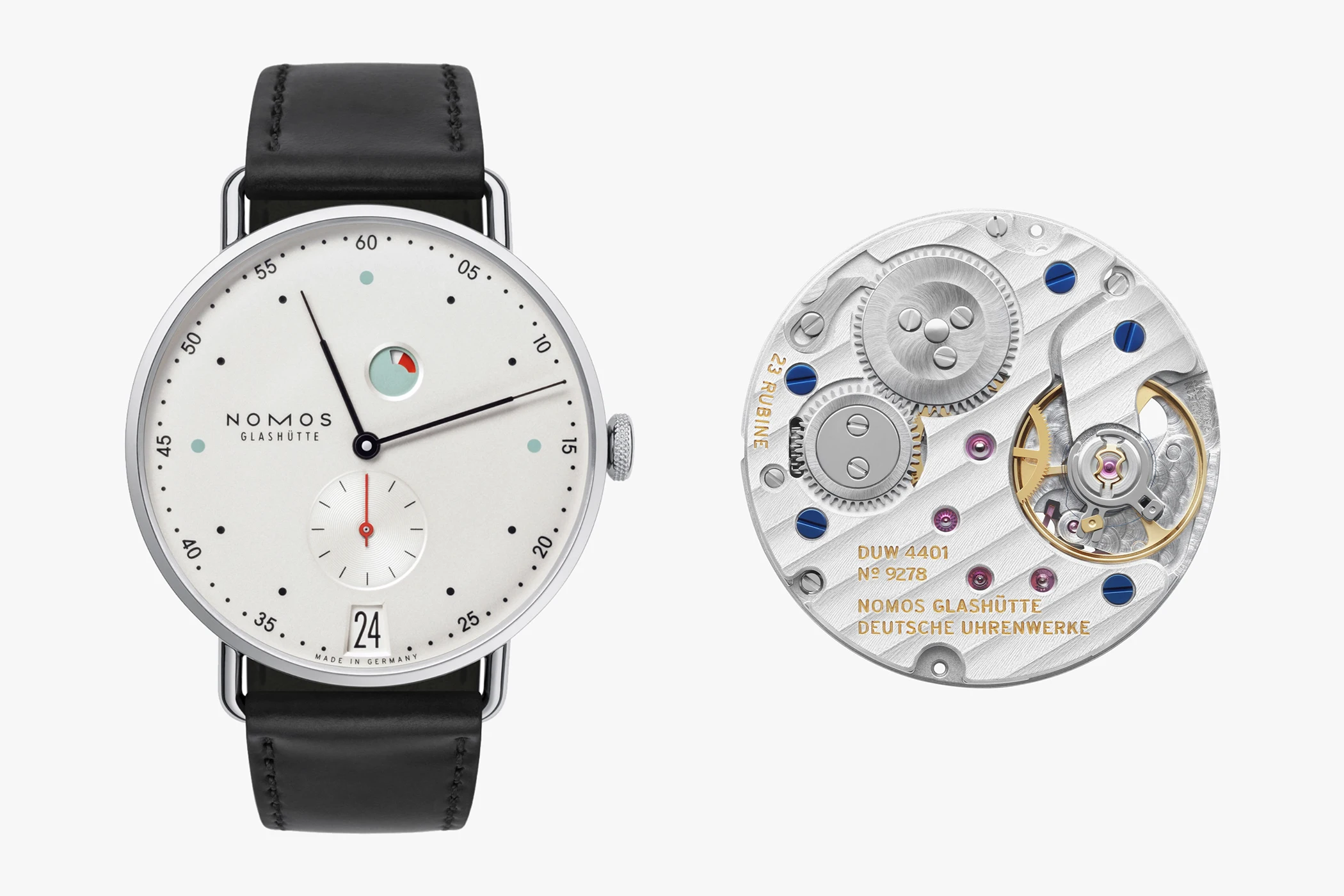
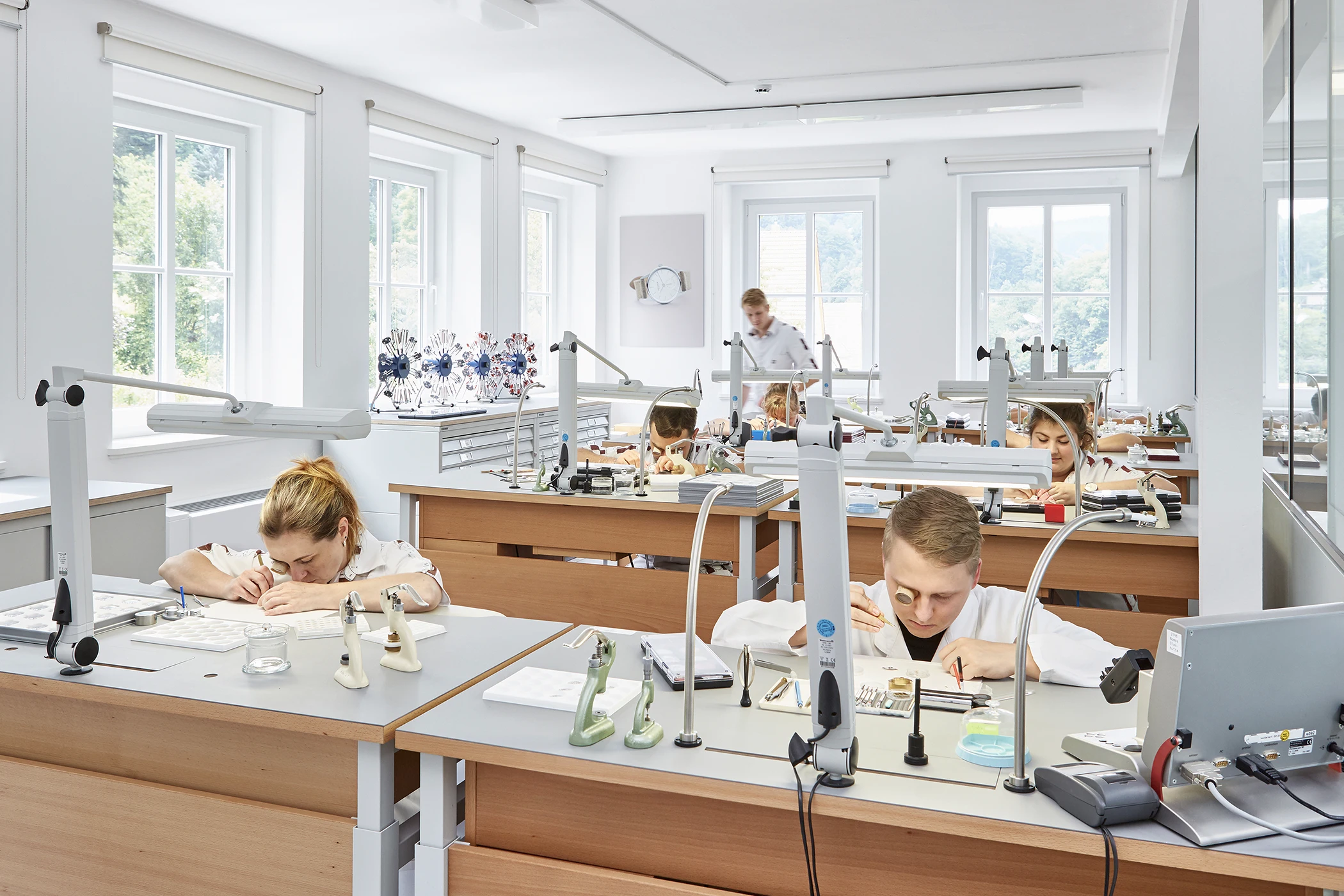
This brings us to the German manufacturer’s understanding of luxury: at Nomos, it comes from within. From the movement, from the materials, from the watchmakers’ craftsmanship. According to Etti, the gold case allows the in-house DUW calibre to shine and adds value of its own. What is crucial, however, is the craftsmanship inside, not the frame. “For anyone who understands that the art of watchmaking is the true art, the case becomes almost secondary.”
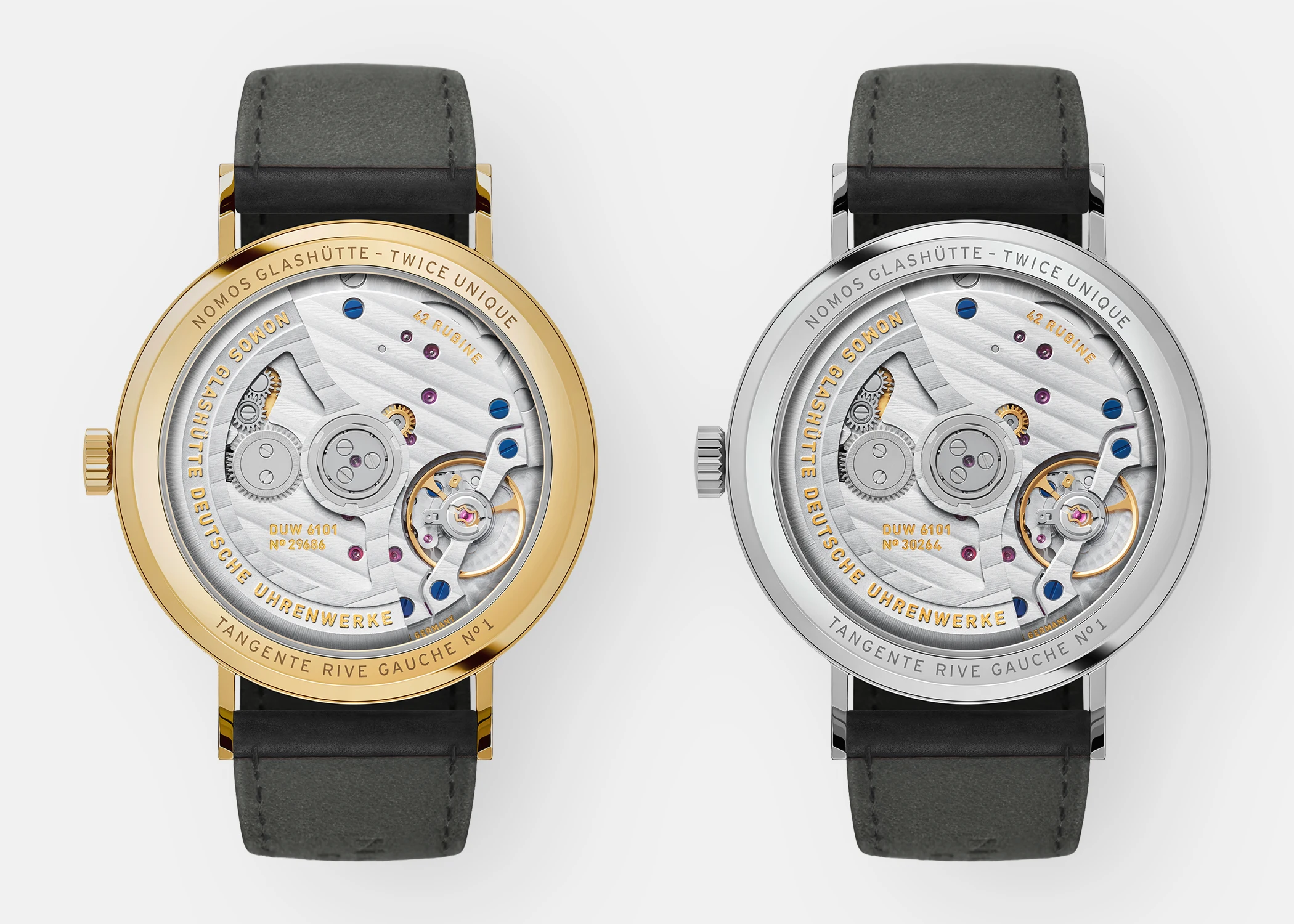
We at Swisswatches might go that far, but this is precisely where Twice Unique comes in. Two versions of the same watch – one in gold, one in steel – both with identical movements. This pairing is also an ironic, metal-clad dig at the competition: if the gold model is luxury, then surely the steel model can be too. And not through the usual interplay of price and status, but through the wearer’s appreciation of fine craftsmanship, the tradition behind the mechanics, and a contemporary design language.
Amidst all the reflection on modern luxury without ostentation, and amidst all the sound arguments, Etti admits that emotion has all too often taken a back seat at Nomos. Yet nobody buys a gold watch for rational reasons; the material value plays the smallest of roles. Behind it there is always a story, a special moment in a person’s life – or in the lives of two people. Twice Unique embodies the story of a shared experience. Who shares the two watches? Married couples, mother and daughter, father and son? Or grandfather and grandson? Do they swap? Who ends up with which one – or do both belong to both of them?
The feedback Nomos has received so far from customers of the range is as varied as the couples themselves. Young parents who are saving up for the gold watch for their newborn child and wear the steel watch together in their everyday lives. Two sisters – one a serious watch connoisseur, the other simply in love with the design. And a couple who, after much deliberation, realised that no Twice-Unique pair quite suited them, and instead ordered two classic Nomos gold watches in different sizes, with engravings, from their local retailer. That, too, says Etti, is a Twice-Unique story.
Nomos describes what it has learnt from this as a remarkable realisation: what is done in Glashütte has always been a form of luxury, though often unrecognised by the makers themselves. The difference lies in the fact that customers do not derive their sense of luxury from a brand backed by an endless marketing budget. “The luxury comes from the customers themselves.” It stems from their very personal passion and their perspective on craftsmanship and design.
The new gold models can certainly be interpreted as a paradigm shift: ‘Hard-working and modest’ – Etti says these two words in German in the middle of her English presentation – ‘we no longer want to be just that’. We will no longer hide our light under a bushel. For Nomos, however, gold does not mean exclusivity or exclusion in the literal sense due to a higher price. “It is rather a further sign of respect for the art of watchmaking.”
Once you’ve learnt about the origins of Twice Unique from Martina Etti, the way it’s brought to life by craftswomen such as Michelle Sachs becomes perfectly clear: she is a master gilder, has been in the trade for 20 years, and runs her own workshop in Berlin. Gilding is a recognised apprenticeship trade in Germany, lasting three years, ‘just as one can train to be a joiner or a painter’. Sachs trained at a Berlin picture-framing workshop, where she gilded and decorated picture frames. For their lessons, the apprentices had to travel to Munich: that is where the country’s only vocational school for gilders is located, and it is also home to the only master craftsman’s school. Just how rare this craft has become is illustrated by one figure: most recently, there were between six and ten apprentices per intake. Not per city. In the whole of Germany.
Credit © Michelle Sachs
Sachs has deliberately moved away from the traditional career path – regilding frames and restoring frames and furniture. There are enough conservators, she says. She set her sights on bigger projects. Architectural gilding: a bathroom alcove, living room walls, the ceiling of a shop, an entire gallery space in Berlin. At the Staatsoper Unter den Linden, she gilded gold mouldings and 20 banisters on the main staircase. In Georgia, she spent weeks gilding a four-metre-high cross on a church. Tower clocks, fence finials, sculptures such as the ‘Goldelse’ on Berlin’s Victory Column – all of this is the work of a gilder.
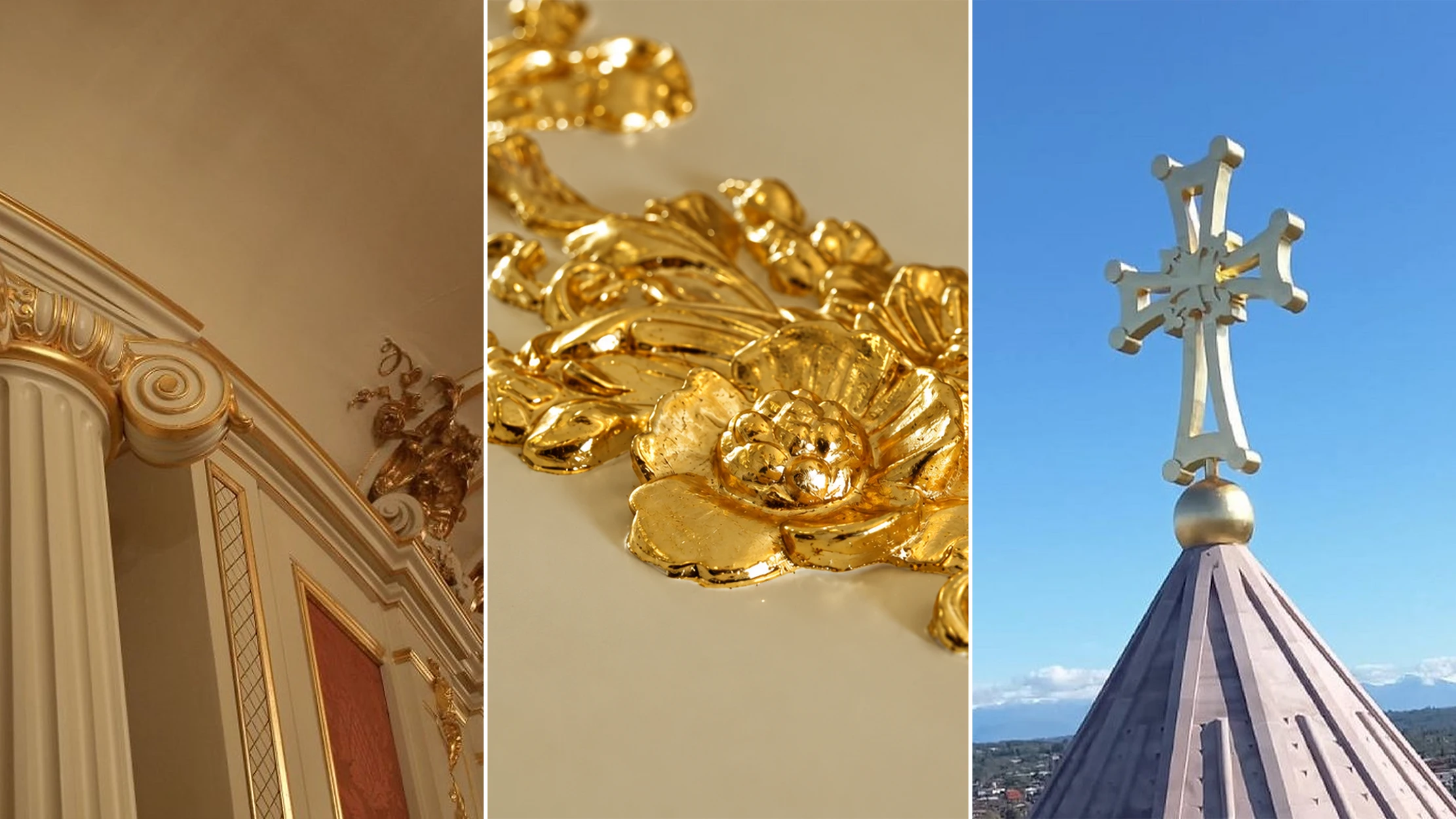
Credit © Michelle Sachs
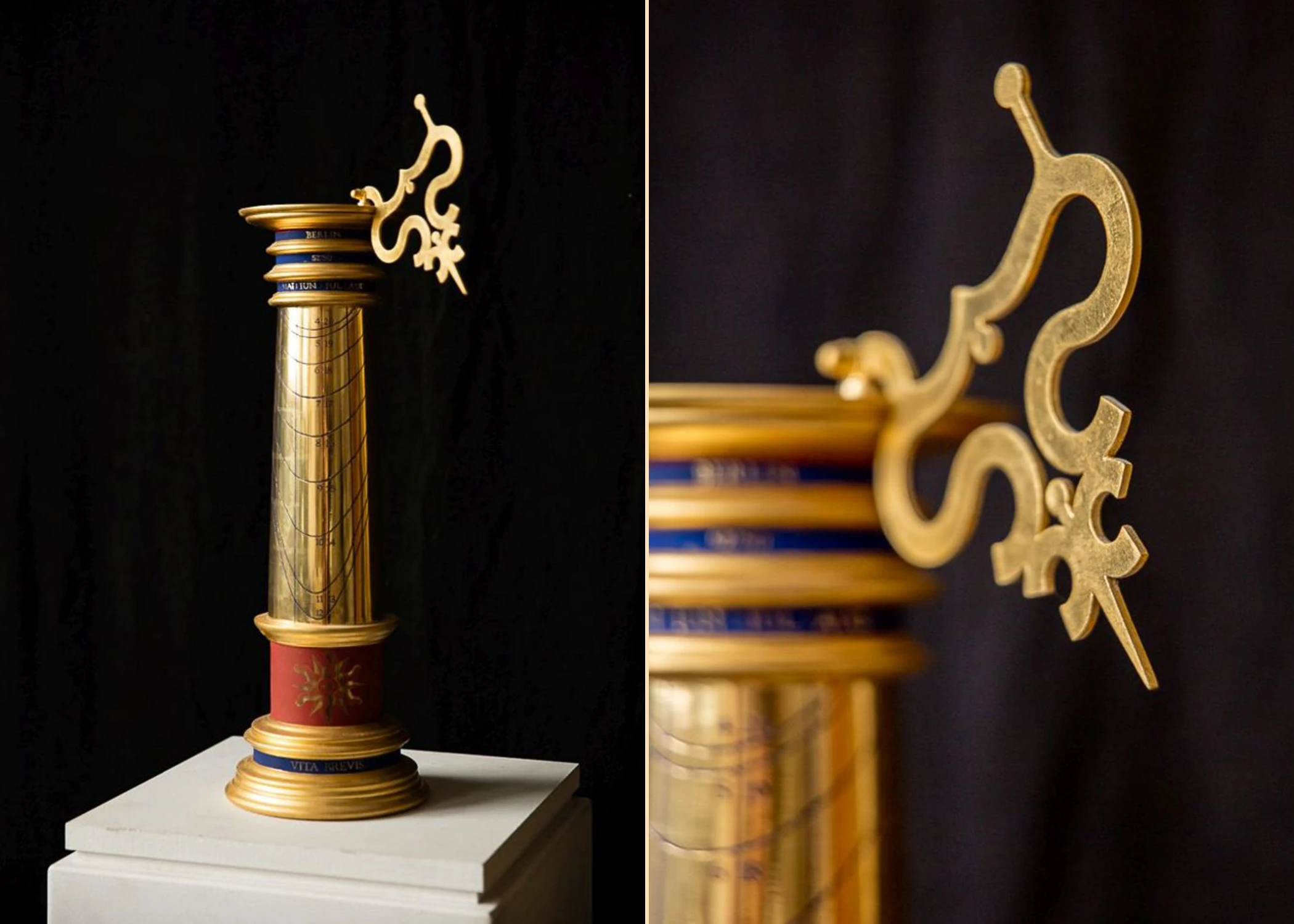
It is striking how often the concept of time features in her work, long before Nomos came calling. For her journeyman’s piece, she chose a travelling sundial modelled on a 16th-century example, made for merchants who wanted to carry a timekeeping device in their pockets – complete with a shadow-casting mechanism, numerals and hour lines, all finished in poliment gilding.
Credit © Michelle Sachs
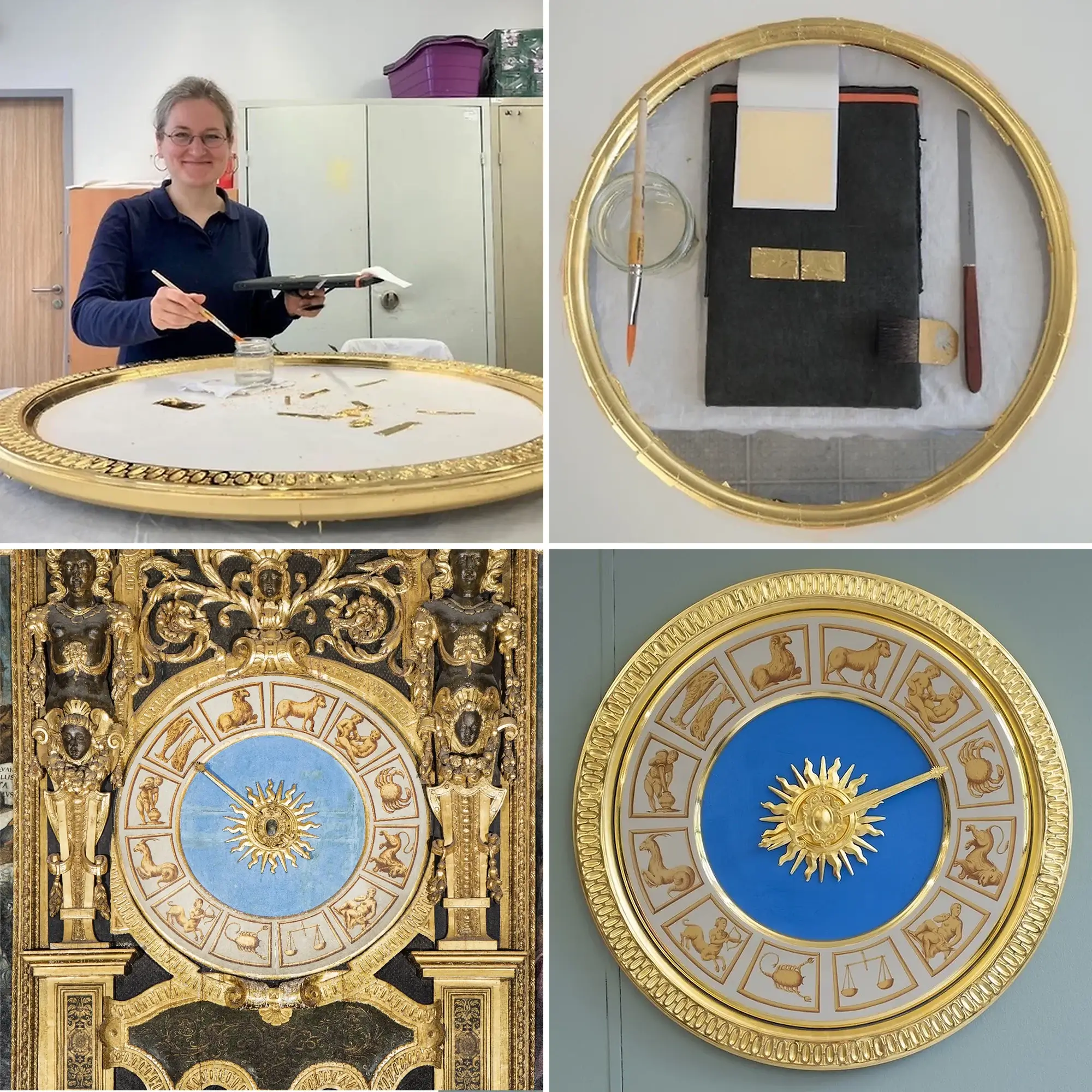
Her masterpiece was created three years ago, based on an original she had seen at the Doge’s Palace in Venice: a zodiac clock with a moving hand, 84 centimetres in diameter. It is made from MDF, a simple wood fibre board. The preparatory work took months; the actual gilding took a week. “Gilding is also the art of creating an illusion,” says Sachs. “I do everything I can to make it look like solid gold.”
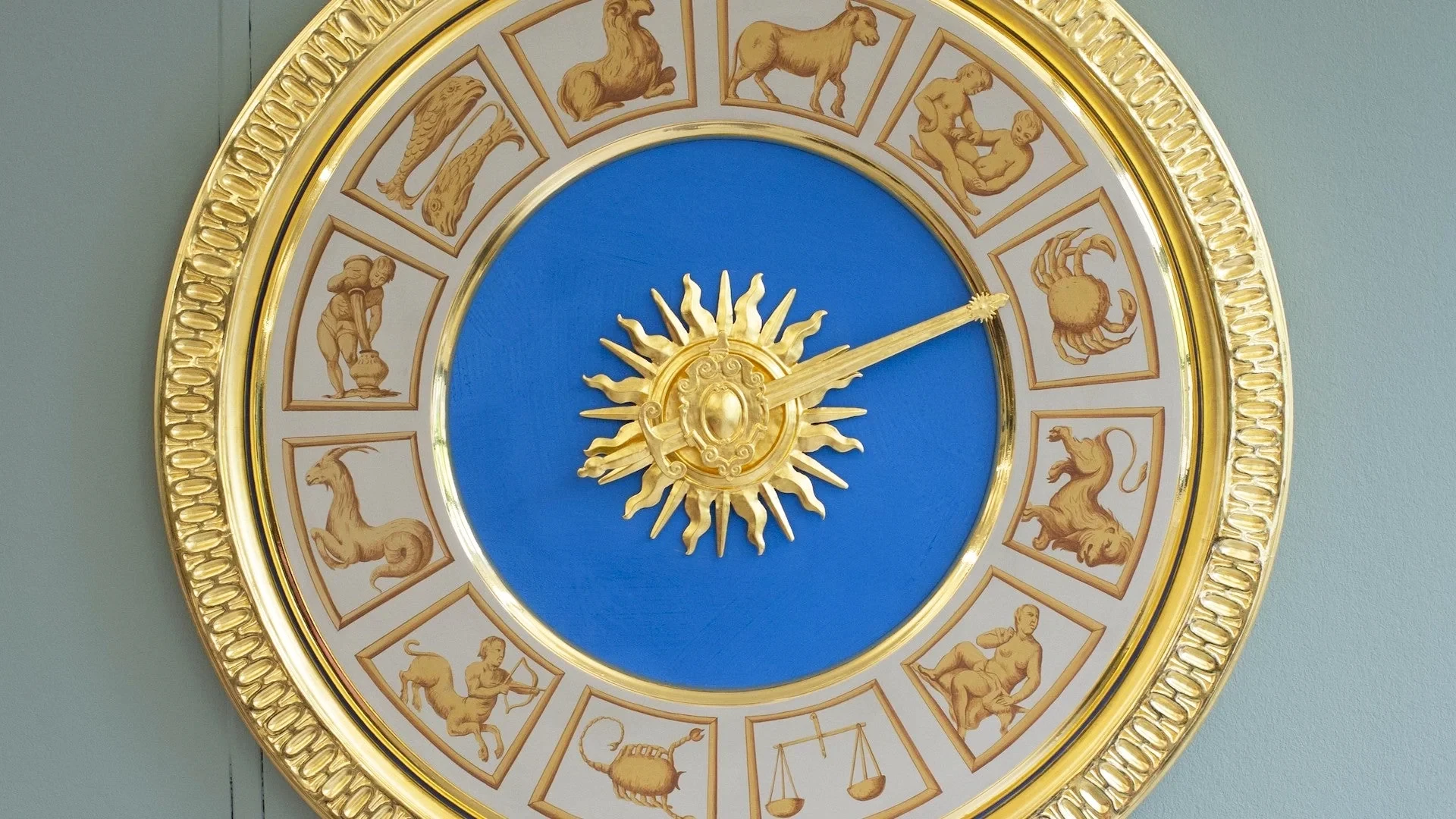
Credit © Michelle Sachs
The fact that she gilds dials at all is down to a stroke of luck. One day, the phone rang. Could she imagine gilding dials? Sachs was sceptical. A watch has to work, the hands have to be able to move, and the consultation process is time-consuming. It was only right at the end of the conversation that the caller from Nomos’s Berlin design team – known as BerlinerBlau – mentioned that he was enquiring on behalf of Nomos. And by that point, Sachs was already wearing a Nomos on her wrist, a gift from her boyfriend, given to her a good year earlier. “That’s when it clicked.”
To understand what goes into an Auric dial, you have to travel to Franconia. In Schwabach, near Nuremberg – the ‘gold-beating town’ – Germany’s last two gold-beating workshops are still in operation.
It all begins with the smelting furnace. Not all gold is the same; as in jewellery-making, it is alloyed with silver, copper or platinum, depending on the desired colour and carat weight. A small ingot weighing between 600 and 800 grams is produced in the crucible. This is rolled into a strip 50 to 60 metres long, which is then cut into pieces measuring approximately four by four centimetres. Around 1,300 of these small plates are stacked, each separated by fine glassine paper, and tied into a bundle. Then the hammering begins.
Twenty or thirty years ago, men used to do this with hammers weighing up to twelve kilograms; today, spring hammers have taken over. Each small plate is turned into a sheet measuring ten to 13 centimetres, which is then cut into nine pieces, reinserted and hammered again. This process is repeated until it measures one ten-thousandth of a millimetre: 0.1 micrometres, 600 times thinner than a human hair. Then comes a remark that audibly amuses the watch experts in the hall, who have travelled from all over the world: the gold leaf is thinner than the tolerances in Nomos’s production. To be precise, thinner than the tolerances in the entire watchmaking industry – though we make no claim to completeness here; who knows whether someone at Rolex isn’t already thinking in these terms in a laboratory?
But back to the manual work. Trimmers, who do nothing else all day, trim the irregular edges with a tool called a ‘Karren’ or ‘Schlitten’, first lengthways, then crossways, until the standard German size is achieved: eight by eight centimetres. Using ebony tweezers, they place each sheet into a booklet made of tissue paper. Twenty-five sheets per booklet – that is the smallest unit sold.
Sachs exhibited her tools at the forum: a gilding pad on which the gold leaf is placed; a gilding knife with which she cuts the gold into the pieces required for the object; and a brush made from the tail hairs of Siberian squirrels. Only a brush this soft can pick up and apply the gold leaf without damaging it.
According to Sachs, however, the actual gilding is the smallest part of the work. “The gold leaf is just the tip of the iceberg, the icing on the cake.” In the case of traditional poliment gilding on wood, she first applies layer upon layer of a chalk base, mixed from rabbit glue and chalk, then sands and smooths the surface before applying a special clay, the poliment. It is a technique that has hardly changed over the centuries, and whose origins Sachs traces back to India. Only then does the gold follow. And even then, it does not yet shine. “It can only shine once I’ve polished it.” This is done using an agate polishing stone. The fact that a layer just a ten-thousandth of a millimetre thick beneath the stone transforms into a mirror-like high gloss is one of those things you have to see to believe.
The most important lesson to be learnt from their craft is also the one that best reflects Nomos’s ethos: the gold reveals everything that lies beneath it. If the surface is smooth, the gilding will be smooth and shiny. If it is textured, the gold leaf will reflect that texture, with light and shadow. When gilding the exterior, it is solely the weather-resistant preparation that determines whether the gold will last for decades. “The layers beneath the gold are the most important thing.” You only need to tweak this sentence slightly, and you have the corporate philosophy from Glashütte: what matters lies hidden beneath the surface.
And it is a task that cannot be rushed. Anyone who works with gold leaf, says Sachs, moves as if in slow motion. “I have to be in the moment, focused. It’s like meditation. I have to slow down, otherwise I lose myself, otherwise I lose the leaf.”
The name gives away the material: Auric, derived from the Latin word ‘aurum’. The dials in this edition are first treated with a milk-based primer, a bonding agent onto which Sachs applies the gold leaf in several stages, with drying intervals in between. The gold is applied, torn, layered and reapplied.
One of the hurdles was the lettering. The name ‘Nomos’ then had to be printed onto the finished gold-plated leaf – uncharted territory for dial production too. Will the print hold up on the gold? “It doesn’t always work,” says Sachs. That’s why, for each model, she gold-plated not only the two leaves in a pair, but also spare and test samples. In total, she estimates, no more than a handful per model. She hasn’t counted them exactly.
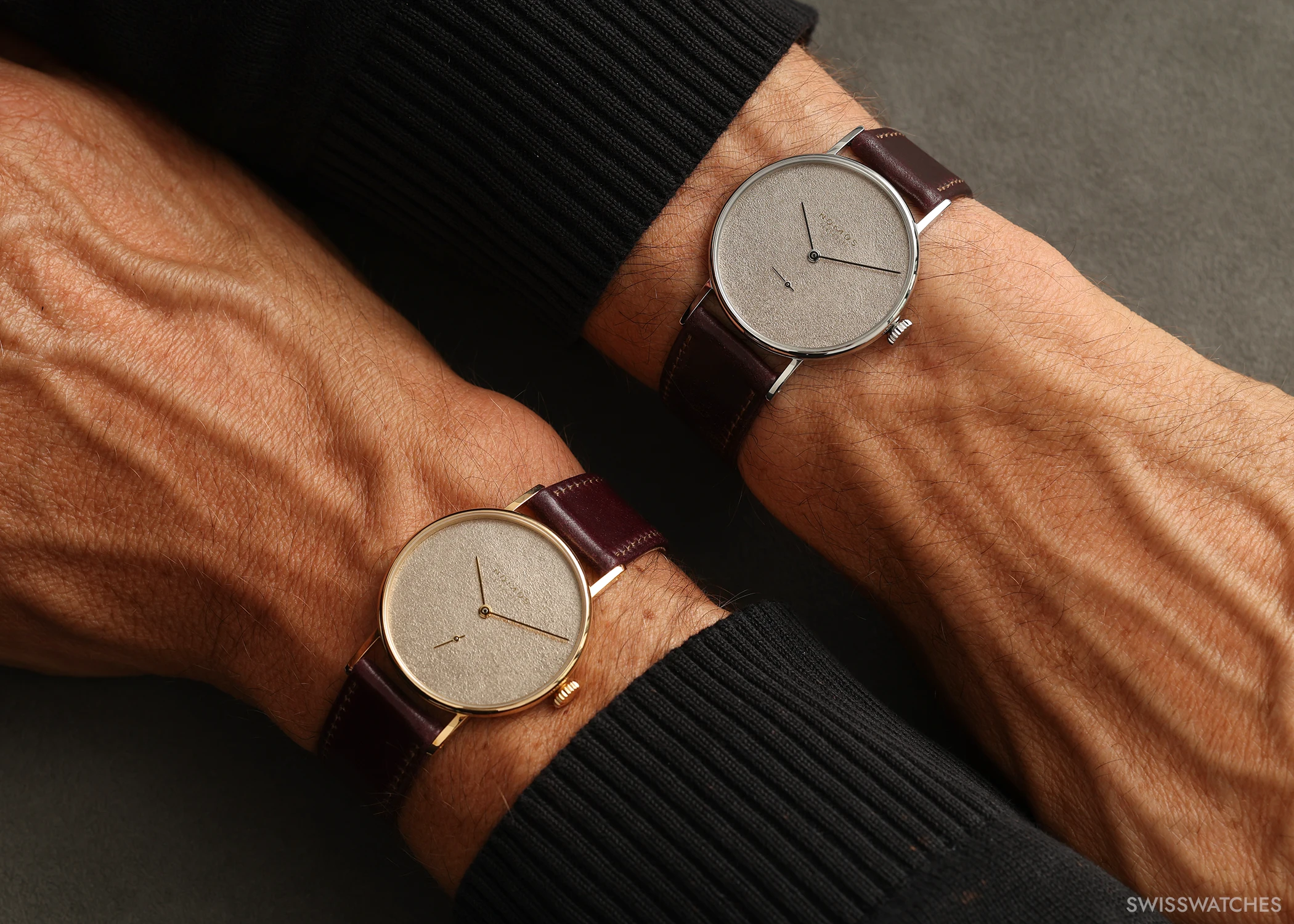
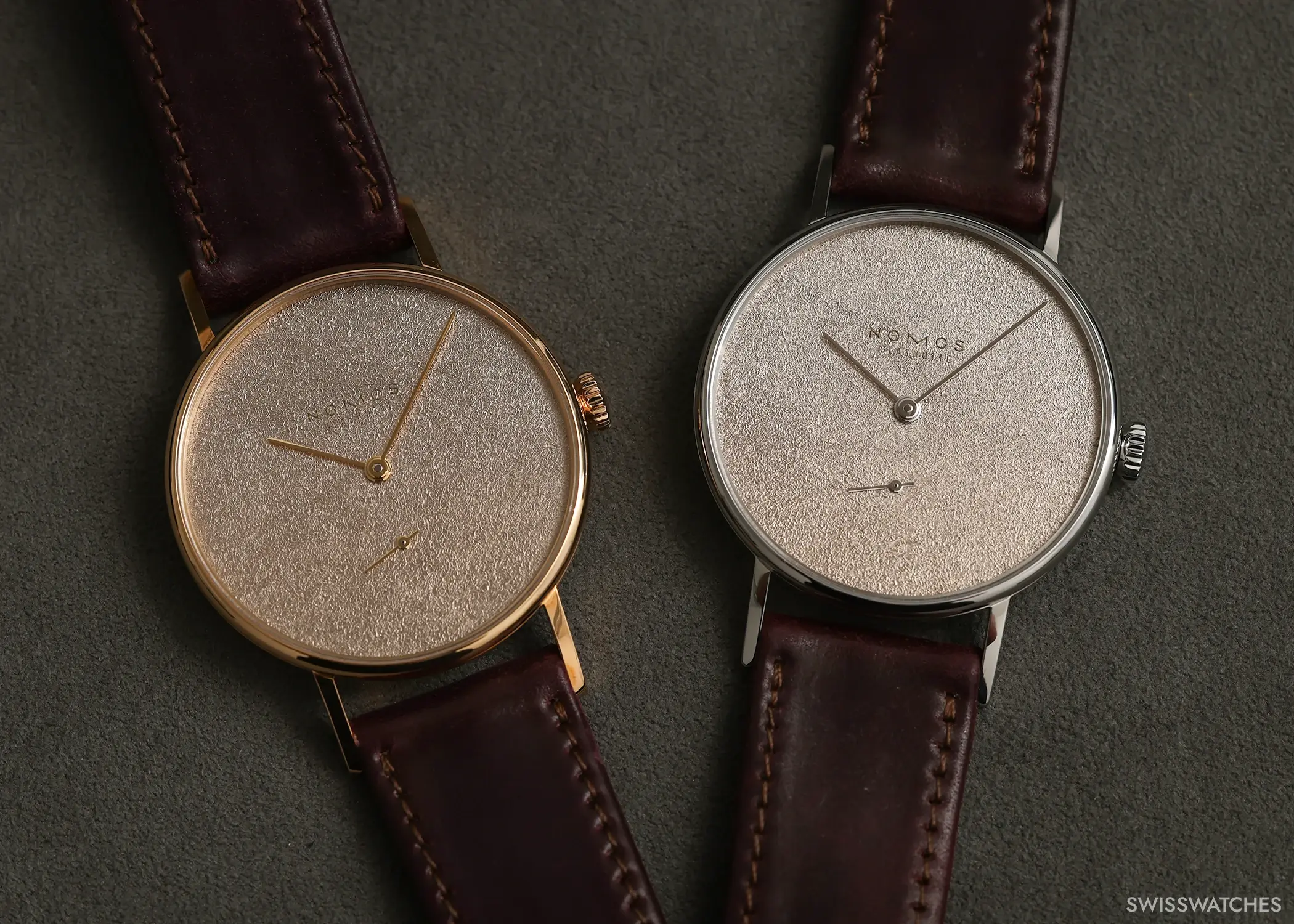
The greater challenge was a creative one. Twice Unique promises one-off pieces that nevertheless form a pair. “That’s the fine line,” says Sachs. “I have an incredible amount of scope on a surface like this. But there has to be a consistent style, so that a customer doesn’t say: ‘That looks completely different from mine.’ Each leaf should be recognisable and yet differ from the next.” Placed side by side – the gold watch and the steel one – you can see it: small creases in the gold, a sparkle here, a denser area there, traces of how the sheet fell when it was laid down. Beneath, the structure of the base shows through, sometimes lighter, sometimes darker, depending on how the light falls.
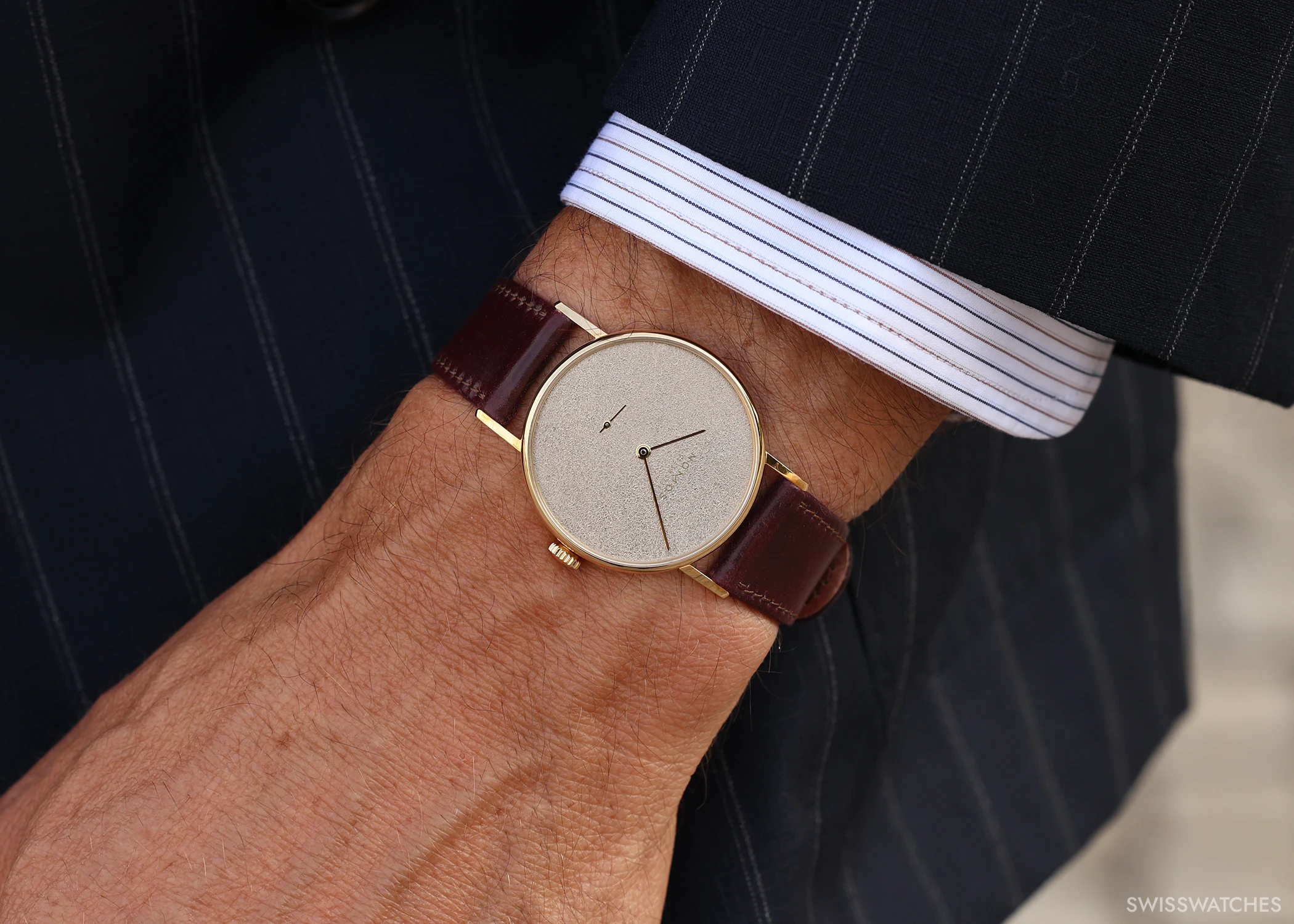
Then there’s the colour. Anyone expecting a warm yellow from Auric is in for a surprise. There are more than 30 colours of gold leaf, ranging from red to green to white gold, as well as silver, platinum and palladium. For Auric, the team chose an alloy containing more than 80 per cent gold, supplemented with palladium and a carefully balanced amount of silver and copper. Palladium has a special property: it decolourises gold. In the right proportions, the yellow hue disappears almost completely. The result is a metal that barely looks like gold, yet consists predominantly of gold. Added to this is an effect that NOMOS itself highlights: although both leaves in a pair are made of the same material, they take on a different hue depending on the case – warmer next to gold, cooler next to steel. They shimmer without casting a clear reflection.
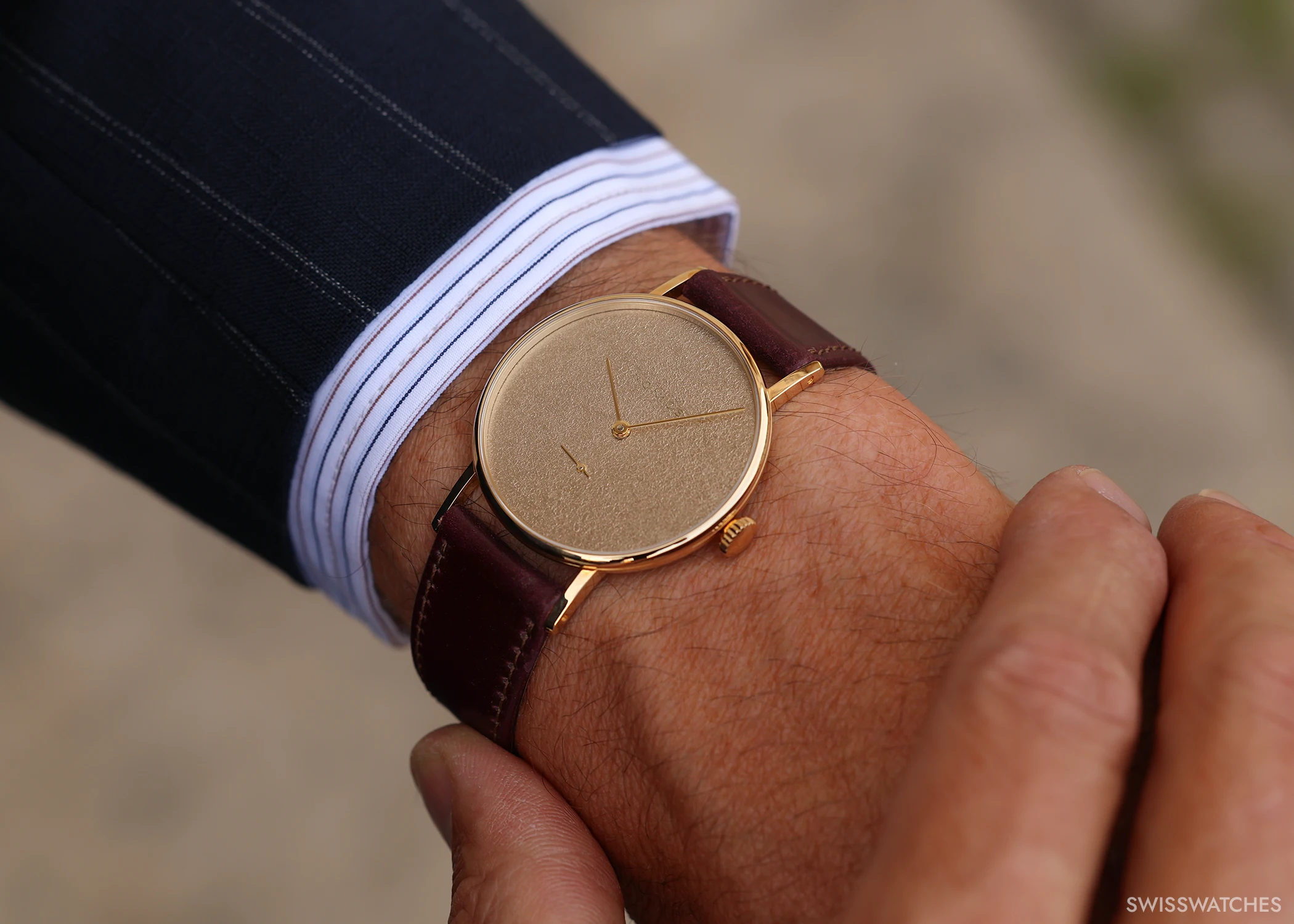
There is scarcely a more apt image to illustrate what Nomos is attempting to achieve with Twice Unique. A dial covered in almost pure gold, yet one that refrains from flaunting its golden splendour. A precious quality that one only recognises once one knows what to look for. On the display stand, alongside the Auric samples, lay a piece of unprocessed gold leaf made from the same alloy. It looked completely different. The light, says Sachs, makes all the difference.
The communication problem faced by Twice Unique is not one specific to Nomos, but rather one of our times. By its very nature, sophistication lies in not being obvious. It rewards a second glance, a closer look, and an appreciation of the difference. The closer you get to the dial, the more striking it becomes. The world in which watches are perceived today works in exactly the opposite way.
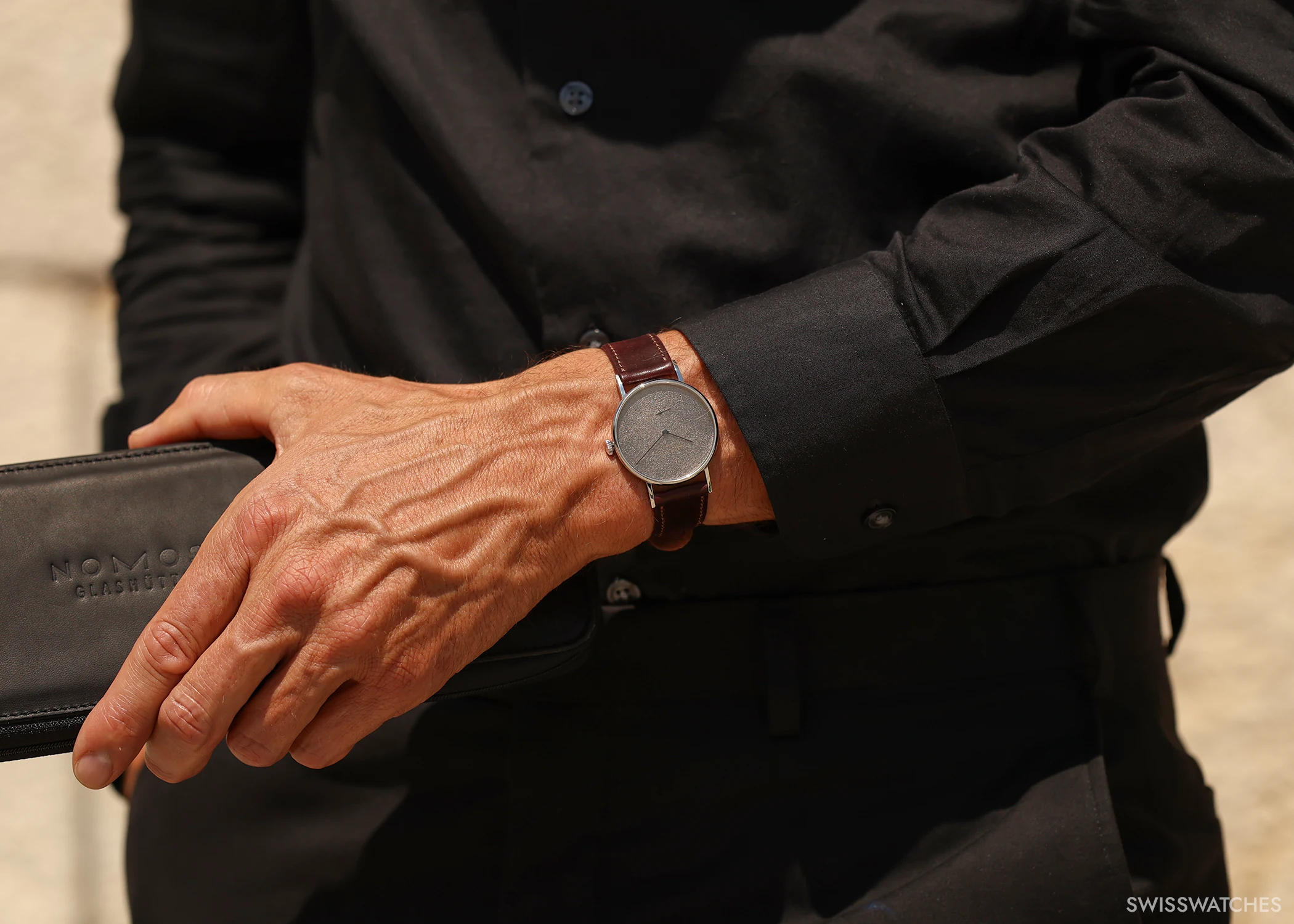
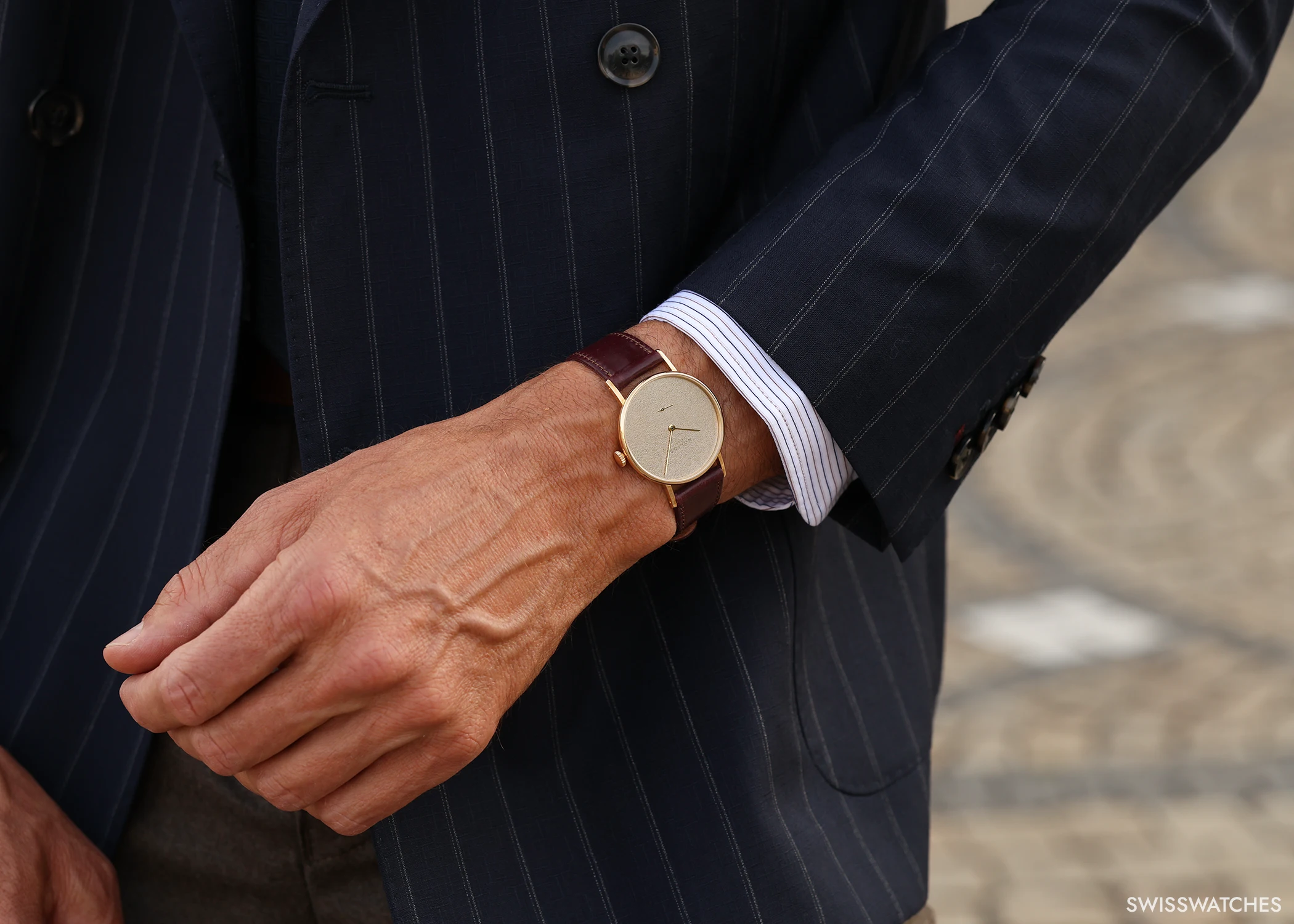
On Instagram, people decide in a fraction of a second whether an image deserves attention. A product has to speak for itself there before the next post takes its place. What wins out there is what stands out: the iconic silhouette, the name that instantly signals status, the colour that jumps out of the feed, the price that gets people talking. A palladium-tinted gold leaf, whose folds are only visible in oblique light, stands no chance on a 1080-pixel-wide square. A photograph shows a light-grey surface. It does not reveal that there lies a ten-thousandth of a millimetre of gold, applied with a squirrel-hair brush by one of the country’s few master gilders.
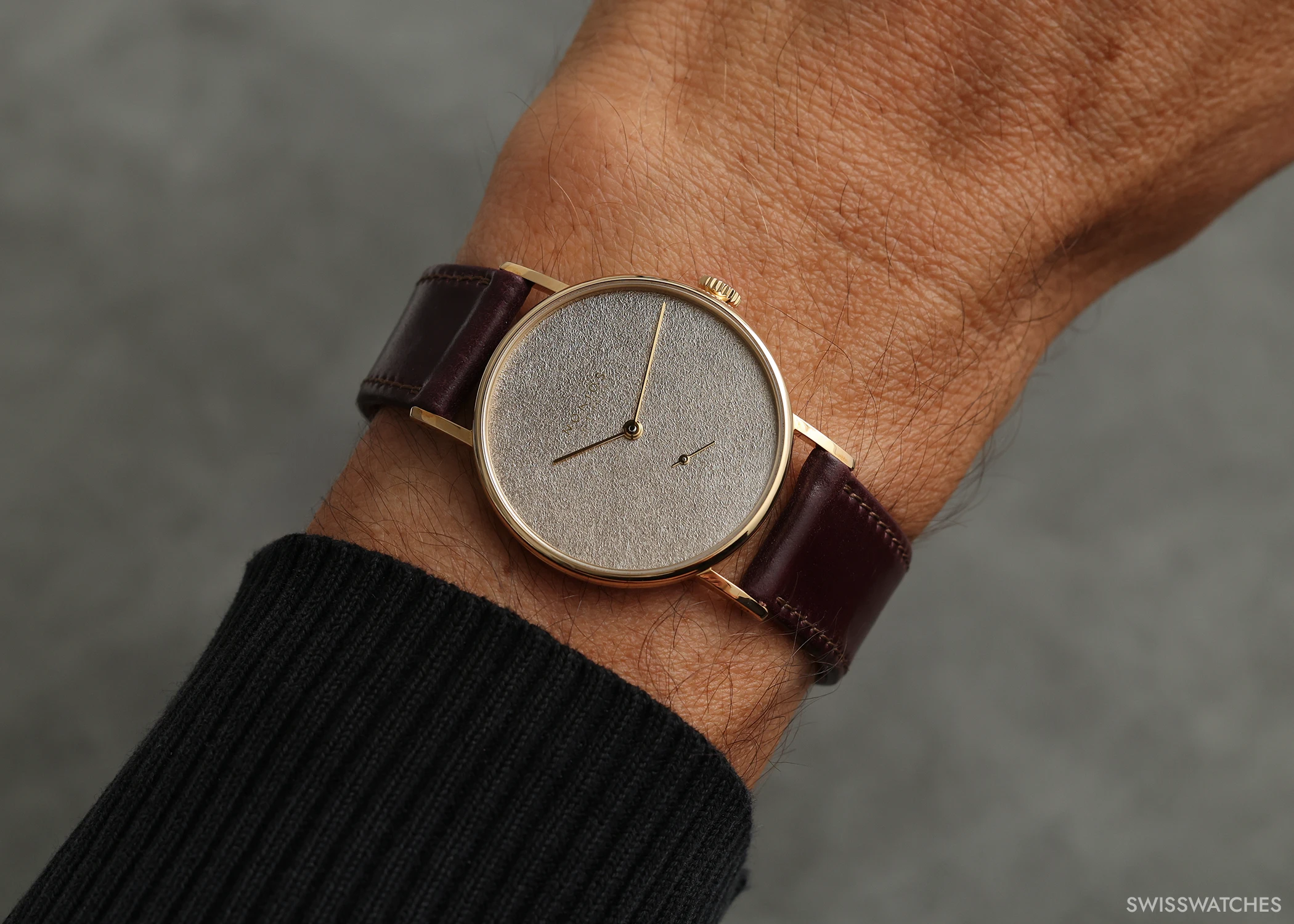
It becomes even more difficult when it comes to the ‘pair’ concept. A single image can show two watches. However, it cannot convey a stance on who shares them, or why the steel model is not a stopgap solution.
Twice Unique needs stories, and stories need time – the resource that is in shortest supply on Instagram. The fact that many media outlets did not quite understand the range at the trade fair is therefore less a failure of communication than a credit to the brand for not simply producing products designed to please straight away: a luxury product that could be fully explained in a single second would not be Twice Unique – nor, ultimately, Nomos.
Refinement is difficult to capture in images, but it can be experienced: at the jeweller’s, as the couple examines the piece closely; in the workshop; in conversation; and in moving images that allow the light time to play across the gold. This is a slower and more labour-intensive process than any advertising campaign. But true connoisseurship has, after all, always taken a little longer.
Nomos could have made things easier for itself. A limited-edition gold model, a price that makes the headlines, a waiting list that fuels desire – these are tried-and-tested tactics. The fact that the brand does not make use of them also has to do with its origins. Nomos has been a member of the Deutscher Werkbund from day one – an association founded in 1907 that viewed design as a matter of quality, materials and function, rather than as a matter of ornamentation and status.
One of the guiding principles of the Werkbund remains evident at Nomos to this day: money invested in fine craftsmanship is never wasted. Following the rediscovery of the glassworks, the founders were expressly determined not to return to a system where such craftsmanship was a luxury reserved for a privileged few, as in the early days of watchmaking. Fine and beautiful things for the many, not just for the ‘happy few’.
This approach takes time. A brand that bases its appeal on vertical integration, the Werkbund ethos and functional design will not be perceived as a luxury brand overnight. It must build its credibility bit by bit – through every discussion with a retailer, every timepiece from Schlottwitz, and every customer who sees the steel model not as a budget version, but as a watch in its own right. The rewards of taking this detour, however, can be considerable.
Anyone who bases their notion of luxury on scarcity and price is dependent on both and must keep raising the bar ever higher. Anyone who bases it on substance – on what lies within the watch and how it is made – possesses a foundation that requires no artificial embellishment and is not at the mercy of fluctuating levels of desirability.
Therein lies the strategic point: the collection frees Nomos from being pigeonholed as a ‘value-for-money’ manufacturer, without sacrificing its own identity. It demonstrates that the brand can work with gold, can create fine craftsmanship, can produce one-off pieces – and that it does so in its own way. Here, the gold does not serve as a marker of distance, but as a tribute to craftsmanship and to the legend of Glashütte. And the steel model alongside it is proof that luxury does not lie in the case.


Etti points to another argument that extends far beyond Nomos: the customer base for fine mechanical watches is shrinking and ageing. An industry that defines its luxury solely through exclusivity will, in the long run, also exclude the next generation. A concept of luxury that focuses on knowledge and appreciation rather than restricted access opens the door to people who buy their watch not as a status symbol, but as an expression of their own discernment. This is perhaps the most modern idea in a project that uses hare’s glue, squirrel hair and spring hammers.
Towards the end of her talk, Michelle Sachs once again turns to a subject that goes beyond technology. Gold is found on every continent, and almost every culture has used it for at least 4,000 years, from the Egyptians to the Maya. It symbolises wealth and power, often reserved for kings and gods. But it also reflects light – warm like sunlight – and brings light into a room. “Gold can bring people together, not just divide them,” she says, looking out across a hall full of people from different countries.
Gold is also durable and can be remelted time and time again. “Perhaps the gold leaf we’re working with today was a wedding ring 100 years ago.” Eternity and the fleeting moment, says Sachs, are closely intertwined in the art of gilding. The material endures for generations, and yet everything is decided in that single, intense moment when the leaf glides from the brush onto the surface.
When asked what she would like to gild one day, she doesn’t have to think twice. She prefers exterior gilding, “because then it’s visible to everyone, at least in theory, and not just reserved for certain people”. Her dream would be a large golden dome that can be seen from afar.
It is a phrase that could just as easily have come from Nomos. Luxury that does not exclude, but shines out for anyone who looks. With Twice Unique, however, you have to get closer than you would to a dome. Those who do so will be rewarded.
Nine dial editions (Rive Gauche, 1966, Moiré, Now, Scribble, Scribble Dark, Auric, Drift, Urania) across five models, available only as numbered pairs in 18-carat gold and stainless steel, produced to order until the end of 2026, available from authorised retailers. Price in Germany: on request. Guide prices from US specialist retailers, per pair:
| Model | Movement | Price per pair (EUR) |
| Tangente 33 | DUW 4001, Manual winding | 15.600 |
| Tetra 27 | DUW 4001, Manual winding | 16.100 |
| Ludwig | DUW 4001, Manual winding | 16.500 |
| Orion neomatik | DUW 3001, Automatic | 21.600 |
| Tangente neomatik 38 Update | DUW 6101, Automatic | 21.700 |